
The flicker of a candle just isn’t going to cut it anymore. Whether you’re facing rolling blackouts, a sudden storm, or just want the freedom to camp without the roar of a gas motor, a modern backup system delivers silent, fume-free power that keeps your refrigerator running, your devices charged, and your internet online. The shift from old-school generators to high-capacity battery stations is one of the most consequential upgrades you can make for your home and outdoor life.
I’m Min — the co-founder and writer behind Gadgets Feed. I’ve spent hundreds of hours parsing datasheets, cross-referencing real-world runtimes against manufacturer claims, and digging into the chemistry of LiFePO4 batteries, inverter efficiency curves, and the thermal limits of pure sine wave outputs to bring you a buying guide that cuts through the marketing noise.
This guide will help you find the right best backup system for your specific needs, whether you need to power a home office during an outage or keep a CPAP machine running all night while boondocking.
How To Choose The Best Backup System
Your primary decision hinges on capacity (Wh), inverter output (W), and recharge speed. A unit with a large battery but a weak inverter won’t start a refrigerator’s compressor, and a powerful inverter with a tiny battery will shut down in an hour. Understand your critical loads and match the specs accordingly.
Capacity (Watt-Hours) vs. Power (Watts)
Watt-hours (Wh) tell you how long the battery lasts, while watts (W) tell you how much it can run at once. A 2,048Wh station will run a 60W refrigerator for roughly 34 hours, but if the fridge’s startup surge peaks at 800W, you need an inverter that can handle momentary spikes. Always check the surge wattage rating, not just the continuous output.
Battery Chemistry — LiFePO4 is the Standard
Lithium Iron Phosphate (LiFePO4 or LFP) batteries offer 3,000 to 4,000 cycles before degrading to 80% capacity, compared to just 500 cycles from older NMC or lead-acid chemistries. They are also thermally stable and won’t catch fire under normal conditions. Avoid any backup system that doesn’t specify LFP cells if you plan to keep it for more than a couple of years.
Recharge Inputs — Speed and Versatility
The best modern stations can recharge from zero to 80% in under one hour via AC wall power. Solar input capability is also critical if you want off-grid independence. Look for high maximum solar input wattage (500W to 1,200W) and MPPT charge controllers for efficiency. Car charging (alternator) is a bonus for road trips.
Quick Comparison
On smaller screens, swipe sideways to see the full table.
| Model | Category | Best For | Key Spec | Amazon |
|---|---|---|---|---|
| Jackery HomePower 3000 | Premium | Whole-home essentials | 3,072Wh / 3,600W (7,200W surge) | Amazon |
| Anker SOLIX C2000 Gen 2 | Premium | Ultra-fast standby | 2,048Wh / 2,400W (4,000W peak) | Amazon |
| EF ECOFLOW DELTA 3 Max | Mid-Range | App-controlled home backup | 2,048Wh / 2,400W (3,400W X-Boost) | Amazon |
| Jackery Explorer 2000 v2 | Mid-Range | Lightweight portability | 2,042Wh / 2,200W (CTB tech) | Amazon |
| BLUETTI AC200L | Mid-Range | RV integration / expansion | 2,048Wh / 2,400W (3,600W lifting) | Amazon |
| BLUETTI AC180 | Mid-Range | Entry-level solar kit | 1,152Wh / 1,800W (2,700W surge) | Amazon |
| AFERIY P210 | Mid-Range | Silent & app-based control | 2,048Wh / 2,400W (4,800W peak) | Amazon |
| Champion 4500W Inverter | Mid-Range | High-wattage gas backup | 3,500W running / 4,500W start (gas) | Amazon |
| VTOMAN Jump 600X | Budget | Car jump starter combo | 299Wh / 600W (1,200W surge) | Amazon |
In‑Depth Reviews
1. Jackery HomePower 3000
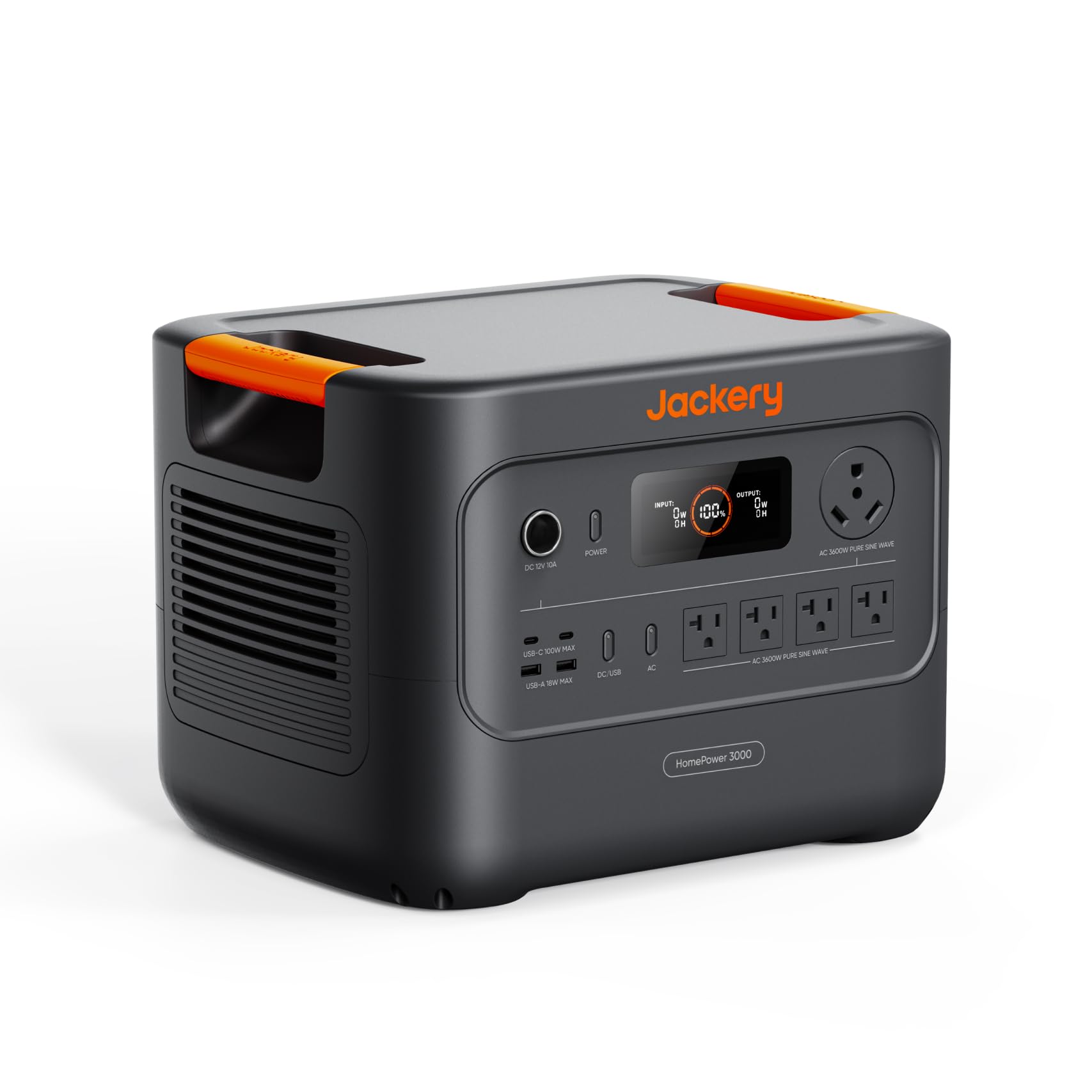
The Jackery HomePower 3000 sits at the top of this list because it delivers 3,072Wh of LFP power with a massive 3,600W continuous inverter that can surge up to 7,200W, making it capable of handling a refrigerator, microwave, and well pump simultaneously. Its ≤20ms UPS switching keeps sensitive electronics online during a grid flicker, and the dual 100W USB-C PD ports charge laptops and tablets at their native speed.
What really separates this unit is the CTB (Cell-to-Body) design, which makes it 47% smaller and 43% lighter than comparable 3kWh stations, yet it still weighs just under 60 lbs. The ChargeShield 2.0 AI algorithm manages charging curves to maximize the 4,000-cycle battery lifespan, meaning this unit can feasibly last over a decade of regular use.
The TT-30 RV port allows direct plug-and-play power into a travel trailer without adapters. It is the most complete single-unit solution for true home backup.
Why it’s great
- Class-leading 7,200W surge handles compressor startup loads
- CTB technology makes it the most compact 3kWh station available
- 4,000-cycle LFP battery with 10-year usable lifespan
Good to know
- Fan noise reaches around 60 dB under heavy load
- Warranty is only valid if purchased directly from Jackery
2. Anker SOLIX C2000 Gen 2

The Anker SOLIX C2000 Gen 2 redefines recharge speed with a full 0-to-100% AC charge in just 58 minutes — the fastest in its class. With 2,048Wh of LFP capacity and a 2,400W rated inverter that peaks at 4,000W, it can run a window AC unit, a full-size refrigerator, and multiple electronics without breaking a sweat. The standby power consumption is only 9W, which is remarkably low for a unit this size.
Expandability is a major differentiator: you can add a dedicated expansion battery to reach 4kWh, effectively doubling runtime to over 64 hours on a dual-door fridge. It also supports 800W ultra-fast alternator charging, meaning a 3-hour car ride can fully refill the battery — this is 8x faster than a standard 12V cigarette lighter port.
The physical footprint is 25% smaller and 29% lighter than similar 2kWh competitors, at just 41.7 lbs. Owners report it powers a 30-quart car fridge for nearly a week on a single charge, and the app-based controls allow you to monitor usage and set charging schedules. For anyone who needs the fastest possible turnaround between outages, this is the clear winner.
Why it’s great
- World’s fastest AC recharge for a 2kWh station
- Ultra-low 9W standby preserves stored energy
- 800W alternator charging for on-the-road top-ups
Good to know
- No hard-copy manual included; everything is app-based
- Solar charging not fully tested in many reviews
3. EF ECOFLOW DELTA 3 Max
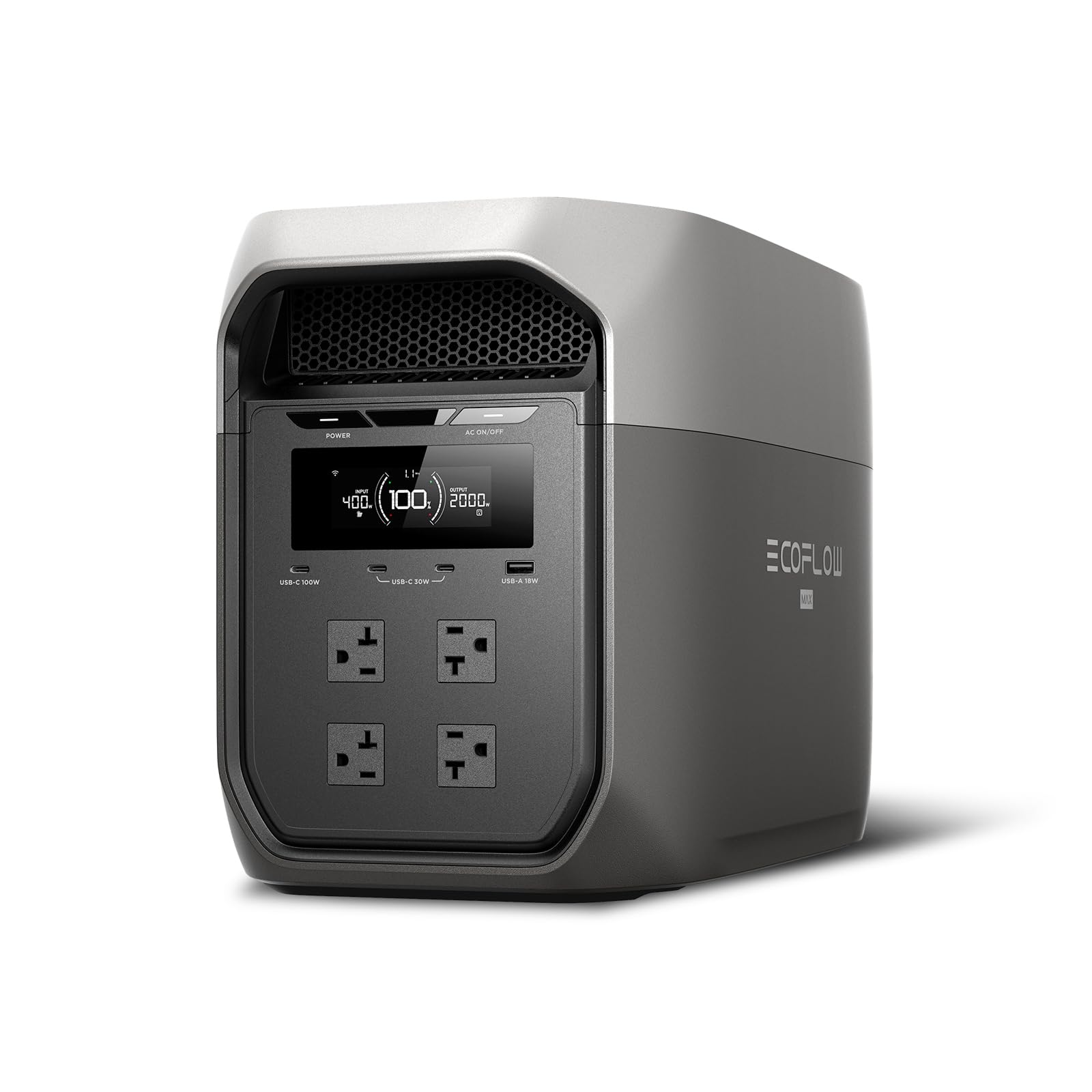
The EcoFlow DELTA 3 Max packs 2,048Wh of LFP capacity with a 2,400W inverter that can X-Boost up to 3,400W to run 99% of household appliances, including microwaves, refrigerators, and power tools. Its standout feature is the sub-10ms UPS transfer time, which is faster than most home UPS units and means your computer or medical device won’t even blink during a switch.
X-Stream technology recharges from 0–80% in just 1.13 hours via a standard wall outlet, and the EcoFlow app offers deep control over energy management, including smart scheduling and cost-saving automation. The dual-handle design and aluminum-plastic composite build make it both durable and relatively portable for its power class.
Real-world use cases are diverse: filmmakers use it to power cameras and monitors on remote shoots all day, while RV owners run their entire rig including roof AC. The Storm Guard app feature pre-emptively tops off the battery when bad weather is forecast, ensuring you’re never caught with a depleted unit during an emergency. It also supports up to 1,200W of solar input for off-grid independence.
Why it’s great
- 10ms UPS protects sensitive electronics seamlessly
- Smart app with Storm Guard automates pre-emergency charging
- Quiet fan even under heavy charging load
Good to know
- Buttons are hard to read in dim light
- 12V car port placement is awkward for some setups
4. Jackery Explorer 2000 v2

At just 39.5 lbs, the Jackery Explorer 2000 v2 is the lightest 2kWh-class portable power station on the market, thanks to its automotive-inspired Cell-to-Body (CTB) construction. Despite the low weight, it delivers a solid 2,042Wh capacity with a 2,200W pure sine wave inverter, and it can do a 0–80% charge in just 66 minutes via AC.
The 20ms UPS switching is UL1778 certified, making it a reliable choice for keeping a home network, modem, and security system running through storms. Owners report running a 21-cubic-foot refrigerator for over 21 hours or powering a CPAP machine and fan through an entire night without any noise disturbance, as the silent charging mode operates at under 30 dB.
Jackery’s CTB tech not only reduces weight but also increases internal space efficiency, making the unit 34% smaller than typical 2kWh stations. The integrated carry handle and flat profile make it easy to slide into an RV storage bay or trunk. It also features 100W USB-C PD for rapid laptop charging directly from the station.
Why it’s great
- Lightest 2kWh station makes it genuinely portable
- Silent charging mode under 30 dB for overnight use
- UL1778 UPS certification for reliable backup switching
Good to know
- Bluetooth connection can drop intermittently
- Solar barrel ports feel flexible and fragile
5. BLUETTI AC200L

The BLUETTI AC200L is the expansion champion, accepting up to two B300K, B210, B300, or one B230 battery to reach a massive 8,192Wh total capacity — enough to run a full-size refrigerator, security cameras, and a router for days. The base unit itself delivers 2,048Wh with a 2,400W inverter that can power-lift to 3,600W for demanding loads.
Fast AC charging hits 0–80% in just 45 minutes, and solar input up to 1,200W means you can fully recharge from panels in under two hours in ideal sun. The built-in 30A RV port is a game-changer for travel trailer owners, allowing direct plug-in without a separate adapter, and the 48V/8A DC port can efficiently charge an RV’s house battery via a voltage regulator.
Owners consistently praise the unit’s reliability when paired with a transfer switch for whole-home backup, noting that the 5-year warranty and 10-year battery lifespan provide confidence for a long-term investment. The app-based monitoring gives real-time grid and solar usage data, and the unit can seamlessly pass through AC power when the battery is full, acting as a smart energy hub.
Why it’s great
- Massive expansion ceiling up to 8,192Wh
- 45-minute 0-80% AC charge speed
- 30A RV and 48V DC ports for direct camper integration
Good to know
- Hefty at 61.4 lbs in base configuration
- Proprietary AC power cord is non-standard
6. BLUETTI AC180 Solar Generator

The BLUETTI AC180 bundles a 1,152Wh LFP battery with a 200W solar panel, making it one of the most accessible entry points into solar-powered backup. The AC180 itself can output 1,800W continuous (2,700W surge) across 11 ports, including 4 AC outlets, and supports a 1440W turbo charge that fills the battery in just one hour from a wall outlet — no bulky external adapter needed.
The 200W solar panel can fully recharge the battery in 4.8 to 9.6 hours depending on sunlight, and the station accepts up to 500W of solar input, so you can later add a second panel for faster top-ups. The app control allows you to toggle between standard and boost output modes, and the 20ms UPS keeps devices running during brief grid interruptions.
Users report real-world solar output reaching 161W on clear days, and the unit can power a mini-fridge for over five hours on half a charge while simultaneously charging phones and a laptop. Weighing around 35 lbs, it is a manageable size for a trunk or campsite, and the three-button operation makes it one of the simplest units to use without a smartphone.
Why it’s great
- Complete solar kit includes 200W panel
- Turbo AC charging to full in 60 minutes
- Straightforward physical controls
Good to know
- Self-consumes up to 20W when powered on
- Real-world solar output lower than rated label
7. AFERIY P210

The AFERIY P210 delivers 2,048Wh of LFP power with a 2,400W pure sine wave inverter that peaks at 4,800W, and it does so at an almost whisper-quiet 16 dB under normal loads and under 30 dB at full output. This makes it ideal for use inside a camper van, food truck, or home where noise would disturb sleep or work.
It offers an exceptional 16 ports, including 6 AC outlets, 4 USB-C ports (one at 100W PD), and a dedicated XT60 300W DC port for specialized equipment. The server-grade UPS switches in under 10ms, and the AFERIY app provides full energy management and automation settings. The 7-year extended warranty (2 years beyond standard) signals strong manufacturer confidence.
In practice, the P210 powers commercial food truck equipment all day with reliable battery life, and the 3,500-cycle LFP battery ensures it will last for a decade of daily cycling. The unit is 20% lighter than comparable stations at 48.5 lbs, and the included dust cover and wire pouch show attention to detail for transport and storage.
Why it’s great
- Near-silent operation at 16 dB under normal load
- Industry-leading 7-year extended warranty
- 16 versatile ports for simultaneous device charging
Good to know
- Display screen can glitch after solar charging
- No schedule charging feature for battery management
8. Champion 4500W Inverter Generator

The Champion 4500W Inverter Generator represents the best of the gas-powered world, delivering 3,500 running watts and 4,500 starting watts with clean power (less than 3% THD) safe for sensitive electronics. At 61 dBA, it is noticeably quieter than conventional construction-style generators, and it can run up to 14 hours on just 2.3 gallons of gasoline using only the fuel in its tank.
The EZ Start Dial simplifies cold starts, and the Intelligauge monitors voltage, frequency, and operating hours. The CO Shield carbon monoxide auto-shutoff system automatically kills the engine if dangerous CO levels build up, adding a crucial safety layer for camping or RV use. It is parallel-ready, meaning you can link a second Champion inverter to double your output to around 7,000 watts.
Real-world tests show it starts a 23-foot camper’s air conditioner with no strain, and commercial users run it for 12+ hour days in food trucks without issue. The 4-stroke 212cc engine is serviceable with easy-access oil drain and a spark plug wrench included. For anyone who needs high continuous wattage at a lower upfront cost than equivalent battery stations, this remains the practical choice.
Why it’s great
- 14-hour runtime on a single tank of gas
- Clean sine wave output under 3% THD
- CO Shield auto-shutoff for safety
Good to know
- Heavy at 92.2 lbs — not a carry-on unit
- Fuel and regular maintenance required
9. VTOMAN Jump 600X

The VTOMAN Jump 600X is the only station on this list that doubles as a 12V car jump starter, making it uniquely valuable for drivers who want both roadside emergency power and portable electronics backup. Its 299Wh LFP battery can be expanded to 939Wh with an add-on battery, and the 600W inverter (1,200W surge) can run a CPAP machine for up to 10 hours or a mini-fridge for a full day.
The regulated 12V/10A DC outputs are a rare feature at this price point, providing stable power for car refrigerators, tire inflators, and other 12V gear without voltage fluctuation. Pass-through charging allows the station to charge internal devices while simultaneously receiving input, so you can top off a laptop and the unit from the same wall outlet.
With 9 output ports including a 60W USB-C PD port, you can charge a MacBook, phone, and camera batteries simultaneously. The LED light with 5 modes (including SOS) is a thoughtful addition for emergencies. At 14.6 lbs, it is light enough to keep in a trunk permanently, and the battery’s 3,000-cycle LFP chemistry means it won’t degrade quickly even with infrequent use.
Why it’s great
- Unique 2-in-1: power station and car jump starter
- Regulated 12V DC ports for sensitive 12V equipment
- Expandable capacity to 939Wh
Good to know
- Limited 299Wh base capacity for heavy loads
- AC recharge takes about 3 hours to full
FAQ
What is the difference between running watts and starting watts?
Can I charge my backup station while it powers my devices?
How long does a LiFePO4 backup system last before needing replacement?
Will a 2,048Wh station run my entire house during a power outage?
Is a gas generator better than a battery backup system?
Final Thoughts: The Verdict
For most users, the best backup system winner is the Jackery HomePower 3000 because its 3,072Wh capacity and 7,200W surge can handle a full home’s essentials including a refrigerator, lights, and internet all at once. If you want the fastest recharge in its class, grab the Anker SOLIX C2000 Gen 2. And for the lightest daily generator that you can actually carry without a dolly, nothing beats the Jackery Explorer 2000 v2.