
A 3/8-inch inline fuel filter sits between your fuel tank and your engine, catching rust, dirt, and debris before they reach delicate jets, injectors, or pump internals. Choosing the wrong micron rating or housing material can turn a five-minute maintenance task into a fuel starvation headache or a plastic-crack fire hazard.
I’m Min — the co-founder and writer behind Gadgets Feed. My research for this guide involved cross-referencing micron ratings, barb dimensions, flow rates, and housing materials across dozens of real user installations to identify which filters actually seal, flow, and filter without causing pressure drops or leaks.
After sifting through real-world feedback and spec sheets, I settled on seven models that represent the best balance of filtration quality, serviceability, and fitment. This guide to the best 3/8 inline fuel filter will help you match a filter to your carbureted, EFI, or marine fuel system without guessing.
How To Choose The Best 3/8 Inline Fuel Filter
Three factors — micron rating, housing material, and serviceability — separate a reliable fuel filter from one that causes performance issues or fails prematurely. Understanding each will narrow your choice immediately.
Micron Rating: The Filtration Sweet Spot
Carbureted engines typically need a 70-to-100 micron filter; fuel injection systems require 10-to-40 microns. A filter that is too fine for a carbureted setup (like a 30-micron unit on a 1960s V8) will restrict flow and cause fuel starvation at high RPM. Conversely, a 100-micron filter on an EFI system lets particles pass that could clog an injector. Match the micron number to your fuel system type — not to the price tag.
Housing Material: Plastic vs. Aluminum vs. Glass
Clear plastic housings let you spot sediment at a glance, but they weaken under engine-bay heat and can crack. Billet aluminum bodies handle up to 150°F+ without deforming and resist fuel corrosion, making them suitable for universal and marine use. Glass-bowl filters offer visual inspection with metal end caps, but the glass is brittle and requires careful torque on the retaining ring.
Serviceable vs. Disposable Elements
Disposable filters — paper or mesh inside a sealed can — are replaced entirely. Serviceable filters feature a sintered bronze or stainless steel element that unscrews for cleaning. If you maintain multiple vehicles or plan to keep your car long-term, a serviceable filter saves money and reduces waste. Disposable units are simpler for quick swaps but add recurring cost.
Quick Comparison
On smaller screens, swipe sideways to see the full table.
| Model | Category | Best For | Key Spec | Amazon |
|---|---|---|---|---|
| Podavelle 3/8″ Billet | Inline | EFI & Carb Systems | 30 Micron Sintered Bronze | Amazon |
| EVIL ENERGY 30 Micron | Inline | High-Performance EFI | 30 Micron Sintered Bronze | Amazon |
| CNRAQR 178 Micron Aluminum | Inline | High-Flow Carb Engines | 178 Micron Stainless Steel | Amazon |
| CarBole 9748 Clear View | Inline | Visual Fuel Inspection | 200 Mesh / Glass Housing | Amazon |
| EVIL ENERGY 100 Micron Adapter | Inline | Versatile Multi-Hose Fits | 100 Micron Serviceable | Amazon |
| Seachoice 20 Micron Plastic | Inline | Johnson/Evinrude Outboards | 20 Micron Molded Plastic | Amazon |
| smseace 5-Pack Plastic | Inline | Budget Multi-Vehicle Kits | Clear Plastic / Bulk Pack | Amazon |
In‑Depth Reviews
1. Podavelle 3/8″ Billet Inline Fuel Filter 30 Micron

The Podavelle filter uses a 30-micron sintered bronze element inside a 6061-T6 billet aluminum housing with a black anodized finish. The housing length is just 52.6 mm excluding barbs, which fits in tight engine bays where plastic filters would need more clearance. The bronze element resists corrosion from ethanol blends and can be removed, cleaned, and reinstalled — no replacement cartridges needed.
Flow data confirms 900 liters per hour with a pressure drop under 1 PSI. That means a carbureted big-block or a moderate EFI setup won’t see fuel starvation even under sustained WOT. The rubber O-ring between the cap and body creates a leak-free seal, and users report zero seepage at the barb connections when paired with proper 3/8-inch ID hose.
Car clubs and individual owners on forums praise this filter for eliminating the “surging at highway speed” problem they had with paper-element filters. The anodized black finish blends into engine bay aesthetics, but the real win is the serviceability — instead of replacing the whole unit, you unscrew the cap, pull the bronze puck, rinse it in solvent, and reinstall.
Why it’s great
- Serviceable sintered bronze element reduces long-term costs
- 900 L/hr flow with sub-1 PSI drop suits EFI and carb alike
- Compact billet housing fits tight engine compartments
Good to know
- Non-clear housing prevents visual sediment checks
- Single-unit purchase; no multi-pack option
2. EVIL ENERGY 3/8″ Barb Billet Inline Fuel Filter 30 Micron
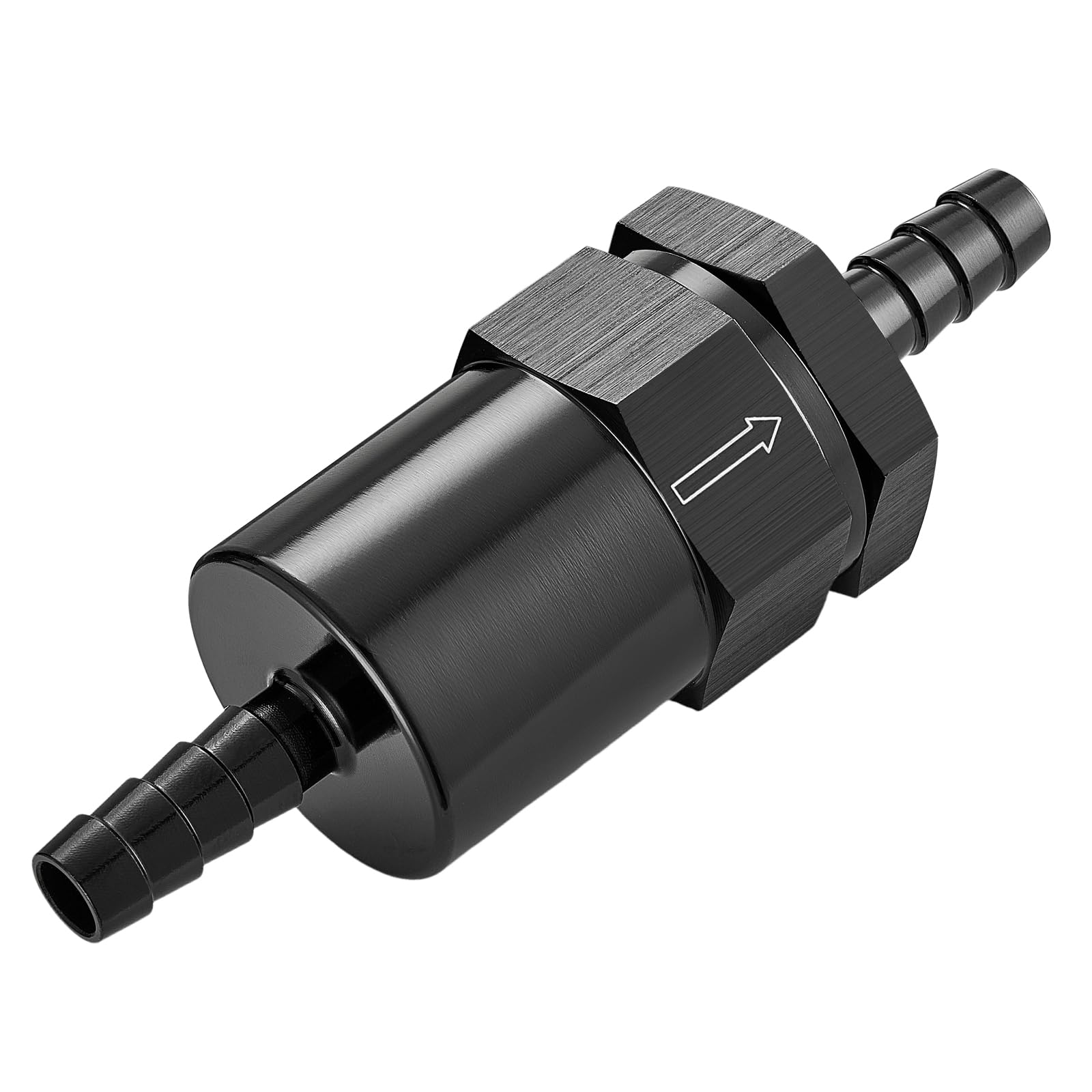
EVIL ENERGY brings the same 30-micron sintered bronze element and 6061 aluminum construction to the table at a slightly lower entry point. The compact housing — roughly 2.07 inches excluding barbs — is almost identical in dimensions to the Podavelle, giving you interchangeability if you already run other EVIL ENERGY fittings in your fuel system.
The compatibility list includes gasoline, diesel, and E85, which makes this filter a candidate for flex-fuel builds or small-block Chevys running alcohol blends. The rubber O-ring seal holds pressure reliably, and users who installed it on carbureted MerCruiser and EFI Merc applications report no leaks or idle issues.
Installation takes about ten minutes: cut your 3/8-inch fuel line, slide it over the barb, secure with a clamp, and check for leaks at startup. The sintered bronze element catches fine particulate that paper filters pass, and the cleanable design means you only buy it once unless you lose the tiny O-ring.
Why it’s great
- E85-compatible sintered bronze element
- Compact size fits restricted engine bay placements
- Cleanable element eliminates replacement costs
Good to know
- No barb size adapters included
- Open element design flows both directions but best with arrow orientation
3. CNRAQR 3/8″ 178 Micron Removable Black Anodized Aluminum 2PCS
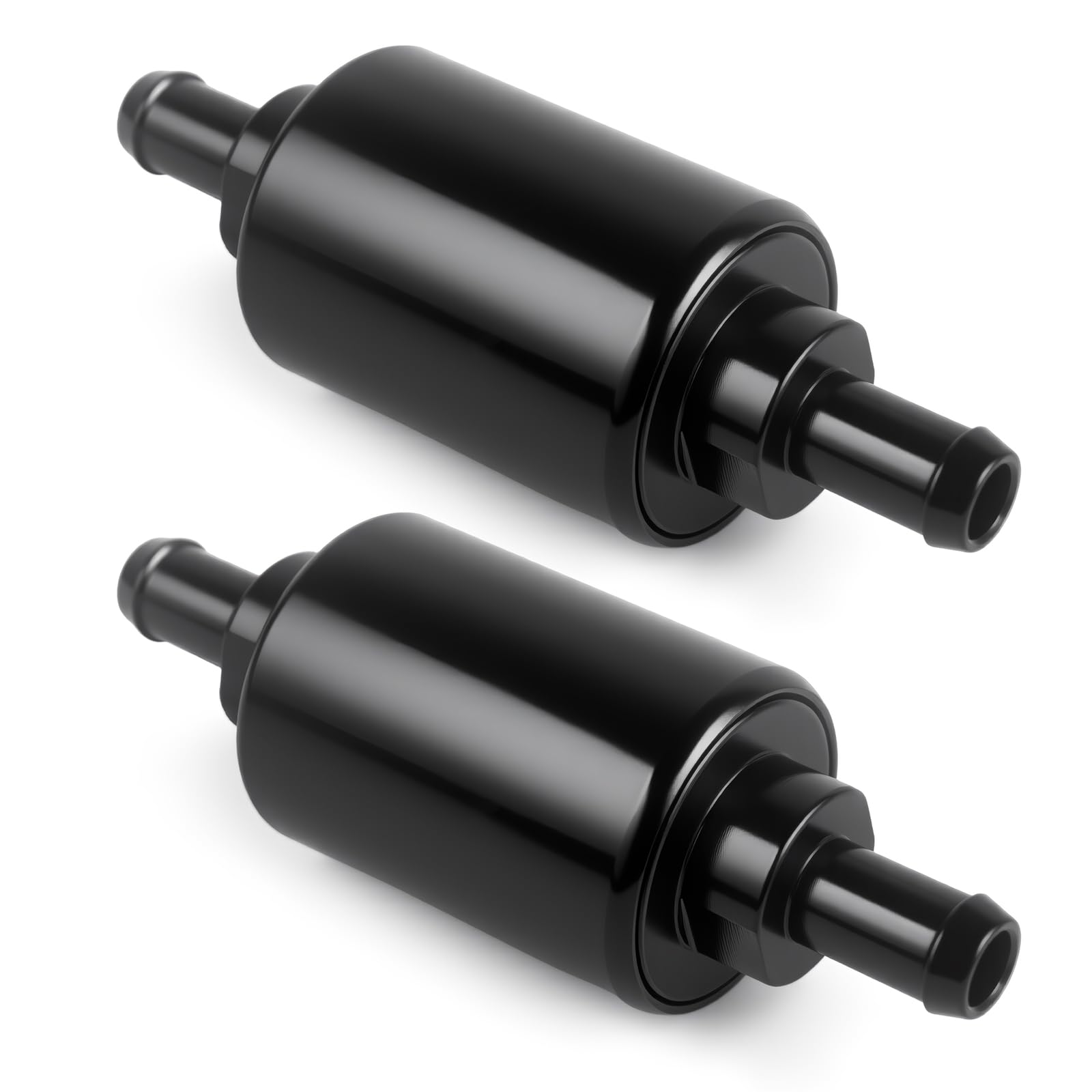
With a 178-micron stainless steel strainer, the CNRAQR filter sits at the coarser end of the spectrum — ideal for carbureted engines that don’t need the finer 30-micron filtration. The 6061-T11 aluminum body is black anodized for corrosion resistance, and the overall housing measures 3.75 inches long with a 1.25-inch outer diameter, giving it a slightly larger profile than the compact billet units.
Users have installed this as a pre-filter before inline electric fuel pumps to catch large debris before it reaches the pump’s internal check valves. The stainless steel element is washable and reusable; you simply unscrew it, rinse with brake cleaner, and reinstall. The 2-pack bundle gives you a spare or allows a dual-filter setup for high-volume race applications.
One detail to watch: the barb ends are not directional, so you can install it either way without flow restriction. Reviewers running small-block Fords and classic Mopars report no pressure drop across the filter at idle or at 6,000 RPM on the dyno.
Why it’s great
- Coarse 178-micron filtration suits high-flow carb engines
- Two-pack provides immediate backup filter
- Washable stainless element is fully reusable
Good to know
- Too coarse for fuel injection or small-displacement EFI
- Housing is longer than compact billet units
4. CarBole 9748 Universal 3/8″ Inlet/Outlet Fuel Pump Filter Clear View Glass

The CarBole 9748 uses a glass bowl with chrome-plated barbed end caps, letting you inspect fuel condition without disassembling the line. The 200-mesh screen traps particles while maintaining flow, and the barbed ends grip 3/8-inch ID hose securely. Overall length is 4.2 inches, which is longer than the billet aluminum units but still manageable in most carbureted layouts.
Reviewers found this filter especially useful for diagnosing hard-starting issues — seeing air bubbles or sediment in the clear bowl tells you whether the problem is a leaky pickup tube or a dirty tank. The glass can be unscrewed from the center stud for cleaning, but the retaining ring must be tightened firmly to prevent fuel seepage at the seam.
The 5-pack price per filter is low enough that you can place one on every vehicle in your fleet. However, the clamping flange on the end caps is short, so you need a quality hose clamp that grips past the barb ridge. Some users noted that over-tightening the glass bowl can cause hairline cracks; hand-tight plus a quarter turn with a strap wrench is the correct torque.
Why it’s great
- Clear glass bowl enables instant visual fuel inspection
- Five-pack value suits multi-vehicle households
- Classic chrome aesthetic fits vintage engine bays
Good to know
- Glass can crack if over-tightened or hit by debris
- Short barb flanges require careful clamp placement
5. EVIL ENERGY Inline Fuel Filter 100 Micron with 1/2″, 3/8″, 5/16″ Barb Adapters

This EVIL ENERGY filter ships with three barb adapters — 1/2″, 3/8″, and 5/16″ — making it the most versatile option for shops or hobbyists with multiple vehicles. The 100-micron stainless steel element is specifically suited for carbureted engines, and the aluminum body is anodized black for longevity. The filter can is 4.25 inches long plus fittings, totaling roughly 7.25 inches end-to-end, so verify clearance before ordering.
The install direction matters: the closed end of the filter element must seat against the spring, and fuel should flow from the spring end to the open end. Ignore that and the element can shift internally, allowing unfiltered fuel to bypass. Users running 100-micron filters on carbureted engines report that idle quality improves because finer filters (like the 30-micron units) created a 1-4 PSI pressure drop that caused lean mixture at low RPM.
Because the housing is not clear, you won’t see when the element is dirty unless you disassemble it. But the serviceable design means a ten-minute cleaning restores full flow. Reviewers mention using this as a pre-filter for mechanical fuel pumps on classic muscle cars with excellent results.
Why it’s great
- Three barb sizes cover most common fuel line diameters
- 100-micron rating matches carbureted engine requirements
- Serviceable element keeps long-term costs low
Good to know
- Long overall length may not fit tight engine bays
- Non-clear housing hides debris buildup until inspection
6. Seachoice In-Line Fuel Filter 3/8″, Plastic, 20 Micron

The Seachoice 21121 is a direct replacement for the Johnson/Evinrude part number 398318, making it a drop-in fix for outboard motors from those brands. The molded white plastic housing uses a 20-micron filter element, which is fine enough for the lower-pressure fuel pump systems found on two-stroke and four-stroke outboards. The 3/8-inch barb ends fit the factory fuel line without adapters.
Boaters appreciate the slim-line profile — the filter is narrow enough to fit inside cramped engine cowlings where billet aluminum filters would not clear. The plastic housing is not as heat-resistant as metal, but outboard engine bays typically run cooler than automotive engine compartments, so thermal failure is less likely. Users report that this filter resolves stalling issues caused by debris from aging fuel tanks.
This is a disposable filter; when it clogs, you throw it away and install another. The white plastic housing does not allow visual inspection, so replace it as part of your annual fuel system maintenance. It is not designed for high-flow EFI or E85 applications.
Why it’s great
- Direct OEM replacement for Johnson/Evinrude outboards
- Slim profile fits tight marine engine compartments
- 20-micron filtration matches outboard fuel system specs
Good to know
- Plastic housing is not suitable for high-heat automotive use
- Disposable design increases recurring replacement cost
7. smseace 5pcs 3/8″ Inline Fuel Filter + 10pcs Hose Clamp

The smseace kit bundles five clear plastic filters and ten hose clamps for a per-filter cost that is among the lowest in the 3/8-inch inline category. The transparent housing lets you see sediment accumulation instantly — a helpful feature when diagnosing fuel system contamination in classic cars, lawn tractors, or generators. The included clamps correspond to each filter, eliminating a separate hardware stop.
Real-world users on vintage carbureted vehicles value the visual feedback. However, the filter element inside the plastic housing is bonded with adhesive, and several reviews report that the element can detach from the housing wall after a week or two, allowing fuel to bypass the filtration media entirely. This failure mode means the filter may not actually filter after a short service life.
Another limitation: the plastic body can soften or melt if routed too close to exhaust headers or engine manifolds. Several reviewers noted that a hot engine bay caused the plastic to deform, resulting in fuel leaks. For cold-side installations on lawn equipment or non-heat-intensive applications, these filters work fine as a cheap visual diagnostic tool.
Why it’s great
- Low per-filter cost for multi-vehicle bulk use
- Clear housing allows instant visual sediment check
- Clamps included for quick installation
Good to know
- Filter element can detach from housing over time
- Plastic body may melt near engine heat sources
FAQ
Can I use a 30-micron filter on a carbureted engine?
Is a sintered bronze filter better than a paper element?
Will a plastic fuel filter melt in my engine bay?
Final Thoughts: The Verdict
For most users, the best 3/8 inline fuel filter winner is the Podavelle 30 Micron Billet because it combines a serviceable sintered bronze element, a compact aluminum housing, and a verified 900 L/hr flow rate that works on both carbureted and EFI systems. If you want clear visual sediment inspection without sacrificing durability, grab the CarBole 9748 Glass Filter 5-Pack. And for a single budget-friendly filter that handles E85 and fits tight compartments, nothing beats the EVIL ENERGY 30 Micron Unit.