
Separating the tweeter from the woofer is the single most impactful upgrade you can make to a factory car audio system, yet most buyers grab a pair of coaxials and call it a day. A real component set unlocks a soundstage that places instruments and vocals in their proper positions across the dash, but the entry price for that experience has historically kept budget-minded shoppers away. That barrier has crumbled.
I’m Min — the co-founder and writer behind Gadgets Feed. After combing through hundreds of real-world user reports, spec sheets, and performance benchmarks across price brackets, I’ve separated the sets that deliver genuine imaging and midbass authority from those that merely look the part on paper.
This guide evaluates seven of the most compelling options available today to help you find the best budget component speakers that actually deliver a true front-stage upgrade without forcing you to compromise on build quality or sonic detail.
How To Choose The Best Budget Component Speakers
Selecting a component set on a budget requires you to prioritize the specs that matter most for soundstage and clarity rather than chasing wattage numbers. Three decision points separate a rewarding upgrade from a disappointing one.
RMS Power vs. Max Power: What Actually Matters
Every budget component set lists two power ratings: RMS (continuous) and peak (maximum). RMS is the number that determines how cleanly the speaker plays at normal listening volumes. A woofer rated for 40W RMS will sound significantly clearer with a 50W RMS per channel amplifier than a set claiming 300W peak that only handles 30W RMS. The peak number is marketing; the RMS number is your anchor point for amplifier matching.
Crossover Design and Build Quality
A true component system includes an external passive crossover network that splits the audio signal before it reaches the woofer and tweeter. Budget sets sometimes use simple inline capacitors instead of a physical crossover board. The external crossover allows for better time alignment and prevents the tweeter from receiving low-frequency energy that would cause distortion or failure. Check that the set includes a proper crossover box — not just inline filters — for the most coherent front-stage imaging.
Installation Realities: Woofer Depth and Tweeter Mounting
Many 6.5-inch component woofers have a mounting depth that exceeds the space available in factory door locations, especially in modern vehicles with limited clearance behind the door panel. Measure your mounting depth before buying. For tweeters, look for sets that include surface-mount, flush-mount, and angle-mount hardware — this flexibility determines whether you can install them in sail panels, A-pillars, or dash corners without custom fabrication.
Quick Comparison
On smaller screens, swipe sideways to see the full table.
| Model | Category | Best For | Key Spec | Amazon |
|---|---|---|---|---|
| Alpine S2-S65C | Premium | Hi-Res certified stage clarity | 80W RMS per set | Amazon |
| Pioneer TS-A653CH | Premium | Factory upgrade with adapters included | 85W RMS per set | Amazon |
| CT Sounds Meso 3-Way | Premium | Full 3-way front stage without a sub | 250W RMS per set | Amazon |
| HERTZ UNO K-165 | Mid-Range | Vintage car restoration upgrades | Water-repellent paper cone | Amazon |
| ORION Cobalt CB65C | Mid-Range | Strong midbass on a moderate budget | 70W RMS, silk dome tweeter | Amazon |
| Rockford Fosgate R152-S | Value | Compact 5.25-inch fitment | 40W RMS, 5.25 inch woofer | Amazon |
| MB Quart FSB216 | Value | Rock-bottom entry to component sound | 40W RMS, titanium tweeter | Amazon |
In‑Depth Reviews
1. Alpine S2-S65C

The Alpine S2-S65C earns the top spot because it brings Hi-Res Audio certification — frequency response stretching to 40kHz — into a price bracket where that spec simply does not exist. The woofer uses a proprietary blend of polypropylene, glass fiber, and mica that keeps the cone lightweight while resisting the distortion that plagues pure paper or plain poly cones. The HAMR (High Amplitude Multi-Roll) surround allows exceptional cone excursion for a 6.5-inch driver, translating to bass authority that most two-way component sets cannot touch without a subwoofer.
Real-world owners consistently note that these speakers require an amplifier in the 80W RMS range to unlock their full potential — running them off a factory head unit will produce clean sound but leaves considerable performance on the table. The tweeters use a threaded removable housing that supports flush, surface, and angle mounting, giving you genuine placement flexibility. The included inline crossovers are simple but effective, though they lack the adjustability of higher-end networks.
Build quality is a clear step above the mid-range competition: the woofer basket is rigid and well-damped, the tinsel leads are secured, and the overall weight suggests a substantial motor assembly. For shoppers who want genuine S-Series Alpine engineering without stepping up to the Type-R price tier, this set delivers the most balanced frequency response and the highest measured sensitivity (91dB) in its class.
Why it’s great
- Hi-Res Audio certified — extended top-end detail beyond 20kHz
- HAMR surround enables genuine low-end extension without a sub
- Flexible tweeter mounting system fits most OEM locations
Good to know
- Requires a dedicated amplifier (80W RMS) to perform at its best
- Crossovers are basic inline units, not full network boards
2. Pioneer A-Series MAX TS-A653CH

Pioneer’s A-Series MAX line targets the buyer who wants maximum output from a moderate amplifier, and the TS-A653CH delivers with a 91dB sensitivity rating — the highest in this roundup. That sensitivity means you get significantly more volume per watt than lower-efficiency designs, making these a fantastic match for factory head units or entry-level aftermarket amplifiers. The frequency response stretches from 33Hz to 58kHz, covering sub-bass fundamentals well beyond human hearing range for a spacious, airy top end.
The woofer uses Pioneer’s optimized cone design with a treated fibrous surround that resists the humidity and temperature swings common in door installations. An underrated feature is the inclusion of multi-fit installation adapters that expand the mounting flexibility — these adapters improve acoustic coupling and reduce installation frustration. The 85W RMS continuous power handling gives you headroom to push these with a 100W per channel amp without stressing the voice coil.
User feedback consistently highlights the warm, non-fatiguing sound signature — the tweeters are detailed without the harsh edge that plagues cheaper titanium dome designs. Some owners note that the tweeter housing is larger than expected, which can complicate A-pillar mounting in tight vehicle interiors. The included crossovers are proper passive networks rather than inline filters, giving you genuine frequency division rather than a simple capacitor roll-off.
Why it’s great
- High 91dB sensitivity — loud output with low amplifier power
- Multi-fit installation adapters included for flexible mounting
- Warm, detailed treble without listener fatigue
Good to know
- Tweeter housing is bulky — measure your mounting location first
- Extended response beyond 20kHz is inaudible to most listeners
3. CT Sounds Meso 6.5” 3-Way

CT Sounds breaks the two-way mold with a genuine 3-way component system that includes a dedicated 3.5-inch midrange driver alongside the 6.5-inch woofer and 25mm silk-dome tweeter. This three-driver architecture delivers a dramatically wider soundstage than any two-way set can achieve, because the midrange driver handles vocal frequencies without the beaming issues that occur when a single woofer tries to cover both midbass and upper mids. The 250W RMS power handling per set is the highest in this group, requiring a serious amplifier to keep up.
The neodymium motor on the 3.5-inch midrange is notably compact, making it easier to locate in custom door panels or kick panels without sacrificing magnetic force. The tweeters use silk domes in brushed aluminum housings that deliver a smooth, non-fatiguing top end. The passive crossover networks are true 18dB per octave designs that properly separate the frequency bands — this is not an inline capacitor setup.
The tradeoff is installation complexity: fitting three drivers per side requires planning, fabrication work, and a solid amplifier. Multiple owners report needing to cut baskets or build spacer rings for proper clearance. This set is not a simple drop-in upgrade for a stock vehicle — it is a project that rewards the effort with a front stage that can overwhelm highway noise and produce genuine imaging without a dedicated subwoofer.
Why it’s great
- Dedicated 3.5-inch midrange driver for superior vocal clarity
- 250W RMS power handling — serious headroom for loud playback
- Silk dome tweeters deliver smooth, non-fatiguing highs
Good to know
- Requires significant fabrication and planning for installation
- Needs a powerful aftermarket amplifier to reach its potential
4. HERTZ UNO Series K-165

Hertz brings Italian engineering to the budget segment with the K-165, a two-way component set that uses a water-repellent pressed-paper woofer cone — an unusual choice that delivers a warm, natural midrange that polypropylene cones often struggle to match. The woofer cone’s treatment resists moisture damage, which is critical for door installations where rain and condensation are constant threats. The ferrite magnet motor provides solid motor force without the cost penalty of neodymium.
The tweeter uses a PEI (polyetherimide) dome with a neodymium magnet, producing a crisp, detailed top end that complements the paper cone’s warmth. Owners installing these in vintage vehicles consistently report that the K-165 sounds significantly better than the era-appropriate speakers they replace, with a clarity that reveals details previously masked. The crossover is a simple inline filter rather than a full network board, which limits fine-tuning but simplifies installation.
Fitment feedback is overwhelmingly positive for older Japanese and European vehicles where door depth is limited. The 6.5-inch woofer’s relatively shallow mounting depth clears most factory baskets without spacer rings. Some users note that the tweeters can sound slightly bright when paired with a factory head unit lacking high-frequency attenuation — a small EQ adjustment resolves this easily.
Why it’s great
- Water-repellent paper cone delivers warm, natural midrange tone
- Shallow mounting depth fits most vintage and import vehicles
- Neodymium tweeter magnet for crisp, efficient high-frequency output
Good to know
- Uses inline filters rather than a full external crossover network
- Tweeter can sound bright with head units lacking EQ adjustment
5. ORION Cobalt Series CB65C

The Orion CB65C prioritizes midbass impact above all else, using a butyl rubber surround and a polypropylene cone that combine for high excursion capability without mechanical noise. The 70W RMS power handling per set gives you solid headroom with a modest 4-channel amp, and the 88dB sensitivity rating means you will not need maximum gain to achieve satisfying volume levels. The frequency response range of 70Hz to 20kHz covers the full musical spectrum.
The silk dome tweeters produce a smooth top end that avoids the sibilance common in budget titanium domes, and the external passive crossover is a proper network board — not an inline capacitor trick. The tweeter can be surface-mounted or flush-mounted, giving you placement options in sail panels or dash corners. Users report that the midbass authority noticeably improves over factory speakers even without a subwoofer playing.
The main installation hiccup reported by owners is that the 6.5-inch woofer basket requires 6.5-to-6.75-inch mounting adapters in many vehicles, and these adapters are not included in the box. The overall build quality is solid for the price point, with a well-damped basket and sturdy terminal connections. For buyers who want a component set that produces genuine low-end punch without stepping up to premium pricing, this is a strong contender.
Why it’s great
- Butyl rubber surround enables high excursion for strong midbass
- External passive crossover network — not inline filters
- Smooth silk dome tweeter avoids sibilance
Good to know
- May require separate 6.5-to-6.75-inch mounting adapters
- Bass extension still limited without a subwoofer
6. Rockford Fosgate Prime R152-S

Rockford Fosgate’s Prime R152-S is a 5.25-inch component system designed for vehicles where 6.5-inch speakers simply will not fit, or for buyers who want a dedicated midrange rather than a full-range woofer. The mica-injected polypropylene cone provides extended frequency response compared to plain poly, and the 40W RMS / 80W peak power handling is appropriate for factory head units or entry-level amplifiers. The Mylar balanced-dome tweeter reproduces highs without the brittleness of cheaper synthetic materials.
The inline crossover simplifies installation dramatically — there is no separate crossover box to mount, which matters in tight door cavities. The tweeter supports flush, surface, and angle mounting, and the included hardware covers most scenarios. Owners consistently praise the balanced sound signature, noting that the R152-S reproduces music exactly as recorded without artificially boosting any frequency band. The 5.25-inch woofer naturally trades low-end extension for midrange clarity, so these pair well with a dedicated subwoofer.
Multiple installers report that these speakers transformed the soundstage in vehicles ranging from a 1992 Cherokee to a 1968 Mustang, demonstrating the versatility of the compact form factor. The build quality reflects Rockford’s reputation — the woofer basket is rigid, the cone surround is durable, and the terminals accept standard spade connectors without modification.
Why it’s great
- Compact 5.25-inch size fits tight OEM locations
- Mica-injected polypropylene cone for extended frequency response
- Balanced, natural sound signature with accurate reproduction
Good to know
- Smaller woofer limits bass output — needs a subwoofer for low end
- Inline crossover lacks the adjustability of a network board
7. MB Quart FSB216 Formula
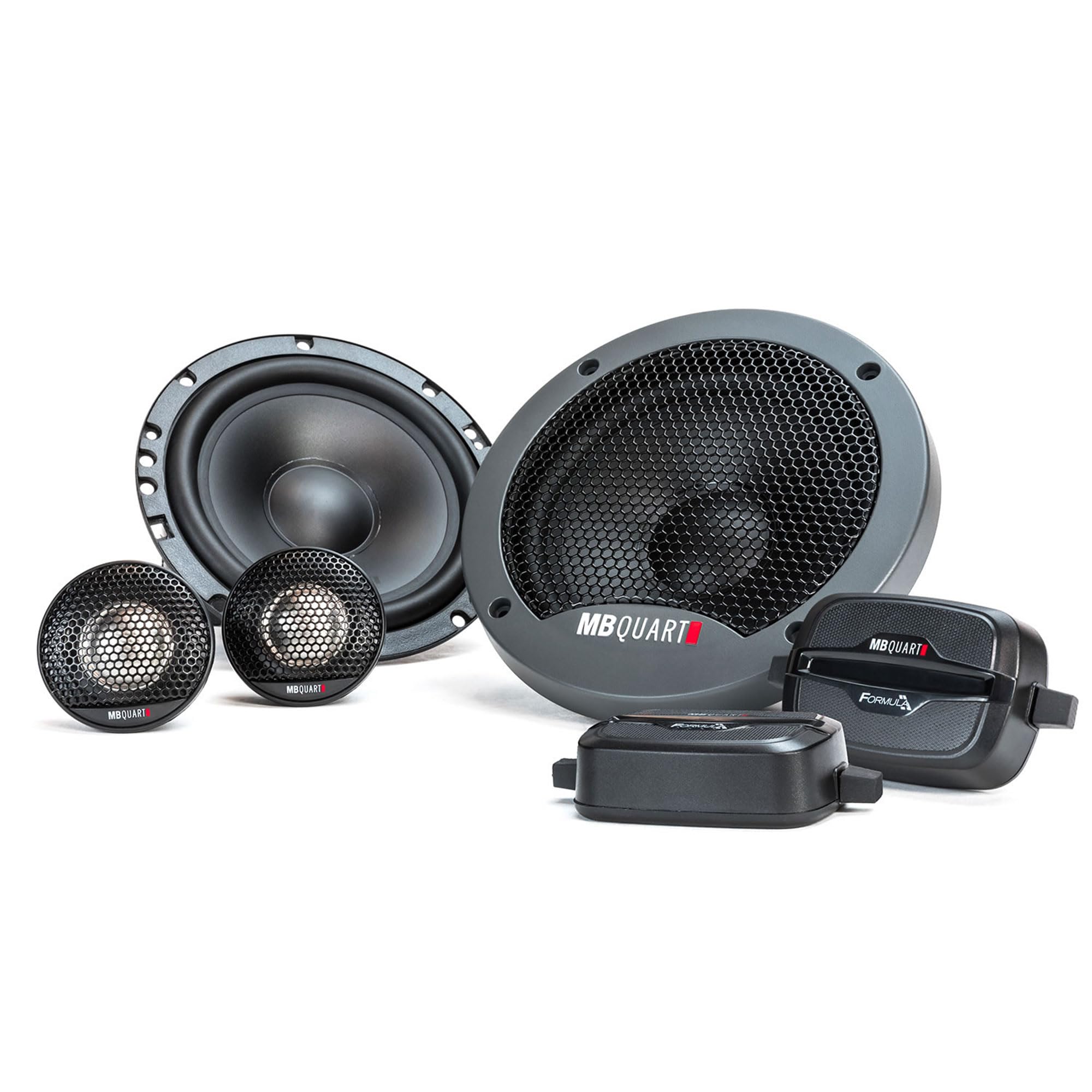
MB Quart’s FSB216 provides the lowest barrier to entry for anyone wanting to audition a true component system without significant financial commitment. The 6.5-inch polypropylene cone and 19mm titanium dome tweeter deliver clarity that immediately outpaces any factory coaxial speaker, with the titanium dome providing extended top-end detail that silk domes cannot match at this price level. The 40W RMS power handling is modest but appropriate for a set designed to work with factory amplification or low-power aftermarket decks.
The external crossover network is a genuine two-way design rather than a simple inline filter, which is remarkable at this price tier. The woofer uses a high-energy magnet and woven tinsel leads for reliability, and the spade terminals accept standard connectors for a secure installation. Owners report that these speakers sound amazing when paired with even a moderate amplifier, delivering crisp highs and punchy midrange that belies the entry-level price.
The limitations are predictable at this price point: the woofer surround is less compliant than premium designs, limiting deep bass extension, and the titanium tweeter can become harsh at extreme volume levels with lower-quality source material. The overall build quality is adequate but does not match the fit and finish of mid-range options. For the buyer on a tight budget who refuses to settle for coaxial speakers, the FSB216 is a legitimate component experience.
Why it’s great
- Genuine external crossover network at an entry-level price
- Titanium dome tweeter delivers extended high-frequency detail
- Clear, loud performance that outperforms any factory coaxial
Good to know
- Tweeter can sound harsh at high volumes with poor source material
- Limited low-end extension without a subwoofer
FAQ
Can I install budget component speakers without an amplifier?
Will 6.5-inch component speakers fit in my vehicle’s factory locations?
What is the real difference between a 2-way and a 3-way component system?
Final Thoughts: The Verdict
For most users, the best budget component speakers winner is the Alpine S2-S65C because it delivers Hi-Res Audio certification and HAMR surround bass extension at a price that undercuts every other premium-tier contender. If you want maximum output from a moderate amplifier, grab the Pioneer TS-A653CH with its 91dB sensitivity. And for a genuine 3-way front stage that can replace a subwoofer in some builds, nothing beats the CT Sounds Meso.