
When a loved one with Alzheimer’s lives at home, every day becomes a negotiation with memory. The wrong dose, a skipped pill, or a double dose isn’t just an inconvenience—it’s a medical emergency that sends families to the ER. An automatic pill dispenser with timed locks and tamper-resistant alarms removes that guesswork by releasing only the correct medication at the correct moment, giving both the patient and their caregiver a structured safety net that no manual pillbox can replicate.
I’m Min — the co-founder and writer behind Gadgets Feed. I’ve spent hundreds of hours digging through technical specs, customer reviews, and professional caregiver forums to separate the automatic pill dispensers that genuinely protect Alzheimer’s patients from those that complicate their routine with confusing interfaces and fragile locks.
Whether the patient lives alone, with family, or rotates between caregivers, the best automatic pill dispenser for alzheimer’s patients must balance loud alarms, battery backup for power outages, and a lock that prevents impulsive access — all while staying simple enough for the patient to use without frustration.
How To Choose The Best Automatic Pill Dispenser For Alzheimer’s Patients
Alzheimer’s medication management demands a dispenser that intervenes before confusion turns into danger. The right model locks out access between scheduled doses, alerts loudly enough to cut through ambient noise or hearing loss, and survives power failures without losing programmed schedules. Focus on these three pillars when comparing options.
Timed Lock Security and Tamper Resistance
An Alzheimer’s patient may forget they already took their medication and attempt to open the dispenser again minutes later. A dispenser with a physical key lock or biometric fingerprint lock that only releases the current dose compartment prevents double-dosing and accidental overdoses. Look for units where the entire tray is locked except for the one active slot — rotary designs that dispense by tipping expose only the current compartment and physically block access to the rest.
Alarm Customization for Hearing and Vision Loss
Many seniors experience age-related hearing loss or live in noisy environments. The best dispensers for Alzheimer’s patients offer both an audible alarm (at least 85 decibels with adjustable pitch) and a flashing LED or strobe light. Models that allow you to record a family member’s voice (“Mom, it’s time for your medicine”) improve adherence because the familiar tone cuts through confusion better than a generic beep.
Power Backup and Connectivity for Remote Caregivers
Power outages can reset programmed schedules and cause missed or skipped doses. Dispensers with built-in rechargeable batteries — preferably 1200mAh or larger — maintain operation for 24 to 48 hours during blackouts. For families who live apart from the patient, WiFi-connected models with companion apps allow remote monitoring of dose confirmation, missed-dose alerts, and refill reminders directly to the caregiver’s phone without requiring the patient to do anything extra.
Quick Comparison
On smaller screens, swipe sideways to see the full table.
| Model | Category | Best For | Key Spec | Amazon |
|---|---|---|---|---|
| MedReady 1700FL | Premium | Hearing-impaired seniors | 85 dB alarm + flashing LED | Amazon |
| Live Fine Smart WiFi | Premium | Remote caregiver monitoring | WiFi app + 4-hour backup | Amazon |
| Colorwing 2026 Smart | Premium | Fingerprint security | 1200mAh, 30+ days standby | Amazon |
| Betife 31-Day Bluetooth | Mid-Range | Voice reminders + plug-in | Fingerprint + mechanical dual lock | Amazon |
| PillCalendar Bluetooth 31-Slot | Mid-Range | Arthritis-friendly press-open | 1200mAh rechargeable, 2-hour charge | Amazon |
| Betife 28-Day Bluetooth | Mid-Range | Bluetooth app management | Fingerprint + mechanical lock | Amazon |
| Live Fine 28-Day Clear Lid | Budget | Budget-friendly basic alarm | 3 beep patterns, 3 volume levels | Amazon |
In‑Depth Reviews
1. MedReady 1700FL 28-Day Automatic Pill Dispenser
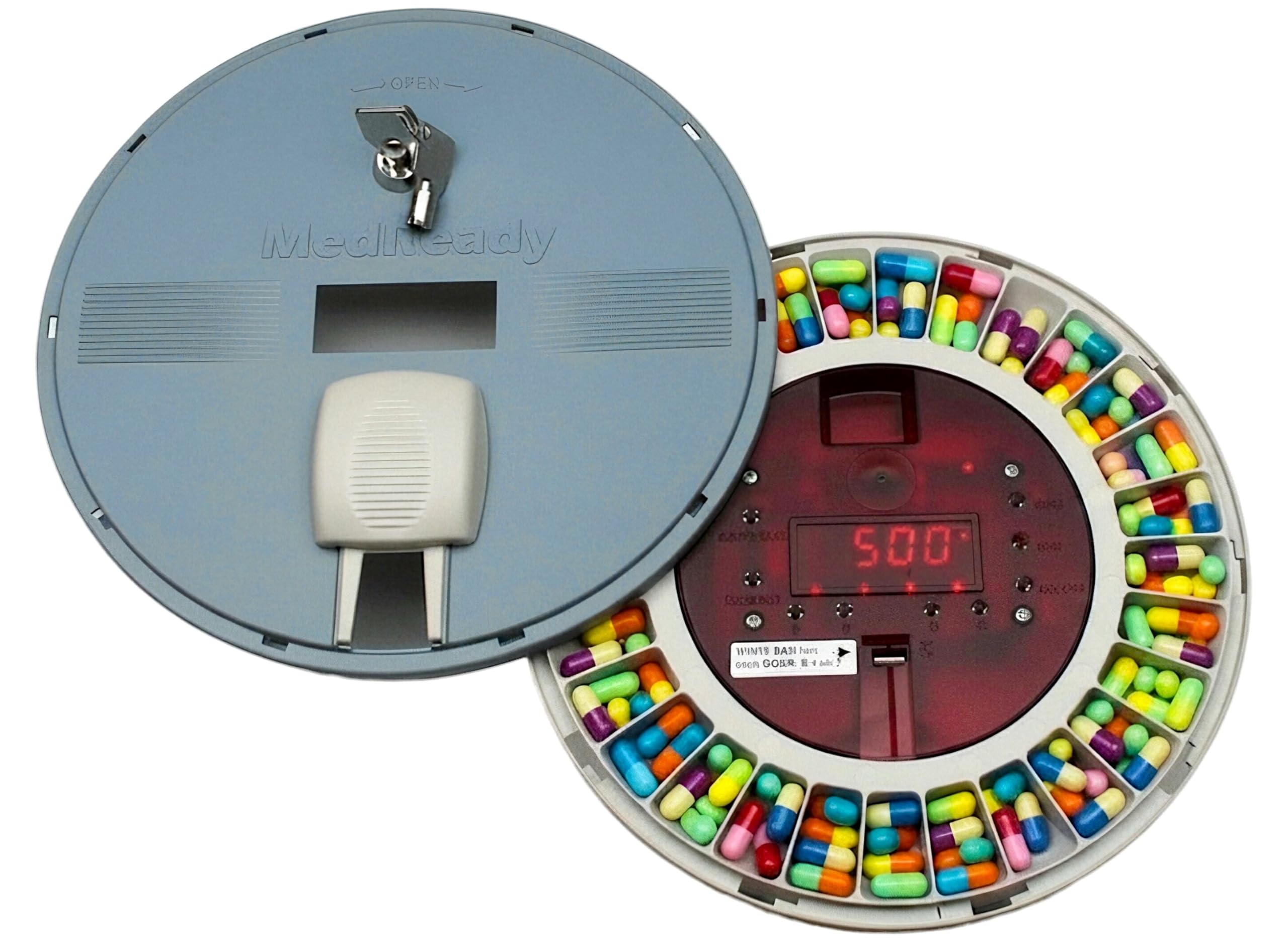
The MedReady 1700FL is purpose-built for Alzheimer’s patients with hearing loss. Its 85-decibel low-frequency alarm penetrates thick walls and ambient noise, while the independently controllable bright red LED flash provides a visual cue for seniors who cannot hear the tone. Each dose is locked behind a real key and mechanical lock — the patient accesses exactly one compartment per scheduled time, with the rest remaining sealed to prevent impulsive double-dosing. The rechargeable NiMH battery delivers up to 48 hours of backup power, so power outages never skip a scheduled dose.
Assembled and serviced in Torrance, California, this unit carries the engineering maturity of a company with over 25 years in medication management. The 28-compartment tray holds up to nine standard-sized pills per slot and dispenses one, two, three, or four times daily. A sloped exit ramp makes it easier for arthritic hands to retrieve pills without spilling, and the large self-illuminating LCD display remains readable in dim light.
Long-term users report compliance rates above 90% even after two to three years of continuous use, with caregivers noting that the patient adapts to the routine within weeks. Some users have bolted the unit to a table to prevent the patient from discarding it during moments of confusion, which speaks to the device’s robustness. The loud mechanical wheel rotation during dispensing is noticeable but does not interfere with the alarm function.
Why it’s great
- 85 dB alarm with independent flashing LED — ideal for hearing-impaired seniors
- Real key lock prevents all tampering and unauthorized access
- 48-hour battery backup survives extended power outages
- Made in USA with reliable domestic customer support
Good to know
- Alarm duration is adjustable but can run up to 30 minutes — may startle the patient initially
- Instructions could be clearer for first-time setup
- No app or remote monitoring — purely local operation
2. Live Fine Smart WiFi Automatic Pill Dispenser

When the caregiver lives thirty miles away from the Alzheimer’s patient, the Live Fine Smart WiFi dispenser closes that distance. Its mobile app connects via your home’s WiFi network — supporting up to 5GHz for stable connectivity — and sends push notifications when a dose is taken or missed. Family members can log into the app to view the patient’s dosing history, send reminder alerts, and even authorize an early release for that one time the schedule shifted. The lockable cover with manual key prevents the patient from accessing compartments outside of scheduled times.
This dispenser accommodates up to nine doses per day across 28 high-capacity slots, with a transparent lid for visual monitoring without unlocking. The large LCD display shows current time, upcoming alarm, and battery level, while three beep patterns and three volume levels allow customization for different hearing abilities. A 4-hour battery backup keeps the schedule intact during short outages, though some users report the USB power connection can be knocked loose easily — secure placement is important.
Setup is straightforward: plug the unit in, connect to the app, and program alarms through the phone interface. Caregivers of early-stage dementia patients report that the 30-minute repeating alarm ensures the patient never sleeps through a dose, and the ability to review missed doses remotely provides peace of mind. Some users note that the plastic locking mechanism feels less robust than metal alternatives, and the backup battery runtime could be longer for extended outages.
Why it’s great
- WiFi app with remote dose monitoring and early-release authorization
- Up to 9 daily alarms with 3 beep patterns and volume control
- 28 slots with transparent lid for easy visual inspection
- Works on 5GHz WiFi for reliable connectivity
Good to know
- Backup battery lasts only 4 hours — insufficient for long outages
- USB power connector can be dislodged accidentally
- Some users report fragile plastic locking mechanism
3. Colorwing Smart Pill Dispenser for Seniors

The Colorwing dispenser addresses a specific Alzheimer’s challenge: patients who impulsively try to open the pillbox outside of scheduled times. Its combination of biometric fingerprint scanning and a physical backup key creates a dual-layer barrier that blocks all access between doses. The fingerprint sensor responds to a pre-registered caregiver or the patient themselves, but only during the programmed dispensing window — at all other times, the tray remains locked. The press-release lid opens with a single palm press, which is especially helpful for patients with arthritis or reduced hand strength.
The 31-slot design comes with seven reversible dose rings, letting you set up weekly or monthly schedules with customizable daily doses. A 1200mAh rechargeable battery charges fully in two hours and runs for over 30 days in energy-smart mode, making it one of the most power-efficient options for continuous use. Bluetooth 5.0 connects to the free companion app for dose tracking and reminders, though the device operates independently without the phone nearby.
Caregivers particularly appreciate the custom voice recording feature — recording a family member saying “Mom, time for your medicine” reportedly improves adherence by 92% compared to standard tones. The round, compact footprint fits easily on a nightstand or kitchen counter, and the frosted white-on-black display remains legible for seniors with macular degeneration or low vision. Some users have repurposed the compartments for small hardware, which underlines the build quality, but the primary function as a secure Alzheimer’s medication dispenser is reliably executed.
Why it’s great
- Fingerprint scanner prevents impulsive medication access
- 1200mAh battery lasts over 30 days on a single charge
- Custom voice recording for personalized medication reminders
- Arthritis-friendly press-to-open lid
Good to know
- Bluetooth range limits app connectivity to nearby rooms
- Fingerprint sensor requires caregiver enrollment for initial setup
- No WiFi for long-distance remote monitoring
4. Betife 31-Day Automatic Pill Dispenser for Elderly
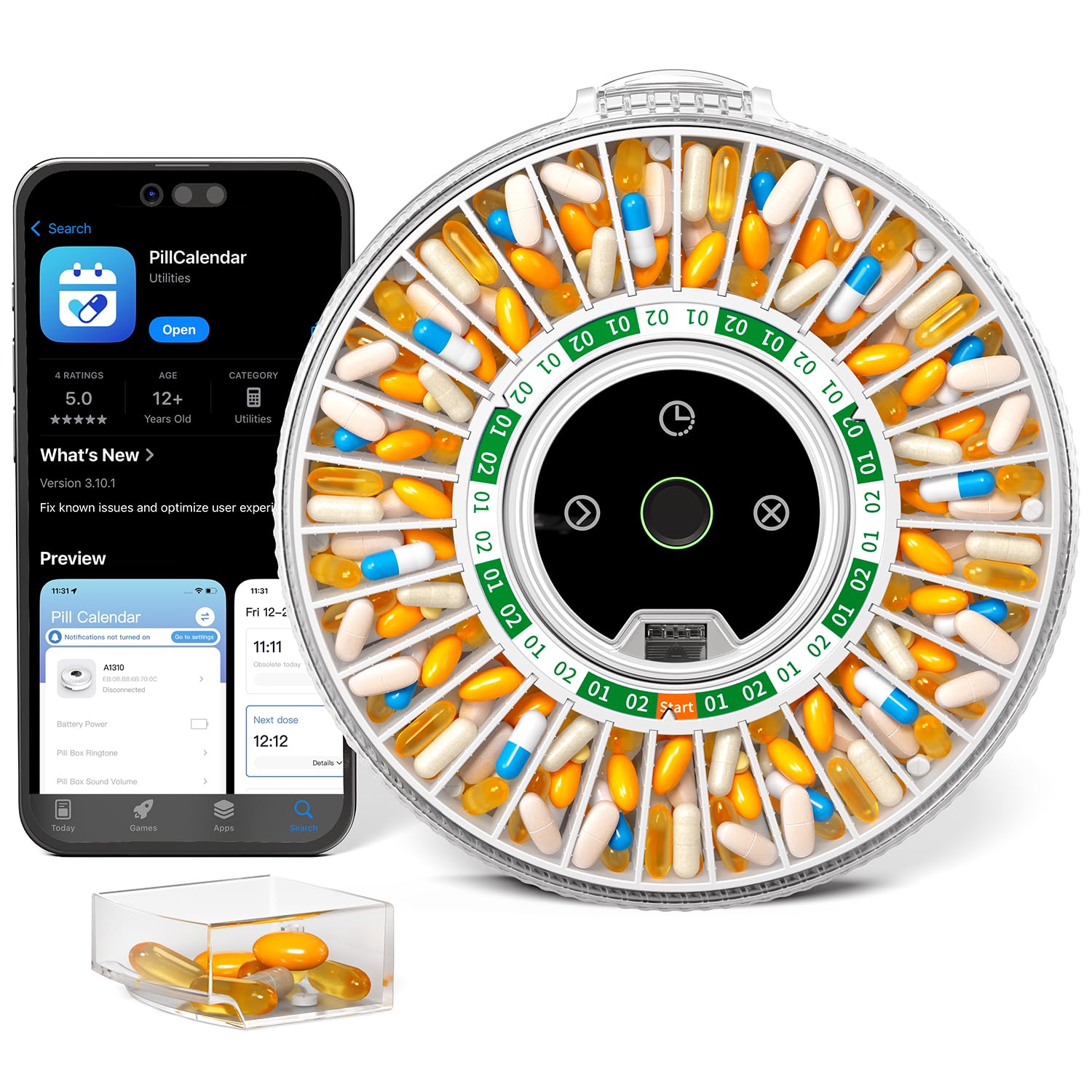
The Betife 31-Day dispenser solves a common frustration with battery-only units: constantly swapping batteries or worrying about low-power shutdowns. This model runs on an AC wall plug for daily use, with a built-in 1200mAh battery that instantly takes over during a power failure, ensuring no scheduled doses are ever skipped. For Alzheimer’s patients living in areas with unreliable power or for families who travel frequently with the patient, this dual-power architecture removes a significant worry.
Security is handled through both a biometric fingerprint scanner and a mechanical key lock — the patient cannot open any compartment except the current dose slot. The press-to-open lid requires no lifting, which is a deliberate design choice for seniors with arthritis or limited hand strength. The 31 compartments and seven double-sided dose rings support both monthly and weekly regimens, and the free app logs every confirmed dose with timestamps that caregivers can review remotely via Bluetooth sync.
Custom voice reminders allow a family member to record a personalized message, which studies indicate improves adherence in Alzheimer’s patients by replacing generic beeps with a familiar voice. Setup is guided by illustrated manuals and video tutorials, and the manufacturer promises 98% issue resolution within four hours. Some early users found the app navigation slightly confusing at first, but once programmed, the dispenser operates autonomously without requiring the patient to interact with the phone.
Why it’s great
- AC plug-in with 1200mAh backup battery for uninterrupted dosing
- Fingerprint plus mechanical key dual-lock security
- Custom voice recording for personalized reminders
- 31-day capacity with reversible weekly dose rings
Good to know
- App navigation requires a short learning curve
- Some Alzheimer’s patients may find the fingerprint sensor confusing
- Bluetooth sync requires phone proximity for data transfer
5. PillCalendar Bluetooth Automatic Pill Dispenser
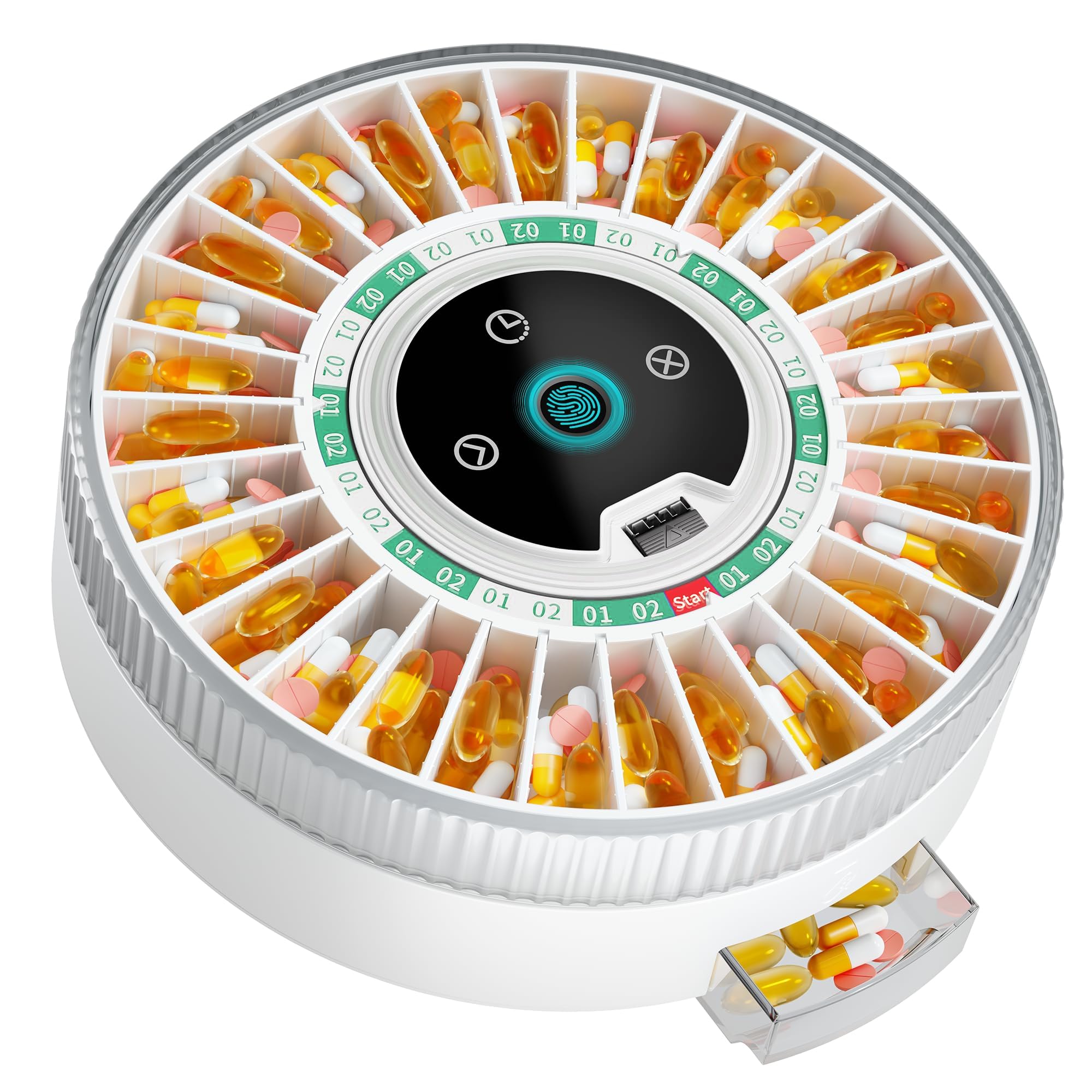
The PillCalendar dispenser was designed with a single ergonomic insight: an Alzheimer’s patient with arthritis should never need to lift the entire unit to access medication. The press-to-open mechanism releases the current dose compartment with a gentle push, keeping the main body planted on the counter. The 31-compartment tray is paired with seven double-sided dose rings for flexible weekly or monthly scheduling, and the fingerprint plus mechanical key lock ensures the patient cannot open the wrong compartment.
A 1200mAh rechargeable battery delivers about a month of operation in low-power mode and charges fully in two hours via USB-C. Bluetooth 5.0 connects to the free Pillcalendar app for setting up to six daily alarms, logging doses, and viewing missed-dose statistics. The app also supports uploading pill images and naming the device for different family members, which is useful when multiple seniors share a home. Three standard alarm tones plus a custom voice recording option give caregivers control over the auditory experience.
Users report that the design is easy to use one-handed and that the tray slides out smoothly for refilling. The round, compact shape takes up less counter space than rectangular dispensers, and the frosted finish hides fingerprint smudges. Some users noted that the app needs to be set up correctly for Bluetooth to work remotely — if the standby button is pressed instead of letting the device time out naturally, the connection may appear lost. Once configured properly, the dispenser operates independently for days without phone interaction.
Why it’s great
- Press-to-open mechanism eliminates lifting — ideal for arthritic hands
- 1200mAh rechargeable battery lasts up to a month
- Custom voice recording for family member reminders
- Fingerprint dual lock prevents impulse access
Good to know
- Bluetooth connection requires careful setup for remote use
- Compartment slots may be tight for very large supplements
- No WiFi — caregiver must be within Bluetooth range for app sync
6. Betife 28-Day Smart Bluetooth Pill Dispenser
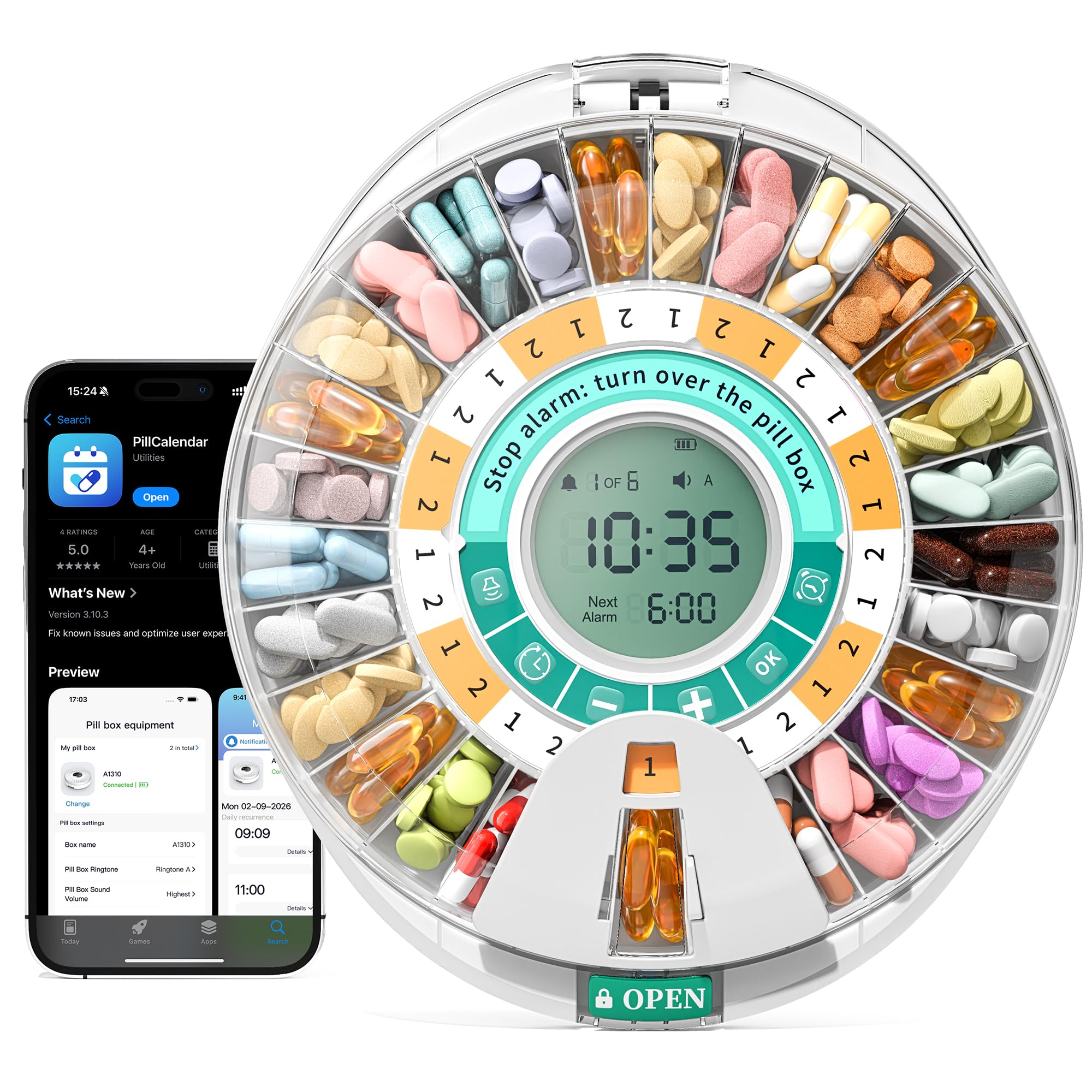
The Betife 28-Day dispenser brings full app control to a mid-range price tier, making it an accessible entry point for families new to automated medication management for Alzheimer’s care. The Pillcalendar app connects via Bluetooth and lets you set up to six daily alarms, customize medication names, upload pill images, and name the device for different family members — useful when multiple seniors live under one roof. For caregivers who prefer manual operation, the large LCD screen with eight intuitive icons and six physical buttons (+, -, OK) allows full control without the phone.
Security is handled through both a fingerprint sensor and a mechanical backup key, creating the same dual-layer access restriction found on more expensive models. The timed lock prevents any compartment from opening outside of the programmed schedule, which stops impulsive or forgetful double-dosing. The 28-day capacity with interchangeable dose rings supports both weekly and monthly regimens, and the transparent lid lets you visually confirm remaining doses without unlocking.
Users consistently praise the easy setup and the push-button lid release that pops open each compartment. The alarms sync between the device and the phone, so even if the patient is in another room, the phone’s push notification ensures they don’t miss the alert. Some users with dementia patients noted that pills can occasionally get stuck in the tray if the compartment isn’t fully rotated — a gentle tap usually resolves it. Betife offers free returns within 30 days and provides step-by-step video tutorials, which reduces the risk of buying a device that ends up confusing the patient.
Why it’s great
- Full app control with up to 6 daily alarms and dose logging
- Fingerprint plus mechanical key dual-lock security
- Large LCD with physical buttons for manual operation
- Push-button lid release for easy access
Good to know
- Runs on 4 AAA batteries — no rechargeable or plug-in option
- Pills can occasionally stick if the tray is not fully rotated
- Bluetooth only — no WiFi for remote monitoring
7. Live Fine 28-Day Automatic Pill Dispenser Clear Lid
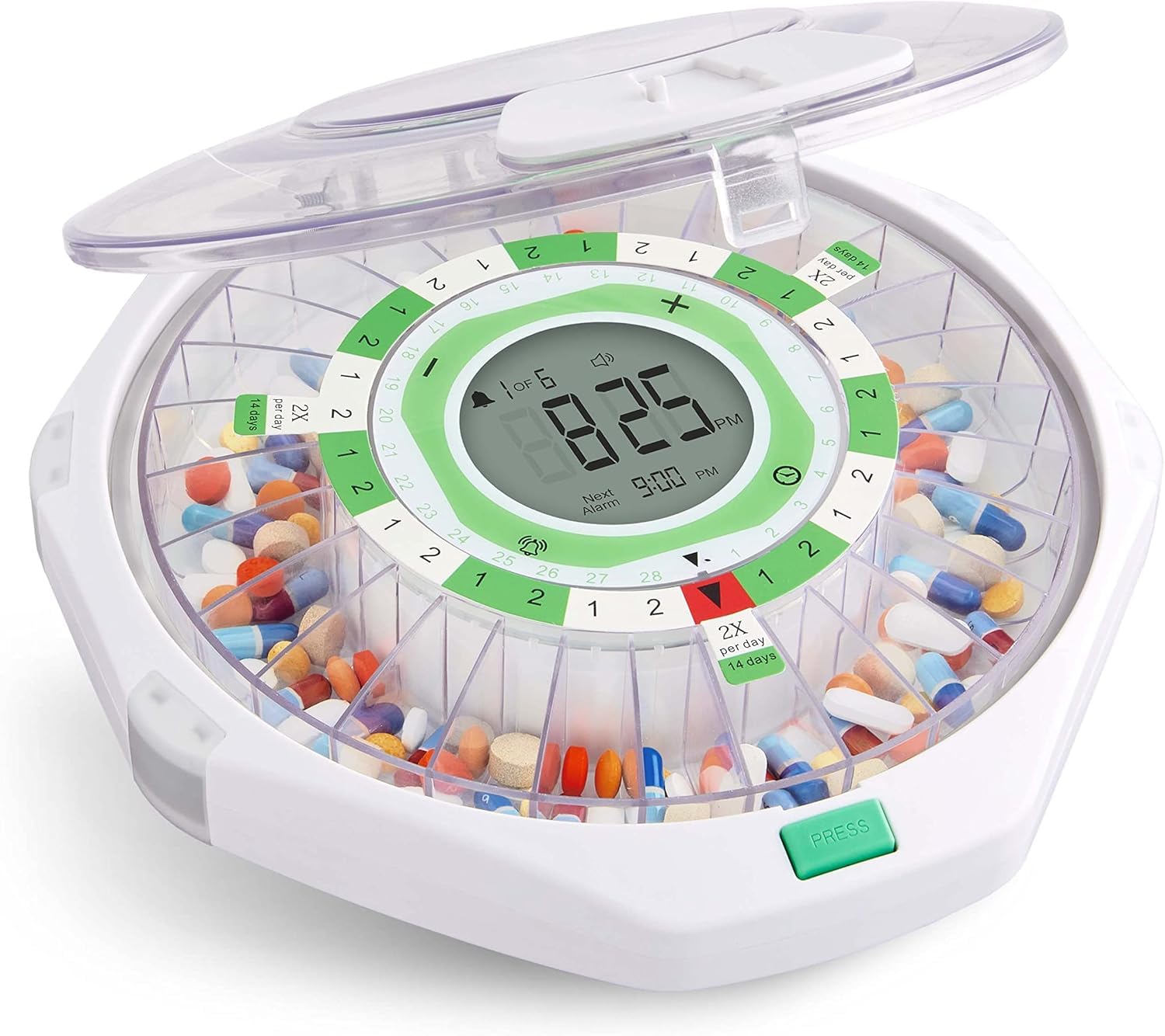
The Live Fine 28-Day dispenser strips away connectivity and biometrics to deliver a no-frills, lockable automatic dispenser that works reliably for Alzheimer’s patients who need simple audio-visual reminders without app complexity. Its standout feature is the clear lid — you can see at a glance how many doses remain without unlocking the unit, which reduces unnecessary openings. The secure lockable cover with manual key blocks unauthorized access, and the smooth sliding retrieval window makes pill retrieval easier for arthritic hands.
Nine interchangeable dosage rings provide preset templates for one to nine daily alarms, which is more flexibility than most budget-tier dispensers offer. The LCD display is the largest in this price bracket, showing current time, upcoming alarm, volume level, battery indicator, and number of alarms set. Three beep patterns and three volume levels (low, high, silent) let you customize the alert without needing a phone app. When the alarm sounds, the interface and border lights illuminate while the tone plays for a full 30 minutes — or until the user inverts the box to dispense pills.
Caregivers of Alzheimer’s patients consistently report that this dispenser gives them peace of mind that their loved one is getting the correct pills at the correct times. The 28 high-capacity slots accommodate multiple pills per compartment, so patients taking several medications don’t need daily refills. Some users noted that the door can be stiff when new — it loosens up after about a month of use — and that pills may spill if the wheel is not empty when opened. The battery-operated design runs on 4 AAA batteries and retains alarm settings when batteries are removed, so reprogramming is not required after replacement.
Why it’s great
- Transparent lid allows visual dose checking without unlocking
- 3 beep patterns and 3 volume levels for customizable alerts
- 9 interchangeable dosage rings for flexible scheduling
- Lockable cover prevents tampering at a budget-friendly price
Good to know
- No WiFi, Bluetooth, or app — entirely local operation
- Door may be stiff initially; takes about a month to loosen
- Pills can spill if the wheel is opened while not empty
- Runs on 4 AAA batteries with no rechargeable option
FAQ
Will an automatic pill dispenser prevent an Alzheimer’s patient from overdosing?
How loud does the alarm need to be for a hearing-impaired senior?
Can the dispenser still work if the WiFi goes out or the phone dies?
What happens if the patient ignores the alarm and does not take the pill?
Final Thoughts: The Verdict
For most families, the best automatic pill dispenser for alzheimer’s patients winner is the MedReady 1700FL because its 85-decibel alarm with independent flashing LED, real key lock, and 48-hour battery backup deliver uncompromising safety for hearing-impaired seniors without relying on an app. If you need remote caregiver monitoring from a different city, grab the Live Fine Smart WiFi dispenser with its app-based dose tracking and early-release authorization. And for a compact fingerprint-secured unit with the best battery efficiency, nothing beats the Colorwing Smart Dispenser — its 30-day standby time and voice recording make it the most discreet option for patients who resist medical devices on the counter.