
A few strong pulls of the cord and the familiar smoky sweet scent of two-stroke oil fills the air — a sound that tells you this motor means business. For small fishing boats, inflatables, and jon boats, a lightweight 2-stroke outboard remains the go-to choice because it delivers more power per pound than its four-stroke cousin, with fewer complex valves to worry about corroding in saltwater.
I’m Min — the co-founder and writer behind Gadgets Feed. My approach to marine gear is rooted in cross-referencing hundreds of customer field reports, parsing displacement and gear ratio specs, and identifying which generic Chinese blocks actually hold up under real abuse on the water.
Whether you are repowering a skiff or starting fresh with a tiller-steered beast, this guide distills the real-world reliability data so you can confidently choose the best 2 stroke outboard for your hull size and budget.
How To Choose The Best 2 Stroke Outboard
Buying a 2-stroke outboard is less about brand loyalty and more about matching displacement, shaft length, and cooling system to your specific hull and abuse tolerance. A few key decisions separate a season of reliable trolling from a weekend of frustration.
Displacement and Cylinder Count
Single-cylinder 102cc to 169cc motors (6 hp to 12 hp) are lighter and simpler but vibrate more at idle. Twin-cylinder 246cc motors (18 hp) run smoother and plane a loaded 14-foot jon boat at 19–25 mph. For anything over a 15-foot hull, prioritize twin-cylinder 246cc blocks — they handle the torque curve better without shaking the tiller out of your hand.
Shaft Length and Transom Height
Short shaft (15-inch) outboards fit inflatables, small fishing boats, and jon boats with transom heights up to 17 inches. If your transom is deeper, a long shaft (20-inch) is required to keep the water intake submerged at planing speeds. Running a short shaft on a high transom aerates the cooling system, causing overheating within minutes.
Cooling System: Water-Cooled vs. Air-Cooled
Water-cooled outboards use a pump impeller to circulate lake or ocean water around the cylinder, maintaining consistent temperatures during long runs at high RPM. Air-cooled models eliminate the impeller — good for murky or silty water where sand eats pump vanes — but they run hotter and louder. For typical freshwater use, water-cooled delivers better longevity.
Quick Comparison
On smaller screens, swipe sideways to see the full table.
| Model | Category | Best For | Key Spec | Amazon |
|---|---|---|---|---|
| DNYSYSJ Hangkai 18HP | Premium | Clone parts availability | 246cc / 38.6 kg / Water-cooled | Amazon |
| EEYBLAEEY 18HP | Premium | Top speed on jon boats | 246cc / 63.7 lb / 1.18 gal/hr | Amazon |
| awolsrgiop 18HP | Premium | Rough-water durability | 246cc / Shaft 15″ / CDI | Amazon |
| HANGKAI 12HP | Mid-Range | Quiet trolling on rivers | 246cc / 77 lb / 12L tank | Amazon |
| BJTDLLX 12HP | Mid-Range | Abuse-tolerant white river | 169cc / 59.5 lb / 6.34 gal | Amazon |
| TBVECHI 6HP | Budget | Light inflatable kicker | 102cc / 45.3 lb / 2.5L tank | Amazon |
| Newport NT300 Electric | Electric | Zero-fume marina use | 1300W / 110 lb thrust / 23.8 lb | Amazon |
In‑Depth Reviews
1. DNYSYSJ Hangkai 18HP
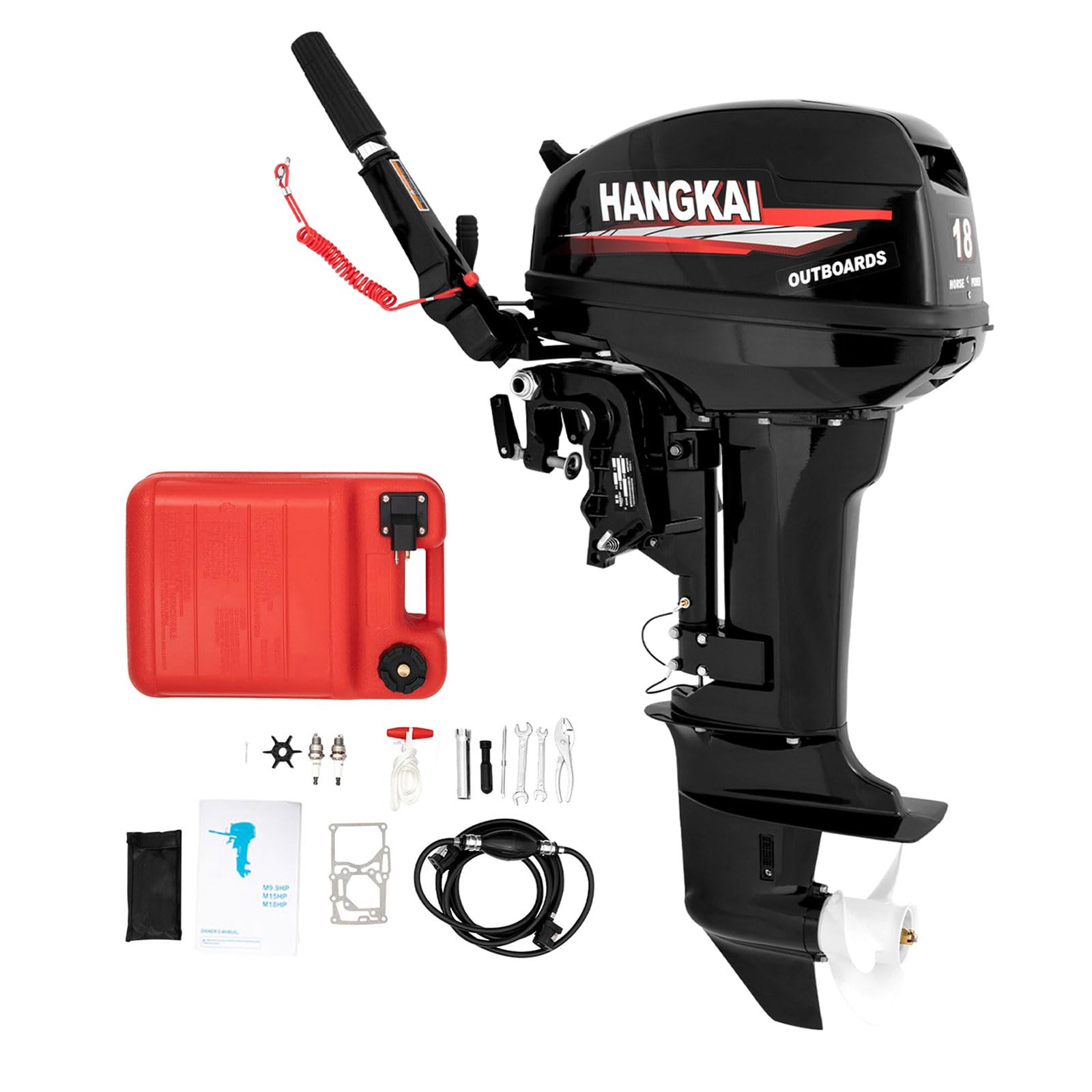
The DNYSYSJ Hangkai 18HP is the single most documented 2-stroke clone on the market — a near-identical copy of the Tohatsu M9.8B block, meaning parts like impellers and lower-unit seals cross-reference easily. At 246cc with a twin-cylinder water-cooled design and CDI ignition, it hits an honest 18–20 mph on a 12-foot aluminum v-hull with two people on board, and owners report starting on the first or second pull after priming.
The included 24-liter external fuel tank gives you all-day range on a jon boat, and the 360-degree tiller rotation allows instant reverse without a shift. Several buyers have registered this motor in the US using the MSO and invoice provided by the seller, solving the title headache common with budget Chinese imports. The two-year warranty is the best in this price tier.
Downsides are real: the throttle decal can arrive reversed (marking full throttle as idle), and the pull-start housing has been known to fail after the second summer of heavy use. Still, this is the only budget 18HP that combines twin-cylinder smoothness, reliable parts sourcing, and easy US registration — the complete package for most skiffs and inflatables.
Why it’s great
- 246cc twin runs smoother than any single-cylinder 12hp
- Tohatsu clone means easy lower-unit parts
- MSO and invoice included for US boat registration
Good to know
- Throttle sticker orientation may be reversed from factory
- Pull-start housing can crack after extended saltwater use
- Frame bolts may loosen during barrel-test break-in
2. EEYBLAEEY 18HP
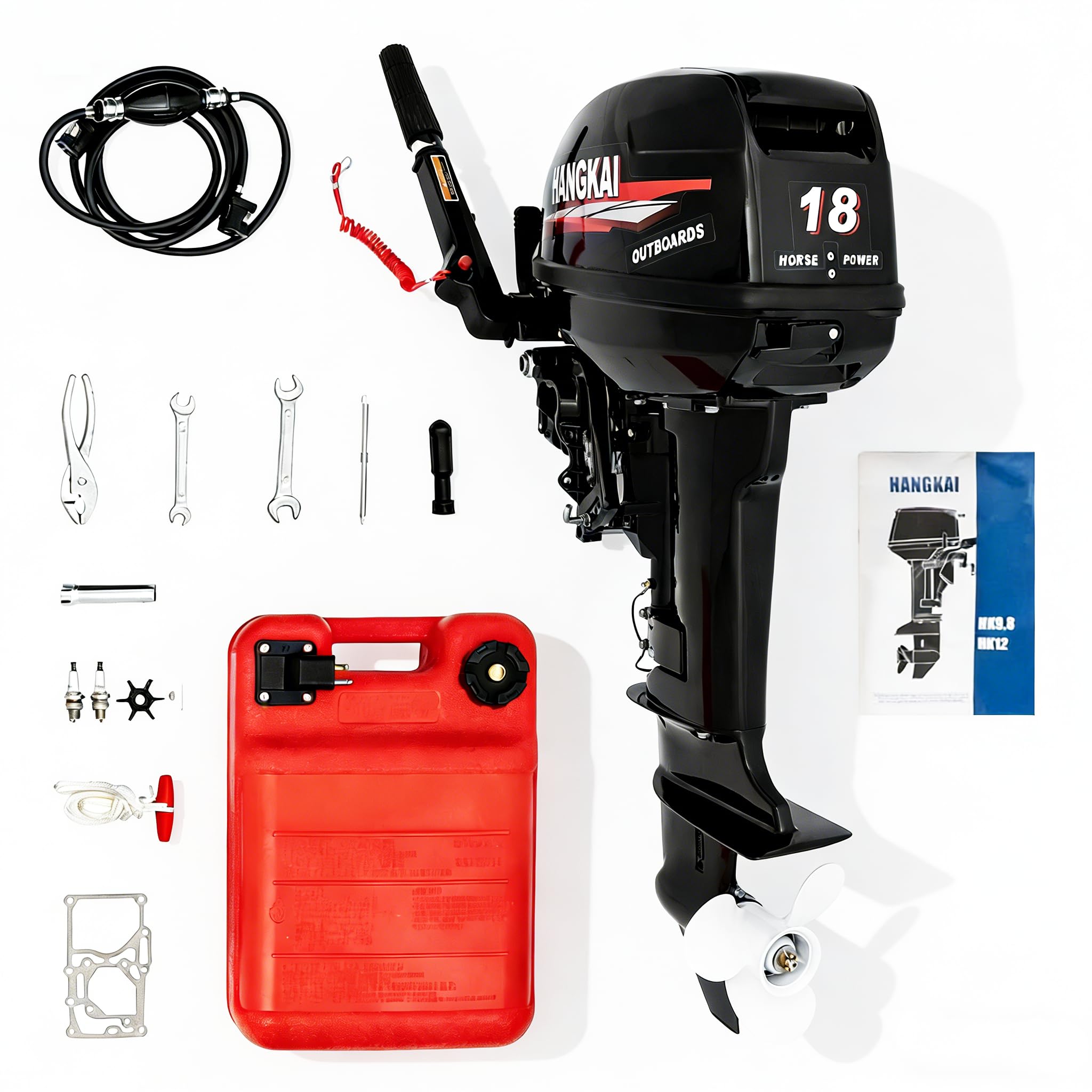
The EEYBLAEEY 18HP delivers verified 19–20 mph on a 1436 jon boat before adding a jack plate, with one owner reporting room for more top-end with trim optimization. Its 246cc block with CDI ignition and water cooling runs noticeably quiet at around 80 decibels, and the large 6.34-gallon external tank supports extended fishing trips at cruise speeds.
Build quality stands out in the price range — buyers consistently mention the 63.7-pound motor arrives well-packed with a spare spark plug, water pump impeller, pull cord, and gasket set. The antiventilation plate and tilt adjustment pins reduce porpoising, and the fuel consumption rate of 1.18 gal/hour means economical running even at higher RPM.
The main catch: this motor ships without gear oil in the lower unit, and the 7-day warranty window is absurdly tight. Owners must add their own TCW-2 gear oil before first start and perform a 10-hour break-in at 25:1 fuel mix. If you want a fast, quiet 18HP on a small hull and you are comfortable with basic pre-launch fluid checks, this motor delivers the best straight-line speed for the money.
Why it’s great
- Recorded 19+ mph on a 1436 jon boat
- Large 6.34-gallon tank for all-day range
- Includes spare impeller and gaskets in box
Good to know
- Ships bone-dry — no gear oil in lower unit
- Warranty period is only 7 days
- Break-in requires 25:1 mix for first 10 hours
3. awolsrgiop 18HP
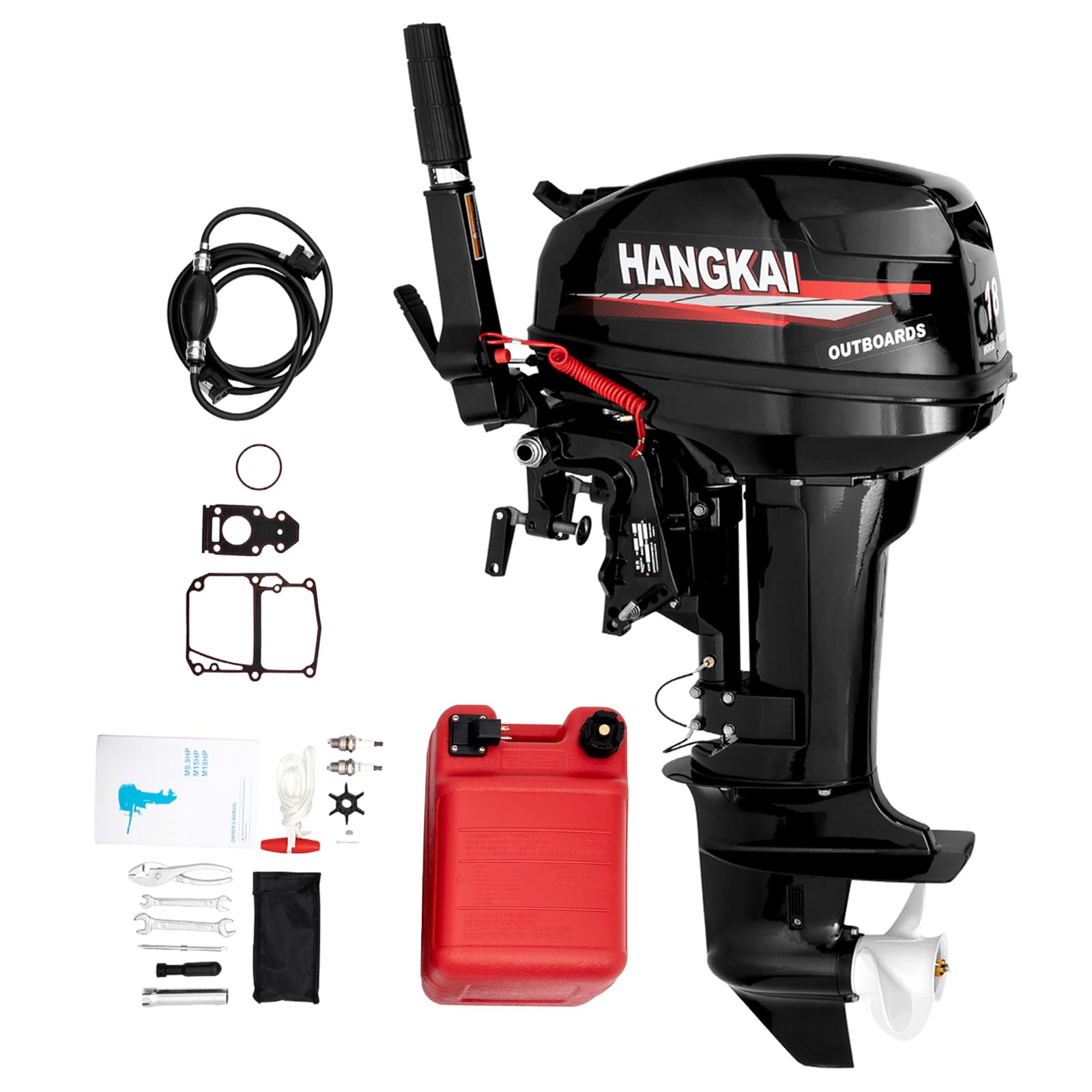
The awolsrgiop 18HP is built for rough-water durability — it is the same 246cc water-cooled block design as the others but tuned for high-torque delivery at lower RPM. Owners pushing inflatables up to 15.4 feet report 25 mph top speeds during break-in, and the motor handles sudden throttle changes and debris strikes better than most in this range, likely due to the streamlined individual fins that protect the high-speed propeller.
The 6.34-gallon tank combined with the anti-vortex plate keeps water flow stable in chop, and the ergonomic rubber-covered tiller handle prevents hand fatigue during long runs. Shipped via FedEx in as little as 7 days, this model is one of the fastest-delivered budget 18HP options. Multiple buyers have run it for 50+ hours with only routine oil changes and impeller checks.
The downside is that delivery times vary wildly — some orders take 2 to 2.5 months. The manufacturer recommends a 25:1 fuel-oil mix for the first 50 hours (double the typical break-in period), which can be smoky and messy. If you need a reliable 18HP that survives rough water and you can plan months ahead for delivery, this is your pick.
Why it’s great
- 25 mph top speed on 15-foot inflatables
- Streamlined fin design protects prop from strikes
- Ergonomic rubber tiller cover reduces vibration
Good to know
- Delivery can take 2+ months on some orders
- Long 50-hour break-in at 25:1 mix ratio
- Water pump impeller should be inspected pre-first-use
4. HANGKAI 12HP

The HANGKAI 12HP is the quietest 2-stroke in this roundup, thanks to a large-profile muffler and a pressurized circulating oil system that dampens mechanical noise. At 246cc (the same displacement as the 18HP motors but detuned), it delivers smooth power without the top-end vibration typical of single-cylinder 12HP outboards. Buyers consistently describe it as “quieter than expected” for a two-stroke.
The included 6.3-gallon tank, tool kit, spare spark plugs, and replacement impeller make this almost turnkey — you just need your own gear oil for the lower unit. Several owners follow Tohatsu break-in guidelines (32:1 for the first 8 hours) and report easy starting after priming even in cooler weather. The cast aluminum construction with spray-painted corrosion resistance holds up well in freshwater.
Weaknesses include the lack of an off switch (you must pull the kill cord to stop), fragile plastic trim pieces on the tiller, and a tilt lock that cannot hold the motor in position without manual adjustment. If silence matters more than raw horsepower on a 14-foot river skiff, this 12HP delivers a pleasant operating experience.
Why it’s great
- Noticeably quieter than comparable 12HP models
- Spare impeller, plugs, and tool kit included
- 246cc runs cooler than smaller single-cylinders
Good to know
- No off switch — kill cord is the only shutdown method
- Tiller trim lock cannot hold under power tilt
- Some plastic components feel low-durability
5. BJTDLLX 12HP

The BJTDLLX 12HP has earned a reputation among owners as “the cheap Chinese outboard that refuses to die.” One documented owner ran it for a full year on the White River — sudden stops, full-throttle-to-reverse shifts, stump hits, weed wraps — with no maintenance beyond clearing the lower unit. It starts on the 3rd or 4th pull cold and half a pull warm. At 169cc with water cooling and CDI ignition, this single-cylinder motor produces 661–1763 pounds of thrust.
The 6.34-gallon external fuel tank provides solid range, and the three gear positions (F-N-R) with continuous variable throttle make it easy to match speed to current conditions. Several buyers have mounted this on 14-foot flat bottoms and report no issues after dozens of trips. The aluminum casting resists corrosion well, and the flameout switch on the handle gives quick shutdown access.
Downsides include slower-than-average shipping and the need for a dedicated break-in period — most owners run 25:1 for the first 10 hours before switching to 50:1. The motor does not come pre-greased on all moving parts, so you must check the gear oil level before the first launch. For a budget 12HP that takes real abuse, this is the survivor.
Why it’s great
- Survived a full season of river abuse with zero repairs
- Starts half-pull when warm
- 6.34-gallon tank provides extended range
Good to know
- Delivery may be slower than other options
- No factory grease on all pivot points
- Break-in requires 10 hours at 25:1 mix
6. TBVECHI 6HP

The TBVECHI 6HP is the lightest gas-powered outboard in this lineup at just 45.3 pounds, making it easy for one person to lift onto the transom of a small inflatable. Its 102cc single-cylinder engine with water cooling is remarkably quiet at idle, and owners report starting on the 2nd or 3rd pull after priming. On a 14-foot jon boat with two people, this motor achieves around 6 mph at quarter to half throttle.
The internal 2.5-liter fuel tank is small — expect to refill on longer trips — but it eliminates the need for an external fuel line on a lightweight tender. The aluminum alloy construction resists rust well, and the CE certification is included with purchase. One owner has been transporting this motor on its side for months with no oil-fouling or flooding issues, thanks to the two-stroke’s simple reed-valve design.
The big risk here is packaging quality: one buyer received a unit damaged in transit with the seller demanding return shipping before Amazon forced a replacement. The 6HP also struggles at higher elevations — two-stroke carbs need rejetting above 5,000 feet. For a cheap, light kicker on a small inflatable under 12 feet, this motor works. For anything larger or more demanding, step up to the 12HP tier.
Why it’s great
- Only 45.3 pounds — easy solo carry
- Starts reliably cold on 2-3 pulls
- Runs quietly at idle for trolling
Good to know
- High elevation requires carb rejetting
- Small 2.5L tank limits range
- Packaging may arrive damaged
7. Newport NT300

The Newport NT300 is the only electric motor on this list, and it serves a very different purpose from the gas outboards above. Rated at 1300W (3HP equivalent) with 110 pounds of thrust, it pushes a Pelican Catch 100 kayak or similar small skiff at about 6.5 mph, with zero noise, zero fumes, and zero two-stroke oil mixing. At 23.8 pounds, it is the lightest motor here by a wide margin, and the digital LCD throttle gives precise speed control.
Range depends heavily on your battery choice — a 36V 100Ah lithium setup delivers about 2 hours at full throttle or a full day at two-thirds throttle. The field-oriented control technology provides smooth acceleration without jerky starts, and the four trim angles (0°, 7°, 14°, 21°) help dial in the best planing angle for different loads. Owners report running 5+ miles on a single charge with plenty of reserve.
The trade-offs are real: 6.5 mph is slow compared to any 6HP gas outboard, and the shaft length (24.6 inches) may be too long for very shallow water, leading to weed pickup. The throttle has a slight delay on input, and the tiller is not offset, so you must reach straight back. For quiet fishing on no-wake lakes or as a backup auxiliary, the NT300 is brilliant. For getting home against a strong current, stick with gas.
Why it’s great
- Zero emissions, near-silent operation
- Only 23.8 lb — easily portable
- Digital LCD throttle with precise speed control
Good to know
- Top speed limited to 6.5 mph
- Requires a separate 36V battery
- Throttle response has a short delay
FAQ
Do I need to add gear oil to the lower unit before first use?
What is the correct break-in procedure for a new 2 stroke outboard?
Can I use a short shaft outboard on a deep transom boat?
How do these budget 2 stroke outboards compare to name brands like Yamaha or Tohatsu?
Final Thoughts: The Verdict
For most users, the 2 stroke outboard winner is the DNYSYSJ Hangkai 18HP because its twin-cylinder 246cc block combines smooth operation, easy parts sourcing as a Tohatsu clone, and US registration support in one reliable package. If you want raw top speed on a small jon boat, grab the EEYBLAEEY 18HP. And for zero-fume electric trolling on restricted lakes, nothing beats the featherlight Newport NT300.