
Thin-film lubrication science determines whether your engine’s cam lobes survive their first hundred miles or whether a high-mileage daily driver finally starts knocking. The wrong additive package does nothing but thicken the oil; the right one bonds a sacrificial layer to metal surfaces, directly competing against the 200-plus pounds per square inch of a valve spring slamming a lifter into a camshaft. This is not about viscosity modifiers or marketing claims—it is about the specific anti-wear chemistry your engine demands.
I’m Min — the co-founder and writer behind Gadgets Feed. I’ve analyzed hundreds of real-world owner reports and factory data sheets to isolate which additive packages actually deliver measurable reductions in coefficient of friction and component temperature.
Whether you are running a flat-tappet muscle car build, a turbocharged direct-injection commuter, or a aging diesel with HEUI injector stiction, the best anti wear additives for oil share one trait: they supplement the precise polar molecules modern base oils are forced to reduce.
How To Choose The Best Anti Wear Additives For Oil
Selecting the right additive requires matching the chemical package to your engine’s valvetrain design, driving load profile, and oil type. The wrong choice can lead to sludge buildup, catalytic converter poisoning, or wasted money on a formula your engine never needed.
ZDDP Concentration and Valvetrain Type
Flat-tappet cams and lifters rely on a sacrificial zinc dialkyldithiophosphate film to survive break-in and sustained high-load operation. Modern API SN/SP oils reduce ZDDP to protect emissions systems, so engines with non-roller valvetrains require a supplemental dose of zinc and phosphorus. Roller-cam engines and most overhead-cam designs are less demanding, meaning high-ZDDP additives deliver no extra benefit and may accelerate catalyst wear over time.
Friction Modifier vs. Anti-Wear Additive
Molybdenum disulfide and organic friction modifiers reduce boundary-layer drag and heat, but they do not form the same hard phosphate glass as ZDDP. For turbocharged gasoline direct-injection engines, molybdenum-based packages like Lubegard’s help suppress low-speed pre-ignition (LSPI), a destructive knock event that conventional ZDDP alone cannot address. Diesel and heavy towing applications benefit from a balanced blend that includes both anti-wear and friction-reducing chemistries.
Quick Comparison
On smaller screens, swipe sideways to see the full table.
| Model | Category | Best For | Key Spec | Amazon |
|---|---|---|---|---|
| Liqui Moly 2009 (4-Pack) | Premium Multi-Dose | High-load street engines | 1 Liter total volume / Moly-based friction modifier | Amazon |
| Polytron MTC | Premium Concentrate | Metal-surface treatment | 16 oz treats 6 quarts / 95% wear reduction claim | Amazon |
| Archoil AR9100 (Gallon) | Premium Diesel | HEUI injector stiction | 128 oz / 1.2 oz per quart treat rate | Amazon |
| COMP Cams 159 | Mid-Range Break-In | Flat-tappet break-in | 12 oz / 2,000+ ppm ZDDP | Amazon |
| Lubegard 30015 | Mid-Range Turbo | Turbo GDI & LSPI reduction | 15 oz / Molybdenum formula, zero zinc | Amazon |
| Red Line 81403 | Mid-Range Break-In | Valvetrain break-in | 16 oz / ZDDP + detergent blend | Amazon |
| Dura Lube Engine Treatment | Budget All-Rounder | General friction reduction | 32 oz / Flash point 495°F | Amazon |
In‑Depth Reviews
1. Liqui Moly 2009 Anti-Friction Oil Treatment (4-Pack)

Liqui Moly’s microlon technology suspends solid lubricant particles in a colloidal carrier, creating a layer that reduces metal-to-metal contact at boundary conditions. German engineering here targets engines subjected to sustained high-load operation—extended towing, full-throttle track sessions, or hot highway cruising. The four-bottle pack covers multiple vehicles or multiple changes, and each 250 mL bottle treats up to 5 liters of engine oil.
Real-world reports across a 5.7L Hemi and a 2014 Honda CRV with 120,000 miles document quieter valve-train operation and a measurable drop in lifter tick noise. The 2010 Tahoe owner reporting nearly inaudible tick at 240,000 miles after years of consistent use points to genuine boundary-layer persistence. Fuel economy gains are modest—single-digit percentage improvements—but the primary value is the reduction in start-up wear, when the oil pump has not yet pressurized the system.
One caveat: the solid moly suspension can cause short-term filter loading if the engine already has significant sludge, though most modern oils handle particulate filtration without issue. The formula is compatible with both conventional and full synthetic base stocks, including 0W-16 through 15W-40 viscosities.
Why it’s great
- Proven lifter-noise reduction on engines over 200k miles
- Four-pack provides multi-vehicle coverage at a competitive per-treatment cost
- Loaded-moly layer persists through drain intervals without shearing
Good to know
- Not ideal for catalytic-converter-sensitive engines requiring zero-zinc formulations
- Solid suspension may temporarily cloud oil appearance
2. Polytron Metal Treatment Concentrate MTC

Polytron MTC operates on a fundamentally different principle from traditional ZDDP or moly additives: it treats the metal lattice itself rather than the oil film. The concentrate contains no solid particles—no PTFE, no zinc—and is not a viscosity modifier. Instead, its polar molecules bond to the ferrous surface through a proprietary process originally developed for military applications, creating a sacrificial layer that can protect an engine even during brief oil or coolant loss.
Customer data aligns with these claims. Users report a 50–100 RPM drop in idle speed after the first application, along with elimination of start-up rattling and scraping noises on high-mileage engines. The idle-drop observation is significant because it indicates reduced internal friction at low RPM where boundary lubrication is dominant. The manufacturer suggests a 10% by volume treat rate (half quart for a six-quart sump), which means a single bottle covers most passenger cars.
The main trade-off is the cure time—full effect requires roughly 50 miles of driving for the chemical bond to establish. Early results at 10–20 miles are less dramatic, so this is not a quick fix for an engine already exhibiting knocking. It is best deployed as a preventive measure on a healthy engine or as a restorative treatment for high-mileage units showing mild wear symptoms.
Why it’s great
- Bonds to metal surfaces instead of relying on oil viscosity alone
- No solid particulates to clog filters or oil passages
- Reduces idle RPM by measurable amounts in many applications
Good to know
- Full effect requires 50+ miles of driving to develop
- Premium price per ounce compared to conventional additives
3. Archoil AR9100 Oil Additive (1 Gallon)

Archoil AR9100 is engineered for the unique demands of HEUI (Hydraulic Electronic Unit Injector) systems found in Ford 6.0L and 7.3L Power Stroke diesels, where high-pressure oil actuates the injectors. Modern ultra-low-sulfur diesel and reduced-additive engine oils cause injector spool valves to stick, producing cold-start misfires, rough idle, and sluggish throttle response. AR9100’s chemistry restores lubricity to the high-pressure oil rail and frees stuck injector spools.
The treat rate is economical: 1.2 oz per quart of engine oil, meaning a single 16 oz bottle treats a 13-quart diesel sump. The gallon jug provides eight full treatments for a Power Stroke or sixteen for smaller-capacity engines. Owners of 1999–2003 7.3L trucks report that the vehicle will not start without the block heater unless AR9100 is present, highlighting how critical the friction-modifying package is for these older injection systems.
Beyond diesels, AR9100 works in gasoline engines, limited-slip differentials, gearboxes, and power steering systems. The anti-wear barrier it creates reduces component noise and vibration under high-load conditions, though the gallon size is overkill for a single passenger-car gasoline engine. This is a specialist tool recommended primarily for HEUI-equipped diesel owners or fleets with multiple heavy-duty vehicles.
Why it’s great
- Specially formulated to resolve HEUI injector stiction in 6.0L and 7.3L Power Strokes
- Usable across multiple drivetrain components—oil, gearbox, differential
- Gallon container offers the lowest per-ounce cost for fleet or heavy users
Good to know
- Large bottle is impractical for single-gasoline-engine households
- Not designed to boost ZDDP for flat-tappet cam break-in
4. COMP Cams 159 Engine Break-In Oil Additive

COMP Cams 159 delivers the highest ZDDP concentration in this comparison, explicitly formulated for the first minutes of a new camshaft or a fully rebuilt engine. The proprietary package includes zinc and phosphorus in the range of 2,000 to 3,000 ppm, plus molybdenum and a detergent package that prevents varnish formation during the break-in process. This is not a maintenance additive—it is designed for the single, high-risk event of mating new metal surfaces.
The 12 oz bottle treats the typical small-block V8 sump (5–6 quarts), and the recommendation is to drain it after the initial break-in period because the high detergent load can cause foaming if used long-term. Flat-tappet builds are the primary use case: the additive protects cam lobes and lifters from the rapid wear that occurs before the parts have work-hardened. Several owners reported that losing a cam lobe on initial start-up was avoided by using COMP 159.
One practical constraint: the bottle is small at 12 oz, and some engines with larger sumps (7+ quarts) require a second bottle. It is also fully compatible with methanol and high-octane race fuel, making it a go-to for performance marine and circle-track builds. For break-in protection where cam failure means a complete teardown, this additive is inexpensive insurance.
Why it’s great
- Extremely high ZDDP concentration for flat-tappet cam and lifter survival
- Includes molybdenum for additional boundary-layer protection
- Compatible with methanol and race fuels beyond standard gasoline
Good to know
- Not intended for long-term use—must be drained after break-in
- Single 12 oz bottle may be insufficient for engines with 7+ quart capacities
5. Lubegard 30015 Engine Oil Protectant for Turbocharged Engines

Lubegard 30015 addresses a modern scourge in downsized turbocharged gasoline direct-injection (GDI) engines: low-speed pre-ignition. LSPI occurs when oil droplets containing calcium-based detergents ignite the fuel-air mixture before the spark plug fires, causing a hammer-like knock that can destroy connecting rods. Lubegard replaces calcium with a molybdenum-based chemistry that suppresses these uncontrolled ignition events without introducing ZDDP that could poison catalytic converters.
The 15 oz bottle treats four to five quarts of oil. Customers running a 2024 Nissan Rogue 1.5L turbo and a 2020 Subaru 2.4L turbo both reported immediately smoother idle and elimination of a ticking noise that had been present with standard synthetic oil. The reduction in LSPI risk is the headline feature, but the additive also reduces oil consumption and volatility, which is critical for GDI engines that dilute their oil with fuel during short-trip operation.
This product is zinc-free by design, so it will not help flat-tappet break-in or older valvetrains that need ZDDP. It is strictly for modern turbo engines where LSPI and catalyst protection are the priorities. The bottle’s slim 15 oz volume means engines with large sumps (over 6 quarts) will need two bottles to achieve the full treat rate.
Why it’s great
- Specifically designed to reduce LSPI knock in turbocharged GDI engines
- Zero zinc protects catalytic converter longevity
- Immediate idle smoothing reported by owners of multiple turbo models
Good to know
- Not suitable for engines requiring high ZDDP for flat-tappet protection
- One bottle may not fully treat larger-capacity engine sumps
6. Red Line 81403 Engine Break-In Additive

Red Line 81403 is a specialized break-in additive that delivers ZDDP along with a detergent package that is less aggressive than COMP Cams’ formulation, allowing for a more gradual ring-seating process. The 16 oz bottle treats up to 12 quarts of conventional oil, making it unusually economical for break-in applications—a single bottle covers two oil changes on most passenger cars or one change on a large diesel. The inclusion of special detergents improves lubricity and reduces the detonation risk that can occur with overly slick break-in oils.
Customers running flat-tappet builds and air-cooled engines (including a 50-year-old VW six-cylinder) have reported successful break-ins without cam lobe loss. The recommended dosing is 1 oz per quart for modern roller-cam engines and 2 oz per quart for older non-roller valvetrains, giving the user flexibility based on engine architecture. The additive is compatible with viscosities from 0W-16 to 15W-40, covering everything from a Honda Civic to a Cummins diesel.
The main functional difference from COMP Cams 159 is the milder detergent load—Red Line 81403 can be used for a longer period without causing foaming, though it is still intended for break-in and first-change service rather than continuous use. It also does not include molybdenum, so the anti-wear film relies entirely on the ZDDP layer.
Why it’s great
- Treats up to 12 quarts per bottle—excellent value for break-in applications
- Flexible dosing rates for different valvetrain types
- Compatible with all oil viscosities from 0W-16 to 15W-40
Good to know
- No molybdenum additive for multi-component anti-wear film
- Not formulated for continuous long-term use like maintenance additives
7. Dura Lube Engine Treatment (32 oz)
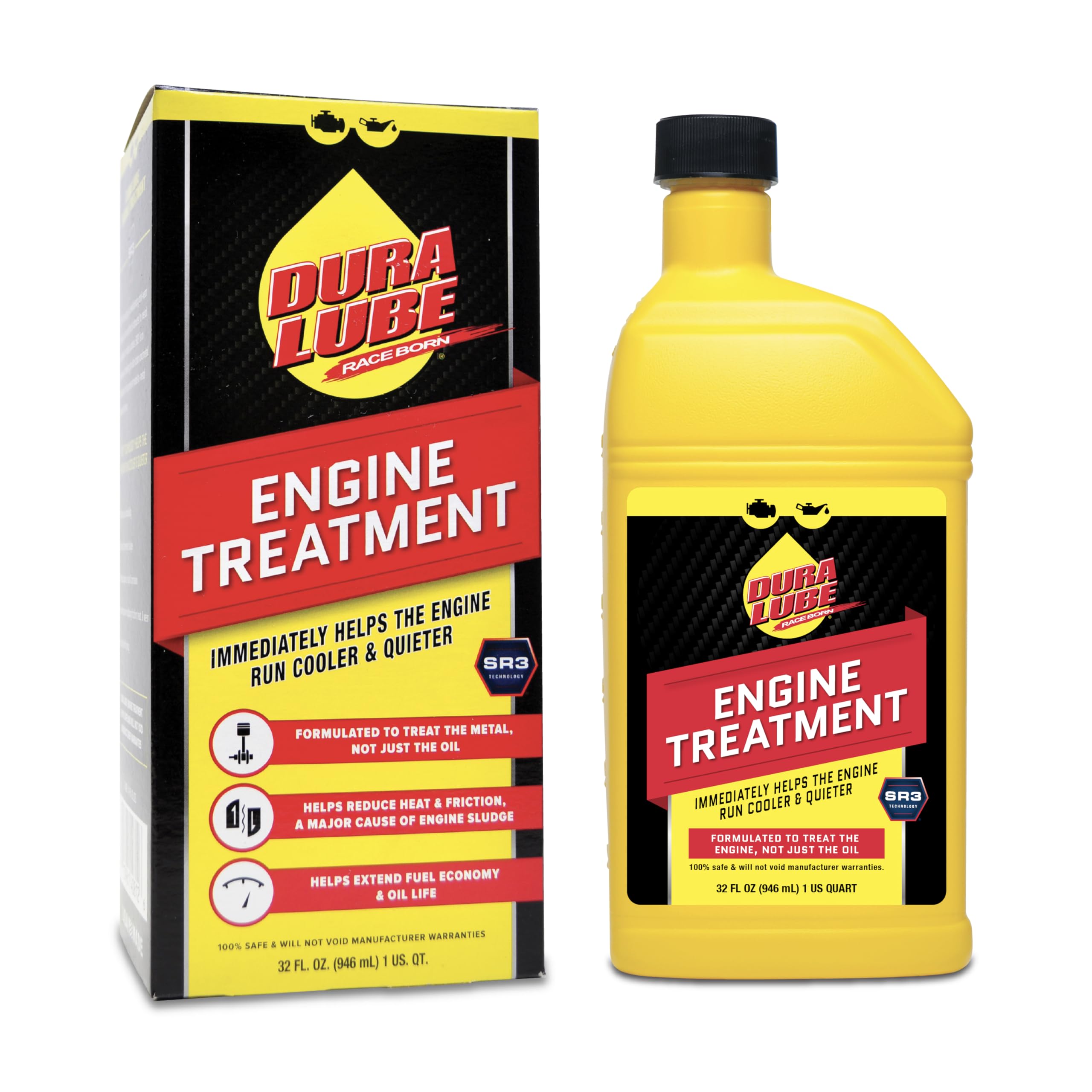
Dura Lube Engine Treatment is the entry-level choice for drivers who want a straightforward friction-reducing barrier without complicated dosing or niche chemistry. The formula forms a protective film on internal engine components and is compatible with conventional, synthetic, and blended oils in both gasoline and diesel engines. The 32 oz bottle is generous—enough for two treatments on a typical passenger car sump—and the flash point of 495°F indicates good thermal stability within normal operating temperatures.
Long-term users report consistent results over 15–20 years of use: one owner sold a Subaru Legacy with 645,000 miles, attributing the engine’s longevity to Dura Lube. Another noted that the engine cranked with barely a half-turn after 2 years of use, suggesting reduced start-up friction. The cold-start protection claim is relevant for anyone living in colder climates where oil thickening increases start-up wear risk. Fuel economy improvements are modest (2–5% based on user reports) but real.
The trade-off is that Dura Lube does not target specific valvetrain issues. It will not resolve HEUI stiction, prevent LSPI knock, or provide the extreme ZDDP levels needed for flat-tappet break-in. It is a general-purpose friction modifier that works best as a maintenance habit on daily drivers and high-mileage vehicles where the goal is to keep an already healthy engine running smoothly.
Why it’s great
- Large 32 oz bottle provides two treatments per purchase
- Decades of positive user reports for high-mileage engine longevity
- Compatible with all oil types and both gas/diesel engines
Good to know
- Not formulated for specialized issues like LSPI or HEUI stiction
- ZDDP levels are not high enough for flat-tappet break-in scenarios
FAQ
Can I use a break-in additive like COMP Cams 159 indefinitely as a maintenance additive?
Will zero-zinc additives like Lubegard 30015 protect a flat-tappet camshaft?
How do I know if my engine has HEUI injector stiction versus normal diesel noise?
Final Thoughts: The Verdict
For most users, the best anti wear additives for oil winner is the Liqui Moly 2009 Anti-Friction Oil Treatment (4-Pack) because it delivers proven moly-based friction reduction across a wide range of modern engines, backed by decades of owner reports showing quieter valvetrains and reduced start-up wear. If you need a specialized solution for flat-tappet cam break-in, grab the COMP Cams 159. And for owners of 6.0L or 7.3L Power Stroke diesels battling HEUI stiction, nothing beats the Archoil AR9100.