
A standard mouse forces your forearm into a twisted, unnatural position for hours on end. That repeated strain is what leads to the dull ache in your wrist, the numbness in your fingers, and the fatigue that cuts your workday short. An adaptive computer mouse changes that by fundamentally rethinking how your hand interacts with the cursor, whether through a vertical handshake grip or a stationary trackball that eliminates arm movement entirely.
I’m Min — the co-founder and writer behind Gadgets Feed. I’ve spent hundreds of hours analyzing the sensor specifications, button matrixes, ergonomic certifications, and real-world durability data across every major adaptive mouse design to separate genuine solutions from marketing gimmicks. This guide focuses on the concrete metrics that matter for long-term comfort.
You need a mouse that supports your specific hand size, grip style, and daily workflow to prevent repetitive strain injuries. That is exactly why I built this guide to the best adaptive computer mouse for every body and budget.
How To Choose The Best Adaptive Computer Mouse
Adaptive mice fall into two broad mechanical categories — vertical ergonomic mice that keep your hand in a neutral handshake position, and trackball mice that keep your hand completely stationary. The right choice depends on the specific source of your discomfort, your hand size, and how deeply you need to customize the button layout. Below are the three criteria that separate a lasting solution from a temporary novelty.
Vertical vs. Trackball: Understanding the Core Mechanism
A vertical ergonomic mouse rotates your forearm from a pronated (palm-down) position to a neutral handshake angle, typically 57 to 70 degrees. This design directly addresses forearm muscle strain and carpal tunnel pressure by realigning the bones in your wrist. In contrast, a trackball mouse keeps your hand and arm completely still — only your thumb or index finger moves the ball. Trackballs are superior when desk space is limited or when you need to eliminate all shoulder and elbow movement. The wrong choice here can introduce a new pain point: a vertical mouse still requires arm movement, and a thumb trackball can aggravate the base of your thumb joint.
Button Count and Programmability for Workflow Integration
The number of physical buttons and the quality of the manufacturer’s software directly determine whether an adaptive mouse reduces or adds friction to your day. Six programmable buttons are the practical minimum for office productivity, allowing you to map copy, paste, undo, and application switching without reaching for the keyboard. The software layer matters just as much — Logitech’s Options+ and Razer’s Synapse 4 offer per-app profiles, while some budget brands lack macOS driver support entirely. If you switch between a PC and a Mac during the day, multi-device pairing via Bluetooth and a unified dongle is a non-negotiable feature.
Sensor Precision and Surface Adaptability
Adaptive mice often operate on varied surfaces — a cluttered desk, a glass tabletop, or the arm of a couch. Standard optical sensors fail on glass and glossy finishes, introducing cursor skip that forces you to readjust your grip repeatedly. Look for sensors rated at 4000 DPI or higher with “on-glass” tracking capability. Models like the Razer Pro Click V2 use the Focus Pro 30K optical sensor, which maintains 99.8% resolution accuracy on transparent surfaces. For trackballs, the ball material and bearing quality determine smoothness — ceramic bearings and precision-machined balls reduce “stiction,” the irritating initial friction that makes micro-movements jerky.
Quick Comparison
On smaller screens, swipe sideways to see the full table.
| Model | Category | Best For | Key Spec | Amazon |
|---|---|---|---|---|
| Logitech Lift Left | Vertical Ergonomic | Left-handed users with small-medium hands | 57° vertical angle | Amazon |
| Razer Pro Click V2 | Vertical Ergonomic | Gamers and power users needing multi-device | Focus Pro 30K sensor | Amazon |
| Evoluent VM4L | Vertical Ergonomic | Left-handed users with large hands | 400-2000 CPI sensor | Amazon |
| Logitech M575S | Thumb Trackball | Users needing stationary hand operation | 18-month battery life | Amazon |
| SABLUTE MAM1 Pro | Thumb Trackball | Flexible angle adjustment on a budget | 0° / 18° adjustable tilt | Amazon |
| PHILIPS Ergonomic | Vertical Ergonomic | Office productivity with dual scroll wheels | 500mAh rechargeable battery | Amazon |
| PORLEI Wired Trackball | Finger Trackball | Budget entry into finger-operated trackballs | 44mm finger-operated ball | Amazon |
In‑Depth Reviews
1. Logitech Lift Left Vertical Ergonomic Mouse

The Logitech Lift Left is the only premium vertical mouse designed specifically for left-handed users with small to medium hands. Its 57-degree angle promotes a natural handshake posture that realigns your forearm bones during extended use, directly reducing carpal tunnel pressure. The softly textured grip and snug thumb rest prevent your hand from sliding, which is a common complaint with larger vertical mice that force your fingers to curl uncomfortably.
Logitech’s ergo-certified design includes whisper-quiet clicks and a SmartWheel that transitions between ratchet and free-spin scrolling automatically. The six customizable buttons integrate deeply with the Logi Options+ software, allowing per-app profiles for shortcuts, cursor speed, and button mapping. The included AA battery delivers up to 24 months of runtime — after 7 months of daily use, one reviewer reported the battery indicator still showed 90% capacity.
The main trade-off is the right-hand-only orientation and the limited hand-size target. Users with 18cm hands report that a palm grip is impossible, requiring a fingertip or claw grip instead. The mouse is also noticeably heavier than a standard gaming mouse, which makes lifting and repositioning slightly more effortful. For left-handed users seeking their first vertical mouse, this is the most complete package on the market.
Why it’s great
- Ergo-certified 57-degree angle aligned by professional ergonomists
- Exceptional 24-month battery life on a single AA cell
- Whisper-quiet clicks suitable for shared workspaces
Good to know
- Only compatible with small to medium left hands
- Software install can trigger driver conflicts on some systems
- Heavier build makes quick repositioning difficult
2. Razer Pro Click V2 Vertical Wireless Mouse

The Razer Pro Click V2 brings a 1000 Hz polling rate and a Focus Pro 30K optical sensor into a vertical form factor, making it the only premium vertical mouse that doubles as a capable gaming peripheral. The sensor delivers 99.8% resolution accuracy on glass surfaces, eliminating cursor skip during fast-paced tracking. The 6-button layout includes a pinky support lip that stabilizes the hand, and the vertical angle is comfortable enough that reviewers with carpal tunnel symptoms reported complete relief after switching.
Multi-device connectivity is the strongest in this category — the Pro Click V2 connects to up to five devices across 2.4GHz HyperSpeed Wireless, Bluetooth (three hosts), and USB-C wired mode. The 18-zone Chroma RGB underglow can be programmed for application-specific notifications via Razer Synapse 4. Battery life is rated at up to six months under standard use, with a 5-minute charge delivering three working days of power.
However, the Pro Click V2 is heavy for a vertical mouse, making it difficult to lift and reposition during gaming. The thumb buttons are easy to press accidentally, which can trigger unintended back-navigation in a browser. Some users report that the wireless connection drops intermittently and that the Synapse software occasionally fails to update. For right-handed users who want one mouse for both productivity and gaming, this is the most versatile option currently available.
Why it’s great
- Focus Pro 30K sensor tracks accurately on glass surfaces
- 1000 Hz polling rate suitable for competitive gaming
- Connects to up to five devices with fast switching
Good to know
- Heavy chassis makes quick lifts and repositions awkward
- Accidental thumb button presses during normal use
- Occasional wireless disconnects reported by users
3. Evoluent VM4L Ergonomic Vertical Mouse Left Hand

Evoluent invented the vertical mouse category, and the VM4L remains the definitive choice for left-handed users with medium to large hands. The vertical orientation is more aggressive than the Logitech Lift, requiring a steeper hand angle that some users find more natural for reducing forearm pronation. The broad bottom lip provides a resting surface for your pinky and ring finger, preventing the hand collapse that occurs on narrower vertical mice.
The six programmable buttons are fully customizable via the included Evoluent Mouse Manager software on Windows. The four-speed CPI adjustment (400 to 2000) is controlled without releasing your grip, which is a practical advantage during workflow transitions. The 6-foot USB cord eliminates battery anxiety entirely and ensures zero input latency. Users with rheumatoid arthritis report significant pain reduction within days of switching, with one reviewer noting their hand cysts began shrinking after two weeks of exclusive use.
The VM4L’s glossy finish can feel slippery during long sessions, though the coating develops a slightly grippier texture as it wears. The button clicks are light enough that accidental presses — especially on the pinky button — happen frequently during the first week. If you have large left hands and need a wired connection for reliability, this is the gold standard.
Why it’s great
- Broad bottom lip prevents hand fatigue during long sessions
- Programmable software remembered across unplug events
- Proven durability with users reporting 10+ year lifespans
Good to know
- Glossy finish can feel slippery without a grippy texture
- Light button actuation leads to accidental clicks initially
- CPI range of 2000 is low for high-resolution monitors
4. Logitech Ergo M575S Wireless Trackball Mouse

The Logitech M575S is the most refined thumb-operated trackball for general office use, offering a sculpted shape that keeps your hand relaxed while the thumb moves the cursor. Logitech’s Ergo Lab reports that this design reduces forearm muscle strain by 25% compared to a standard mouse, and the trackball mechanism means you never need to move your arm — ideal for cramped desks or couch-based workflows. The scroll wheel now features quiet clicks, addressing a key complaint from the previous M570 generation.
Connectivity is dual-mode via Bluetooth or the included Logi Bolt USB receiver, which supports a 10-meter range with encrypted data transmission. The Logi Options+ app provides per-application button customization and cursor speed adjustment. Battery life is rated at 18 months from a single AA battery, and the trackball can be ejected for cleaning without tools. Users report the ball remains smooth with zero sticking issues, and several reviewers noted they bought a second unit for a secondary workstation.
The primary limitation is the thumb-operated mechanism itself — users with existing thumb joint pain or arthritis may find the repeated thumb movement aggravates their symptoms. The M575S also uses the new Bolt receiver, which is incompatible with older Logitech Unifying peripherals, requiring two separate USB ports if you also use a Unifying keyboard. It is right-hand only with no left-handed option. For right-handed users without thumb issues who want to eliminate arm movement, this is the best trackball at this price point.
Why it’s great
- Eliminates arm movement entirely for small desk spaces
- 18-month battery life from a single AA battery
- Easy-to-clean ball cage with tool-free ejection
Good to know
- Thumb operation can aggravate existing thumb joint pain
- Bolt receiver is not backward compatible with Unifying devices
- Right-hand only; no left-handed variant exists
5. SABLUTE MAM1 Pro Ergonomic Wireless Trackball Mouse
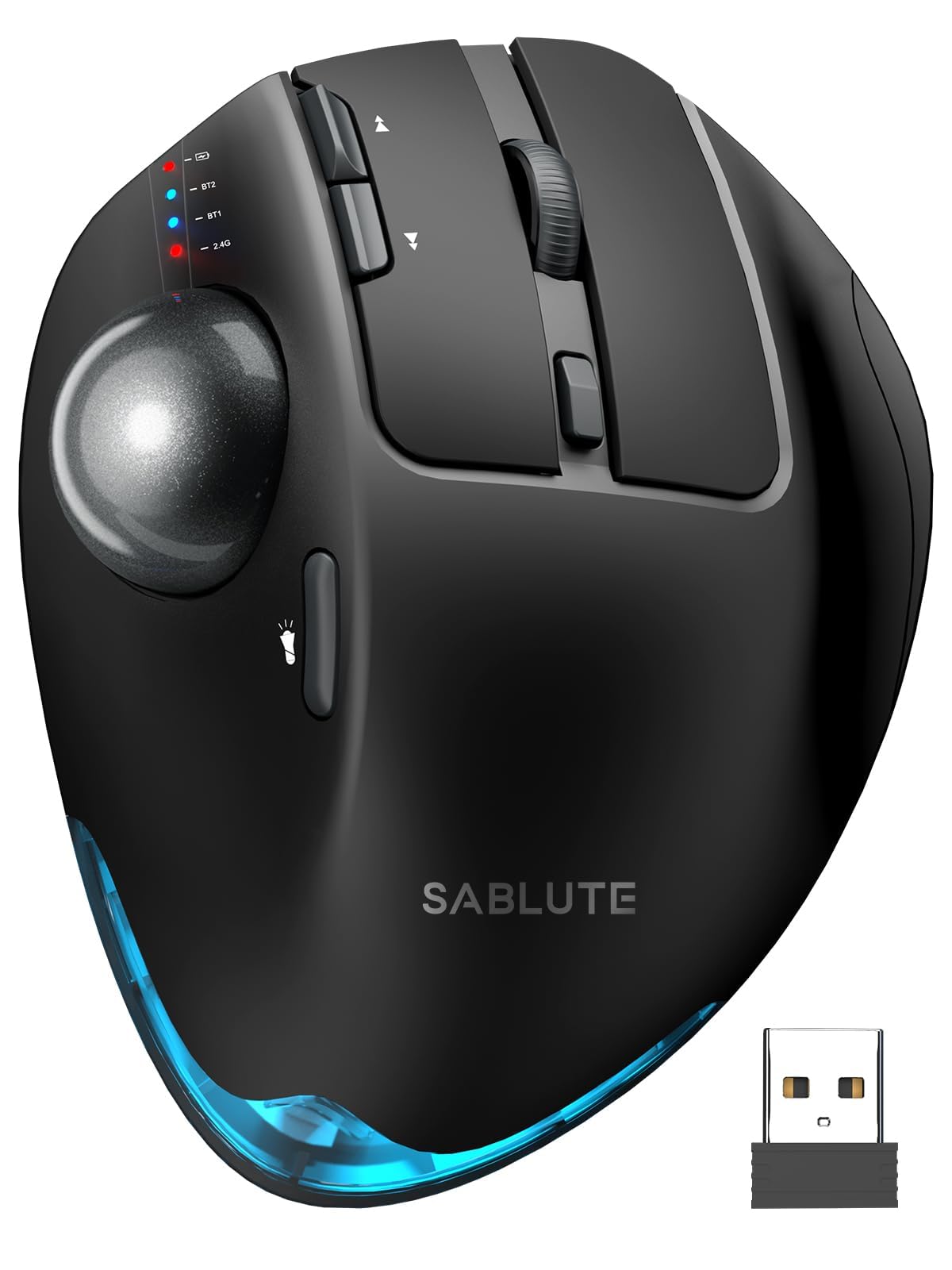
The SABLUTE MAM1 Pro stands out in the mid-range trackball category by offering an adjustable tilt mechanism that lets you switch between a flat 0-degree angle and an 18-degree angled position. This flexibility allows you to find the wrist angle that minimizes strain for your specific physiology, which is rare at this price point. The thumb-operated trackball uses a smooth, replaceable ball with a magnetic base for easy removal during cleaning.
Connectivity covers three devices simultaneously — two Bluetooth channels and one 2.4 GHz USB receiver. The receiver stores magnetically in the mouse base, preventing loss during travel. The eight buttons include a customizable DPI switcher with five levels from 800 to 4800, and the clicks are rated at 95% noise reduction for quiet office environments. The built-in rechargeable battery charges via USB-C and lasts several weeks under normal use, with users reporting two weeks or more between charges.
The channel switch button is located on the bottom of the mouse, requiring you to flip it over to change connected devices — a significant inconvenience if you frequently switch between a laptop and a desktop. Some users with existing wrist pain found that the thumb control introduced a new discomfort point in their thumb joint. The driver software is functional but the UI is small and the sensitivity slider is imprecise. For users who want to experiment with tilt angles on a trackball without committing to a premium price, this is the most versatile entry point.
Why it’s great
- Adjustable 0°/18° tilt helps dial in wrist angle
- Rechargeable with USB-C and long battery life
- Magnetic base and replaceable ball for easy cleaning
Good to know
- Device switch button is inconveniently placed on the underside
- Thumb control may cause new strain for some users
- Software UI is small and the sensitivity slider is imprecise
6. PHILIPS Ergonomic Wireless Mouse SPK7858
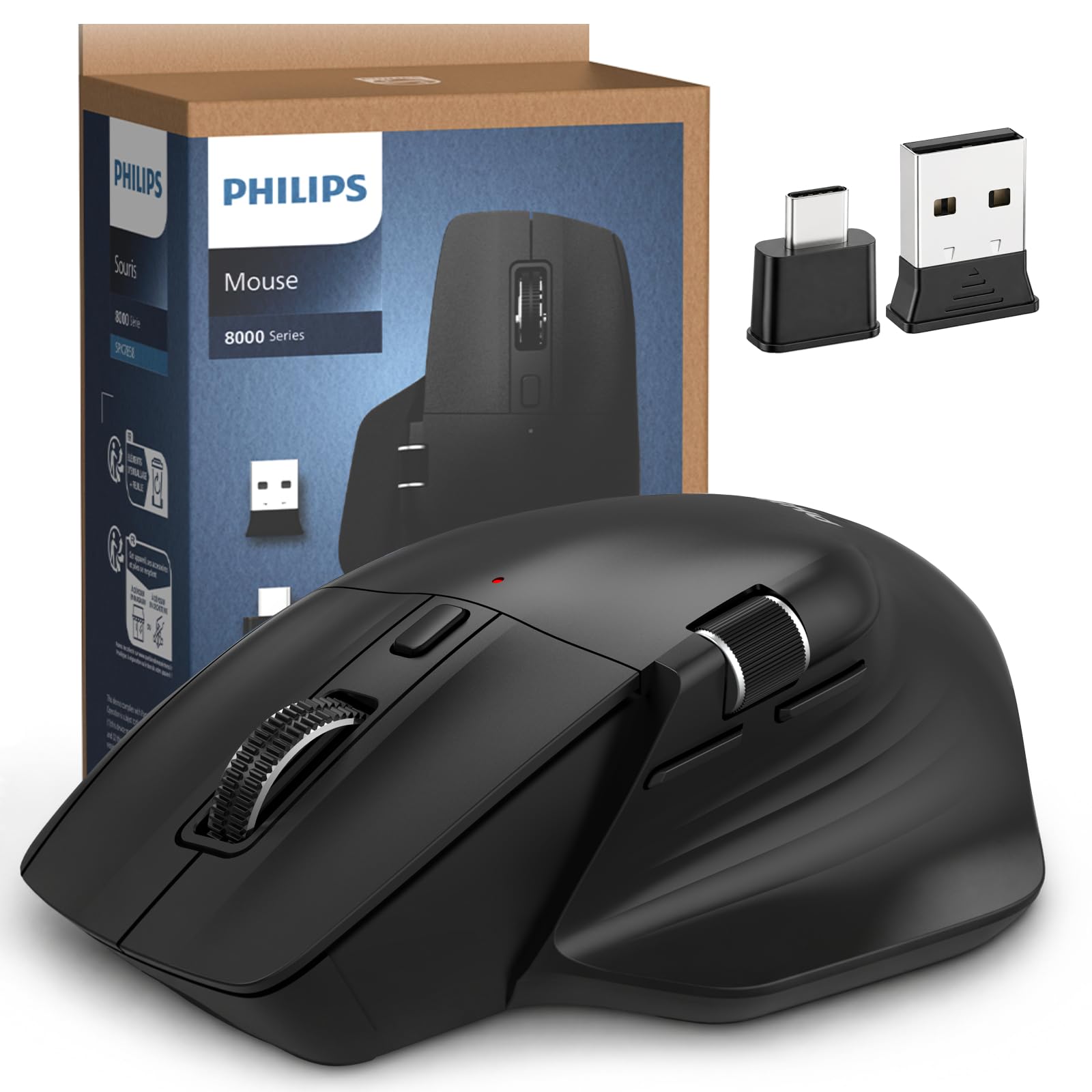
The Philips SPK7858 is purpose-built for spreadsheet-heavy workflows, featuring a dedicated thumb-side horizontal scroll wheel that lets you navigate wide Excel columns without dragging the cursor across the screen. The right-handed contoured shell includes an anti-slip thumb rest and a library-quiet click mechanism rated to reduce noise by 95%. The 500mAh rechargeable battery supports 25 days of heavy use (8 hours/day) with a 5-minute emergency top-up that delivers one hour of tracking.
Multi-device connectivity is handled through a unique dual-format receiver that includes both USB-A and USB-C connectors, eliminating the need for a separate dongle for modern laptops. You can pair up to three devices via Bluetooth and the 2.4 GHz receiver, switching with a button on the top surface. The 5-level DPI range (800 to 4000) is adjustable on the fly, and the middle-click button is programmable via Philips software for custom macros.
The scroll wheel texture uses small dots instead of traditional ridges, which some users find uncomfortable during extended scrolling sessions. After several months of daily use, the USB-A plug on the receiver can develop a loose connection, requiring slight upward pressure to maintain contact. The RGB lighting cycles through colors automatically and cannot be adjusted or disabled in the current firmware. For analysts and accountants who spend hours scrolling horizontally through large datasets, the dual-wheel design is genuinely transformative.
Why it’s great
- Thumb-side horizontal scroll wheel speeds up spreadsheet navigation
- Dual USB-A/C receiver works directly with modern laptops
- Emergency 5-minute charge provides one hour of use
Good to know
- Dotted scroll wheel texture can cause skin irritation over time
- USB plug connection may become loose after several months
- RGB lighting cannot be turned off or customized
7. PORLEI Wired Trackball Mouse for Large Hands

The PORLEI Wired Trackball Mouse offers the most affordable entry into finger-operated trackball technology, specifically designed for users with larger hands who find standard mice too small. The 44mm ball is controlled with your index finger, which distributes the movement across a larger muscle group compared to thumb-operated trackballs, reducing the risk of localized joint strain. The sculpted palm rest accommodates hands up to glove size 11 without forcing the fingers to curl.
The six-button layout includes forward and backward navigation buttons, a scroll wheel, and five adjustable DPI levels from 800 to 4800. The optical sensor uses 3-point positioning technology for precise cursor placement with minimal hand movement. The 1.8-meter USB cable provides a wired connection with zero latency, and the device is plug-and-play on Windows, Mac, and Linux without driver installation. Users transitioning from the discontinued Microsoft Trackball Explorer report that this is the closest modern alternative in terms of comfort and ball smoothness.
The gloss finish can feel slippery during extended sessions, and the forward and backward buttons are not supported on macOS. After approximately 18 months of consistent use, the scroll wheel can develop inconsistent behavior and the left-click switch may begin sticking. The wired connection limits your desk layout flexibility compared to wireless options. For users on a tight budget who need a large finger-operated trackball to address wrist pain, this is the most cost-effective solution available.
Why it’s great
- Large 44mm finger-operated ball reduces localized joint strain
- Accommodates hands up to size 11 without finger curling
- True plug-and-play on Windows, Mac, and Linux
Good to know
- Gloss finish can feel slippery during extended use
- Forward/backward buttons are not supported on macOS
- Scroll wheel and left click may degrade after 18 months
FAQ
How long does it take to adapt to a vertical ergonomic mouse?
Should I choose a thumb trackball or a finger trackball for wrist pain?
Can I use an adaptive computer mouse for gaming?
Final Thoughts: The Verdict
For most users, the best adaptive computer mouse winner is the Logitech Lift Left because it combines an ergo-certified 57-degree angle with exceptional battery life and deep software customization for left-handed users. If you want a gaming-capable vertical mouse for right-handed use, grab the Razer Pro Click V2. And for eliminating arm movement entirely on a tight budget, nothing beats the PORLEI Wired Trackball Mouse for large hands.