
A flip screen isn’t just a spec sheet bullet point—it’s the difference between framing a shot properly and blindly hoping for the best. Whether you’re vlogging on a city street, composing a low-angle shot of a pet, or nailing a self-portrait, a fully articulating display turns guesswork into precision. The market offers everything from compact point-and-shoots to interchangeable lens systems, and the trade-offs between sensor size, video codec support, and autofocus performance are sharp.
I’m Min — the co-founder and writer behind Gadgets Feed. For this guide, I cross-referenced thousands of user experiences across multiple price tiers, analyzing how each camera’s flip mechanism, autofocus speed, and video output capabilities actually hold up in real-world content creation and photography workflows.
My goal is to cut through the marketing noise and deliver a clear, data-backed breakdown of which models deliver the best value for creators. Read on for the definitive guide to finding the best affordable camera with flip screen for your specific needs.
How To Choose The Best Affordable Camera With Flip Screen
Selecting the right camera in this category requires balancing your need for a functional flip screen against core imaging hardware. Many entry-level models include a flip screen but cut corners on sensor readout speed or autofocus capability, which can lead to missed shots. You need to identify which features directly impact your specific use case, whether that’s talking-head vlogs, travel photography, or streaming.
Screen Type: Tilt vs. Fully Articulating
A tilt screen flips up or down on a single hinge, which is fast and keeps the camera compact but can be blocked by a tripod plate or a hot-shoe microphone. A fully articulating screen swings out and rotates 270 degrees, offering more flexibility for overhead or chest-level shots. For solo vloggers who film themselves, a fully articulating design around a side hinge is almost mandatory.
Autofocus and Tracking Reliability
If you plan to film yourself walking toward the camera or moving through a scene, phase-detection autofocus (PDAF) with eye tracking is crucial. Contrast-detection-only systems may hunt or lag, especially in dimmer conditions. Real-time Eye AF, 425-point phase detection systems are the benchmark for locking focus on a subject without touch interaction while you’re in front of the lens.
Sensor Size and Video Codec Depth
An APS-C or larger sensor provides better background separation and performs significantly better in low light than a 1-inch or smaller sensor. Check for 4K video recording without a heavy crop factor, as heavy cropping negates the wide-angle perspective you want from a selfie-shot. Also verify if the camera records in 8-bit or 10-bit color—higher color depth gives more flexibility in post-production for color grading.
Quick Comparison
On smaller screens, swipe sideways to see the full table.
| Model | Category | Best For | Key Spec | Amazon |
|---|---|---|---|---|
| Panasonic LUMIX G85 | Mirrorless ILC | All-round hybrid work | 5-Axis IBIS + 12-60mm kit | Amazon |
| Sony ZV-1 | Compact | Point-and-shoot vlogging | 1” sensor, f/1.8-2.8 lens | Amazon |
| Nikon Z 30 (Kit) | Mirrorless ILC | Travel vlogging | 4K 30p, no crop, USB-C PD | Amazon |
| Canon EOS R50 V | Mirrorless ILC | Vertical video creators | 24.2MP, 14-30mm RF-S | Amazon |
| Canon EOS R50 (Kit) | Mirrorless ILC | Hybrid photo/video | 651 AF zones, 15fps | Amazon |
| Sony Alpha ZV-E10 | Mirrorless ILC | Pro-level vlog setup | APS-C, 6K oversampled 4K | Amazon |
| Sony Alpha a6400 | Mirrorless ILC | Fast-action tracking | 0.02s AF, 11fps burst | Amazon |
| Canon EOS RP (Kit) | Mirrorless Full-Frame | Full-frame entry point | RF 24-105mm, 26.2MP | Amazon |
| DJI Osmo Action 5 Pro | Action Camera | Rugged outdoor vlogs | 4hr batt, 4K/120fps | Amazon |
| Nikon COOLPIX P950 | Superzoom | Wildlife/birding | 83x optical zoom | Amazon |
| Canon EOS Rebel T7 Bundle | DSLR | Budget learning kit | 24.1MP, 3fps, 9-point AF | Amazon |
In‑Depth Reviews
1. Panasonic LUMIX G85 (12-60mm Kit)

The Panasonic LUMIX G85 offers a near-perfect balance of price, stabilization, and build quality for hybrid creators. Its Micro Four Thirds 16MP sensor omits the low-pass filter, which extracts slightly sharper detail than older MFT sensors. The 5-axis In-Body Image Stabilization works in tandem with the kit lens’s Optical Image Stabilization, allowing smooth handheld footage even at slower shutter speeds or during walking shots.
The 3-inch fully articulating touchscreen swings out sideways, making front-facing composition effortless whether you’re standing, holding the camera overhead, or resting it on a flat surface. The 4K video records at 30fps without a severe crop, and the 4K Photo mode lets you pull 8MP stills from 30fps bursts—useful for capturing the exact moment in action scenarios. The magnesium alloy front panel and weather sealing add durability for outdoor shoots.
For those transitioning from a phone or an entry-level DSLR, the G85 feels immediately intuitive. The live viewfinder is sharp, the ergonomic grip reduces hand fatigue during long recording sessions, and the mic jack provides audio upgradeability. The main trade-off is the 16MP resolution, which limits aggressive cropping in stills, but for video-first hybrid work, this camera remains a top contender.
Why it’s great
- Best-in-class IBIS that works with any lens
- Weather-sealed magnesium alloy body
- Fully articulating touchscreen for vlogging
Good to know
- Battery life is average (around 300 shots per charge)
- No headphone jack for real-time audio monitoring
2. Sony Alpha ZV-E10 (Kit)
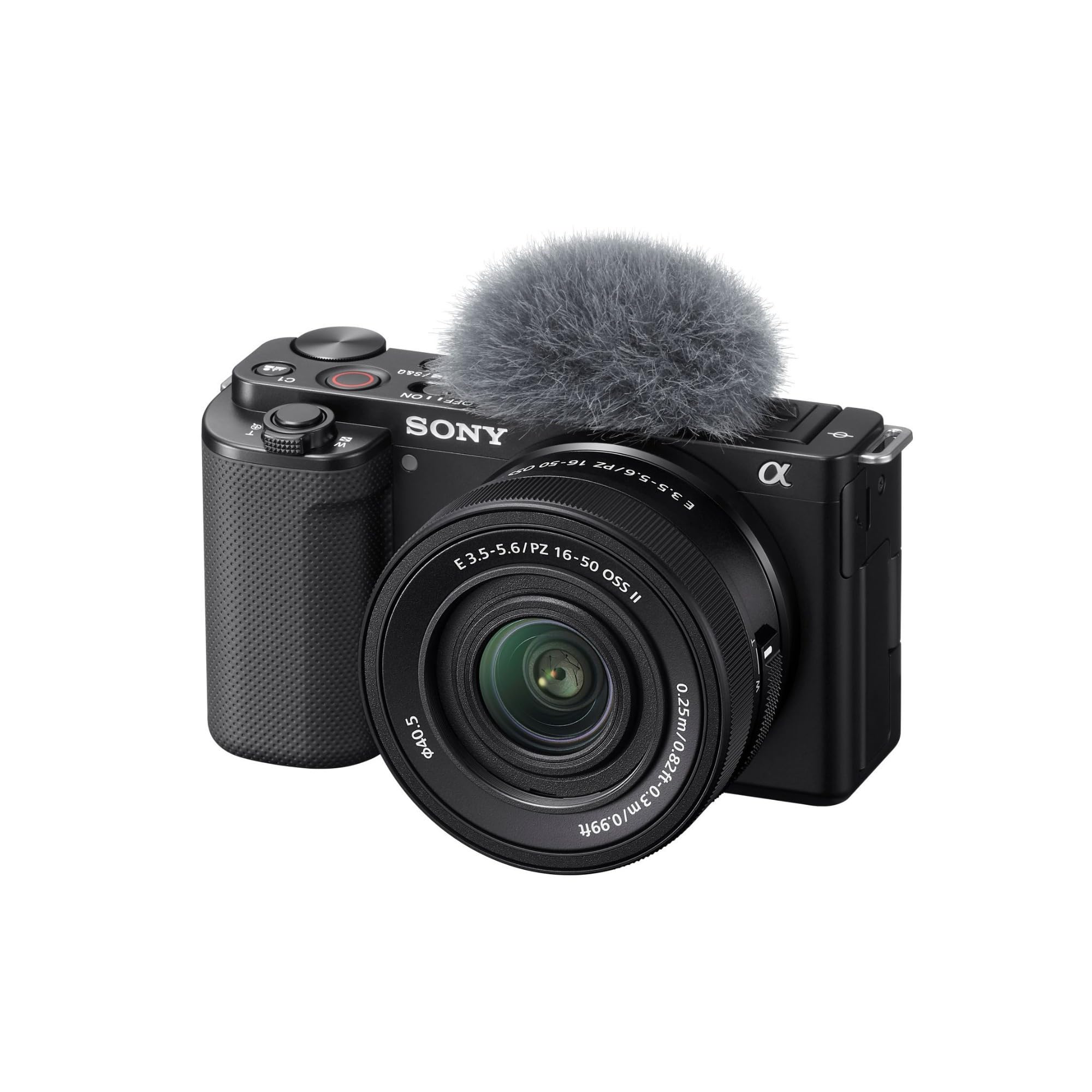
The ZV-E10 builds on Sony’s popular vlog-centric line with a 24.2MP APS-C sensor that shoots 4K video oversampled from 6K. This oversampling method produces exceptionally sharp footage with reduced moiré and aliasing, making it a strong choice if you plan to punch in or reframe in post. The BIONZ X processor enables fast Hybrid AF with Real-time Eye Tracking for both humans and animals.
A dedicated Background Defocus button instantly switches between a deep and shallow depth of field, and the Product Showcase setting smoothly racks focus from your face to an item held up to the lens. The 3.5mm mic jack and Multi Interface Shoe allow for a range of audio solutions, from a simple shotgun mic to a wireless receiver. The side-hinged flip screen with 270° articulation makes self-framing straightforward, though the touchscreen responsiveness is limited mostly to focus control.
Users praise its versatility for both in-studio streaming via USB-C and on-the-go vlogging. The in-body stabilization is digital-only (Standard/Active), which crops in when activated, so pairing it with a gimbal or a stabilized lens is recommended for walk-and-talk footage. Battery life is moderate, but USB-C power delivery means you can run it indefinitely with an external battery pack.
Why it’s great
- 6K oversampled 4K with real detail
- Fast, reliable AF with eye tracking
- Flip screen with dedicated vlogging features
Good to know
- Digital stabilization crops the video significantly
- No built-in flash and no viewfinder
3. Nikon Z 30 (16-50mm Kit)

Nikon designed the Z 30 specifically for content creators who want a compact body without sacrificing video quality. The 20.9MP DX (APS-C) sensor records 4K UHD at up to 30p using the full width of the sensor, meaning your wide-angle lens stays wide. The hybrid autofocus system includes Eye-Detection AF for people and pets, which locks onto a moving subject reliably without constant hunting.
The 3-inch vari-angle touchscreen flips down 180° for selfies or flips fully forward for monitoring, and a red REC light on the front panel lets you know recording is underway—a small detail that saves ruined takes. The built-in stereo microphone has adjustable sensitivity, and the USB-C port supports constant power delivery, so you can shoot for hours during streams or extended recordings without worrying about battery swaps.
One notable omission is the lack of a viewfinder, but the bright rear screen handles exposure preview well even in moderate sunlight. At under 700g with the kit lens, it’s the lightest option in this comparison, making it ideal for travel creators who walk long distances with gear. The kit lens (16-50mm f/3.5-6.3 VR) includes optical stabilization that works alongside the electronic VR for smoother handheld pans.
Why it’s great
- Uncropped 4K with oversampling from 6K
- Very lightweight and portable
- USB-C with unlimited recording power
Good to know
- No built-in viewfinder
- Kit lens aperture is slow in low light
4. Sony ZV-1

The Sony ZV-1 packs a 20.1MP stacked 1-inch Exmor RS sensor with a Zeiss Vario-Sonnar T* 24-70mm f/1.8-2.8 lens into a body that fits in a jacket pocket. The bright lens is the standout feature: f/1.8 at the wide end gives natural background separation even without a large sensor, making talking-head videos look polished with minimal effort. The built-in directional microphone with a detachable windscreen captures clear audio directly from the camera.
This camera was built from the ground up for content creation, not general photography. The side-flip screen works beautifully for self-recording, and the dedicated bokeh switch lets you toggle between sharp and soft backgrounds instantly. The Product Showcase mode transitions focus from your eyes to an object held up to the lens, ideal for unboxings or reviews. 4K video is sharp at 30p, and the S-Log/HLG profile support helps retain dynamic range for grading.
Battery life is limited—expect around 45 minutes of continuous recording per charge—but USB-C charging means a power bank keeps you going in the field. The lack of interchangeable lenses and the 24mm starting focal length (which is not particularly wide) are the main limitations for users who need ultra-wide shots or specialized optics. For a grab-and-go vlogging tool with excellent color science and autofocus, the ZV-1 remains unbeatable in its form factor.
Why it’s great
- Bright f/1.8-2.8 lens for natural bokeh
- Excellent internal mic with windscreen
- Very compact and travel-friendly
Good to know
- No interchangeable lens system
- Battery life below average
5. Canon EOS R50 V (14-30mm Kit)
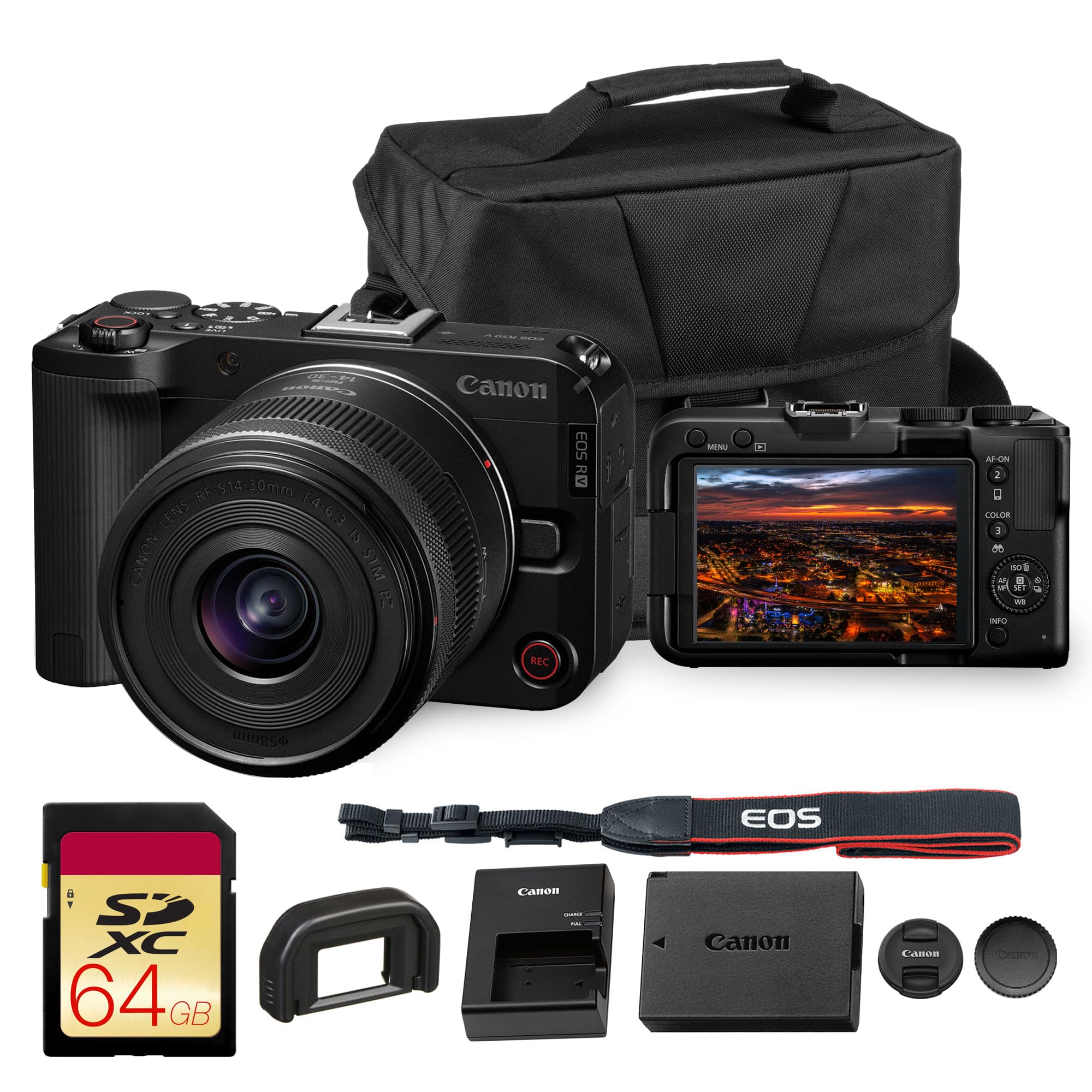
Canon’s EOS R50 V is a variant of the standard R50, tuned for video-first creators. It retains the same 24.2MP APS-C sensor and DIGIC X processor but ships with the ultra-wide RF-S 14-30mm f/4-6.3 IS STM PZ lens, which gives a 22.4-48mm equivalent field of view—ideal for selfie-style vlogging where you want more background in the frame. The Power Zoom rocker on the lens provides smooth zoom control without touching the lens barrel.
The fully articulating rear screen can flip forward to face you, and the camera supports vertical video capture with in-system metadata tagging so footage stays oriented correctly for social platforms. Dual Pixel CMOS AF II covers about 100% of the frame with 651 AF zones, giving reliable subject detection for people, animals, and vehicles. The R50 V can stream 4K 30p over HDMI, making it a capable plug-and-play webcam alternative.
Users note the lightweight body and intuitive touchscreen menu as major advantages over the complicated UI of some competitors. The kit lens is plastic-y but sharp in the center, and the built-in stabilization helps smooth out handheld shots. The main downside is the lack of a hot shoe (only a cold shoe is included) and the absence of IBIS—meaning stabilization depends entirely on the lens.
Why it’s great
- Ultra-wide 14-30mm kit lens for vlogging
- Dual Pixel AF with 100% coverage
- Vertical video mode saves editing time
Good to know
- No IBIS—relies on lens stabilization
- Plastic lens barrel feels less durable
6. Canon EOS R50 (18-45mm Kit)

The standard Canon EOS R50 offers nearly identical internals to the R50 V but with a more photography-focused approach. The 18-45mm f/4.5-6.3 kit lens is slightly less wide than the V variant, but the camera itself includes a built-in flash and a 2.36-million-dot EVF, which the V version lacks. This makes the standard R50 a better choice for users who want to shoot stills alongside 4K video.
Autofocus performance is exceptional for the category: Dual Pixel CMOS AF II with deep learning-based subject detection tracks people, animals, and vehicles across 651 zones. Electronic shutter allows shooting at 15fps, useful for catching action without mirror slap noise. The vari-angle touchscreen works well for front-facing vlogging, though the 18-45mm kit lens may not be wide enough to show both you and your surroundings in a selfie shot.
Video capabilities are solid but not bleeding-edge: 4K 30p is oversampled from 6K for good detail, and Full HD 120p enables smooth slow-motion. The R50 lacks IBIS and the kit lens stabilization is modest, so a tripod or gimbal is recommended for walk-and-talk footage. The small grip size may be less comfortable for users with larger hands, but a third-party cage solves that issue quickly.
Why it’s great
- Excellent AF performance with subject tracking
- Built-in EVF and flash for still photography
- 4K oversampled from 6K
Good to know
- Kit lens is slow and not very wide
- No body stabilization
7. Sony Alpha a6400 (Body Only)

The Sony a6400 remains a benchmark for autofocus speed in the mid-range mirrorless segment. Its 0.02-second acquisition time and 425 phase-detection points covering 84% of the sensor make it the go-to choice for shooting fast-moving subjects—whether pets, kids, or sports. Real-time Eye AF works for both humans and animals in stills and video, maintaining focus lock even during erratic movement.
The 180° tilting screen flips upward, making it suitable for vlogging, though it blocks the hot shoe when deployed—a quirk that forces a side-mounted microphone solution. The 24.2MP APS-C sensor delivers excellent dynamic range and color from Sony’s Exmor CMOS, and the BIONZ X processor supports 4K 30p video shot from the full sensor width. S-Log2/3 and HLG gamma profiles are available for color grading in post-production.
At 11fps continuous shooting with mechanical shutter (8fps with live view), the a6400 keeps up with action reliably. The magnesium alloy body feels solid, and the large handgrip improves stability. The main complaints center on the outdated menu interface, limited touchscreen functionality (only for focus point selection), and a pronounced rolling shutter effect in 4K that can wobble during fast pans.
Why it’s great
- World-class 0.02s autofocus with eye tracking
- Compact but solid build with great ergonomics
- S-Log3, HLG and Picture Profiles included
Good to know
- Screen blocks hot shoe when flipped up
- Rolling shutter is noticeable in 4K
8. Canon EOS RP (RF 24-105mm Kit)

For creators who prioritize shallow depth of field and high-ISO performance, the Canon EOS RP is the most accessible full-frame camera with a flip screen. The 26.2MP full-frame CMOS sensor delivers a noticeable step up in image quality compared to APS-C models, with smoother tonality and better noise control at ISO 6400 and above. The RF 24-105mm f/4-7.1 IS STM lens provides a versatile zoom range with optical stabilization rated at up to 5 stops.
The vari-angle touchscreen swings out from the side for flexible framing, and the 2.36-million-dot EVF with OLED panels makes low-light composition comfortable. Canon’s Dual Pixel CMOS AF with phase detection covers about 88% of the sensor area, delivering smooth and confident focusing for video. The EOS RP also works as a high-quality webcam via USB (using Canon’s EOS Utility software) for streaming without a capture card.
4K video recording has a significant 1.6x crop factor and is limited to 24/25p with a 30-minute time limit, which may frustrate video creators. The continuous shooting speed of 5fps is slow by modern standards, and the single SD slot lacks UHS-II support. For photo-centric hybrid shooters wanting full-frame depth and color, the RP offers tremendous value, but video-first users should weigh the crop and time limits against mirrorless APS-C alternatives.
Why it’s great
- Full-frame sensor with excellent low-light performance
- Compact body relative to other FF options
- Great image quality and ergonomic grip
Good to know
- 4K video has a 1.6x crop and 30-min limit
- Slow burst rate and only UHS-I SD slot
9. DJI Osmo Action 5 Pro

The DJI Osmo Action 5 Pro redefines what an action camera can do with a flip screen. Unlike traditional action cameras with only a rear display, the Action 5 Pro sports dual OLED touchscreens—a 1.4-inch front display and a 2.25-inch rear screen—so you can frame selfie shots perfectly without guessing. The 1/1.3-inch sensor captures more light than typical 1/2.3-inch action camera sensors, delivering usable footage at dusk or indoors.
Recording 4K 120fps video with the 4nm chip ensures smooth slow-motion clips even during high-speed activities. The 360° HorizonSteady stabilization keeps the horizon level even when the camera rotates a full circle, useful for POV action vlogs and sports footage. The built-in front OLED screen shows a live preview of your selfie shot, something few other action cameras offer at this price point.
Voice control recognition works reliably within one meter, allowing hands-free operation when your hands are busy on a mountain bike or ski slope. The Extreme Battery with 1950 mAh capacity extends recording time to approximately 2.5 hours of 4K 60fps footage. The small USB-C door on the side can pop open during rough off-road rides, and the exposed lens is vulnerable to scratches without the included protective frame. For durable outdoor creators who need a front-facing preview, this is the most affordable option with that specific feature.
Why it’s great
- Front OLED screen for perfect selfie framing
- 360° HorizonSteady for level action footage
- Waterproof to 20m without a housing
Good to know
- USB-C door may open during heavy vibration
- Lens is vulnerable without the protective frame
10. Nikon COOLPIX P950

The Nikon COOLPIX P950 occupies a unique niche: a fixed-lens superzoom with an 83x optical zoom (24-2000mm equivalent) and a fully articulating screen. The rotating LCD rotates 180° for selfies and tilts up and down for overhead or ground-level shots, giving you flexible composition even at extreme focal lengths. The 16MP sensor is modest, but the image stabilization is surprisingly effective at holding a steady frame at full zoom.
Built-in Bird and Moon modes optimize settings for distant subjects, automatically adjusting shutter speed and ISO for common telephoto scenarios. 4K UHD video recording works throughout the zoom range, and the manual zoom ring (inherited from the P900) gives fine control over framing. The microphone input jack allows a simple lavalier setup for commentary during nature observations.
At maximum zoom, the variable aperture drops to f/6.5, which means you’ll need bright outdoor lighting or high ISO to maintain a fast shutter speed. The autofocus can hunt when tracking small, fast subjects at long distances. The P950 is not a low-light camera, nor is it compact—it weighs 1,005g. For wildlife watchers, birders, or travel photographers who want to capture distant details without carrying interchangeable telephoto lenses, its zoom range is unmatched.
Why it’s great
- 83x optical zoom reaches extreme distances
- Excellent stabilization for handheld telephoto
- Fully articulating screen for any angle
Good to know
- Small sensor produces noise above ISO 800
- AF hunts on fast-moving subjects at long distances
11. Canon EOS Rebel T7 Bundle
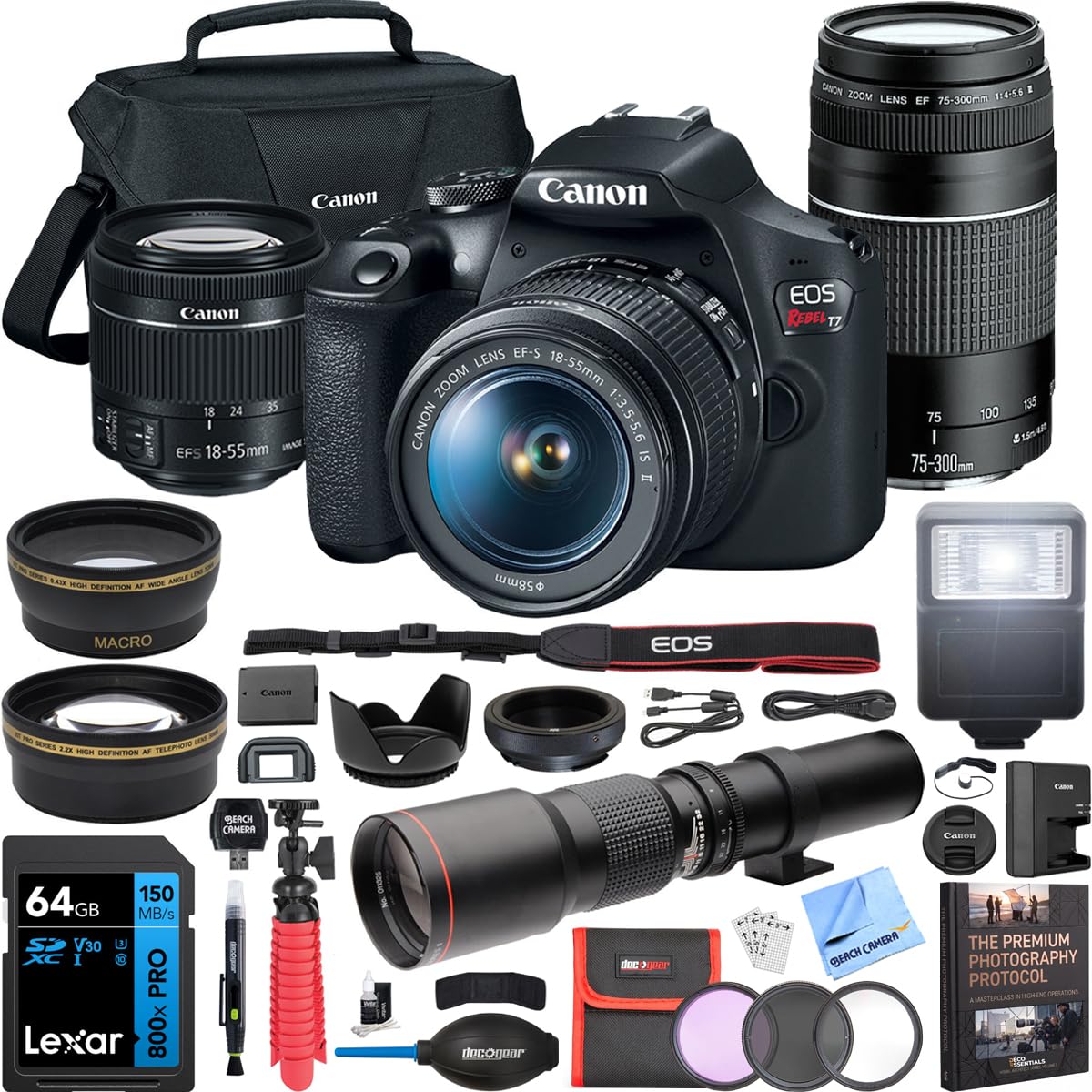
The Canon EOS Rebel T7 bundle provides an all-in-one entry-level kit for users who want to learn photography and vlogging without a high upfront investment. The 24.1MP APS-C sensor paired with DIGIC 4+ delivers solid image quality for its class, and the included 18-55mm f/3.5-5.6 IS II and 75-300mm f/4-5.6 III lenses cover a wide range of focal lengths from wide-angle to moderate telephoto. The 3-inch rear LCD with 920,000 dots is a fixed screen—but it tilts slightly upward for waist-level shots—so it qualifies as a low-cost flip-screen option, albeit with limited articulation.
Full HD 1080p video up to 30fps is acceptable for basic YouTube content, though the 9-point AF system lacks the sophisticated tracking of mirrorless systems. Built-in Wi-Fi and NFC allow direct transfers and remote shooting via the Canon Camera Connect app, which makes sharing to social media straightforward. The included bundle adds a 500mm manual preset telephoto, a wide-angle adapter, a flash, a tripod, a 64GB memory card, and a bag.
The 3fps continuous shooting rate and the optical viewfinder with 95% coverage are outdated by modern standards, but they teach fundamental photography principles effectively. The battery drains quickly (some users report only 8-10 shots from a full charge on older units—plan for an extra battery). For a student, young creator, or casual family photographer on a strict budget, the T7 bundle provides the most hardware per dollar, even if the flip screen is minimal and the video specs lag behind mirrorless competitors.
Why it’s great
- Very complete starter kit with long telephoto lens
- Wi-Fi/NFC for quick mobile sharing
- 24.1MP APS-C sensor at an entry-level price
Good to know
- Fixed screen limits vlogging angles
- 3fps burst and 9-point AF are dated
FAQ
Do I need 4K 60fps for vlogging or is 30fps enough?
Can I use an external microphone with a camera that has a flip screen?
Is a dedicated flip-screen camera better than using a phone for vlogging?
Final Thoughts: The Verdict
For most users, the best affordable camera with flip screen is the Panasonic LUMIX G85 because it bundles weather-sealed build, best-in-class IBIS, and a fully articulating touchscreen into a kit that handles photo and video equally well. If you want dedicated vlogging features in a compact body with a bright lens, grab the Sony ZV-1. And for interchangeable lens flexibility with a leading-edge flip screen and excellent autofocus, nothing beats the Nikon Z 30 at this price point.