
Running a 75-foot HDMI cord is a different beast than plugging in a 6-footer. At this length, standard copper cables often hit a wall, struggling to maintain a stable 4K signal without dropouts, flickering, or discoloration. The solution lies in understanding when you need a boosted active cable, a fiber optic hybrid, or a high-end copper build with heavy shielding — and that choice determines whether your long-run setup delivers theater-quality visuals or a frustrating, glitchy mess.
I’m Min — the co-founder and writer behind Gadgets Feed. This guide is built from dozens of hours cross-referencing real user reports with the technical specs that matter at this exact distance: bandwidth limits, conductor material, shielding layers, and certification status.
After sorting through the options, I’ve gathered the top contenders to help you find the best 75 foot hdmi cord for your home theater, classroom, or conference room.
How To Choose The Best 75 Foot HDMI Cord
Picking the wrong 75-foot cable can mean constant blackouts, a flickering screen, or worse — a signal that degrades so badly your 4K source looks like 720p. The key specs that separate a reliable long-run cable from a dud are bandwidth, cable type, and build quality. Here is what to look for.
Bandwidth: HDMI 2.0 vs. 2.1
HDMI 2.0 tops out at 18 Gbps, enough for 4K at 60Hz. HDMI 2.1 jumps to 48 Gbps, supporting 4K at 120Hz or 8K at 60Hz. If you own a PS5, Xbox Series X, or a high-refresh gaming monitor, you want the 48 Gbps pipe. For standard streaming and Blu-ray, 18 Gbps is perfectly adequate. At 75 feet, the bandwidth requirement determines whether a passive copper cable can even work.
Copper vs. Active vs. Fiber Optic
Standard passive copper cables lose signal integrity past 30 feet at 4K. Active copper cables use built-in signal boosters to push 4K past 50 feet. Fiber optic HDMI cables convert the signal to light, eliminating electromagnetic interference (EMI) entirely and easily running 75 feet at full 48 Gbps bandwidth. The trade-off is that fiber cables are unidirectional — the source and display ends are fixed, so you cannot reverse them after installation.
In-Wall Rating: CL2 vs. CL3
If you are routing the cable inside a wall, ceiling, or conduit, local fire codes usually require a CL2 or CL3 rated jacket. CL3 is the more stringent standard, offering a higher temperature rating for longer runs in plenum spaces. An unrated cable used in-wall violates code and can be a fire hazard. Check your installation environment before buying.
Certification Matters
Many cables claim “8K” or “48 Gbps” but lack official HDMI Licensing Administrator certification. An uncertified cable might work today but fail when pushed to its rated spec or after firmware updates on your hardware. Certified cables have a QR code you can scan to verify compliance. For a critical long-run setup, certification is cheap insurance.
Quick Comparison
On smaller screens, swipe sideways to see the full table.
| Model | Category | Best For | Key Spec | Amazon |
|---|---|---|---|---|
| BlueRigger 8K Fiber Optic HDMI | Fiber Optic | Full 48 Gbps bandwidth | 48 Gbps, 8K@60Hz | Amazon |
| Conable Certified 8K Fiber Optic HDMI | Fiber Optic | Certified 48 Gbps cable | 48 Gbps, 8K@60Hz | Amazon |
| Yauhody Real 8K Fiber Optic HDMI | Fiber Optic | Proven 4K 120Hz stability | 48 Gbps, 4K@144Hz | Amazon |
| Eareyesail 8K Fiber HDMI 2.1 | Fiber Optic | Value 48 Gbps option | 48 Gbps, 8K@60Hz | Amazon |
| PowerBear 4K HDMI Cable | Active Copper | Durable braided 4K build | 18 Gbps, 4K@60Hz | Amazon |
| grofyllaa 4K HDMI Cable 75FT | Budget Copper | Budget 4K 60Hz run | 18 Gbps, 4K@60Hz | Amazon |
| Monoprice Moonrise Active HDMI | Active Copper | Basic 4K 24Hz projector | 10.2 Gbps, 4K@24Hz | Amazon |
In‑Depth Reviews
1. BlueRigger 8K Fiber Optic HDMI Cable 75FT
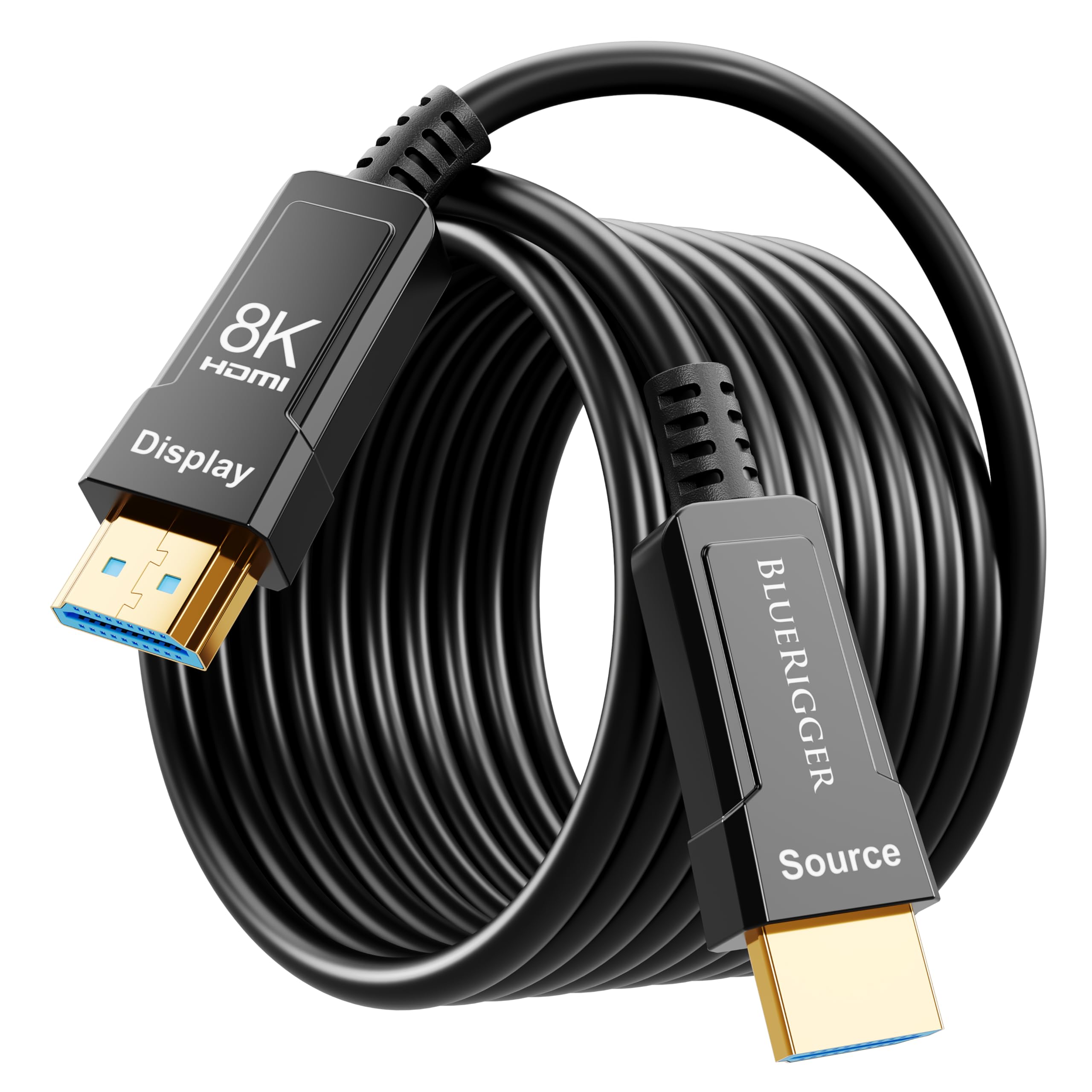
BlueRigger’s 75-foot fiber optic AOC cable delivers the full 48 Gbps of HDMI 2.1 without signal degradation, supporting 8K at 60Hz and 4K at 144Hz. The fiber optic core eliminates EMI, so running it alongside power cables in a conduit won’t cause interference. Users consistently report flawless 4K 120Hz performance on PC-to-TV runs, with noticeably better color depth and stability than copper alternatives.
The cable uses a zinc alloy shell with 24K gold-plated connectors, rated CL3 for in-wall installation. At roughly 1/8-inch diameter, it is much more pliable than a thick copper cable, making it easier to fish through conduit or behind molding. BlueRigger backs it with a lifetime warranty, which speaks to their confidence in the build.
Be aware that this is a unidirectional cable — the source and display ends are fixed and clearly labeled. It is best suited for a permanent or semi-permanent install, as moving it repeatedly can stress the fiber optics. For anyone building a dedicated home theater or high-end gaming room, this is the cable to beat.
Why it’s great
- Full 48 Gbps bandwidth with certified HDMI 2.1 support
- Thin, flexible fiber optic design simplifies conduit runs
- Lifetime warranty from a trusted brand
Good to know
- Unidirectional — cannot reverse ends after install
- Fiber core is fragile; avoid kinking or sharp bends
2. Conable Certified 8K Fiber Optic HDMI 2.1 Cable 75 FT
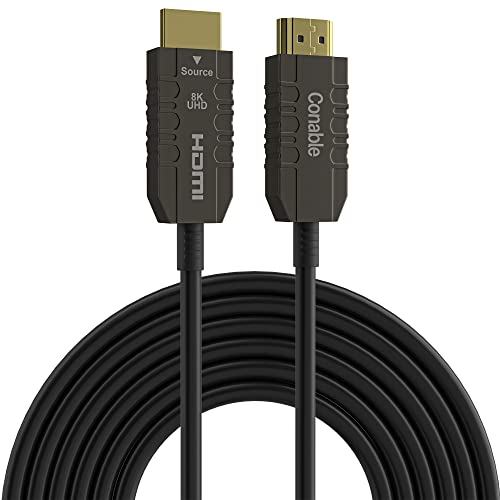
The Conable 75-foot fiber optic cable stands out because it is officially HDMI-certified, a rarity among long-run cables. This means it has passed compliance testing for 48 Gbps bandwidth, 8K@60Hz, and features like Dynamic HDR and eARC. Users have validated its ability to drive 4K 120Hz HDR from a Samsung Book4 laptop to a projector without issues, including through wall plates and conduit.
Its hybrid construction uses pure optical glass for the signal core and OFC copper wires for power, keeping the cable extremely thin — roughly half the thickness of a standard 75-foot copper cable. The package includes cable ties and mounting clips, a thoughtful addition for securing the run. The zinc alloy shells and gold-plated pins resist corrosion over time.
The main caveat is that some users report the included 90-degree adapters are defective and cause signal drops; the cable itself works perfectly when using straight connections. Also, it is unidirectional, so plan your source and display ends before routing. For those who want the peace of mind of a certified cable in a long-run install, this is the top choice.
Why it’s great
- Officially HDMI-certified for 48 Gbps compliance
- Very thin and flexible, ideal for conduit
- Includes mounting clips and cable ties
Good to know
- Bundled 90-degree adapters may be defective
- Unidirectional installation only
3. Yauhody Real 8K HDMI Fiber Optic Cable 75ft

Yauhody’s 75-foot fiber optic cable delivers a genuine 48 Gbps transfer rate, supporting 4K at 144Hz and 8K at 60Hz. The fiber construction provides excellent EMI resistance, and the triple shielding on the copper conductor portion adds durability. Users confirm it works flawlessly for 4K 120Hz gaming on PC, with no signal dropouts even after months of use.
The cable is built with 24K gold-plated connectors and a flexible PVC jacket that withstands over 15,000 90-degree bends according to the manufacturer. It supports the full suite of HDMI 2.1 features including Dynamic HDR, eARC, VRR, and HDCP 2.3. The 0.6 kg weight is notably lighter than many copper equivalents, making routing easier.
One user noted that it solved a long-standing Prime Video streaming issue that shorter cables could not fix, which highlights the importance of cable quality at distance. The main downside is that the brand is less established than BlueRigger or Monoprice, so the lifetime warranty is less proven. Still, for the price, this cable offers outstanding performance.
Why it’s great
- Full 48 Gbps with support for 4K 144Hz
- Lightweight and flexible for easy installation
- Strong EMI resistance from fiber optic core
Good to know
- Brand has less long-term warranty reputation
- Unidirectional — must plan install direction
4. Eareyesail 8K HDMI Cable 2.1 75 FT

The Eareyesail 75-foot fiber optic HDMI cable offers a compelling mix of 48 Gbps bandwidth and in-wall CL3 rating at a very accessible price point. It supports 8K@60Hz and 4K@120Hz, with 24K gold-plated joints and aluminum alloy shells that add durability. The cable uses 4 layers of shielding to maintain signal integrity over the full distance.
Users praise its build quality and strong signal — one reviewer noted that it duplicates signal without any loss, which is exactly what you need at this length. The directional nature (source vs. display end labeled) is critical; some early confusion was cleared up after reading the instructions. The cable is also UL CL3 rated, which means it is approved for in-wall use per fire codes.
The main issue is that some users report intermittent 4K 120Hz handshake issues, requiring a power cycle of the TV to re-establish the connection. This is not uncommon with uncertified fiber cables at the edge of their spec. For standard 4K 60Hz or 1080p use, it works perfectly. If you only need 4K 60Hz from a projector, this is a great value pick.
Why it’s great
- CL3 rated for safe in-wall installation
- 4-layer shielding for stable signal
- Very affordable for 48 Gbps fiber
Good to know
- Intermittent 4K 120Hz handshake reported
- Not officially HDMI-certified
5. PowerBear 4K HDMI Cable 75 ft

The PowerBear 75-foot cable is a premium active copper HDMI 2.0 cable that hits 18 Gbps bandwidth, supporting 4K@60Hz with 48-bit HDR color depth. What separates it from cheaper copper cables is its double-braided nylon jacket, which gives it exceptional abrasion resistance — ideal for pulling through walls, attics, or conduit. The 26 AWG copper wire and triple tin shielding ensure the signal holds up.
Users who installed it in-wall report it still works perfectly after 18 months, with no signal degradation. The gold-plated connectors resist corrosion, and the cable supports Audio Return Channel (ARC) for sending audio back to your receiver. It is CL3 rated, so it meets in-wall fire codes for most residential installations.
The trade-off is that this cable is limited to 4K@60Hz — it does not support 8K or 4K at 120Hz. At this length, that is fine for most streaming and Blu-ray use, but not for high-refresh gaming on PS5 or Xbox Series X. Also, the 8mm diameter makes it less flexible than fiber options, which can be a problem in tight spaces. For a robust, reliable 4K 60Hz run, this is a top contender.
Why it’s great
- Extremely durable braided nylon jacket
- CL3 rated for safe in-wall installs
- Reliable 4K 60Hz signal at full 75ft
Good to know
- Limited to 18 Gbps, no 8K or 4K 120Hz
- Thicker than fiber, harder to route in tight spaces
6. grofyllaa 4K HDMI Cable 75FT
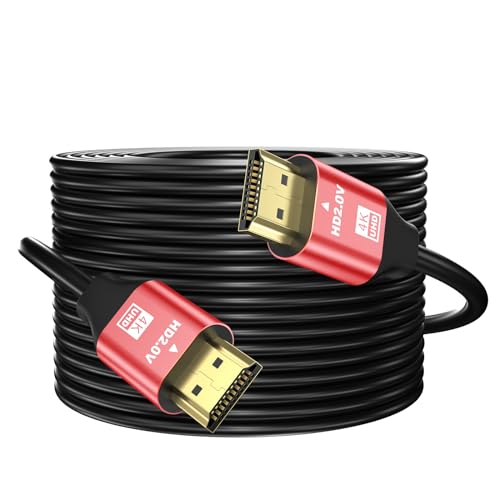
The grofyllaa 75-foot cable proves that you do not have to spend heavily for a usable long HDMI run. It is a standard passive copper cable rated for 18 Gbps, supporting 4K@60Hz and 2K@120Hz with HDCP 2.2/2.3 compliance. The gold-plated connectors add some corrosion resistance, and it is backward compatible with older HDMI standards.
Users report that it works well for connecting a Blu-ray player or laptop to a TV in a different room, delivering stable 1080p and 4K 60Hz signals. The price is the lowest among the options here, making it a viable choice for budget-conscious installations where the cable will not be heavily flexed or stressed.
However, this cable is not shielded as heavily as premium options, and some users report random disconnects and graphical glitches when the cable is run near other power cords. QC seems inconsistent — a replacement unit fixed the issue for one reviewer. It is also not CL3 rated, so it should not be used in-wall. For a simple, direct run that avoids electrical interference, it gets the job done.
Why it’s great
- Most affordable 75-foot HDMI option
- Supports 4K 60Hz and 2K 120Hz
- Backward compatible with older devices
Good to know
- Not CL3 rated for in-wall use
- Can suffer interference near power cables
7. Monoprice Moonrise Active HDMI Cable 75 Feet

The Monoprice Moonrise is an active HDMI 1.4 cable that uses built-in signal amplification to reach 75 feet. It supports 4K at only 24Hz with a 10.2 Gbps bandwidth — fine for movies and standard video, but not for modern gaming or smooth PC desktop use. It is CL2 rated for in-wall installation, and the active design includes right and left angle adapters for connecting to wall-mounted TVs.
Users confirm it works reliably for 1080p and 4K 24Hz content, with no stutters or dropouts. The directional nature (source vs. display end) is critical to respect during installation. The build quality is solid, typical of Monoprice’s reputation for professional-grade cables.
However, this cable is outdated for modern use. Testing with a PS4 Pro at 4K with HDR (4:4:4) caused frequent blank-outs, which means it cannot handle high-bandwidth signals. For a basic projector feed at 1080p or 4K 24Hz, it works fine, but most buyers today should opt for a 4K 60Hz or fiber optic cable instead. It is a niche pick for very specific legacy installations.
Why it’s great
- Active amplification maintains signal at 75ft
- Includes right-angle adapters for tight spaces
- Trusted Monoprice brand and build quality
Good to know
- Limited to 4K 24Hz and 10.2 Gbps
- Cannot handle 4K HDR gaming signals
FAQ
Will a standard 75-foot HDMI cable work for 4K 60Hz?
Can I use a 75-foot fiber optic HDMI cable for gaming at 4K 120Hz?
How do I know if a 75-foot HDMI cable is safe to install in my wall?
Final Thoughts: The Verdict
For most users, the best 75 foot hdmi cord is the BlueRigger 8K Fiber Optic HDMI because it delivers the full 48 Gbps bandwidth, supports 4K 144Hz gaming, and comes with a lifetime warranty. If you want an officially certified cable for peace of mind, grab the Conable Certified 8K Fiber Optic. And for a robust 4K 60Hz in-wall installation without the fiber optic price premium, nothing beats the PowerBear 4K HDMI Cable.