
Single-handing a sailboat means constant micro-adjustments to the helm, pulling focus away from trimming sails, navigating, or simply enjoying the passage. A reliable autopilot transforms this dynamic, turning a two-person job into a manageable solo effort and adding hours of fatigue-free sailing to every trip.
I’m Min — the co-founder and writer behind Gadgets Feed. I’ve spent countless hours combing through technical specifications, customer feedback, and installation guides for marine autopilots to separate reliable performers from the units that drift off course or fail prematurely.
This guide cuts through the marketing noise to identify the best autopilot sailing boat options that deliver real-world heading accuracy, low power draw, and the rugged durability needed for coastal and offshore conditions.
How To Choose The Best Autopilot Sailing Boat
Selecting the right autopilot for your sailboat comes down to matching the unit’s physical drive capacity to your vessel’s displacement and steering type. Over-specifying wastes money, but under-specifying leads to poor course-keeping and premature wear. Focus on these three criteria first.
Displacement and Drive Force
Every tiller pilot specifies a maximum boat weight in pounds or kilograms. A Raymarine ST1000+ handles vessels up to 6,600 lbs, while the ST2000+ stretches that to 10,000 lbs. Exceeding these limits forces the motor to work harder, draining your battery faster and risking clutch failure. For heavier boats with wheel steering, you need a hydraulic pump system like the EV-150 rather than a tiller unit.
Power Consumption and Battery Management
Autopilots run for hours, so their current draw in milliamps (mA) directly impacts your house bank. The best tiller pilots draw around 40 mA in standby — that’s roughly 1 amp-hour per 24 hours. With solar charging or a healthy battery bank, that’s negligible. But a heavy-hunting autopilot that never settles can double or triple that draw, becoming a problem on longer passages without engine charging.
NMEA Integration and Navigation Interfaces
A modern autopilot needs to talk to your chartplotter and GPS. NMEA 0183 is the older standard, sufficient for simple waypoint tracking. NMEA 2000 offers plug-and-play networking with other instruments, enabling features like wind-steering and route-following. If you plan to integrate with a multi-function display, ensure the autopilot control head and sensor core are compatible with your existing marine network.
Quick Comparison
On smaller screens, swipe sideways to see the full table.
| Model | Category | Best For | Key Spec | Amazon |
|---|---|---|---|---|
| Raymarine ST2000+ | Tiller Pilot | Mid-sized cruisers up to 10,000 lbs | 40 mA power consumption | Amazon |
| Raymarine ST1000+ | Tiller Pilot | Small daysailers and pocket cruisers | 6,600 lbs maximum displacement | Amazon |
| Simrad TP10 | Tiller Pilot | Solo sailors on coastal passages | 2-pin connector for power | Amazon |
| Simrad AP44 Rotary | Control Head | Upgrading an existing Simrad autopilot system | Rotary knob course adjustment | Amazon |
| Raymarine EV-150 Power Pilot | Hydraulic System | Hydraulically-steered vessels up to moderate size | 1.0L hydraulic pump included | Amazon |
| AutoPilot PPC2 RC-28 Cell | Pool Part | N/A — Pool system component | For Pool Pilot Nano Plus only | Amazon |
| Furuno 1815 Radar | Marine Radar | N/A — Navigation radar system | 4 kW / 36 nm range | Amazon |
In‑Depth Reviews
1. Raymarine ST2000+ 5-Ton Tiller Pilot

The Raymarine ST2000+ is the sweet spot for the majority of cruising sailors, handling vessels up to 10,000 lbs — enough for a well-loaded 30- to 35-footer. Its 40 mA standby draw is identical to the smaller ST1000+, so you get higher drive capacity with no extra battery penalty. Owners consistently report smooth, low-noise operation and zero mechanical play in the tiller arm after thousands of miles.
Setup is straightforward for anyone comfortable with basic boat wiring. The included mounting socket and deck power plug make installation clean, and the unit works with both NMEA 0183 and SeaTalk networks for waypoint tracking. On a Catalina 27, the ST2000+ is the recommended upgrade over the ST1000+ for its faster response time and better performance in choppy conditions.
One nuance: in salt air, the lifespan averages about three seasons before corrosion affects the internal fluxgate, so owners in coastal environments should plan for eventual replacement. For the price and performance, this is the tiller pilot to beat.
Why it’s great
- Higher drive force than the ST1000+ with same 40 mA power draw
- Low noise and smooth operation praised by solo sailors
- NMEA 0183 and SeaTalk compatible for GPS integration
Good to know
- Salt air corrosion can limit lifespan to 3-4 years in coastal use
- Off-wind performance in heavy seas can be confused by wave action
- Power saving mode may need disabling for best heading hold
2. Raymarine ST1000+ 3.3-Ton Tiller Pilot
The ST1000+ is the entry-level gold standard for pocket cruisers and daysailers under 6,600 lbs. Its 2-inch LCD display with pushbutton control gives you a 10-degree course adjustment per press, allowing precise heading changes without touching the tiller. Real-world owners report flawless performance on lake crossings and coastal hops — one verified review notes it “allows hands-off sailing for trimming, foredeck work, etc.”
Installation is genuinely plug-and-play for anyone with basic tools. The unit comes with a tiller pin, mounting socket, and deck-mounted power plug. It draws only 40 mA, meaning you can run it on a 100Ah battery for over 100 hours before hitting 50% discharge. It also accepts an optional wireless remote, useful when you’re working on the foredeck.
The internal fluxgate compass provides accurate heading reference without needing an external sensor, though some users report occasional beeping and bearing drift when battery voltage drops. A small solar panel to keep the battery topped off solves this issue entirely.
Why it’s great
- Ultra-low power consumption ideal for small battery banks
- Simple pushbutton 10-degree course adjustment perfect for solo sailing
- Well-built and reliable — multiple users report 3+ years of heavy use
Good to know
- Limited to 6,600 lbs displacement; not suitable for larger cruisers
- Beeping and drift can occur at low voltage without solar charging
- NMEA 0183 only — no native NMEA 2000 support
3. Simrad TP10 Tiller Pilot

The Simrad TP10 is engineered for sailors who prioritize silent operation and precision steering in coastal conditions. Its low noise design is genuinely noticeable — owners comment on how the unit glides through tiller movements without the clicking or whining common in other pilots. The waterproof sealing gives you confidence in spray-prone cockpits.
Installation is fast; one solo sailor had the TP10 up and running in under an hour. The unit uses a simple 2-pin connector for power, which is straightforward but also its biggest vulnerability. A verified owner reported that a momentary reverse polarity connection blew a fuse and damaged the control board, noting the lack of a protective diode as a design oversight for a device in this price tier.
That said, the TP10 shines in its core job: holding a heading with minimal drift. One powerboat owner even switched from Raymarine to the TP10 after experiencing consistent 10-degree wandering on two different Raymarine units. For sailboats, it prevents accidental jibes and holds course while you go below.
Why it’s great
- Extremely quiet operation — noticeable step up from competitors
- Waterproof sealing for spray-prone environments
- Fast installation — often under one hour
Good to know
- Lacks reverse polarity protection; careful wiring is essential
- No NMEA interface on the base TP10 — requires expansion module
- Maximum vessel size is 33 feet, limiting upgrade options
4. Simrad AP44 Rotary Control Head

The Simrad AP44 is a dedicated control head for Simrad autopilot systems, not a standalone autopilot. It replaces aging AP22 and AP24 displays with a modern rotary knob interface that lets you dial in course changes with tactile precision. Owners of Grand Banks and similar trawler-style vessels report it works “perfectly” with the NEC-2 computer and existing chain/wire drive systems.
Installation is simple via the SimNet network — basically plug-and-play if your boat already has Simrad components. The rotary knob is the standout feature, making course adjustments feel intuitive compared to pushbutton-only systems. One user called it “awesome” for the ability to make micro-adjustments while hand-steering is tiring.
The catch: the AP44 is purely a display and controller. If you’re building an autopilot from scratch, you still need the EV-1 sensor core and a drive unit. Ensure compatibility with your existing motor drive before purchase.
Why it’s great
- Rotary knob provides intuitive, precise course control
- Simple SimNet installation for existing Simrad users
- Modern display with better durability than older AP22/AP24 units
Good to know
- Not a standalone autopilot — requires separate sensor core and drive
- One buyer reported a defective unit with poor customer service support
- No touchscreen — all navigation is via knob and buttons
5. Raymarine EV-150 Power Pilot with p70Rs
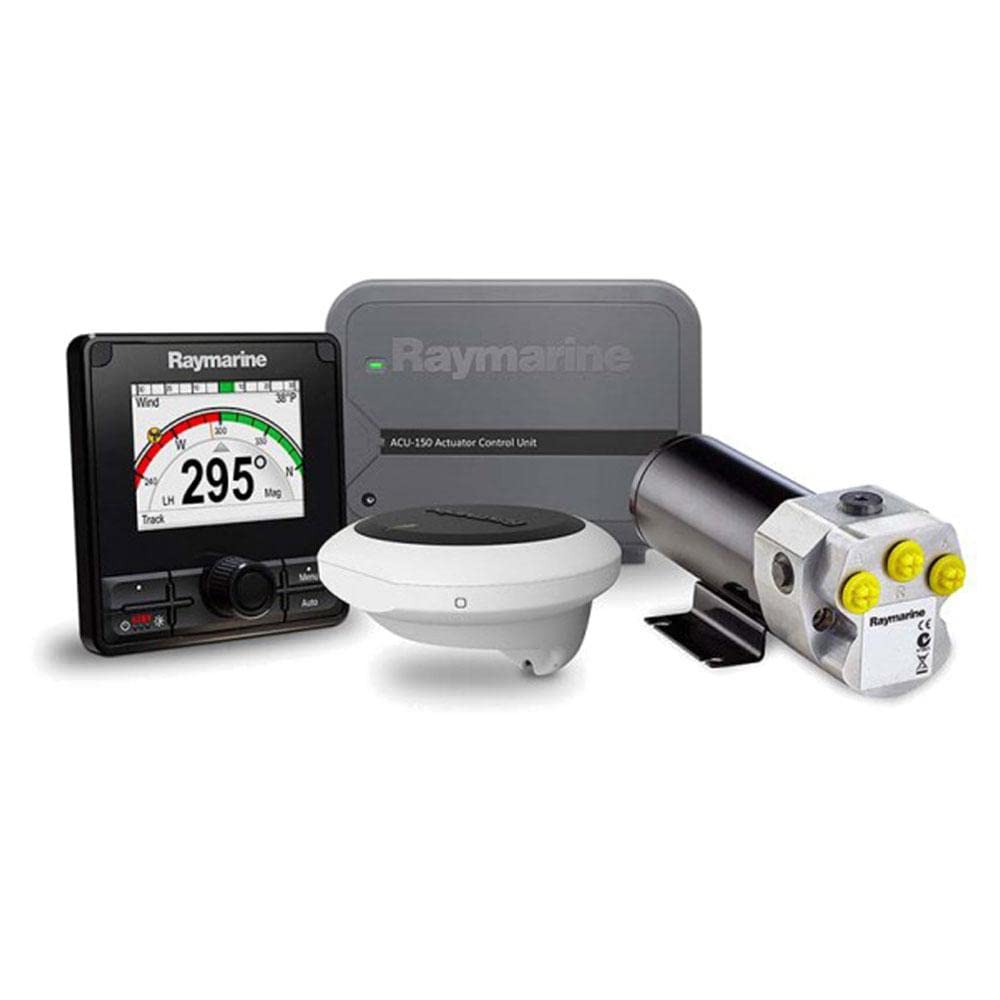
The Raymarine EV-150 is a complete below-deck autopilot system for hydraulically-steered vessels. It bundles the p70Rs control head, ACU-150 actuator drive unit, EV-1 sensor core with rate gyros, and a 1.0L hydraulic pump — everything you need for a full installation. The EV-1’s 9-axis heading sensor delivers superior track-keeping compared to older fluxgate designs, adapting to your boat’s steering characteristics over time.
Installation is moderate complexity. Owners report that bleeding air from the hydraulic lines is the trickiest part — one user had to relocate the pump to the helm for better prime. Once dialed in, the system holds a straight track even at trolling speeds of 2-3 mph. The Raymarine Axiom 9 integration allows control from your chartplotter or phone via Wi-Fi.
The main complaint is the instruction manual, which several users found vague and incomplete. You’ll likely need to supplement with online forums or YouTube. Raymarine offers a 3-year warranty with product registration, which adds peace of mind for a premium system.
Why it’s great
- Complete kit with pump, actuator, sensor, and control head
- 9-axis EV-1 sensor core for superior heading accuracy
- 3-year warranty with product registration
Good to know
- Installation instructions are vague — expect internet research
- Hydraulic bleeding can be tricky on long line runs
- Requires 10/12 gauge tinned wire for pump power (not included)
6. AutoPilot PPC2 RC-28 Replacement Salt Cell
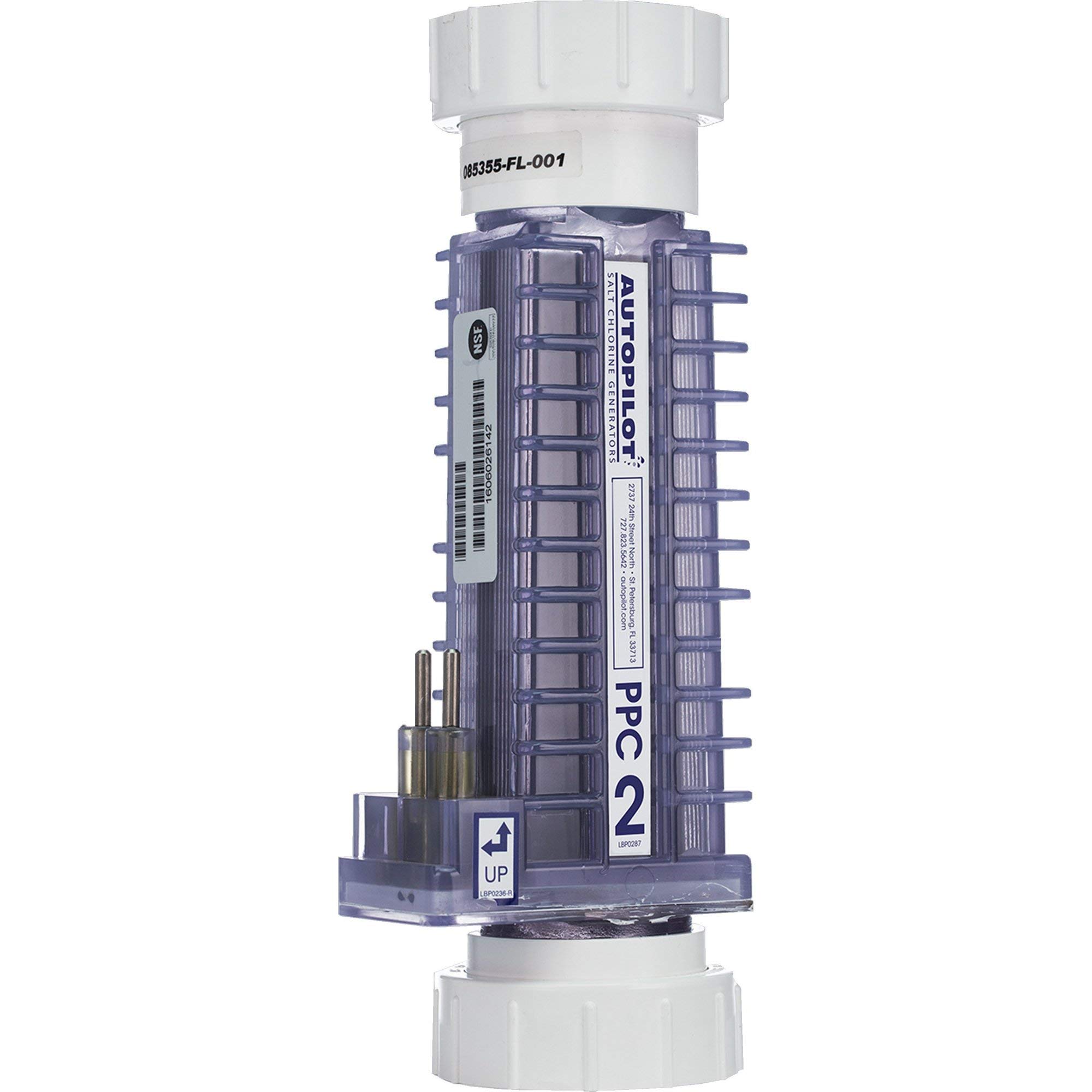
This is a pool chlorinator replacement cell, not a marine autopilot. It appears in this dataset because the Amazon taxonomy groups pool equipment under the “AutoPilot” brand name. It is included here for completeness but has zero relevance to sailboat steering. Buyers searching for sailing autopilots should disregard this item entirely.
The PPC2 RC-28 is designed exclusively for the Pool Pilot Nano Plus system, using a 3-pin cord (not the older 2-pin). It is a straightforward replacement part that takes roughly 20 minutes to install. Customers confirm it fits perfectly and restores chlorine production.
If you are shopping for a sailboat autopilot, skip this product. If you also maintain a saltwater pool, this is a functional, if expensive, replacement cell that keeps your system running.
Why it’s great
- Genuine AutoPilot part — correct fit guaranteed
- Fast 20-minute DIY installation
- Hard to find elsewhere — convenient Amazon availability
Good to know
- Not a marine autopilot — does not steer a sailboat
- Premium pricing compared to generic pool cells
- Only compatible with Pool Pilot Nano Plus systems
7. Furuno 1815 8.4 Color LCD Radar 19” 4kW Dome

The Furuno 1815 is a standalone 4 kW marine radar with an 8.4-inch color LCD display and a 19-inch radome antenna. It is not an autopilot and does not steer your boat. However, its 36-nautical-mile range and Fast Target Tracking (tracking up to 10 targets automatically) make it an invaluable companion to any autopilot system for collision avoidance and navigation.
For offshore sailors running 100+ miles out, this radar provides the weather awareness and target detection that complements an autopilot’s course-holding. The adjustable display colors help readability in different light conditions, and the touchscreen interface is intuitive for waypoint and target management.
At this price point, the Furuno 1815 is a serious navigation investment. Pair it with a reliable tiller or hydraulic autopilot to create a complete, hands-free navigation station suitable for bluewater passages.
Why it’s great
- Clear 8.4-inch color LCD for easy target interpretation
- 4 kW output reaches 36 nm for offshore awareness
- Fast Target Tracking with speed and course vectors for 10 targets
Good to know
- Not an autopilot — does not provide steering control
- 1995 model year — older technology, no radar overlay on chartplotters
- Requires dedicated display mounting; not a networked MFD
FAQ
Can a tiller pilot handle 40-foot sailboats?
How much battery capacity do I need for an autopilot on a weekend cruise?
Is the Simrad TP10 better than the Raymarine ST1000+ for coastal sailing?
What’s the difference between a control head and a full autopilot system?
Should I install an autopilot myself or hire a professional?
Final Thoughts: The Verdict
For most sailors, the best autopilot sailing boat winner is the Raymarine ST2000+ because it pairs the widest tiller capacity (10,000 lbs) with the lowest power draw (40 mA), backed by decades of proven reliability. If you want silent, precise operation in coastal chop and don’t mind a 2-pin power plug, grab the Simrad TP10. And for hydraulically-steered vessels needing a full below-deck system with modern 9-axis sensor accuracy, nothing beats the Raymarine EV-150 Power Pilot.