
Portable solar power has moved past the novelty phase—a 300W panel kit is now a legitimate tool for serious off-grid energy. Whether you are topping off an RV battery bank, running a fridge during a power outage, or building a remote cabin system, the right kit hinges on conversion efficiency, panel durability, and how well the charge controller matches your battery chemistry.
I’m Min — the co-founder and writer behind Gadgets Feed. I’ve spent countless hours cross-referencing the technical specifications, real-world user output reports, and compatibility data for every major 300W panel kit on Amazon to separate the genuine performers from the underwhelming options.
After analyzing conversion rates, connector types, and build materials, I’ve curated the definitive list to help you find the absolute best 300w solar panel kit for your specific setup and budget.
How To Choose The Best 300W Solar Panel Kit
Three specifications separate a kit that delivers on its label from one that leaves you with half the rated power. Focus on conversion efficiency, the charge controller, and how the panel handles partial shade—everything else is negotiable.
Conversion Efficiency and Cell Technology
A panel’s conversion efficiency dictates how much sunlight actually becomes electricity. Standard panels hover around 22.5%, but premium N-type or 16BB (busbar) designs push past 25%. In a 300W kit, that difference translates to 20-30 extra watts under the same sun—critical when space is tight or clouds roll in. Monocrystalline silicon is the baseline you want; polycrystalline and thin-film are obsolete for portable power.
Controller Type: PWM vs. MPPT
The charge controller is the brain of your kit. PWM controllers are cheap and work for small 12V systems, but they waste voltage from higher-panel output. An MPPT controller captures that excess voltage and converts it into extra charging current—boosting efficiency by up to 30% in cold or low-light conditions. If your battery bank is 24V or you want maximum harvest, an MPPT is non-negotiable.
Panel Form Factor and Durability
Foldable suitcase panels prioritize portability with lightweight frames, fabric backs, and integrated kickstands. Rigid bifacial panels capture light from both sides, boosting output by up to 30% on reflective surfaces like snow or white RV roofs, but they are heavier and require permanent mounting. Consider IP rating (IP67 for waterproof, IP68 for submersion) and whether the ETFE coating or tempered glass construction matches your environment.
Quick Comparison
On smaller screens, swipe sideways to see the full table.
| Model | Category | Best For | Key Spec | Amazon |
|---|---|---|---|---|
| Renogy 300W Suitcase | Portable | Higher efficiency per square foot | 25% N-Type 16BB cells | Amazon |
| BougeRV Bifacial 300W | Rigid | Permanent rooftop or ground mount | 25% efficient, 16BB N-Type | Amazon |
| PECRON 300W Foldable | Portable | Pecron power station pairing | 23.5% conversion rate | Amazon |
| DOKIO 300W Foldable | Portable | Budget entry with included controller | 36V output, 15.21 lbs | Amazon |
| Ecosonique 300W | Portable | Multi-adapter compatibility kit | 23.5% mono cells, 15.4 lbs | Amazon |
| Jackery Explorer 2000 v2 Kit | All-in-One | Integrated 2kWh power station | 2x200W panels, 2042Wh battery | Amazon |
| ECO-WORTHY 400W Starter Kit | Complete System | Full off-grid RV setup under 2kWh | 40A MPPT + 2000W inverter | Amazon |
| ECO-WORTHY 800W System | Complete System | Large RV with air conditioning | 3000W inverter, 7.168kWh | Amazon |
| ECO-WORTHY 1200W 24V System | Complete System | High-capacity off-grid cabin power | 24V bank, 60A MPPT, 5.52kWh | Amazon |
In‑Depth Reviews
1. Renogy 300W Portable Solar Panel Suitcase
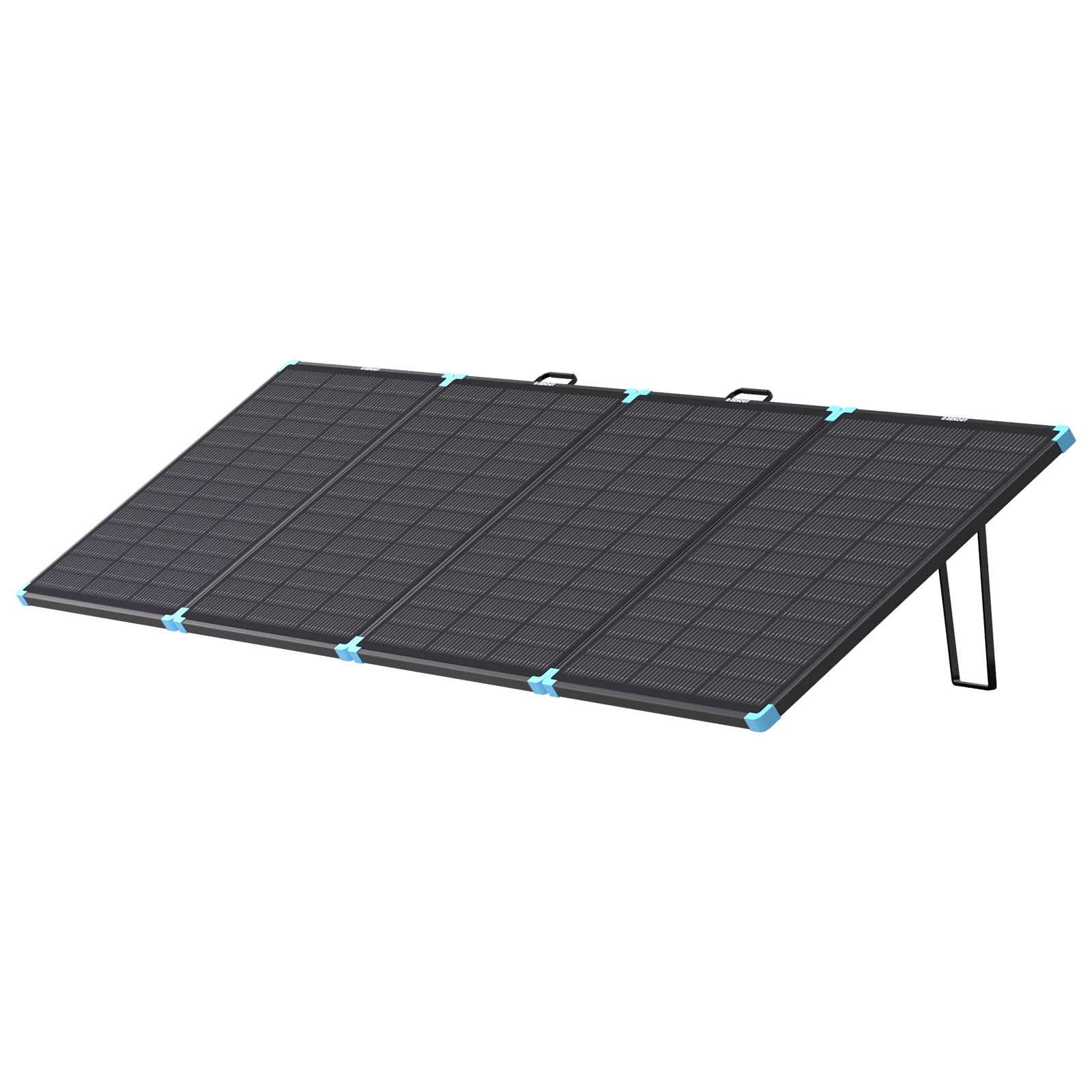
The Renogy 300W Suitcase is built around 16BB N-Type cells that achieve a verified 25% conversion efficiency—outpacing the 22.5% average of most portable panels. Real-world owners report pulling 250-280W in full sun, with one user exceeding 300W after a 60-foot cable run, indicating minimal transmission loss. The IP67 waterproof rating, ETFE coating, and hail-resistant construction mean it can survive extreme temps from -40°F to 185°F without delamination.
Weighing just 18.7 lbs and folding down to 23.2 x 29.3 x 3.2 inches, this suitcase uses parallel wiring to maintain output under partial shading—a common weak point for series-wired competitors. The rust-proof kickstands enable a one-minute setup, and the IP68 connectors are cross-compatible with most modern power stations. The 3-year output warranty provides longer coverage than the industry-standard 12 months.
Keep in mind that the kit does not include a charge controller or cables, so you will need to factor those into your budget. Some users noted the kickstands create a steeper angle than ideal for summer use, and the wire pouch is smaller than previous Renogy versions. For pure panel performance and long-term durability, this is the most technically advanced foldable 300W kit available.
Why it’s great
- Industry-leading 25% N-Type cell efficiency
- IP67 waterproof and hail-resistant ETFE coating
- Parallel wiring prevents total loss from partial shade
- 3-year output warranty is best-in-class
Good to know
- No charge controller or cables are included in the box
- Kickstand angle can be too steep for optimal sun tracking at high latitudes
- The storage pouch for wiring has been downsized
2. BougeRV Bifacial N-Type 300W
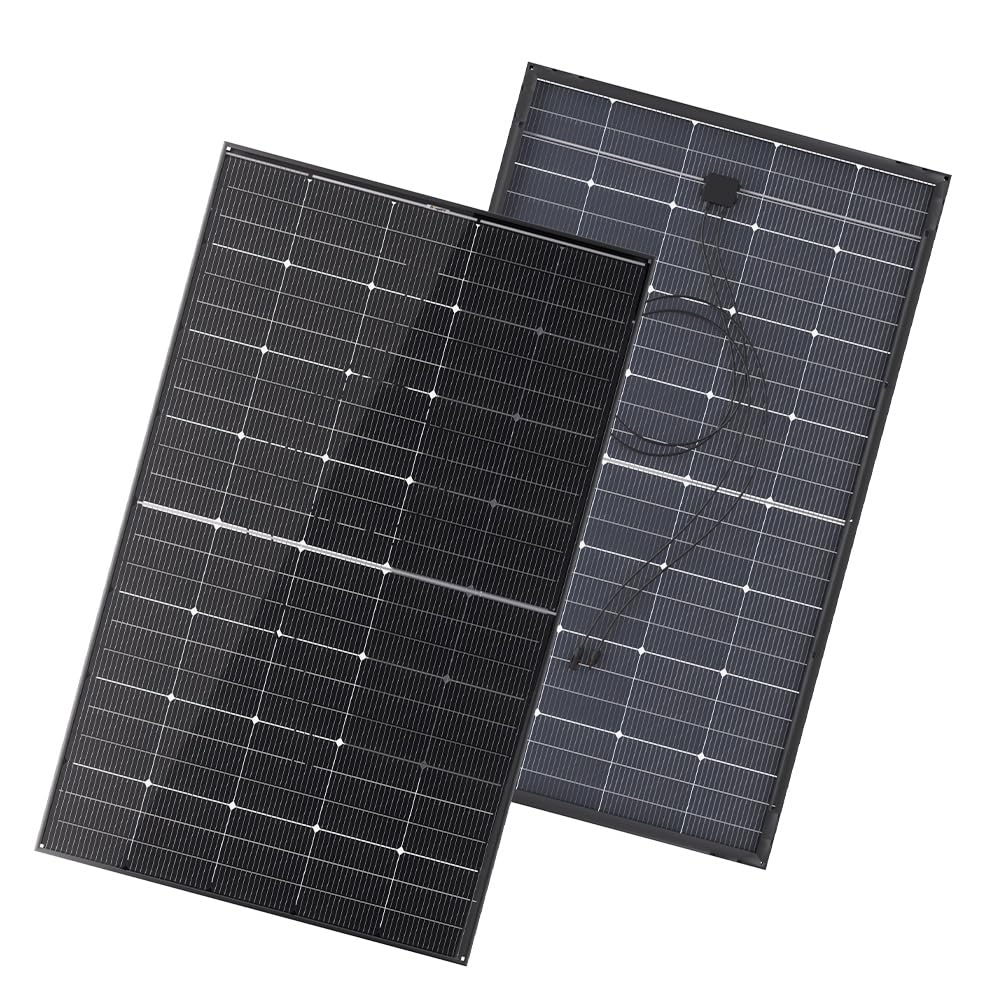
The BougeRV Bifacial 300W panel leverages a transparent backsheet to absorb reflected light from the ground, boosting total energy harvest by up to 30% in ideal conditions like snow-covered grounds or white RV roofs. Its 16BB N-Type cells hit 25% efficiency, and the 37.6V maximum voltage makes it compatible with both 12V and 24V battery banks when panels are series-wired for 48V systems. The IP68 junction box and corrosion-resistant aluminum frame are built for permanent outdoor exposure.
At 32.8 lbs, this is a rigid panel designed for fixed mounting rather than daily portability. It saves 11% in roof space compared to three separate 100W panels by reducing connector losses. Real-world users in winter Utah reported 170W average output from 9:30 AM to 4:30 PM, with 300W realistic in summer. BougeRV backs it with a 10-year product technical support policy, which is reassuring for a permanent installation.
Quality control has been inconsistent—some users reported one panel in a batch underperforming at 225W versus the typical 285W. The panel is also too large for sideways mounting on a Sprinter or Transit roof, though it fits a Promaster. If you have the roof space and want the extra yield from ground reflection, the bifacial design creates a measurable advantage over standard mono-faced panels.
Why it’s great
- Bifacial design captures up to 30% more energy from reflected light
- 25% efficiency with advanced 16BB N-Type cells
- IP68 waterproof junction box for permanent outdoor installs
- 10-year product technical support included
Good to know
- Heavier (32.8 lbs) and not designed for portable use
- Panel-to-panel consistency varies; some units underperform
- Too large for sideways mounting on many van roofs
3. PECRON 300W Foldable Solar Panel
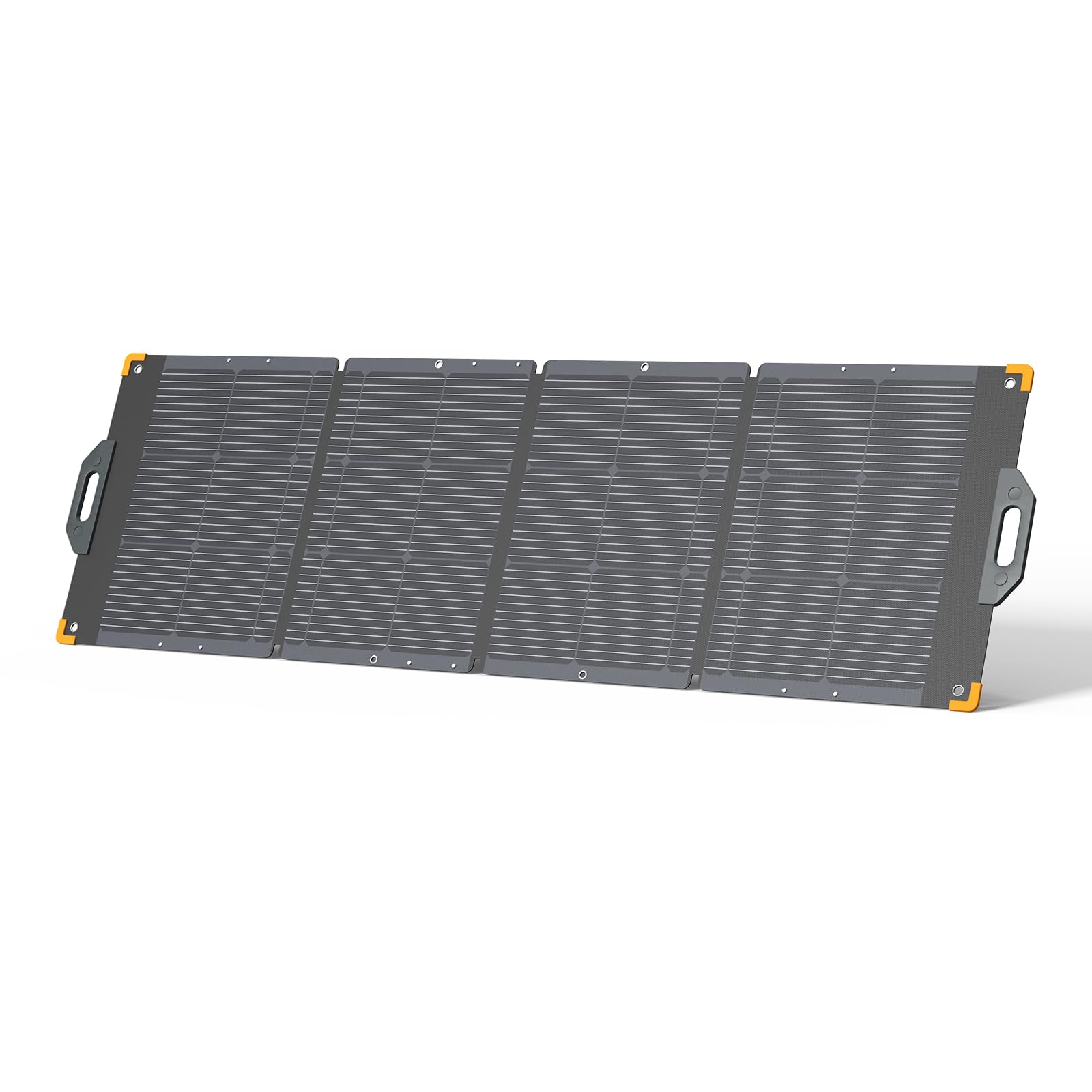
The PECRON 300W folds into a super-thin profile and pairs natively with the PECRON E-series power stations (E600LFP through E3600LFP), though it works with any power station via standard MC4 connectors. Its 23.5% monocrystalline conversion rate is respectable, and owners have measured peaks around 330W under strong sunlight—exceeding the rated 300W. The aluminum, tempered glass, and monocrystalline construction provides durability without making the panel too heavy to carry.
One user reported a delamination spot under the panel surface, but the seller promptly replaced it through the 1+1 year warranty. The included 15-16 foot cable gives flexibility to keep the controller in the shade. The adjustment stand has limited angling options—users have solved this with inexpensive jack stands to level the panel, pushing real-world output from 260W to 285W.
This kit does not include a charge controller, so budget for an MPPT controller if you are not pairing it directly with a PECRON power station. The build quality from the aluminum frame feels solid, and the 24/7 customer service has a responsive reputation. For a direct match with the PECRON ecosystem at reasonable cost, this is the clear choice.
Why it’s great
- Can peak above the rated 300W (users report 330W)
- Natively compatible with the PECRON power station line
- 1+1 year worry-free warranty with responsive support
- Long MC4 cable allows flexible placement
Good to know
- No charge controller included
- Built-in adjustment stand offers limited tilt angles
- Delamination has been reported, though seller covers replacement
4. DOKIO 300W 36V Portable Foldable Solar Panel Kit

The DOKIO 300W kit stands out for including a PWM charge controller, making it a true plug-and-play option for 12V battery systems right out of the box. Its 36V panel output allows the controller to charge a LiFePO4 battery to 14.6V, and owners have confirmed it fully charges a 50Ah battery quickly in full sun. The folded thickness is just 1.1 inches, and at 15.21 lbs, it is one of the lightest 300W kits you can grab with the handle.
Real-world output is lower than the label suggests—most users see 128-149W at midday under light clouds and peaks around 160W, about half the rated 300W. Panels in series can reach closer to 300W total when combined. The included 9.8-foot cable is generous, and the PWM controller includes reverse polarity, overcharge, and short-circuit protection. The fabric panels have survived a 7-foot drop but the stitching and kickstand rings feel less robust.
The SAE connectors are not standard MC4, which limits compatibility with some power stations without an adapter. The kit includes everything you need for a 12V battery setup, making it the lowest-friction entry point. If you are new to solar and want to test the waters with a complete kit, the DOKIO provides a functional path—just temper your expectations on raw wattage output.
Why it’s great
- Includes a PWM charge controller for immediate 12V battery charging
- Extremely portable—folds to 1.1 inches thick at 15.21 lbs
- Full circuit protection (reverse polarity, overcharge, short-circuit)
- 9.8-foot cable gives flexible placement options
Good to know
- Typical real-world output is around 50-60% of the 300W rating
- SAE connectors are non-standard; an MC4 adapter may be needed
- Kickstand and stitching are less durable than premium competitors
5. Ecosonique 300W Portable Solar Panel
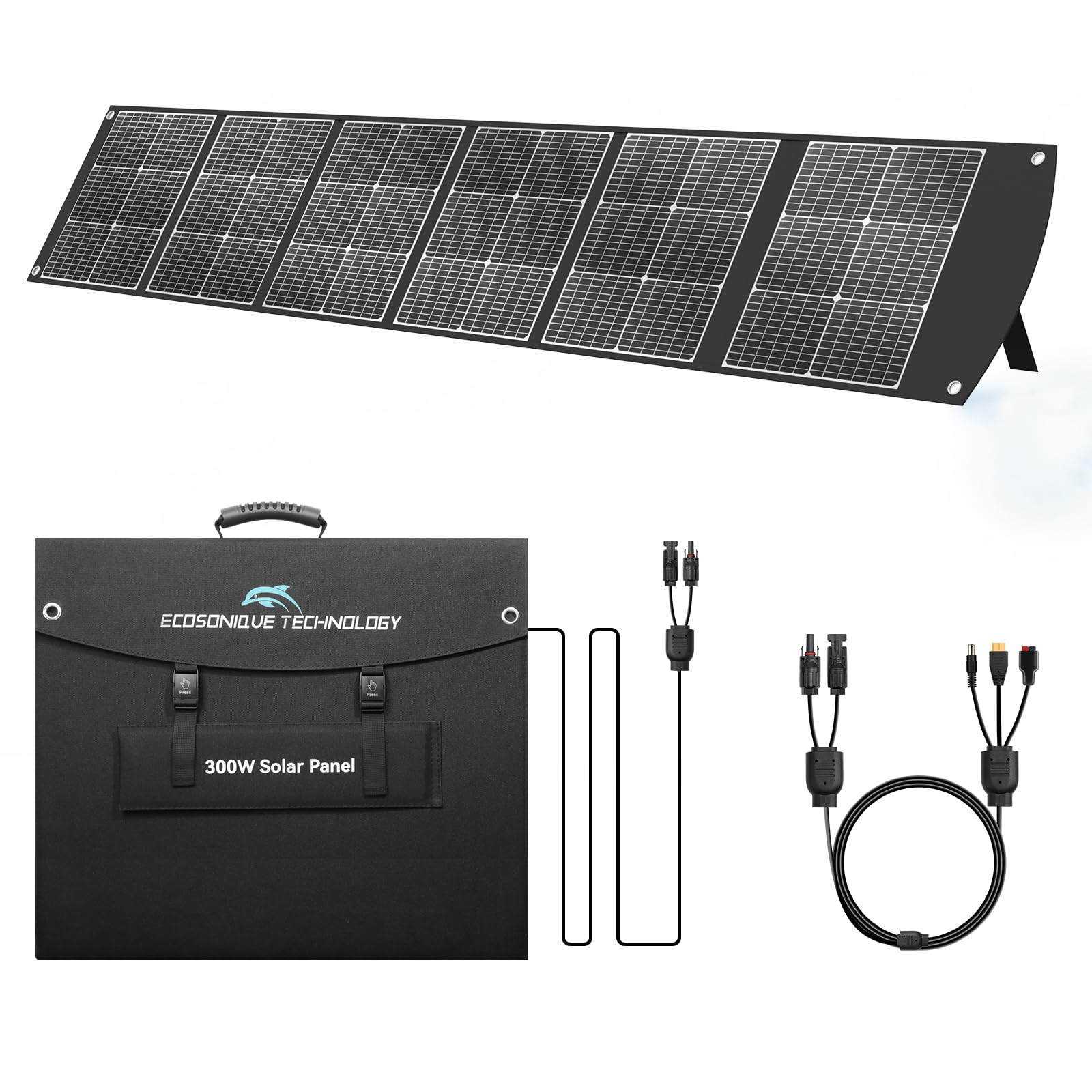
The Ecosonique 300W panel excels in connectivity, shipping with a 3-meter MC4 cable plus three adapter cables (XT60, Anderson, DC8020) to work with power stations from EcoFlow, Jackery, Bluetti, Anker, and more. Its 6-angle kickstand and auto-restart technology ensure the panel resumes charging after temporary shade interruptions. The 23.5% conversion rate on monocrystalline cells delivers real-world performance—one user confirmed it charged their EcoFlow from 85% to 100% in 50 minutes, pulling roughly 230W in full sun.
The 6-fold design collapses to 23 x 19 x 3 inches, and the CPC-laminated Oxford fabric makes the panel tear-resistant and dustproof. Temperature tolerance spans -4°F to 158°F, and the manufacturer claims a lifespan exceeding a decade. The semi-flexible panel construction helps it withstand minor flexing during transport without cracking, unlike rigid glass panels.
Customer service responsiveness has been mixed—one user received a defective unit and found the seller unresponsive after the return window closed. The advice to test immediately upon arrival is sound. The built-in smart protection and auto-restart features are genuine differentiators, but the lack of a charge controller means you will need a compatible power station or external controller to complete the system.
Why it’s great
- Comes with XT60, Anderson, and DC8020 adapters for broad compatibility
- 6-angle kickstand maximizes sun exposure
- Auto-restart technology resumes charging after shade interruptions
- Lightweight at 15.4 lbs with a compact folded size
Good to know
- No charge controller included in the kit
- Quality control and post-return support have raised concerns
- Real-world output is closer to 230W than the rated 300W
6. Jackery Explorer 2000 v2 with 2x200W Solar Panels
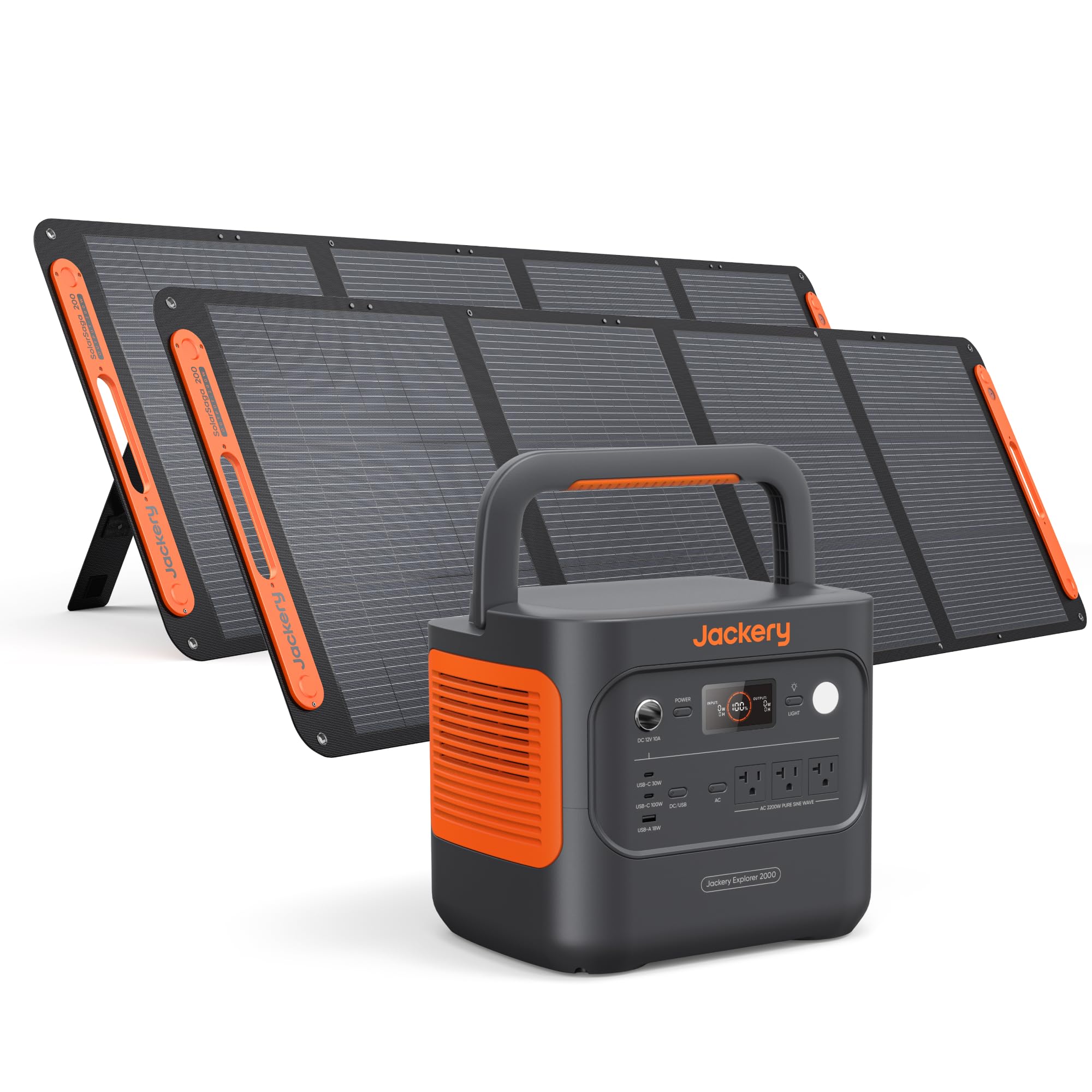
The Jackery Explorer 2000 v2 combines a 2042Wh LiFePO4 power station with two 200W solar panels, providing 400W of solar input to recharge from empty to full in about 6 hours. The power station itself supports up to 2200W AC output and uses CTB (Cell-to-Body) technology to achieve a 39.5 lb weight—41% lighter than conventional 2kWh units. The 20ms UPS switching ensures critical devices stay online during a grid failure without a glitch.
Users report the two 200W panels charging at 397-400W in full sun, and the power station can run a window AC unit for 3.5 hours on a full charge. The separate AC charging cable can bring the unit to 80% in 66 minutes. The LiFePO4 chemistry delivers over 10 years of service life with daily use, and the silent charging mode operates at 30 dB, making it suitable for indoor emergency power without fumes or noise.
The package is heavy at nearly 40 lbs for the power station plus the two panels, so it is car-camping portable rather than backpack-able. The dual 200W panels combined are essentially a 400W kit—rooms you above the 300W target but provides meaningful extra energy. Be aware the panels ship separately from the power station, and the connection requires switching from the L-shaped DC7909 plug to a straight DC8020 plug.
Why it’s great
- Complete all-in-one system with 2042Wh LiFePO4 battery and 400W solar
- CTB technology makes it 41% lighter than other 2kWh stations
- 20ms UPS protects critical devices during outages
- Excellent real-world solar charging at nearly 400W
Good to know
- Heavy system (power station + panels) requires vehicular transport
- Panels and power station ship separately
- Requires switching the L-shaped connector for proper solar hookup
7. ECO-WORTHY 1.6KWH Complete Solar Panel Kit 400W

The ECO-WORTHY 400W kit delivers a truly complete system: four 100W bifacial panels, a 40A MPPT charge controller, two 12V 100Ah lithium batteries, a 2000W pure sine wave inverter, and a Bluetooth monitoring module. The 12BB solar cells reach 23% conversion efficiency, and the MPPT controller achieves 99% tracking efficiency and 98% peak conversion—ensuring the batteries get every available watt. The daily output of 1.6kWh under 4 hours of sunlight is enough to run a TV, refrigerator, and other 110V AC devices under 2000W.
The lithium batteries come with a built-in BMS that handles overcharge, over-discharge, and short-circuit protection, giving them over 3000 deep cycles. The Bluetooth module lets you monitor system performance on your phone from up to 82 feet away. Owners confirm the system powers their RVs effectively, with easy assembly using the provided wiring diagram. The bifacial panels add a bonus of reflected light collection on bright surfaces.
The inverter has had quality control issues—one owner reported it failing quickly with no help from the company, while others rate it 5 stars. Parts arrive in separate shipments, which can be confusing. The system is designed for 12V battery banks; running a large air conditioner on the 2000W inverter may be marginal. For a user who wants a full turnkey solar system that includes panels, batteries, controller, inverter, and Bluetooth tracking, this kit eliminates the guesswork of component matching.
Why it’s great
- Complete turnkey system with panels, batteries, MPPT, and inverter
- 99% tracking efficiency on the 40A MPPT controller
- Lithium batteries with BMS provide 3000+ deep cycles
- Bluetooth module for real-time monitoring on your phone
Good to know
- Inverter reliability is inconsistent; some report early failure
- Components ship separately, which can be confusing
- 2000W inverter is not sufficient for large AC loads
8. ECO-WORTHY 7.168KWH 800W Solar Panel Kit
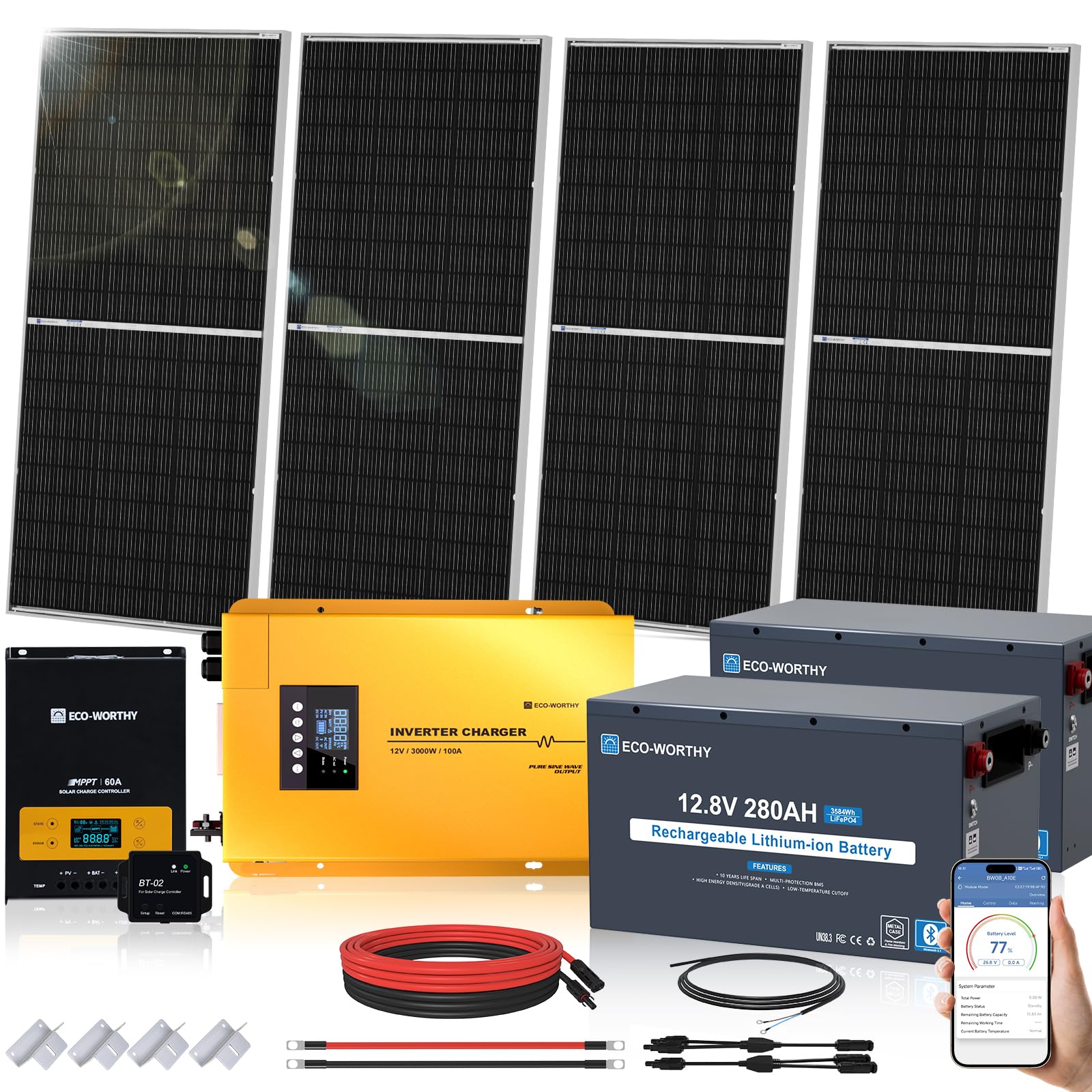
This ECO-WORTHY system delivers 800W of solar capacity through four 200W bifacial panels using 25.2% high-efficiency cells, paired with a 3000W pure sine wave inverter/charger and two 12.8V 280Ah lithium batteries for 7.168kWh of storage. The 60A MPPT controller with Bluetooth ensures maximum power extraction and remote monitoring. The UPS function on the inverter charger provides instant power switching between solar, battery, and AC input—critical for maintaining fridge and other sensitive loads during grid drops.
Real-world owners report the system runs their entire camper, including air conditioning, with the 800W solar production keeping the battery above 40% even on cloudy days. The 4-step installation process is genuinely plug-and-play, using Y-branches for 2S2P panel wiring. The 200W panels are lighter and easier to handle than the 4x100W alternative, reducing roof load. ECO-WORTHY’s customer service is responsive for part replacements, though some users noted the 800W solar rarely produces more than 450W in real use.
No disconnects or breakers are included, so you will need to add those for code compliance. The estimate of daily kWh assumes 9 hours of high sunlight, which is unrealistic in most US locations (4-6 hours is typical). The system is substantial—you need roof space for four 58.86 x 26.18 inch panels. For an RV owner who wants to run an AC, microwave, and full-size fridge without worrying about battery capacity, this is one of the most complete sub- kits available.
Why it’s great
- 7.168kWh storage with 3000W inverter handles full RV loads including AC
- 60A MPPT controller with Bluetooth for remote monitoring
- True UPS function for automatic power switching
- Novice-friendly 4-step assembly
Good to know
- Real-world solar output is often around 450W, not the full 800W
- No disconnects or breakers are included in the kit
- Daily energy estimates assume unrealistically high sun hours
- Requires significant roof space for four large panels
9. ECO-WORTHY 1200W 24V 5.52KWH Solar System
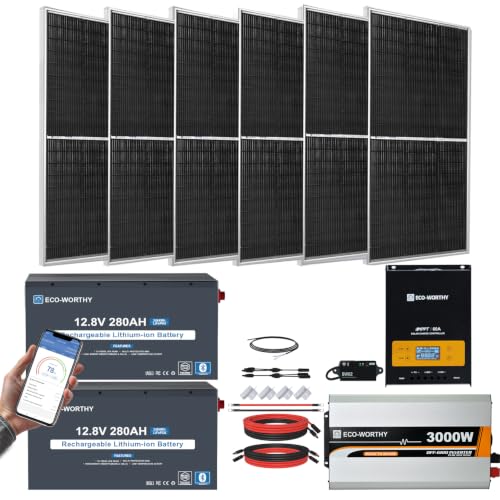
This ECO-WORTHY system uses a 24V architecture for higher efficiency on longer wire runs, pairing six 195W bifacial panels (1,170W total) with two 12.8V 280Ah lithium batteries wired in series for 5.52kWh of storage. The 60A MPPT controller with Bluetooth provides 99% tracking efficiency and 98% peak conversion, while the 3000W pure sine wave inverter handles medium AC loads. The panels use 12BB cells with a transparent back for bifacial gain, reaching 25% conversion efficiency on the front side.
Owners in Ecuador report the system powers their refrigerator, computer, and all house lights during grid outages, with daily photovoltaic production exceeding 4kWh. A Colorado user at 8,500 feet found the bifacial panels generate extra power from snow reflection and uses the system to run refrigeration and freezer loads. The 24V battery bank reduces current draw by half compared to 12V, meaning thinner copper wire and less voltage drop. The 3000W inverter can start a 6000 BTU air conditioner.
The installation is more complex than a 12V system—wiring batteries in series requires attention to polarity, and there are no detailed instructions included. One reviewer received a charge controller with a bent case and a broken temperature probe. The kit is large: six panels plus two 280Ah batteries demand substantial space. For an off-grid cabin, tiny home, or serious RV installation where 24V system efficiency makes a real difference, this kit provides the most watt-hours per dollar of any complete system on this list.
Why it’s great
- 24V architecture reduces wire losses for long-distance runs
- 5.52kWh storage with 3000W inverter for cabin-scale loads
- Bifacial 195W panels with 25% conversion efficiency
- Excellent value for a complete 1200W+ system
Good to know
- Larger and more complex to install than 12V systems
- No detailed installation instructions included
- Quality control on charge controller has been inconsistent
- Requires significant space for six panels and two large batteries
FAQ
Will a 300W solar panel kit charge a 100Ah battery?
Can I use a 300W panel kit with a 24V battery system?
How much power can I expect from a 300W panel per day?
Final Thoughts: The Verdict
For most users, the best 300w solar panel kit winner is the Renogy 300W Portable Suitcase because its N-Type 25% efficiency, parallel shading tolerance, and IP67 durability make it the most technically capable foldable panel for the price. If you want a fixed bifacial installation that harvests extra energy from ground reflection, grab the BougeRV Bifacial 300W. And for a complete all-in-one system with battery storage and inverter ready to go, nothing beats the Jackery Explorer 2000 v2 kit.