
You spot the perfect birch branch for a bow drill set, but the hatchet in your pack is already dull from last weekend’s campfire prep. You didn’t pack a file, so you’re stuck hacking at it with a butter knife disguised as an axe. That’s the core pain of bushcraft: your hatchet needs to hold a razor edge through a weekend of splitting, carving, and notching, not bounce off dry wood after five swings. A proper Bushcraft Hatchet isn’t for felling giants; it’s for the precise, repetitive work of transforming raw wood into tools, tent pegs, and kindling.
I’m Min — the co-founder and writer behind Gadgets Feed. For this guide, I’ve spent dozens of hours researching steel chemistries (C43/45, 1055, 1066, Swedish axe steel), handle geometries (Scandi grind, convex, full tang vs. wedge), and head weights to identify the hatchets that deliver real control and edge retention for the bushcraft environment.
After analyzing hundreds of reviews and comparing seven of the most respected models on the market, I’ve built a clear ranking of what matters when you need the best bushcraft hatchet for carving, splitting, and surviving the backcountry.
How To Choose The Best Bushcraft Hatchet
A bushcraft hatchet is a different animal from a construction framing axe or a tactical tomahawk. It is built for the precision of carving feather sticks and notching timber, not for brute-force demolition. To find the one that fits your hands and your wood, you need to look past the handle color and focus on three elements: steel type, edge geometry, and how the head attaches to the handle.
Steel Type: 1066 vs. Swedish vs. 1055
Bushcraft hatchets almost always use carbon steel because it sharpens easily and can take a scary fine edge. 1055 carbon steel (seen on the CRKT Chogan) is tough and resists chipping but won’t hold a high-grit edge as long. 1066 carbon steel (used by BPS Knives) offers a good balance of toughness and edge retention for carving. Swedish axe steel, from brands like Gränsfors Bruks and Hults Bruk, is a medium-carbon alloy forge-welded and heat-treated to a specific hardness that makes it both sharp and durable. The difference in practice: a 1066 hatchet will need a quick touch-up with a stone after a heavy weekend, while a premium Swedish head might go several more trips before needing a full pass.
Edge Geometry: Scandi, Convex, and Flat
The grind — the shape of the edge profile — determines how the hatchet bites into wood. Scandi grind (a single, flat bevel from the edge to the body) is ideal for carving and whittling because it slices cleanly with excellent control. A convex grind (a smooth, rounded belly) is tougher and better for splitting tasks because the thicker metal behind the edge prevents chips and rolls. A flat grind is a compromise between the two. For pure bushcraft use, a Scandi grind or a thin convex edge running close to 20 degrees per side will give you the authority for feather sticks and the durability for small splits.
Handle Attachment: Full Tang vs. Wedge Tang
Most hatchets use a wedge-tang construction: a tapered head is driven onto a wooden handle and secured with a metal wedge. This is the classic, proven method, but it can loosen over time if the wood shrinks or dries out. Full tang construction (like the BPS Knives Bushcraft Axe) runs the steel through the handle in one continuous piece, making it nearly impossible to snap at the neck and immune to head-loosening issues. Full tang tends to be heavier and transmits more vibration to your hand, while a well-hung wedge tang absorbs shock better. An epoxied handle (like the Gerber’s synthetic composite) eliminates shrinkage but lacks the traditional feel and repairability of wood.
Quick Comparison
On smaller screens, swipe sideways to see the full table.
| Model | Category | Best For | Key Spec | Amazon |
|---|---|---|---|---|
| Gransfors Bruks Small Forest Axe | Premium Swedish | Heirloom-quality carving & splitting | 19 in, 2 lbs, Swedish steel | Amazon |
| Hults Bruk Akka Foresters Axe | Premium Swedish | Deep-biting cuts in hardwood | 24 in, curved hickory, 1.5 lb head | Amazon |
| Gerber Gear Bushcraft Axe | Modern Synthetic | Integrated storage + hammer poll | 27 in, 4.5 lbs, hollow compartments | Amazon |
| Husqvarna Wooden Curved Carpenter Axe | Carpenter Heritage | Fine control for carving & limbing | 20.5 in, 2.42 lbs, Swedish steel | Amazon |
| BPS Knives Bushcraft Axe | Full Tang Compact | Precision carving + packability | 9.2 in, 17.2 oz, 1066 carbon steel | Amazon |
| CRKT Chogan Hammer T-Hawk | Tactical Tomahawk | Light-weight splitting + hammering | 17.9 in, 2.3 lbs, 1055 carbon steel | Amazon |
| Prandi German Style Hatchet | Budget Entry | Budget-friendly entry into bushcraft | 14.2 in, 1.32 lbs, C43/45 carbon steel | Amazon |
In‑Depth Reviews
1. Gransfors Bruks Small Forest Axe 19 Inch

The Gransfors Bruks Small Forest Axe is the gold standard in bushcraft for a reason: its 2-pound head is forged from Swedish axe steel with a convex grind that slices like a straight razor but withstands the shock of splitting seasoned oak. The 19-inch hickory handle is shaped with a subtle palm swell that locks into your hand during a draw cut, and the grain alignment on even a mid-tier unit is better than what most budget brands reserve for their flagship. Out of the box, the edge is shaving sharp — multiple verified reviews confirm it will peel hair from your arm or cut a leather sheath if you brush against it. That speaks to a heat treat that hits the sweet spot close to 57 HRC, keeping the edge aggressive without becoming brittle.
For bushcraft tasks, the SFA is extraordinary at feather-stick carving, notching, and processing small to medium firewood. The convex grind rolls smoothly through a cut, reducing friction and sticktion that plagues flat-ground hatchets. It also handles limbing and small-felling jobs (trees up to about 8-10 inches) with surprising authority, though the 19-inch length means you lose some leverage on larger splits. The vegetable-tanned leather sheath is beautifully crafted, with a snug fit that protects the edge during pack carry. Some users note that the sheath’s leather is stiff at first and can leave tiny scuff marks on the polished steel finish, but this does not affect performance.
Good to know: the factory edge is delivered at roughly 30 degrees inclusive, which is sharp but not optimized for maximum carving control. Many experienced users regrind the edge to a slightly steeper 25-degree convex to improve bite on feather sticks. The 20-year warranty is the industry’s best, but Gransfors is a premium brand, so if you nick the edge on a rock, sharpening requires care to preserve the convex profile. This is an investment in heirloom quality — it will outlast most other gear in your pack.
Why it’s great
- Shaving sharp edge out of the box — no initial sharpening needed
- Convex grind provides excellent edge retention and smooth cutting action
- Hand-fitted hickory handle with perfect grain alignment on most units
- Compact 19-inch length packs well and offers good control for carving
Good to know
- Premium price reflects hand-forged production in Sweden
- Leather sheath can be stiff initially and may scuff blade finish
- 20-year warranty covers manufacturing defects, not abuse
2. Hults Bruk Akka Foresters Premium Outdoor Axe

The Hults Bruk Akka is built on a heritage that stretches back to 1697, and it shows in the forging. The 1.5-pound head is struck multiple times during hand grinding, increasing steel density and creating a tempered zone that holds a keen convex edge through repeated sharpenings. The 24-inch straight hickory handle is longer than the Gransfors SFA, offering more leverage for deeper cuts on medium logs and making it a better all-arounder for both trail clearing and campfire processing. The head is treated with a lacquer finish that resists rust out of the box, though many users strip it down to bare steel and apply boiled linseed oil for a more traditional feel and easier field maintenance.
For deep carving notches or splitting shoulder-height wood, the extra length on the Akka provides mechanical advantage that the shorter SFA lacks. The convex grind is slightly more aggressive than the Gransfors, biting deeper on the first swing rather than gliding through. This can be a double-edged sword — it makes split tasks more efficient, but it also means the edge is slightly more prone to rolling if you strike a side grain knot. The leather sheath is beautifully stitched with traditional Swedish decorative embossing, though some users found the leather is slightly thinner than the Gransfors version. The axe arrives in a sturdy storage box with a detailed manual.
Good to know: the Akka head frequently comes delivered with a more acute factory edge than the Gransfors, but some owners report needing to clean up the edge with a fine stone because the bevel angle can be inconsistent due to the hand finishing process. The lacquer finish on the head can chip off during first use, which is cosmetic but fine. For the price, you get a tool that competes directly with the Gransfors for pure wood performance, though the overall fit and finish (grain alignment on the handle) is slightly more variable. If you want maximum length for leverage without crossing into felling-axe territory, this is the one.
Why it’s great
- Forged Swedish steel with multiple hand strikes for superior density
- 24-inch handle offers more leverage for deeper, more powerful cuts
- Traditional leather sheath with beautiful decorative stitching
- Excellent for splitting medium wood and clearing trails
Good to know
- Factory edge angle can be inconsistent on some units
- Lacquer finish on head may chip with first use
- Handle grain alignment varies more than Gransfors
3. Gerber Gear Bushcraft Axe
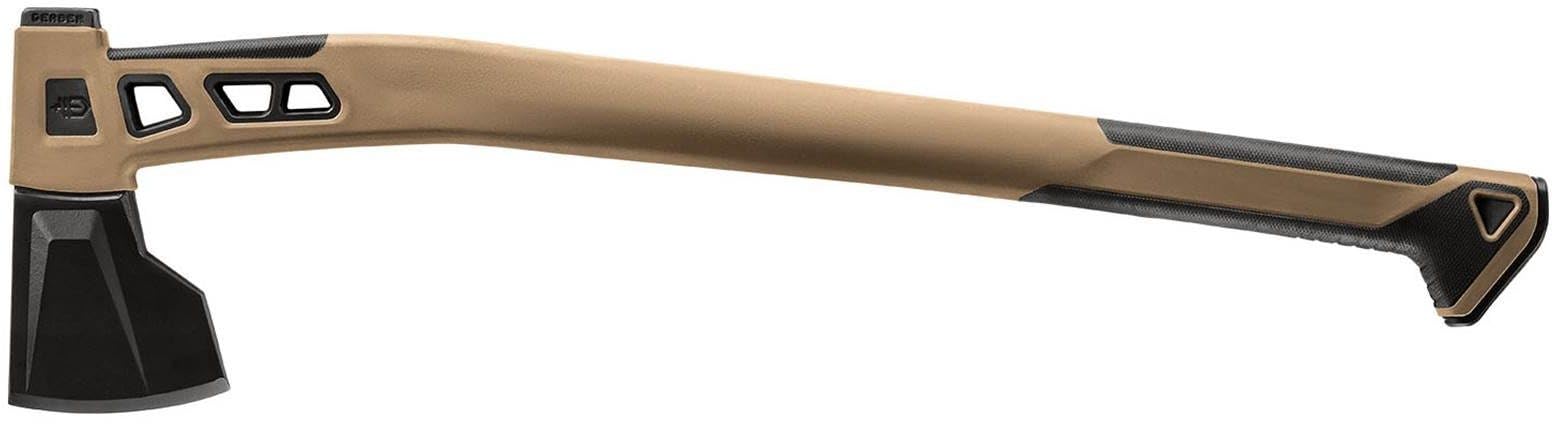
The Gerber Gear Bushcraft Axe takes a modern approach by integrating a forged stainless steel head with a rubberized synthetic handle that features two water-resistant internal compartments. These compartments are designed to hold a mini lighter and a length of paracord — a genuine bushcraft contingency that keeps your ignition source dry and your cordage accessible without adding bulk to your pockets. The head is one solid piece of stainless steel, which means it resists rust better than any carbon steel hatchet in this lineup. For wet-weather camping or salt-adjacent environments, that alone is a major advantage. The hammer poll on the back is substantial — about 2 inches across — and works perfectly for driving tent stakes, splitting wedges, or even light demolition.
The blade features a machined, flat grind with a slight relief cut near the edge, which helps the hatchet bite deeper on the first swing. Verified reviews note the edge is extremely sharp out of the box and requires minimal touch-up. At 27 inches and 4.5 pounds, this is the heaviest and longest hatchet in the list. That mass cuts through wood with authority, making it ideal for medium splitting and thicker branch work, but it is too hefty for delicate carving tasks like feather sticks or notching. The rubberized grip is comfortable for gloved and bare hands and reduces shock significantly compared to a wooden handle. The overstrike guard wraps around the top of the handle, protecting it from missed swings — a practical design feature for new users.
Good to know: the storage compartments are water-resistant but not waterproof — submersion will drown your lighter. The hollow handle also creates a slightly unbalanced feel compared to solid-wood tools; the center of gravity is shifted toward the head, which aids splitting power but makes carving less precise. The stainless steel edge is harder to sharpen in the field than carbon steel, requiring diamond stones or ceramic rods. For campers who prioritize survival tools over traditional carving feel, this is an excellent multi-purpose hatchet that doubles as a hammer and a survival kit.
Why it’s great
- Internal water-resistant compartments for lighter and paracord
- Stainless steel head resists rust and corrosion
- Hammer poll adds splitting and stake-driving versatility
- Rubberized synthetic grip reduces vibration during heavy use
Good to know
- Heavy weight (4.5 lbs) makes fine carving difficult
- Stainless steel edge harder to sharpen in the field
- Storage compartments not fully waterproof
4. Husqvarna 596271201 20 in. Wooden Curved Carpenter Axe
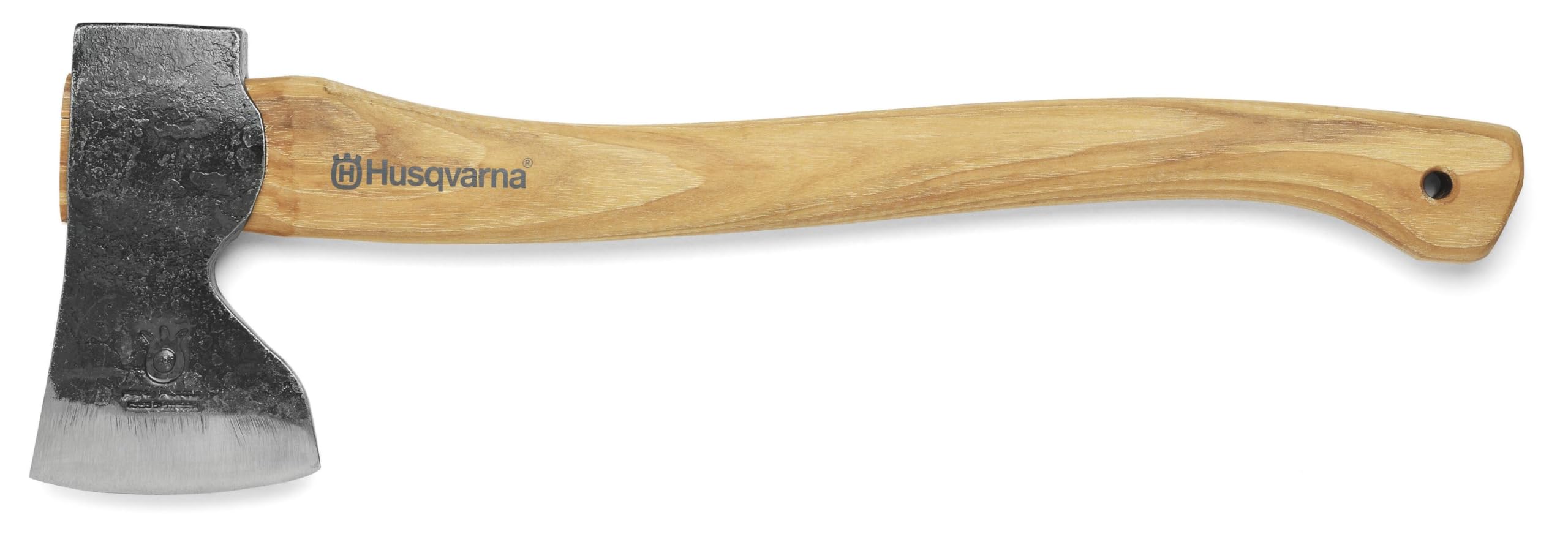
The Husqvarna Carpenter Axe is a hybrid that brings Swedish forging quality (the heads are made by Hultafors/Hults Bruk) into a mid-range price territory. The head is hand-forged from Swedish alloy steel, hardened and tempered to hold a fine edge through prolonged carving and light splitting sessions. At 20.5 inches with a curved hickory handle, it offers exceptional reach and control for limbing and notching tasks. The straight, carpenter-style edge is ground at a slightly thinner angle than a traditional forest axe, which makes it bite aggressively into green wood and allows for surprisingly precise carving for users willing to take the time to sharpen it to a Scandi-like profile. The 2.42-pound overall weight keeps it agile without sacrificing much mass for power.
Most users report that the axe arrives usable but not optimally sharp. The factory edge is workable for immediate splitting tasks, but you’ll want to spend 15 minutes with a fine file and a strop to get it into bushcraft condition. The straight blade profile is excellent for notching and trimming flat surfaces (a carpenter’s heritage), but less efficient for deep feather-stick carving than a convex grind. The leather edge cover is a functional cowhide sheath that protects the edge during storage, though it lacks the polish of the premium Swedish sheaths. The handle is varnished at the factory; many owners sand it down and apply boiled linseed oil for a better grip and to prevent blisters on long sessions.
Good to know: the listed weight (2.4 lbs) can vary; some units shipped at 3 lbs 2 oz, requiring users to sand down the handle to reduce weight. The straight blade makes it less forgiving on angled carving cuts — you’ll need to develop a cleaner swing. For the price, you are getting a Hultafors/Hults Bruk head with a handle that needs finishing work. If you are willing to put in an hour of tuning, this hatchet punches far above its price point and will rival tools costing twice as much. It is particularly good for users who value a longer handle and the precision of a straight edge for notching.
Why it’s great
- Swedish hand-forged steel head at a mid-range price
- Straight carpenter edge ideal for precise notching tasks
- 20.5-inch curved handle offers excellent leverage for limbing
- Leather edge cover provides functional edge protection
Good to know
- Factory edge needs significant sharpening for optimal carving
- Manufacturing weight variance reported (can be 0.5 lb heavier)
- Straight blade less efficient for deep feather-stick carving
5. BPS Knives Bushcraft Axe with Leather Sheath

The BPS Knives Bushcraft Axe stands out for its full tang construction — the 1066 carbon steel extends through the entire walnut handle, creating a solid one-piece tool that is immune to head-loosening failures. This is a rare design for a hatchet and gives it exceptional lateral strength, meaning you can baton a knife against it or use it for light prying without fear of snapping the neck. The Scandi grind (a single, flat bevel) is ground by hand in Ukraine and is extremely precise on good units — it allows for incredible carving control, letting you shave off feather sticks with the same finesse as a dedicated bushcraft knife. At only 9.2 inches overall and 17.2 ounces (without sheath), it is the most packable hatchet in this review, easily fitting into a daypack or even a large coat pocket.
The walnut handle is oiled and feels warm in the hand, though some users found the factory convex grind was delivered thick (about 0.2 inches at the edge), requiring filing to achieve a truly acute Scandi angle. The included leather sheath is a full-grain cover that fits well, though multiple users reported the snap closure was too tight out of the box and needed a few minutes of wet-forming to function comfortably. The hatchet is handcrafted in BPS Knives’ workshop in Ukraine, and the craftsmanship shows in the mirror-polished steel on the spine and the clean fit of the handle scales. For carving, this is the best pure wood sculpting tool in the list — its small size and Scandi edge allow you to shape wood like a crooked knife.
Good to know: the factory edge varies. Some units arrive shaving sharp with a perfect convex grind, while others are delivered with a zero edge that is completely blunt and rounded — a clear QC variance. The blade thickness (0.2 inches) makes it less efficient for splitting unless you baton it through wood; this is a carver, not a splitter. Also, the 9.2-inch length means you lose significant leverage for any chopping task — you cannot effectively fell even a small sapling with it. But for carving spoons, tent pegs, and fine notches, nothing else here matches its precision-to-weight ratio.
Why it’s great
- Full tang construction eliminates head-loosening and adds lateral strength
- Scandi grind offers excellent carving precision for feather sticks
- Ultra-compact at 9.2 inches — fits in any pack or pocket
- Hand-crafted in Ukraine with quality walnut handle and leather sheath
Good to know
- Factory edge QC is inconsistent; some units arrive completely blunt
- 0.2-inch blade thickness makes splitting tasks difficult
- Short length limits chopping power for larger wood
6. CRKT Chogan Hammer T-Hawk

The CRKT Chogan, designed by RMJ Tactical’s Ryan Johnson, brings a tactical tomahawk profile to bushcraft. Its 1055 carbon steel head is forged and coated in a black anti-corrosion finish, with a sharpened plain edge on one side and a hammer poll on the other. The 17.88-inch Tennessee hickory handle is straight-grained and finished with a matte varnish that provides a secure grip without being sticky. The hammer poll is substantial — approximately 2.25 inches square — and works as an effective steel hammer for driving stakes, splitting wedges, or even light chisel work. At 2.3 pounds, it sits in the middle of the weight spectrum, balancing portability with enough mass for splitting kindling without excessive swing effort.
For bushcraft tasks, the Chogan excels at light splitting and small branch de-limbing. The thin-ish profile of the 1055 steel edge bites through dry deadfall efficiently once sharpened. However, the factory edge arrives with a standard tomahawk grind that is not optimized for carving. Most verified reviews note it requires a sharpening pass with a file to bring it to bushcraft-ready sharpness. The tactical design includes a lanyard hole and a slight curve on the handle, but the handle itself is not ergonomically sculpted for precision carving — it’s more of a straight, functional grip. The tomahawk design means the head is not securely wedged onto the handle; instead, it’s held on by friction and the swelling of the wood. This allows for easy removal for handle replacement, but it also means the head can loosen with hard use if not frequently tightened.
Good to know: the hammer poll is not hardened steel — it’s the same 1055 carbon steel as the head, so repeated striking against hardened steel stakes will mar the finish and eventually create mushrooming. The black coating can chip off at the edge during normal chopping, which is cosmetic but fine. For the price, you get a surprisingly capable splitting tool and a genuine hammer in one package. If your bushcraft style involves setting up a camp with tarps and stakes, the hammer function is genuinely useful. But if your primary activity is detailed wood carving, the Chogan’s blunt edge geometry will frustrate you.
Why it’s great
- Integrated hammer poll is genuinely useful for tent stakes and wedges
- 1055 carbon steel is tough and resists chipping during split work
- Long 17.88-inch handle provides good leverage for light splitting
- Tennessee hickory handle is durable and easy to replace
Good to know
- Factory edge needs significant sharpening for carving work
- Hammer poll not hardened — can mushroom with heavy use
- Head loosening is common with heavy use if not retightened
7. Prandi German Style Hatchet – PRA0306TH

The Prandi German Style Hatchet is the most affordable option in this lineup, offering a 1.32-pound head made from C43/45 carbon steel mated to an American hickory handle. The design is a classic German pattern hatchet — compact at 14.18 inches with a 3-inch blade — that prioritizes control over raw swinging power. The C43/45 steel is similar to 1045 carbon steel, with enough carbon content to hold a working edge for moderate carving tasks but not reaching the edge retention of higher-carbon steels like 1066. For a beginner bushcrafter or someone who wants a beater hatchet for frequent sharpening practice, this is a logical entry point. The head is polished and hardened at the factory, and many users reported it arrived sharp enough to shave hair from light arm strokes.
In use, the Prandi is best suited for light wood processing: splitting small diameter kindling, trimming branches, and rough carving. The 1.32-pound head lacks the mass for efficient splitting of larger logs — it will bounce off dry oak rather than bite through. The edge geometry is a flat grind with a slight convex polish, which works for general tasks but lacks the bite of a dedicated Scandi or acute convex grind. The included leather sheath is a basic slip-on cover that provides edge protection during storage but does not secure the hatchet — it can fall off during pack carry. Several users noted that the head-to-handle fit was tight initially but required a re-hanging session after moderate use as the wood dried and the wedge loosened.
Good to know: the fit and finish is inconsistent. Some units arrive with a perfectly centered blade and a smooth, well-oiled handle, while others have visible router marks on the handle, uneven wedge seating, and a varnish finish that feels sticky. The factory edge is sharp but the C43/45 steel develops a wire edge easily — you will need to spend time with a fine stone to remove the burr and get a true carving edge. For the price, the Prandi offers a low-risk introduction to bushcraft hatchets. If you are handy with a file and a stone, you can turn it into a solid performer. If you want a tool that works straight out of the box, consider the BPS or Husqvarna instead.
Why it’s great
- Affordable entry point for beginner bushcrafters
- Classic German pattern with good control for light carving
- Polished and hardened head arrives sharp on most units
- American hickory handle absorbs shock well
Good to know
- Fit and finish varies — router marks and uneven wedges reported
- C43/45 steel develops a wire edge and requires burr removal
- Light head (1.32 lbs) struggles with splitting larger wood
FAQ
What is the ideal head weight for a bushcraft hatchet?
Should I get a full tang or wedge tang hatchet for bushcraft?
How important is the handle length for bushcraft tasks?
What is the right Scandi grind angle for a bushcraft hatchet?
Final Thoughts: The Verdict
For most users, the best bushcraft hatchet winner is the Gransfors Bruks Small Forest Axe because its Swedish steel convex grind and 19-inch hickory handle deliver an unmatched balance of carving precision and splitting power for the bushcraft environment. If you want maximum packability and carving control for detailed wood shaping, grab the BPS Knives Bushcraft Axe. And for a lightweight survival tool that doubles as a hammer and a small storage kit, nothing beats the Gerber Gear Bushcraft Axe.