
Our readers keep the lights on and my morning glass full of iced black tea. As an Amazon Associate, I earn from qualifying purchases.
That ball joint is welded in place by years of grit and corrosion. A hammer alone beats up your arms and the surrounding metal—a dedicated ball joint puller applies targeted, progressive force exactly where it is needed to break the taper loose without collateral damage.
I’m Min — the co-founder and writer behind Gadgets Feed. I’ve spent hundreds of hours researching suspension tool specs, analyzing steel alloys, thread pitches, jaw capacities, and real-world user feedback on the most stubborn tie rods and pitman arms to build this guide.
Whether you are a weekend DIYer or a shop tech, this guide walks through every critical feature so you can confidently choose the best ball joint puller for your next front-end job.
How To Choose The Best Ball Joint Puller
Selecting a ball joint puller goes beyond picking the cheapest kit. The wrong tool bends, strips threads, or fails to fit the knuckle, turning a 30-minute job into an afternoon of frustration. Focus on the type, jaw capacity, material strength, and the specific vehicles you work on.
Pickle Forks vs. Screw-Type Separators vs. C-Frame Presses
Pickle forks use hammer force to wedge between the joint and the control arm. They are fast for demolition but often destroy the rubber boot, making the joint unusable. Screw-type separators (OTC 6297 style) apply steady mechanical pressure without hammering, preserving the boot if you plan to reuse the part. C-frame presses like the Astro Goliath handle the heaviest press-fit ball joints on trucks and SUVs, offering the greatest mechanical advantage but requiring more setup time.
Jaw Capacity and Throat Depth
The jaw opening determines which ball joint tapers the tool can grip. A 2-inch maximum opening covers most passenger cars and light trucks. For heavy-duty trucks and full-size SUVs with larger knuckles, look for a throat depth of at least 9 inches and a jaw capacity of 2.5 inches or more. Measure the space around your vehicle’s ball joint before buying; tight engine bays may require a more compact tool.
Steel Grade and Thread Quality
Cheap pullers use mild steel that deforms under high torque. Premium units are forged from alloy steel (AISI 1045 or equivalent) and heat-treated. The forcing screw should have fine ACME threads for smooth, high-force application—coarse threads require more effort and can gall under load. Look for corrosion-resistant finishes like chrome plating or black oxide that prevent rust after exposure to road salt and moisture.
Quick Comparison
On smaller screens, swipe sideways to see the full table.
| Model | Category | Best For | Key Spec | Amazon |
|---|---|---|---|---|
| OTC 6297 | Screw-Type | FWD cars, boot preservation | Adjustable up to 2″ | Amazon |
| Astro 78100 Goliath | C-Frame Press | 3/4 and 1-ton trucks | 9.1″ throat depth | Amazon |
| OTC 6295 Kit | Multi-Tool Set | Full front-end service | 5 pullers in case | Amazon |
| Neiko 20687A | Pickle Fork Set | Quick removal on cars | 5 fork sizes included | Amazon |
| Orion Motor Tech 5pc | Pickle Fork Set | Mixed car and light truck | AISI 1045 steel forks | Amazon |
| DASBET Press Kit | C-Frame Kit | Press-fit joints 2WD/4WD | 10-piece adapter set | Amazon |
| DURATECH 5pc Set | Pickle Fork Set | Budget DIY starter kit | 40# forged steel forks | Amazon |
In‑Depth Reviews
1. OTC 6297 Ball Joint Separator

The OTC 6297 is the benchmark screw-type separator for front-wheel-drive cars and light imports. Its adjustable jaw opens up to 2 inches, letting you dial in the exact fit around the ball joint taper without resorting to hammer blows. The forcing screw uses a high-lead ACME thread that translates wrench turns into smooth, progressive pressure, popping even the most stubborn joints with three to four rotations.
Owners report this tool handling Mazda 6, VW Passat, and BMW 3-series ball joints after penetrating oil and heat failed. The bottom jaw features a scalloped design that centers on the knuckle, reducing the risk of the tool walking off during cranking. At only 1.1 pounds and 11 inches long, it fits into tight wheel wells where bulkier C-frames cannot reach.
The 6297 does not include adapters for press-fit ball joints—it is purpose-built for taper-style joints on FWD vehicles. Lubricating the thread before each use extends its life significantly, and wrapping the tool in a rag during operation adds a margin of safety in case the joint releases violently.
Why it’s great
- Preserves ball joint boots for reuse
- Adjustable jaw fits multiple domestic and import models
- Lightweight and compact for confined spaces
Good to know
- Not designed for press-fit or 4WD truck ball joints
- Threads require periodic lubrication to avoid galling
2. Astro Pneumatic Tool 78100 Goliath Ball Joint XL C-Frame Press

The Astro 78100 Goliath sacrifices portability for sheer power and clearance. Its 9.1-inch throat depth is roughly three times that of standard C-frame press kits, allowing you to work around oversized knuckles, tall stacked adapters, and top-mount grease fittings without removing them. The frame is forged from alloy steel and shows no signs of deformation even after repeated use on 1-ton Super Duty trucks.
Two drive screws are included—a long screw for initial setup and a short screw for final pressing when space is tight. The notched foot is a smart touch: it lets you clear the grease fitting so you do not have to remove it before pressing. Users report this press handling 2016 Chevy Suburban 1500 and Ram 3500 ball joints without flexing, something standard kits struggle with.
At almost 15 pounds, the Goliath is not a grab-and-go tool for quick roadside repairs—it belongs in a shop setting. The black oxide finish tends to flake after the first few uses, though this is cosmetic and does not affect performance. Grease the threads generously to keep the screw moving smoothly under the 10,000+ pounds of force this press can generate.
Why it’s great
- Massive throat depth clears tall adapters and fittings
- Forged alloy steel frame resists bending
- Two drive screws for versatile clearance management
Good to know
- Heavy and bulky for storage or mobile use
- Paint finish flakes after initial use
3. OTC 6295 Front End Service Set

The OTC 6295 is a complete front-end service kit that eliminates the need to own five separate pullers. Inside the blow-molded case you get two pitman arm pullers (large and small), two ball joint separators, and three tie rod pullers—all built to OTC’s professional-grade standard. The set covers everything from compact cars to Ram 3500 trucks, making it the single-box solution for a shop that services mixed fleets.
The forcing screws are machined with fine threads for controlled pressure, and the jaws are forged from heat-treated alloy steel. A mechanic friend recommended this set after the user’s cheaper kit bent on the second use; the 6295 has held up through dozens of aggressive pulls on rusted-out truck front ends without measurable wear. The compact case fits into a standard toolbox drawer, keeping everything organized.
WD-40 on the threads caused stiction and popping during one use; switching to a lithium-based grease resolved the issue completely. The pitman arm puller threads can deform slightly on extremely stubborn joints if the nut is not partially reinstalled for safety, but the tool continues to function. For the DIYer who wants professional results without buying individual tools, this kit delivers unbeatable value.
Why it’s great
- Covers pitman arms, ball joints, and tie rods in one case
- Heat-treated alloy steel construction handles heavy use
- Organized storage fits standard toolbox drawers
Good to know
- No press-fit adapter cups for 4WD ball joints
- Threads must be greased, not oiled
4. Neiko 20687A Ball Joint Separator Tie Rod End Remover Pickle Fork Set

Neiko’s 20687A set provides five pickle fork sizes—3/4, 1, 1-1/8, 1-7/32, and 1-15/32 inches—covering the most common ball joint, tie rod, and pitman arm tapers on domestic and import vehicles. The forks are machined from one-piece alloy steel and heat-treated to withstand repeated hammer strikes without bending. A molded storage case keeps the set organized and protects the cutting edges.
The knurled handles offer a secure grip even with oily hands, preventing the tool from twisting mid-swing. Users have successfully removed stubborn tie rod ends on 2008 HHR and Ford F-150 models, noting that the tapered fork design slips into tight gaps without damaging the aluminum steering knuckle. The ends will mushroom slightly over time if hammered aggressively; this is normal for pickle forks and does not impact function.
This set is not ideal for press-fit ball joints that require C-frame adapters. The forks are designed for the wedge-and-hammer method, which sacrifices the boot. If you plan to reuse the ball joint, choose a screw-type separator instead. For quick removal of joints that are already slated for replacement, the Neiko set is a cost-effective choice.
Why it’s great
- Five fork sizes cover most common automotive tapers
- One-piece alloy steel resists bending
- Knurled handles provide oil-resistant grip
Good to know
- Hammer action destroys ball joint boots
- Fork ends may mushroom with heavy use
5. Orion Motor Tech 5-Piece Pickle Fork Tool Set

Orion Motor Tech uses AISI 1045 medium carbon steel that is heat-treated and then zinc-galvanized for corrosion resistance. The five fork openings are 3/4, 1, 1-3/32, 1-15/32, and 1-2/3 inches, covering cars and light trucks. The single-piece solid construction means there are no welded joints that could fail under impact, and the zinc coating holds up well against road salt and moisture better than bare steel.
Users note the tools feel heavy and solid in hand, with the right balance for controlled hammer strikes. The set worked effectively on lower control arm ball joints and tie rods for multiple vehicles. The included storage case is more robust than the budget blow-molded cases found with cheaper sets, with secure latches that do not pop open during transport.
This is still a pickle fork set—it relies on hammer force and will damage the rubber boot. The AISI 1045 steel is harder than the alloy steel used in some entry-level sets, but repeated abuse on oversized truck joints may still cause edge deformation. For occasional DIY work on cars and light vans, this set offers a noticeable step up in material quality over sub- options.
Why it’s great
- Heat-treated AISI 1045 steel resists wear
- Zinc coating prevents corrosion
- One-piece construction eliminates weld failure points
Good to know
- Pickle fork design destroys boots
- Not suitable for heavy-duty truck press-fit joints
6. DASBET Ball Joint Removal Tool Kit (Press Kit)
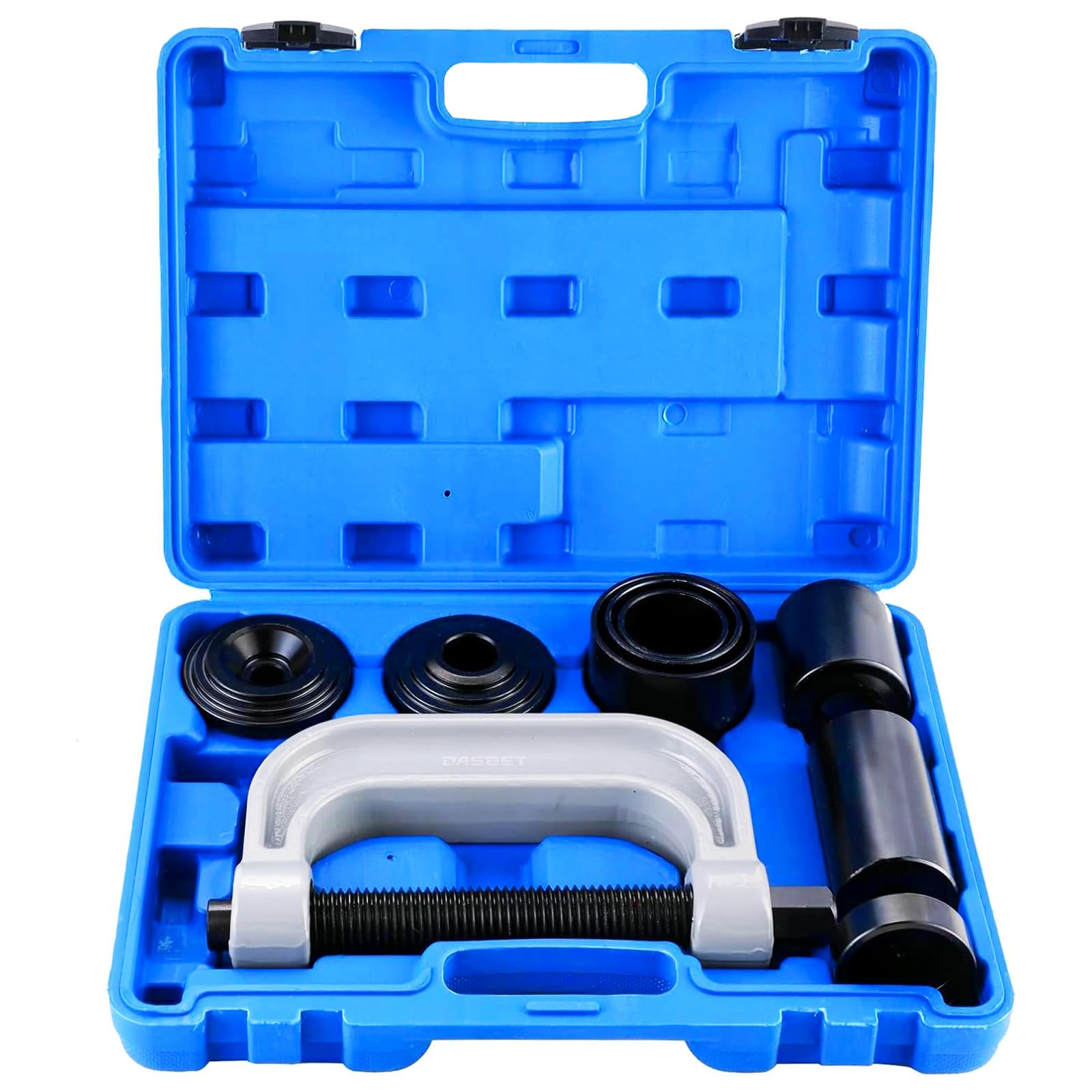
DASBET’s press kit is built around a heavy forged steel C-clamp with a black oxide finish, paired with a forcing screw and nine adapters for pressing ball joints, universal joints, and brake fixing pins. The kit specifically covers Dana 30 and Dana 44 front axles found on 1967–present 1/2 and 3/4 ton 4WD vehicles from Ford, GM, Dodge, IHC, and Jeep—a niche that many universal kits miss.
The receiving cups and installation adapters come in three diameters each, allowing you to match the press fit without damaging the control arm bore. Users report breaking loose ball joints on Jeep Gladiator pitman arms with an estimated 10,000 to 17,000 pounds of force, requiring a 1/2-inch breaker bar torqued past 250 ft-lb. The C-frame did not deform or stretch under this load, confirming the forged steel construction.
The blow-molded case is the weak point—several units arrived with cracked corners due to insufficient padding during shipping. The tool surfaces also carry anti-rust oil residue that should be wiped off before first use. This kit is overkill for passenger car ball joints but essential if you regularly service lifted trucks or vintage 4WD vehicles with press-fit front axles.
Why it’s great
- Adapter set covers Dana 30/44 axles for 4WD trucks
- Forged steel C-frame withstands high force
- Cup sizes match press-fit ball joint bores
Good to know
- Carrying case prone to shipping damage
- Surfaces arrive with anti-rust oil residue
7. DURATECH 5-Piece Ball Joint Separator Set

DURATECH’s set offers five SAE-standard forks—11/16, 15/16, and 1-1/8 inches—paired with two interchangeable handles: a 7-7/8 inch knurled striking handle for conventional hammering and a 6-31/32 inch adapter handle for use with an air hammer. The forks are made from 40# forged steel and chrome-plated to resist corrosion. The blow-molded suitcase keeps everything organized and portable.
Users report that the set made short work of replacing tie rods on a truck and separating ball joints on multiple cars. The knurled handles provide a positive grip even with greasy gloves, and the air hammer adapter is a unique inclusion at this price point—it allows faster removal when you have pneumatic tools available. The chrome plating has held up well against casual shop use and cleaning solvents.
The 40# steel designation indicates a medium-carbon grade that is adequate for DIY and light professional use but not as durable as AISI 1045 or forged alloy steel. The striking handle can loosen with repeated hammer blows; occasional tightening of the collet is recommended. For a weekend mechanic servicing personal vehicles, this set provides functional coverage at minimal investment.
Why it’s great
- Includes air hammer adapter for faster removal
- Chrome plating resists rust
- Interchangeable handles reduce tool count
Good to know
- Steel grade is less hard than premium sets
- Striking handle may loosen with use
FAQ
Can I use a pickle fork without damaging the ball joint boot?
What size ball joint separator do I need for a Ford F-150?
Why does my ball joint puller keep slipping off the joint?
Final Thoughts: The Verdict
For most users, the best ball joint puller winner is the OTC 6297 because its adjustable 2-inch jaw and screw-type mechanism deliver controlled, boot-safe separation on the widest range of FWD and light import vehicles. If you service heavy-duty trucks and need massive throat clearance, grab the Astro Goliath XL. And for a complete front-end service arsenal in one case, nothing beats the versatility of the OTC 6295 kit.