
A 25-key MIDI keyboard is the most space-efficient gateway into music production, beat-making, and live performance. But with keybeds ranging from mushy membrane to responsive mini-keys, and features varying from basic note-entry to full clip-launching and arpeggiation, picking the wrong one means fighting your gear instead of making music.
I’m Min — the co-founder and writer behind Gadgets Feed. I’ve spent countless hours dissecting the technical specifications, DAW compatibility lists, and real user workflows that separate a capable compact controller from a frustrating desk ornament.
Whether you produce in Ableton, compose on an iPad, or need a travel-ready sketchpad, this guide breaks down the seven best options to help you find the best 25 key midi keyboard for your specific creative process.
How To Choose The Best 25 Key MIDI Keyboard
Not all 25-key controllers are built alike. The keybed feel, control surface, software bundle, and DAW integration vary wildly — and each matters depending on whether you’re finger-drumming, sketching chord progressions, or launching clips in a live set.
Key Action and Feel
The keyboard itself is the star. Mini keys are the norm in this class, but their weight, travel distance, and velocity response differ. Some controllers use full-size slim keys (Arturia MiniLab 3) for a more piano-like reach, while others use membrane-style quiet keys (Korg nanoKEY Fold) for silent, discreet play. If velocity sensitivity matters for expressive piano parts, prioritize models with responsive mini keys like the Nektar Impact LX Mini or Akai MPK Mini IV.
Control Surface: Pads, Knobs, and Faders
Drum pads are essential for beat production. The Akai Professional MPK Mini IV features MPC pads with RGB feedback — an industry standard for finger drumming. For knob control, look for 360-degree encoders (MPK Mini IV) or endless rotary knobs (Novation Launchkey Mini 25 MK4) that map seamlessly to software synth parameters. A pitch/mod wheel or touch strip is also a key differentiator for expressive leads and bass lines.
DAW Integration and Software Bundle
Your chosen DAW dictates which controller fits best. The Akai Professional APC Key 25 MK2 is practically built for Ableton Live, with a dedicated 5×8 RGB pad matrix for clip launching. The Novation Launchkey Mini 25 MK4 offers deep integration with Ableton, Logic, and Cubase. The included software bundle (Ableton Live Lite, analog synths, drum kits) can save hundreds of dollars — a critical factor for beginners building their first studio.
Portability and Connectivity
If you travel or produce on the go, size matters. The Korg nanoKEY Fold collapses into a pocket-sized rectangle. USB-C is standard across the board, but some models (Arturia MiniLab 3, Akai MPK Mini IV) also include a 5-pin MIDI out for connecting to hardware synths. If you plan to use an iPad or smartphone, ensure the controller includes a USB-C-to-OTG adapter or is listed as iOS-compatible.
Quick Comparison
On smaller screens, swipe sideways to see the full table.
| Model | Category | Best For | Key Spec | Amazon |
|---|---|---|---|---|
| Akai MPK Mini IV | Premium | Full production & finger drumming | 8 MPC pads with aftertouch | Amazon |
| Arturia MiniLab 3 | Premium | Expressive play & software bundle | Full-size slim keys, mini display | Amazon |
| Novation Launchkey Mini 25 MK4 | Premium | Ableton & FL Studio clip launching | 16 FSR pads, polyphonic aftertouch | Amazon |
| Nektar Impact LX Mini | Mid-Range | DAW control & dual arpeggiators | 16 knobs (2 banks) | Amazon |
| Akai APC Key 25 MK2 | Mid-Range | Ableton Live clip launching | 40 RGB clip-launching pads | Amazon |
| Donner DMK 25 Pro | Value | Beginners & learning | OLED display, 40 teaching courses | Amazon |
| Korg nanoKEY Fold | Compact | Ultra-portable & mobile production | Foldable design, TRS-MIDI | Amazon |
In‑Depth Reviews
1. Akai Professional MPK Mini IV
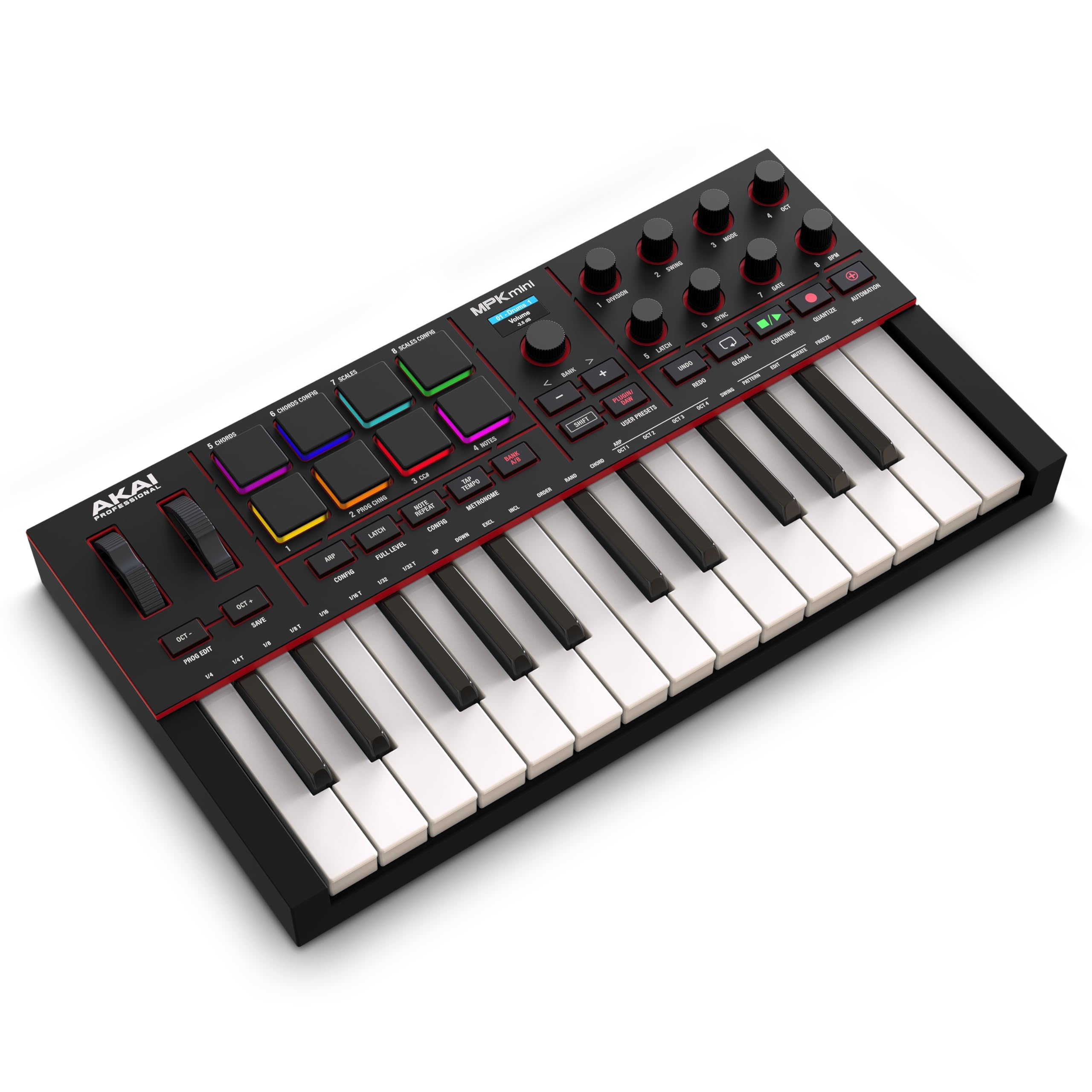
The MPK Mini IV is the gold standard for a complete production controller in a 25-key form. Its 8 velocity- and pressure-sensitive MPC pads deliver the iconic finger-drumming response that beat-makers trust, and the 8 assignable 360-degree knobs give you tactile control over synth parameters without reaching for the mouse. The full-color screen and push/turn encoder make preset browsing and menu navigation fast — a major upgrade over the Mini III.
Under the hood, the arpeggiator includes Pattern, Freeze, and Mutate functions, plus Chord and Scale modes that turn a confined two-octave keybed into a limitless melodic playground. The pitch and mod wheels — not touch strips — provide the precise, spring-loaded control that players prefer for synth leads. USB-C and a full-size MIDI Out jack allow it to interface with both your DAW and external hardware synths.
The bundled software is the deepest in this class: over 1,000 pro-grade sounds from AIR, Akai Pro, and Moog, plus Ableton Live Lite 12, a 30-day Melodics trial, and 2 months of Splice. Pre-mapped integration with Ableton, FL Studio, Logic, and Cubase means you’re productive in under 15 minutes. If you want a single controller that handles drums, melodies, and DAW control, this is the one to beat.
Why it’s great
- MPC pads with RGB feedback are best-in-class for finger drumming
- Full arpeggiator with Pattern, Freeze, and Mutate functions
- USB-C and full-size MIDI Out for hardware synth connectivity
- Massive software bundle saves hundreds of dollars
Good to know
- Mini keys are unweighted — not ideal for advanced piano players
- Front-panel editing of pad sounds is not audible during edit mode
2. Arturia MiniLab 3

The MiniLab 3 stands apart from the mini-key crowd by using full-size slim keys. This may not sound like a big deal, but for anyone transitioning from a real piano or simply wanting better finger placement for chord voicings, the difference is immediate. The keys are velocity-sensitive and have a satisfying resistance — not mushy, not flimsy — making them the most playable in this roundup for melodic expression.
Control-wise, Arturia gave the MiniLab 3 a mini display, a touch-sensitive fader, 8 multi-color drum pads, and 8 rotary knobs. The pads are slightly smaller than MPC-style pads but responsive enough for basic beat programming and clip launching. The included Analog Lab Intro software contains hundreds of vintage synth presets, and the controller is pre-mapped for deep integration with Ableton Live Lite (included) and other major DAWs.
A standout feature is the 5-pin MIDI Out, which lets you control hardware synths and drum machines without an adapter. The USB-C connection works with computers and iPads, and the eco-design uses over 50% recycled materials without sacrificing build quality. If key feel is your top priority and you want a controller that doubles as a classy desktop instrument, the MiniLab 3 is the strongest choice.
Why it’s great
- Full-size slim keys offer the most natural playing feel in this class
- 5-pin MIDI Out for hardware synth control without adapters
- Analog Lab Intro provides hundreds of pro-grade synth presets
- Solid build with eco-friendly recycled materials
Good to know
- Drum pads are smaller and less responsive than MPC pads
- Auto-assign knobs/sliders may not work seamlessly with iPad Logic/GarageBand
3. Novation Launchkey Mini 25 MK4
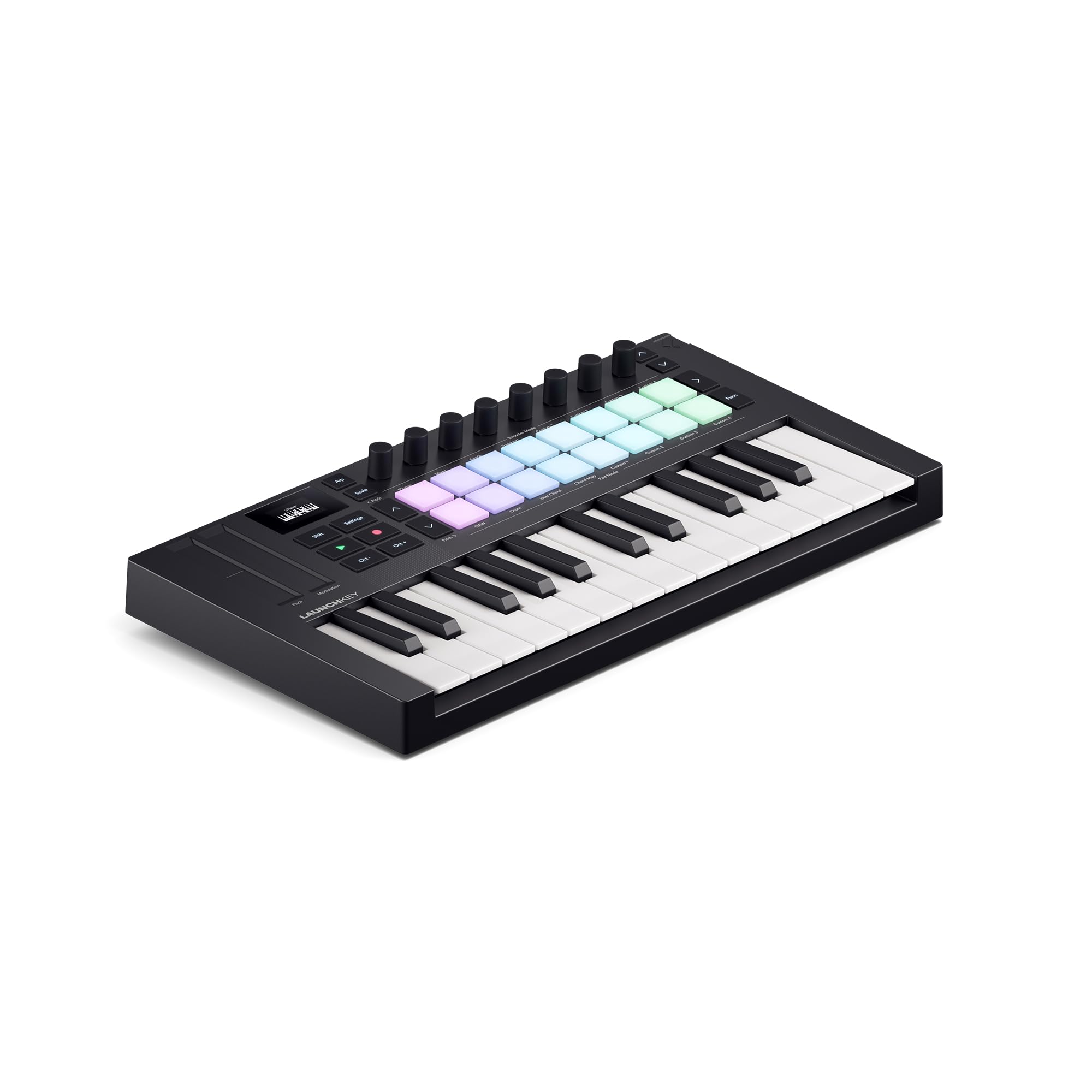
The Launchkey Mini 25 MK4 is designed for producers who live inside their DAW — especially Ableton Live. Its 16 FSR (Force Sensing Resistor) drum pads are a generational leap over standard velocity pads: they respond to the force of your finger, not just the speed, and they support polyphonic aftertouch, meaning each pad can send pressure data independently for nuanced finger drumming and expressive sound design.
The keybed itself is a set of responsive mini keys that reviewers consistently rate as more usable than the Keystep for fast idea input. Scale Mode and Chord Mode eliminate wrong notes by constraining your playing to a selected key or triggering full chords from a single pad. The arpeggiator includes mutate functions for generating evolving patterns. For Ableton users, the transport controls and clip-launching matrix provide deep one-to-one integration out of the box.
The bundled software is generous: Ableton Live Lite, Cubase LE, Novation Play, and sound packs from GForce, Klevgrand, Orchestral Tools, Native Instruments, plus free Melodics lessons. NKS-ready integration means it also controls Native Instruments software seamlessly. If your workflow revolves around clip launching, session view, and fast sketching, the Launchkey MK4 is purpose-built for you.
Why it’s great
- 16 FSR pads with polyphonic aftertouch for expressive drumming
- Deep one-to-one integration with Ableton Live, plus Logic, Cubase, FL Studio
- Scale Mode and Chord Mode eliminate wrong notes instantly
- Lightweight, compact, and backpack-friendly
Good to know
- Knob/fader mapping can be flaky with Reason DAW
- Requires a 3.5mm-to-DIN adapter for hardware synth MIDI out
4. Nektar Impact LX Mini

The Nektar Impact LX Mini punches above its price point by offering 16 assignable knobs across two banks — more real-time control than most competitors at this tier. The dual arpeggiator engine is a hidden gem: you can run two separate arpeggio patterns simultaneously, which is incredibly useful for layering synth bass lines with melodic leads in a small setup.
Nektar’s DAW integration is the headline feature here. The controller maps automatically to most major DAWs — including Logic, Ableton, Cubase, and FL Studio — without manual configuration. The keys themselves have a firm, solid feel that users frequently compare favorably to the AKAI MPK Mini series. The unit also includes an arpeggiator/repeat engine, and the compact footprint makes it ideal for crowded desks or travel rigs.
It ships with Bitwig Studio 8-Track and a sound content package, giving beginners a full production suite out of the box. The only compromise is the USB-A connector (no USB-C) and the lack of Bluetooth, but the value proposition is undeniable. If you need maximum knob control and deep DAW integration on a tight budget, the LX Mini is the smart buy.
Why it’s great
- 16 assignable knobs across two banks for extensive plugin control
- Dual arpeggiator engine enables layered patterns
- Deep DAW integration with automatic mapping for Logic, Ableton, and more
- Solid key feel that rivals more expensive competitors
Good to know
- USB-A connector — no USB-C or Bluetooth support
- Ports on the left side can create cable strain in tight spaces
5. Akai Professional APC Key 25 MK2
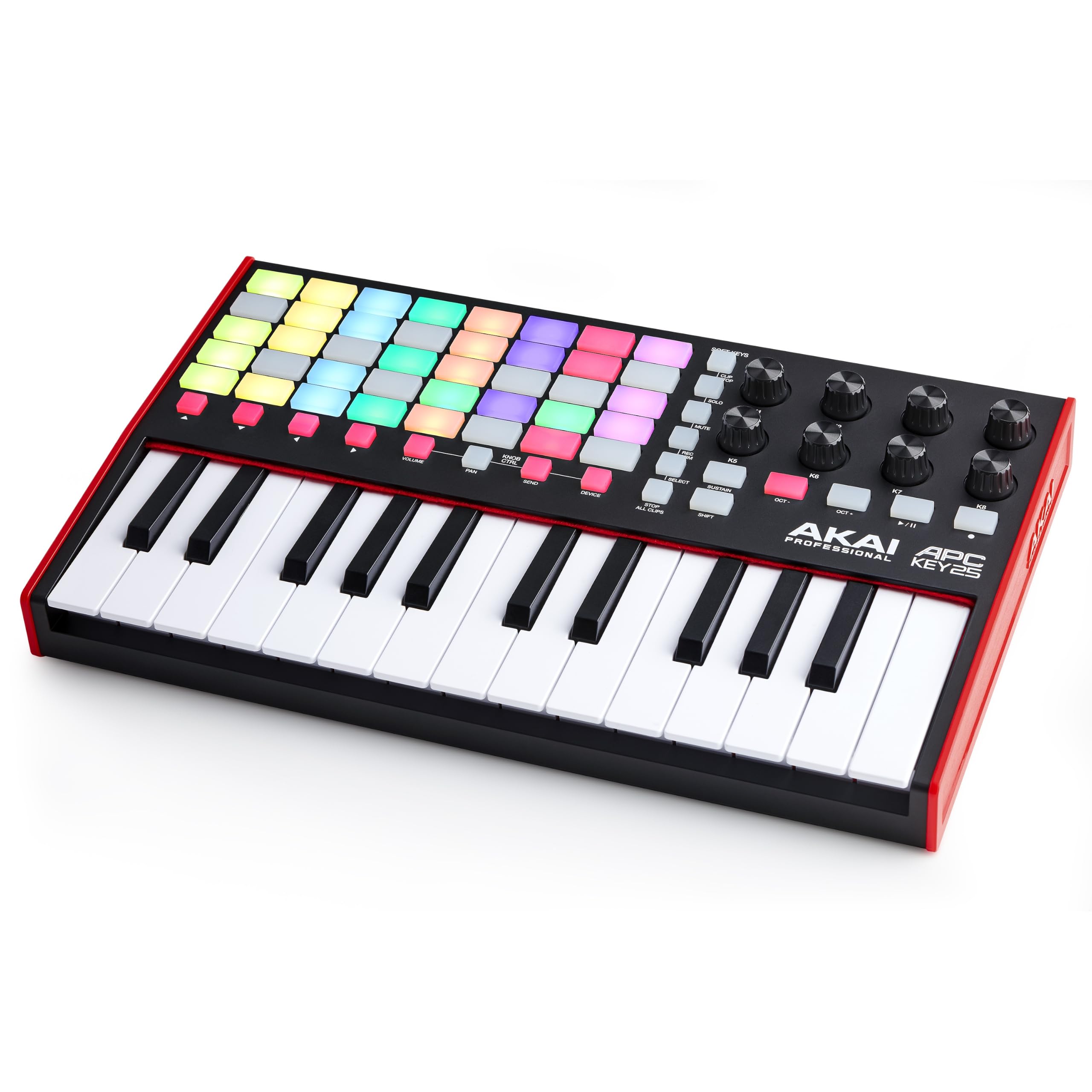
The APC Key 25 MK2 is less a general-purpose MIDI keyboard and more a dedicated Ableton Live instrument. Its defining feature is the 5×8 RGB pad matrix — 40 pads that map directly to Ableton’s clip launching grid, with color feedback matching your session view. This makes it an exceptionally powerful tool for triggering loops, vocals, and samples during live performance or studio jams.
The 25 mini keys are velocity-sensitive and paired with dedicated octave up/down buttons that let you access the full melodic range. Eight assignable rotary knobs control volume, pan, sends, and Device mode macros. The 4-directional arrow buttons let you navigate through tracks and scenes without touching the mouse. For Ableton users, the integration is frictionless: plug in via USB, and the controller is immediately recognized with zero configuration.
It ships with Ableton Live Lite, plus Hybrid 3 (polyphonic analog synth), Mini Grand (acoustic piano), and Velvet (vintage electric piano). The build is solid, the keybed is reliable, and the form factor is compact. If you perform live with Ableton or build tracks around loop-based clip launching, the APC Key 25 MK2 is uniquely suited to your workflow — nothing else in this list offers this level of grid control.
Why it’s great
- 5×8 RGB pad matrix provides instant, visual Ableton clip launching
- Pre-mapped 1-to-1 integration with Ableton Live — plug and play
- 8 assignable rotary knobs for hands-on mixing and macro control
- Includes Ableton Live Lite and premium virtual instruments
Good to know
- Not natively compatible with Ableton 10 — requires manual mapping
- Limited utility outside of Ableton; not a general-purpose MIDI controller
6. Donner USB-C MIDI Keyboard Controller DMK 25 Pro

The Donner DMK 25 Pro is the most feature-dense budget option on this list. The OLED display is unusual at this price point — it shows scale names, arpeggiator settings, and preset info, making navigation far easier than blind LED systems. The 8 touch-sensitive drum pads are velocity-sensitive and work well for basic beat programming, and the 16 smart scale modes let you play in key without hitting wrong notes.
The arpeggiator, note repeat, and chord functions are all present and functional. The ribbon-style pitch/mod touch bar with light scale adds a performance element missing from many entry-level controllers. USB-C connectivity works with PC, Mac, and mobile devices (OTG adapter required for phones/tablets). Donner includes 4 DAW software licenses and 40 keyboard-teaching courses — a real bonus for absolute beginners learning arrangement and music theory.
Customer feedback is mixed on long-term durability — some units have reported key breakage — but for the money, the feature set is hard to match. The unit is lightweight, compact, and includes 4 innovative encoder wheels and 6 transport controllers. If you’re a beginner on a tight budget who wants an OLED screen, drum pads, and educational content all in one box, the DMK 25 Pro delivers tremendous value.
Why it’s great
- OLED display provides clear visual feedback for settings and scales
- 16 smart scale modes and arpeggiator make melody creation easy
- Includes 4 DAW licenses and 40 teaching courses for beginners
- USB-C connectivity compatible with PC, Mac, and mobile devices
Good to know
- Build quality and long-term durability are inconsistent
- Non-standard sustain pedal jack — requires a specific pedal type
7. Korg nanoKEY Fold

The Korg nanoKEY Fold prioritizes portability above all else. Its unique folding mechanism collapses the 25-key controller into a smartphone-sized rectangle that fits in a jacket pocket or backpack accessory pouch. The membrane-style keys are silent — no clicking or clacking — making it the only controller on this list that’s truly discreet for use in quiet spaces like planes, hotel rooms, or coffee shops.
Despite its tiny footprint, Korg packed in serious performance features: a powerful arpeggiator, chord mode, scale guides, assignable touch sliders, split mode, and memory slots for storing presets. The USB-C and TRS-MIDI connectivity lets it plug directly into smartphones, tablets, laptops, and hardware MIDI sound sources without dongles. It’s available in five colors, which is a nice touch for personal style.
The trade-off is feel and durability. The membrane keys lack the velocity response and travel of even average mini keys — they work best for triggering notes rather than expressive piano playing. The plastic build and hinge mechanism feel fragile, and some users report concerns about long-term reliability. But if your priority is having a MIDI keyboard that’s always with you, the nanoKEY Fold is in a class of its own.
Why it’s great
- Folds into a pocket-sized form — unmatched for travel and mobile use
- Silent membrane keys are ideal for discreet play in quiet environments
- Full arpeggiator, chord, scale, and split modes in a tiny package
- USB-C and TRS-MIDI for direct connection to phones, tablets, and gear
Good to know
- Membrane keys lack velocity sensitivity and expressive feel
- Build quality and hinge feel flimsy compared to rigid controllers
FAQ
Can I use a 25-key MIDI keyboard without a computer?
What is the difference between mini keys and full-size slim keys?
Final Thoughts: The Verdict
For most users, the best 25 key midi keyboard winner is the Akai MPK Mini IV because it combines professional-grade MPC drum pads, versatile arpeggiator functions, and a massive software bundle into a compact, USB-C controller. If you prioritize key feel and want the most piano-like playing experience, grab the Arturia MiniLab 3. And for deep Ableton Live integration and clip-launching performance, nothing beats the Novation Launchkey Mini 25 MK4.