
Connecting a TV, game console, or CD transport to a classic stereo amplifier usually demands a digital-to-analog conversion step that can muddy the signal. An optical input on your amplifier eliminates that external converter box, receiving a clean, jitter-free PCM stream directly from your source. That small Toslink port is the difference between a noisy signal chain and the transparent soundstage a good speaker system deserves.
I’m Min — the co-founder and writer behind Gadgets Feed.
Whether you are building a desktop system or upgrading a living room setup, finding the right best amp with optical input means balancing clean power delivery, versatile connectivity, and a DAC section that does not color the sound.
How To Choose The Best Amp With Optical Input
An optical input is a feature, not a category. Choosing the right amplifier means looking past the Toslink port and evaluating how the entire unit handles power, DAC conversion, and connectivity for your specific speakers and sources.
Power output and speaker pairing
Watts per channel must be matched to your speakers’ sensitivity (dB) and impedance (ohms). A 45W amp like the Marantz PM6007 can drive a sensitive bookshelf pair to satisfying levels, but low-sensitivity speakers (under 88 dB) benefit from the higher headroom of a 100W design. Do not chase peak power claims — look for continuous RMS ratings at 8 ohms.
DAC quality and chipset
The optical input feeds a built-in DAC, so the chipset matters. Budget amplifiers often use generic converters that add grain or roll off the treble. Models with dedicated chips — such as the ES9038Q2M in the AIYIMA A80 or the ESS Sabre in the WiiM Amp Ultra — produce measurably lower distortion and better channel separation, especially at moderate listening levels.
Connectivity beyond the optical port
An optical input alone is not enough if your system needs HDMI ARC for TV audio, a phono stage for a turntable, or a dedicated subwoofer output. Evaluate the full I/O panel. The WiiM Amp, for example, includes HDMI ARC and a sub out, making it a genuine hub. A stripped-down desktop amp with just optical and RCA may leave you adding splitters later.
Quick Comparison
On smaller screens, swipe sideways to see the full table.
| Model | Category | Best For | Key Spec | Amazon |
|---|---|---|---|---|
| AIYIMA A80 | Class D DAC Amp | Desktop Hi-Fi with digital VU | ES9038Q2M DAC / 109 dB SINAD | Amazon |
| WiiM Amp | Streaming Amp | Smart multiroom + TV hub | 60W x 2 @ 8Ω / HDMI ARC | Amazon |
| Fosi Audio MC331 | Tube Hybrid | Warm sound on a desktop | 105W x 2 @ 4Ω / VU meter | Amazon |
| Donner Stereo Receiver | Budget Combo | Karaoke and basic TV audio | 25W x 4 RMS / Dual mic inputs | Amazon |
| FiiO K7 | DAC / Headphone Amp | Headphone listening + pre-amp | AK4493SEQ x 2 / 2000mW BAL | Amazon |
| Dayton Audio HTA100 | Hybrid Tube A/B | Living room aesthetics + warmth | 50W x 2 RMS / Bluetooth 5.0 | Amazon |
| WiiM Amp Ultra | Premium Streamer | Room correction + high power | 100W x 2 / ESS ES9039Q2M DAC | Amazon |
| Marantz PM6007 | Classic Integrated | Pure two-channel stereo | 45W x 2 @ 8Ω / HDAM SA3 | Amazon |
| Denon PMA-600NE | Analog-Focused | Vinyl + digital hybrid setup | 70W x 2 @ 4Ω / Analog Mode | Amazon |
In‑Depth Reviews
1. AIYIMA A80 Bluetooth Stereo Amplifier DAC
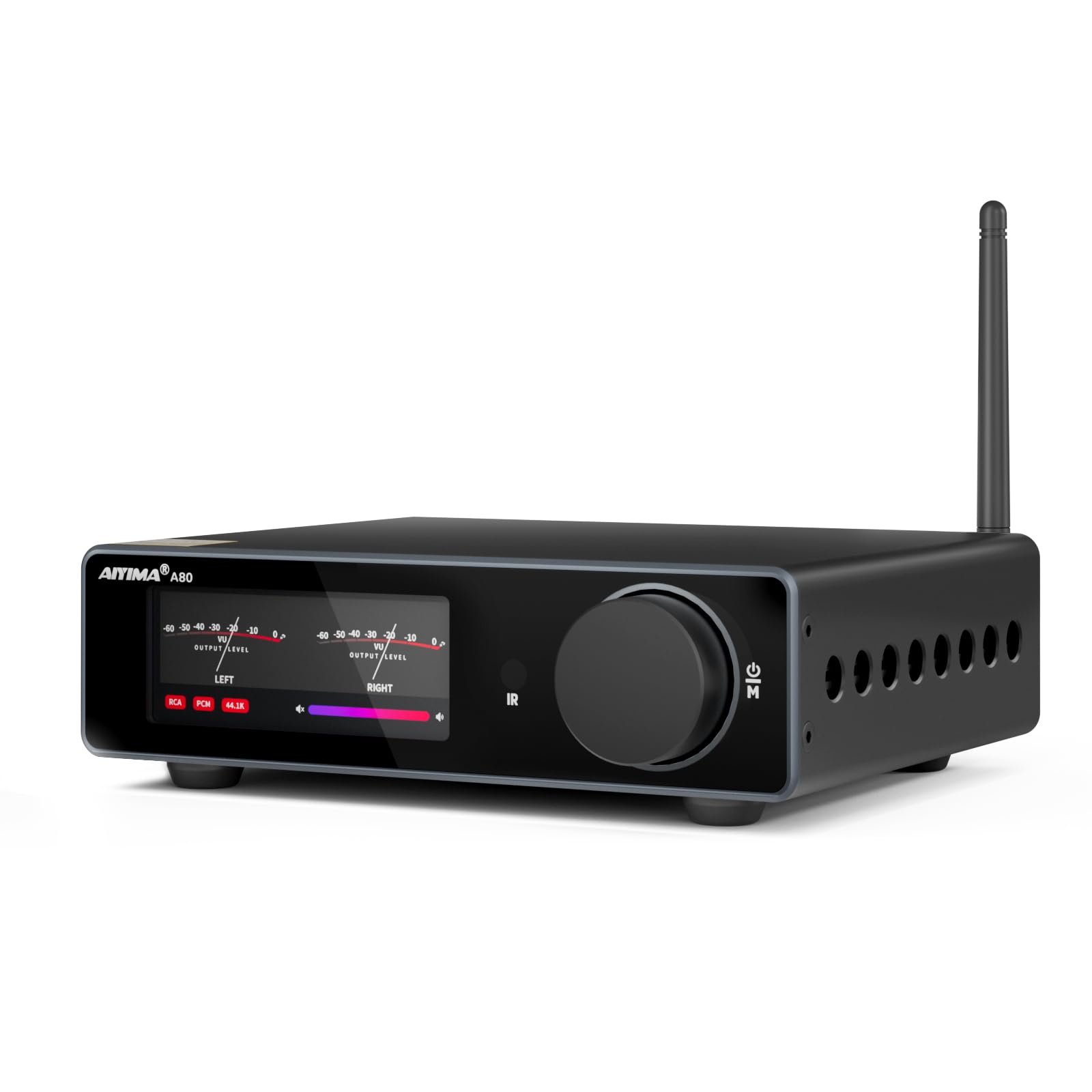
The AIYIMA A80 combines an ES9038Q2M DAC chip with a TPA3255 Class D amplifier in a compact chassis that fits any desktop. With a measured SINAD of 109 dB and total harmonic distortion as low as 0.006 percent, this unit delivers reference-grade clarity through its optical input — a significant step above generic DAC implementations found in cheaper receivers.
Output peaks at 300 watts per channel (peak) with the included 48V 5A GaN power supply, giving it real authority with bookshelf speakers like the Sony SSCS5 or JBL Stage 100. The digital VU meter offers multiple display modes and shows input status, volume, and codec information. The front panel also includes bass and treble knobs, a TRS balanced input, and a 3.5mm subwoofer pre-out for 2.1-channel expansion.
Bluetooth 5.0 streams at near-wired quality, and the USB input supports DSD512 for high-resolution file playback. The all-metal build and smooth rotary encoder add to the tactile experience. For anyone building a small near-field system that demands both transparency and power, the A80 is the strongest all-rounder in this list.
Why it’s great
- Premium ESS DAC delivers exceptional clarity and low distortion.
- Versatile inputs: USB, optical, coaxial, TRS balanced, and Bluetooth.
- Digital VU meter and tone controls add usability and style.
Good to know
- Power output claims are peak; continuous RMS is lower than some competitors.
- Runs warm at higher volumes; requires adequate ventilation.
2. WiiM Amp

The WiiM Amp is a streaming-first amplifier that bridges passive speakers with modern multiroom audio. With 60 watts per channel at 8 ohms and 120 watts at 4 ohms, it provides enough headroom for most living-room speakers. Its HDMI ARC port auto-powers on with your TV, making it a straightforward upgrade from a soundbar for dialogue clarity and stereo imaging in shows and movies.
The WiiM Home App handles room correction, independent EQ per source, and integration with Alexa, Google Assistant, and Siri. Chromecast Audio and AirPlay 2 support let you group the WiiM Amp with other wireless speakers throughout the house. A subwoofer output with adjustable crossover adds flexibility for 2.1 systems without needing an extra processor.
Note that the USB port serves only for local file playback — not as a USB DAC input. The plastic remote feels light, but the app provides full control. For users who prioritize streaming convenience and multiroom sync over pure analog headroom, the WiiM Amp delivers a polished, integrated experience.
Why it’s great
- HDMI ARC simplifies TV audio integration and auto-switching.
- Advanced room correction and source-specific EQ via the app.
- Multiroom audio with AirPlay 2 and Chromecast built-in.
Good to know
- USB port is for storage playback only, not a DAC input.
- Lacks headphone jack and coaxial input.
3. Fosi Audio MC331 Tube Integrated Amplifier
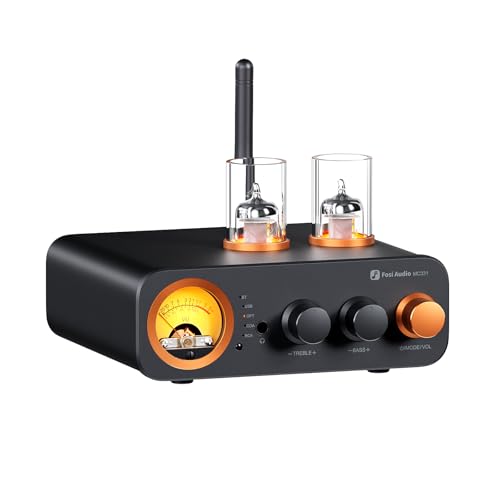
The Fosi Audio MC331 packages a vacuum tube preamp and a Class D amplifier in a chassis that fits next to a monitor. The onboard DAC accepts optical, coaxial, USB, and Bluetooth inputs, while the 5725W tubes add a subtle second-order harmonic warmth that flatters voices and acoustic instruments without turning the sound into a blur.
Rated at 105 watts per channel into 4 ohms, the MC331 drives vintage BOSE 201 and modern bookshelf speakers with authority in medium rooms. The front VU meter provides visual feedback and retro appeal. Bass and treble controls are accessible from the included remote, and a 3.5mm headphone jack with its own amplifier circuit lets you switch to private listening.
The remote control has a noticeable latency of roughly two seconds and requires direct line-of-sight. A subset of units shipped with factory tubes that failed within days, necessitating a replacement set of 6J1 or 5725W tubes — a fix that costs about as much as a streaming subscription. If you are willing to budget for a tube upgrade, the MC331 offers genuinely rich tonality for the money.
Why it’s great
- Warm tube character that standard Class D amplifiers cannot replicate.
- Compact footprint with a built-in DAC and headphone amp.
- Replaceable tubes let you tailor the sound signature.
Good to know
- Factory tubes may fail early; budget for a replacement pair.
- Remote has sluggish response and requires direct line-of-sight.
4. FiiO K7 Full Balanced DAC / Headphone Amplifier

The FiiO K7 is a desktop balanced DAC and headphone amplifier that also works as a preamp for powered speakers. Dual AK4493SEQ DAC chips feed dual THX AAA 788+ amplifiers, delivering 2000 milliwatts of balanced output through a 4.4mm jack — enough power to drive demanding planar magnetic headphones like the Hifiman Sundara or high-impedance Sennheiser HD 600 series without current droop.
The optical input accepts PCM up to 24-bit / 192 kHz, while the coaxial and USB inputs go up to DSD256. The front panel includes a 6.35mm single-ended output and a 3.5mm single-ended output in addition to the balanced 4.4mm. Three gain levels and RGB indicator lights that change color with the sampling rate make the K7 a flexible tool for both critical listening and daily desktop use.
This is not a speaker amplifier — there are no speaker terminals. It functions as a DAC / pre-amp / headphone amplifier only. The dedicated analog volume knob has an intentional dead zone at the bottom for fine adjustment with sensitive in-ear monitors. If you need a headphone-first setup that also feeds a powered subwoofer or active monitors, the K7 is the cleanest signal path available under mid-range pricing.
Why it’s great
- Exceptional balanced output power for demanding headphones.
- Dual flagship AKM DACs with THX AAA amplification for ultra-low noise.
- Compact desktop footprint with multiple input and output options.
Good to know
- No speaker amplifier section — only headphone and pre-amp outputs.
- Marginal audible improvement over good soundcards for casual users.
5. Dayton Audio HTA100 Integrated Stereo Hybrid Tube Amplifier

The Dayton Audio HTA100 uses a hybrid architecture — a vacuum tube preamp driving a Class A/B power stage — to produce a sound that many describe as round, musical, and forgiving. Rated at 50 watts RMS per channel, it drives sensitive bookshelf speakers and high-impedance headphones through the front 6.35mm jack. The audible tube glow and dual VU meters make it a centerpiece in any listening room.
Connectivity includes optical, USB, RCA, Bluetooth 5.0, and a built-in phono preamp for moving magnet turntables. That means you can switch from TV audio via optical to a turntable without swapping cables. The bass and treble knobs give you control over tonal balance without leaving the listening chair. Owners report the HTA100 creates a natural, live-music character that solid-state Class D amplifiers often lack.
The remote control is sluggish and feels low-grade compared to the amplifier itself. The optical input does not support 24-bit / 192 kHz — it tops out at 24-bit / 96 kHz — so high-resolution purists may prefer a separate DAC. For everyday listening across vinyl, streaming, and TV, the HTA100 delivers character and convenience in equal measure.
Why it’s great
- Hybrid tube preamp adds musical warmth without excessive distortion.
- Built-in phono preamp for direct turntable connection.
- Aesthetic VU meters and tube glow suit any shelf or console.
Good to know
- Optical input limited to 24-bit / 96 kHz; not full hi-res.
- Remote control has poor build and noticeable lag.
6. WiiM Amp Ultra

The WiiM Amp Ultra represents a significant jump in both power and processing. At 100 watts per channel into 8 ohms with an ESS ES9039Q2M DAC and dual TI TPA3255 amplifiers, it delivers a measured THD+N of -106 dB. The built-in RoomFit room correction uses an internal microphone to calibrate the output based on your space and speaker placement — a feature previously reserved for much more expensive components.
The front touchscreen displays album art, input status, and system settings, removing the need to always reach for your phone. The connectivity panel includes HDMI ARC, optical, RCA, and Wi-Fi 6 with Bluetooth 5.3 LE Audio. Multiroom support works with WiiM, Alexa, and Google speakers, and the Amp Ultra supports Spotify Connect, TIDAL Connect, Chromecast, and Roon Ready.
There is no coaxial input and no AirPlay support, which limits certain Apple-centric setups. The aluminum body and glass-covered screen feel premium, and the included voice remote matches the build quality. If you want streaming convenience with room-aware tuning and enough power to drive floor-standing speakers, the WiiM Amp Ultra justifies its premium over the base model.
Why it’s great
- RoomFit calibration tailors sound to your specific room acoustics.
- ESS Sabre DAC and dual TPA3255 amps for ultra-low distortion.
- Touchscreen interface and Wi-Fi 6 for fast, reliable streaming.
Good to know
- Does not support AirPlay or coaxial digital input.
- Room correction strength is not adjustable.
7. Marantz PM6007 Integrated Amplifier

The Marantz PM6007 is a traditional integrated amplifier that prioritizes analog signal integrity. It delivers 45 watts per channel at 8 ohms via a current feedback topology and Marantz’s proprietary HDAM SA3 modules. Two optical inputs and one coaxial input feed a built-in 192 kHz / 24-bit DAC, making it equally capable with a CD transport or TV audio.
The MM phono preamp with a FET input stage provides excellent signal purity for vinyl playback, and the five analog inputs cover everything from cassette decks to streaming DACs. Owners consistently describe the sound as warm and detailed, with an open midrange that makes vocals feel present without sibilance. The steel chassis and copper-plated screws reduce resonance.
The units sold through Amazon are UK-spec models requiring a 220-volt step-down transformer for use in North America — a hidden cost and logistical step that is easy to miss. The PM6007 also lacks Bluetooth, HDMI, or subwoofer output, so your source must provide those functions. For a dedicated two-channel stereo system where the amplifier is the only component with speaker terminals, the PM6007 rewards patience with time-tested Marantz engineering.
Why it’s great
- Detailed, musical sound quality that improves with system synergy.
- High-quality phono stage for turntable enthusiasts.
- Robust build with resonance-dampening chassis design.
Good to know
- UK import requires a 220V step-down transformer in US/Canada.
- No HDMI, Bluetooth, or subwoofer pre-out.
8. Denon PMA-600NE Bluetooth Stereo Amplifier

The Denon PMA-600NE targets listeners who want Bluetooth convenience without sacrificing analog purity. Its Advanced High Current (AHC) push-pull circuit delivers 70 watts per channel into 4 ohms and 45 watts into 8 ohms. The optical input pairs with a built-in DAC that produces clean, spacious sound, and the Analog Mode disengages all digital circuitry — including Bluetooth — for undivided analog playback.
Two optical inputs and one coaxial input cover digital sources, while the MM phono input handles turntables. A dedicated subwoofer pre-out makes adding a powered sub straightforward. The Source Direct and Analog Mode functions let you strip away any circuitry you do not need, reducing noise floor further. Owners often describe the sound as warm and tube-like without the maintenance of actual vacuum tubes.
The headphone output drives low-impedance headphones well but struggles with high-impedance models over 100 ohms. The remote is functional but feels cheap relative to the amplifier’s substantial build. The PMA-600NE runs cool compared to Class A/B rivals and includes a 3-year manufacturer warranty. For someone juggling a turntable and a TV, this is a versatile, durable bridge between analog and digital domains.
Why it’s great
- Analog Mode and Source Direct eliminate digital noise when not needed.
- Warm, spacious sound signature that flatters both vinyl and streaming.
- Subwoofer pre-out for easy 2.1 system expansion.
Good to know
- Headphone output is not ideal for high-impedance headphones.
- Remote control build quality does not match the amplifier.
9. Donner Stereo Receiver

The Donner Stereo Receiver packs optical and coaxial digital inputs, Bluetooth 5.0, FM radio, dual microphone jacks with echo control, and four independent speaker channels into one affordable chassis. Rated at 25 watts RMS per channel (1000 watts peak marketing), it is best suited for casual listening, kitchen TV audio, or karaoke parties rather than high-fidelity music reproduction.
The front panel provides independent volume knobs for each of the four channels, along with treble, midrange, and bass controls. The optical input connects to most smart TVs (you may need to set the TV to external audio output mode). The included remote adjusts all tone controls remotely — a rare convenience at this level. For its price, the feature set is dense, covering multiple use cases with a single box.
Customer feedback reveals a split experience: some users find the sound quality surprisingly good with small, efficient speakers, while others report inadequate power for larger towers or low-sensitivity designs. The peak power claims do not translate to real-world current delivery for demanding loads. If you need a simple, multi-channel receiver for casual TV audio and garage stereo duty, the Donner offers broad capability. For critical listening, look higher up this list.
Why it’s great
- Wide feature set: optical, coaxial, Bluetooth, FM, dual mics.
- Individual channel volume knobs for flexible zone control.
- Low entry point for adding optical audio to a basic speaker system.
Good to know
- Power output is limited; struggles with low-sensitivity or large speakers.
- Peak power rating is misleading versus real RMS output.
FAQ
Can I connect a TV to an amp using only the optical input?
Does an optical input sound better than RCA from a TV?
What is the real difference between Class D and Class A/B amplifier topologies?
Final Thoughts: The Verdict
For most users, the best amp with optical input winner is the AIYIMA A80 because it pairs a genuine ESS flagship DAC with enough Class D power for demanding speakers, all in a compact, feature-rich package. If you want full streaming integration and HDMI ARC for a TV-centric living room, grab the WiiM Amp. And for warm, tube-infused character with a built-in phono stage, nothing beats the Dayton Audio HTA100.