
A 100-liter backpack is a serious commitment — a mobile basecamp strapped to your spine. Pushing past the 80L threshold fundamentally changes how you pack, how you carry weight, and which trails you can tackle. The right suspension system and frame design determine whether a 40-pound load feels punishing or manageable over a 10-mile day.
I’m Min — the co-founder and writer behind Gadgets Feed. I’ve spent hundreds of hours cross-referencing torso-length ranges, hipbelt circumferences, frame materials, and real-user load-testing data to separate the packs that distribute weight from those that just promise it.
After analyzing 7 of the leading models on the market, I’ve filtered by frame integrity, adjustability, and long-haul durability to find the best 100 liter backpack for extended backcountry expeditions and heavy gear hauls.
How To Choose The Best 100 Liter Backpack
A 100L pack is built for expeditions, not day hikes. The deciding factors come down to how the load is transferred to your hips, how the frame handles weight shifts on uneven terrain, and whether the organization matches how you access gear on the trail.
Frame and Suspension System
The frame is the backbone of any large pack. Internal perimeter frames with a single aluminum or carbon fiber stay provide a stable, close-to-body carry for loads between 40 and 60 pounds. Packs with adjustable torso lengths and multi-position hipbelts let you fine-tune the fit — critical when the pack itself weighs over 6 pounds empty. A fixed frame that doesn’t match your torso length will cause hot spots and sore shoulders by day two.
Pocket Layout and Accessibility
At 100 liters, the main compartment is cavernous. Good packs compensate with zippered sleeping bag compartments, stretch front pockets for layers, and hipbelt pockets for snacks and navigation tools. Side pockets that swallow 1-liter Nalgene bottles are a must — some packs route pockets inward, making them useless when the pack is fully loaded. Floating top lids that convert into daypacks add versatility for summit scrambles.
Weight and Material Density
An empty 100L pack typically weighs between 4 and 8 pounds. Lighter nylon fabric (210D to 420D) saves weight but sacrifices abrasion resistance when bushwhacking. Heavier Cordura (500D to 1000D) adds durability for military or rough-terrain use at the cost of base weight. The tradeoff is straightforward: lighter packs require careful packing to avoid tears; heavier packs punish your base weight on long carry days.
Quick Comparison
On smaller screens, swipe sideways to see the full table.
| Model | Category | Best For | Key Spec | Amazon |
|---|---|---|---|---|
| Osprey Aether Plus 100L | Premium | Heavy expedition loads, technical terrain | Fit-on-the-Fly hipbelt, 6.69 lb empty weight | Amazon |
| Kelty Glendale 85L-105L | Mid-Range | Thru-hiking and multi-day backpacking | Adjustable perimeter frame, 5.0 lb empty weight | Amazon |
| Tasmanian Tiger Range Tactical MKII | Premium | Military and heavy-duty tactical carry | 700D Cordura, detachable daypack, 8.25 lb empty weight | Amazon |
| Osprey Aether Plus 85L | Premium | Winter camping and bulky gear storage | Removable DayLid daypack, 6.35 lb empty weight | Amazon |
| Cressi Moby 3 Roller 100L | Premium | Travel with dive gear and heavy rollers | Wheeled base with backpack straps, 3.0 lb empty weight | Amazon |
| Night Cat 100L Internal Frame | Budget | Budget-friendly multi-day treks | 100L capacity, 4.4 lb empty weight | Amazon |
| MOUNTAINTOP 80L Internal Frame | Budget | Entry-level backpacking and day hikes | 80L capacity, aluminum frame stay, 2.2 lb empty weight | Amazon |
In‑Depth Reviews
1. Osprey Aether Plus 100L Men’s Backpacking Backpack
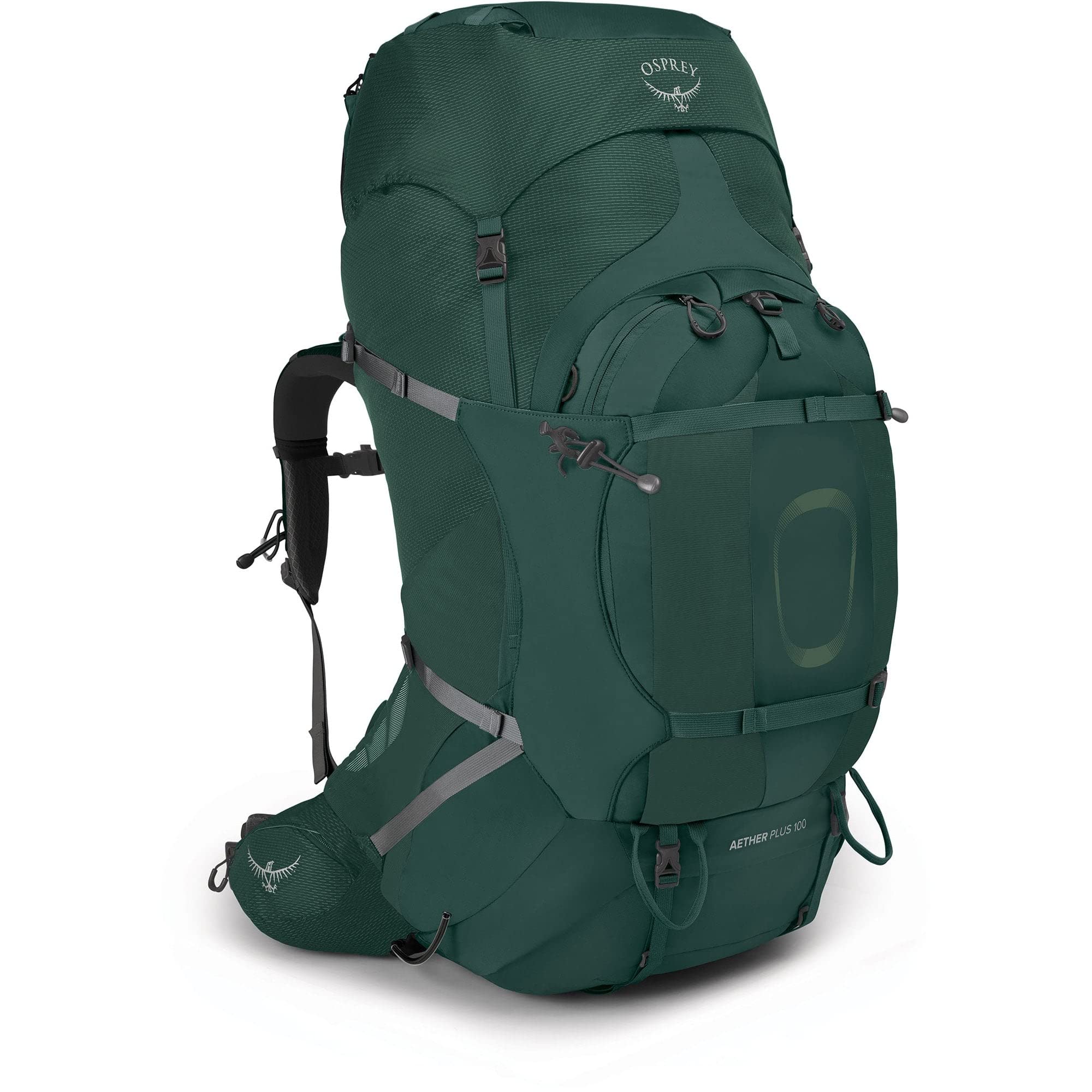
The Osprey Aether Plus 100L is the benchmark for expedition-grade packs. Its Fit-on-the-Fly hipbelt and shoulder straps let you dial in torso length and hipbelt angle on the trail without tools — critical when you are carrying a 50-pound load over granite slabs. The internal perimeter frame keeps the load locked to your center of gravity, reducing sway even when scrambling through boulder fields. At 6.69 pounds empty, it is not ultralight, but every ounce of that weight goes into load transfer efficiency.
The top lid converts into a DayLid daypack with its own shoulder straps, which is genuinely useful for summit hikes or scouting ahead without unstrapping the entire main pack. The J-zip front access and zippered sleeping bag compartment mean you don’t have to dig through 100 liters of gear to reach your tent at the bottom. Dual water bottle pockets on the sides are usable when full, though some users report bottles popping out on aggressive side-hills.
The waist belt pockets are zippered and positioned for one-handed access while hiking, though reviewers note the zipper pulls are small and tricky with gloves on. The included rain cover is made with PFAS-free DWR and bluesign approved fabrics — a thoughtful touch for alpine environments. If you plan to carry bulky winter gear, a bear canister, or a week’s worth of food, this pack handles it without complaint.
Why it’s great
- Fully adjustable hipbelt and torso for fine-tuned fit
- Converts top lid into functional daypack
- Excellent load transfer to hips for heavy carries
Good to know
- Side water bottle pockets can eject bottles on uneven terrain
- Waist belt zippers are glove-unfriendly
- Heavy base weight compared to frameless alternatives
2. Kelty Glendale 65L to 105L Internal Frame Backpack
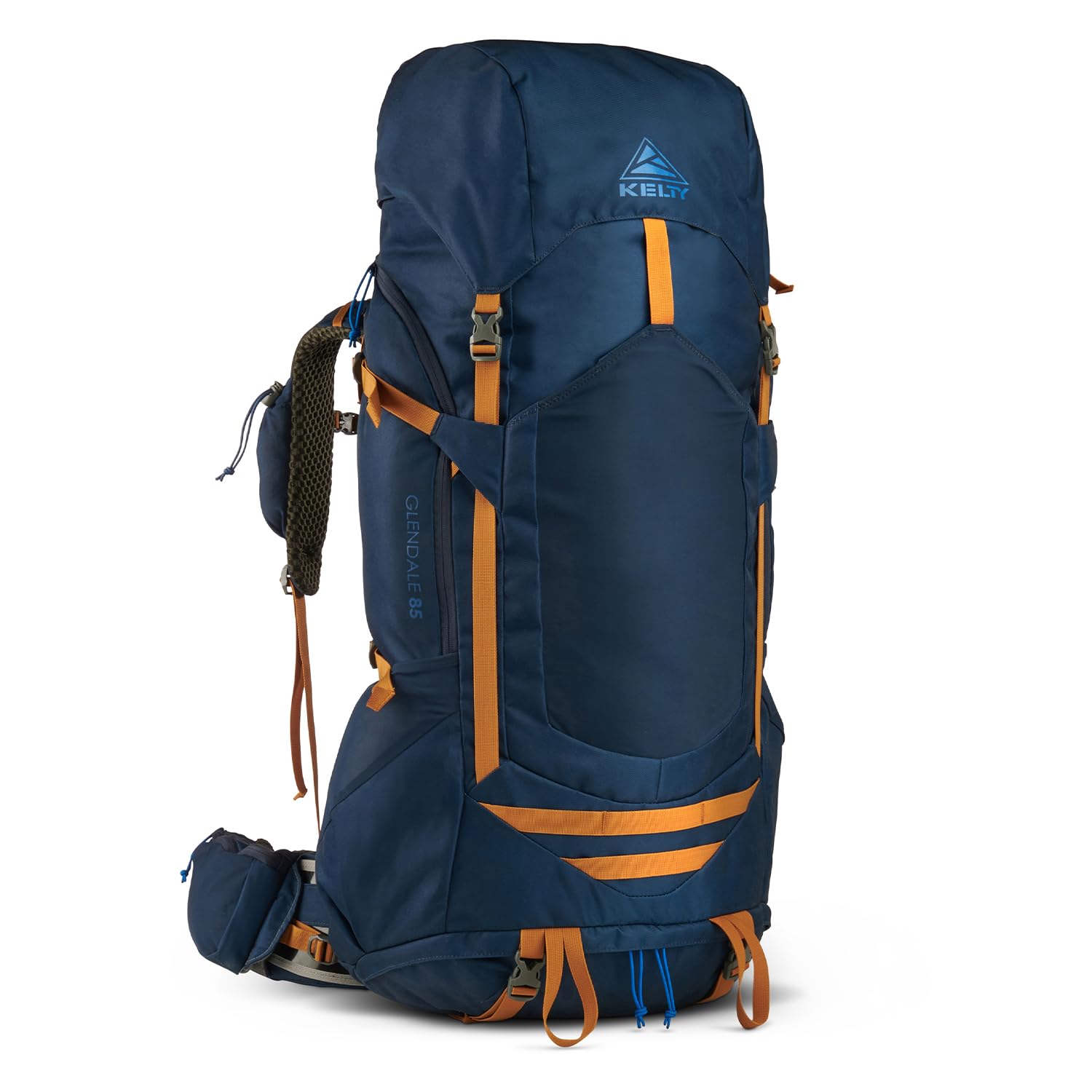
The Kelty Glendale sits in a sweet spot between price and performance for multi-day backpackers. Its redesigned suspension system with size-adjustable torso and hipbelt accommodates a wider range of body types than its predecessor, and the perimeter frame provides enhanced stability when loads creep past 45 pounds. The 85L version expands to 105L with the extension collar, giving you flexibility for trips where you need extra volume for bulky gear like a winter sleeping bag or bear canister.
Dual stretch pockets on the shoulder straps hold a phone or bear spray within easy reach, which is a thoughtful detail missing from many packs at this price point. The J-zip front access and zippered sleeping bag compartment mirror Osprey’s layout but at a significantly lower investment. The stretch shove pocket in front can swallow a rain shell or puffy jacket without compression. Reviewers praise the comfort and fit, though some note that the hipbelt barely cinches on smaller frames even at its tightest adjustment.
The side pockets are designed to accept large canteens, but when the pack is fully loaded, the inward angle makes them tight to access without a partner’s help. The floating top lid is removable but does not convert into a daypack — a tradeoff at this price tier. At 5.0 pounds empty, it strikes a reasonable balance between durability and weight for thru-hikers who prioritize organization over ultralight grams.
Why it’s great
- Excellent pocket layout with stretch shoulder and hipbelt pockets
- Adjustable torso and hipbelt fit a wide range of body sizes
- J-zip front and sleeping bag compartment for easy access
Good to know
- Side pockets become inward-tight when pack is full
- Hipbelt may not cinch adequately for very small frames
- Top lid does not convert to daypack
3. Tasmanian Tiger Range Tactical Backpack MKII

The Tasmanian Tiger Range MKII is built for a different mission than traditional backpacking packs. Constructed from 700 denier Cordura, this pack is designed to survive dragged over rocks, dropped from vehicles, and stuffed into tight helicopter cargo bays. The X-1 carrying system uses an adjustable aluminum frame that distributes loads exceeding 70 pounds to the hips, which is rare in civilian packs. At 8.25 pounds empty, it is the heaviest pack on this list, but the tradeoff is extraordinary abrasion resistance.
The detachable front pocket converts into a standalone daypack with its own shoulder straps, giving you a summit pack without dedicating space to a separate bag. The MOLLE system on the sides and front allows for modular attachment of pouches, radios, or hydration carriers — critical for tactical users who need to reconfigure their carry per mission. The main compartment opens clamshell-style with a J-zip, and the lower compartment is separated by a zippered divider suitable for a sleeping bag or wet gear.
User reviews consistently highlight the weight distribution as exceptional even when packed to 50 pounds, but note that the lower compartment is tight for a compressed military sleep system with multiple bags. The rain cover is sold separately, which is notable at this price point. For civilian thru-hiking, this pack is overbuilt — but for extended field operations, hunting trips, or anyone who treats their gear like a tool rather than equipment, it delivers unmatched durability.
Why it’s great
- Extremely durable 700D Cordura construction
- Modular MOLLE system for mission-specific configuration
- Detachable front pocket doubles as functional daypack
Good to know
- Over 8 pounds empty — very heavy for civilian backpacking
- Lower compartment too small for compressed military sleep system
- Rain cover not included
4. Osprey Aether Plus 85L Men’s Backpacking Backpack
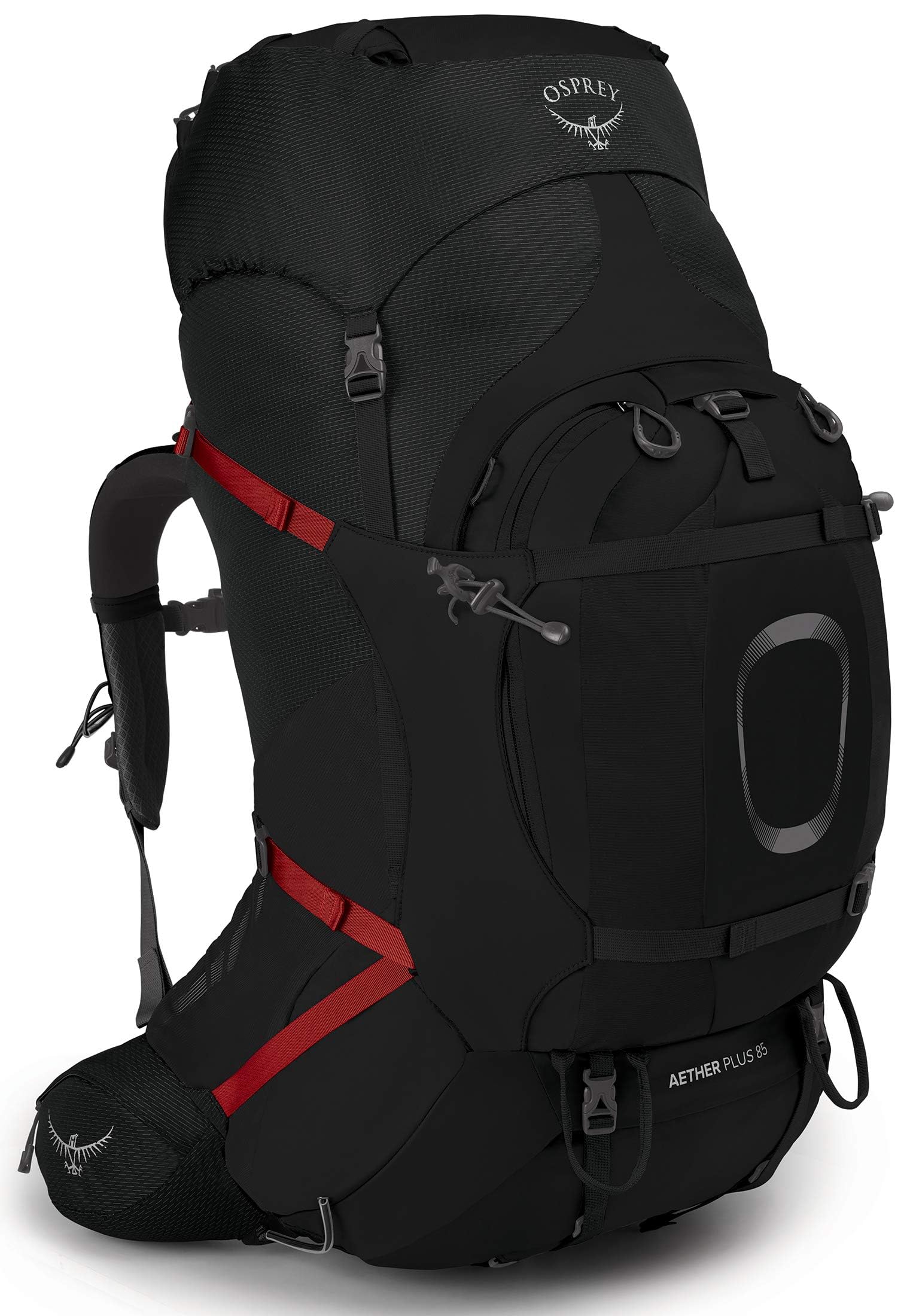
The Osprey Aether Plus 85L shares the same suspension DNA as its 100L sibling but packs into a slightly shorter, more manageable profile. The Fit-on-the-Fly hipbelt and shoulder straps are identical, meaning you get the same load-transfer engineering in a package that is less prone to over-packing. At 6.35 pounds empty, it is lighter than the 100L version while still accommodating bulky winter gear, a bear canister, and a week’s worth of supplies for users who don’t need the extra 15 liters.
The removable DayLid daypack is the same system found on the 100L — it unclips from the top lid and deploys as a standalone pack with its own shoulder straps. This feature alone justifies the premium over cheaper packs if you plan to use your base camp as a hub for day hikes. The sleeping bag compartment has a removable divider, and the front J-zip access provides full visibility into the main compartment without unloading everything from the top.
Reviewers consistently rate the comfort as excellent even with loads pushing 50 pounds, though some note that the hipbelt’s adjustability range may be insufficient for very narrow waists. The included rain cover is PFAS-free, and the main fabric is bluesign approved. For backpackers who want Osprey’s proven suspension but don’t need the full 100 liters, this is the smarter choice — it carries smaller loads more efficiently and avoids the temptation to overpack.
Why it’s great
- Same excellent suspension as the 100L version
- DayLid daypack system is genuinely useful
- More manageable size reduces overpacking temptation
Good to know
- Hipbelt adjustability may not suit very narrow frames
- Side bottle pockets can lose bottles on technical terrain
- Still heavy for an 85L pack at 6.35 pounds
5. Cressi Moby 3 Large Capacity Roller Luggage 100L
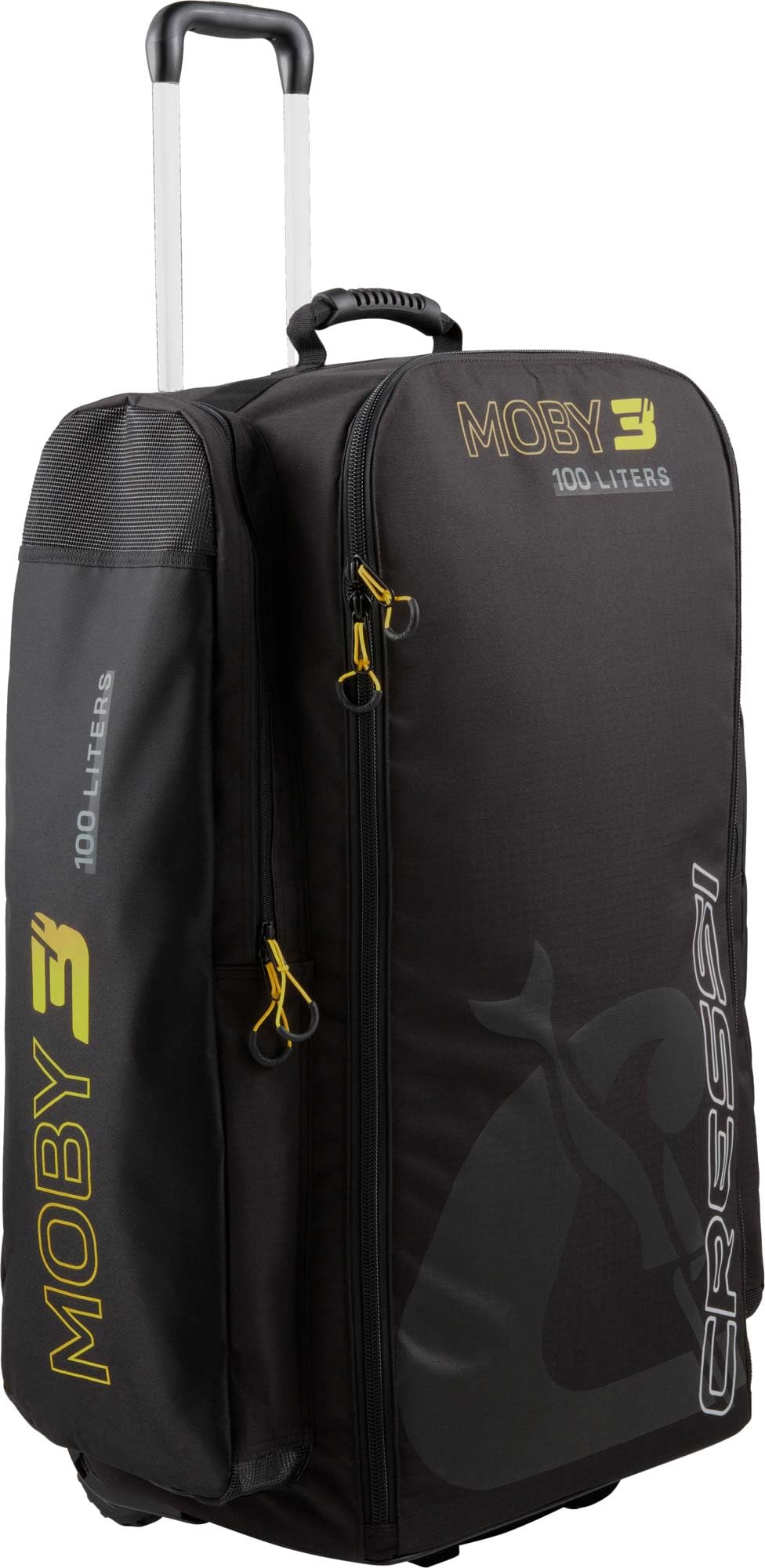
The Cressi Moby 3 is a hybrid design that blurs the line between duffel and backpack. It features large-diameter wheels and a telescoping handle for smooth rolling on airport tiles, but also includes padded shoulder straps and a reinforced back panel for carrying up stairs, curbs, or unpaved paths. This dual-mode approach makes it uniquely useful for travel scenarios where you need to haul dive gear, photography equipment, or heavy tools between vehicles and job sites.
The main compartment opens on three sides for suitcase-style packing, eliminating the need to dig through a top-loading tube to find gear at the bottom. Two large side pockets are specifically shaped to hold dive fins, but also work for water bottles, tripod legs, or rolled rainwear. YKK zippers are used throughout, and the base weight is just 3.0 pounds — remarkably light for a 100-liter roller bag, thanks to the nylon construction rather than hard-shell plastic.
Reviewers consistently note that the backpack straps are functional for short carries but lack the load-bearing suspension of a dedicated hiking pack — this is not designed for 10-mile trail days. The wheels perform well on smooth surfaces but struggle on gravel or sand. For its intended use case (hauling heavy gear through airports and to dive sites), it is excellent. For wilderness backpacking, look elsewhere.
Why it’s great
- Wheeled design with functional backpack straps for hybrid carry
- Three-sided main compartment opens like a suitcase
- Light 3-pound empty weight for a 100L bag
Good to know
- Backpack suspension is not suited for long trail carries
- Wheels struggle on gravel, sand, or uneven ground
- Limited to airport-to-taxi type use cases
6. Night Cat 100L Internal-Frame Hiking Backpack
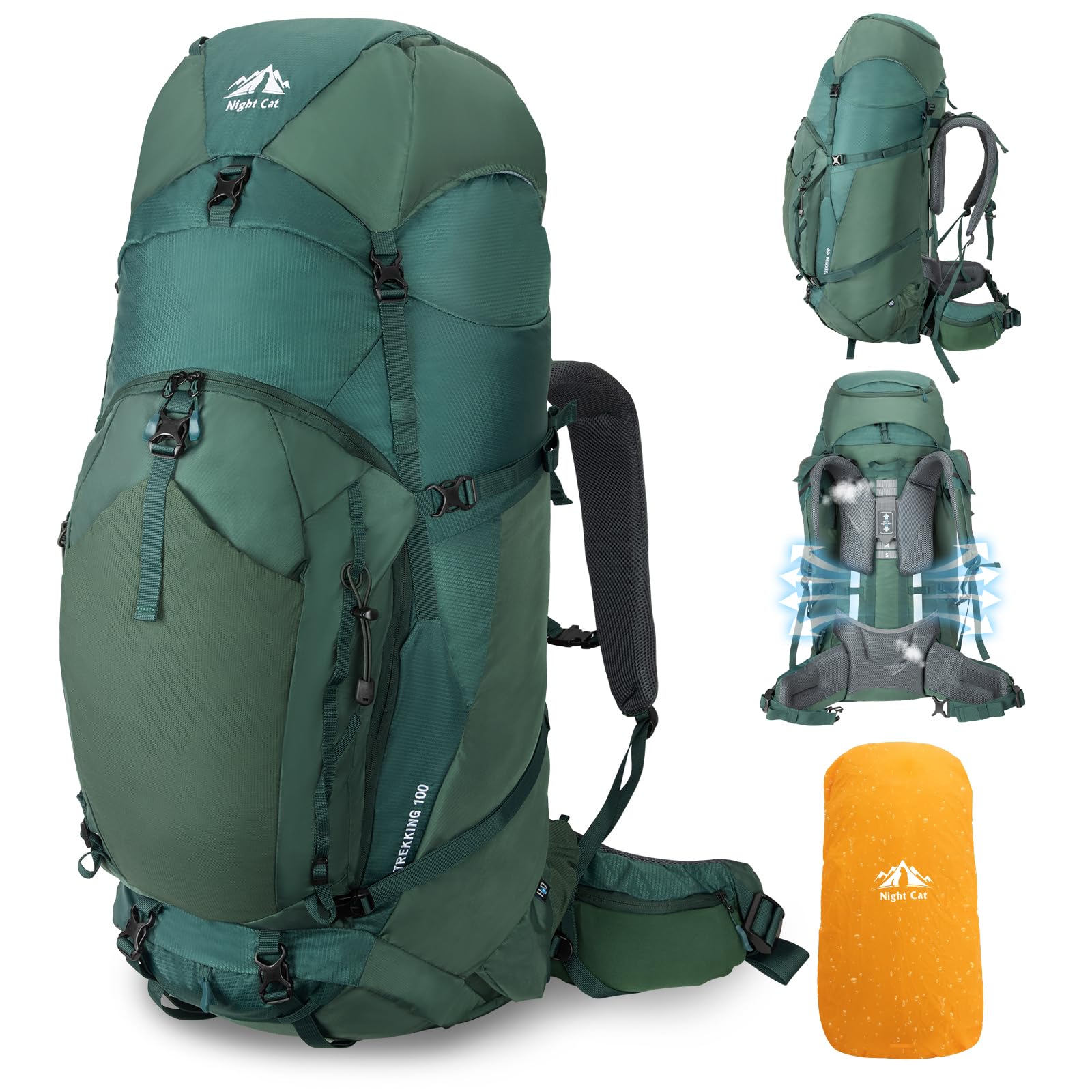
The Night Cat 100L offers a full internal-frame suspension at a price point that competes with small daypacks. The aluminum stay frame and ventilated back panel provide functional load transfer, and the adjustable torso length covers most adult heights between 5’0″ and 6’2″. The main compartment divides into top, main, and base sections with separate access, which is impressive for a pack in this tier. At roughly 4.4 pounds empty, it is competitive with packs costing twice as much.
Rain cover is included, which is a welcome inclusion at this price. The hydration bladder compartment fits a 3-liter reservoir, and the tube routing exits cleanly over the shoulder strap. The side pockets are deep enough to hold standard 1-liter water bottles, though the fabric lacks the stretch of premium brands. The hipbelt is padded and reasonably shaped, but the adjustment mechanism uses a simpler buckle system that may slip under very heavy loads above 50 pounds.
User reviews are mixed on long-term durability — some report excellent performance over multi-week trips, while one reviewer experienced a bottom seam tear after four days. Quality control appears to vary between units. For lightweight backpackers who pack under 40 pounds and need 100 liters for bulky but light gear, this pack offers immense value. For serious expeditions where a pack failure would end the trip, the material density is a real concern.
Why it’s great
- Full internal-frame suspension at an entry-level price
- Adjustable torso for multiple body types
- Included rain cover and hydration sleeve
Good to know
- Durability concerns with reports of seam failure under heavy loads
- Hipbelt may slip when loads exceed 50 pounds
- Fabric density is lower than premium competitors
7. MOUNTAINTOP 80L Internal Frame Backpack

The MOUNTAINTOP 80L sets the floor for what a functional internal-frame backpack costs. It uses lightweight aluminum frame panels to provide basic load structure, and the ergonomic back padding is comfortable for loads up to 35 or 40 pounds. The 80-liter capacity is slightly below the 100L threshold, but the inclusion of a hydration sleeve, side zip access, and a removable sleeping bag compartment makes it a credible option for budget-conscious backpackers tackling weekend trips.
YKK zippers are a surprising find at this price point, and the included rain cover provides a layer of weather protection that many entry-level packs omit. The hipbelt fits up to 46-inch waists, which is rare for budget gear and makes it accessible to larger body types. Side pockets are deep and usable when the pack is full, though the stretch material on the front shove pocket is minimal compared to premium alternatives.
At 2.2 pounds empty, this is the lightest pack on the list, but that featherweight comes from thinner nylon fabric that sacrifices abrasion resistance. Users report the pack holds up well for moderate use, but the aluminum frame stays are less supportive than the perimeter frames on the Osprey or Kelty models. For someone getting into backpacking without wanting to invest heavily upfront, this pack performs well for its price tier — just keep loads reasonable and avoid bushwhacking through dense scrub.
Why it’s great
- Extremely light at 2.2 pounds empty
- YKK zippers and rain cover at a budget price
- Hipbelt fits larger waist sizes up to 46 inches
Good to know
- Limited to 80L — below the 100L threshold for this category
- Thin nylon fabric is less abrasion-resistant
- Aluminum frame stays lack perimeter-frame stability
FAQ
What torso length do I need for a 100L backpack?
Is a 100L backpack too big for a week-long trip?
How do I prevent a 100L pack from sagging when half-full?
Final Thoughts: The Verdict
For most users, the best 100 liter backpack winner is the Osprey Aether Plus 100L because its adjustable suspension handles heavy, technical loads better than any other pack on this list while the DayLid conversion adds genuine versatility. If you want a near-identical experience at a lower price, grab the Kelty Glendale for its excellent pocket layout and perimeter frame. And for military-grade durability where gear failure is not an option, nothing beats the Tasmanian Tiger Range MKII.