
Swapping out a 60-watt incandescent bulb for a standard LED fixture cuts power draw by over 80%, but the real question for accent and task lighting is whether a dedicated LED strip system can beat your existing overheads on cost per lumen. The gap between what a 5-meter tape pulls at full brightness versus a ceiling fixture running 10 hours a day translates into real dollars over a year.
I’m Min — the co-founder and writer behind Gadgets Feed. I specialize in breaking down the raw specs, lumens-per-watt ratios, and control-system efficiency of consumer LED lighting to help buyers make an informed choice between strip-based and traditional home lighting.
This guide compares power draw, brightness per foot, and control system overhead to help you determine are light strips cheaper on power bill than house lighting for your specific layout.
How To Choose The Best Strip For Power Bill Savings
Not every LED strip saves you money. Standard decorative RGB tape with a cheap controller can waste 10-15% of incoming power through resistance heat and adapter inefficiency. The right COB strip running at 24V with a high CRI and proper driver will beat any incandescent or halogen fixture by a factor of six or more on lumens per watt. The key is matching the strip’s total wattage to your room’s actual light requirement.
Voltage Choice: 12V vs 24V Efficiency
24V strips carry current at half the amperage of 12V for the same wattage, which cuts copper losses in long runs. If you’re running 15 feet or more from the power supply, 24V reduces voltage drop significantly and keeps brightness uniform from end to end. Every millivolt lost to resistance is wasted energy that doesn’t become light, so 24V systems are inherently more bill-friendly for extended installations.
COB vs SMD: The Density Factor
Chip-on-Board (COB) technology packs hundreds of tiny diodes per meter, producing a continuous line of light without visible dots. Those tiny chips operate at lower individual current than larger SMD 5050 or 2835 packages, which shifts the efficiency curve upward. A high-density COB strip at 400 LEDs per meter can deliver 3000 lumens from under 30 watts — a ratio that beats most ceiling-mounted LED panels on a per-watt basis.
Quick Comparison
On smaller screens, swipe sideways to see the full table.
| Model | Category | Best For | Key Spec | Amazon |
|---|---|---|---|---|
| PAUTIX COB 24V | Premium | High-efficiency accent lighting | 2400 LEDs, 24V, CRI 93+ | Amazon |
| Pandery COB 24V | Premium | Touch-dimmable task lighting | 1600 LEDs, 24V, CRI 90+ | Amazon |
| Tatazone Smart COB Wi-Fi | Mid-Range | Voice-controlled smart accent | 1920 LEDs, 16.4ft, 3000K | Amazon |
| BTF-LIGHTING FCOB COB | Mid-Range | UL-listed DIY linear lighting | 336 LEDs/m, 12V, CRI 90+ | Amazon |
| DAYBETTER COB 24V | Mid-Range | Daylight white task lighting | 1600 LEDs, 24V, 6500K | Amazon |
| TOPAI 3mm Narrow COB | Budget-Friendly | Ultra-narrow space installations | 400 LEDs/m, 12V, 3mm width | Amazon |
| DAYBETTER RGB 200ft | Budget-Friendly | Large-room color ambiance | 200ft, RGB, app + remote | Amazon |
In‑Depth Reviews
1. PAUTIX COB LED Strip Light, 16.4ft

Pushing 2400 individual diodes across a 24V bus, this strip achieves a higher lumen-per-watt ratio than typical 12V designs because the lower current per foot reduces copper losses. The CRI 93+ rating means the light renders colors with near-sunlight fidelity, which is rare at this wattage per meter. UL listing and lead-free construction close the loop on safety and environmental concerns.
The included RF remote handles dimming in three steps — 25%, 50%, 100% — which gives you direct control over power draw. At 25% brightness you are effectively running a 12W load over 16 feet, which translates to pennies per hour of operation. The six-year warranty is longer than most homeowners keep a ceiling fixture.
Real-world installers report the adhesive struggles with textured surfaces, requiring mechanical clips for permanent mounting. The remote operates on line-of-sight RF through walls up to 99 feet, but there is no app or voice control if you want to tie it into a smart home schedule. For a pure hardwired solution with minimal standby waste, this is the top performer.
Why it’s great
- Highest diode density at 480 LEDs/m reduces per-LED current draw
- UL listed with 6-year warranty and lead-free materials
- Three-level dimming directly trims power consumption
Good to know
- No Wi-Fi or smart assistant integration for scheduling
- Adhesive backing does not bond well to rough surfaces
2. Pandery COB LED Strip, 16.4ft

This 24V strip uses a 180-degree beam angle to spread 1600 COB diodes across 16.4 feet, creating a continuous light line at an efficiency level that outpaces most linear fluorescent tubes.
The touch-control dimmer allows 10% to 100% brightness stepping, meaning you can drop power consumption to roughly 3.6W when the strip acts as a night light. The 50000-hour rated lifespan means the strip will outlast several generations of power adapters. Double-sided copper PCB helps heat management, keeping the LEDs at their optimal junction temperature for consistent lumen output.
A few buyers note that the touch sensor is sensitive to moisture or accidental contact, and the controller lacks a memory function for power-outage recovery. It ships with the power supply included, so you skip the compatibility guesswork that wastes efficiency with mismatched adapters.
Why it’s great
- Touch dimmer provides stepless power reduction down to 10%
- 180-degree beam eliminates wasted light spill behind the strip
- Includes power supply matched to 36W peak draw
Good to know
- Touch control can activate inadvertently with moisture
- No state memory after a power cycle
3. Tatazone Smart White COB LED Strip, 16.4ft
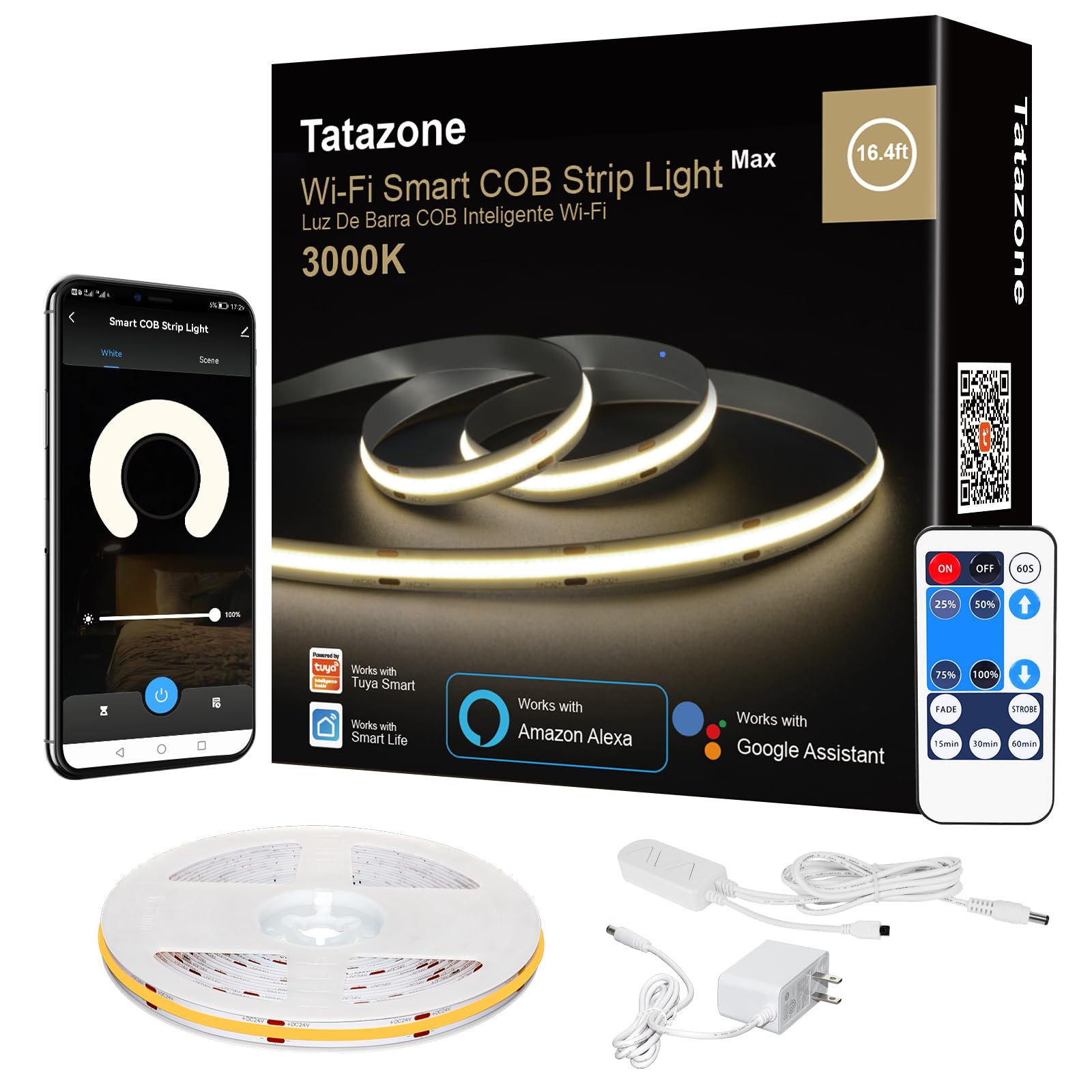
Connecting 1920 COB diodes to the Tuya/Smart Life platform gives this strip a decisive advantage for bill-conscious users: scheduling. You can set the strip to run only during occupied hours and drop to 1% brightness at bedtime, eliminating the human error of leaving lights on. The 3000K warm white tone is close to halogen color but pulls a fraction of the wattage.
Voice control via Alexa or Google Assistant removes the friction of walking to a switch, which sounds minor but measurably increases the likelihood of turning lights off when leaving a room. The included IR remote and controller button give fallback options if the Wi-Fi network drops, so standby power is not wasted polling a dead connection. An 8.2-foot cord from the power supply to the tape relieves placement constraints near outlets.
Some units have experienced controller glitching after a few months, resulting in the strip staying on permanently until the adapter is physically unplugged. The seller’s support reportedly ships replacement controllers on request, but the failure mode directly wastes power until addressed. This is the clear choice if automation is your method of reducing runtime.
Why it’s great
- Smart scheduling and voice control cuts unnecessary runtime
- Long adapter-to-strip cord eases placement next to outlets
- COB density delivers bright continuous light at low per-chip draw
Good to know
- Controller can fail and lock strip to full-on state
- IR remote response has noticeable delay
4. BTF-LIGHTING FCOB COB LED Strip, 16.4ft
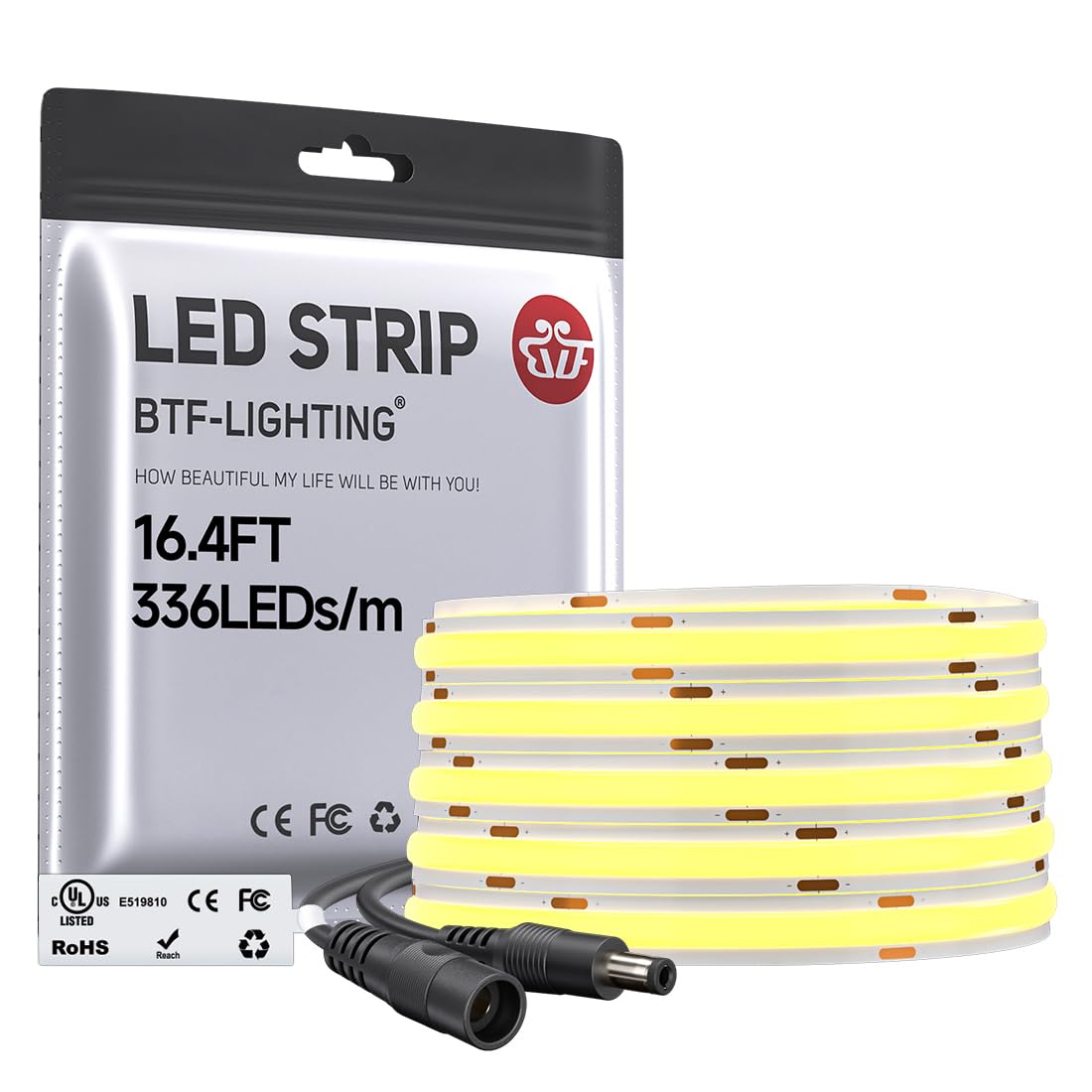
The FCOB (Flip Chip On Board) construction places the diodes directly on the PCB without wire bonds, reducing electrical resistance at each junction. Customers measuring actual draw reported 1.43A at 24V for a total of 34.32W across the 16.4-foot length, which works out to approximately 6.9W per meter. For a 2700K warm white strip with CRI 90+, that is within the efficiency band of a premium LED tube.
UL listing adds confidence that the PCB and solder masking meet fire-safety standards, which matters when the strip runs for extended hours under cabinets or inside coves. The strong 3M adhesive and double-layer copper PCB help dissipate the modest heat generated at 12V, though running it at 24V with a compatible controller yields higher efficiency per lumen. The strip is cuttable at marked intervals and can be reconnected with solderless connectors.
This unit ships without a power supply or controller, so the onus is on you to match a driver that delivers the correct voltage and adequate current without excessive overhead. A poorly matched adapter can waste 20% of the input power as heat, negating the strip’s natural efficiency.
Why it’s great
- Flip-chip design reduces junction resistance for better efficiency
- UL listed with double-layer copper PCB for heat management
- Measured draw of roughly 34W per 16.4ft at full brightness
Good to know
- No power supply or controller included
- Adhesive is weak on porous surfaces; recommend U-channel mounting
5. DAYBETTER COB LED Strip, 16.4ft

This 24V strip outputs a 6500K daylight white that matches the color temperature of many home office ceiling panels, but at a fraction of the total wattage. The 1600 COB LEDs spread across 16.4 feet produce a uniform beam with no dark spots, and the included dimmer lets you drop brightness to 0% — effectively turning the strip into a zero-watt off state when not needed, assuming the power supply has no parasitic draw.
The self-contained kit includes a 24V power adapter and a button-style dimmer, so there is no compatibility guesswork. Running at full brightness, the 24V bus keeps amp draw low enough that you can daisy-chain multiple strips from a single higher-capacity adapter without worrying about voltage drop. The 0.57-pound total weight and flexible PCB make it easy to route along cabinet edges and corners.
A small number of users report flickering developing after a few weeks of use, typically linked to a solder joint on the power supply rather than the strip itself. The adhesive tape is strong when applied to clean, dry surfaces, but repositioning can weaken the bond. For a straight-up replacement of under-cabinet task lighting with minimal complexity, this is the most direct swap.
Why it’s great
- 24V system reduces amperage and voltage drop over long runs
- All-in-one kit with matched adapter and dimmer
- Daylight color temp ideal for task lighting without ceiling fixture overhead
Good to know
- Some units develop flicker from power supply solder quality
- Adhesive loses tack if repositioned during install
6. TOPAI 3mm Narrow COB LED Strip, 16.4ft

At only 3mm wide, this strip fits into crevices where an 8mm COB or standard SMD tape simply cannot go — picture the gap behind a picture frame, inside a display cabinet groove, or along a thin mirror edge. The 400 LEDs per meter density pushes the theoretical brightness to 3000 lumens per 5-meter run, all while the 12V bus keeps the per-chip current low enough that heat dissipation is not an issue even in enclosed spaces.
The cutting interval of 1cm allows extremely precise length matching, which avoids the energy waste of running excess tape that cannot be trimmed cleanly. The 180-degree beam angle means the light spills wide from a very narrow source, so you get broad coverage without needing to double the strip length. A DC female plug is included for connection to a standard 12V adapter.
This strip does not ship with a power supply or controller, so the final system efficiency depends entirely on your choice of driver. The 3mm PCB is more fragile than the 8mm variants and can snap if bent too aggressively around tight radius corners. Best reserved for targeted accent spots rather than primary room illumination.
Why it’s great
- Ultra-narrow 3mm PCB fits spaces no other strip can reach
- 1cm cutting interval minimizes excess length waste
- High 400 LEDs/m density for uniform output from a tiny profile
Good to know
- No power supply or controller included
- Narrow PCB is less durable under repeated flexing
7. DAYBETTER RGB LED Strip Lights, 200ft
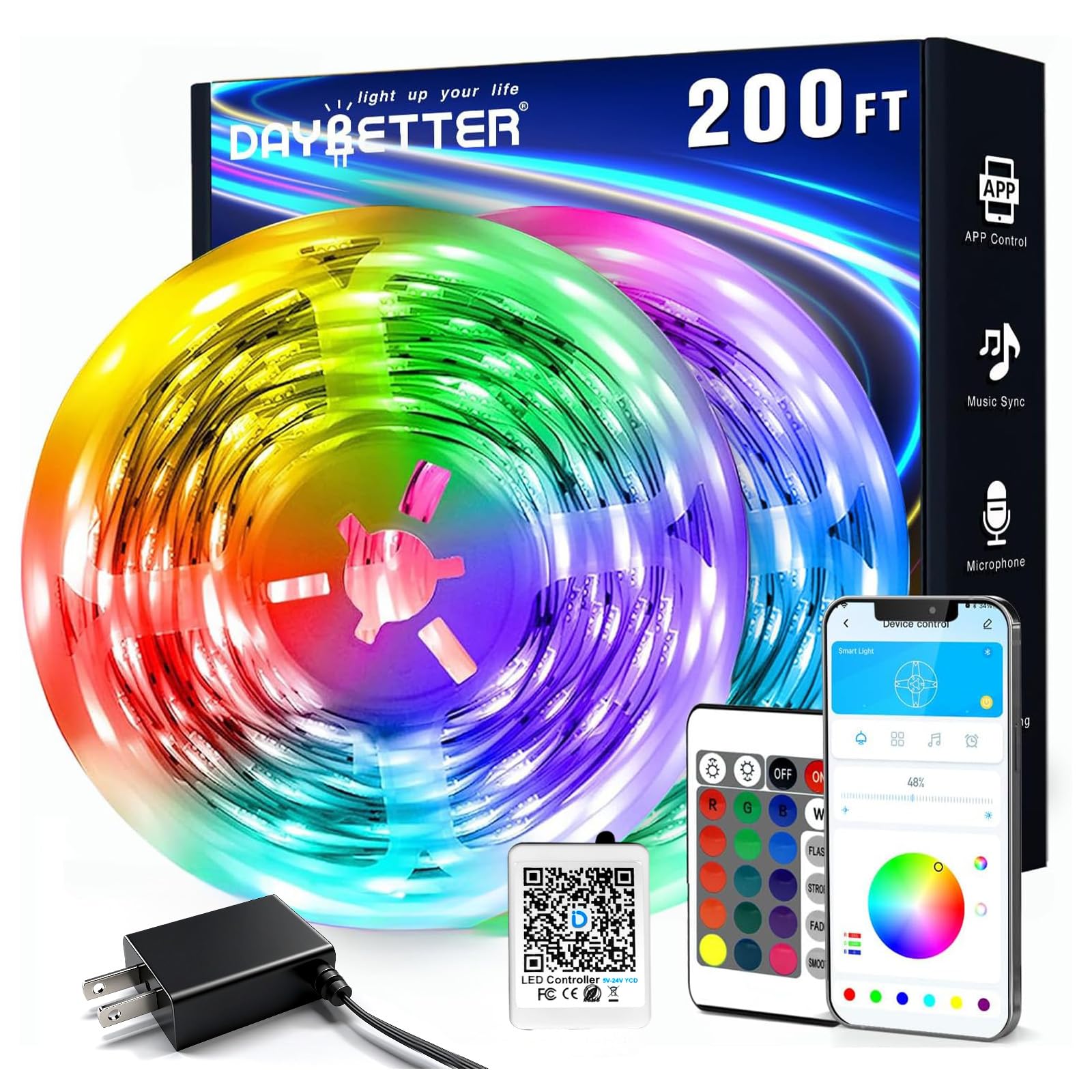
Two 100-foot rolls of RGB tape cover an entire room perimeter, but the efficiency story is different from a pure white COB strip. RGB LEDs consume roughly 2-3 watts per foot at full white, meaning 200 feet pulls 400-600W — more than eight 60W incandescent bulbs. The trade-off is controllable via the app; you can run only a subset of the length or drop to a single color at low brightness to drastically cut consumption.
The smart app includes timer and music-sync functions, but the standby power of the Wi-Fi controller adds a parasitic draw of roughly 0.5W continuously. Over a year that is about 4.4 kWh, which is negligible compared to the strip’s full-on load. The 24V power supply included with the kit is matched to handle the full 200-foot load without overheating, though daisy-chaining four 50-foot sections through the included connectors introduces some voltage drop at the far end.
Stickiness of the adhesive is consistently praised, but the connector count is a point of friction — some packs arrive with only one connector, limiting the ability to segment the strip for selective zone use. The controller can fail after several months of use, locking the lights on until the unit is physically unplugged. For large decorative installations where brightness is controlled, this works, but for base-load bill savings, use a dimmer aggressively.
Why it’s great
- Generous 200-foot coverage for large rooms at entry-level cost
- Smart app with timer and music sync enables runtime control
- 24V power supply is included and rated for the full length
Good to know
- RGB LEDs draw significantly more power than white COB per foot
- Controller failure can leave strip stuck on full power
FAQ
Do LED strip lights with a Wi-Fi controller use extra power even when turned off?
Can I replace my ceiling lights entirely with LED strips and save more money?
Does using a dimmer actually reduce power consumption or just waste it as heat?
Why does my 12V strip feel warm while my 24V strip stays cool?
Final Thoughts: The Verdict
For most users, the are light strips cheaper on power bill than house lighting winner is the PAUTIX COB 24V because its 480 LEDs per meter density and CRI 93+ rating deliver maximum usable light per watt with minimal voltage drop. If you want smart scheduling and voice control to automatically limit runtime, grab the Tatazone Smart COB. And for covering a large room with color-changing ambiance on a tight budget, nothing beats the DAYBETTER RGB 200ft when you keep brightness under 50%.