
That handheld device that claims to read your mind — the one where you think of an object and it narrows down your selection by asking yes, no, or unknown — is back with updated databases, voice recognition, and themed editions for dedicated fans. Whether you are trying to stump a classic 20Q gadget or racing a Poké Ball to identify a specific Pokémon, the core mechanic remains the same: answer a series of questions and watch the algorithm zero in on your secret thought.
I’m Min — the co-founder and writer behind Gadgets Feed. I’ve spent countless hours analyzing the question databases, speech recognition accuracy, and guess success rates of these electronic guessing games to identify which models deliver the most satisfying stump-or-be-stumped experience.
After reviewing the latest releases, I’ve pinpointed the models that have the largest content pools and the smartest deduction logic. Read on to find my picks for the best 20 questions electronic game for every type of player.
How To Choose The Best 20 Questions Electronic Game
The key to a great 20Q experience lies in three factors: the breadth of the internal database, the quality of the deduction algorithm, and the physical input method. A game with a thin database becomes predictable after a few rounds, while a poorly tuned algorithm asks irrelevant questions that waste your precious twenty turns. Likewise, a finicky answer button or unreliable microphone can kill the flow mid-round.
Database Size and Accuracy
The number of items the device can guess is its most important spec. Classic units like the John N. Hansen 20Q boast thousands of possible outcomes spanning objects, animals, and concepts. Themed editions, such as the Harry Potter 20Q, narrow the field to a specific universe, which can make the device eerily accurate within that domain but useless outside it. Look for a stated database count if available; models with at least 1,000 outcomes tend to feel smarter.
Input Method: Buttons vs. Voice
Traditional handheld 20Q games use three buttons: Yes, No, and Unknown. This is the most reliable input method because it never mishears you. Voice recognition models, like the Pokémon Trainer Guess Poké Ball, add a wow factor by letting you speak the Pokémon’s name aloud. However, speech recognition requires a quiet room and clear pronunciation; background noise or a crowded table can cause misreads and frustrate younger players.
Quick Comparison
On smaller screens, swipe sideways to see the full table.
| Model | Category | Best For | Key Spec | Amazon |
|---|---|---|---|---|
| John N. Hansen 20Q Classic | Handheld | Classic mind-reading fun | 3 Languages, Thousands of Outcomes | Amazon |
| University Games 20 Questions Board Game | Board Game | Group game night | 300 Cards, 6,000 Clues | Amazon |
| Pokémon Trainer Expert Board Game | Board Game | Pokémon fan groups | 151 Pokémon, Electronic Game Master | Amazon |
| Mattel 20Q Harry Potter | Handheld | Harry Potter trivia mastery | All 7 Books, Golden Snitch Design | Amazon |
| Basic Fun Simon Electronic Game | Handheld | Memory skills and recall | LED Display, Built-in Counter | Amazon |
| Ultra Pro Pokémon Trainer Guess: Unova | Handheld/Voice | Voice-activated Pokémon quiz | 156 Pokémon, Speech Recognition | Amazon |
| Ultra Pro Pokémon Trainer Guess: Ash’s Adventures | Handheld/Voice | Portable solo Pokémon fun | 151 Pokémon, Voice Recognition, 15 Min Play | Amazon |
In‑Depth Reviews
1. John N. Hansen 20Q Classic Electronic Guessing Game

The John N. Hansen 20Q Classic is the closest thing to the original mind-reading gadget that started it all. This palm-sized plastic device asks you to think of something — an animal, a vegetable, a mineral, a concept — and then grills you with up to twenty questions before making its guess. Its database contains thousands of possible outcomes, and the algorithm has been refined over years to be genuinely surprising in its accuracy. The new and improved version adds support for English, Spanish, and French, making it a solid choice for bilingual households or road trips abroad.
The interface is dead simple: three buttons for Yes, No, and Unknown. There is no speech recognition to flub, no companion app to pair, and no screen to distract. The unit includes a mute option for quiet car rides and a backlight for playing in dim light. Player reviews frequently mention that it guesses correctly even when you skip the category prompts, and that its dad jokes between rounds keep the tone light. At about the size of a deck of cards, it fits easily into a glove box or backpack.
That said, a small number of users report units that develop a constant button-mashing glitch that requires a battery pull to reset, and the included battery is reported to drain in about a month with regular use. The questions in this version have been updated, but some long-time fans feel the new algorithm is slightly less accurate than the nostalgic original. For the price, however, the breadth of content and the sheer replayability make it the most broadly appealing 20Q device on the market.
Why it’s great
- Massive database of thousands of outcomes keeps the game fresh for months
- Trilingual support (English, Spanish, French) is rare in this category
- Mute and backlight features make it excellent for car trips
Good to know
- Occasional hardware glitch causes phantom button presses in some units
- Battery life is short; expect to replace the 3V cell monthly with heavy play
- Algorithm is slightly less sharp than the original 1990s version per some fans
2. University Games 20 Questions Board Game

This is not a handheld guessing device — it is a full tabletop board game for 2 to 6 players aged 12 and up. Instead of a machine reading your mind, the University Games edition uses 300 topic cards covering people, places, and things, with 6,000 total clues distributed across sports, history, literature, and pop culture. The game master reads clues one by one, and the other players race to identify the mystery topic. The all-play style ensures nobody sits idle; everyone is engaged every turn.
The physical components are robust: a game board, a clue board, 6 playing pieces, 20 purple chips, and 5 blue chips. Each guessing round lasts about 20 minutes, making it easy to fit into a standard game night without dragging on. The topics are deliberately well-known — think Beyoncé, the Eiffel Tower, or “pizza” — so the challenge lies in how few clues you need, not in obscure trivia knowledge. Players who enjoy geography find the place-based cards particularly satisfying.
The main trade-off is that the game relies entirely on the knowledge of the person reading the clues. If the designated game master does not know the topic, they cannot effectively guide the round. The “people” category can also be a generation gap issue — older players may not recognize younger celebrities, and vice versa. Still, for a social, non-electronic take on the 20 questions concept, this is the most polished and replayable option.
Why it’s great
- 6,000 clues across 300 cards provide enormous variety for repeat plays
- All-play style keeps every participant guessing on every turn
- 20-minute play time fits perfectly into a casual game night
Good to know
- Requires a game master who knows the topic for each round to work well
- “People” category can be hit-or-miss depending on the age range of players
- No electronic component; strictly a card-and-board experience
3. Mattel 20Q Harry Potter

The Mattel 20Q Harry Potter edition is a dedicated handheld device shaped like a Golden Snitch, complete with removable wings and a display stand. It draws its guessing database exclusively from the seven Harry Potter books, and its accuracy on anything from “Hedwig” to “The Half-Blood Prince’s textbook” is genuinely spooky — player reviews report a 99% success rate even on deeply obscure entries like Merchieftaness Mercus or Hermione’s Yule Ball planners. The unit uses a trans-reflective screen for easy reading in sunlight and has a light switch for nighttime play.
The device responds to three button presses (Yes, No, Unknown) like the classic 20Q, so there is no learning curve. It includes a mute option for quiet play and runs on a standard battery. The text scrolls slowly, which some users find reminiscent of old stadium ad boards, but the trade-off is a deliberately paced experience that gives you time to think. The Snitch design is compact at about 2.85 x 7.62 x 10.37 inches and weighs only 6.4 ounces, making it easy to toss into a bag for trips.
The major limitation is that it is worthless for non-Harry Potter fans — ask it about a Star Wars character and it will fail immediately. The removable wings are fragile and best left off the unit during active play. Some deeply niche references (Inferi, Marvolo Gaunt) are missing from the database. But for a Potterhead who wants to test their knowledge against a machine that knows the source material cold, this is the definitive edition.
Why it’s great
- Eerily accurate at guessing obscure Harry Potter characters and items
- Compact Snitch design with stand looks great on a shelf
- Light toggle and mute function add flexibility for different play environments
Good to know
- Completely useless for any topic outside the Harry Potter universe
- Plastic wings are fragile and prone to breaking off
- Text scrolls quite slowly, which can feel tedious during long sessions
4. Basic Fun Simon Electronic Game

The Basic Fun Simon is a faithful update of the classic memory game, now featuring a digital screen and a built-in counter that tracks your score. It stands 9 inches in diameter and uses four colored buttons that light up in sequences you must memorize and repeat. While it does not guess your thoughts in the 20Q sense, the core loop — watch, remember, repeat — scratches a similar itch for pattern recognition and cognitive challenge. It is recommended for ages 7 to 12, but adults find it equally addictive.
The unit runs on four AA batteries and uses bright LED lights that are visible even in a brightly lit room. The built-in counter eliminates the need for pencil-and-paper scorekeeping, and the difficulty ramps up naturally as the sequences grow longer. Learning disability coaches specifically recommend Simon for improving working memory and sustained attention span. The game is purely electronic — no cards, no board, no setup — so it is ready to play the moment you insert the batteries.
The main complaint is scale: some buyers expected the full-size tabletop version but received a smaller unit that fits in the palm of your hand. The box dimensions match the original product photos, so check the 9 x 9 x 9 inch measurement before purchasing. It does not offer multiplayer beyond taking turns, and the sound effects, while nostalgic, cannot be turned off entirely. For a focused memory workout with zero setup, however, Simon remains the gold standard.
Why it’s great
- Digital screen and built-in counter make scoring effortless
- Improves working memory and sustained attention, per learning specialists
- Instant setup with no cards or boards required
Good to know
- Smaller than the classic tabletop version some buyers remember
- Sound effects are always on, which may be distracting in quiet rooms
- Single-player only; group play means simply passing the device
5. Pokémon Trainer Expert Board Game
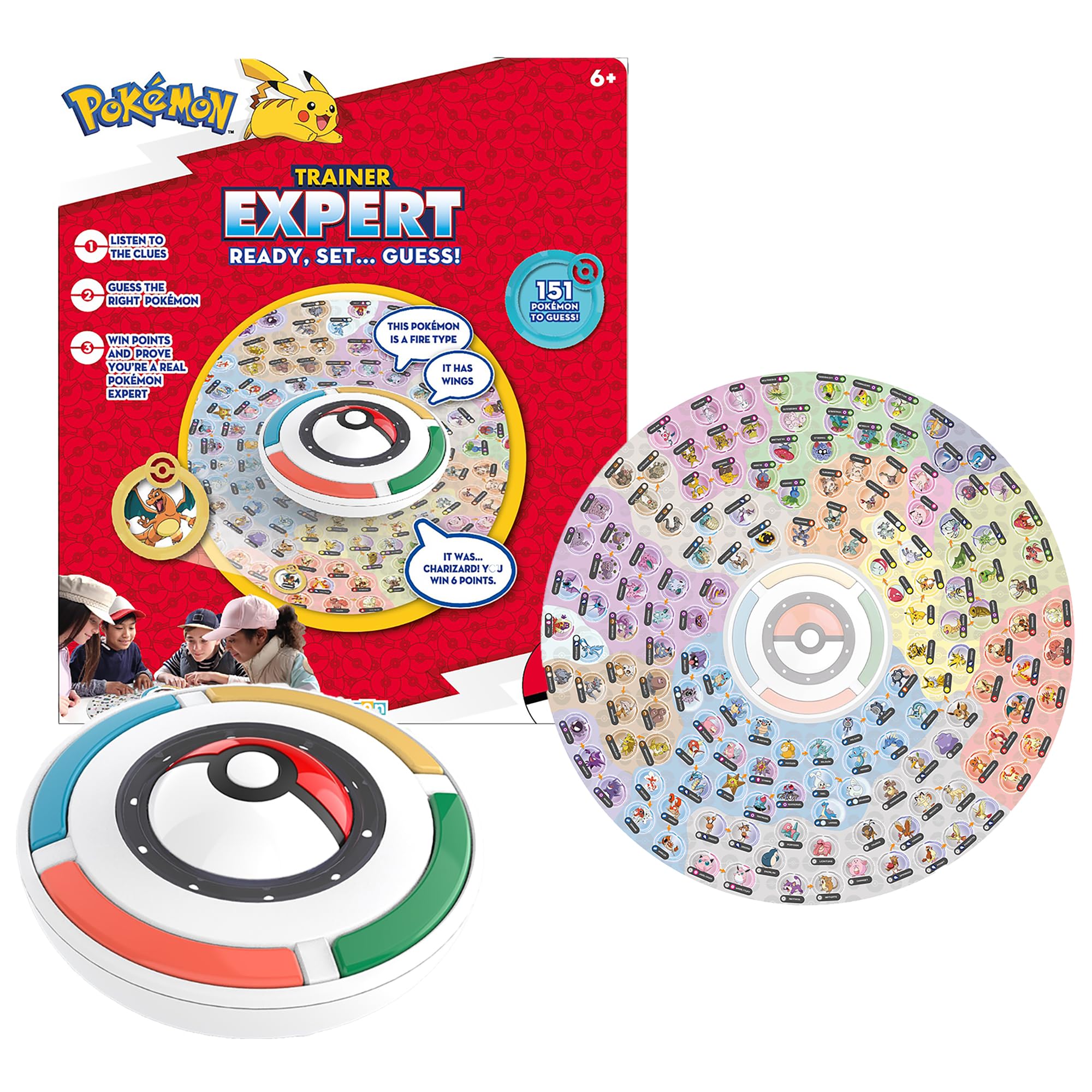
The Pokémon Trainer Expert game turns the 20 questions concept into a competitive board game for 1 to 4 players aged 6 and up. An electronic Game Master speaks clues about one of the original 151 Pokémon, and players race to identify the creature and move their token across the board. The fewer clues you need, the more points you earn — so speed and knowledge are equally rewarded. The game supports both solo play, where you practice against the clock, and multiplayer where up to four players compete.
The components are high-quality: a durable playboard, 4 tokens, and the central electronic device that delivers the clues aloud. The clues are well-designed to be challenging without being unfair — a kid who knows Pikachu by sight can still identify it by hearing “this Pokémon stores electricity in its cheeks” on the second clue. The game auto-keeps score, removing the need for manual tallying. The box is compact at 5.91 x 5.91 x 2.17 inches, making it easy to bring to a friend’s house.
The main drawback is battery life: the electronic Game Master drains batteries relatively quickly, and multiple reviews recommend keeping rechargeable batteries on hand. The game is also limited to the original 151 Pokémon, so kids who only know the newer generations (Sword and Shield, Scarlet and Violet) will be lost. For families with a child who loves classic Pokémon, however, this is the most engaging group guessing game available.
Why it’s great
- Electronic Game Master reads clues aloud and auto-scores, no facilitator needed
- Point system rewards quick identification, adding strategic depth
- Solo mode makes it playable alone for practice or quiet time
Good to know
- Battery drain is significant; keep rechargeable batteries ready
- Only covers the original 151 Pokémon, limiting appeal for newer fans
- Young children may need adult help reading the clue timing
6. Ultra Pro Pokémon Trainer Guess: Unova Edition
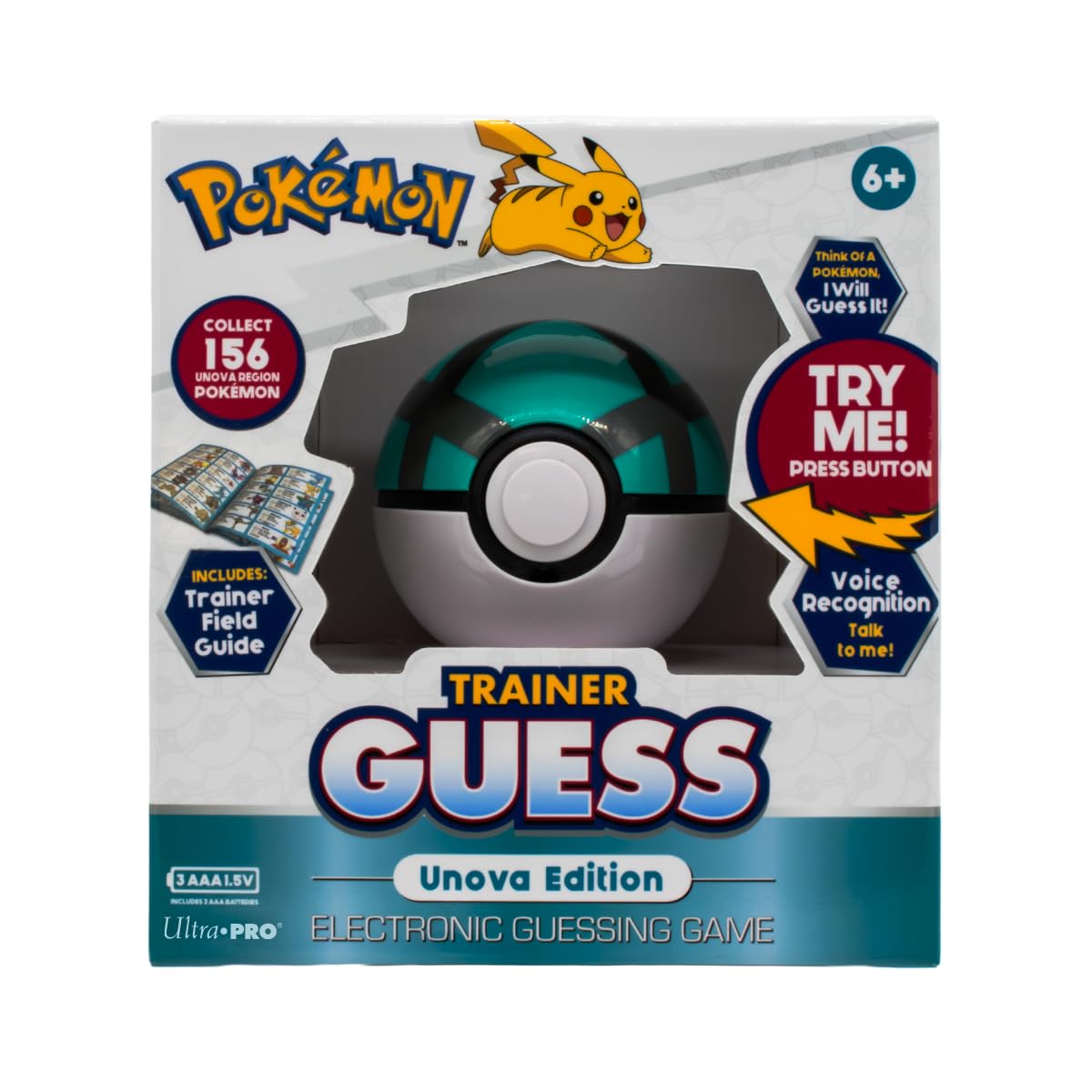
The Ultra Pro Pokémon Trainer Guess: Unova Edition is a Poké Ball-shaped device that uses speech recognition to guess the Pokémon you are thinking of from the Unova region (generation 5). You think of a Pokémon, press the button, and the Poké Ball asks you yes/no questions via its built-in speaker. When it guesses, you speak the Pokémon’s name aloud — if it recognizes the word, it tells you whether you are correct. The device includes a printed field guide covering all 156 Unova Pokémon, which serves as both a reference and a checklist.
Play sessions last about 15 minutes, making it a quick-hit activity that fits between chores or during a commercial break. It supports 1 or more players, so a single child can enjoy it solo or challenge a friend. The speech recognition is surprisingly accurate when the room is quiet, with most users reporting correct identification on the first try. The Unova focus means it avoids the “too easy” problem of a general Pokémon database — even knowledgeable fans will find some obscure entries that take the full 20 questions.
The speech recognition struggles in noisy environments; playing near a TV or in a busy living room leads to frequent mishearings. The device also has a tinny speaker that can be hard to understand at low volume. And because it uses voice output, you cannot play silently. For a child who loves Unova Pokémon and has a quiet room to play in, this is a magical experience. For a family with multiple kids shouting answers at once, it can become frustrating.
Why it’s great
- Voice recognition creates an impressive “talking to your Poké Ball” experience
- Field guide doubles as a collectible checklist for completionists
- 15-minute rounds are perfectly sized for quick entertainment bursts
Good to know
- Speech recognition accuracy drops sharply in noisy rooms
- Tiny speaker can be difficult to hear clearly at lower volumes
- No silent mode; sound is always required for gameplay
7. Ultra Pro Pokémon Trainer Guess: Ash’s Adventures

The Ultra Pro Pokémon Trainer Guess: Ash’s Adventures Edition is the predecessor to the Unova edition, covering the 151 Pokémon that Ash and his friends encountered during the original animated series. It uses the same Poké Ball form factor and voice recognition system: you think of a Pokémon, answer the device’s questions, and speak the name aloud when prompted. A printed field guide is included to help young trainers learn each Pokémon’s attributes and evolution lines.
The device runs on 3 AAA batteries that are included in the box, so it is ready to play immediately. The voice recognition requires a relatively quiet room to function well, but when it works, the device accurately guesses Pokémon based on your yes/no answers. The game resets once you have “caught” all 151, allowing you to start over from scratch. For a solo player, this creates a satisfying completion loop that can occupy hours of quiet time. Player reviews mention that the device sometimes provides funny mishearings that add a layer of lighthearted humor.
Similarly to the Unova edition, background noise kills the voice recognition accuracy. The tin packaging is also prone to arriving dented in shipment, and some units have been reported as previously opened. The 151 Pokémon here are the classic ones, so any Pokémon fan from age 6 to adult will recognize the roster. For a budget-friendly entry point into the world of voice-controlled 20Q games, this is the simplest and most affordable option.
Why it’s great
- Includes 3 AAA batteries so play can start immediately out of the box
- Classic 151 roster appeals to Pokémon fans of any generation
- Completionist loop (“catch all 151”) adds long-term replay value
Good to know
- Voice recognition requires a quiet room; TVs or siblings ruin accuracy
- Thin metal packaging can arrive dented from shipping
- Some units show signs of prior opening; check seals on arrival
FAQ
How many outcomes do electronic 20Q games typically have?
Can I play a 20Q electronic game with multiple people?
Final Thoughts: The Verdict
For most users, the best 20 questions electronic game winner is the John N. Hansen 20Q Classic because its massive general-knowledge database, trilingual support, and dead-simple button interface make it the only device that works for every age and every setting. If you want a themed experience that tests your deep universe knowledge, grab the Mattel 20Q Harry Potter for its spooky accuracy on all seven books. And for a group game night with friends who love deduction, nothing beats the University Games 20 Questions Board Game.