
A properly engineered overhang built from corrosion-resistant alloys changes that equation entirely, and the difference between a flimsy polycarbonate shell and a rigid aluminum structure determines whether you’re replacing this thing next season or leaving it in place for a decade.
I’m Min — the co-founder and writer behind Gadgets Feed. After analyzing the material thickness, bracket design, snow-load ratings, and drainage engineering across dozens of models, I’ve narrowed down the specific builds that actually hold up against the elements without rattling loose.
The trouble with cheap sheet-metal covers is that they buckle under a heavy wet snow or develop stress cracks where the frame meets the wall. Because every entryway geometry is different — some require a wide span, others need deep projection — I’ve assembled a focused set of aluminum door awnings that solve those exact pain points for different use cases.
How To Choose The Best Aluminum Door Awnings
Choosing an aluminum door awning isn’t about which one looks the prettiest in the product photo — it’s about matching the bracket strength, panel material, and drainage system to your local weather and wall type. A mismatched overhang can actually funnel water sideways onto your siding.
Projection Depth and Wide-Span Coverage
The projection depth — how far the awning sticks out from the wall — determines whether rain reaches your door handle or stops a foot short. Standard entry doors need at least 31 inches of projection; wider double or French doors demand 40 inches or more. Measure from the wall to the outer edge of your door threshold and add a few extra inches for wind deflection.
Panel Material: Solid Polycarbonate vs. Hollow Sheets vs. Full Aluminum
Solid polycarbonate panels with a UV protectant additive hold up to 200+ pounds of static load without shattering, while hollow sheets trap moisture internally and become brittle in freeze-thaw cycles. Full aluminum or powder-coated steel canopies offer the best rigidity but weigh significantly more — your mounting surface must be capable of supporting that weight plus any snow accumulation.
Bracket Design and Wall-Mounting Hardware
The bracket is the single weakest link in any install. Look for fiber-reinforced nylon or ABS brackets that sandwich the panel from underneath rather than clamping from the top — this prevents the panel from sliding under load. Stainless steel lag screws with expansion anchors are mandatory for brick and stucco installations; wood-frame mounts need long lag bolts driven into studs at 16-inch spacing.
Integrated Drainage and Wind Resilience
A front gutter channel that directs runoff to the sides rather than dripping straight onto your doormat is the feature that separates entry-level covers from serious weather shields. Pair this with a reverse-slope design on the brackets so wind pressure pushes the canopy against the wall rather than lifting it away.
Quick Comparison
On smaller screens, swipe sideways to see the full table.
| Model | Category | Best For | Key Spec | Amazon |
|---|---|---|---|---|
| NuImage 1500 Series with Sidewings | Premium | Wide double doors & US-made build | 60″ wide × 42″ projection, 5-year warranty | Amazon |
| Palram Canopia Aquila 1500 | Premium | High-end look with UV solar-gray panels | 59″ × 36.25″, 37.5 lbs steel frame | Amazon |
| Kozyard Adjustable 4-Level Tilt 82″ | Premium | Seasonal angle control for wide entryways | 82″ wide, adjustable 31″–42″ projection | Amazon |
| Kozyard Window Awning 48″ with Side Wings | Mid-Range | Side wind & rain deflection | 48″ wide × 40″ deep, PVC panels | Amazon |
| ADVANING PN Series 47″ × 31″ | Mid-Range | Tested load capacity & modular linking | Solid polycarb, 200 lbs tested, clear | Amazon |
| HIAPES 40″ × 40″ Smoke Gray | Mid-Range | UPF 50+ UV block for sunny climates | 40″ × 40″, 220 lbs rated brackets | Amazon |
| Yaheetech 8×7 ft Retractable | Mid-Range | Large retractable coverage with crank | 8 ft projection, 280g/m² polyester fabric | Amazon |
| GGNEBAI 40×60 with Drainage Sink | Budget | Integrated gutter for leak-prone areas | 40×60 in, built-in drainage sink | Amazon |
| GGNEBAI 40×60 Hollow Sheet | Budget | Low-cost entry-level coverage | 40×60 in, polycarbonate hollow panels | Amazon |
In‑Depth Reviews
1. NuImage 1500 Series Aluminum Door Canopy with Sidewings

This is the awning you buy when you want zero compromises on material quality — the mill-finish aluminum framework gets a two-coat baked enamel that doesn’t peel or chip, plus it’s made in the USA. The integrated front rain gutter channels water away from the door threshold rather than letting it drip straight down onto the welcome mat, solving the exact pooling problem that ruins entryway tiles.
At 60 inches wide with a 42-inch projection, it covers a standard single door with room to spare, and the positive-locking snap-in mechanism for the canopy makes mounting more secure than cheap bracket-over-panel designs. Assembly is straightforward with the included hardware, though you absolutely need two people to handle the 6-foot span during installation. The 5-year limited warranty backs up the build quality, and multiple reviews confirm it stops water ingress from failed door seals effectively.
One thing to watch — if you mount on brick or stucco, pick up masonry expansion bolts separately since the included fasteners are best suited for wood. The sidewings add an extra layer of protection against wind-driven rain, so this is the right pick for exposed entryways that take the full brunt of storms.
Why it’s great
- Full aluminum construction with baked enamel finish that will never rust
- Integrated front gutter directs runoff away from the door
- 5-year manufacturer warranty on materials and workmanship
Good to know
- Heavy unit requires two people for lifting and alignment
- Stock hardware not suitable for masonry — buy expansion bolts separately
- Premium price reflects domestic manufacturing and 60-inch width
2. Palram Canopia Aquila 1500 Door Awning

Palram is one of the few manufacturers that actually thickness-tests its polycarbonate and uses a coated galvanized steel frame rather than standard aluminum. The Aquila 1500 measures 59 inches wide by 36.25 inches deep, with a sleek metal frame that supports the solar-gray polycarbonate panel — this tint cuts glare while letting diffused natural light through, which is ideal for north-facing doors that suffer from direct sun in summer.
The frame assembly is heavier than most polycarbonate-only units at 37.5 pounds, and the structural steel bracketing makes the whole canopy feel like a permanent structural addition rather than an add-on cosmetic piece. Installation requires drilling into studs or using toggle bolts for stucco, and the supplied hardware works best on concrete or wood — stucco mounts need aftermarket anchors. The 3-year limited warranty provides peace of mind against manufacturing defects.
Multiple user reports confirm the product withstands heavy Pacific Northwest rain without leaking after proper caulking at the wall seam. The modern cantilevered look blends cleanly with contemporary architecture, making this a favorite for homeowners who want weather protection without the bulk of a traditional fabric canopy.
Why it’s great
- Coated galvanized steel frame outlasts standard aluminum in coastal climates
- Solar-gray polycarbonate reduces glare while passing natural light
- 3-year limited warranty and responsive US-based support
Good to know
- Packaging often arrives damaged — inspect before installing
- Stucco install requires separate masonry anchors not included
- Assembly is detailed; set aside a full afternoon with two helpers
3. Kozyard Adjustable 4-Level Tilt Door Awning 82″
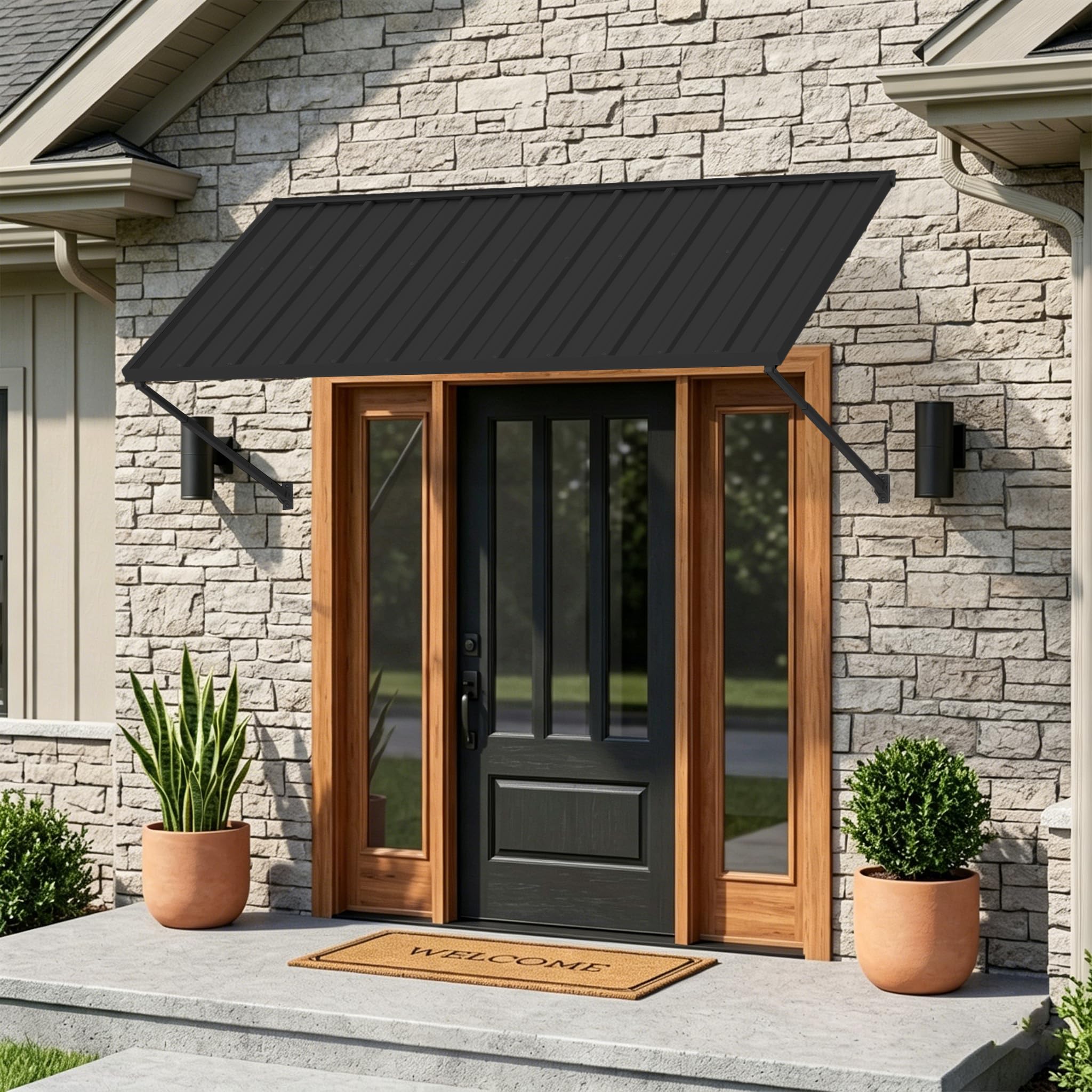
Most fixed-pitch awnings lock you into one angle, which means summer sun blasts through in July and winter light never reaches the window. Kozyard solved that with a 4-level tilt mechanism that lets you change the projection from 31 inches to 42 inches simply by adjusting the arm connections — you can flatten the pitch to block high summer sun or steepen it for snow shedding in winter.
The powder-coated iron canopy is heavy-duty and resists bending under load, and the built-in front gutter routes water to the sides rather than dumping it in front of the door. At 82 inches wide, this is one of the broadest options available for sliding patio doors or French-door pairs. Users consistently call out the easy assembly process and the sturdy feel after mounting — one review noted it survived a strong storm without any issue.
Keep in mind that the metal canopy can be noisy during heavy rain if not fully secured with the included stainless steel screws and spacers. For brick or vinyl siding, you may need additional mounting blocks or expansion anchors. The dark gray finish hides dirt well and resists fading, making this a strong candidate for high-traffic front doors that face direct southern exposure.
Why it’s great
- Four adjustable tilt angles for year-round shade management
- 82-inch width covers wide French and sliding doors
- Powder-coated iron canopy resists rust and bending
Good to know
- Metal panels amplify rain noise unless fully tightened
- Requires two to three people for safe mounting
- Vinyl siding may need supplemental mounting blocks
4. Kozyard Window Awning 48″ with Side Wings
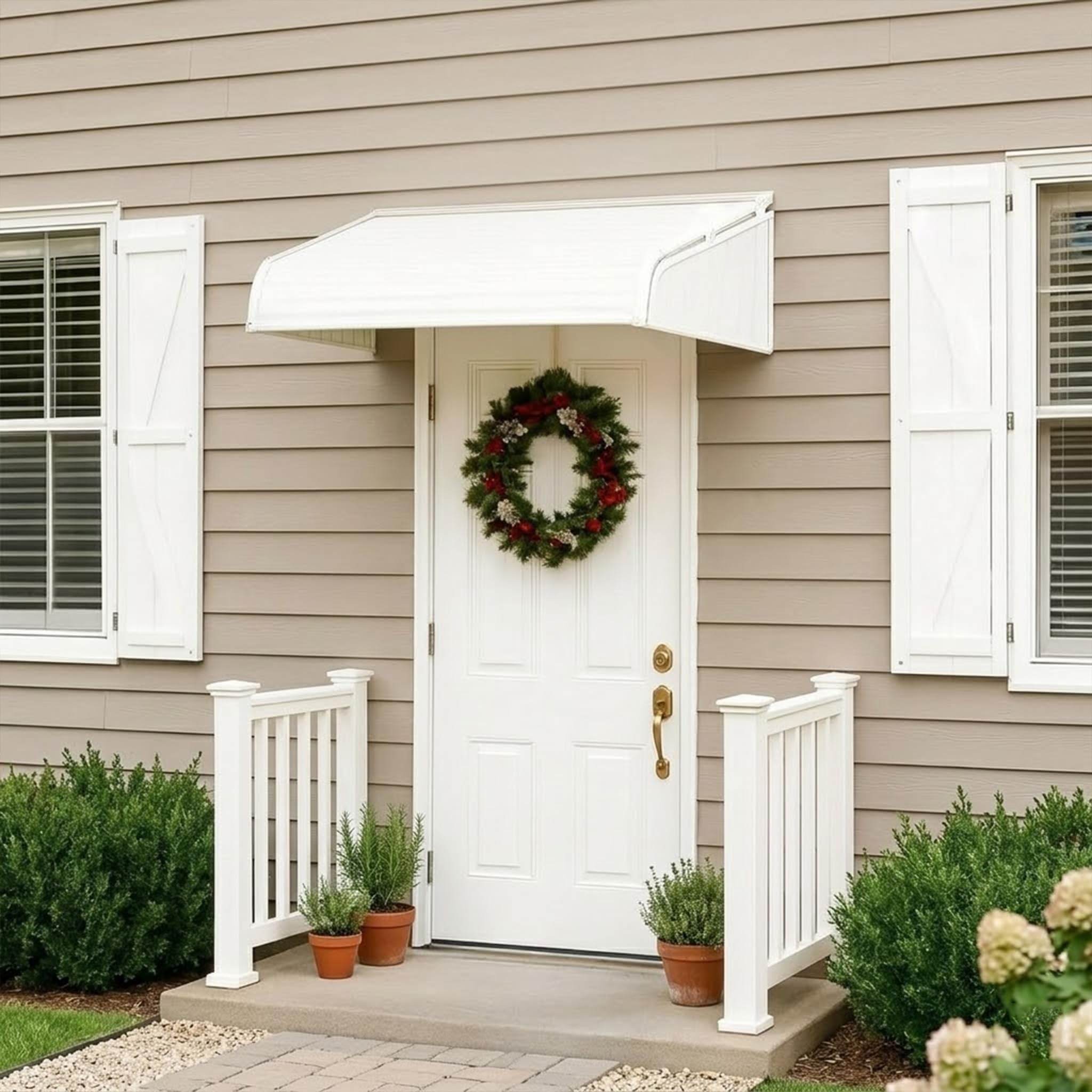
The integrated side panels on this model are what make it stand out — two molded plastic shields bolt onto each side of the main canopy to prevent wind from wrapping rain horizontally around your door frame. This matters enormously for doors located on corner walls or in breezeways where typical awnings leave the sides exposed.
The frame uses lightweight aluminum tubing with impact-resistant PVC corrugated panels that are waterproof and UV-resistant. The curved-edge design and built-in drainage channels keep water from ponding on top, and the panel joints overlap tightly enough to resist leaks even during prolonged downpours. Users report a noticeable temperature drop in rooms behind the awning within hours of installation thanks to the shade effect.
Assembly is manageable for two people, but the included adhesive strips for the panel slats are borderline useless — most reviewers recommend replacing them with silicone sealant for a permanent bond. The awning survived a recorded 60+ MPH windstorm without damage, though the frame feels slightly wobbly during assembly before the panels lock in. This is a solid mid-range choice for side-exposed entryways where a standard canopy alone wouldn’t cut it.
Why it’s great
- Built-in side wings block horizontal wind-driven rain
- Aluminum frame with PVC panels resists corrosion
- Curved edges and drainage channels prevent ponding
Good to know
- Included adhesive strips are poor — use silicone sealant instead
- Only 5 panel clips provided; ideally needs 10 for a secure hold
- Frame feels flimsy until all panels are locked into place
5. ADVANING PN Series 47″ × 31″ Solid Polycarbonate Awning

Most polycarbonate awnings use hollow twin-wall sheets that trap moisture and turn brittle after a few freeze-thaw cycles. ADVANING’s PN Series uses a solid polycarbonate panel independently tested by Intertek to hold 200 pounds without shattering — and it incorporates an 80-plus-percent UV protectant that prevents yellowing over time.
The mounting bracket design here is smarter than average: the brackets sit under the panel rather than clamping on top, which stops the canopy from slipping or vibrating loose in high winds. The panel connects via a rubber gasket channel system that seals the edges, though installing those gaskets requires a rubber mallet and soapy water to ease them into place. The 47-inch width and 31-inch depth fit most standard single doors, and the modular PN design lets you connect multiple units for longer runs of coverage.
The biggest installation challenge is that the bracket-slot tolerances are tight — if you don’t fully assemble the awning before attempting to mount it, you’ll struggle to align the hardware. The included hardware mixes metric and SAE fasteners, so keep a socket wrench set handy. Despite the fiddly assembly, the end result looks clean and unobtrusive, and the California-based support team is responsive for troubleshooting.
Why it’s great
- Solid polycarbonate panel tested to 200 lbs load capacity
- Bracket-under-awning design prevents sliding and vibration
- Modular system allows connecting multiple units for longer runs
Good to know
- Rubber gasket channel installation requires patience and a mallet
- Hardware mix of metric and SAE — socket wrench recommended
- Tight bracket tolerances make pre-assembly mandatory
6. HIAPES 40″ × 40″ Smoke Gray Awning
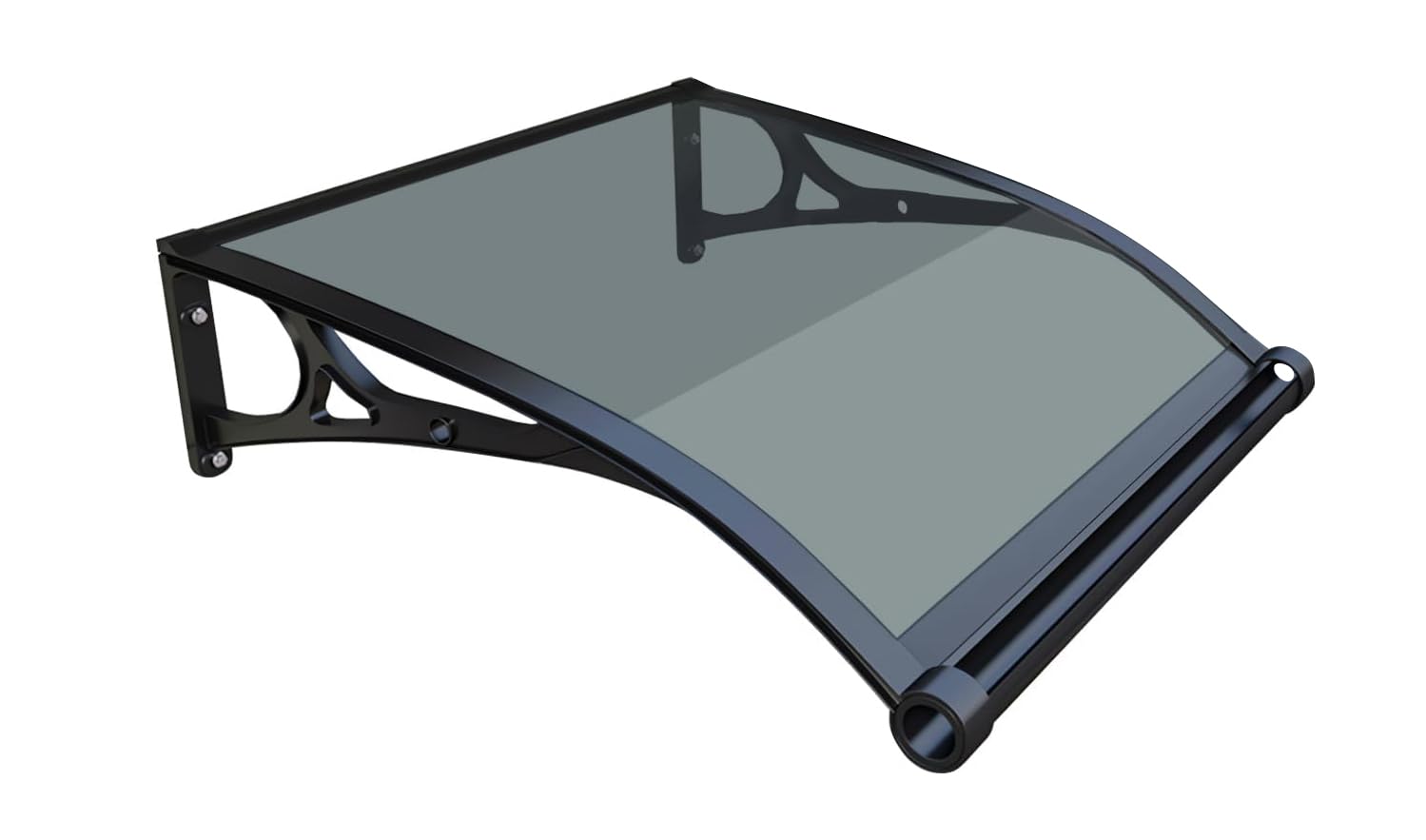
HIAPES markets this as a UPF 50+ shield, and the smoke-gray polycarbonate panels genuinely cut the heat load while preserving visibility through the canopy. The aluminum alloy brackets are rated to handle 220 pounds, which is higher than most competitors at this size point, and the panels are both shock-resistant and noiseless — no annoying drumming sound during rain.
At 40 inches wide by 40 inches deep, this is a compact option better suited for single-person doors or small windows rather than wide French doors. The assembly is straightforward with solid components, though one 120-inch version user reported that the instruction manual was nearly useless — the 40-inch version’s manual is clearer. The powder-coated finish on the brackets matches well with modern decor.
A common tip from installers: fully assemble the awning on a flat surface first, then trace the mounting hole pattern onto a plywood template. This eliminates guesswork when aligning to the wall. The stopper screw holes on some units are slightly undersized and may require filing to accept the hardware. For the price, this is one of the better UV-blocking options if your door faces unshaded afternoon sun.
Why it’s great
- UPF 50+ rating blocks significant UV exposure
- Brackets rated for 220 lbs load capacity
- Noiseless polycarbonate panels don’t drum in rain
Good to know
- Compact 40×40 size limits coverage to single doors only
- Stopper screw holes may be undersized on some units
- Manual quality varies between size variants
7. Yaheetech 8×7 ft Manual Retractable Patio Awning

This is fundamentally different from the fixed polycarbonate and metal awnings above — it uses a 280g/m² polyester fabric with a PU coating stretched over an aluminum frame, and it retracts fully with a 4.5-foot hand crank. For homeowners who want the option to retract the awning during snow season or severe storms, this is the only type that offers that flexibility without a motor.
The 8-foot projection is massive — it covers an entire patio door or deck entry, and the angle adjusts from 5 to 35 degrees via the crank. The wavy valance adds a decorative touch, but the real utility is being able to roll the fabric up when wind speeds exceed 30 mph (which is the recommended limit). Assembly takes about an hour for one person, but mounting requires two people to lift the heavy frame into position.
The fabric will hold water if the pitch is too shallow — you must set the angle steep enough for runoff. The included mounting hardware works on masonry and concrete walls only; wood siding needs supplemental brackets. Some users report that the right arm sits slightly lower than the left after installation, which may require a shim. At this price point, it outperforms comparable retractables from big-box brands, but it’s not in the same league as a Sunsetter for wind tolerance.
Why it’s great
- Full retraction via hand crank for storm protection
- 8-foot projection covers large doors and patio areas
- Angle adjustable from 5° to 35° for seasonal pitch control
Good to know
- Fabric holds water if pitch is too shallow
- Mounting requires 2-person lift and masonry-anchored walls
- Not recommended for sustained wind over 30 mph when extended
8. GGNEBAI 40×60 with Drainage Sink

GGNEBAI added a feature here that most budget-tier awnings skip entirely: an integrated drainage sink at the front edge that channels rainwater to the sides instead of letting it drip straight off the bottom edge. For entryways where the existing step or landing has no positive drainage slope, this single design detail justifies the selection over the standard hollow-sheet version.
The construction uses polycarbonate panels over ABS brackets and aluminum alloy support bars — the same material stack as many mid-range options. The 40×60 size is generous for single doors, and the transparent panels allow light through while blocking UV. Users consistently praise the value proposition and the effective rain deflection, though several note that the panels feel flimsy before installation and only gain rigidity once fully bolted to the wall.
The main trade-off is long-term durability: reviewers in northern climates express reservation about snow load and panel deformation under direct summer heat. Applying glass glue to the seams is strongly recommended to prevent water seepage. If your climate is mild and your primary concern is keeping rain off the doorstep without spending a lot, this is the practical choice with an integrated gutter that cheap units omit.
Why it’s great
- Integrated drainage sink channels water to the sides
- Large 40×60 size covers most standard doors
- Transparent panels allow natural light transmission
Good to know
- Panels feel flimsy before final wall mounting
- Glass glue required at seams for reliable water seal
- Snow load capacity is questionable for northern climates
9. GGNEBAI 40×60 Hollow Sheet Awning
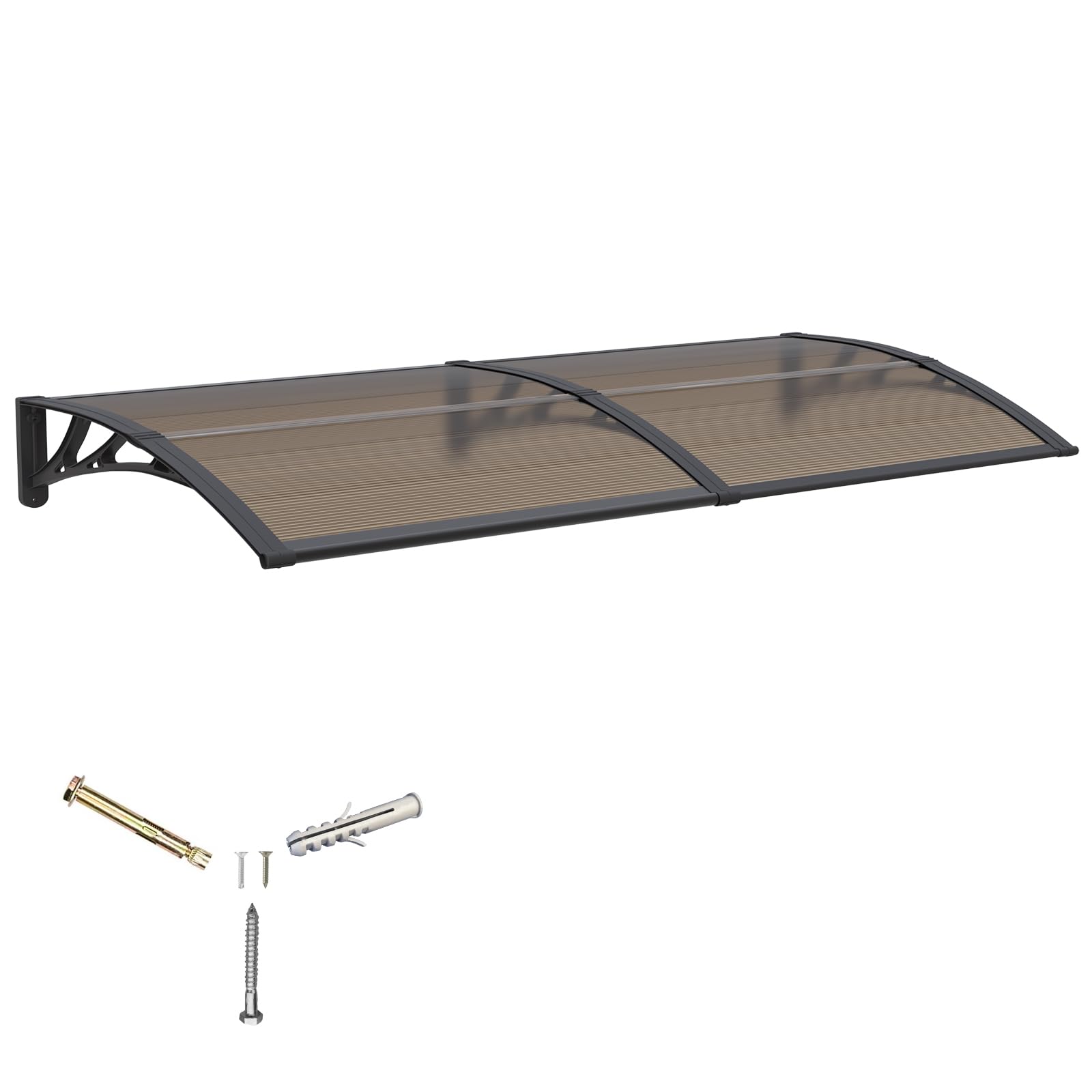
This is the entry-level price point for getting a complete polycarbonate door awning kit with brackets and all mounting hardware included. The hollow polycarbonate panels keep the weight low enough for a single person to lift, but the trade-off is reduced structural rigidity compared to solid-sheet alternatives. The ABS brackets and aluminum fixing bars provide the primary load path — the panel itself contributes minimal sheer strength.
At 40 inches wide by 60 inches deep, the coverage area is decent for a standard front door, and the brown-board-on-black-bracket color combo blends reasonably well with most exterior color schemes. Assembly is manageable with two people despite the vague instruction sheet, and once installed, the awning feels noticeably sturdier than it does in the box. Users report it handles rain and moderate winds fine, but several note the panels develop a slight warp after the first direct summer heat exposure.
The biggest limitation is long-term material durability — hollow polycarbonate traps moisture inside the channels, which leads to micro-cracking in freeze-thaw cycles after a year or two in colder climates. If your goal is a low-cost, lightweight solution for a protected back door or a seasonal rental property, this fills that role cleanly. For a permanent front-door install, the solid-panel alternatives above justify the higher spend.
Why it’s great
- Most budget-friendly option for getting covered protection
- Lightweight enough for single-person handling
- Good rain and sun performance for mild climates
Good to know
- Hollow panels trap moisture and degrade in freeze-thaw cycles
- Panels may warp slightly under direct summer heat
- Instruction sheet is minimal — plan for trial-and-error assembly
FAQ
Can I install an aluminum door awning on vinyl siding without an extra mounting block?
How do I calculate the right projection depth for my specific door?
What is the maximum snow load a standard polycarbonate door awning can handle before structural failure?
Is there a meaningful difference between the fade resistance of painted aluminum vs powder-coated steel awning frames?
Can I link two smaller awnings together to cover a wider span instead of buying one large unit?
Final Thoughts: The Verdict
For most users, the aluminum door awnings winner is the NuImage 1500 Series with Sidewings because it pairs a full mill-finish aluminum frame with an integrated gutter and a 5-year warranty — no rust, no pooling, no replacement in three seasons. If you want adjustable seasonal tilt control and a wide 82-inch span, grab the Kozyard 4-Level Tilt. And for the absolute best UV protection with a proven load rating at a mid-range price, nothing beats the HIAPES Smoke Gray 40×40.