
Nothing ruins a manicured lawn or a tidy driveway faster than weeds that refuse to die after the first spray. The difference between a treatment that barely singes the leaves and one that nukes the root system comes down to active ingredients, formulation, and the proper application technique. Most homeowners make the mistake of grabbing the cheapest bottle without reading the label, only to spray again three weeks later when the same clover and crabgrass bounce back stronger.
I’m Min — the co-founder and writer behind Gadgets Feed. I’ve spent hundreds of hours analyzing herbicide labels, comparing concentration ratios, and cross-referencing verified buyer experiences to separate the formulas that actually translocate to the root from those that just brown the surface.
This guide breaks down concentrate versus ready-to-use, systemic versus contact killers, and the best chemistry for every surface from flower beds to gravel driveways. Here is the definitive, no-fluff breakdown of the best all weed killer for every yard situation.
How To Choose The Best All Weed Killer
The right formula depends entirely on where you’re spraying and what you want to happen afterward. Non-selective killers wipe out everything green, while selective formulas spare your lawn grass while taking down nutsedge and dandelion. Concentration is the biggest hidden variable — a 41% glyphosate concentrate mixed at the right ratio covers 20 times more ground than a ready-to-use spray bottle of the same size.
Systemic vs. Contact Killers
Systemic herbicides like glyphosate absorb into the plant’s vascular system and travel to the roots. You see browning in 5 to 8 days but the root dies completely, which prevents regrowth of perennial weeds. Contact killers like diquat dibromide destroy leaf tissue on contact — you see wilted vegetation within hours — but the roots can regenerate if the plant is a perennial with an established root network. For driveways and patios where annual weeds are the main problem, contact killers work fast. For poison ivy, bindweed, or Canada thistle, you need systemic action.
Concentrate vs. Ready-to-Use
A 32-ounce concentrate bottle typically yields 1 to 20 gallons of spray solution depending on the dilution ratio. Ready-to-use bottles are convenient for spot treatments but cost significantly more per square foot of coverage. If you maintain a large property, a gallon of 41% glyphosate concentrate provides the lowest cost per treated area — up to 26,000 square feet per gallon versus roughly 1,350 square feet from a 32-ounce ready-to-use bottle.
Rainfast Windows and Application Timing
A rainfast window is the time a herbicide needs to dry on the leaf surface before rain can wash it off without reducing effectiveness. Diquat-based formulas can be rainfast in as little as 15 minutes. Glyphosate products typically need 2 to 6 hours rainfree to fully translocate. Spraying when rain is forecast within the product’s rainfast window is the most common reason homeowners think a weed killer didn’t work.
Quick Comparison
On smaller screens, swipe sideways to see the full table.
| Model | Category | Best For | Key Spec | Amazon |
|---|---|---|---|---|
| Roundup with Comfort Wand | Ready-to-Use | Driveways & patios | 1.33 gal, 4% glyphosate, rainfast in 30 min | Amazon |
| Spectracide Concentrate | Contact Concentrate | Visible results in hours | 32 oz diquat dibromide, 1,350 sq ft | Amazon |
| RM18 Fast-Acting | Contact Concentrate | Long driveways & large areas | 32 oz, covers 3,000 sq ft | Amazon |
| 41% Glyphosate Concentrate | Systemic Concentrate | Total root kill on perennials | 1 gal, 41% glyphosate, 26,000 sq ft | Amazon |
| Ortho Nutsedge Killer | Selective RTU | Nutsedge in lawns | 24 oz, selective for turf | Amazon |
| Pet’s Pal Natural | Natural RTU | Pet-safe broadleaf control | 1 gal, natural ingredients, 1,000 sq ft | Amazon |
| Airmax Pond Defense | Aquatic Herbicide | Pond & lake weed control | 1 qt, fish-safe, 5,000 sq ft | Amazon |
In‑Depth Reviews
1. Roundup Weed and Grass Killer₄ with Comfort Wand
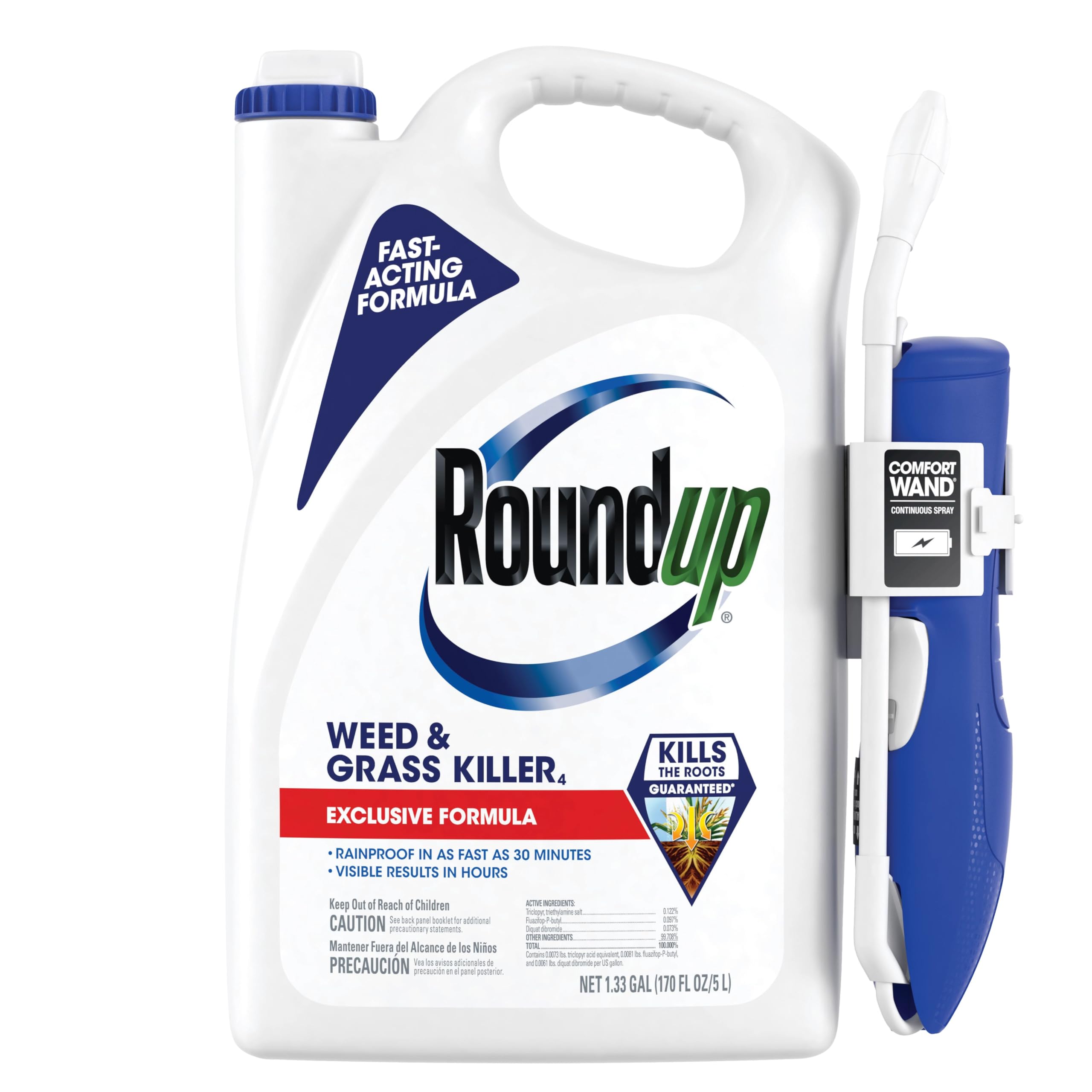
The 1.33-gallon Ready-to-Use formulation with the Comfort Wand delivers one-touch continuous spray that covers driveways, patios, and flower bed edges without requiring mixing or measuring. The 4% glyphosate concentration translocates to the root system of broadleaf weeds including dandelion, crabgrass, poison ivy, clover, and spotted spurge. Verified buyers report visible browning within 24 hours and complete kill in 2 to 5 days depending on temperature and weed maturity.
The rainfast window of 30 minutes separates this formula from standard glyphosate products that demand 2 hours of dry weather. This matters for homeowners who cannot guarantee a long rain-free forecast. The Comfort Wand eliminates trigger-finger fatigue during extended spraying sessions along long fence lines or retaining walls. One reviewer noted browning the same afternoon after spraying weeds growing in driveway cracks.
Planting windows vary by target — 1 to 30 days after application depending on the treated weed species. The wand design does limit application precision in tight areas like narrow flower bed gaps compared to a dedicated spot sprayer. For the combination of speed, root kill, and application convenience on hardscapes and ornamental beds, this is the most balanced all-rounder in the lineup.
Why it’s great
- 30-minute rainfast window beats most glyphosate formulas
- Comfort wand reduces hand fatigue on large areas
- Kills tough perennials including poison ivy at the root
Good to know
- Ready-to-Use format costs more per square foot than concentrate
- Wand less precise for spot treatments in tight garden beds
2. 41% Glyphosate Super Concentrate Weed & Grass Killer (1 Gallon)
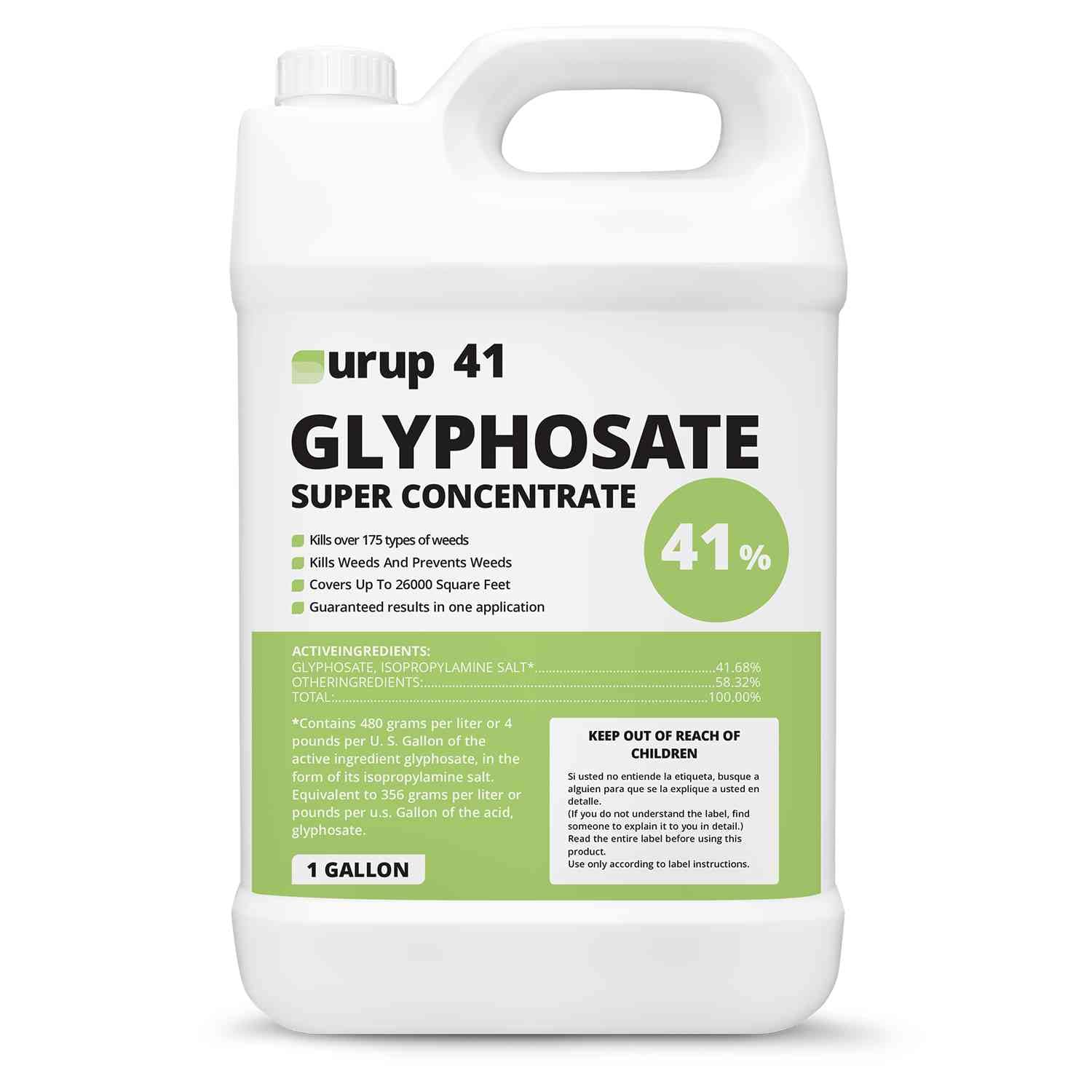
At 41% glyphosate concentration, this gallon of concentrate is the highest active-ingredient ratio in this roundup and delivers the lowest cost per treated square foot. One gallon mixes to cover up to 26,000 square feet — enough for a multi-acre property or a season’s worth of maintenance on a large farm. The formulation kills over 130 weed and grass species including poison ivy, bindweed, and bermudagrass by translocating the herbicide to the root system over 5 to 8 days.
Verified buyers report yellowing begins around day 5 with full die-off by day 15 when applied at the recommended dilution rate. The systemic action means established perennial weeds with deep taproots die completely rather than regrowing from root fragments. The concentrate format requires mixing with water in a tank sprayer, which adds a step but allows you to dial in the exact concentration for the weed species and density you’re fighting.
The 41% concentration demands careful handling — proper PPE including gloves and eye protection is non-negotiable, and the mixed solution should be used within 24 hours for full potency. One reviewer reported poor results at the standard ratio and needed to increase concentration for tough weeds. For buyers managing large properties who want industrial-strength chemistry at a fraction of the per-ounce cost of ready-to-use sprays, this concentrate is the clear economic winner.
Why it’s great
- Highest concentration ratio provides enormous coverage
- Systemic action kills roots of deep-rooted perennials
- Cost per square foot significantly lower than RTU
Good to know
- Requires mixing and a sprayer — not grab-and-go
- Some users needed higher concentration for stubborn weeds
3. Spectracide Weed and Grass Killer Concentrate, 32 oz
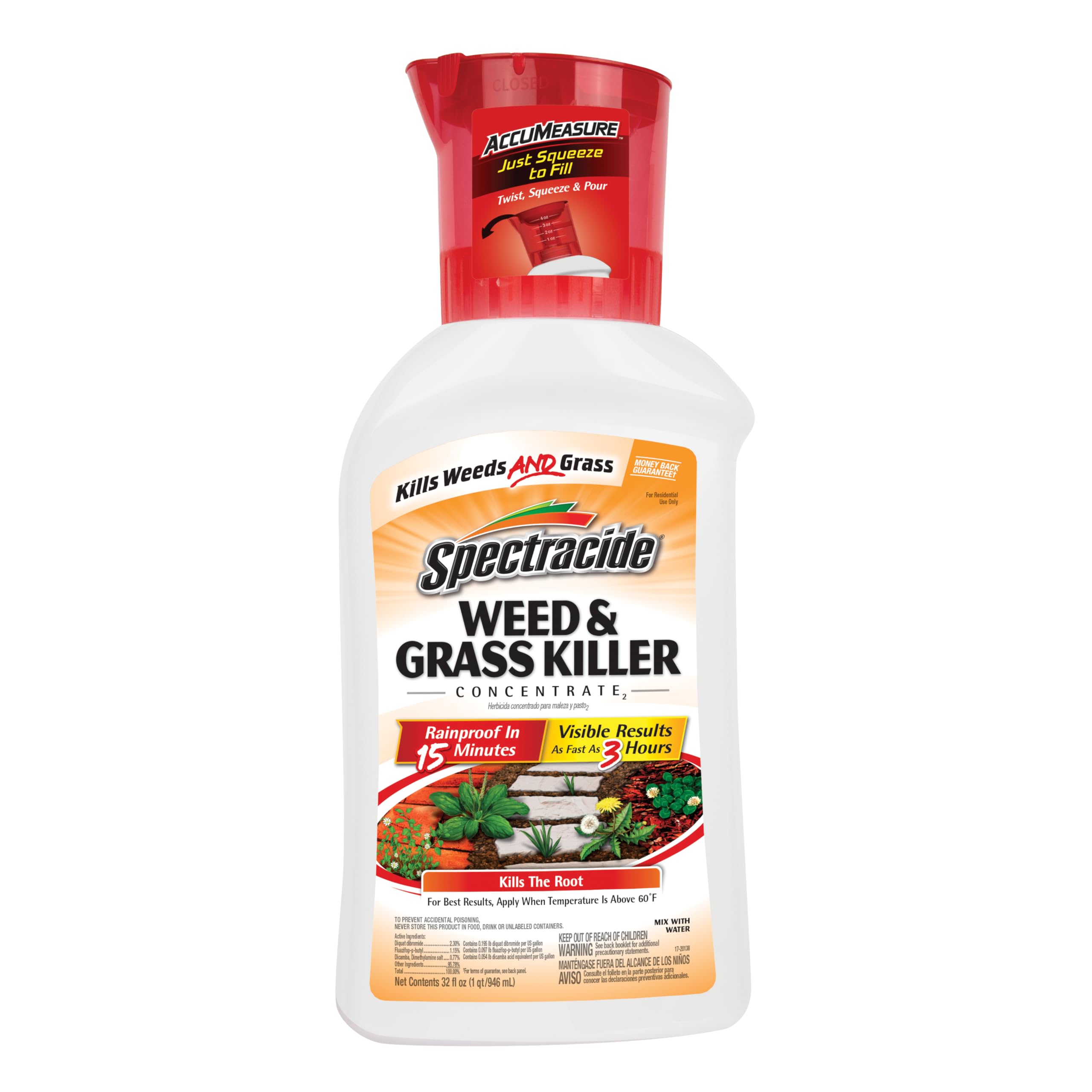
The Spectracide concentrate uses diquat dibromide, a contact herbicide that disrupts leaf cell membranes on contact and produces visible wilting in as fast as 3 hours. The 32-ounce bottle mixes to cover 1,350 square feet — ideal for driveway cracks, walkways, and fence lines where you want fast knockdown of annual weeds. The Accumeasure cap simplifies measuring by eliminating the need for a separate measuring cup, though some reviewers found the twist-and-squeeze mechanism finicky and preferred a standard cap.
The 15-minute rainfast window is the shortest in this guide, making it the best option when unpredictable weather is a factor. Because diquat is a contact killer rather than a systemic, it does not translocate to roots. This means established perennial weeds like dandelion or bindweed may regrow from the root system within a few weeks. For surface weeds in gravel or mulch beds where you don’t mind reapplying, the speed is unmatched.
Reviewers consistently praise the formula for rapid knockdown on annual grassy weeds and broadleaves along curbs and patios. One verified buyer noted reseeding flowers the same weekend after application. The main tradeoff is the lack of root kill — if your weed problem is predominantly annuals like crabgrass and foxtail, this is a fast, effective solution. If you’re battling perennials, pair it with a systemic treatment or expect to reapply.
Why it’s great
- Visible results in as fast as 3 hours
- 15-minute rainfast window is best-in-class
- Accumeasure cap simplifies mixing
Good to know
- Contact killer only — roots survive on perennials
- Accumeasure lid design received mixed reviews
4. RM18 Fast-Acting Weed & Grass Killer Herbicide, 32 oz

The RM18 herbicide delivers 3,000 square feet of coverage per 32-ounce bottle, more than double the coverage of the Spectracide concentrate at a similar active volume. The formula is designed for fast-acting contact kill on annual and perennial weeds along driveways, long gravel paths, and fence lines. Verified buyers with extended driveways reported eliminating the need for a weed whacker after a single application, with control lasting approximately 3 months before spot treatments were needed.
The formulation appears to offer a broader spectrum of weed suppression than typical diquat-based products, though the manufacturer does not disclose the full active ingredient breakdown. Repeat buyers noted using the product annually for consistent results. The fast-acting nature means browning begins within hours of application, providing immediate visual satisfaction that the treatment is working.
The product ships as a liquid that requires a tank sprayer for application. Some delivery delays were reported by reviewers, which is a shipping issue rather than a product performance concern. For large properties with extensive driveway or pathway weed problems where coverage area matters more than root eradication, the RM18 offers impressive value by treating 3,000 square feet from a single bottle.
Why it’s great
- 3,000 sq ft coverage from a single 32 oz bottle
- Visible results within hours of application
- Reported 3-month suppression on driveways
Good to know
- Limited information on specific active ingredient
- Requires tank sprayer — not ready-to-use
5. Ortho Max Nutsedge Killer RTU, 24 fl. oz (2 Pack)
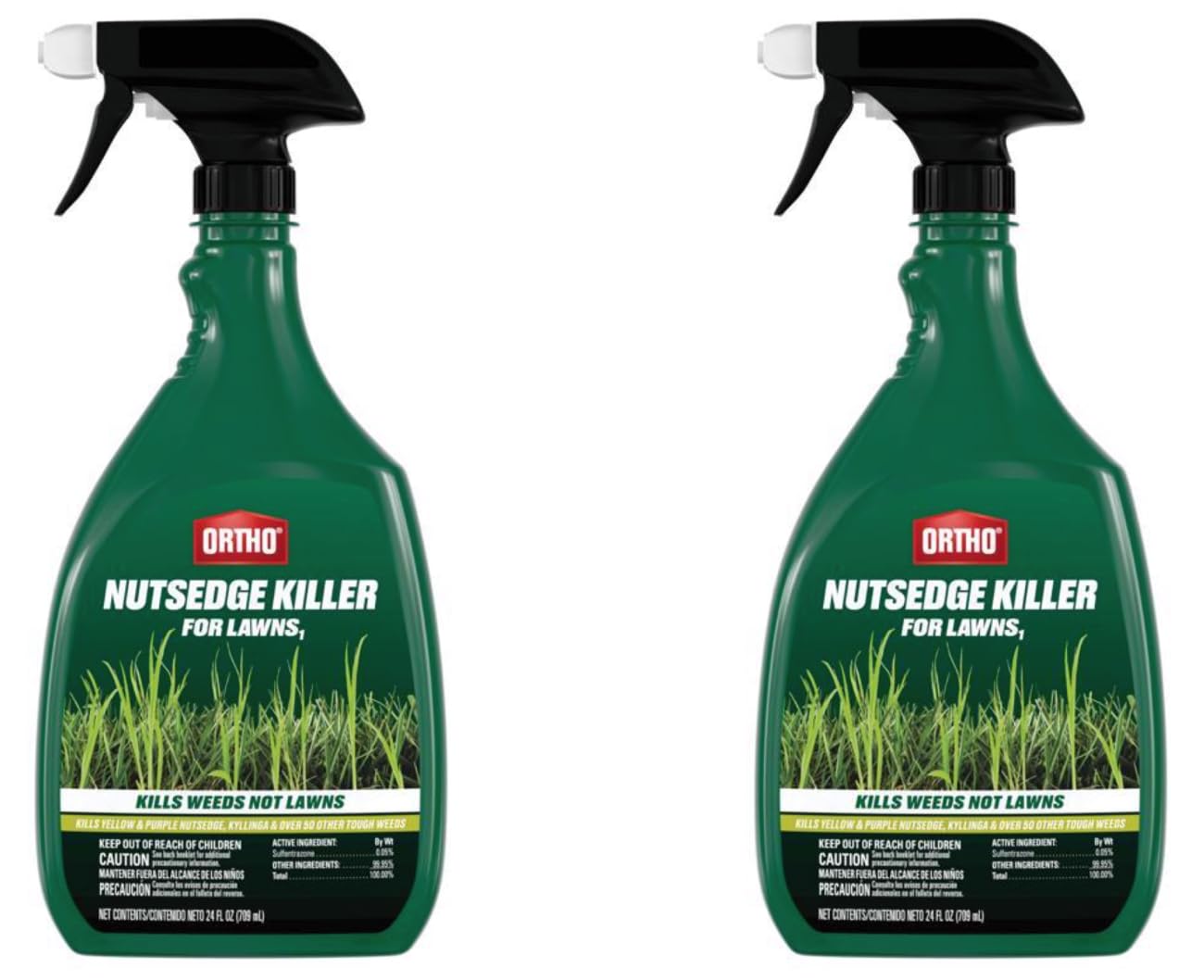
The Ortho Nutsedge Killer is a selective herbicide formulated specifically to target yellow and purple nutsedge, kyllinga, wild onion, garlic, broadleaf plantain, purslane, redroot, pigweed, dandelion, and spurge without harming turfgrass. This selectivity makes it the only product in this guide that can be applied directly over a lawn without killing the grass. The 2-pack provides 48 total fluid ounces of ready-to-use liquid.
Reviewers in Northern and Southern climates confirm the formula effectively suppresses nutsedge without the grass die-off that non-selective herbicides cause. One verified buyer emphasized that early application — when nutsedge first breaks the soil surface — yields die-off within a day or two, while waiting until the weed is taller reduces effectiveness. The rainfast window is 2 hours.
Because it is formulated for nutsedge specifically, this product does not provide the broad-spectrum non-selective control that the other formulas in this guide deliver. If your main lawn invader is nutsedge or kyllinga, this is the best targeted solution. For general driveway and patio weed control, a non-selective formula is more appropriate. The ready-to-use format eliminates mixing but limits coverage per bottle.
Why it’s great
- Selectively kills nutsedge without harming turfgrass
- Ready-to-use with no mixing required
- Works on purple and yellow nutsedge plus 50 other weeds
Good to know
- Narrow spectrum — not for general non-selective use
- Effectiveness drops on mature, tall nutsedge
6. Pet’s Pal Natural Weed Killer, 1 Gallon

The Pet’s Pal formula uses natural ingredients including chloride-based chemistry without glyphosate, targeting pets and children as the primary safety concern. The 1-gallon ready-to-use spray covers 1,000 square feet of broadleaf weeds and grasses. The active ingredients break down quickly in the soil, reducing the risk of chemical exposure for pets that frequent treated areas.
Reviewers report mixed results on speed — some see die-off within hours, while others note it takes significantly longer to work compared to synthetic formulas. The formula is non-selective and will kill grass, so application should be confined to flower beds, mulched areas, gravel, and driveway cracks. One verified buyer reported zero effect on established weeds even after multiple applications, suggesting the natural formula works best on young, tender weeds rather than mature growth.
For households with dogs that spend time on the lawn and in garden beds, the peace of mind of a glyphosate-free formula is the primary advantage. The tradeoff is inconsistent performance on tough, established weeds. If your weed problem is small, young weeds in areas where pets roam freely, this is a reasonable choice. For serious weed infestations, a synthetic concentrate will deliver more reliable results.
Why it’s great
- Glyphosate-free formula safer for pets and kids
- Ready-to-use spray with no mixing required
- Fast-acting natural ingredients show results in hours
Good to know
- Performance inconsistent on mature, established weeds
- Non-selective — will kill grass if applied to lawn
7. Airmax Ultra Pondweed Defense Aquatic Herbicide, 1 Quart
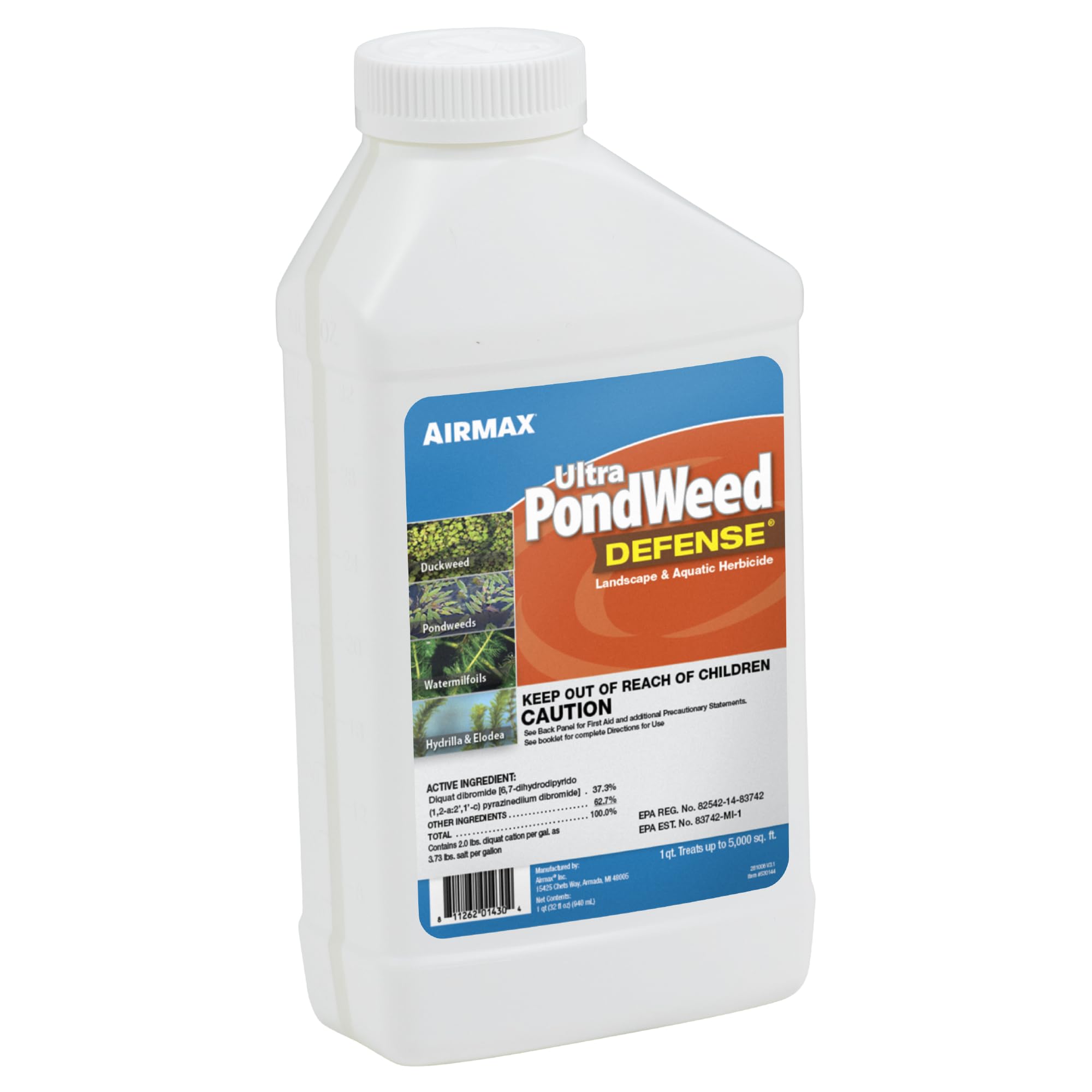
The Airmax Ultra Pondweed Defense is the only aquatic-specific herbicide in this guide, formulated for submerged, floating, and emergent pond and lake weeds including watermilfoil, hydrilla, naiad, coontail, and American pondweed. The 1-quart concentrate treats up to 5,000 square feet of pond surface. The active ingredient formula is designed to not harm game fish — bass, trout, bluegill, catfish, and even koi — when used according to the label.
Reviewers on ponds and lakes report visible browning within 24 to 28 hours of application with full control developing over 7 to 10 days. The contact action works best when weeds are actively growing. For early-season emergent treatments, multiple applications may be needed. The formula also temporarily suppresses duckweed and watermeal in slow-moving water.
The main limitation is the relatively short suppression period — some reviewers note weeds return within weeks and require repeated applications throughout the season. The concentrate must be mixed with water in a tank sprayer for even application across the water surface. For pond owners managing invasive aquatic weeds without killing fish, this is the only appropriate product in the lineup and fills a narrow but essential niche.
Why it’s great
- Safe for game fish including bass and trout
- Controls broad spectrum of submerged and floating weeds
- Fast visible results within 24-28 hours
Good to know
- Only for aquatic use — not for lawns or gardens
- Short suppression period may require repeat applications
FAQ
Does diquat dibromide kill weeds permanently?
How long should I wait before rain after applying glyphosate?
Can I use a non-selective weed killer on my lawn without killing the grass?
Final Thoughts: The Verdict
For most users, the best all weed killer winner is the Roundup with Comfort Wand because it balances quick visible results with systemic root kill and a 30-minute rainfast window that works with unpredictable weather. If you need the lowest cost per square foot for a large property, grab the 41% Glyphosate Concentrate — one gallon treats up to 26,000 square feet. And for fast knockdown on annual weeds in driveways and walkways where root kill isn’t necessary, nothing beats the Spectracide Concentrate with its 3-hour visible results and 15-minute rainfast window.