
Restless nights spent leaning over a crib, watching for the subtle rise and fall of a tiny chest, define the early months of parenthood. The quiet anxiety of not knowing whether your baby is breathing steadily drives many parents to seek an electronic second set of eyes. An at home doppler or movement monitor bridges that gap between instinct and data, turning an invisible process into a trackable signal you can rely on without hovering.
I’m Min — the co-founder and writer behind Gadgets Feed. I’ve spent countless hours dissecting the technical specifications across dozens of these devices, from sensor sensitivity and battery longevity to alarm latency and material safety certifications, to separate the genuinely reassuring from the merely marketed.
This guide cuts through the noise to identify the best at home doppler for your family’s specific sleep setup, budget tolerance, and anxiety level.
How To Choose The Best At Home Doppler
An at home doppler is not a single technology — it’s a category split between acoustic fetoscopes that listen for the fetal heartbeat and sensor-based movement monitors that track an infant’s breathing after birth. Understanding which phase of parenthood you are in determines which device is actually useful.
Fetal vs. Postnatal Monitoring
Acoustic fetoscopes like the Pinard horn amplify sound through mechanical resonance. They are passive, require practice, and typically only detect heart tones after 28 to 36 weeks gestation. In contrast, postnatal movement monitors clip to a diaper or sit under a mattress and use motion sensors to alert you if abdominal movement pauses for 15 to 20 seconds. Buy the tool for the stage you are actually in right now.
Sensor Type: Contact vs. Non-Contact
Direct-touch sensors — clipped to a diaper or onesie — offer higher sensitivity and fewer false alarms because they detect micro-movements through physical contact. Non-contact monitors use pressure-sensitive pads under the mattress. The trade-off is that contact monitors must be positioned correctly every time you dress the baby, while pad-based systems cover the entire crib area without any wearable component.
Alarm System and Battery Life
A two-stage alarm — first a gentle vibration intended to rouse the baby, then an audible alert after five seconds of continued non-movement — gives you precious seconds to respond without panic. Battery life is non-negotiable for overnight use. Look for at least seven days of typical runtime or a replaceable cell that lasts months. A device that dies mid-sleep cycle defeats its entire purpose.
Quick Comparison
On smaller screens, swipe sideways to see the full table.
| Model | Category | Best For | Key Spec | Amazon |
|---|---|---|---|---|
| Sense-U Pro | Movement Monitor | App-connected data tracking | 7-day battery, temperature sensor | Amazon |
| Snuza Hero SE | Movement Monitor | Ultra-sensitive contact detection | 6-month replaceable battery | Amazon |
| Babysense 7 | Movement Monitor | Non-contact, full crib coverage | Dual under-mattress sensor pads | Amazon |
| Levana Oma Sense | Movement Monitor | Zero-app simplicity | No WiFi or Bluetooth required | Amazon |
| BEMPU Baby Movement Monitor | Movement Monitor | Budget smart connectivity | 56-hour battery, 1-hour charge | Amazon |
| Skywin Fetal Heartbeat Monitor (White) | Fetoscope | Late-pregnancy acoustic listening | 14.4-ounce plastic build | Amazon |
| Skywin Fetal Heartbeat Monitor (Blue) | Fetoscope | Late-pregnancy acoustic listening | 12.9-inch Pinard horn | Amazon |
In‑Depth Reviews
1. Sense-U Pro Baby Breathing Movement & Sleep Position Monitor
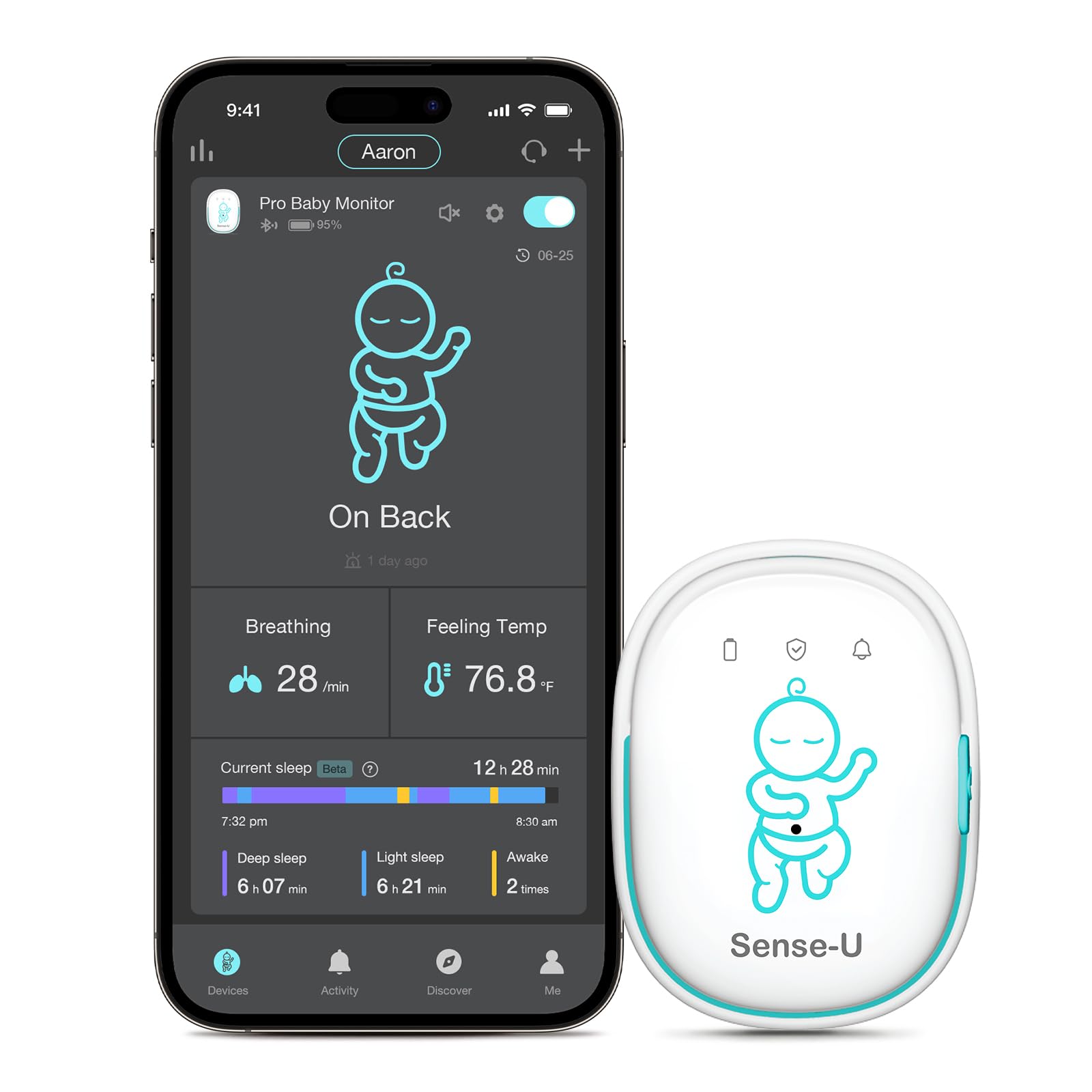
The Sense-U Pro combines a direct-contact clip-on sensor with a dedicated smartphone app, giving you real-time abdominal movement tracking plus temperature notifications and sleep cycle reports. Its Bluetooth Low Energy 4.0 module operates at a fraction of typical smartphone radiation, and the device meets FSA/HSA eligibility criteria, which matters for families budgeting through flexible spending accounts.
The two-stage alert system works identically to premium competitors: a gentle vibration attempts to rouse the baby after 15 seconds of no movement, and an audible alarm follows five seconds later if breathing hasn’t resumed. Parents report that the 7-day battery life comfortably lasts through the night even when the indicator shows 10 percent remaining, and a quick 10-minute top-up restores enough charge for another full night. The 1-year manufacturer warranty adds a layer of confidence that budget options omit entirely.
Where the Sense-U pulls ahead is its sleep trend analysis. The app generates detailed cycle reports distinguishing light sleep, deep sleep, and awake phases. This data helps you identify patterns that might indicate discomfort or early illness. The trade-off? Sleep history resets each morning rather than accumulating across weeks, which limits longitudinal analysis. For most families, the combination of portable clip-on design, temperature monitoring, and app-based notifications makes this the most complete single-device solution on the market.
Why it’s great
- Temperature sensor alongside movement tracking provides two health signals in one clip
- Battery charges to full in under an hour and lasts 7+ days of nightly use
- Bluetooth Low Energy minimizes RF exposure compared to WiFi-based monitors
Good to know
- Sleep history data resets each morning and is not saved across days
- App must remain active on your phone to receive real-time notifications
2. Snuza Hero SE Baby Movement Monitor

The Snuza Hero SE uses patented direct-touch sensors that attach to the front of a diaper, detecting the micro-movements of abdominal breathing through physical contact. This sensor architecture yields a lower false-positive rate than clip-on monitors that rely on positional stability, and the 1.38-ounce weight means even a newborn wearing a diaper won’t feel the device pressing into their belly. The replaceable battery lasts up to six months — no charging cables, no battery anxiety, no midnight low-battery warnings.
Alarm logic follows the proven 15-second vibration / 5-second audible cascade. The green LED indicator flashes with each detected breath, giving you a silent visual reassurance that the system is active. An optional ticking sound can be enabled for parents who prefer an audible confirmation of movement while using a separate audio or video monitor. The device contains no WiFi, no Bluetooth, and no app — it is a standalone safety device that cannot be accidentally disconnected by a phone update or app crash.
Medical-grade plastic and silicone construction means it passes skin-contact safety standards, and the included protective carry case makes it genuinely portable. The most frequently cited limitation is that the alarm volume, while audible across a standard hallway, may not wake a deep-sleeping parent. The solution is to position the base station or use a secondary audio monitor as a relay. For parents who distrust app-dependent systems and want a set-and-forget device with the highest contact sensitivity, the Snuza Hero SE remains the clinical benchmark.
Why it’s great
- Replaceable battery delivers up to six months of runtime without any charging routine
- Direct-touch sensor design minimizes false alarms compared to non-contact monitors
- Green LED breath indicator provides silent visual confirmation without waking the baby
Good to know
- Alarm volume may not be loud enough for heavy sleepers in larger homes
- Device can trigger false alerts if the diaper shifts and the sensor loses contact
3. Babysense 7 Baby Sleep Breathing Movement Monitor
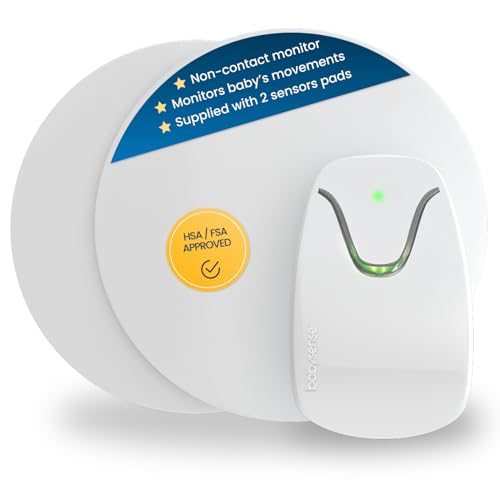
The Babysense 7 takes a fundamentally different approach by placing two pressure-sensitive sensor pads under the crib mattress, eliminating any wearable component. This non-contact design means there is nothing to clip, nothing to wash, and nothing the baby can kick off. The dual-pad configuration provides full crib coverage, so rolling from one side to the other does not create a blind spot. The passive sensor system is inherently safe — it has zero surface contact with the infant and emits no radiation.
Enhanced sensitivity in the current generation reduces the historical complaint of false alarms. The monitor sounds an alert if no movement is detected for 20 seconds — five seconds longer than most wearable competitors — which slightly decreases false positives while maintaining a clinically safe response window. The device requires no WiFi, no Bluetooth, and no app, making it immune to network outages and smartphone battery deaths. HSA and FSA approval means you can pay with pre-tax healthcare dollars.
Installation requires sliding the sensor pads between the mattress and the crib support board. Some crib designs need small wooden spacers to keep the pads flat, which you may need to source separately. The unit also lacks any vibration or visual breathing indicator, so you cannot glance at a light to confirm the baby is breathing without walking to the base station. For families who want zero wearable, zero app dependency, and zero daily setup, the Babysense 7 is the most proven non-contact system available.
Why it’s great
- Two under-mattress sensors cover the entire sleep surface without any wearable component
- HSA and FSA eligible, reducing out-of-pocket cost for eligible families
- No WiFi, Bluetooth, or app dependence means the device works during network outages
Good to know
- Installation may require additional spacers for cribs with thin mattress supports
- No visual breath indicator — you must listen for the base station to confirm operation
4. Levana Oma Sense Portable Baby Breathing Movement Monitor
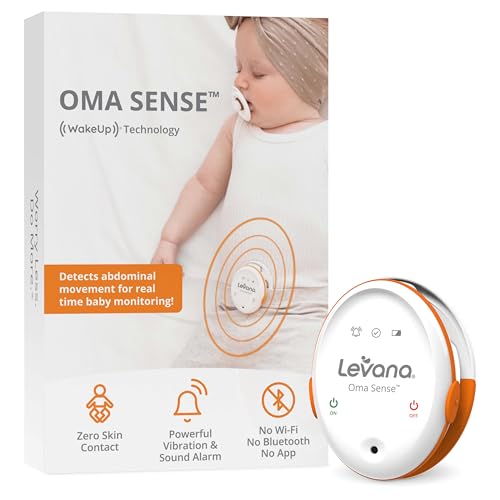
The Levana Oma Sense deliberately strips away every non-essential feature — no app, no Bluetooth, no WiFi — and functions as a pure standalone movement monitor. Designed in Canada from medical-grade materials, the unit slips over the baby’s diaper or buttoned-up onesie with zero skin contact. The absence of any radio frequency emissions makes this a strong choice for parents who want to minimize electromagnetic exposure while still getting a reliable breathing alert.
Patented Wakeup Technology uses a randomized series of vibrations after 15 seconds of no detected abdominal movement, followed by an audible alarm five seconds later. The randomized pattern is intended to be more effective at rousing the baby than a single monotonous pulse. A flashing blue light confirms normal operation at a glance, and the device works for infants from 0 to 6 months. Parents consistently praise the low false-alarm rate, noting that the Oma Sense rarely triggers incorrectly compared to competitor units.
The single most common criticism is that the alarm volume is insufficient for heavy sleepers. Several parents report building a DIY elastic waistband to keep the device positioned correctly, as the included strap can slip on certain diaper shapes. There is no battery indicator beyond the blue operational light, so you must remember to replace the battery on a schedule. For families who prioritize simplicity above all else and want a device that cannot be disconnected by a software glitch, the Oma Sense delivers exactly what it promises with minimal fuss.
Why it’s great
- Completely wireless and app-free — no setup beyond clipping to the diaper
- Medical-grade materials with zero skin contact reduce irritation risk
- Randomized vibration pattern is gentler for waking the baby than a single pulse
Good to know
- Alarm may not be loud enough to wake a deep-sleeping parent across the house
- No battery level indicator means you must track replacement intervals manually
5. BEMPU Baby Movement Monitor
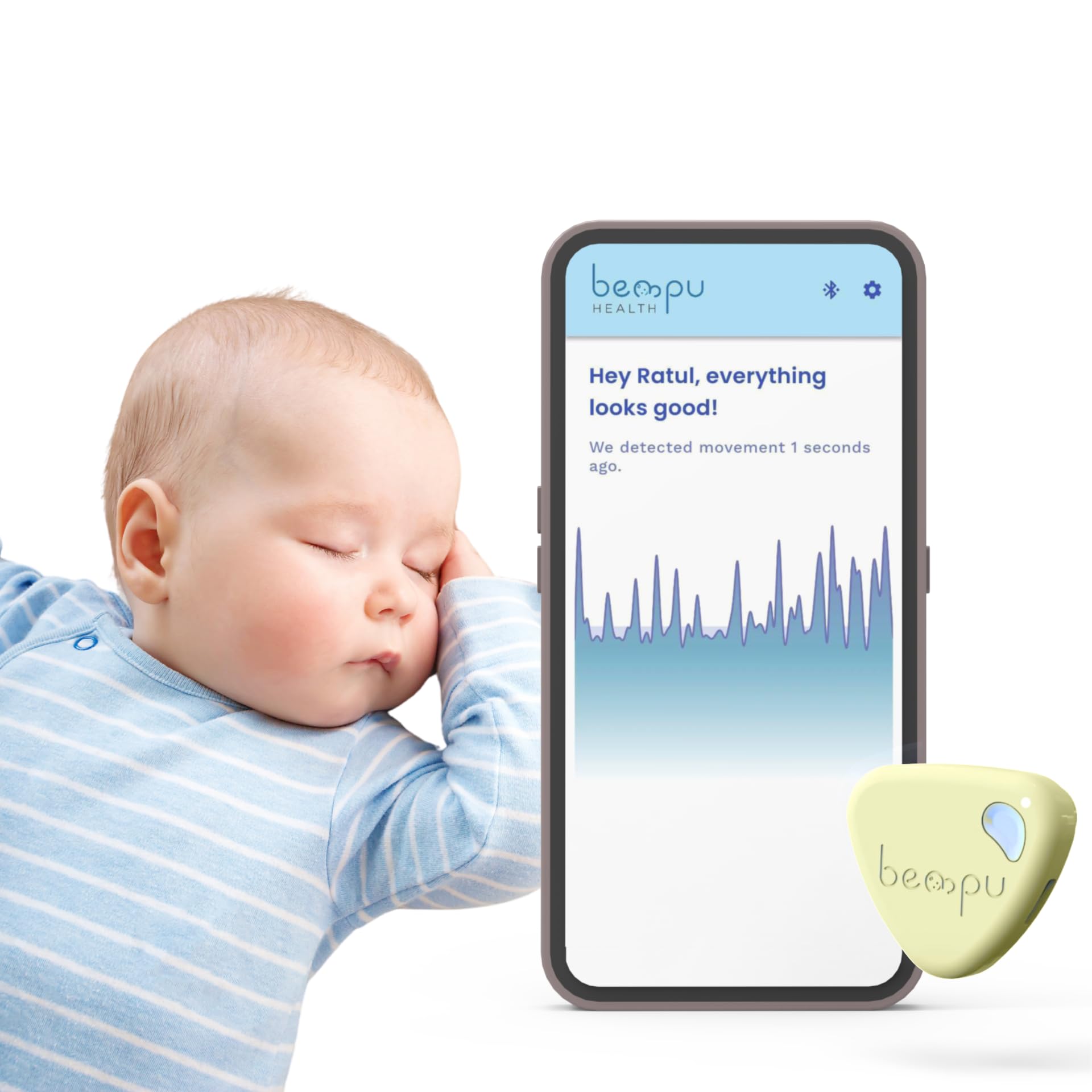
The BEMPU Baby Movement Monitor enters the market as a compact, 13-gram clip-on device that pairs with a smartphone app via Bluetooth for real-time alerts. The ABS plastic housing is lightweight enough to attach to a diaper without sagging, and the USB-C rechargeable battery delivers around 56 hours of typical use on a single 1-hour charge. At its price point, the BEMPU undercuts most app-connected competitors while still offering the same core two-stage alert system — gentle vibration followed by audible alarm.
Real-world battery performance exceeds the rated 56 hours, with one user reporting nine days before needing a charge. The device does not require WiFi and functions independently of the app once configured, so even if your phone battery dies, the unit still vibrates and sounds its alarm when movement stops. The clip design works on diapers, onesies, and swaddles, and users with 3-week-old infants report no issues with the sensor detecting movement through layered fabric.
The trade-off for the aggressive price is app stability. Several users report that the app disconnects when you switch to another application on your phone, requiring you to remove and reattach the device to re-sync. The startup noise is also noticeably loud, which can startle a sleeping baby if you activate the device bedside. For budget-conscious families who want app connectivity and fast charging without paying premium prices, the BEMPU offers the core functionality at a fraction of the cost, with the understanding that software polish is not its strong suit.
Why it’s great
- USB-C charging reaches full capacity in one hour with excellent real-world battery life
- 13-gram weight makes it the lightest clip-on monitor available
- Works independently without app after initial setup for core vibration and alarm functions
Good to know
- App can disconnect when switching between phone applications, requiring re-sync
- Loud startup chime may disturb a sleeping baby if activated nearby
6. Skywin Fetal Heartbeat Monitor (White)

The Skywin Fetal Heartbeat Monitor in White is a classic Pinard horn fetoscope — a purely mechanical acoustic device that requires no electricity, no batteries, and no charging. Its 14.4-ounce build and 12.56-inch package dimensions make it a substantial but portable tool for late-pregnancy listening sessions. The manufacturer explicitly states that detection is generally not possible before 24 weeks and recommends waiting until 30 to 36 weeks for the best chance of hearing clear fetal heart tones at 120 to 160 bpm.
Using the device demands patience and precise technique: find a quiet room, insert the earpieces tightly, and slowly scan different areas of the belly, applying slight pressure with the horn. The included user manual provides step-by-step positioning guidance and troubleshooting tips. However, the learning curve is steep — even experienced OB nurses have reported being unable to detect heart tones at 24 weeks, which matches the device’s stated limitations. The unit works best when you understand that it is designed exclusively for fetal auscultation and will not produce clear sound when tested on an adult chest.
Review data reveals a polarized user experience: roughly half find it rewarding after 28 weeks with consistent positioning, while the other half consider it completely ineffective. The common denominator is gestational age — users below 27 weeks overwhelmingly report failure. For families who want an electronic-free bonding ritual and are willing to practice positioning, this is the entry-level option. The compact design makes it easy to pack for travel, and the lack of electronic components means it will never fail due to a dead battery. Just calibrate expectations to the 30-week minimum window.
Why it’s great
- Zero electronic components means unlimited use without charging or battery replacement
- Compact and portable design fits easily into a diaper bag for travel
- Includes detailed user manual and troubleshooting guide for proper positioning technique
Good to know
- Inconsistent results before 28 weeks; best performance starts at 30 to 36 weeks gestation
- Acoustic design requires quiet environment and practice — not a quick or guaranteed listen
7. Skywin Fetal Heartbeat Monitor (Blue)

Identical in core design to the white variant, the Skywin Fetal Heartbeat Monitor in Blue offers the same Pinard horn acoustics with a green exterior finish and a 12.9-inch length. The plastic construction keeps the weight manageable while providing the rigid structure needed to conduct sound waves from the abdomen to the earpieces. Like its white counterpart, this is a non-invasive fetoscope that relies entirely on physical resonance rather than amplification electronics.
The instruction set emphasizes the same critical point: detection is barely possible at 24 to 30 weeks, with the best window being 30 to 36 weeks. The device is specifically tuned for fetal heart tones in the 120 to 160 bpm range and will not produce clear amplification of adult heartbeats. The green finish is the only meaningful differentiator between the two Skywin models — the technical specifications, included components, and user experience are otherwise identical.
Customer feedback mirrors the white version exactly, with the same polarized split between successful late-pregnancy users and frustrated early-pregnancy buyers. The device ships with one unit count and no additional accessories beyond the manual. For families choosing between the two Skywin options, the selection comes down to color preference and which listing arrives faster on Prime shipping. Both share the same limitation: they are supplementary bonding tools for the third trimester, not reliable early-detection devices. If your pregnancy is past 30 weeks and you want a battery-free, electronic-free listening experience, this fulfills that role without the complexity of digital dopplers.
Why it’s great
- Identical acoustic performance to premium fetoscopes at a fraction of the cost
- Green finish provides a visual alternative for parents who prefer color variety
- No batteries, charging, or electronic maintenance required for the life of the product
Good to know
- Requires 30 to 36 weeks gestation for reliable detection — will not work in early pregnancy
- Plastic construction may feel less durable than metal fetoscopes used in clinical settings
FAQ
Can I use a fetal doppler as a postnatal movement monitor after the baby is born?
At what gestational week can I reliably hear a heartbeat with a Pinard horn fetoscope?
How do I reduce false alarms from my baby’s movement monitor?
Final Thoughts: The Verdict
For most users, the best at home doppler winner is the Sense-U Pro because it bundles movement tracking, temperature sensing, sleep analysis, and a fast-charging battery into a single app-connected clip that works from newborn through six months. If you want a clinically proven contact sensor with a six-month replaceable battery and zero app dependence, grab the Snuza Hero SE. And for a non-contact solution that requires nothing on the baby and covers the entire crib, nothing beats the Babysense 7.