
A sagging, squeaking attic ladder door doesn’t just announce your presence to the entire house — it signals that your spreader hinge arms have finally given out. That wobble at the top of the ladder, the binding when you try to close it, or the door that won’t fully latch are all telltale signs of fatigued hinge metal that has lost its original geometry. Replacing those worn arms restores the precise parallelogram motion needed for smooth, single-pull operation.
I’m Min — the co-founder and writer behind Gadgets Feed. After cross-referencing dozens of compatibility matrices, material specs, and real-world user fitment reports for the most common Werner and aftermarket models, I’ve isolated the hinge arms that actually align with factory drilling patterns and hold up to repeated tension.
This guide cuts through the confusion of 55-1 versus 55-2 fitments and galvanized versus zinc coatings to deliver a clear, vetted ranking of the best replacement options. The result is a definitive list of the best attic door hinge arms available right now.
How To Choose The Best Attic Door Hinge
Choosing the right replacement attic door hinge arms is almost entirely about matching the model number and manufacturing date of your existing ladder. The physical dimensions and bolt patterns are not universal, so a wrong pick means drilling new holes — which compromises the structural integrity of the ladder frame.
Confirm the 55-1 vs 55-2 Split
Werner, the dominant manufacturer in this category, split its hinge design around February 2006. Ladders built before that date use the 55-1 hinge pattern (also called Mk 1, Mk 2, or Mk 3). Ladders manufactured after 2010 use the 55-2 pattern (Mk 5). The critical difference is the pivot point spacing and the overall arm length — 55-2 arms are approximately 30 inches long, while the 55-1 is shorter. Always check the sticker on your ladder frame before buying.
Material: Zinc vs Galvanized Steel
Most OEM Werner arms are stamped from thick zinc, which offers excellent corrosion resistance but can be more brittle under repeated impact. Aftermarket arms from HECASA and ECOTRIC use the same zinc spec. Galvanized steel, found on some budget alternatives, is tougher but heavier. For the hinge arm, weight isn’t a problem — the ladder supports nothing. The key is that the material doesn’t bend under the tension of the springs, which is why premium options use a three-layer electrophoretic coating for both wear and rust protection.
Evaluate the Hardware Quality
The included lag bolts and screws are the most common failure point reported by users across all price tiers. Thin or brittle screw heads snap off when driven into aged, dense wood framing, stranding you mid-installation. If the kit comes with hardware that looks undersized or has a Phillips head instead of a Torx or hex head, budget for a separate trip to the hardware store for 5/16-inch x 3-inch lag screws with a hex drive. The hinge arm itself might be perfect, but poor installation fasteners ruin the entire experience.
Quick Comparison
On smaller screens, swipe sideways to see the full table.
| Model | Category | Best For | Key Spec | Amazon |
|---|---|---|---|---|
| Werner 55-2 | Premium OEM | Exact factory fit | Aluminum, 30 in, 300 lb capacity | Amazon |
| Vanesa 55-2 w/ Springs | Premium | Complete kit with springs | Electrophoretic coated steel | Amazon |
| ECOTRIC 55-2 | Mid-Range | Thick zinc durability | Zinc, 30 in, pair (L & R) | Amazon |
| HECASA 55-2 | Mid-Range | Direct Werner Mk 5 swap | Thick white zinc, pair | Amazon |
| Vanesa 55-1 | Mid-Range | Older ladders (pre-2006) | Steel, electrophoretic coated | Amazon |
| MOUNTAIN_ARK T-Strap | Budget | Heavy shed / barn gate | Low carbon steel, 3/16 in thick | Amazon |
| CTrowelpro Gate Hinge | Budget | Multi-pack shed doors | Cast iron, 3.5 in x 4.5 in | Amazon |
In‑Depth Reviews
1. Werner 55-2 Replacement Attic Ladder Hinge Arms

The Werner 55-2 is the gold-standard OEM replacement for any Werner Mk 5 ladder manufactured after 2010. The arms are constructed from aluminum, which keeps the overall weight down to 6 pounds while still supporting a 300-pound load capacity rating stamped right into the part. The 30-inch overall length matches exactly with the factory parallelogram geometry, meaning the bolt pattern aligns without any slot elongation or modification to the ladder frame.
Users consistently report a “perfect fit” with no slop in the pivot holes, though several note that the included hardware screws are too long for some ceiling thicknesses — you may need to add a washer or trim the bolt to get a snug bite into the framing. The arms themselves are high quality, operating smoothly and quietly once installed, with no binding at the hinge point. One caveat: the packaging does not include the tension springs, so if your springs are also worn, you’ll need to source those separately.
Installation is the standard two-person job — one to hold the ladder at the correct angle while the other aligns the arm and drives the lag bolts. The only reported issue is that measurement has been exactly one inch shorter than some original ladders, requiring a slight repositioning of the bracket to avoid screw interference. Overall, this is the most reliable choice if you want a direct factory-grade swap and are willing to buy your own springs.
Why it’s great
- Precision OEM fit for Werner Mk 5 ladders — zero modification needed
- Aluminum construction keeps weight low while holding 300 lb capacity
- Smooth, quiet operation restores factory ladder performance
Good to know
- Springs are not included — budget extra if your old springs are weak
- Included lag bolts may be too long for some ceiling frames
- Arms measure slightly shorter than some early Mk 5 ladders
2. Vanesa 55-2 Attic Ladder Hinge Arms with Springs
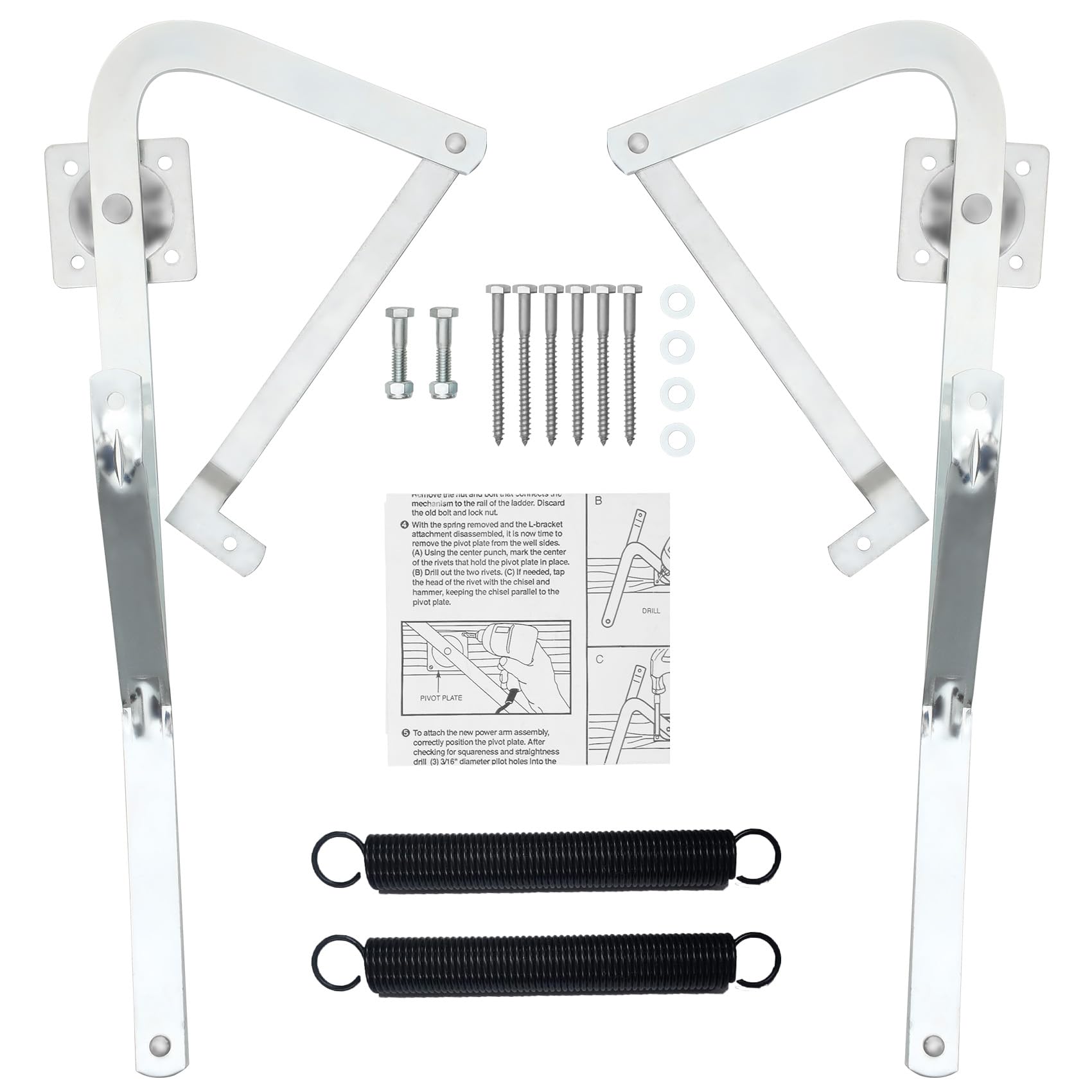
The Vanesa 55-2 kit is the most complete drop-in solution for Werner Mk 5 ladders because it includes both the hinge arms and the spring assemblies — something the OEM Werner kit and most competitors omit. The arms use an electrophoretic coating with a three-layer galvanizing process that provides excellent wear and corrosion resistance, which matters in an attic environment where temperature swings can cause condensation. The material is steel rather than aluminum, adding about 7 pounds to the overall weight, but the thickness translates into a very rigid hinge that resists the inward bending that thinner arms can develop over repeated cycles.
Installation reviews emphasize that the springs add significant tension during the install process — having a second person to center the lower hole while reattaching the spring is nearly mandatory. The included lag screws are 3 inches long, which is adequate for most ceiling joists, but users with older homes (pre-1980s) report that the screw heads can snap off if the wood is particularly dense or brittle. The instructions are a weak point, described as “poorly written,” so you will likely rely on online video guides to complete the job in under 60 minutes.
Once installed, the new spring tension creates a satisfying “snap-close” action that locks the door securely into the ceiling panel. The upgrade from a wobbly, bent set of original arms to these rigid replacements restores full safety to the ladder operation. With a two-year manufacturer warranty, this is the lowest-risk choice for anyone who wants fresh springs without hunting for separate parts.
Why it’s great
- Complete kit — hinge arms and springs included for a single-box fix
- Electrophoretic coating offers superior corrosion protection for attic environments
- Two-year warranty provides peace of mind against manufacturing defects
Good to know
- Poor instruction manual — expect to use online video guides
- Steel construction adds weight compared to aluminum OEM arms
- Lag bolts can snap in very old or dense framing wood
3. ECOTRIC 55-2 Replacement Attic Ladder Hinge Arms
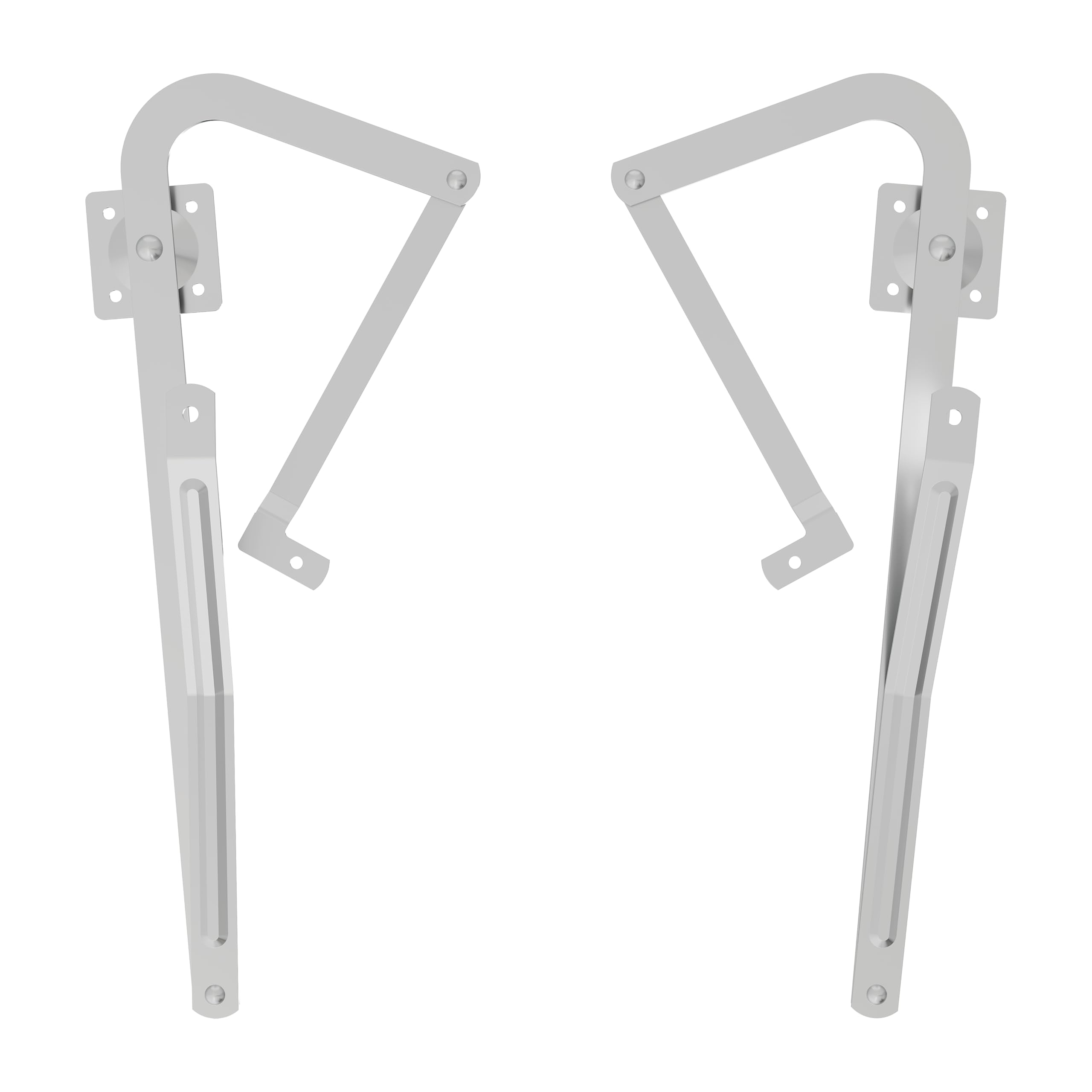
The ECOTRIC 55-2 arms are built from thick zinc, matching the material spec of the original Werner OEM part while costing less than half the price of the branded option. Each arm is clearly marked “R” and “L,” removing any guesswork during installation — a small detail that significantly reduces installation time. The overall dimension is 30 inches, which aligns perfectly with the 2010+ Werner Mk 5 geometry, and the 5.3-pound pair weight feels substantial enough to resist bending under the constant tension of the springs.
User feedback is overwhelmingly positive for the fit and finish, with several owners of 1990s Werner models reporting that these arms fit their older ladders just as well as modern Mk 5 ladders — suggesting some cross-compatibility beyond the advertised spec. The most common complaint involves the included lag screws: one user sheared off a 5/16-inch screw head during installation with a standard ratchet, recommending replacement with higher-quality hardware from a local store. The instructions are clear and straightforward compared to some competitors.
A concern shared by a long-term reviewer is that the hinge arms may bend slightly inward during use, similar to the failure mode of the original parts they replaced. This suggests the zinc, while thick, is not as rigid as the steel or aluminum options. For ladders that see daily use — such as in a workshop or storage loft — this bending could accelerate over time. For standard residential attic access used a few times per month, this is an excellent mid-range balance of cost and durability.
Why it’s great
- Thick zinc construction matches OEM material for authentic feel
- Left/right marked arms simplify installation and prevent errors
- Affordable price point without sacrificing dimensional accuracy
Good to know
- Lag screws supplied are prone to shearing — use your own hardware
- Arms may bend inward slightly under heavy spring tension over time
- Pair weight is about 5.3 pounds, lighter than steel alternatives
4. HECASA 55-2 Attic Ladder Spreader Hinge Arms

The zinc has a rust-protection treatment that holds up well even in unconditioned attic spaces where humidity can spike. Compatibility is strictly limited to Werner Mk 5, WU2210, W2208, and W2210 models manufactured after 2010 — it will not work on Century or any other brand of ladder.
Installation reviews are mixed but lean positive. One user nailed the install in under 30 minutes, while another reported that the included hardware only provides six lag bolts when the factory design calls for eight. The arm-to-ladder bolts are a slightly smaller diameter than the originals, which is a concern for some installers, though most agree the smaller bolts are likely sufficient given that the primary load is transferred through the spring tension, not the bolts themselves. One unit had a rivet snap off on the bracket during installation, resulting in a return.
The biggest strength of the HECASA kit is that it targets a very specific pain point: the Werner 55-2 spreader hinge is notoriously expensive from the manufacturer, and this aftermarket option delivers the same geometry at a fraction of the price. While the hardware could be better, the arms themselves are dimensionally accurate and restore smooth ladder operation. It is the smart pick for budget-conscious homeowners who already own a set of quality lag bolts.
Why it’s great
- Thick white zinc arms resist rust in high-humidity attic environments
- Dimensional accuracy matches Werner 55-2 factory specs precisely
- Light enough for one person to handle during initial positioning
Good to know
- Only includes 6 lag bolts — you need 8 for full structural support
- Reported rivet failure on the bracket of one unit
- Bolts to ladder arms are smaller diameter than original OEM fasteners
5. Vanesa 55-1 Attic Ladder Spreader Hinge Arms

If your Werner ladder has a manufacturing date before February 2006 — meaning it belongs to the Mk 1, Mk 2, or Mk 3 series — the Vanesa 55-1 is the only aftermarket arm that fits without drilling new mounting holes. The steel arms use an electrophoretic coating that provides a hard, corrosion-resistant surface far more durable than the original painted finish that typically flakes off after a decade. This kit replaces the spreader hinge arms only and does not include springs, which is consistent with the 55-1 standard.
User reviews consistently praise the perfect fitment on older ladders, with one owner of a 1989 Werner ladder reporting a seamless 45-minute installation after the original hinge snapped. The included lag screws are 3 inches long, matching the spec printed on the box, though the manual lists them as 2 inches — a documentation error that doesn’t affect installation. The new arms add significant rigidity to older ladders that may have developed wobble from years of use, and the fresh spring tension (using existing or purchased replacement springs) restores the positive snap-close action.
The biggest challenge is that removing the original hinge rivets is difficult, especially on factory-built ladders where the pins are pressed in. A drill and a sharp bit are required to grind out the rivet heads before the old arm can be freed. The instructions are again a weak point — vague and poorly diagrammed — so a video guide is highly recommended. Despite this, the 55-1 Vanesa is the definitive fix for anyone whose ladder predates the 2010 hinge redesign and wants to avoid replacing the entire ladder assembly.
Why it’s great
- Exact fit for pre-2006 Werner ladders — no drilling or modifications needed
- Electrophoretic coating offers superior durability over factory paint
- Restores structural rigidity to older, wobbly attic ladders
Good to know
- Factory rivets are very difficult to remove; a drill is required
- Poor instruction manual — rely on online video tutorials
- Does not include springs; you must purchase or reuse old ones
6. MOUNTAIN_ARK 2 Pack 14-1/2″ Black Strap Gate Hinges
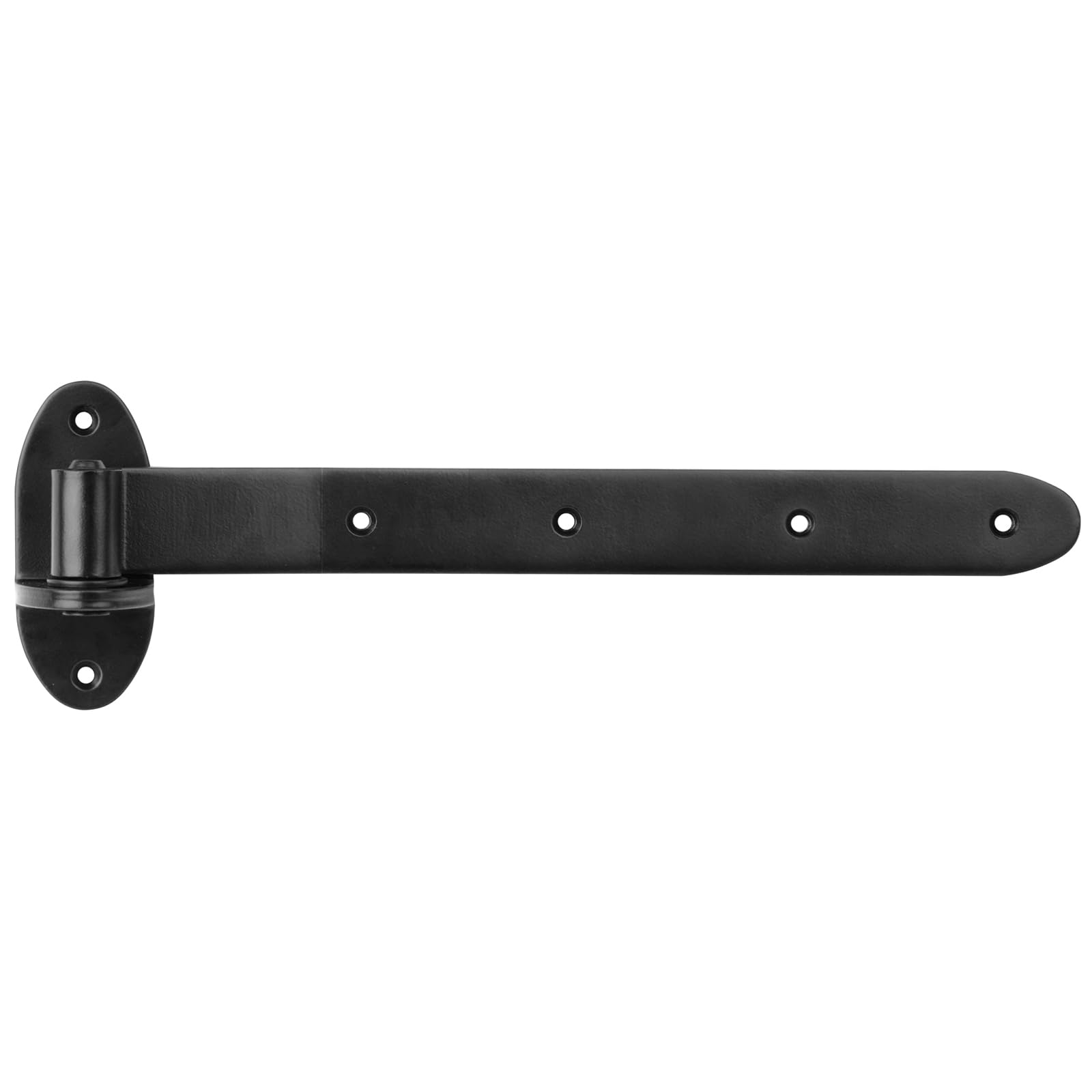
The MOUNTAIN_ARK T-strap hinges are not attic ladder spreader arms — they are heavy-duty gate hinges that can serve as a creative workaround for building a custom attic door or replacing a non-standard hinge setup on a shed-style entry. The 2-pack includes two 14.5-inch low carbon steel straps with a 3/16-inch thickness and a black powder-coated finish that resists wear and corrosion. The pintle plate measures 4-5/8 inches by 2 inches with a 5/8-inch pin diameter, making these extremely robust compared to standard residential hinges.
Real-world users have mounted these on pole barn doors weighing over 150 pounds with zero sag after weeks of daily use. The lift-off design allows the door to be removed from the hinge pins without unscrewing anything, which is convenient for seasonal door swaps. The countersunk holes accept standard #12 screws, and the 180-degree rotation angle is sufficient for most gate and door applications. The low carbon steel core is solid enough to last years without deformation.
The critical limitation for attic use is that these are not designed for the spreader-arm parallelogram mechanism that attic ladders require. They are useful as a replacement for the hinge on the door itself if your existing hinge has corroded, but they cannot substitute for the counter-balance arms that control the ladder’s folding motion. For a pure hinge replacement on a heavy shed door or a custom attic access hatch, this is a premium budget option. For a direct Werner ladder repair, skip to the 55-2 options above.
Why it’s great
- Extremely durable 3/16-inch steel construction handles over 150 lbs
- Powder-coated finish withstands outdoor humidity and temperature swings
- Lift-off design simplifies door removal for maintenance or seasonal use
Good to know
- Not a replacement for attic ladder spreader arms — different mechanism
- Requires drilling new mounting holes for attic door installation
- Screws are not included; you must provide your own #12 fasteners
7. CTrowelpro 3-1/2″ Heavy Duty Gate Hinges, 8 Pack
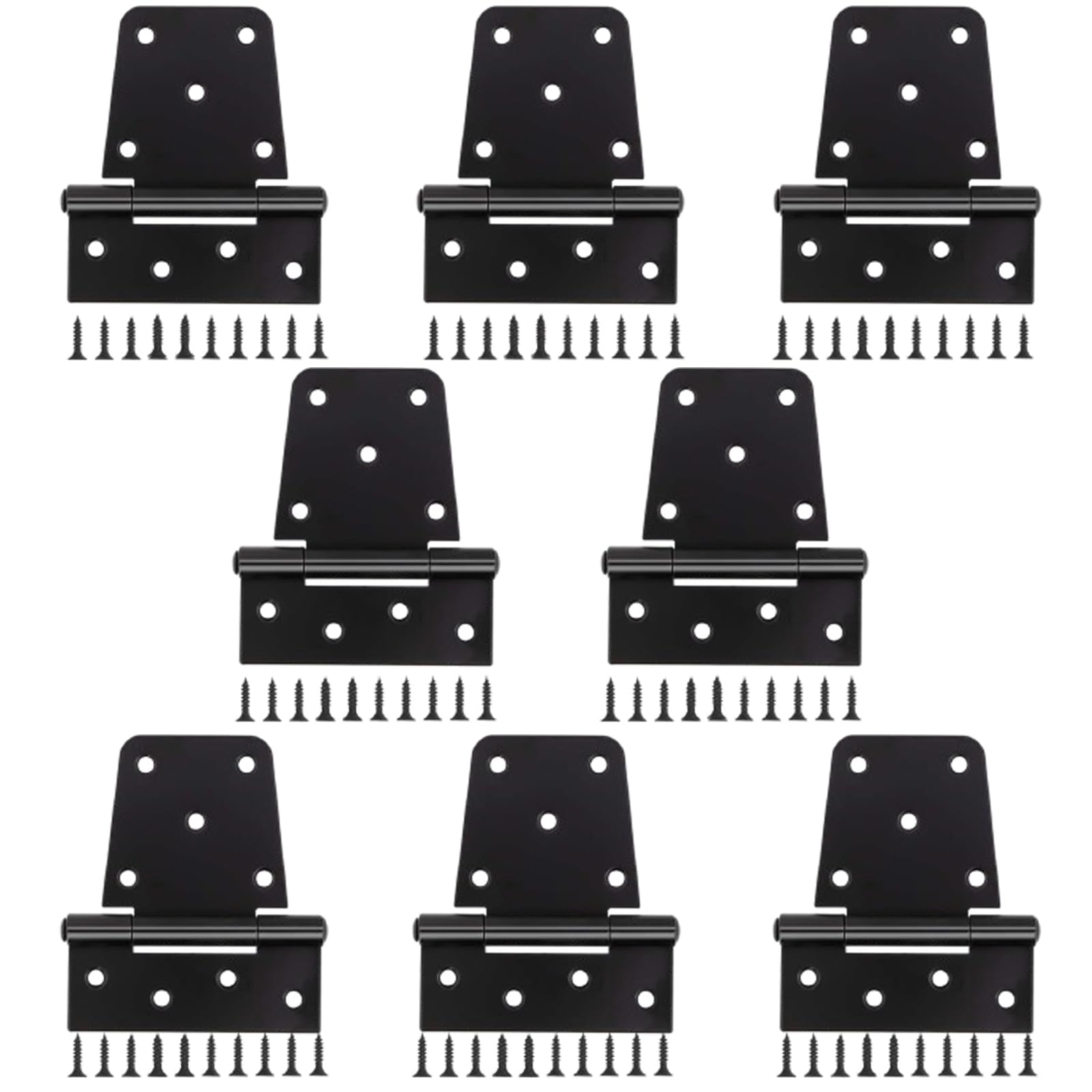
The CTrowelpro 8-pack of 3.5-inch T-hinges is the wallet-friendly option for anyone replacing hinges on a storage shed, gate, or tool box — not for an attic ladder spreader mechanism. Each hinge is made of cast iron with a matte black powder coating and a 1.2-inch thickness that gives them a sturdy feel. The maximum capacity is rated at 60 pounds per hinge, which means a bank of four hinges can support a 240-pound door without issue. The offset screw-hole pattern is specifically designed to prevent wood splitting when driven into softer lumber.
Users report that the cast iron construction is noticeably heavier and more solid than the stamped steel hinges found at big-box stores. The 8-pack includes 144 screws (72 at 20mm and 72 at 25mm), though the screws are widely described as the weakest link — soft metal that strips easily or snaps under torque. The general consensus is to use the hinges and buy a separate box of quality wood screws. The hinge design allows for a full 180-degree opening, and the matte black finish blends well with dark hardware on sheds and fences.
For an attic door specifically, these hinges would only work if you are building a custom hatch door from scratch where a simple T-hinge pair can suffice. They lack the spreader-arm linkage that makes attic ladders fold and unfold automatically. Within their intended category of gate and shed hardware, this is a solid bulk purchase. For anyone reading this guide hoping to fix a broken Werner ladder, these are not the correct component — stay focused on the 55-1 and 55-2 options.
Why it’s great
- Bulk 8-pack provides enough hinges for multiple doors or large projects
- Cast iron construction is more rigid than common stamped steel hinges
- Offset screw-hole pattern prevents wood splitting during installation
Good to know
- Included screws are low quality — replace with your own fasteners
- Not a functional replacement for attic ladder spreader arms
- Each hinge rated at only 60 lbs, requiring multiple hinges for heavier doors
FAQ
Can I use a 55-2 hinge on a pre-2006 Werner ladder?
Why do my new hinge arms keep bending inward under tension?
How do I remove the old factory rivets from my Werner ladder?
What size lag bolts do I need for a secure installation?
Final Thoughts: The Verdict
For most users, the best attic door hinge winner is the Vanesa 55-2 Kit with Springs because it is the only complete solution that includes both arms and springs, eliminating the risk of mismatched parts. If you want exact OEM fitment and already have good springs, grab the Werner 55-2. And for owners of pre-2006 ladders who need a 55-1 pattern, nothing beats the Vanesa 55-1 for preserving the original factory geometry.