
Color-accurate line work, zero banding in gradients, and smooth playback of 24‑fps cel animation — an anime graphics card built for this workload handles those non‑negotiable tasks while also crushing 1440p gaming at high refresh rates. Flat shading, fast camera pans, and layered compositing expose flaws that gaming‑first GPUs often mask with motion blur or aggressive upscaling.
I’m Min — the co‑founder and writer behind Gadgets Feed. I’ve spent hundreds of hours researching PCB layouts, VRAM configurations, and thermal solutions across AMD’s RDNA 4 and NVIDIA’s Blackwell architectures to filter the cards that consistently deliver artifact‑free rendering and stable driver support for animation workflows.
The right GPU eliminates aliasing on thin outlines and stutter during scrubbing while keeping fan noise low enough not to bleed into your mic. This guide dissects the nine best options dominating the current market so you can match silicon to your specific creative pipeline.
How To Choose The Best Anime Graphics Card
Anime rendering places unique demands on a GPU that mainstream gaming benchmarks ignore. Banding artifacts in flat gradients, aliasing on thin character outlines, and micro‑stutter during camera pans are all tell‑tale signs of a card that wasn’t designed with cel‑shaded content in mind. Here are the specs that matter most.
VRAM Size and Memory Bus Width
Cel‑shaded textures at 4K resolution can spike VRAM usage past 12 GB, especially when working with layered PSDs or uncompressed video timelines. Cards with 16 GB of GDDR6 or GDDR7 and a 256‑bit bus handle large frame buffers without swapping to system RAM, eliminating dropped frames during scrubbing.
Driver Stability and Codec Support
AMD’s RDNA 4 drivers have matured significantly in the past twelve months, offering reliable OpenGL performance for animation suites like Clip Studio Paint and Blender. NVIDIA’s Studio drivers remain the gold standard for CUDA‑accelerated rendering, but both camps now support AV1 encoding for high‑quality exports without bloated file sizes.
Cooling Solution and Acoustic Profile
Cards with 0dB fan modes — such as the WINDFORCE and Taichi 3X systems — allow silent operation during light 2D work. When rendering or gaming pushes temperatures above 55 °C, triple‑fan designs with composite heat pipes keep noise under 35 dBA even under sustained load, a critical factor for noise‑sensitive recording environments.
Quick Comparison
On smaller screens, swipe sideways to see the full table.
| Model | Category | Best For | Key Spec | Amazon |
|---|---|---|---|---|
| GIGABYTE RX 9060 XT ICE | Mid‑Range | 1440p gaming + silent rendering | 16 GB GDDR6 / 128‑bit | Amazon |
| PNY RTX 5070 Epic‑X ARGB OC | Mid‑Range | 1440p high‑FPS + DLSS 4 | 12 GB GDDR7 / 192‑bit | Amazon |
| GIGABYTE RTX 5070 WINDFORCE OC | Mid‑Range | Compact builds + quiet operation | 12 GB GDDR7 / 192‑bit | Amazon |
| XFX Mercury RX 9070 XT White | High‑End | Aesthetic builds + 4K rendering | 16 GB GDDR6 / 256‑bit | Amazon |
| ASRock RX 9070 XT Taichi | High‑End | 4K gaming + streaming | 16 GB GDDR6 / 256‑bit | Amazon |
| ASUS Prime RX 9070 XT OC | High‑End | Linux compatibility + 4K | 16 GB GDDR6 / 256‑bit | Amazon |
| ASUS TUF RTX 5070 OC | High‑End | Durability + AAA titles | 12 GB GDDR7 / 192‑bit | Amazon |
| Sapphire Nitro+ RX 9070 XT | High‑End | Premium build + 4K | 16 GB GDDR6 / 256‑bit | Amazon |
| PowerColor Red Devil RX 9070 XT | High‑End | 1440p 100+ FPS gaming | 16 GB GDDR6 / 256‑bit | Amazon |
In‑Depth Reviews
1. Sapphire Nitro+ AMD Radeon RX 9070 XT Gaming OC (16 GB)

The Sapphire Nitro+ RX 9070 XT delivers a 60 to 90 percent performance uplift over last‑generation mid‑range cards, with boost clocks sustaining around 3.0 GHz under load. Its 16 GB VRAM on a 256‑bit bus handles 4K cel‑shaded renders without stutter, while the triple‑fan cooler keeps junction temperatures below 80 °C even during hour‑long exports.
Real‑world 1% lows at 1440p in demanding scenes are dramatically improved, meaning camera pans in animation playback stay buttery smooth. The card ships with a clean 12V cable routing channel under the backplate, a small detail that simplifies cable management in tight chassis. No coil whine was reported across multiple units, a rarity at this power envelope.
Power draw peaks near 340 W, so an 850 W PSU is recommended. The cooler extends past the PCB by a few millimeters — triple‑check case clearance, especially width clearance against the side panel. The included support bracket helps with sag, but some users found it insufficient for the card’s 2.6 kg weight.
Why it’s great
- Sustained 3.0 GHz boost for smooth 4K rendering
- No coil whine reported across multiple units
- 16 GB VRAM eliminates frame‑buffer swap
Good to know
- Weighs 2.6 kg — extra support bracket advised
- Power / RGB connectors on inner edge are fragile
- Requires 3+ slots of clearance
2. PowerColor Red Devil AMD Radeon RX 9070 XT (16 GB)

The Red Devil RX 9070 XT crushes 1440p at triple‑digit frame rates — 100+ fps on max settings and 165+ with high/medium presets — while FSR 4 delivers image quality competitive with DLSS 4. Its three 8‑pin power connectors feed a 340 mm PCB that runs cool and quiet thanks to a triple‑fan solution with a composite heat‑pipe array.
In real‑world use, the card delivers consistent 200 fps in Warframe and excellent stability in Stalker 2 and Cyberpunk 2077 when paired with a 9800X3D. The 900 W minimum PSU recommendation is not an exaggeration; transient spikes can trip lower‑capacity units. The included addressable RGB cable and graphics card holder add value for builders chasing a cohesive aesthetic.
Vertical orientation in cases like the Thermaltake Tower 500 causes overheating because the heat‑pipe layout relies on horizontal gravity flow. This card is strictly for standard horizontal mounts. At full load, fan noise remains unobtrusive, roughly matching the ambient level of a quiet office.
Why it’s great
- Crushes 1440p at 100+ fps on max settings
- FSR 4 quality rivals DLSS 4
- Runs cool with low fan noise
Good to know
- Does not work well in vertical orientation
- 340 mm length may not fit many cases
- Needs a 900 W PSU minimum
3. ASUS Prime AMD Radeon RX 9070 XT OC Edition (16 GB)

The ASUS Prime RX 9070 XT is among the few high‑end GPUs that works flawlessly out of the box on Fedora Linux KDE, making it a top choice for creators who dual‑boot or run Linux‑native animation tools. At 311 mm long, it fits most mid‑tower cases without the clearance headaches of longer 340 mm cards.
Power draw under stress hovers between 180 and 190 W — lower than many competitors — and the dual‑ball fan bearings are rated for twice the lifespan of sleeve bearings. Idle temperatures sit at 28 to 32 °C, rising to 55 to 59 °C under load, well within safe operating ranges. The phase‑change GPU thermal pad ensures consistent heat transfer over years of use.
The card lacks RGB lighting, which may be a pro or a con depending on your build aesthetic. Users report no coil whine, and the 2.5‑slot design leaves room for adjacent PCIe cards. Keep in mind that the warranty process is run directly through ASUS, and customer service response times have been a pain point for some owners.
Why it’s great
- Native Linux support out of the box
- Low power draw of 180–190 W under stress
- Dual‑ball fans rated for longer lifespan
Good to know
- No RGB lighting for aesthetic builds
- ASUS warranty support can be slow
- Struggles at 4K 144 Hz with max ray tracing
4. ASRock Radeon RX 9070 XT Taichi (16 GB)

The ASRock Taichi pushes a factory boost clock of 3100 MHz — the highest factory OC among all RX 9070 XT cards tested. Its 16‑phase SPS power delivery allows aggressive undervolting via Adrenaline, which often improves both thermals and sustained performance beyond stock settings. The Taichi 3X cooling system with triple 100 mm striped‑ring fans and reverse spin keeps noise in check even during extended rendering sessions.
At 13 inches long and 2.18 kg, this is a physically large card that requires careful case measurement. The Dual BIOS switch lets you toggle between Performance and Silent modes, the latter dropping fan speed noticeably without sacrificing more than 3 to 5 percent frame rate. Polychrome SYNC RGB adds customization, though some users report the RGB software losing connection intermittently.
The 16‑pin to 3×8‑pin adapter is included, but an 850 W PSU is the realistic minimum for stable operation. When paired with a 7600X3D, this card maxes out 1440p in every modern title with ray tracing enabled. The reinforced metal backplate adds structural rigidity, preventing PCB flex that can cause long‑term solder joint stress.
Why it’s great
- Highest factory OC at 3100 MHz boost
- 16‑phase SPS power for stable undervolting
- Dual BIOS lets you trade noise for performance
Good to know
- RGB software can lose connection
- 13‑inch length needs large case
- LED color change is finicky
5. ASUS TUF Gaming RTX 5070 OC Edition (12 GB GDDR7)

The ASUS TUF Gaming RTX 5070 is built around military‑grade components and a protective PCB coating that guards against moisture, dust, and debris — an edge for creators working in less‑than‑pristine environments. The 3.125‑slot design incorporates a massive fin array that keeps the card at roughly 65 °C under sustained gaming loads, even with DLSS 4 and ray tracing enabled simultaneously.
The phase‑change GPU thermal pad outlasts traditional thermal paste, maintaining optimal contact pressure over years of thermal cycling. At 13 inches long and 3.4 pounds, this card includes a support bracket that doubles as a screwdriver — a thoughtful inclusion for builders who frequently swap components. Benchmarking shows roughly 8 percent factory OC headroom beyond the 2610 MHz boost clock.
Installation is straightforward if your case has 13 inches of clearance and a 3.5‑slot gap from the motherboard. The 12 GB GDDR7 frame buffer handles current AAA titles at 1440p with maxed‑out textures and ray tracing, but future game releases requiring 16 GB may force compromises. Noise levels are impressively low — several users noted it runs quieter than previous‑gen 70‑class cards.
Why it’s great
- Military‑grade components with PCB coating
- Stays at ~65 °C under gaming load
- Support bracket doubles as screwdriver
Good to know
- 12 GB VRAM may be tight for future 4K titles
- Large — 13 inches, 3.4 pounds
- Installation tricky in compact cases
6. XFX Mercury AMD Radeon RX 9070 XT White Edition (16 GB)

The XFX Mercury White Edition is the only card on this list with a full white PCB and triple‑fan shroud, making it the go‑to choice for white‑themed builds. The boost clock reaches 3100 MHz, and the 16 GB GDDR6 on a 256‑bit bus handles 4K rendering with zero stutter. The included GPU stand is a welcome extra given the card’s weight and 2 kg heft.
Owners report stable AMD drivers as of mid‑2025 with no flickering or black‑screen issues, a marked improvement over earlier RDNA generations. In CPU‑heavy games, the Mercury often beats the RTX 5070 Ti in raw frame rate due to AMD’s more efficient draw‑call handling. The three 8‑pin power connectors require an 800 W PSU at minimum, and the card is longer and wider than a standard RTX 3080.
Fan noise at the default curve is commendably low — the 20 Gbps memory clock runs cool enough that fans rarely exceed 1800 RPM during gaming. However, at above 3000 RPM, the fans become audibly louder, so manual tuning of the fan curve is recommended if you prioritize silence. Fits in a Corsair mid‑tower with about half an inch of clearance remaining.
Why it’s great
- Full white PCB for themed builds
- Beats RTX 5070 Ti in CPU‑heavy games
- Stable drivers with no flickering
Good to know
- Fans get loud above 3000 RPM
- Needs 800 W PSU minimum
- Longer and wider than standard RTX 3080
7. PNY NVIDIA GeForce RTX 5070 Epic‑X ARGB OC (12 GB GDDR7)
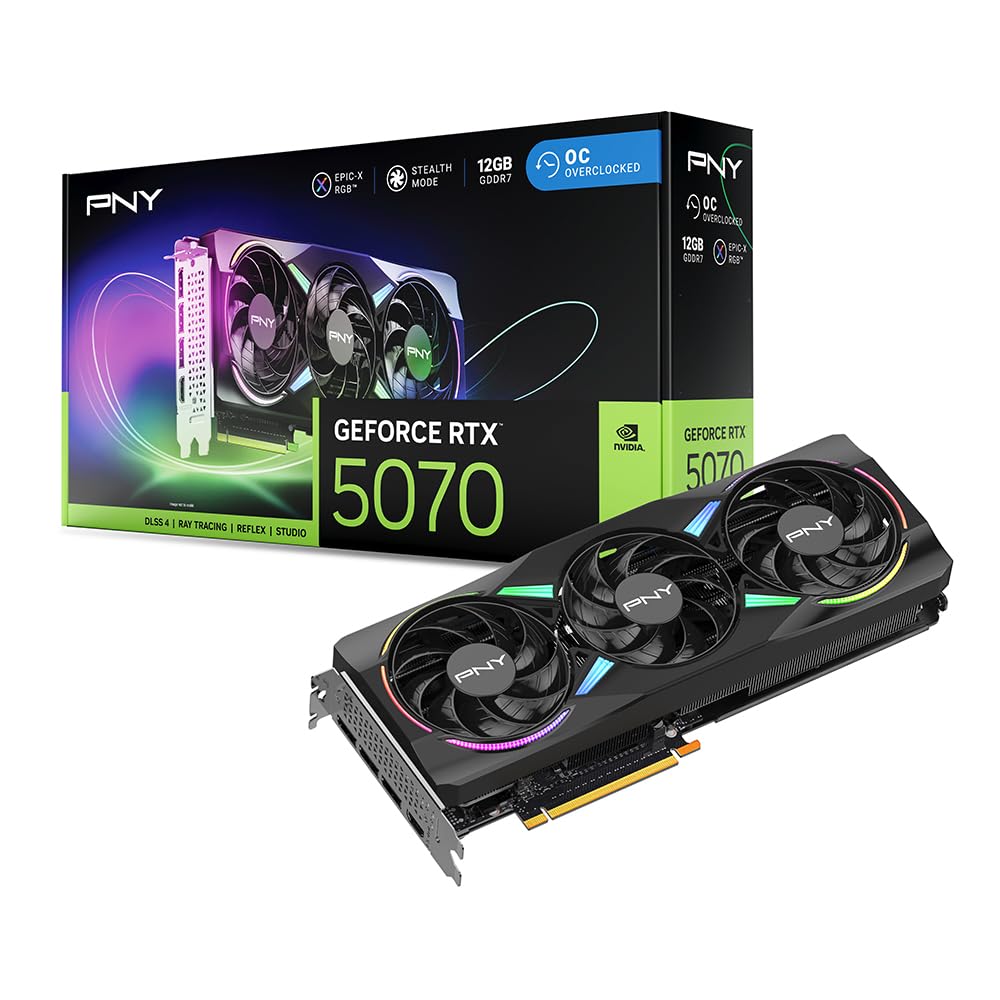
The PNY RTX 5070 Epic‑X offers the sweet spot for 1440p high‑refresh gaming with DLSS 4 and fifth‑gen Tensor Cores. Its 12 GB of GDDR7 on a 192‑bit bus delivers memory bandwidth of 672 GB/s, enough for ultra textures at 1440p in 95 percent of current titles. The SFF‑ready design and 250 W TDP make it one of the more power‑efficient 70‑class cards available.
Real‑world testing shows it outperforms the RTX 4070 Super by a clear margin without relying on frame generation — raw rasterization and ray tracing gains are tangible. The triple‑fan cooler keeps thermals in check even during extended sessions, and the 8 percent factory OC provides extra headroom for manual tuning. Users upgrading from 20‑series or 30‑series cards will see a generational leap in both frame rate and power efficiency.
The card includes a dual 8‑pin to 12‑pin adapter, compatible with standard 750 W power supplies. All 80 ROPS are confirmed active in early samples, and the build fits compact chassis like the HP Z4 G4. The ARGB lighting syncs with most motherboard ecosystems, and the fan noise is impressively low — barely audible over case fans.
Why it’s great
- Outperforms RTX 4070 Super without frame gen
- 250 W TDP — power‑efficient for the class
- All 80 ROPS confirmed active
Good to know
- 12 GB VRAM limit noted by some users
- Requires dual 8‑pin to 12‑pin adapter
- Size may still be tight in small cases
8. GIGABYTE GeForce RTX 5070 WINDFORCE OC SFF (12 GB GDDR7)

The GIGABYTE WINDFORCE OC SFF is the smallest GeForce RTX 5070 on this list at just 11.1 inches long and 2 slots thick, making it the ideal choice for small‑form‑factor builds. Despite the compact size, it runs remarkably cool — users report temperatures barely above 75 °C in maxed 1440p games, and the triple‑fan setup is often quieter than the 2080 Super it replaces.
NVIDIA SFF ready certification means it fits in cases as small as the Fractal Terra or Cooler Master NR200 without modification. The card has no RGB lighting, which reduces potential failure points and keeps the aesthetic clean for stealth builds. PCIe 5.0 support ensures forward compatibility with upcoming motherboards and processors.
Out of the box, the factory clock of 2600 GHz (base) is sufficient for 180 Hz 1440p monitors at max settings in most games. Overclocking headroom exists but is limited by the compact cooler’s thermal capacity. No DOA issues were reported across dozens of verified reviews, and Gigabyte’s build quality is consistently praised for reliability.
Why it’s great
- Smallest RTX 5070 — fits SFF cases easily
- Runs at 75 °C under load with quiet fans
- No RGB for reliable, stealth operation
Good to know
- Limited overclocking headroom
- Compact cooler = higher noise at max RPM
- 12 GB VRAM ceiling for 4K ultra textures
9. GIGABYTE Radeon RX 9060 XT Gaming OC ICE (16 GB GDDR6)
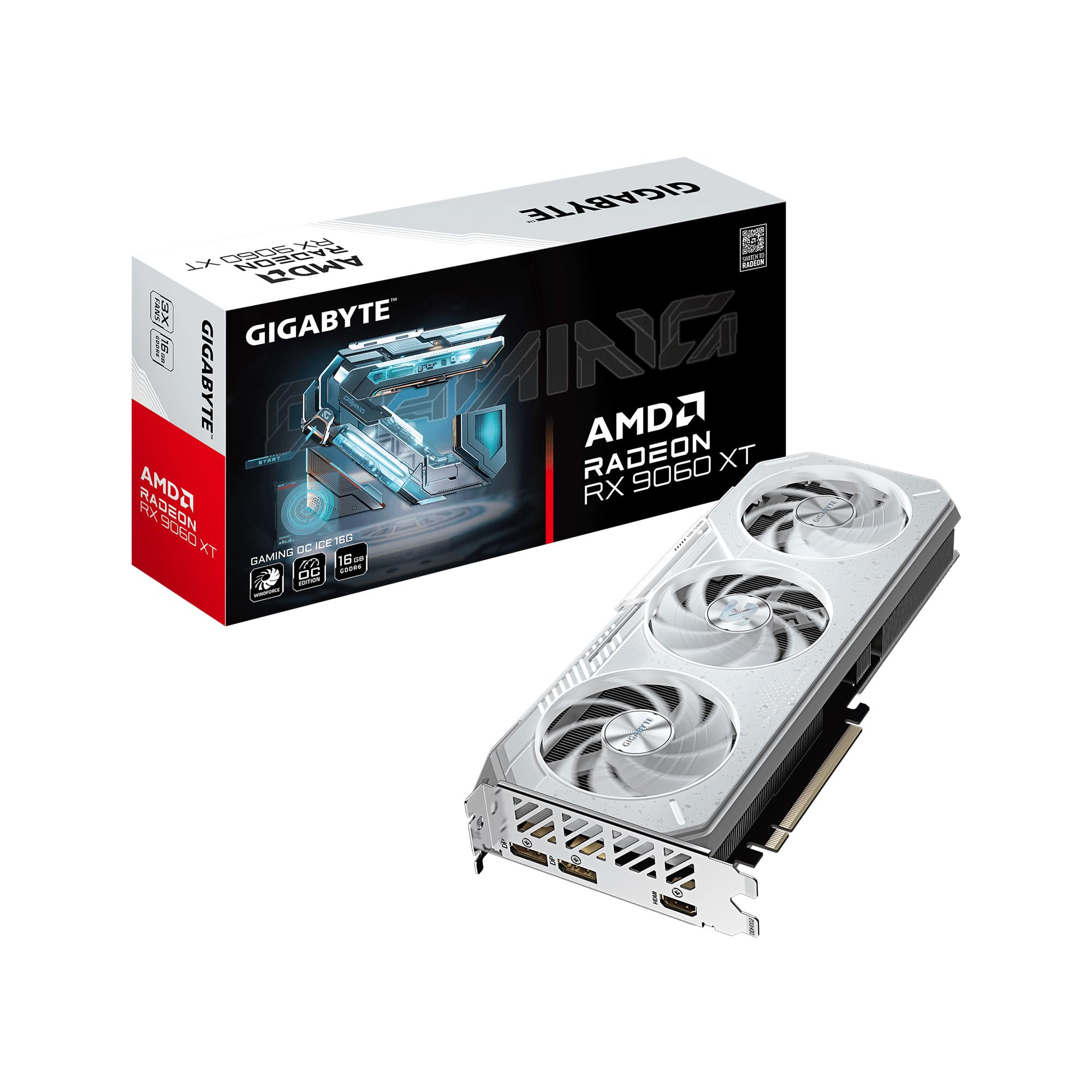
The GIGABYTE RX 9060 XT ICE is the most budget‑friendly entry on this list while still offering 16 GB of GDDR6 VRAM and PCIe 5.0 support. The WINDFORCE cooling system with server‑grade thermal gel and Hawk fans keeps temperatures low even during extended rendering sessions, and the Dual BIOS switch lets you toggle between Performance and Silent modes.
In real‑world use, this card delivers solid 1440p performance — consistent 240 fps in Fortnite and high frame rates in DCS World — making it a strong option for competitive gamers who also do occasional animation work. The 128‑bit memory bus is the main bottleneck for 4K rendering, but at 1440p and below the card holds its own against more expensive alternatives.
The reinforced metal backplate with bent edge provides excellent structural rigidity, preventing PCB flex. At 11.06 inches long and 1.85 pounds, it fits most standard ATX cases without clearance issues. Ray tracing is decent but not a strength — stick to rasterized rendering for animation workflows and use FSR for gaming where available.
Why it’s great
- 16 GB VRAM at entry‑level price point
- Solid 1440p performance in competitive titles
- Compact size fits most ATX cases
Good to know
- 128‑bit bus limits 4K rendering
- Ray tracing is not a strength
- Large size still requires case clearance check
FAQ
Do I need ray tracing hardware for anime rendering?
How much VRAM is enough for 4K anime production?
Should I choose AMD or NVIDIA for animation software?
Final Thoughts: The Verdict
For most users, the anime graphics card winner is the Sapphire Nitro+ RX 9070 XT because it delivers uncompromising 4K rendering performance with 16 GB VRAM, zero coil whine, and whisper‑quiet cooling that won’t bleed into your mic. If you need Linux compatibility for a dual‑boot animation pipeline, grab the ASUS Prime RX 9070 XT. And for the best price‑to‑performance ratio for 1440p work, nothing beats the PowerColor Red Devil RX 9070 XT.