
Dragging five-gallon jugs from the pump to your tractor, generator, or truck bed is a workout nobody asked for. A 30-gallon gas tank changes the math entirely—one trip replaces six standard cans, and a wheeled caddy means the weight does the work, not your back. The real challenge isn’t capacity anymore; it’s picking the right material, pump type, and wheel setup so you aren’t fighting a leaky, rust-prone drum six months from now.
I’m Min — the co-founder and writer behind Gadgets Feed. I’ve spent dozens of hours comparing steel-gauge thickness, pump flow rates, hose durability, and wheel designs across the most popular 30-gallon caddies to separate the tanks that genuinely deliver from those that cut corners on welds and fittings.
A quick scan of customer feedback reveals one persistent pattern: a poorly sealed pump or substandard grounding clamp can turn a simple refueling task into a safety hazard. This guide breaks down the specific construction details, pump mechanisms, and portability features that define the best 30 gallon gas tank for your workshop or property.
How To Choose The Best 30 Gallon Gas Tank
Not all 30-gallon tanks are built the same. The cheapest options often use thin steel that dents during shipping and rusts within a season, while premium models add reinforced welds, heavy-duty wheels, and robust pump systems. Focus on three things: the material and finish of the tank body, the pump mechanism and its flow rate, and the wheel setup that determines whether you can actually move the thing when it’s full.
Tank Material and Rust Resistance
The tank body is the single most important component. Look for high-strength carbon steel with a powder-coated finish. Avoid tanks where the coating is thin or chips easily around welded joints—those spots will rust first. Some budget units arrive with unpainted areas around the pump attachment neck that require immediate touch-up to prevent corrosion. If you plan to store diesel long-term, also check whether the interior has any protective lining; untreated steel can react with fuel over time.
Pump Type and Flow Rate
Most caddies in this category ship with a rotary hand pump rated around 25 liters per minute at 80 RPM. That’s sufficient for occasional refueling of tractors, generators, and ATVs. The critical detail is whether the pump is bi-directional—being able to reverse the crank to siphon leftover fuel back into the tank prevents waste and line cleanup. Electric pumps are rarer at this price tier but offer higher flow rates (around 6 gallons per minute) and zero hand cranking. The trade-off is battery or AC power dependency and more failure points.
Wheel Size and Tire Construction
A full 30-gallon tank weighs roughly 240 to 260 pounds. That mass needs solid, large-diameter wheels to roll without tipping. Models with 10-inch rear wheels and solid rubber tires perform best on gravel, grass, and uneven shop floors. Units with smaller plastic wheels sink into soft ground and become nearly immovable when loaded. Also check the wheel bracket construction—thin stamped metal brackets bend under repeated heavy loads, while welded steel brackets hold up over years of use.
Quick Comparison
On smaller screens, swipe sideways to see the full table.
| Model | Category | Best For | Key Spec | Amazon |
|---|---|---|---|---|
| VEVOR 30 Gallon Diesel Caddy | Electric Pump | Diesel users wanting fast electric transfer | 180W electric pump, 6.2 gal/min flow | Amazon |
| GarveeTech 30 Gallon Fuel Caddy | Premium Hand Pump | All-around heavy-duty use on varied terrain | 9.8-ft automotive-grade rubber hose, all-terrain wheels | Amazon |
| Parts-Diyer 30 Gallon (Yellow) | Mid-Range Hand Pump | Farm and tractor refueling on solid ground | 10-inch solid rubber wheels, anti-static clamp | Amazon |
| AutoForever 30 Gallon | Sturdy Steel | Diesel storage with non-standard thread tolerance | 10-inch wheels, high-strength carbon steel | Amazon |
| Parts-Diyer 30 Gallon (Red) | Solid Build | Multi-fuel storage with consistent pump flow | 25L/min pump, 8-ft kink-free hose | Amazon |
| KODOM 30 Gallon Red | Budget Hand Pump | Flat-surface garage use with moderate fuel needs | Alloy steel tank, two-way rotary pump | Amazon |
| Garvee 30 Gallon Orange | Value Hand Pump | Emergency generator and lawn equipment fueling | 9.8-ft hose, 8-inch wheels, carbon steel tank | Amazon |
| TUFFIOM 30 Gallon Gas Caddy | Entry-Level Steel | Light-duty gasoline storage on smooth pavement | Alloy steel tank, 8.9-ft hose, swivel wheels | Amazon |
| Flame King YSN330 30lb Propane | Propane Cylinder | High-capacity propane for grills, RVs, and heaters | 23 lbs empty, built-in gauge, OPD valve | Amazon |
In‑Depth Reviews
1. VEVOR 30 Gallon Diesel Caddy

This is the only unit in the roundup with a 180W electric pump, delivering 6.2 gallons per minute—more than double the flow rate of any hand-crank model here. If you’re refueling multiple machines in a single session, that speed advantage is transformative. The pump draws from a 12V system, so it’s well-suited for a truck bed or garage with battery access. The metal wire-reinforced hose won’t collapse under suction, a common failure point on cheaper rubber hoses.
The tank is explicitly rated for diesel only, so gasoline users need to look elsewhere. Build quality is solid for the price point: the steel body is powder-coated, and the ball valve on the discharge line provides a positive shutoff that prevents dribbling. The 10-inch rear wheels and 2.5-inch front swivel casters make it maneuverable on concrete and packed gravel, though the front casters are small enough to catch on uneven ground.
Assembly takes about 20 minutes, and users recommend adding fuel-rated Teflon tape to the pump and hose barb threads to eliminate any seepage. One long-term review noted corrosion developing inside the tank after roughly a year with diesel, so periodic inspection of the interior is advised. For anyone who prioritizes speed and electric convenience over hand-cranking simplicity, this caddy is the clear front-runner.
Why it’s great
- Electric pump moves fuel at 6.2 gal/min—no hand cranking
- Metal wire hose resists collapsing under use
- Ball valve provides positive leak-stopping shutoff
Good to know
- Rated for diesel only—not suitable for gasoline
- Small front casters can snag on rough terrain
- Some reports of internal corrosion after extended storage
2. GarveeTech 30 Gallon Fuel Caddy
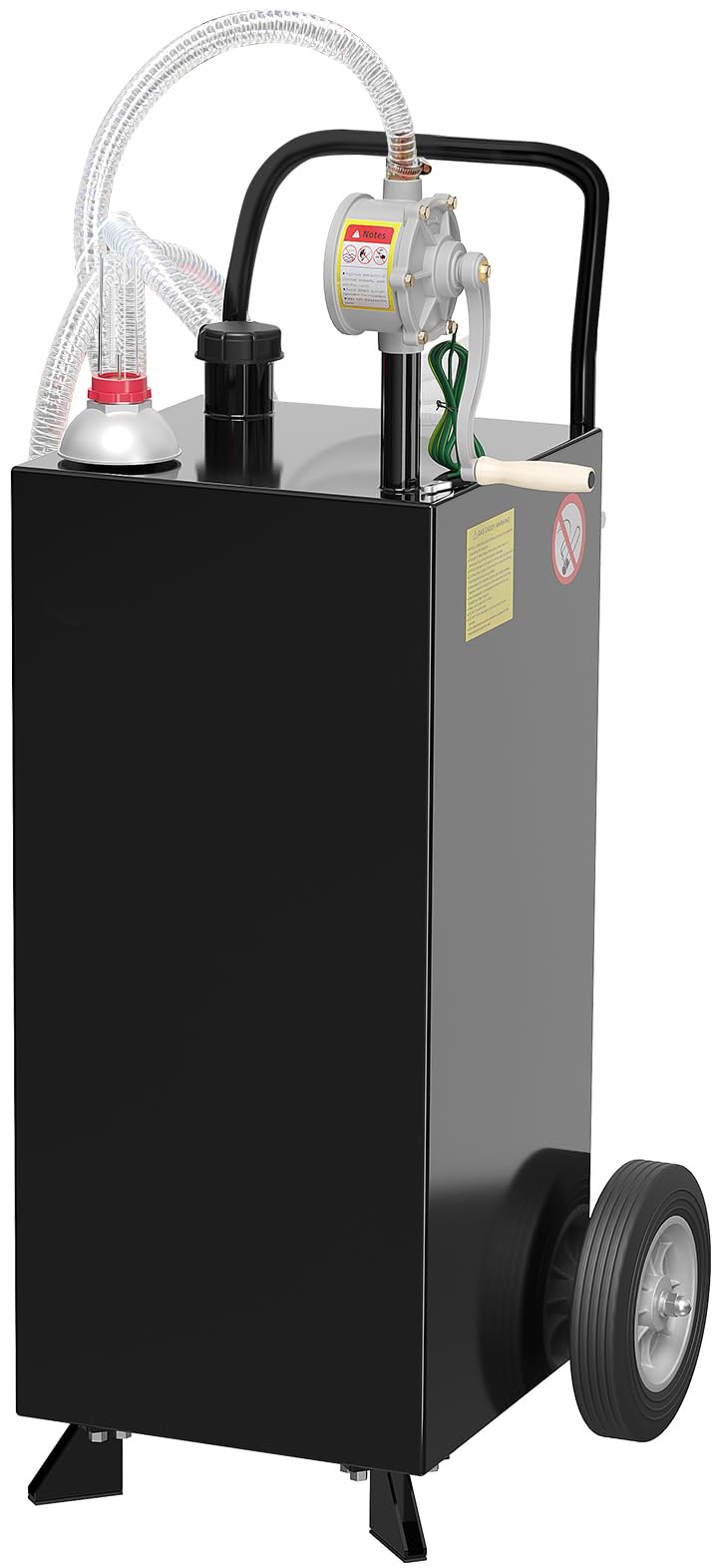
This caddy hits a rare sweet spot: it pairs a stainless steel tank with a 9.8-foot automotive-grade rubber hose that resists UV and corrosion, plus a two-way rotary hand pump. The pump allows you to reverse the crank to siphon leftover fuel back into the tank, keeping the hose clean and preventing drips. The all-terrain wheels and sturdy handle make it manageable across grass, gravel, and concrete—even when fully loaded to around 260 pounds.
The build quality is notably higher than most competitors in this tier. The welds are clean and consistent, the powder-coat finish is thick, and the top-view fuel gauge lets you check remaining capacity without opening the cap. Users consistently mention that the instructions are minimal (basically a single page), but the assembly is straightforward enough that most people figure it out in under 30 minutes. The hose is clear with a steel coil inside, so you can see the fuel flowing.
The main drawback is the lack of a dedicated nozzle—the hose terminates in a metal end without a shutoff valve, so you need to pinch or kink the hose to stop flow between fills. Replacing the end with a ball-valve nozzle is a cheap upgrade. A few units arrived with minor dents from shipping, though function wasn’t affected. For the combination of tank quality, hose length, and wheel design, this is the most balanced performer for general farm and workshop use.
Why it’s great
- Stainless steel tank with thick powder coating resists rust
- Two-way pump reverses to drain hose back into tank
- Long 9.8-ft hose reaches far into equipment fill necks
Good to know
- No hose shutoff nozzle—must upgrade to prevent drips
- Instructions are nearly nonexistent
- Some shipping damage reported, though tank function unaffected
3. Parts-Diyer 30 Gallon (Yellow)
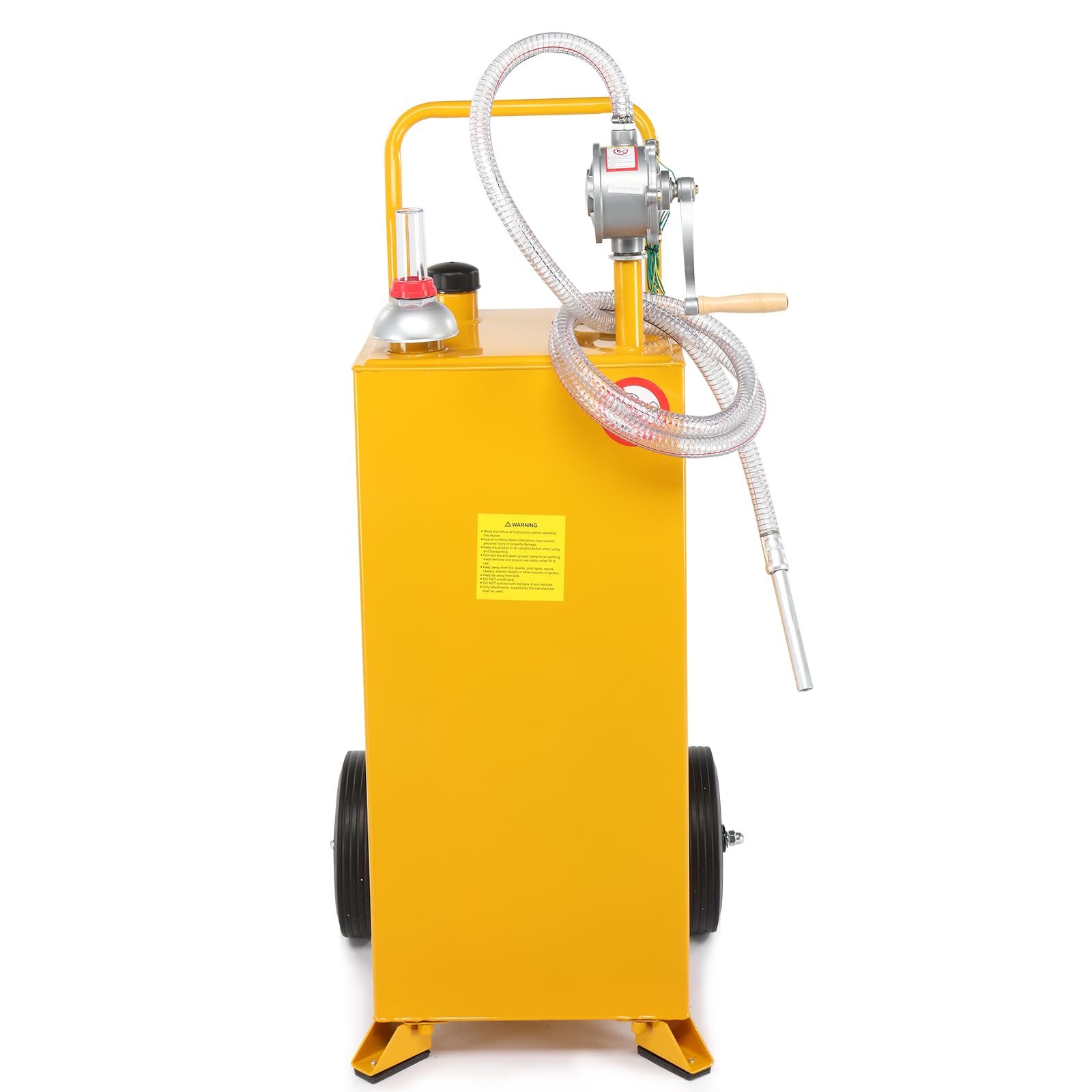
This yellow caddy from Parts-Diyer focuses on rugged simplicity. The tank is made from high-strength carbon steel with a powder-coated finish, mounted on a frame with two 10-inch solid rubber wheels that roll well over dirt and gravel. The rotary hand pump delivers about 25 liters per minute, and the anti-static ground clamp is included as standard safety equipment. The 8-foot kink-free hose is adequate for most refueling scenarios.
The build quality is a step above the budget-tier options—the welds are clean, the steel feels thick, and the frame doesn’t flex when the tank is full. Users note that the pump works smoothly out of the box, and the large fill neck makes refilling from bulk fuel containers fast. The fuel gauge is a simple float-type that gives a rough reading, accurate enough for most purposes. Assembly is straightforward, though the instructions are sparse.
The biggest gripe from owners is that the actual usable capacity is closer to 28 gallons than a full 30, with the remaining headspace required for expansion and safe transport. A few units have arrived with dents, and the hand pump on some early batches developed pinhole leaks—Parts-Diyer’s return policy only covers 20% refund after fuel contact, so inspect the pump before filling. For the price, this is a solid mid-range choice for farm and tractor work, especially if you need reliable rolling on unpaved surfaces.
Why it’s great
- Large 10-inch solid rubber wheels handle rough terrain well
- Thick carbon steel tank with clean welds
- Anti-static clamp included for safe gasoline transfer
Good to know
- Actual capacity is about 28 gallons, not full 30
- Hand pump can develop pinhole leaks over time
- Return policy is poor once fuel has been in the tank
4. AutoForever 30 Gallon (Yellow)
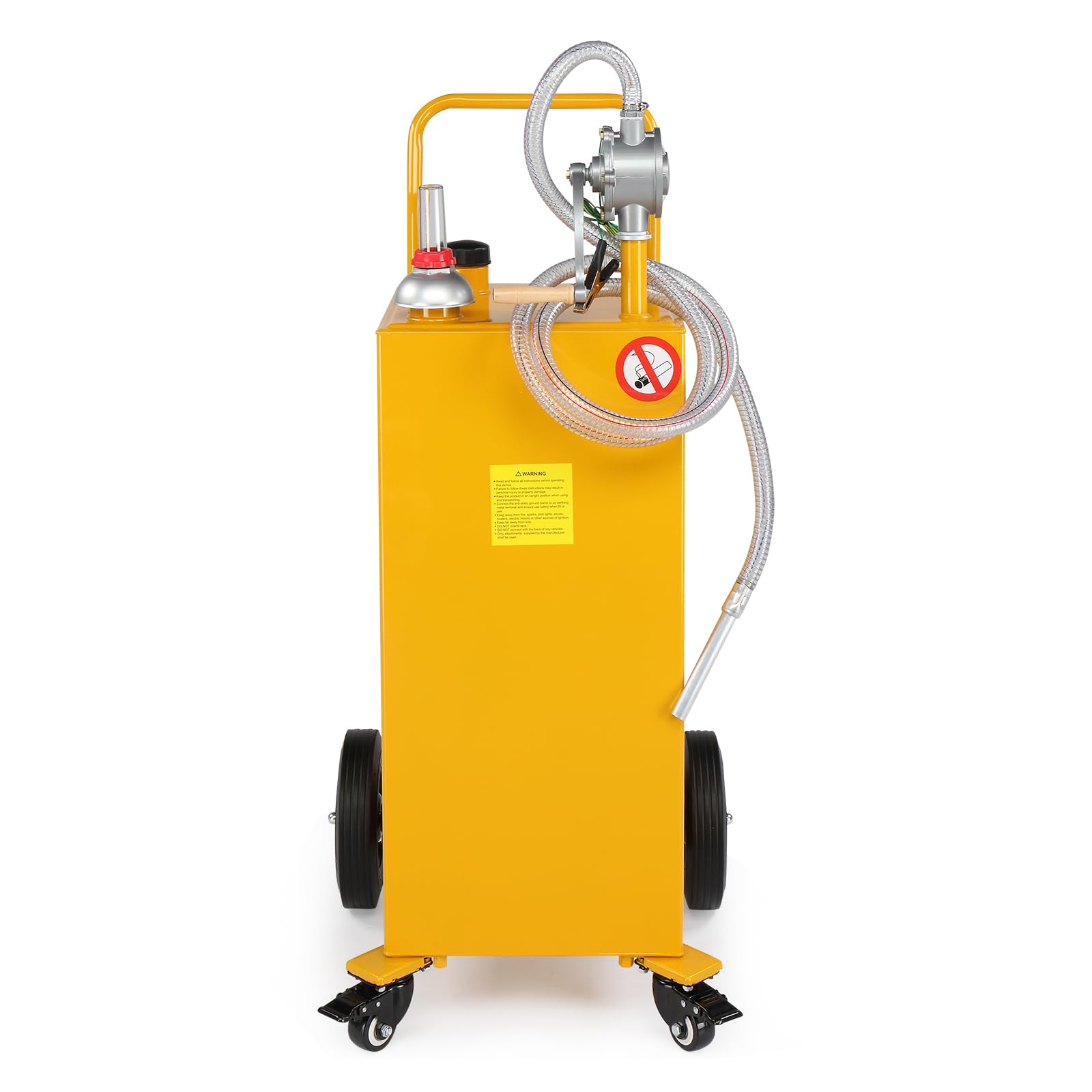
The AutoForever caddy emphasizes material quality with its high-strength carbon steel construction and powder-coated finish. It’s designed for diesel, engine oil, and kerosene storage, though some users have successfully filled it with gasoline. The 10-inch rear wheels and two swivel casters up front give it good maneuverability in a garage or workshop setting. The hand pump is rated at 25 liters per minute at 80 RPM.
Owners consistently praise the tank’s rigidity—the steel doesn’t flex or oil-can when the unit is full, and the welds hold up without cracking. The large fill opening makes adding fuel quick, and the included anti-static ground clamp adds a layer of safety against static discharge. Assembly is simple, though AutoForever provides essentially no written instructions; the design is intuitive enough that most users complete it in under 30 minutes.
The most common complaint involves the fittings: the threads on the pump and hose connections are a non-standard size, making replacement parts tricky to source locally. The fuel gauge is also unreliable on some units, failing to read accurately from the start. And like many caddies in this class, the clear PVC hose is cheap and can harden over time with diesel exposure. If you can tolerate the odd threading and plan to use it mainly with diesel, this is a durable option that won’t rust through quickly.
Why it’s great
- Rigid carbon steel tank with no flex under full load
- Large fill opening for fast refueling
- Anti-static clamp for safe operation
Good to know
- Fittings use non-standard threads—hard to replace
- Fuel gauge often inaccurate from factory
- Hose can harden with extended diesel use
5. Parts-Diyer 30 Gallon (Red)

This red variant from Parts-Diyer shares most of the DNA with its yellow sibling but ships with a slightly different pump assembly. The pump flow rate is the same 25 liters per minute, and the 8-foot kink-free hose is identical. What sets this unit apart is the inclusion of a heavier-gauge steel frame that feels more substantial than the budget options—the tank body is thick, the welds are clean, and the solid rubber tires don’t deform under weight.
Multiple buyers note that the unit works perfectly out of the box: all hardware is present, the pump primes easily, and there are no leaks. The anti-static clamp is properly wired, and the fill neck is wide enough to accept a standard fuel nozzle without splashing. Users running gasoline report the clear hose holds up fine initially, though some switch to a fuel-rated rubber hose for long-term diesel storage. Assembly is quick, and the instructions, while basic, are sufficient.
The downsides mirror the yellow version: the actual capacity maxes out around 28 gallons, and the hand pump on a small number of units has developed pinhole leaks. The return policy after fuel contact is restrictive—only a partial refund—so thorough leak-testing with water before first use is highly recommended. For the price, this is a well-balanced caddy that delivers reliable performance for mixed-use refueling on farms and job sites.
Why it’s great
- Heavy-gauge steel frame feels durable and stable
- Pump works consistently out of the box with easy priming
- Wide fill neck accepts standard fuel nozzles without splash
Good to know
- Actual capacity is closer to 28 gallons
- Some pump pinhole leak issues reported
- Restrictive return policy after fuel exposure
6. KODOM 30 Gallon Red

The KODOM caddy is built around an alloy steel tank with a two-way rotary hand pump that can both dispense and siphon fuel. The design includes a wide filling neck that reduces spills, and the anti-static grounding clamp is standard. The wheels are a mix of two fixed and two swivel casters, which makes steering in tight garage spaces easier than a simple two-wheel setup.
For the money, the tank body is decent—the powder coating is reasonably thick, and the pump works smoothly when new. The reversible pump feature is genuinely useful for draining the hose after use, preventing residual fuel smell. The gauge is a simple vented float that gives a ballpark reading, and the overall assembly is straightforward for anyone comfortable with basic tools. Owners who use it on smooth concrete report satisfaction with the rolling ease.
However, quality control is inconsistent. Multiple reviews describe the unit arriving with interior rust, poorly cut float holes, and enamel blocking threaded connections. The hose can get stuck inside the tank, and the welds on some units look rushed. When full at roughly 240 pounds, the plastic swivel casters struggle on anything other than smooth concrete—rolling it on grass or gravel is nearly impossible. This is a usable caddy if you stick to flat, hard surfaces and inspect it thoroughly before the first fill, but the variance in build quality makes it a gamble.
Why it’s great
- Two-way pump allows hose draining after refueling
- Wide fill neck reduces spills during refills
- Swivel casters improve steering in tight garage spaces
Good to know
- Inconsistent quality control—some units arrive rusted inside
- Plastic swivel casters struggle on grass and gravel
- Welds and threading can be poorly finished
7. Garvee 30 Gallon Orange
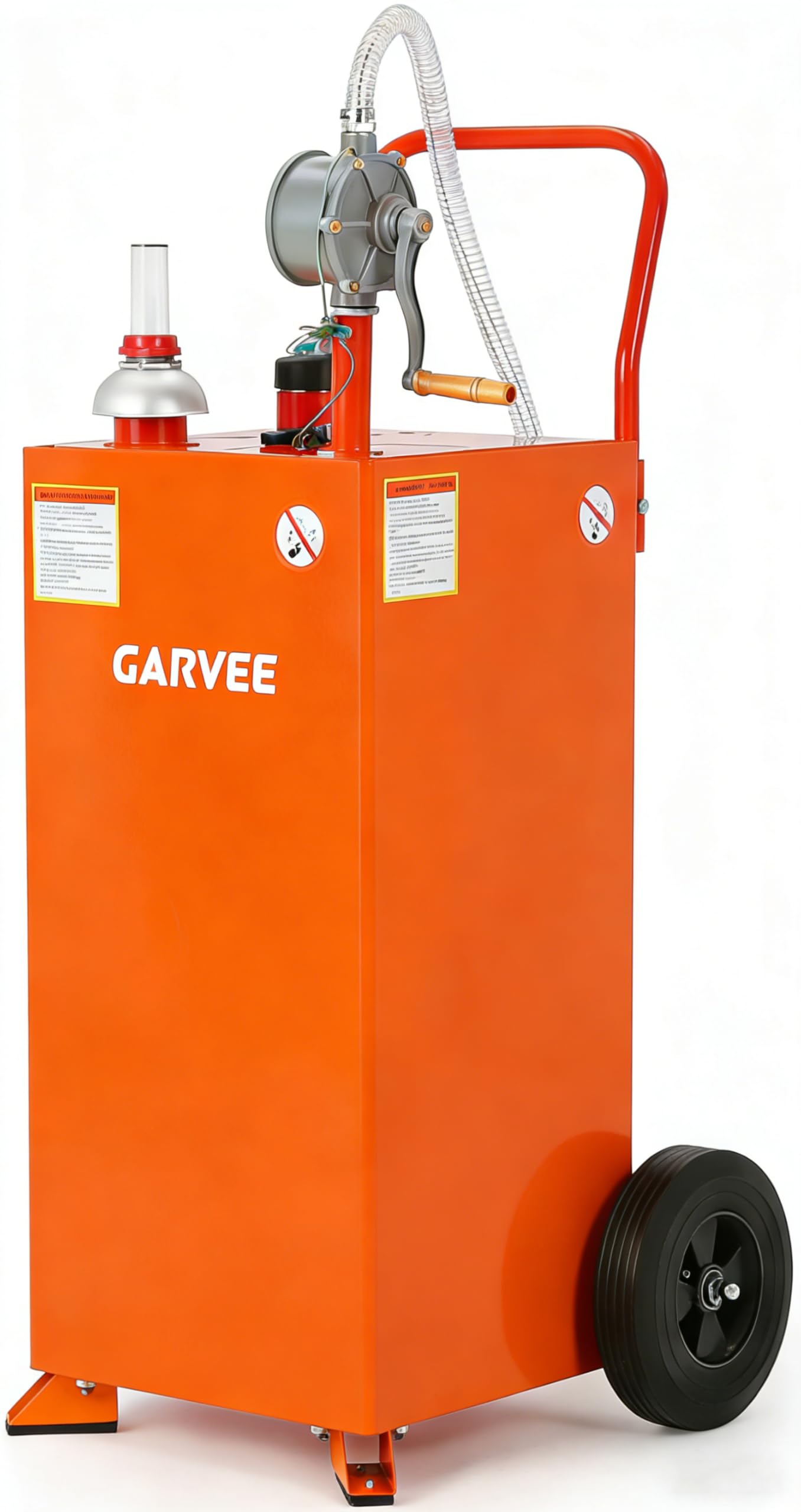
Garvee positions this bright orange caddy as a budget-friendly alternative to the premium units, and it largely delivers on the basics. The carbon steel tank is powder-coated to resist UV and dents, and it includes a 9.8-foot kink-free hose—the same length as the more expensive GarveeTech model. The two-way rotary hand pump is functional, and the anti-static ground clamp is present for safety.
The tank is noticeably lighter in weight than the premium options, with thinner steel that can flex slightly when fully loaded. The 8-inch rear wheels and 2-inch front casters are adequate for smooth surfaces but struggle in soft ground. The bright orange color is a safety bonus—highly visible in a workshop or field setting. Assembly is easy, and the hose hanger keeps the line organized during storage.
The primary complaints center on the pump and fittings: the plastic hand crank feels fragile and can be difficult to prime, sometimes failing to deliver consistent flow. The plastic fuel gauge is also a weak point—it can break or leak after a few uses. Some users have replaced the pump with an aftermarket unit entirely. The fuel cap is cheap plastic and can warp, letting fumes escape. For light, occasional use on a smooth garage floor, this caddy works, but the plastic components will likely need upgrading within the first season.
Why it’s great
- Long 9.8-ft hose provides good reach for refueling
- Bright orange tank is highly visible for safety
- Lightweight when empty—easy to move around
Good to know
- Plastic hand crank feels flimsy and is hard to prime
- Plastic fuel gauge is fragile and prone to breaking
- Fuel cap can warp, causing fume leakage
8. TUFFIOM 30 Gallon Gas Caddy
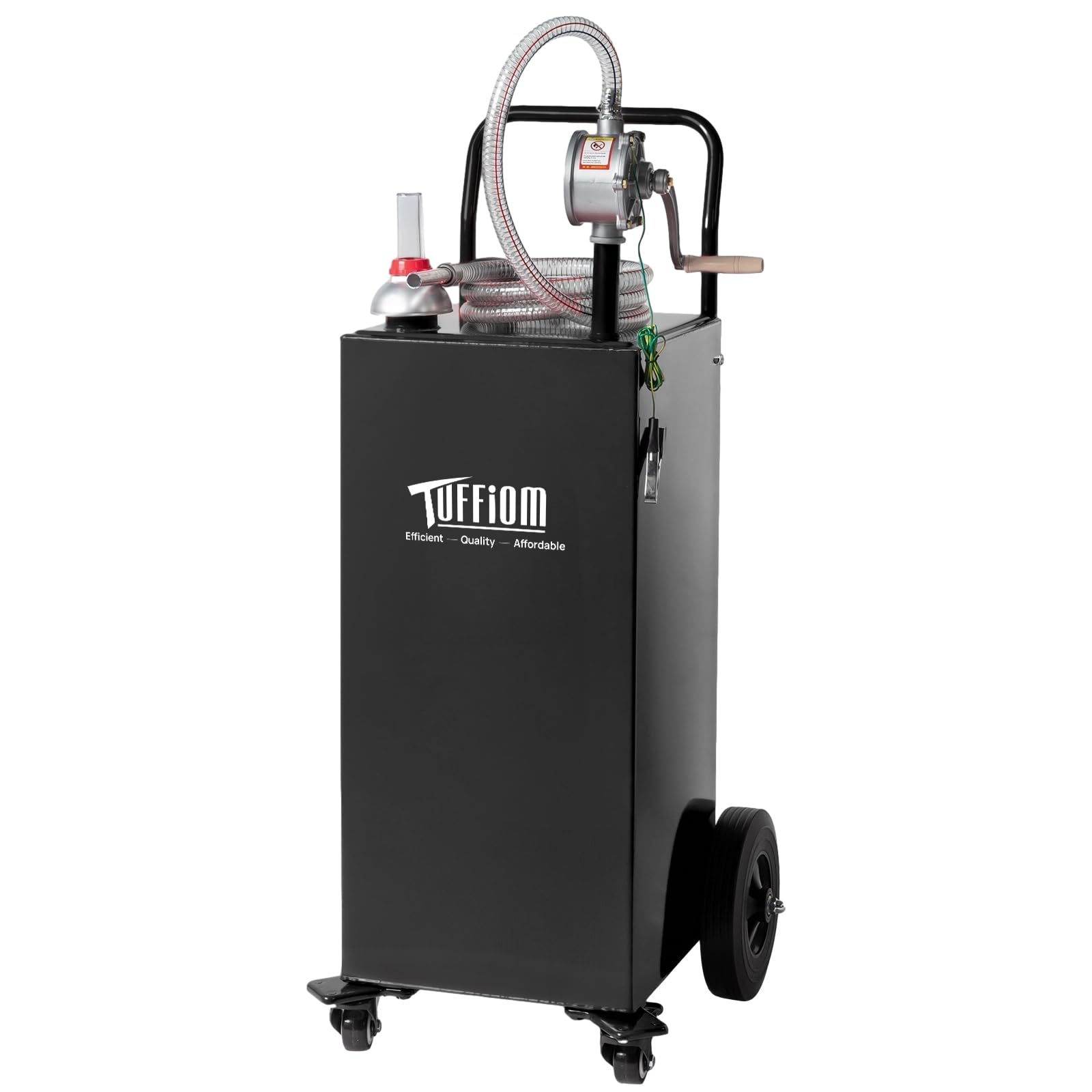
TUFFIOM’s 30-gallon caddy is one of the more affordable all-steel options on the market. It features an alloy steel tank with a powder-coated finish, an 8.9-foot kink-free hose, and a two-way rotary hand pump. The wheel setup includes two fixed rear wheels and two front swivel casters for easier steering. The anti-static ground clamp is included, and the ergonomic handle is angled for comfortable pushing.
The tank itself is reasonably well-constructed for the entry-level price point. The swivel wheels genuinely help with positioning in tight garage spaces, and the reversible pump works as advertised—cranking one way dispenses, reversing siphons the hose clean. The fill neck is wide, and the vent/oil level gauge is easy to read. Assembly is straightforward, and most users report no leaks from the tank body or welded joints.
Build quality shows its budget roots in a few areas: the metal is thinner than premium models, leading to some flex under full load, and the handle height is too low for tall users, forcing a stooped pushing posture. The clear PVC hose hardened significantly after exposure to diesel in long-term testing, and a few owners report cracking within months. The pump threads are metric and not standard US pipe thread, making replacement parts harder to find. For occasional gasoline use on smooth pavement, it’s a functional entry-level choice, but heavy users will quickly outgrow it.
Why it’s great
- Swivel front wheels make maneuvering in tight spaces easy
- Reversible pump drains hose after refueling
- Wide fill neck reduces spill risk
Good to know
- Handle height is too low for taller users
- PVC hose hardens and cracks with diesel exposure
- Metric threads make pump replacement difficult
9. Flame King YSN330 30lb Steel Propane Tank

Note that this is not a liquid fuel tank—the Flame King YSN330 is a 30-pound propane cylinder, not a 30-gallon gas caddy. It’s included here because many buyers searching for large-capacity gas storage also consider high-capacity propane for generators, RVs, and grills. The tank holds roughly 7 gallons of propane by volume (30 pounds by weight), pre-purged and vacuum-ready for filling. It includes a built-in gas gauge and an OPD (Overfill Prevention Device) valve that is legally required for filling at most exchange stations.
The tank is constructed from high-grade welded steel with a powder-coated finish for rust resistance. It comes DOT and Transport Canada certified, meaning it’s legal for road transport in both the US and Canada. The standard connection valve is compatible with any propane appliance that uses a standard regulator. At 23 pounds empty, it’s much lighter than a 30-gallon liquid fuel caddy and can be carried by one person.
The customer-reported issue with the built-in gauge is that it often fails within the first few uses—several owners note that the gauge stops reading accurately or stops working entirely. The tank itself is well-regarded, but the gauge is a point of frustration. If you need a reliable propane source for a high-BTU generator or large RV setup, this tank is a solid choice for the money, provided you don’t rely on the gauge for precise readings.
Why it’s great
- Pre-purged and vacuum-ready for immediate filling
- DOT and Transport Canada certified for legal transport
- Standard valve fits all propane appliances with a regulator
Good to know
- Built-in fuel gauge often fails after a few uses
- This is a 30lb propane cylinder, not a 30-gallon liquid fuel tank
- Must be exchange-filled or recertified periodically
FAQ
Can I store gasoline in a diesel-rated caddy?
Why is my 30-gallon caddy actually holding only 28 gallons?
How do I ground a gas caddy properly to prevent static discharge?
Final Thoughts: The Verdict
For most users, the 30 gallon gas tank winner is the GarveeTech 30 Gallon Fuel Caddy because it pairs a stainless steel tank, a 9.8-foot automotive-grade hose, and all-terrain wheels into a well-balanced package that handles gasoline and diesel without major compromises. If you want electric pump speed for diesel refueling, grab the VEVOR 30 Gallon Diesel Caddy. And for a reliable propane alternative for big generators or RV setups, nothing beats the Flame King YSN330 30lb Propane Tank.