
A 5G hotspot without an Ethernet port is just a glorified phone tether. When you need to plug in a security camera system, a gaming console, or a wired VoIP setup, that missing RJ45 jack is the difference between a stable network and constant dropped connections. The market is flooded with portable 5G devices, but only a fraction feature a true wired LAN port — and fewer still deliver industrial-grade throughput through that connection.
I’m Min — the co-founder and writer behind Gadgets Feed. I’ve spent months analyzing datasheets, customer reliability reports, and real-world throughput tests to separate the genuine wired 5G routers from the SIM-card toys that claim an Ethernet port but deliver sub-100Mbps speeds under load.
Whether you’re setting up failover internet for a home office, equipping an RV for remote work, or building a temporary network at an event, choosing the right device hinges on real wired performance. Here is our curated selection of the best 5g hotspot with ethernet port that actually delivers on the promise of low-latency, high-speed wired connectivity.
How To Choose The Best 5G Hotspot With Ethernet Port
Not every device labeled a “5G hotspot” actually gives you a wired Ethernet connection worth using. Many budget-tier units hide a USB-C-only data port behind a marketing claim. Others include a Gigabit LAN port but bottleneck it with an underpowered modem. Knowing which specs actually matter — and which carriers your device will work with — saves you from buying a paperweight.
Ethernet Port Genuine or Gimmick
Pinch-test the specifications. A true Ethernet port must be labeled as a Gigabit (1000Mbps) or 2.5G LAN port — not a USB-to-Ethernet adapter sold separately. Some “hotspots” like the Franklin Jextream RG2100 lack the jack entirely despite listing wired connectivity; only the USB-C port charges the battery. Look for explicit “LAN Port Bandwidth: 1000 Mbps” or “2.5G port” in the technical specs.
Carrier Locking and Modem Bands
5G hotspots are carrier-sensitive. AT&T-locked units (like the Nighthawk M6 Pro renewed) won’t work on Verizon out of the box without an unlock code. T-Mobile-only devices (like the RG2100) are cheaper but useless if your coverage area favors Verizon. The safest path is a fully unlocked device like the GL.iNet routers or a CloudSIM-based unit like the GlocalMe Numen Air — these work across multiple carriers and allow physical SIM swapping.
Dual SIM and Auto Failover for Reliability
If the hotspot is your primary internet connection, dual-SIM with automatic failover is non-negotiable. Models like the GL.iNet Spitz AX (GL-X3000) and the MOFINETWORK MOFI6500 let you insert two different carrier SIMs — when the primary network drops, the router switches to the secondary carrier in seconds. Single-SIM hotspots leave you fully exposed to carrier outages.
Battery Backup vs. Wired Stationary Use
Portable hotspots with built-in batteries (5040mAh in the Nighthawk M6 Pro, 6400mAh in the GL.iNet Puli AX) provide critical uptime during power failures. However, running these units in high-power mode for 2.5G Ethernet or WiFi 6 generates significant heat. The best strategy: remove the battery when using them as stationary routers and let the device run on continuous AC power to avoid thermal throttling.
Quick Comparison
On smaller screens, swipe sideways to see the full table.
| Model | Category | Best For | Key Spec | Amazon |
|---|---|---|---|---|
| GL.iNet GL-X3000 (Spitz AX) | Cellular Router | Dual-SIM failover + OpenWrt | 2 x 2.5G Ethernet Ports | Amazon |
| GL.iNet GL-XE3000 (Puli AX) | Cellular Router | Portable UPS with 5G | 6400mAh battery + 2x Ethernet | Amazon |
| MOFINETWORK MOFI6500-5GXeLTE | Business Router | Rugged metal + amplified WiFi | 3.4Gbps combined throughput | Amazon |
| NETGEAR Nighthawk M6 Pro (MR6500) | Mobile Hotspot | Premium portable + 2.5G port | 2.5G Ethernet + 5040mAh battery | Amazon |
| GlocalMe Numen Air 5G (50GB Bundle) | Travel Hotspot | International travel + no SIM | 2.5Gbps data rate, CloudSIM | Amazon |
| GlocalMe Red Numen Air 5G | Travel Hotspot | Global coverage + physical SIM | 2.5Gbps data rate, USB-C | Amazon |
| SIMO Solis 5G WiFi Hotspot | Travel Hotspot | Multi-carrier scanning + IP54 | 1GB lifetime data/month | Amazon |
| TravelWiFi Sapphire 5G | Travel Hotspot | Large touch screen + CloudSIM | 5GB preloaded global data | Amazon |
| Jextream RG2100 Franklin Wireless | Mobile Hotspot | Budget T-Mobile option | 1Gbps LAN port, WiFi 6 | Amazon |
In‑Depth Reviews
1. GL.iNet GL-X3000 (Spitz AX)

The GL.iNet GL-X3000 Spitz AX is the only device in this roundup that pairs true dual 2.5G Ethernet ports with an enterprise-grade OpenWrt operating system. That means you can use one port for wired LAN devices and the second as a WAN failover from a cable modem or Starlink — the router automatically manages load balancing between 5G cellular and your wired backup. The dual-SIM slot (single standby) supports AT&T and T-Mobile IoT certifications, making carrier swapping trivial.
WiFi 6 throughput hits 574Mbps on 2.4GHz and 2402Mbps on 5GHz, but the real story is the wired performance: the 2.5G LAN port sustains full Gigabit+ speeds to a wired switch or console without the packet loss that plagues portable hotspots. The six detachable antennas (two cellular, four WiFi) give you the flexibility to mount external high-gain antennas for rural or RV deployment. The OpenWrt v21.02 firmware unlocks advanced features like VPN tunneling (WireGuard up to 300Mbps), DNS over TLS, and custom routing — capabilities no consumer hotspot offers.
Some users report that initial configuration with Verizon MVNOs like Visible requires switching to LTE+NSA mode, but the tech support team is responsive and the community forums document every carrier-specific workaround. The Spitz AX is heavier and less portable than a pocket hotspot, but if you need a stationary wired 5G gateway you can actually manage, nothing else comes close at this level.
Why it’s great
- Dual 2.5G Ethernet ports for wired failover and LAN
- OpenWrt with 5000+ plug-ins for power users
- Dual-SIM with automatic carrier failover
- Detachable antennas for external antenna upgrades
Good to know
- Requires specific modem lock settings for some MVNOs
- Pricier than portable hotspots
- Bulkier form factor, not pocketable
2. GL.iNet GL-XE3000 (Puli AX)
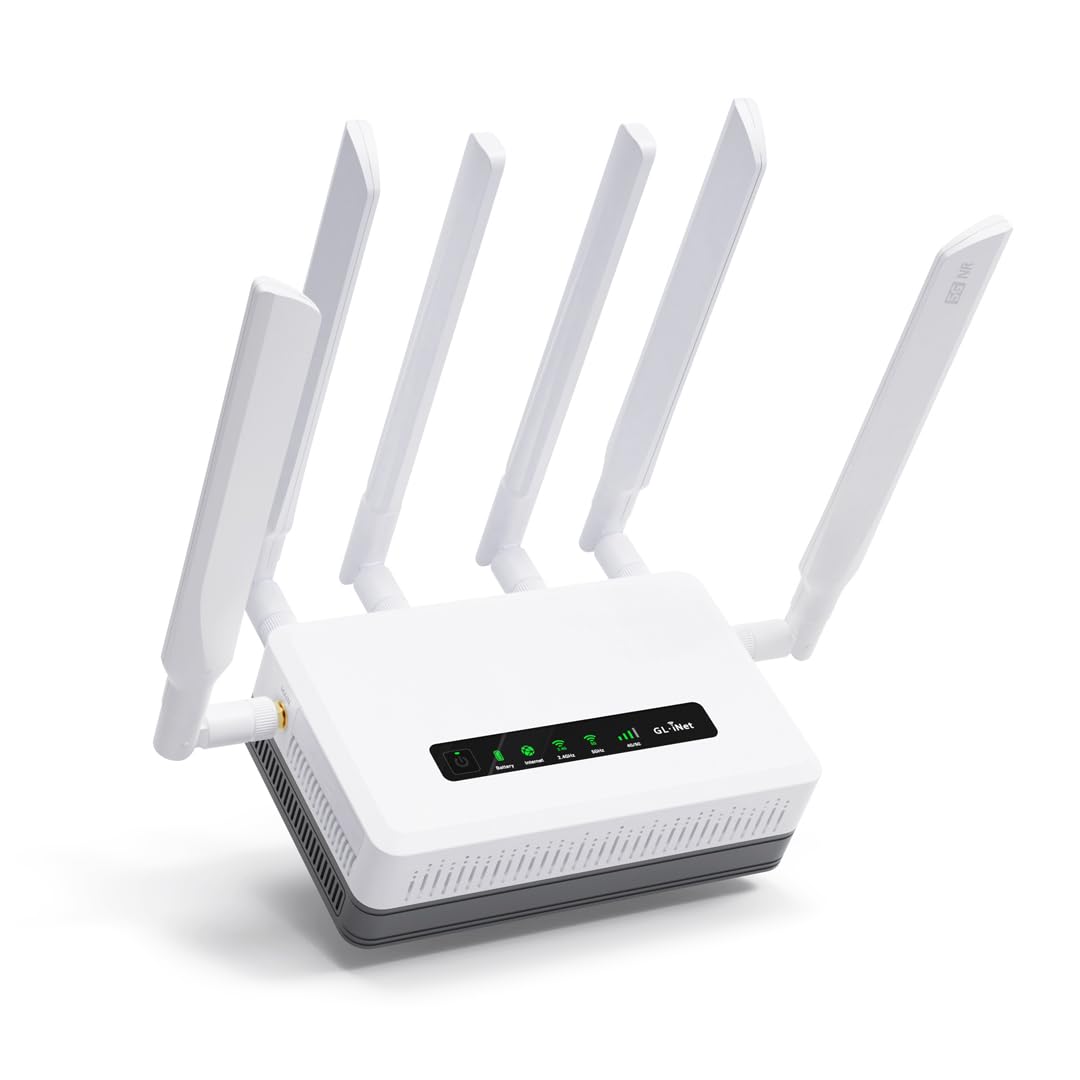
The Puli AX takes the same 5G modem and OpenWrt DNA as the Spitz AX and adds a 6400mAh battery that delivers up to 8 hours of uninterrupted connectivity. That makes it the only device in this list capable of acting as a true UPS for your wired network — when the power goes out, the Puli AX keeps your Ethernet-connected devices online without missing a beat. The dual 10/100/1000Mbps Ethernet ports (one WAN, one LAN) support Multi-WAN with load balancing and failover across cellular, wired Ethernet, WiFi repeater, and USB tethering.
Real-world speed tests from RV users show sustained 250Mbps+ down on Verizon and T-Mobile SIMs, with the retractable antennas providing better range than any pocket hotspot. The WiFi 6 coverage is exceptional for a device this size — users report strong signal through two floors of a warehouse. The OpenWrt interface is identical to the Spitz AX, giving you full control over VPN, DNS encryption, and band locking. The built-in battery also means you can pack it for road trips and run it for a full workday without AC power.
The tradeoff is size and heat. The Puli AX is chunky — about the size of a thick paperback — and runs warm during sustained 5G throughput. The fanless design means it needs decent airflow. Some users note that the dual-SIM feature uses a single IMEI, which can cause activation confusion with carriers that expect a phone IMEI for data plans. But for anyone who needs wired 5G with battery backup in a single box, this is the most versatile option available.
Why it’s great
- 6400mAh battery keeps Ethernet alive through power outages
- Multi-WAN with 4 connection types
- Full OpenWrt customization
- Excellent WiFi 6 range from retractable antennas
Good to know
- Chunky and warm under load
- Single IMEI for dual-SIM causes carrier setup issues
- Premium pricing
3. MOFINETWORK MOFI6500-5GXeLTE-RM520-HP
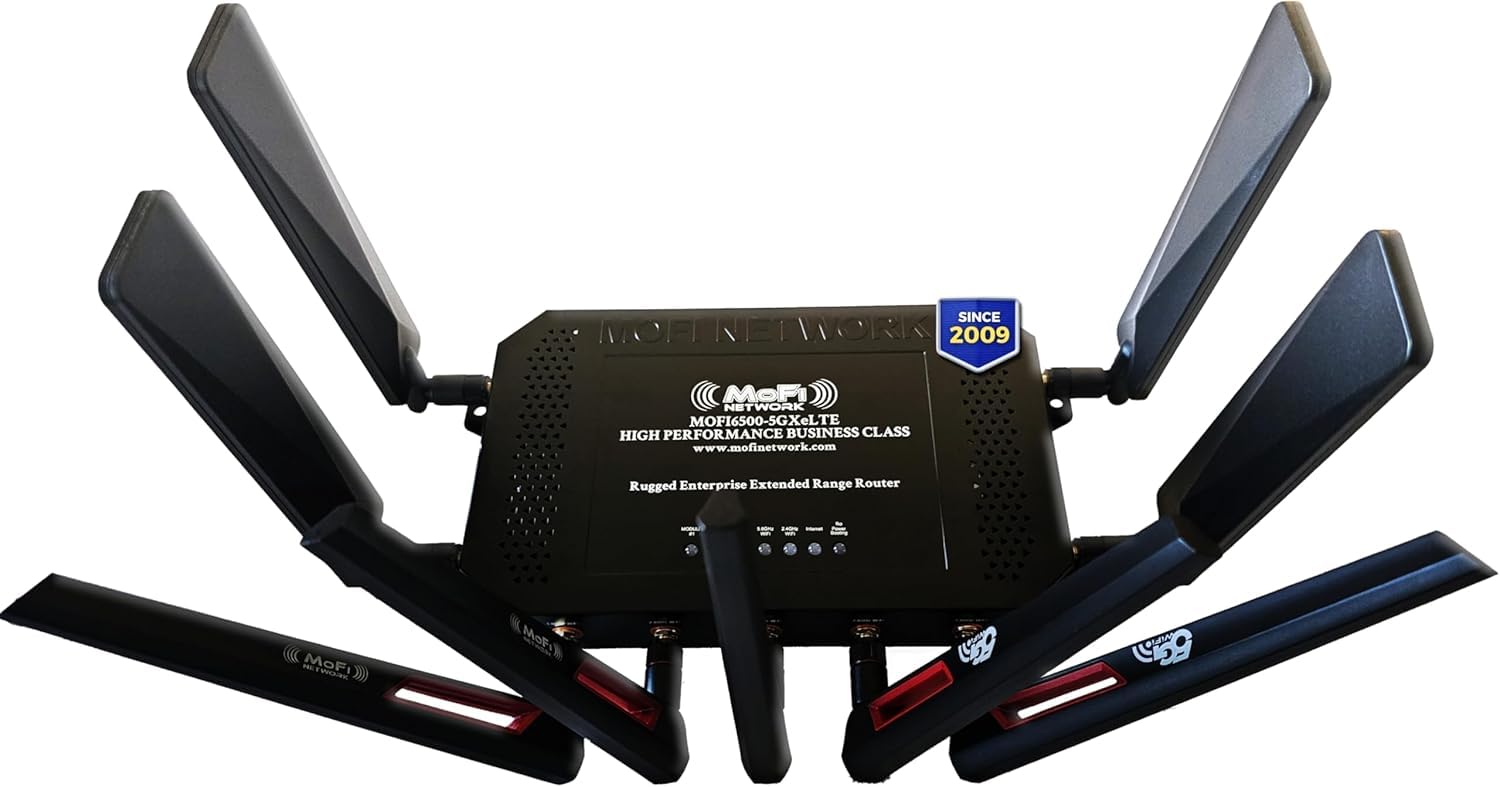
The MOFINETWORK MOFI6500 is built for environments where consumer-grade plastic won’t survive. The full metal chassis acts as a massive heatsink, allowing the 5G modem to run at full throttle without thermal throttling — a critical advantage for wired Ethernet connections that need to sustain high throughput for hours. The dual-Gigabit Ethernet ports support IP pass-through, failover, and band locking, and the internal signal amplification means the WiFi 6 coverage extends significantly farther than standard hotspots.
Setup is surprisingly simple: insert any carrier SIM (Verizon, AT&T, T-Mobile), run the quick-start wizard, and both Ethernet ports become active. The 3.4Gbps combined data rate is genuine — users replacing Verizon Jetpacks report stable 200Mbps+ wired connections covering two buildings. The dual-SIM (failover only, not simultaneous) keeps you online when one carrier drops. The programmable periodic reboot feature is a lifesaver for remote deployments where you can’t physically reset the router.
The MOFI6500 is not portable — it’s designed for permanent or semi-permanent installation in RVs, cabins, workshops, or warehouses. The included 10-foot CAT6E cable and 3.5A power adapter are industrial-grade. Customer support is US-based and responsive (toll-free number included), a rarity among networking hardware brands. The main downsides are the price and the fact that dual-SIM is failover only — you cannot bond two active connections simultaneously without the more expensive DUAL model.
Why it’s great
- Full metal chassis for heat dissipation and durability
- Internal WiFi amplification for extended range
- Dual-SIM auto failover keeps Ethernet alive
- Toll-free US-based tech support
Good to know
- Bulky — not for travel or pocket use
- Dual-SIM is failover only, not load balancing
- Premium price point
4. NETGEAR Nighthawk M6 Pro (MR6500) Renewed

The Nighthawk M6 Pro is the rare portable hotspot that includes a genuine 2.5G Ethernet port (not a USB-to-Ethernet dongle). This is significant because 2.5Gbps wired throughput exceeds what most cable modems deliver, making the M6 Pro viable as a primary wired internet source for gaming PCs or NAS devices. The Qualcomm SD X65 chipset supports both mmWave and Sub-6 5G bands, and the tri-band WiFi 6E (AXE3600) handles up to 32 simultaneous devices without breaking a sweat.
The 5040mAh battery runs the hotspot for a full workday, but the critical detail is that the 2.5G Ethernet port only operates at full speed in “high power mode” — which requires connecting the included 9V adapter and removing the battery to prevent heat damage. In mobile mode, the Ethernet port is limited to 1Gbps. The 2.8-inch color touch LCD is genuinely useful for monitoring signal strength and data usage without opening an app. AT&T users report consistent 100Mbps+ wired speeds near windows with decent signal.
This unit is the AT&T-locked renewed version, so Verizon and T-Mobile compatibility depends on the carrier’s unlock policy. Some renewed units arrive with APN issues that require manual configuration. The WiFi range is mediocre — fine for a single room but not for covering a house. Despite these caveats, the M6 Pro remains the only truly portable device that can output 2.5Gbps over a physical Ethernet cable, which matters for specific wired applications.
Why it’s great
- 2.5G Ethernet port in a portable form factor
- Qualcomm X65 with mmWave and Sub-6
- Tri-band WiFi 6E supports 32 devices
- Color touch LCD for easy monitoring
Good to know
- AT&T locked; carrier unlock may be required
- 2.5G full speed only in tethered high-power mode
- WiFi range is limited to small spaces
- Renewed units may have quality control issues
5. GlocalMe Numen Air 5G (50GB Bundle)
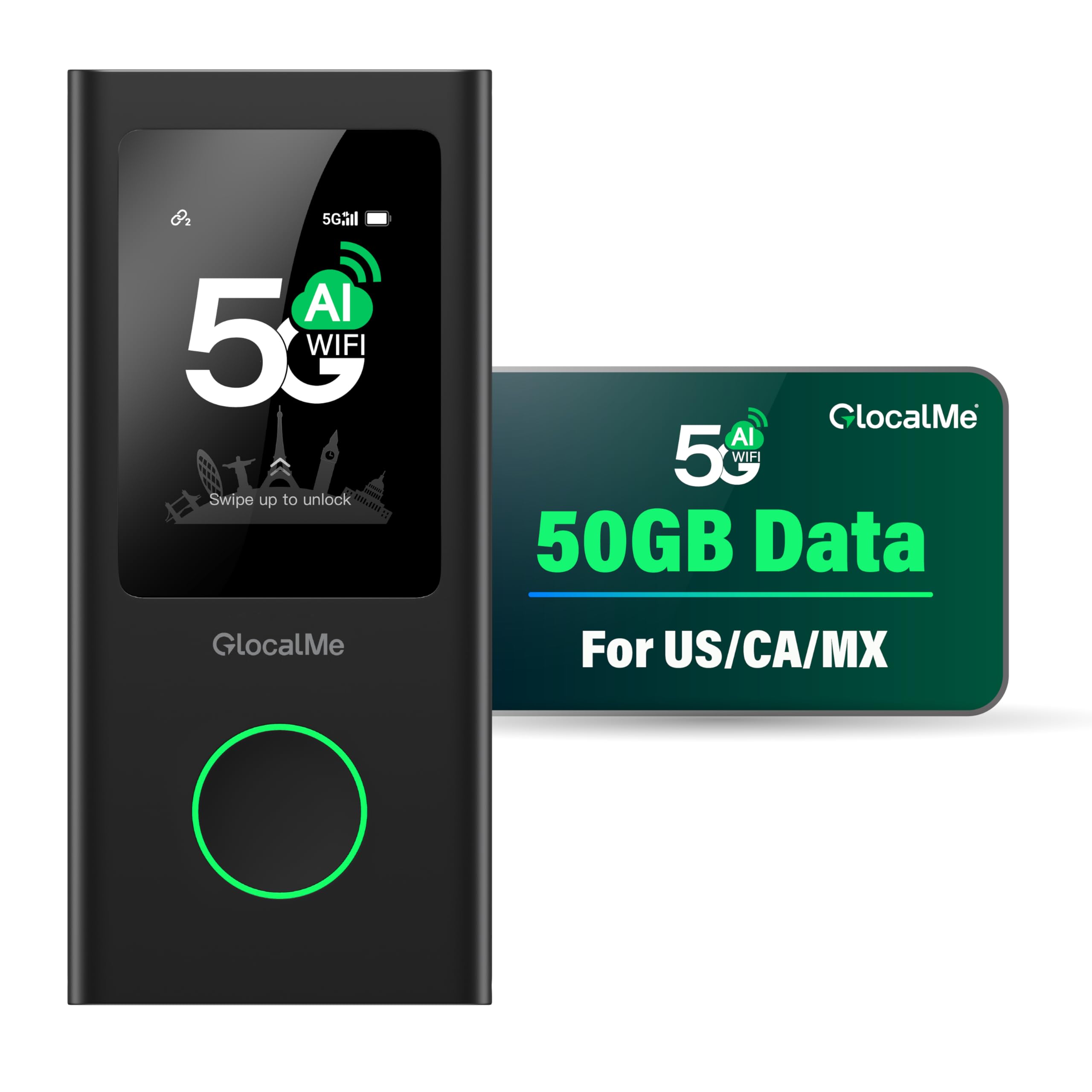
The Numen Air 5G in its 50GB bundle variant removes the biggest headache of travel hotspots: finding a local SIM on arrival. The device comes preloaded with 50GB of data valid for 90 days across the US, Canada, and Mexico — enough for heavy video conferencing, streaming, and map usage during extended trips. The CloudSIM technology automatically connects to the strongest local carrier without requiring a physical SIM, though a SIM card slot is present for users who prefer local carriers for better rates.
The 2.5Gbps theoretical data rate is achievable in strong 5G coverage areas, but real-world tests show 80-110Mbps outdoors and 25-40Mbps indoors, which is still faster than most hotel WiFi. The 2.4-inch LCD touch screen displays data usage, signal strength, and connected devices clearly. The device also functions as a power bank for emergency phone charging — a genuinely useful secondary feature for travelers. The Numen Air supports up to 16 simultaneous connections, and the Gigabit Ethernet port (via USB-C to Ethernet adapter, not built-in) allows wired connections when stationary.
The biggest drawback is that the bundled CloudSIM data is carrier-dependent and non-refundable if coverage is poor in your specific route. Users report that the data plans for additional top-ups are pricier than buying a local SIM in many countries. The device itself is well-built and the interface is intuitive, but the Ethernet connection requires a separately purchased adapter — the device does not have a native RJ45 jack. For travelers who want plug-and-play data with the option of wired connectivity via adapter, this is a solid middle-ground choice.
Why it’s great
- 50GB preloaded data for US/CA/MX, no SIM hunting
- CloudSIM selects best carrier automatically
- USB-C power bank function
- Clear LCD touch interface
Good to know
- No built-in Ethernet port; requires USB-C adapter
- Data top-ups are expensive compared to local SIMs
- Indoor speeds drop significantly
6. GlocalMe Red Numen Air 5G
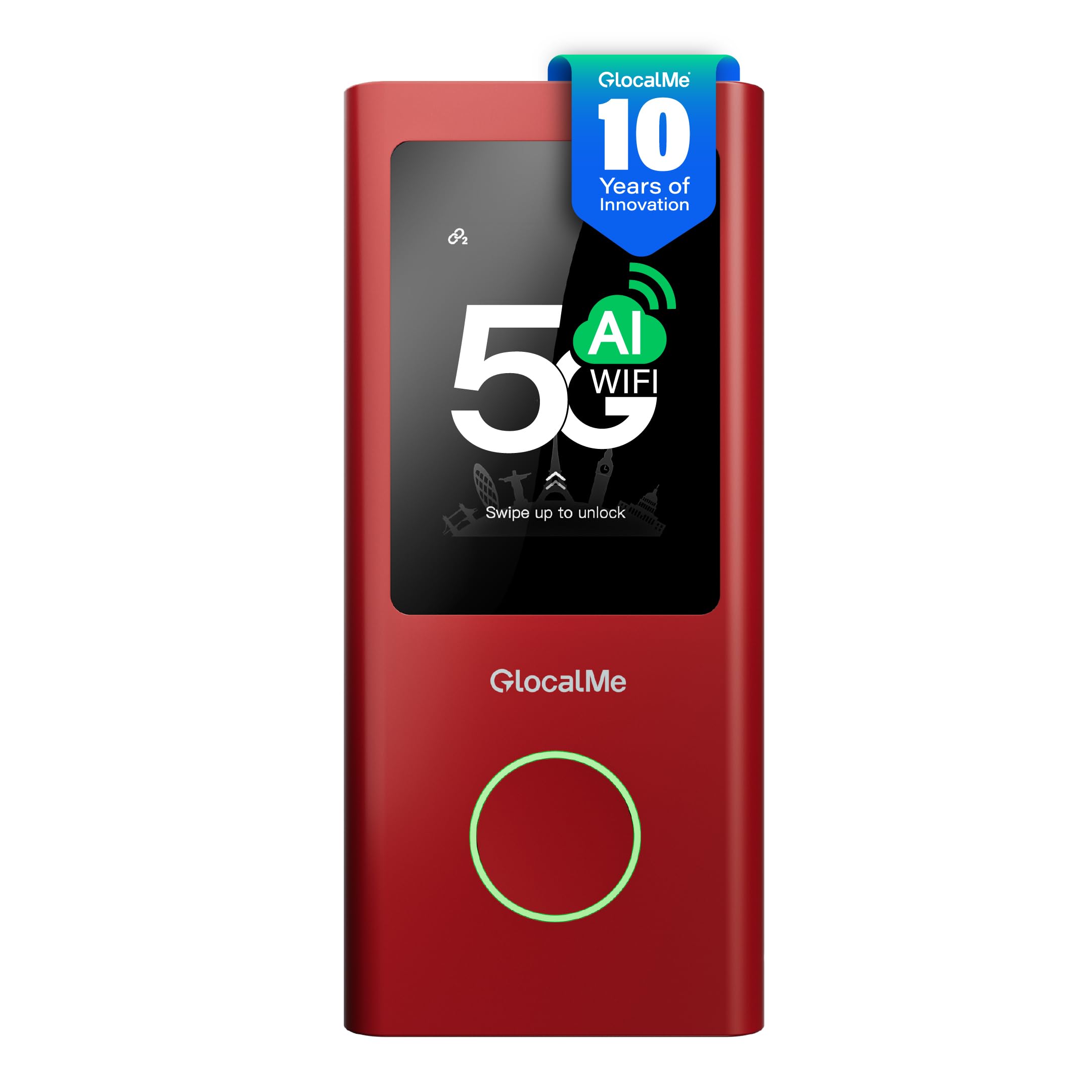
The Red Numen Air 5G is functionally identical to the black 50GB bundle version but sold without the preloaded data, making it a better choice for travelers who prefer to use their own physical SIM cards from local carriers. The device works with Google Fi (T-Mobile network) out of the box, and users report 80-110Mbps speeds outdoors in strong 5G coverage. The CloudSIM technology provides a fallback option when physical SIM coverage is weak, automatically switching to the strongest available carrier in the region.
The 2.4-inch LCD touch screen is bright and responsive, with a simple UI that shows real-time signal strength, data consumption, and device count. The device supports up to 16 connected devices and includes a WiFi passthrough feature that lets you connect to hotel WiFi and relay it as your own secured network — saving your cellular data for when you actually need it. Boot time is roughly 10 seconds, significantly faster than many travel routers. The USB-C port handles both charging and data, so you can use a USB-C to Ethernet adapter for wired connections.
The main limitation is the same as the bundled version: there is no native RJ45 Ethernet jack. You must carry a USB-C to Ethernet adapter for wired connections, which adds bulk and potential compatibility issues. Some users note that the data plans sold through the GlocalMe app are expensive compared to buying a local SIM in most regions. The battery life is around 6 hours of continuous use, adequate for a full day of travel but requiring a midday charge for heavy users. For globetrotters who want the flexibility of CloudSIM plus physical SIM support, this is a capable device that trades native Ethernet for portability.
Why it’s great
- Dual connectivity: CloudSIM + physical SIM tray
- Works in 200+ countries with auto network switching
- WiFi passthrough to save cellular data
- Fast boot time (~10 seconds)
Good to know
- No built-in Ethernet port; adapter required
- CloudSIM data is expensive for top-ups
- Battery life limited to 6 hours
7. SIMO Solis 5G WiFi Hotspot (Renewed)

The SIMO Solis 5G Hotspot is built around a unique value proposition: 1GB of free global data every month for the life of the device. That 1GB is genuinely useful for emergency connectivity, checking emails, or mapping during short trips — and it never expires. For heavier use, you purchase top-up data through the Solis app at competitive rates (around for 100GB of high-speed data before throttling). The device uses a virtual multi-carrier network to automatically connect to the strongest available signal across 135+ countries, eliminating the need for SIM cards or contracts.
The IP54 ruggedized design (dust and splash resistant) makes the Solis 5G more durable than the average travel hotspot. The 2.4-inch LCD touch screen provides clear data usage and signal monitoring, and the SignalScan feature lets you manually switch carriers if one underperforms. The device also doubles as a power bank for charging phones on the go. Users report reliable speeds of 250Mbps down on the high-speed tier, with throttled speeds around 20-30Mbps after exceeding the data cap — still usable for browsing and homework.
The critical gap for our category is connectivity: the Solis 5G has no Ethernet port at all, even via USB adapter. It is a WiFi-only device, designed purely for wireless connections. If your use case strictly requires a wired Ethernet connection for a specific device, this is not the right pick. However, for travelers who need a simple, durable, globally-capable WiFi hotspot with a free monthly data safety net, the Solis 5G offers excellent value despite the lack of wired output.
Why it’s great
- 1GB free global data every month for life
- IP54 rugged for outdoor and travel use
- No SIM card needed for global coverage
- SignalScan for manual carrier switching
Good to know
- No Ethernet port whatsoever — WiFi only
- Throttled speeds after data cap
- Long-term data costs can exceed local SIMs
8. TravelWiFi Sapphire 5G

The TravelWiFi Sapphire 5G distinguishes itself with a large, high-resolution touch screen that makes navigation and network monitoring genuinely pleasant — no squinting at tiny LCD panels. The CloudSIM technology provides connectivity in over 100 countries without swapping SIM cards, and the device comes preloaded with 5GB of global data to get you started. The optional physical SIM slot (with a retrieval pin included) gives you the flexibility to insert a local carrier SIM for better rates on extended stays.
Up to 10 devices can connect simultaneously, and the tri-band WiFi support helps minimize congestion in crowded environments like convention centers and airports. The central navigation button plus touch interface gives you two ways to control the device. Users report decent range and stable connections across European travel routes, with particularly strong performance in Scandinavia. The built-in network congestion monitoring is a unique feature that helps you identify when a carrier is overloaded and switch to a less crowded network.
The Sapphire 5G shares the same critical limitation as the other travel-focused hotspots: no built-in Ethernet port. If your primary need is wired connectivity for a console, PC, or VoIP system, you will need a USB-C to Ethernet adapter, and there is no guarantee of Gigabit speeds through that path. Additionally, some users report that the device fails to connect in certain European countries despite the coverage map claiming support — always verify coverage for your specific travel route before departure. The 5GB free data is a nice starter but depletes quickly with video streaming.
Why it’s great
- Large touch screen with network congestion monitor
- CloudSIM + optional physical SIM slot
- 5GB of free global data included
- Tri-band WiFi for less congestion
Good to know
- No built-in Ethernet port
- Actual coverage may not match marketing claims
- 5GB data runs out fast; top-ups are costly
9. Jextream RG2100 (Franklin Wireless)

The Jextream RG2100 is the most affordable entry point into 5G with a wired LAN port, but there are important caveats. The specifications clearly state a “1 Gbps LAN port bandwidth” and a touch control method, yet multiple customer reviews confirm that the device lacks a physical Ethernet jack — the USB-C port is for charging only, and Franklin Wireless explicitly warns against using a permanent power connection to avoid battery damage. This means the RG2100 cannot actually deliver wired Ethernet despite the marketing language referencing LAN bandwidth.
As a pure WiFi 6 hotspot on T-Mobile’s network, the RG2100 performs well. Users at farmers markets report reliable credit card processing through the hotspot, and speeds are adequate for general browsing and streaming on up to four devices. The dual-band WiFi 6 provides solid throughput for a single user or small group. The compact design is genuinely travel-friendly, and the touch method of control is intuitive for a hotspot.
The RG2100 is a T-Mobile-only device (no Verizon or AT&T compatibility), and some units arrive with display defects (vertical lines on screen) or pre-charged batteries indicating prior use. The lack of an actual Ethernet jack makes this a misleading option for buyers specifically searching for a wired connection. It belongs at the bottom of this list as a budget WiFi-only alternative for T-Mobile customers who do not actually need an Ethernet port — consider it only if your Ethernet requirement is flexible and your budget is extremely tight.
Why it’s great
- Lowest price point for 5G + WiFi 6
- Compact and portable design
- Touch interface is easy to use
- Reliable for low-bandwidth use like credit card processing
Good to know
- No actual Ethernet jack despite LAN port claims
- T-Mobile only — not carrier flexible
- Quality control issues reported (display defects)
- USB port is charging-only
FAQ
Can I use any 5G hotspot as a wired backup for my home network?
What does dual-SIM single standby mean for 5G hotspots?
Why does my 5G hotspot throttle or disconnect when I plug in the Ethernet cable?
Can I connect a 5G hotspot to my home router’s WAN port for backup internet?
Do all 5G hotspots with an Ethernet port support external antennas for better signal?
Final Thoughts: The Verdict
For most users, the best 5g hotspot with ethernet port winner is the GL.iNet GL-X3000 (Spitz AX) because it combines true dual 2.5G Ethernet ports with dual-SIM failover and the advanced customization of OpenWrt — a combination no other device matches at its price point. If you need UPS-style battery backup for your wired network, grab the GL.iNet GL-XE3000 (Puli AX). And for rugged, business-class deployment in remote buildings or RV parks, nothing beats the MOFINETWORK MOFI6500 with its metal chassis and amplified WiFi range.