
An antenna signal meter is the only tool that replaces the guesswork of rotating a mast while staring at a TV screen fuzzy with static or relying on the “signal bars” on a two-way radio’s display—bars that are often just a smoothed-over marketing number rather than a real measurement. Whether you are tuning a rooftop TV antenna for maximum reception of distant broadcast towers, trimming a VHF marine whip to a flat SWR, or fine-tuning a ham radio dipole for the best forward power transfer, the signal meter’s needle or digital readout gives you the precise feedback loop needed to lock onto the strongest transmission path.
I’m Min — the co-founder and writer behind Gadgets Feed. My approach to this guide involved cross-referencing the advertised bandwidth, sensitivity control, and output format (analog needle movement vs. digital decibel readout) of each unit against real-use scenarios described by experienced installers, ham radio operators, and RV travelers, ensuring the recommendations reflect genuine field utility rather than just spec-sheet numbers.
After comparing analog field-strength meters, vector network analyzers, and satellite-specific finders, the complete and curated list of the best antenna signal meter options below will help you pick the right tool for your specific coaxial connector and frequency band.
How To Choose The Best Antenna Signal Meter
The right signal meter depends entirely on the type of antenna you are tuning and the frequency range you operate in. A meter built for VHF marine radios (around 156 MHz) is useless for aligning a C-band satellite dish, and a tiny field-strength meter with a passive diode detector cannot show you the standing wave ratio of a 70cm amateur antenna. Start by identifying your frequency band and connector type, then match the meter’s capabilities to those parameters.
Frequency Coverage and Connector Type
Every meter has a specified frequency range—100 kHz to 3 GHz for general-purpose field-strength meters, 9 kHz to 1.5 GHz for a NanoVNA, or the narrow 155–158 MHz window of a marine VHF tester. Check that the meter’s input connector matches your antenna’s feedline: SMA is common on handheld analyzers and small radios, PL-259 (UHF) is standard on amateur and CB gear, and F-Type is universal for TV antennas. Adapters can bridge mismatches, but every adapter adds a tiny insertion loss and potential for loose connections.
Analog Needle vs. Digital Readout
An analog meter with a moving needle gives instant visual feedback of relative signal changes—perfect for the rapid back-and-forth rotation of a TV antenna during aiming. A digital display (LCD with numeric dBµV or SWR values) provides absolute, repeatable measurements that allow you to log readings and compare sites across different days. Digital analyzers like the NanoVNA also generate Smith charts and return-loss plots, letting you characterize an antenna’s impedance across a wide frequency sweep rather than just one spot frequency.
Sensitivity Control and Input Protection
Field-strength meters are sensitive; if you are working near a high-power transmitter (100W+), the input stage can be overloaded and the needle can peg hard against the stop, damaging the movement. Look for a gain or amplitude adjustment knob that lets you attenuate the input before connecting, then slowly increase sensitivity to a usable reading. The best meters include a built-in automatic damping function that prevents the needle from swinging violently when a signal first appears.
Quick Comparison
On smaller screens, swipe sideways to see the full table.
| Model | Category | Best For | Key Spec | Amazon |
|---|---|---|---|---|
| Winegard RFL-342 Sensar Pro | TV/RV Aiming | OTA antenna alignment with audio feedback | On-screen numerical scale | Amazon |
| SEESII NanoVNA-H | Vector Analyzer | Ham SWR & impedance sweep | 9 kHz – 1.5 GHz range | Amazon |
| GT Media V8 Finder2 | Satellite Finder | DVB-S/S2 dish alignment | 3.5″ HD LCD + spectrum analyzer | Amazon |
| Shakespeare ART-3 | VHF Marine | Boat radio & antenna diagnostics | 155–158 MHz, VSWR test | Amazon |
| Mcbazel Surecom SS10 | Field Strength | Pre-screening HT antennas | 100 kHz – 3 GHz range | Amazon |
| Mcbazel Surecom SS11 | Amplified FS Meter | RF leakage detection | Amplified, 1 MHz – 3 GHz | Amazon |
| MOOKEERF 50ft Coax (Accessory) | Cable Pairing | Connecting meter to distant antenna | KMR400, loss <2.8dB @450MHz | Amazon |
In‑Depth Reviews
1. Winegard RFL-342 Sensar Pro
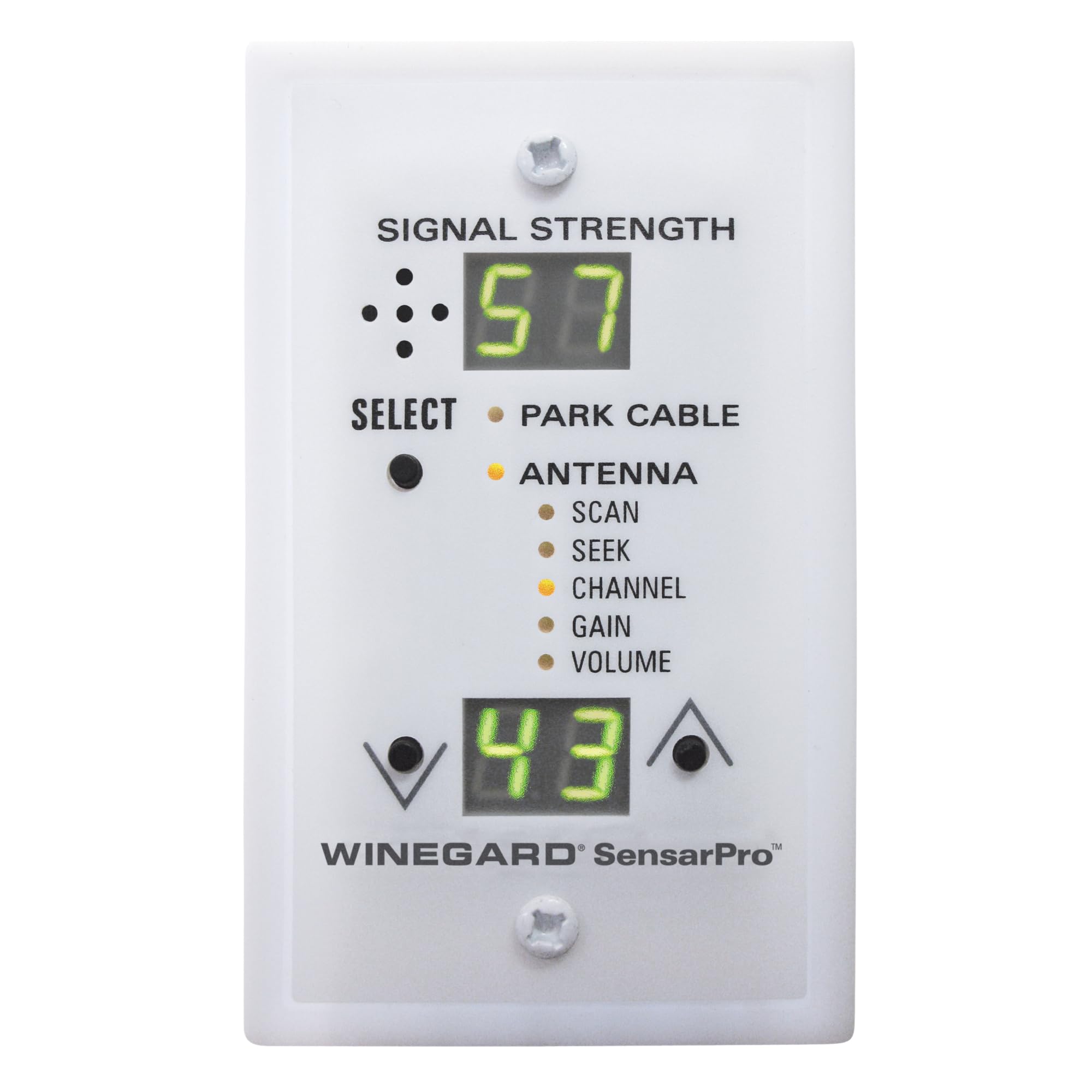
The Winegard RFL-342 Sensar Pro is the definitive signal meter for RV and home over-the-air TV antenna alignment. It connects directly into your coax line between the antenna and the TV, displaying a real-time numerical signal strength scale on the TV screen so you can rotate the antenna and see the number rise without needing a separate handheld device. The integrated amplifier’s adjustable gain lets you pull in weak stations in rural fringe areas or reduce gain in urban corridors to avoid overload from nearby towers.
The audio feedback feature is a practical touch—it produces a rising tone as the signal increases, which is invaluable when you are adjusting the antenna on the roof alone and the TV is inside the RV or house. It supports Scan Seek mode, which automatically sweeps through active broadcast frequencies, and Channel mode, which locks onto a specific digital channel. The unit is designed to be wall-plate mounted and works with most RV antennas, making it a permanent part of your installation rather than a loose test lead that gets lost in a drawer.
Some users have noted that the meter’s performance degrades slightly when the 12V supply voltage drops below optimal, and it requires a DC blocker if you want to use it as a standalone meter away from its intended amplifier wall plate. Despite this, the RFL-342 eliminates the most frustrating part of TV antenna setup—the blind trial-and-error rotation—and replaces it with deterministic, real-time feedback. For any OTA TV deployment, this is the category-defining tool.
Why it’s great
- On-screen numerical scale gives unambiguous signal strength readout
- Audio tones let you aim the antenna without looking at the TV
- Adjustable amplifier gain adapts to both weak and strong signal markets
Good to know
- Requires a 12V power source and coaxial connection to the TV
- Best performance is achieved with a clean, regulated DC supply
2. SEESII NanoVNA-H Vector Network Analyzer
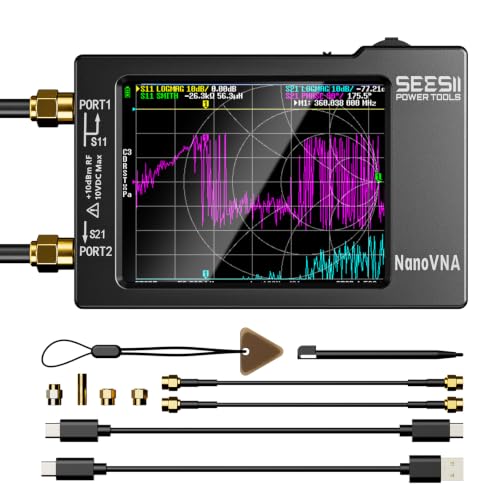
The NanoVNA-H from SEESII is a full vector network analyzer that fits in the palm of your hand, covering 9 kHz to 1.5 GHz. Unlike a simple field-strength meter that only shows relative signal intensity, this device measures S11 (return loss), VSWR, impedance, phase, and even plots a Smith chart on its 2.8-inch touchscreen. For a ham radio operator building a multi-band dipole or a technician tuning a 2-meter collinear, this level of insight—seeing exactly where the antenna resonates on a frequency sweep—is the difference between a “good enough” installation and an optimized one.
The HW3.7 revision improves the frequency algorithm using the SI5351 oscillator’s odd harmonics, achieving a 70 dB dynamic range from 50 kHz to 300 MHz. It also includes a built-in micro-SD card slot for saving screen captures and measurement data, and the USB-C port allows connection to a PC for more advanced post-processing with NanoVNASaver software. The kit comes with two SMA cables, a calibration kit (open/short/load), and a lanyard—everything needed to start measuring the second you unbox it.
The learning curve is real: you need to understand calibration sweeps, port extensions, and how to interpret a Smith chart to get the full value. The tiny screen can be hard to read in direct sunlight, and the SMA connectors may require adapters to mate with PL-259 or N-type gear. However, for the RF enthusiast who wants to quantify antenna performance rather than just glance at a needle, this analyzer offers a level of sophistication that previously cost ten times as much.
Why it’s great
- Full VNA capability for SWR, impedance, and return loss measurement
- Compact and portable with a color touchscreen and USB-C
- Includes calibration kit and cables for immediate use
Good to know
- Steep learning curve—Smith charts are not beginner-friendly
- Requires recalibration when changing frequency bands
3. GT Media V8 Finder2 Satellite Finder

The GT Media V8 Finder2 is a dedicated satellite signal meter that supports DVB-S, DVB-S2, and DVB-S2X modulation standards, making it the right tool for aligning dishes intended for FTA (free-to-air) satellite television. Its 3.5-inch HD LCD screen shows a live constellation analyzer and a spectrum analyzer view, so you can see not just whether there is signal but what the signal quality looks like in terms of modulation error ratio and carrier-to-noise. It also decodes H.264 video streams, meaning you can watch the actual channel output on the meter during alignment—a huge convenience when tweaking the azimuth and elevation of a 90cm Ku-band dish.
The built-in rechargeable battery provides several hours of field operation, and a speaker emits a tone that varies with signal strength, which again is critical when you are behind the dish making adjustments while the meter sits up front. The V8 Finder2 comes with a portable carrying pouch, making it easy to take to a rooftop, campsite, or remote cabin location. It also supports BISS and PowerVu auto-roll for encrypted channels, though that functionality is more relevant for advanced users pulling specific feeds.
This meter is not compatible with DirecTV or ATSC terrestrial signals, and the user interface can be non-intuitive for someone without previous satellite aiming experience. The initial satellite database needs to be configured to your location’s orbital positions (like 97°W or 101°W) before it can show meaningful numbers. However, for anyone installing satellite dishes—for a motorhome, a remote homestead, or a fixed FTA setup—the combination of visible video decoding and real-time constellation display makes this the most direct path to a locked signal.
Why it’s great
- Live video decoding on the meter confirms both signal lock and correct channel
- Constellation and spectrum analyzers reveal signal quality, not just strength
- Battery-powered with a carrying pouch for outdoor work
Good to know
- Not compatible with DVB-S2X on some transponder types
- Requires prior knowledge of satellite arc locations and proper LNB setup
4. Shakespeare ART-3 Antenna/Radio Tester
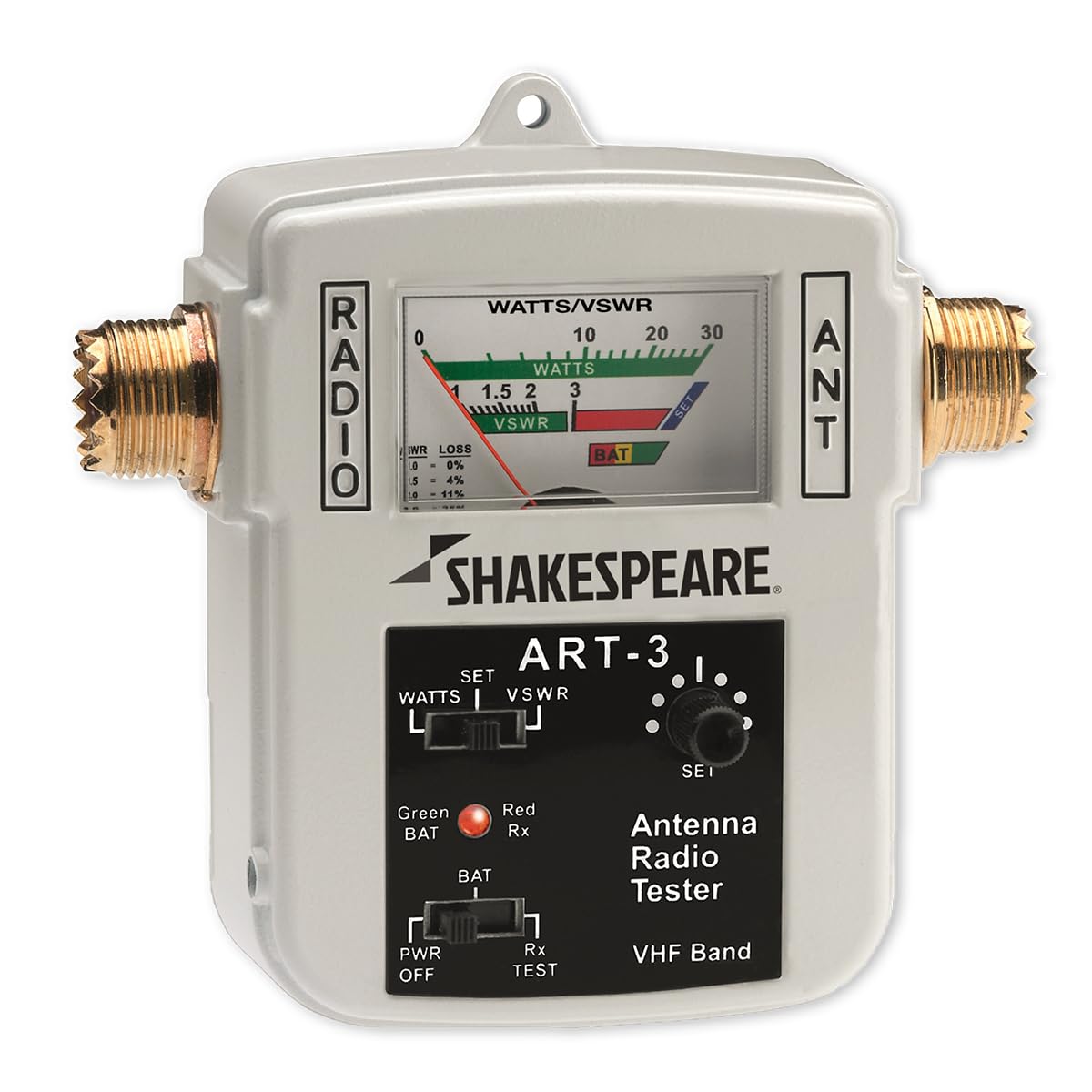
The Shakespeare ART-3 is purpose-built for the marine VHF band (155–158 MHz), which covers the international maritime mobile frequencies used by boaters for communication and safety. Rather than giving you a relative dB reading, this tester performs three critical checks: it measures the radio’s output power in watts, it measures the VSWR (standing wave ratio) to assess antenna efficiency, and it generates a low-power test signal to verify the receiver’s sensitivity. For a boat owner suspecting a bad cable splice or a corroded antenna base on a sailboat mast, this all-in-one diagnostic tool eliminates the isolation guessing game.
The die-cast aluminum housing is built to withstand the saltwater marine environment, and the front panel is clearly labeled with a rotary function switch and a backlit LCD panel. The ART-3 requires the separately sold Style 4079 cable to connect to your VHF radio—a frustrating omission that many owners wish was included in the + price tag. The unit is tuned exclusively to the narrow VHF band, so it cannot be used for CB, GMRS, or amateur HF testing. This limitation is also its strength: the readings are calibrated for the exact channel frequencies a mariner cares about, and the wattage measurement is accurate enough to spot when a 25W radio is only putting out 10W due to a failing final amplifier stage.
User reports indicate the test tone is nearly inaudible when the coax and antenna are connected, so you need to detach the antenna and lower the squelch to hear the injected signal. The internal power measurement reads slightly low compared to a lab-grade RF wattmeter, but for relative diagnostics—like confirming a radio is transmitting at all—it is perfectly adequate. For any nautical VHF installation or repair, the ART-3 is the definitive standalone field tester.
Why it’s great
- Tests power output, VSWR, and receiver sensitivity in one rugged marine housing
- Calibrated to the exact 155-158 MHz maritime band
- Die-cast aluminum construction resists corrosion and impact
Good to know
- Cable (Style 4079) required to connect to the radio is sold separately
- Only a narrowband VHF tool—not usable for HF, CB, or UHF
5. Mcbazel Surecom SS10 100K-3GHz RF Signal Strength Meter

The Mcbazel Surecom SS10 is the baseline entry-level field-strength meter for the amateur radio and GMRS crowd, covering 100 kHz to 3 GHz with an analog moving-needle indicator. It is an unamplified passive detector, meaning it simply rectifies the RF signal picked up by its whip antenna and drives the meter movement proportionally to the field strength. This simplicity gives it the widest useful dynamic range of any meter in this guide—it can sit in front of a 50W output without the needle smashing against the stop, because the user can dial down the amplitude adjustment knob to protect the movement before connecting the source.
The SS10 works best as a relative indicator: you point the meter’s whip at the transmitted antenna and compare readings between different antennas to see which radiates more efficiently at a given distance. Reviews consistently confirm it distinguishes between a stock FRS radio’s 30% scale reading and a better-performing model’s 50% reading from the same distance. The built-in automatic damping function prevents the needle from overshooting when you first key up, a feature that many inexpensive field-strength meters lack.
This meter does not provide calibrated dBm or watt readings—every measurement is relative and subjective to the gain control setting and the proximity to the source. It also requires the user to rotate the meter and the radio antenna to match polarizations for meaningful readings. For a ham who wants a quick go/no-go check on a homebrew 2-meter antenna before climbing a tower, or for a GMRS user comparing aftermarket antennas on a handheld, the SS10 delivers actionable feedback at a very accessible price point.
Why it’s great
- Passive detection means no batteries needed and no amplifier noise floor
- Wide 100 kHz to 3 GHz range covers all common VHF/UHF bands
- Adjustable damping prevents needle slam on sudden transmissions
Good to know
- Readings are relative, not calibrated—unusable for exact SWR or dBm
- Best results require matching polarization between meter whip and source antenna
6. Mcbazel Surecom SS11 Portable Field Strength Meter

The Mcbazel Surecom SS11 is the amplified sibling of the SS10, adding an internal amplifier stage that boosts sensitivity—ideal for picking up very weak signals like leakage from consumer electronics, WiFi routers, or distant handheld radios. The frequency spec is similar (1 MHz to 3 GHz), and it uses the same analog needle display, but the amplification means the needle will swing for signal levels that the unamplified SS10 would ignore. This makes it a decent tool for tracing RF interference inside a house or shop: you can walk around with the SS11 and see where a microwave oven’s leakage is strongest, or where a poorly shielded power supply is radiating noise.
The unit requires a power source (it runs on a built-in USB-rechargeable battery) to drive the amplifier, so the operating time is limited to the battery capacity. The amplified nature also means the meter can overload extremely easily: even with the amplitude knob at minimum, a strong nearby source pegs the needle, requiring you to move far away (sometimes outside the building) to get a readable deflection. Some users have recommended getting the SS10 instead specifically because the SS11’s gain is too high for typical amateur radio HT testing, unless you are working at distances of 50 feet or more.
The build quality feels solid, and the package includes a USB charging cable and a whip antenna with an SMA connector. The instruction manual is poorly translated, which adds to the frustration of learning the right distance-to-signal ratio. For a specific use case like mapping relative RF field pattern variations of a base station antenna by walking multiple radial lines, the SS11’s sensitivity is an asset. For routine HT antenna swapping, most users will prefer the simpler, more predictable SS10.
Why it’s great
- Amplified input stage detects signals the passive SS10 would miss
- Rechargeable battery via USB, no need for disposable cells
- Good for locating RF leaks or interference sources in an environment
Good to know
- Too sensitive for close-range HT testing—needs significant separation distance
- Battery life limits continuous field use away from power
7. MOOKEERF 50ft KMR400 Coaxial Cable

While this is strictly a coaxial cable rather than a signal meter, the 50-foot MOOKEERF KMR400 patch cable is included in this guide because it is the precise accessory many signal meter users need to connect their instrument to a rooftop antenna from inside the house or vehicle. The KMR400 spec (similar to LMR400) offers low loss of less than 2.8 dB at 450 MHz over this 50-foot run, with an SWR rating of 1.25:1 or less—critical when you are trying to get a true reading of the antenna’s RF output rather than seeing the loss in a cheap RG-58 patch cord distorting the measurement. The cable comes terminated with PL-259 male connectors on both ends, which is the standard for amateur radio, marine, and CB gear, and the connectors are protected by 2.2-inch heat-shrink tubing with adhesive to prevent pull-out in outdoor installations.
The inner conductor uses copper-clad aluminum and the braid is tinned copper, giving good corrosion resistance for outdoor use without the cost of full copper. Users report that the cable works well for runs between a radio amplifier and a SWR meter, or as a feedline extension from the antenna pass-through into a shack. The cable is relatively stiff due to the foam polyethylene dielectric and the double shielding, making it better suited for fixed installations where you can route it once and leave it, rather than for frequent coil-up-and-uncoil field operations.
The MOOKEERF cable does not include an adapter for SMA-to-PL-259, so if your signal meter uses an SMA input (like the NanoVNA or the Surecom handhelds), you will need a separate SMA female to PL-259 male barrel adapter. The stiff cable is also prone to kinking if bent sharply. For the signal meter user who needs to place the meter in a comfortable operating position 50 feet away from the base of the antenna, this cable delivers the signal fidelity required for meaningful measurements.
Why it’s great
- Low-loss KMR400 construction preserves signal fidelity over 50 feet
- PL-259 connectors on both ends match standard amateur and marine gear
- Adhesive-lined heat shrink on connectors resists water ingress
Good to know
- Cannot attach directly to SMA-meter inputs without an adapter
- Cable is stiff and not ideal for frequent portable deployments
FAQ
Can I use a field-strength meter to measure SWR?
Why does the needle jump off-scale when I key the mic near the meter?
Can a satellite finder work for terrestrial TV antennas?
Final Thoughts: The Verdict
For most users, the best antenna signal meter winner is the Winegard RFL-342 Sensar Pro because it provides unambiguous, repeatable, numeric feedback on a TV screen while you aim the antenna, eliminating the guesswork and second-guessing that plague OTA installations. If you want precision impedance analysis of an amateur radio antenna, grab the SEESII NanoVNA-H. And for dedicated satellite dish alignment, nothing beats the GT Media V8 Finder2 with its live video decoding.