
There is a distinct sound when a welder fires an arc that is unconstrained by a generator or a 50-foot extension cord—it is the sound of pure freedom. Battery-powered welding has finally crossed the threshold where portability no longer means comically weak penetration. The inverter revolution has shrunk power supplies to the size of a lunchbox, while advanced capacitor and LiFePO4 battery technology delivers the instantaneous amperage to burn rods or fuse nickel strips without tripping a breaker or dragging a heavy gas cylinder. Whether you are patching a trailer gate in a pasture or building a battery pack on a workbench, the modern cordless welding landscape offers real solutions.
I’m Min — the co-founder and writer behind Gadgets Feed. I have spent hundreds of hours cross-referencing technical specifications, inverter topology, duty cycles, and real-world user performance data to isolate exactly which cordless welding platforms deliver true commercial-grade results versus which ones overpromise on marketing hype and undershoot on usable arc stability.
If you are ready to cut the cord without cutting corners on weld quality, this guide to the best options available in the best battery powered welder category will steer you toward the machine that matches the exact thickness of metal you plan to fuse and the availability of jobsite power.
How To Choose The Best Battery Powered Welder
The cordless welder market is not monolithic. You must separate the machine designed for building lithium battery packs from the machine intended for general arc welding repairs. The capacitor-discharge units deliver massive energy in milliseconds—perfect for welding nickel strips to 18650 cells, but useless for joining two pieces of angle iron. Conversely, a portable stick or flux-core inverter needs a battery bank capable of sustaining a stable arc voltage for several minutes of burn time. Understanding these boundaries is the first step toward a purchase that actually matches your workflow.
Capacitor Bank vs. Inverter Architecture
A battery-powered spot welder stores energy in supercapacitors and releases it in a high-current pulse. The critical spec here is peak power (measured in kilowatts) and the ability to weld pure nickel, not just nickel-plated steel. For full-arc welding, the machine must use an IGBT inverter that draws from a high-discharge lithium battery to produce a smooth DC welding current. Look for machines with adjustable amperage (20A to 120A or more) and Hot Start / Anti-Stick features—these directly affect arc ignition success and electrode longevity.
Duty Cycle and Thermal Regulation
Battery-powered welders are thermally limited by both the electronics and the battery pack. A 20% duty cycle at 90A means 2 minutes of welding followed by 8 minutes of cooldown. If you plan to run multiple beads back-to-back, prioritize machines with active cooling (a high-CFM fan) and over-temperature protection that shuts down components before permanent damage occurs. The inverter topology matters here: dual IGBT modules with copper heat sinks dissipate heat far more efficiently than single-transistor designs.
Electrode and Wire Compatibility
For stick welding (SMAW), the battery-powered unit should support common electrode diameters from 3/32-inch to 1/8-inch. If you need to run 6010 rods (deep penetration, difficult arc), verify the machine’s Open Circuit Voltage (OCV) rating—higher OCV helps ignite those rods. For flux-core welding, check that the machine can drive 0.030-inch or 0.035-inch cored wire at a consistent feed speed. For spot welding, the ability to switch between nickel-plated steel and pure nickel strips without tearing the material defines the machine’s versatility.
Quick Comparison
On smaller screens, swipe sideways to see the full table.
| Model | Category | Best For | Key Spec | Amazon |
|---|---|---|---|---|
| Lincoln Electric 90i MIG K5256-1 | MIG & Flux Core | Mobile MIG welding with gas on 110V | 15 lb portable with genuine Lincoln inverter | Amazon |
| AWithZ P20B Spot Welder | Capacitor Spot | Lithium battery pack building | 14.6 kW pulse power, 999 gear adjust | Amazon |
| Lincoln Electric 90i FC K5255-1 | Flux Core Only | Light fabrication and sheet metal | Infinite voltage dial, 120V flux core | Amazon |
| Forney 271 Easy Weld 140 MP | Multi-Process | Stick/MIG/TIG on all-metal chassis | 140A output, 3-position process switch | Amazon |
| Arc Welder Handheld HB-1 | Stick Welding | Emergency repairs and hobbyist welding | 3.8 lbs, 20-120A with Hot Start | Amazon |
| Sefaspe ARC 200Pro | Stick Welder | Entry-level stick on 110/220V | 200A max, synergic electrode match | Amazon |
| YESWELDER FLUX-135PRO | Flux Core | Compact flux core with bundled helmet | 11.4 lbs, synergic wire feed | Amazon |
| CraftZone Handheld MIG | Handheld Gun | Quick small fixes and DIY repairs | Gun-style form factor, flux core only | Amazon |
| Ehomful MIG145A | Multi-Process | Beginner-friendly 4-in-1 with smart synergic | 145A dual voltage, auto-match wire speed | Amazon |
In‑Depth Reviews
1. Lincoln Electric 90i MIG K5256-1

The Lincoln 90i MIG is the closest thing to a full workshop MIG machine that runs on a standard 110V wall outlet. It handles solid wire with shielding gas (MIG) up to 3/16-inch thickness and flux-cored wire up to 1/4-inch, giving you genuine process flexibility without stepping up to a 220V circuit. The inverter power supply produces a noticeably smoother arc than transformer-based units, with less spatter and better bead control on thin sheet metal.
Weighing just under 20 pounds with a shoulder strap and a protective metal case, this machine is built for mobile repair work—think fencing, trailer bodies, and farm equipment. The dual-knob interface (infinite voltage and wire speed) lets you fine-tune the arc characteristics precisely, and the included gas regulator means you can run MIG right out of the box. On a 15-amp circuit, users report consistent welds up to 3/16-inch without tripping breakers.
The main trade-off is duty cycle: at high power settings, the machine demands cool-down periods, and the 1-pound spool capacity means more frequent wire changes. It also carries a premium price premium over comparable generic inverters, but the build quality, brand reliability, and availability of Lincoln consumables justify the investment for professionals who cannot afford downtime.
Why it’s great
- Genuine dual-process capability (MIG + flux core) in a 15 lb package
- Inverter-based arc is exceptionally smooth with low spatter
- Includes gas regulator and metal carrying case for job site protection
Good to know
- Limited to 1 lb wire spools—requires frequent changes for long runs
- Premium price point compared to single-process alternatives
- Duty cycle is restrictive at max output
2. Forney 271 Easy Weld 140 MP

The Forney 140 MP is the strongest performer in the consumer multi-process category, delivering Stick, MIG, and DC TIG from a single 120V outlet. The all-metal case and 25.8-pound weight suggest durability that far exceeds the plastic-clad machines at similar price points. The 3-position process switch plus infinite voltage and wire feed adjustments make it straightforward to switch between a 6013 rod and a 0.030-inch MIG wire without digging into menus.
On a dedicated 20-amp circuit, the Forney easily runs 1/8-inch 6013 rods with a smooth arc and low spatter. Users transitioning from Harbor Freight welders consistently report better bead consistency and less splatter. The included 10-foot MIG gun, electrode holder, and ground clamp are serviceable, though experienced welders may replace the stock MIG gun for extended use. It is also generator-friendly, pulling manageable amps for remote repair jobs.
The DC TIG function is a bonus for light-gauge stainless or mild steel, but it requires an external gas setup and torch purchase. The main limitation is the absence of a 240V input option—if you need to weld 1/4-inch steel in a single pass, you will be pushing the machine to its duty cycle limits. For the home workshop or farm shop running on 110V, however, this machine offers the most capability per dollar.
Why it’s great
- Genuine 3-in-1 capability: Stick, MIG, and DC TIG
- All-metal chassis provides superior durability over plastic competitors
- Infinite voltage and wire feed controls for precise arc tuning
Good to know
- No 240V support—limited to 110V input
- Stock MIG gun is functional but not heavy-duty
- DC TIG requires separate gas and torch purchase
3. Lincoln Electric 90i FC K5255-1

The flux-core version of Lincoln’s 90i platform strips away the gas MIG components to deliver a dedicated flux-cored wire feeder that is astonishingly portable. At 15 pounds with a shoulder strap, this machine feels more like a power tool than a welder, yet it penetrates up to 1/4-inch steel with E71T-11 wire. The inverter technology produces a noticeably cleaner flux-core arc compared to the older transformer-based units—less spatter and better bead appearance.
The infinite voltage dial (1–10) replaces the two-position rocker switches found on budget machines, allowing you to dial in the exact heat needed for thin sheet metal or thicker plate. Users who upgraded from cheap flux-core welders report a dramatic reduction in spatter and significantly better penetration consistency. The cold feed feature helps prevent wire birdnesting, and the included metal case protects the machine during transport.
The biggest constraint is the 1-pound spool capacity—larger projects require wire changes mid-job. There is also no handle on the case; you rely on the shoulder strap for carry. For small fabrication, car restoration, and light construction work, this welder is hard to beat for portability and arc quality at its price point.
Why it’s great
- Extremely portable at 15 lbs with included shoulder strap
- Infinite voltage dial enables precise heat tuning for thin materials
- Inverter produces much less spatter than traditional flux-core welders
Good to know
- Only accepts 1 lb spools—frequent wire changes for long projects
- No gas MIG capability; flux-core only
- Metal case lacks a carry handle (shoulder strap only)
4. AWithZ P20B Spot Welder

The AWithZ P20B is a capacitor-discharge spot welder purpose-built for assembling battery packs from 18650, 21700, and LiFePO4 cells. The 14.6 kW peak pulse power and 999 adjustable gear settings allow you to fine-tune the weld energy for everything from thin nickel-plated steel to 0.3mm pure nickel strips. The dual supercapacitors charge via a 15A adapter within minutes, and once charged, the unit can deliver dozens of welds without being plugged in—true cordless operation.
The dual-mode operation is a standout feature: automatic mode triggers each weld instantly when the probes contact the work, while foot pedal mode frees both hands to position the workpiece accurately. Users report that at 50% power (roughly gear 500), the P20B welds 0.2mm x 8mm pure nickel strips with no tearing and minimal heat transfer to the battery cells. The flexible, 60cm probe leads are soft and easy to position, and the replaceable tungsten pins extend the machine’s lifespan.
The packaging is surprisingly complete—the machine includes a foot pedal, a roll of nickel-plated strip, a battery holder jig, and a file for dressing the tips. The only downsides are a poorly written manual and a foot pedal that feels slightly cheap compared to the rest of the machine. For anyone building power tool battery packs or e-bike batteries, this is the most capable unit in its class.
Why it’s great
- 14.6 kW pulse power welds pure nickel without tearing
- Dual mode (auto + foot pedal) for precise battery pack assembly
- Charges quickly and delivers dozens of welds untethered
Good to know
- Manual is poorly translated and lacks setup detail
- Foot pedal feels lower quality than the main unit
- Not useful for general arc welding—strictly spot welding only
5. Tvgoo HB-1 Handheld ARC Welder
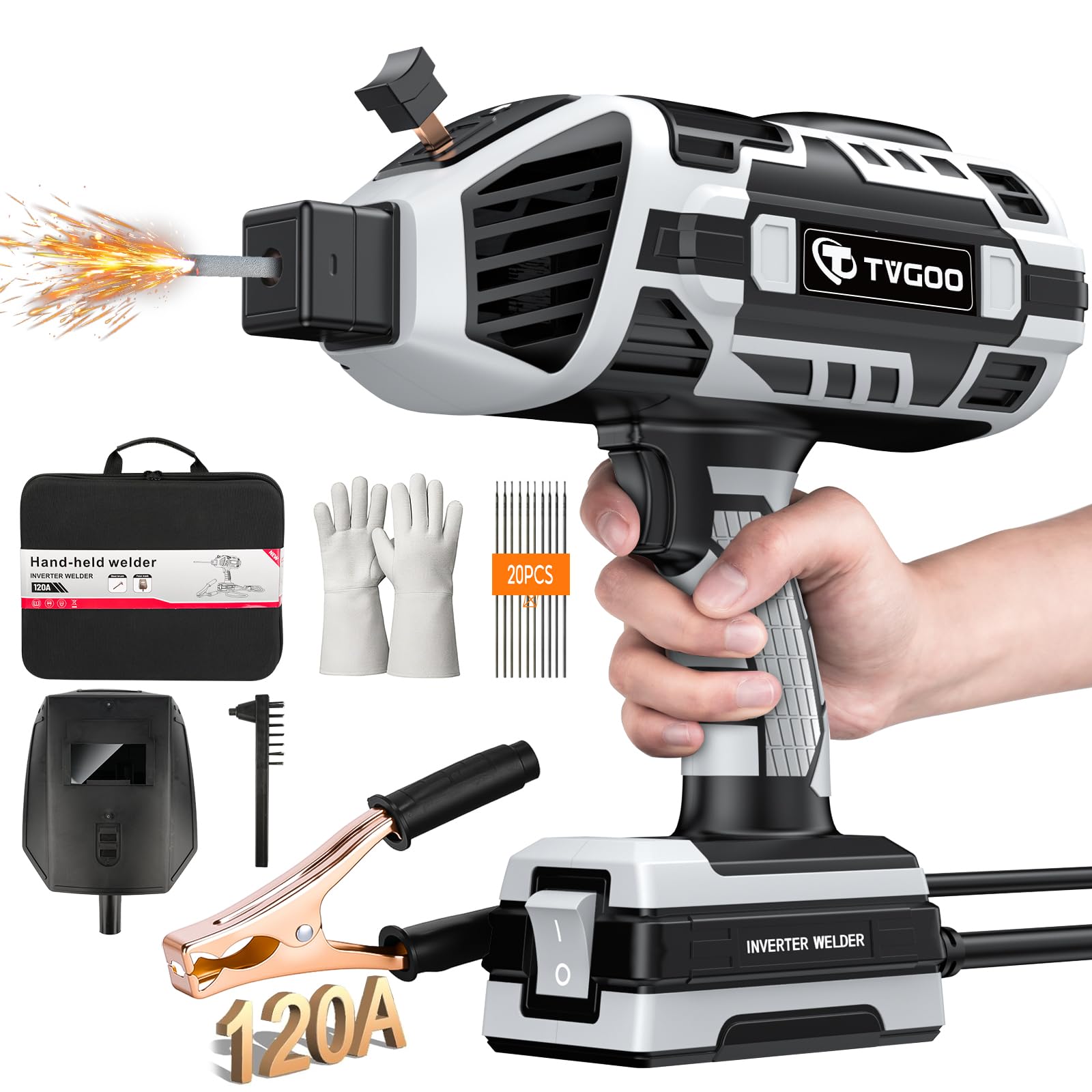
The Tvgoo HB-1 redefines portability in stick welding. At just 3.8 pounds and roughly the size of a cordless drill, this 110V IGBT inverter fits into the tightest tool bags and can be operated with one hand. The 20–120A adjustable output covers everything from thin 3/32-inch rods up to 1/8-inch electrodes, and the Hot Start function provides a boost current at ignition that makes striking an arc almost foolproof for beginners.
The 6-knob dial gives you fine control over amperage, and the digital display shows real-time current during welding. Users report that the Anti-Stick feature genuinely prevents the rod from freezing to the workpiece, which is a common frustration for novice welders. The 360° cooling system with an internal fan allows for longer run times than the size suggests, and the overheat protection shuts down the machine before any component damage occurs.
This is not a production welder—its duty cycle at 120A is short, and it is best suited for light repairs, field fixes, and hobbyist projects. The 2.7-pound weight makes it an ideal emergency kit tool to keep in a truck for chain-link fence repairs or trailer hitch work. Output quality at 3/32-inch 6013 rods is genuinely impressive for such a compact device, with stable arc and decent penetration.
Why it’s great
- Ultra-portable 3.8 lb design fits in a small tool bag
- Hot Start and Anti-Stick features make arc striking easy for beginners
- Digital display shows real-time welding current for precision
Good to know
- Duty cycle is short at 120A—requires frequent cooldown
- Not suitable for heavy fabrication or production welding
- Instructions are sparse for first-time users
6. Ehomful MIG145A

The Ehomful MIG145A is a 4-in-1 multi-process machine (gas MIG, flux-core MIG, lift TIG, and stick) that brings synergic control to the budget tier. The smart synergic system automatically matches voltage and wire feed speed when you select the wire diameter and material thickness, effectively removing guesswork for beginners. The 145A output runs on both 110V and 220V, and the dual-voltage flexibility makes it suitable for home garages and mobile work where power availability varies.
The updated HD digital screen is bright enough to read under direct sunlight, and the indicator lights allow you to adjust settings without lifting the welding helmet. Users consistently praise the smooth arc with minimal spatter in MIG mode, and the 4-in-1 capability means you can try stick or TIG without purchasing separate machines. The complete accessory bundle—helmet, gloves, flux-core wire, solid wire, and a storage strap—gets you welding immediately.
The limitations are typical for budget multi-process machines: the built quality is acceptable but not industrial-grade, and the duty cycle is moderate. The TIG torch is not included, so you will need to purchase one separately to use the lift TIG function. For a beginner who wants to learn multiple welding processes without a huge financial commitment, this machine offers exceptional value and a smooth learning curve.
Why it’s great
- Smart synergic system automates voltage/wire speed for easy setup
- 4-in-1 capability covers MIG, flux core, lift TIG, and stick
- Complete starter kit includes helmet, gloves, and wire
Good to know
- TIG torch not included—separate purchase required
- Build quality is adequate for home use but not industrial
- Duty cycle limits extended continuous welding
7. Sefaspe ARC 200Pro
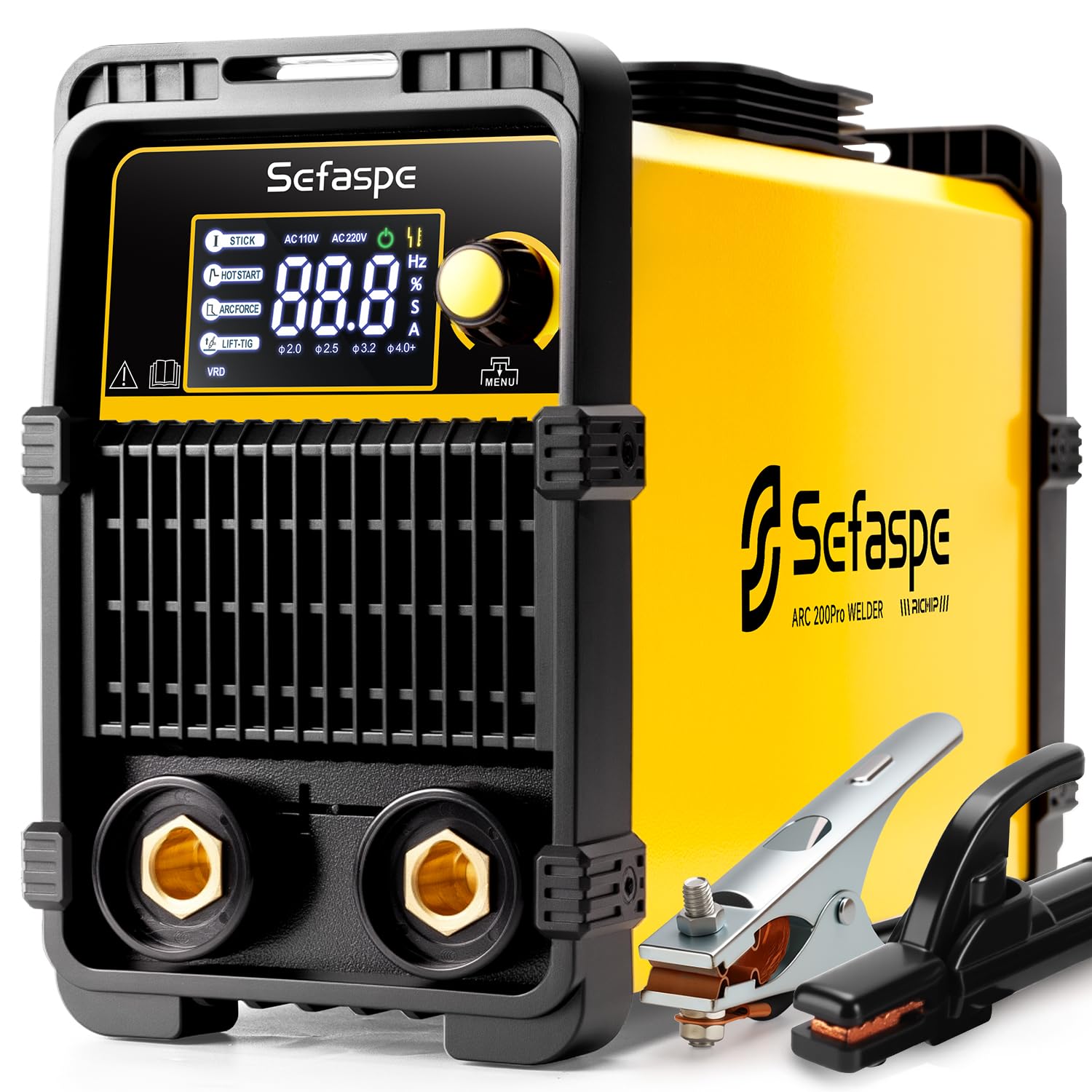
The Sefaspe ARC 200Pro is a dedicated stick welder with a smart synergic system that automatically recommends the correct electrode size based on the selected amperage. The 200A maximum output supports electrodes from 2.5mm to 4.0mm, giving it enough power for multi-pass welding on up to 12mm mild steel. The adjustable Hot Start (0–1 second duration, 1–10% boost) makes arc initiation reliable even with difficult electrodes like 6010.
The Adaptive Arc Force is a standout feature: when the welding voltage drops during short arc conditions, the system increases output current to maintain arc stability and prevent the rod from sticking. This directly improves weld quality for beginners who have not yet developed a steady hand. The Anti-Stick function cuts current to zero instantly if a short circuit occurs, preventing the rod from freezing to the work. The VRD safety protection lowers the no-load voltage in humid environments, adding a layer of safety for outdoor work.
The dual-voltage design (110V/220V) provides flexibility, though users report that running at 120A on a 50-foot extension cord on 110V may trip breakers if the circuit is shared. On a dedicated 220V circuit, the machine runs 3/32-inch 6013 rods effortlessly with a stable, quiet arc. The included accessory kit is basic but functional. For a beginner stick welder who wants advanced arc control features without paying premium prices, this is an excellent choice.
Why it’s great
- Adjustable Hot Start and Adaptive Arc Force improve weld quality
- 200A capacity handles 4.0mm electrodes for thicker material
- VRD safety protection for safe operation in humid conditions
Good to know
- May trip 110V breakers at high amperage with long extension cords
- Struggles with 6010 electrodes—best suited for 6013
- Accessory kit cables could be upgraded for better conductivity
8. YESWELDER FLUX-135PRO
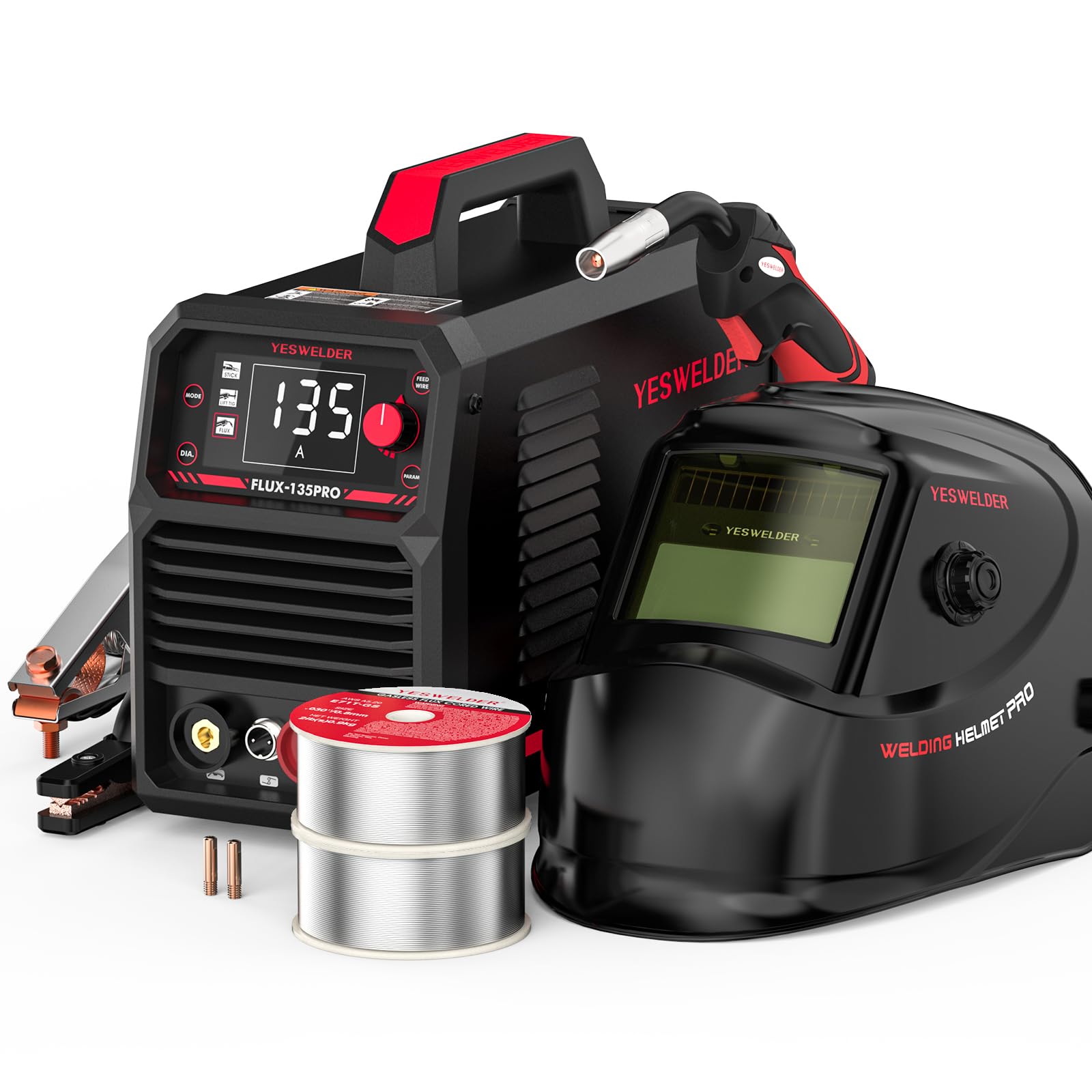
The YESWELDER FLUX-135PRO is a 3-in-1 machine (flux-core MIG, stick, and lift TIG) that has been refined through multiple iterations. At 11.4 pounds, it is lightweight enough to carry one-handed, yet the 135A output handles mild steel up to 2/5-inch thickness. The synergic control is intuitive: adjusting the wire feed speed automatically suggests a voltage value, and you can fine-tune within a ±3V range—perfect for dialing in the arc on different material thicknesses.
The bundled LYG-L600A auto-darkening helmet is a significant upgrade over typical packaged helmets. It features blue light blocking technology that filters harmful high-energy blue wavelengths, reducing eye strain during extended welding sessions. The true color view with 1/1/1/1 optical clarity improves visibility of the weld puddle, and the two premium arc sensors trigger darkening in 1/30,000 second. The helmet is powered by a solar panel with a replaceable CR2450 backup battery.
Users who upgraded from previous YESWELDER generations report that the new digital display provides better real-time feedback, and the machine runs noticeably cooler than older models. The main limitation is the lack of gas MIG capability—this unit is flux-core only. For a portable flux-core kit that includes a genuinely usable helmet and produces clean, consistent welds on thin to medium steel, this is a strong contender.
Why it’s great
- Lightweight 11.4 lb design with powerful 135A output for its size
- Synergic control simplifies voltage/wire speed matching
- Bundled LYG-L600A helmet has true color view and blue light blocking
Good to know
- Flux-core only—no gas MIG capability
- Some units may have cosmetic or assembly defects from shipping
- User manual could be better for initial setup
9. CraftZone Handheld MIG
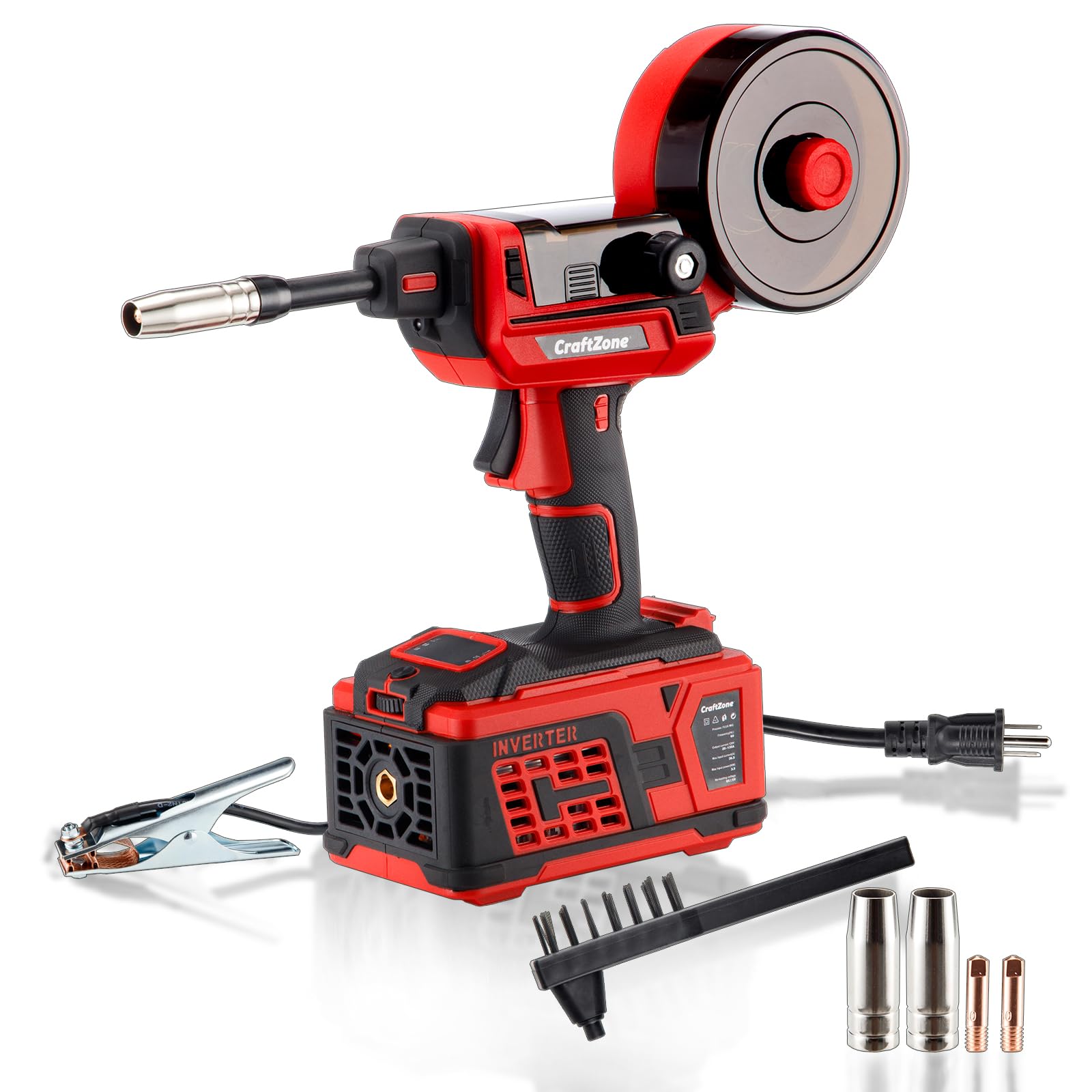
The CraftZone Handheld MIG is a radical departure from traditional welder form factors: it is shaped like a large glue gun, with the wire spool and drive mechanism integrated into the handle. At roughly the weight of a cordless drill, it eliminates the separate wire feeder and long torch cable, letting you work in tight spaces like inside car trunks or behind machinery. The gun handles 0.8mm and 1.0mm flux-cored wire, and the single knob for amperage control keeps operation straightforward.
Despite its toy-like appearance, the CraftZone delivers surprisingly good penetration on thin steel up to about 1/8-inch. Users report that after a short learning curve, the gun produces functional welds that hold well for repair work—trailer fenders, lawn mower decks, and light brackets. The built-in overheat protection and cooling fan allow for several consecutive beads before needing a cooldown, and the automatic voltage compensation helps maintain arc stability despite line voltage fluctuations.
This is not a replacement for a full-size MIG machine. The wire feed mechanism is simpler and less precise than dedicated MIG units, and the lack of gas capability limits weld appearance (more spatter). The ground clamp is also functional but entry-level. For quick emergency repairs, hobbyist projects, and anyone who needs a welding capability that fits in a backpack, this is a uniquely convenient tool.
Why it’s great
- Ultra-compact gun form factor fits into tight spaces
- Lightweight design for easy one-handed use
- Built-in overheat protection and cooling fan for extended use
Good to know
- Flux-core only—gasless; weld appearance has more spatter
- Simpler wire feed mechanism limits fine control
- Not suitable for heavy fabrication or structural welding
FAQ
Can a battery powered welder weld 1/4 inch steel?
How long does the battery last on a cordless welder?
Is a flux core welder the same as a battery powered welder?
What is the difference between a spot welder and an arc welder for batteries?
Final Thoughts: The Verdict
For most users, the best battery powered welder winner is the Forney 271 Easy Weld 140 MP because it combines multi-process versatility (Stick, MIG, DC TIG) with a rugged all-metal chassis and excellent arc control on standard 110V household power. If you need dedicated flux-core portability for mobile repairs, grab the Lincoln Electric 90i FC K5255-1. And for building lithium battery packs, nothing beats the AWithZ P20B for its 14.6 kW pulse power and pure nickel welding capability.