
One splash when no one is watching is all it takes. An above-ground pool alarm isn’t a nice-to-have accessory — it is the single electronic barrier between a wandering toddler or pet and a silent, invisible edge they cannot see. The problem is that most pool alarms on Amazon either false-alarm themselves into obsolescence or fail to detect a 15-pound object the first time, which defeats the entire purpose of buying one.
I’m Min — the co-founder and writer behind Gadgets Feed. I have spent dozens of hours cross-referencing UL 2017 compliance records, decibel ratings, real user installation photos, and battery-life failure reports to isolate the seven above-ground pool alarms that deserve serious consideration for your yard.
The market is split between gate-mounted magnetic reed switches and immersion-based water motion sensors, and the wrong choice can actually create a false sense of security. This guide breaks down the best above ground pool alarm options by real-world detection method, loudness in decibels, and the install headache each one will cause on a typical round or oval steel wall pool.
How To Choose The Best Above Ground Pool Alarm
Above-ground pool alarms fall into two distinct categories: gate/door alarms that sound when a pool fence or door opens, and immersion alarms that sit on the pool wall and detect water displacement caused by a falling object. Each covers a different failure mode, and many state safety codes require both. Understanding the difference before you order will save you a return trip and a false sense of coverage.
Gate Alarms vs. Immersion Alarms
A gate alarm uses a magnetic reed switch — two halves aligned on the gate and the gate frame. When the gate opens, the magnetic connection breaks and the siren fires. This is effective for active entry prevention but does nothing if a child slips through an already open gate or climbs the fence. An immersion alarm uses a submerged pressure or motion sensor tube that detects wave pulses from a falling body. Immersion alarms can detect a child or pet entering the water even when all gates are closed, but they suffer from false triggers from wind, rain, or pool cleaners if the sensitivity isn’t tuned correctly.
Decibel Output and Audibility Range
Pool alarms range from 85 dB to 140 dB. An 85 dB alarm is roughly as loud as a kitchen blender — audible from about 50 feet outdoors but easily masked by a lawn mower, pool pump, or air conditioner. A 140 dB alarm, by contrast, is painful to stand next to and can be heard from 100 yards away. If the alarm must alert someone inside the house while the TV and air conditioning are running, aim for 110 dB or higher. The trade-off is that the loudest units consume battery faster and may annoy neighbors during accidental triggers.
Battery Life and Low-Battery Warnings
Nearly all above-ground pool alarms run on alkaline batteries (9V or AA), and battery life is the single most common failure point in real user reviews. Units without a low-battery indicator will simply stop working without warning, leaving the pool unprotected. Look for a dedicated low-battery beep or an always-on red LED that signals imminent failure. The power draw of a 140 dB siren is significant — expect to replace batteries every 4 to 8 months in high-use summer conditions.
UL 2017 Compliance and Legal Requirements
Many US states and municipalities require pool alarms to meet the UL 2017 safety standard for water hazard entrance alarms, especially if the pool is accessible directly from a house door. UL 2017 compliance means the alarm must sound within 7 seconds of the door opening and must be impossible to disable with a simple switch. If you need to pass a home inspection before selling or for insurance compliance, check the product listing for explicit UL 2017 listing. Non-compliant alarms will not pass inspection regardless of how loud they are.
Quick Comparison
On smaller screens, swipe sideways to see the full table.
| Model | Category | Best For | Key Spec | Amazon |
|---|---|---|---|---|
| IC ICLOVER Pool Alarm | Immersion | Remote receiver with flashing LED | 85 dB, 13-lb detection | Amazon |
| RoamRider Pool Alarm | Immersion | Tool-free 3M tape install | 85 dB, 13-lb detection | Amazon |
| PoolGuard GAPT-2 | Gate | Outdoor gate alarm | 85 dB at 10 ft, UL compliant | Amazon |
| Techko S187D | Gate/Door | UL 2017 pass-through inspection | 110-115 dB, 6-tone siren | Amazon |
| PoolGuard DAPT-2 | Door | Indoor-to-pool door entry | 85 dB, 7-sec delay, UL listed | Amazon |
| PoolEye Immersion Alarm | Immersion | Above-ground steel wall pools | 85 dB, 15-lb detection | Amazon |
| HENDUN Pool Gate Alarm | Gate | Maximum outdoor loudness | 140 dB, IP67 waterproof | Amazon |
In‑Depth Reviews
1. IC ICLOVER Pool Alarm with Remote Receiver

The IC ICLOVER Pool Alarm addresses the fundamental flaw of standalone sirens: if no one is near the pool when the alarm sounds, the siren is useless. This system uses a water-level motion sensor mounted at the pool edge that wirelessly communicates with a separate remote receiver — a plug-in alarm that can sit in the kitchen, living room, or master bedroom. The receiver emits both a loud 85 dB siren and a flashing red LED, making it nearly impossible to miss even with a running dishwasher or television.
The motion sensor detects objects weighing 13 pounds or more, which covers the weight range of most toddlers and small pets. Four selectable modes — Surveillance, Swimming, Mute, and Off — let you silence the system during active swim time without needing to remove batteries or dismount the sensor. Installation offers two routes: permanent screw holes for concrete or steel walls, or heavy-duty double-sided tape for smooth pool edges. The submerged tube needs to sit roughly 4 inches below the water surface, so you will need to test the placement carefully during setup.
Real-world users report the system works as described out of the box, with one reviewer noting it saved a cat that wandered into the pool area. The battery-powered sensor and receiver run on alkaline cells, and you will need to keep spares handy. This is not a life-saving device and should never replace adult supervision, but as an electronic early-warning layer for an above-ground pool, it is the most complete system in this roundup.
Why it’s great
- Wireless remote receiver reaches inside the house
- 13-pound detection threshold catches toddlers and pets
- Four operating modes eliminate false alarms during swim time
Good to know
- Installation requires precise 4-inch submersion depth
- Batteries not included for sensor or receiver
2. RoamRider Pool Alarm with Remote Receiver

The RoamRider Pool Alarm shares the same fundamental architecture as the IC ICLOVER — an edge-mounted immersion sensor paired with a remote receiver — but distinguishes itself with a simplified installation process that requires zero tools for smooth surfaces. The 3M adhesive tape mounting option means you can install this on a vinyl or resin above-ground pool wall without drilling holes. For pool owners who rent their home or simply want to avoid permanent modifications, this is a major practical advantage.
The detection system triggers the 85 dB receiver siren and LED flasher when a 13-pound object enters the water. The color-coded status system — yellow for standby, green for armed, flashing red for alarm — provides clear visual feedback at a glance. The instruction manual mentions an adjustable sensitivity recalibration process, though some users have reported difficulty finding this setting in the documentation, so be prepared to experiment with sensitivity after initial installation.
A few early buyers reported continuous false alarms immediately after installation, which suggests the sensitivity calibration step is mandatory and not optional. If you follow the test procedure immediately after mounting, the system generally performs as expected. For renters, DIY-first users, and anyone who dreads pulling out a drill, this is the most practical immersion alarm on the current market.
Why it’s great
- 3M adhesive tape mount requires no drilling
- Color-coded LED status system is intuitive
- Remote receiver with flashing light for indoor alert
Good to know
- Sensitivity calibration can be tricky to find in the manual
- Continuous false alarms reported if calibration is skipped
3. PoolGuard GAPT-2 Outdoor Pool Gate Alarm

The PoolGuard GAPT-2 is the outdoor-specific version of the company’s well-known DAPT-2 door alarm, designed to mount directly onto pool gates rather than house doors. It uses a magnetic reed switch system where a wire connects the gate-side sensor to the wall-side alarm unit. When the gate opens, the magnetic field breaks, and the 85 dB horn sounds after a 7-second delay — just enough time for an adult to press the built-in bypass button before the siren fires.
Built for weather exposure, the GAPT-2 is battery-powered with a 9V cell and comes with a 1-year warranty from a US-based manufacturer. The 7-second delay is deliberate: it prevents the alarm from firing every time a responsible adult enters the pool area but still catches slow-moving toddlers who cannot reach the bypass button. The 6-foot wire is long enough to span most gate gaps but may need careful cable management to avoid a trip hazard.
Some users have reported inconsistent bypass performance, with the alarm sounding even after pressing the button. Others found the wire length excessive for small gates. But for a dedicated outdoor gate alarm that passes most building code inspections, the GAPT-2 remains a reference standard in this category. It is not the loudest option, but it is the most field-tested.
Why it’s great
- Built specifically for outdoor pool gate exposure
- 7-second delay prevents nuisance triggers from adults
- Made in the USA with 1-year warranty
Good to know
- Bypass button reliability is inconsistent on some units
- 6-foot wire requires management on small gates
4. Techko S187D Safe Pool Alarm
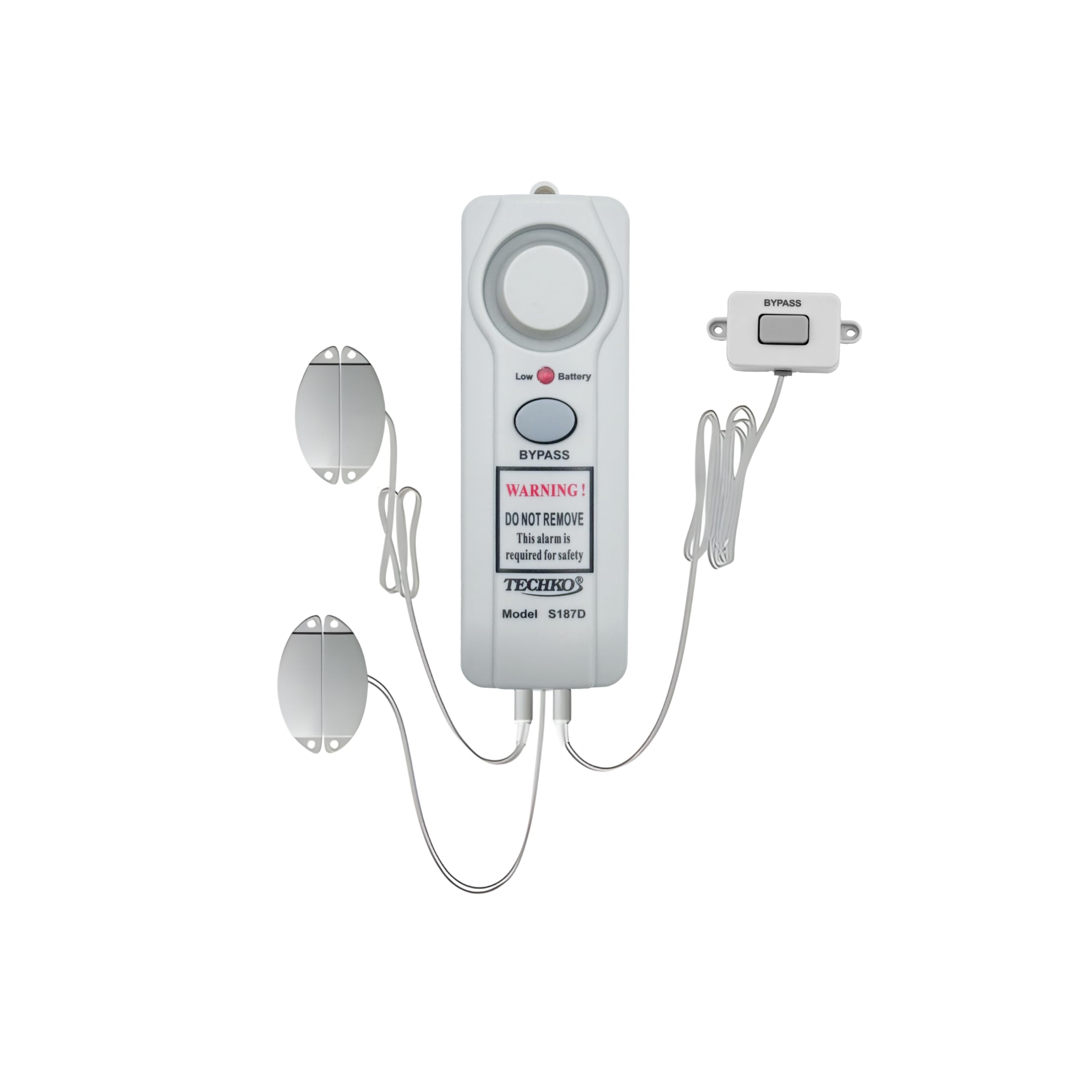
The Techko S187D is a door-mounted pool alarm that explicitly lists UL 2017 compliance on the box, making it the most straightforward option for homeowners who need to pass a pool safety inspection. It mounts to the door frame that leads directly to the pool area and sounds a 110-115 dB six-tone alarm when that door opens. The alarm is significantly louder than most gate-based competitors — closer to a fire alarm in intensity — which matters when the pool door is at the back of the house.
The S187D uses a 9V battery (not included) and features two bypass buttons that silence the alarm for 10 seconds, allowing adults to pass through without triggering the siren. A blinking blue LED indicates the bypass period is active. A patented screen door sensor is included as a secondary accessory; this mounts on the sliding screen door track and allows you to keep the glass door open without tripping the alarm when the screen is drawn. This is a niche but genuinely useful feature for homes where the screen door is the primary summer barrier.
The most significant concern reported by long-term users is rapid battery drain. Several reviews note that the 9V battery dies within 4 days, and there is no low-battery beep on this model — only a permanently illuminated red LED that is easy to miss. If you buy this unit, budget for frequent battery changes or check the LED weekly. For inspection-only use or as a secondary alarm, the S187D is hard to beat on price and compliance.
Why it’s great
- UL 2017 listed — passes most pool safety inspections
- 110-115 dB six-tone siren is among the loudest in class
- Screen door sensor allows glass door open with screen closed
Good to know
- Battery drain can be severe — some units last only 4 days
- No low-battery beep, only a red LED indicator
5. PoolGuard DAPT-2 Water Hazard Pool Door Alarm

The PoolGuard DAPT-2 is the indoor door version of the GAPT-2 gate alarm, designed to mount on the house door that leads directly to the pool area. It is UL 2017 listed and made in the USA, and it features a key adult pass-through mechanism: the alarm sounds a 7-second delay after the door opens, but if an adult presses the bypass button during that window, the alarm resets without sounding. If a child opens the door and walks through without pressing the button, the alarm fires at 85 dB and will not stop until the door is closed or the bypass is used.
The two-position switch lets you choose between instant alarm (no delay) or the 7-second delay mode. The 85 dB horn at 10 feet is comparable to the GAPT-2 and is loud enough to alert the entire house but not so deafening that it disturbs neighbors during accidental triggers. Users who installed this for rental properties reported that guests adapted to the system quickly, which is a mark of good design for a device that needs to be understood by strangers.
The biggest installation complaint involves the short sensor wire. The wired sensor needs to align perfectly with the magnetic half on the door, and the short cable can force you to mount the alarm unit at an awkward height. Some users fabricated custom risers to get the alignment right. If your door frame is irregular or if the gap between the door and the frame is wider than 3/8 inch, the DAPT-2 may require more effort than expected to install correctly.
Why it’s great
- UL 2017 listed, passes code inspections
- Adult pass-through with bypass button works reliably
- Instant or 7-second delay modes
Good to know
- Short sensor wire makes alignment difficult on some doors
- 85 dB may not be loud enough if the door is far from living areas
6. PoolEye Aboveground Pool Alarm

PoolEye is an immersion alarm designed specifically for above-ground pools with steel walls up to 1.2 inches thick. The sensor mounts under the top ledge of the pool wall and uses sub-surface wave detection to ignore surface disturbances from wind and rain — a design choice intended to reduce false alarms. The siren is built directly into the poolside unit at 85 dB, so there is no remote receiver; the alarm sounds only at the pool edge.
The adjustable sensitivity switch allows you to calibrate the detection threshold, and the manufacturer claims it can detect an object as light as 15 pounds. The bracket is adjustable, but the maximum pool wall thickness of 1.2 inches means this will not fit on some thicker vinyl or resin pool walls without modification. A few users found the drill template instructions confusing — the manual calls for 3/8-inch pilot holes when 3/32-inch holes are correct — so take that into account before drilling.
The biggest risk with the PoolEye is poor quality control: multiple reviews describe units that arrived dead out of the box or that filled with rainwater and failed after a single season. The 6-month warranty is shorter than most competitors, which reflects the lower build cost. If you need a bare-bones immersion alarm for inspection compliance and can return a defective unit quickly, this works. For long-term reliability, the IC ICLOVER or RoamRider systems are better investments.
Why it’s great
- Sub-surface wave detection reduces wind and rain false alarms
- Adjustable sensitivity switch for tuning
- Designed specifically for steel wall above-ground pools
Good to know
- Quality control is inconsistent — some units arrive dead
- No remote receiver, alarm sounds only at the pool
7. HENDUN Pool Gate Alarm (2-Pack)

The HENDUN Pool Gate Alarm delivers 140 dB of sound — the highest output in this entire guide — making it the only option that can project across an acre lot, through a closed house, and into the farthest bedroom. The IP67 waterproof rating ensures the sensor withstands direct rain, sprinkler overspray, and the humid microclimate around an above-ground pool without corrosion. The unit is a standard two-piece magnetic gate alarm: one sensor mounts on the gate, the other on the frame, and the alarm fires when the magnetic connection is broken.
Two features stand out here. First, the 140 dB output is not adjustable and is described by users as genuinely uncomfortable indoors — this is a siren designed for outdoor use where you need to be heard over lawn equipment. Second, the remote control and numeric keypad are used for function settings (mode, volume of the remote beep, pairing) rather than for a password bypass, which some buyers initially misunderstand. The low-battery feature beeps six times continuously when power runs low, giving you a clear audible signal rather than a missed LED.
The two-pack format means you can cover both the gate and a back door for roughly the same price as a single premium unit. Battery life is a concern: reviewers who used alkaline cells reported the product dying within 8 months, sometimes without the low-battery beep triggering. The PVC housing and rubberized seal are well-built for outdoor use, but the unit lacks UL rating, so it will not pass a formal pool safety inspection that requires UL 2017 compliance. This is a practical perimeter alarm, not an inspection tool.
Why it’s great
- 140 dB is by far the loudest alarm in this category
- IP67 waterproof for direct outdoor exposure
- Two-pack covers gate and door for one price
Good to know
- Not UL 2017 compliant — will not pass code inspection
- Battery drain can be inconsistent across units
FAQ
Does an above-ground pool alarm count as a legal pool safety barrier?
Will an immersion pool alarm false-alarm from rain or wind?
What does UL 2017 compliance mean for a pool alarm?
Can I use a gate alarm on a chain-link pool fence?
Final Thoughts: The Verdict
For most users, the best above ground pool alarm winner is the IC ICLOVER Pool Alarm because it bridges the gap between gate and immersion detection with a remote receiver that actually reaches the kitchen table. If you want tool-free installation and a simple adhesive mount, grab the RoamRider Pool Alarm. And for pure gate-loudness coverage across an acre lot, nothing beats the HENDUN Pool Gate Alarm two-pack at 140 dB.