
When your build pushes past a single flagship GPU into multi-card territory or extreme overclocking, a 1500-watt power supply isn’t a luxury — it’s the foundation for system stability. The difference between a PSU that delivers clean, transient-resistant power and one that introduces ripple or voltage droop can mean the difference between stable peak performance and random shutdowns mid-render.
I’m Min — the co-founder and writer behind Gadgets Feed. I’ve spent hundreds of hours analyzing the electrical performance data, protection circuit quality, and platform maturity of the highest-wattage consumer power supplies to build this guide on selecting the right one for your needs.
This guide breaks down the electrical architecture, connector standards, and real-world noise characteristics that define the best 1500 watt power supply for enthusiast-grade gaming workstations and professional compute rigs.
How To Choose The Best 1500 Watt Power Supply
Selecting a PSU at this wattage level requires more than just checking the total wattage number. You must evaluate the unit’s transient load handling, its efficiency certification, and the quality of its output regulation. A poorly designed 1500W unit can introduce electrical noise that destabilizes overclocks and shortens the life of sensitive components.
ATX 3.1 Compliance and Transient Load Support
The ATX 3.1 standard defines a PSU’s ability to handle instantaneous power excursions up to 200% of its rated wattage for brief periods. This is critical for modern GPUs like the RTX 5090, which can draw sudden power spikes well above their average TDP. A compliant unit with native 12V-2×6 connectors provides a more secure and reliable connection than adapter-based solutions.
Efficiency Certification: Platinum vs. Titanium
At 1500W output, efficiency losses produce significant waste heat. An 80 Plus Platinum unit (92% efficient at 50% load) will dissipate roughly 130W as heat under full load, whereas a Titanium unit (94% efficient) cuts that to 95W. This directly impacts the PSU’s internal temperature, fan speed, and overall system noise. The Cybenetics ETA and Lambda certifications offer a more granular view of real-world efficiency and noise performance than the 80 Plus labels alone.
Ripple Suppression and Voltage Regulation
High-wattage PSUs power multiple voltage rails simultaneously. Look for a unit with tight ±3% voltage regulation on the +12V rail and low ripple noise — ideally below 20mV peak-to-peak. Designs that use a DC-to-DC converter for the +3.3V and +5V rails (derived from the main +12V rail) generally produce cleaner output than group-regulated designs. Japanese 105°C-rated capacitors are the gold standard for maintaining stable output under sustained high-temperature operation.
Quick Comparison
On smaller screens, swipe sideways to see the full table.
| Model | Category | Best For | Key Spec | Amazon |
|---|---|---|---|---|
| Corsair HX1500i (2025) | Mid-Range | Software-controlled iCUE integration | 140mm FDB fan, Cybenetics Platinum | Amazon |
| ASRock PG 1600G | Mid-Range | Value with dual 12V-2×6 connectors | 1600W, 133.3A on +12V rail | Amazon |
| ASUS ROG Strix 1200W Platinum | Mid-Range | GPU-First voltage stabilization | GaN MOSFET, dual ball bearings | Amazon |
| NZXT C1500 Platinum | Premium | Digital power control & low noise | 140mm MagLev fan, Cybenetics Titanium | Amazon |
| Silverstone ST1500 | Entry-Level | Budget-friendly multi-GPU builds | 110A on eight +12V rails | Amazon |
| EVGA Supernova 1600 P+ | Premium | Reliability with 10-year warranty | 1600W Platinum, Japanese caps | Amazon |
| Seasonic Prime TX-1600 Noctua Edition | Premium | Ultra-quiet semi-passive operation | Noctua NF-A12x25 fan, Lambda A++ | Amazon |
| MSI MEG Ai1600T PCIE5 | Premium | Tri-certified Titanium efficiency | Dual 12V-2×6, 12-year warranty | Amazon |
| ASUS ROG Thor 1600W Titanium | Premium | Real-time power draw OLED monitor | GaN FET, 80+ Titanium, 135mm PWM fan | Amazon |
In‑Depth Reviews
1. Corsair HX1500i (2025)

The Corsair HX1500i (2025) strikes an excellent balance between modern ATX 3.1 compliance and software configurability. Its 140mm Fluid Dynamic Bearing fan remains effectively silent under medium loads thanks to the Zero RPM mode, and the fan curve can be further tuned through iCUE. The unit delivers stable output with minimal ripple, even near the 1500W ceiling, making it a reliable choice for high-end single-GPU systems like an RTX 5090 paired with a flagship CPU.
iCUE adds real utility here — you can toggle between single-rail and multi-rail overcurrent protection modes on the fly without opening the case. The fully modular cable set includes a native 12V-2×6 connector that seats securely and braided cables that route cleanly even in tight chassis. Build quality feels dense and well-damped, with no audible coil whine under typical gaming loads.
Compact dimensions for its class help with case compatibility, though the included cable bundle is generous enough that tight mid-tower builds may need to plan cable routing carefully. The bright dome-shaped activity light on the unit itself is the only notable aesthetic distraction in an otherwise polished package.
Why it’s great
- iCUE software integration for real-time power monitoring and rail switching
- Native 12V-2×6 connector with secure braided cable
- Near-silent Zero RPM fan mode with excellent thermal performance
Good to know
- Bright dome activity light may be distracting in dark builds
- Fewer SATA cables than previous-generation Corsair flagships
2. ASRock PG 1600G

The ASRock PG 1600G punches well above its price tier by offering two native 12V-2×6 connectors with integrated TempGuard thermal monitoring on a 1600W platform. The +12V rail delivers 133.3A of continuous current, which provides ample headroom for dual modern GPU setups or a single flagship card with extreme overclocking. The 135mm FDB fan with iCool intelligent fan control keeps the fan off entirely during low to medium load for silent operation.
Build quality is anchored by 100% Japanese capacitors and a 5V BOOST function that compensates for transient voltage droops on the +5V rail — a feature typically reserved for more expensive workstation PSUs. The fully modular design includes sleeved cables for the 24-pin and 12+4 pin connectors, and the connector count covers 8x PCIe 6+2-pin and 12x SATA, which is generous for multi-GPU builds or storage-heavy systems.
At 180mm depth, it is a larger unit that may not fit compact cases. A minority of units have reported faulty PCIe 5 cables, so checking cable integrity immediately upon arrival is advisable. Still, for the combination of dual 12V-2×6 support and 1600W capacity at this price point, it is a compelling option.
Why it’s great
- Two native 12V-2×6 connectors with TempGuard thermal monitoring
- 5V BOOST feature compensates for transient voltage droops
- Dense connector count suitable for multi-GPU or storage-heavy builds
Good to know
- 180mm depth may not fit compact or mid-tower cases without checking clearance
- Occasional reports of faulty PCIe 5 cable require early verification
3. ASUS ROG Strix 1200W Platinum
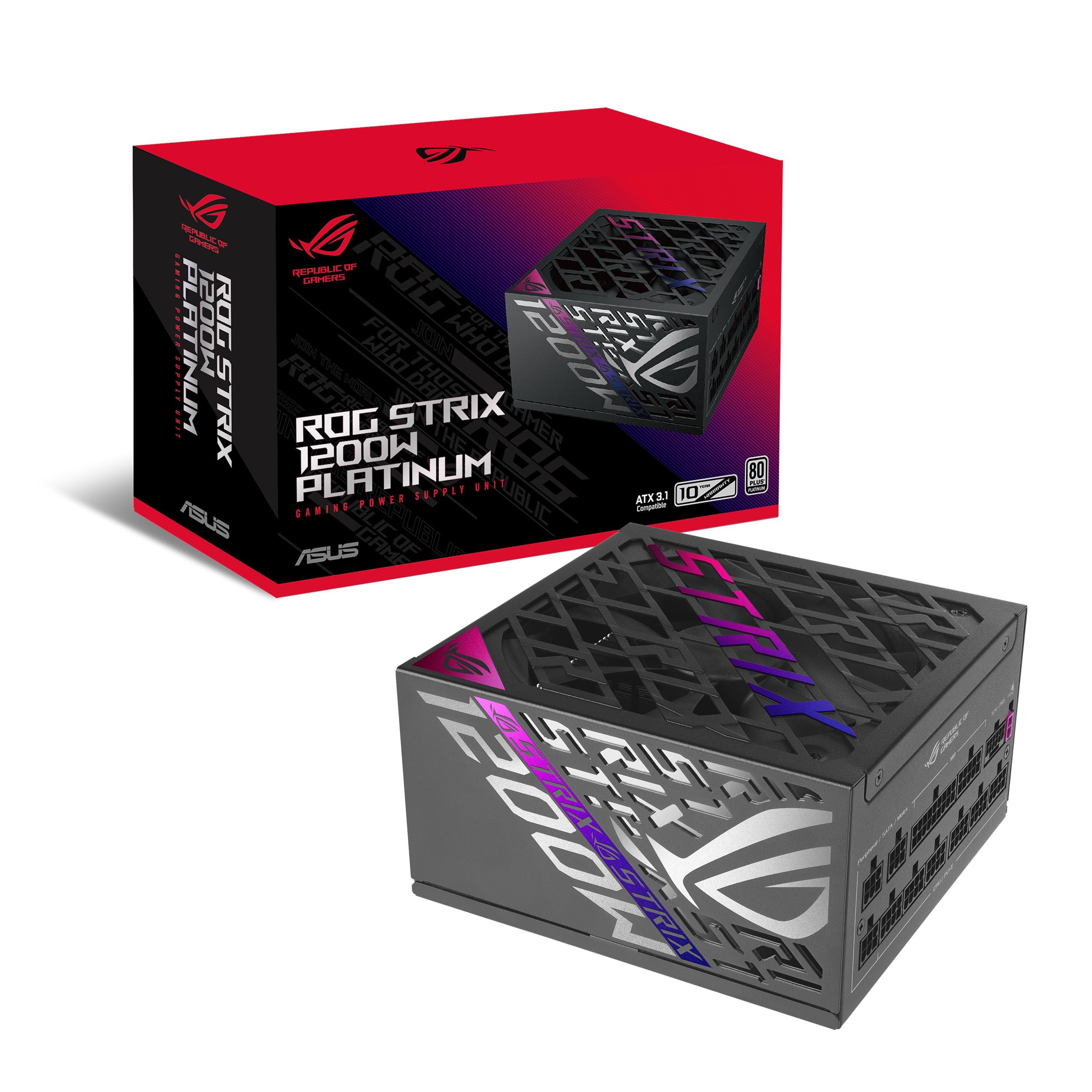
While rated at 1200W, the ASUS ROG Strix Platinum belongs in this conversation because it uses gallium nitride MOSFETs to reduce switching losses and a patented GPU-First intelligent voltage stabilizer that improves voltage delivery to the graphics card by up to 45%. This translates to tighter voltage regulation at the PCIe slot, which directly benefits transient-heavy loads from cards like the RTX 5090. The large ROG heatsinks keep critical components cooler than typical reference designs, reducing fan noise.
The dual ball bearing fan setup lasts significantly longer than sleeve bearing designs, and the 0dB Technology keeps the fan off entirely during light gaming sessions. In multi-GPU or AI workload scenarios, the unit maintains stable output with no coil whine reported from verified buyers. The fully modular cable set includes a secure 12V-2×6 connector specifically designed for the 5090 series.
A single verified failure report involving a loud pop on power-on is concerning, though such events appear isolated. The 10-year warranty and ASUS support provide some coverage, but the unit’s premium price makes it a choice for buyers prioritizing voltage stability above raw wattage capacity.
Why it’s great
- GaN MOSFET technology for up to 30% better efficiency and cooler operation
- GPU-First voltage stabilizer reduces voltage droop to the graphics card
- Dual ball bearing fans with extended lifespan and 0dB silent mode
Good to know
- Rated at 1200W, not 1500W — best for single flagship GPU builds
- Isolated failure reports highlight need for early stress testing
4. NZXT C1500 Platinum

The NZXT C1500 Platform takes a fully digital approach to voltage regulation, with digital control loops that reduce ripple noise and improve transient response compared to analog designs. It exceeds 80 Plus Platinum standards and achieves a Cybenetics Titanium efficiency rating, meaning it sustains up to 94% efficiency at typical loads. The 140mm magnetic levitation fan uses an air-suspended rotor to minimize mechanical noise, and the zero RPM toggle allows silent operation under light loads without requiring software.
Dual 16-pin 12V-2×6 PCIe 5.1 cables are included, each rated for delivering over 600W. This makes the C1500 a strong candidate for dual high-power GPU configurations like RTX 4090 SLI or an RTX 5090 with headroom for overclocking. The braided cable set covers the essentials, though the cables themselves are not individually sleeved, which may be a minor aesthetic point for windowed builds.
At 1500W, the unit runs cool enough that the fan rarely spins audibly in real-world use. A minority of reports mention a faulty SATA/peripheral output that may damage connected components, so testing all peripheral rails upon installation is wise. Overall, it offers clean digital power delivery for those who prioritize precision over absolute wattage.
Why it’s great
- Fully digital voltage regulation for low ripple and precise output
- Cybenetics Titanium efficiency rating for reduced waste heat
- Dual 12V-2×6 connectors each rated over 600W
Good to know
- Non-sleeved cables may not match premium aesthetic in windowed builds
- Isolated SATA/peripheral output failures warrant early testing
5. Silverstone ST1500

The Silverstone ST1500 is a long-running workhorse design built on eight independent +12V rails with a combined 110A (120A peak) output. Its 80 Plus Silver certification (85-88% efficiency) lags behind modern Platinum units, but the unit makes up for it with a proven track record of supporting multi-GPU compute rigs. The 135mm fan operates as low as 19dBA at idle, making it surprisingly quiet for a 1500W unit from this era.
The modular cable set includes four PCI-E 8-pin and eight PCI-E 6-pin connectors, plus twelve SATA connectors, which is sufficient for four-GPU configurations. The Japanese main capacitors provide a baseline of reliability, and the strict ±3% voltage regulation helps maintain clean output under mixed loads. The unit lacks an ATX 3.1 certification and native 12V-2×6 connector, so modern GPU builds will need adapter cables.
Some users report that the unit struggles to maintain stability with four high-power GPUs simultaneously, with isolated cases of melted ATX wires under extreme sustained load. The 80+ Silver efficiency means it runs hotter than modern competitors, requiring good case airflow. It remains a viable entry-level option for cost-conscious multi-GPU builders who accept the efficiency trade-off.
Why it’s great
- Eight independent +12V rails for balanced multi-GPU power delivery
- Very quiet 135mm fan with 19dBA minimum noise
- Generous PCIe and SATA connector count for compute rigs
Good to know
- 80+ Silver efficiency generates more waste heat than modern alternatives
- Lacks native ATX 3.1 support and 12V-2×6 connectors
6. EVGA Supernova 1600 P+

The EVGA Supernova 1600 P+ is a 1600W, 80+ Platinum certified unit built around 100% Japanese capacitors and a DC-DC converter design that stabilizes the +3.3V and +5V rails. The double ball bearing fan and EVGA ECO Mode allow the fan to stop completely under light load, though some users report the ECO mode transitions can be audible as the fan ramps from 0% to 70% intermittently. Without ECO mode, the fan is consistently audible but still quieter than many competing 1600W units.
Fully modular cabling keeps the build clean, and the included power-on self tester is a small but genuinely useful diagnostic tool for troubleshooting. The 10-year limited warranty is backed by EVGA’s customer support, which historically has been a differentiator in this price bracket. The unit delivers reliable power for high-wattage single-GPU systems and can handle dual-GPU setups with an RTX 3090 Ti class of card.
The main drawback is that the thick braided cables included are non-standard, limiting the ability to use third-party custom cable sets. At 1600W, the unit has substantial overhead for future upgrades. The fan noise profile, even with ECO mode enabled, is not silent — buyers seeking near-inaudible operation should look at Seasonic or Corsair alternatives.
Why it’s great
- 100% Japanese capacitors with DC-DC converter for stable secondary rails
- 10-year warranty with established EVGA customer support
- Power-on self tester included for quick diagnostics
Good to know
- Thick braided non-standard cables limit custom cable compatibility
- ECO mode fan transitions can be audible in silent builds
7. Seasonic Prime TX-1600 Noctua Edition

The Seasonic Prime TX-1600 Noctua Edition is the quietest 1600W power supply available, thanks to the bespoke integration of a Noctua NF-A12x25 fan and a custom-optimized fan grill that reduces turbulence noise. It achieves Cybenetics Lambda A++ certification, meaning it is roughly 8-10 dB(A) quieter than the standard Prime TX-1600. The semi-passive mode keeps the fan off entirely until 50% load at 25°C, so most desktop workloads never trigger fan spin.
Electrical performance is equally flagship-grade: 80 PLUS Titanium and Cybenetics ETA Titanium certified, delivering 94% efficiency at 50% load. The fully modular cable set includes individually sleeved brown-and-black cables with combs, matching the Noctua aesthetic. ATX 3.1 and PCIe 5.1 compliance with a 12V-2×6 connector ensures compatibility with the RTX 4090 and 5090 series. The 12-year warranty underscores the intended long-term investment.
At 21cm depth, this is one of the longest consumer PSUs on the market and will not fit in many mid-tower cases without careful measurement. The C19 power connector is an uncommon standard, so carrying a spare cable is essential for travel or replacements. The premium price places it firmly in enthusiast territory, but for those who prioritize silence above all else, it is unmatched.
Why it’s great
- Noctua NF-A12x25 fan delivers the quietest operation in its class
- Cybenetics ETA Titanium and Lambda A++ dual certification
- 12-year warranty with premium individually sleeved cables
Good to know
- 21cm depth requires a spacious case and careful clearance verification
- Uses C19 power connector which is less common than C13
- Premium price targets silence-obsessed enthusiasts only
8. MSI MEG Ai1600T PCIE5

The MSI MEG Ai1600T PCIE5 is one of the few consumer PSUs to achieve tri-certified Titanium efficiency from 80 PLUS, Cybenetics, and PPLP, meaning its electrical performance has been validated across all three independent testing bodies. The unit uses 100% Japanese 105°C-rated capacitors and includes dual-native 12V-2×6 connectors, making it one of the best-equipped PSUs for dual 5090 or dual 4090 builds. Industrial-level protections cover OCP, OTP, OPP, SCP, OVP, UVP, SIP, and NLO.
The fully modular cable set uses separated (non-bundled) wires that allow flexible routing in tight spaces, and the yellow-insert 12V-2×6 connectors provide clear visual confirmation of full insertion — a critical safety feature for high-current GPU connections. The 12-year warranty is the longest in this comparison, reflecting MSI’s confidence in the platform’s longevity. The zero fan mode keeps operation silent during typical desktop use.
At this price level, the included accessories and unboxing experience feel premium, though some users note the cable clips could be more robust. The unit is compact for a 1600W design, which improves case compatibility compared to the Seasonic Noctua or ASUS Thor units. For buyers who want the most certified efficiency and dual 12V-2×6 support with the longest warranty, the Ai1600T is a top-tier choice.
Why it’s great
- Tri-certified Titanium efficiency across all three major testing bodies
- Dual 12V-2×6 connectors with visual insertion confirmation
- 12-year warranty, the longest in this class
Good to know
- Premium price point targets high-end builders exclusively
- Cable clip design could be more secure for some builds
9. ASUS ROG Thor 1600W Titanium

The ASUS ROG Thor 1600W Titanium is built around gallium nitride MOSFETs that reduce switching losses beyond what traditional silicon transistors can achieve, combined with 80 Plus Titanium certification for 94%+ efficiency. The standout hardware feature is the integrated OLED display that shows real-time power draw in watts, allowing users to see exactly how much load their system is placing on the PSU during demanding tasks. The 135mm Axial-tech PWM fan with 0dB mode stays silent under light loads.
ROG heatsinks cover critical components, reducing both operating temperatures and fan noise compared to reference designs. The fully modular cable set is high-quality and covers all necessary connectors for a flagship build. The unit includes PCIe 5.0 cable support, and the 0dB fan mode combined with the PWM-controlled 135mm fan keeps noise low even under moderate gaming loads.
Reliability concerns emerge from verified reports of units failing with loud pops after about a month of use, and OLED readouts showing erroneous spikes over 1900W causing system shutdowns. ASUS RMA support has been described as difficult, with reports of receiving incorrect replacement units. The extremely high price makes these reliability issues harder to accept, and the unit’s large size can complicate installation in standard chassis. For buyers who value the OLED feature and GaN efficiency above all else, it offers a unique feature set, but risk-averse builders may prefer the MSI or Corsair options.
Why it’s great
- Built-in OLED display for real-time power draw monitoring
- GaN MOSFETs for superior switching efficiency and lower heat
- ROG heatsinks and 0dB fan mode for quiet operation
Good to know
- Multiple verified failure reports raise reliability concerns
- ASUS RMA process has been reported as problematic by some users
- Very high price makes the unit a risky investment for some builders
FAQ
Do I really need 1500W for my gaming PC?
What does ATX 3.1 compliance actually mean for a 1500W PSU?
Is a Cybenetics rating more important than 80 Plus?
Can I use a 1500W PSU in a standard ATX case?
Final Thoughts: The Verdict
For most users building a flagship single-GPU system, the 1500 watt power supply winner is the Corsair HX1500i (2025) because it combines ATX 3.1 compliance, iCUE software control, and quiet operation at a price that undercuts premium options without sacrificing electrical performance. If you need dual 12V-2×6 connectors and the longest warranty, grab the MSI MEG Ai1600T PCIE5. And for the absolute quietest operation possible in a 1600W package, nothing beats the Seasonic Prime TX-1600 Noctua Edition, provided your case has the depth for it.