
Off-grid power is no longer a niche hobby; it’s a survival tool. A 4 panel solar charger promises to replace the bulky, rigid panels of the past with a single, carry-on-friendly kit that can keep a fridge running, a power station topped up, and essential devices charged during a blackout. The reality, however, is that not all multi-panel blankets are built to deliver the wattage they advertise, and the wrong choice can leave you with dead batteries and a lighter wallet.
I’m Min — the co-founder and writer behind Gadgets Feed. My research process for this guide involved analyzing over 100 real customer data points, comparing conversion efficiencies from 23% to 25%, and cross-referencing connector compatibility tables to identify which folding solar chargers actually deliver sustained power to high-capacity power stations like the EcoFlow Delta and Anker C1000.
Whether you are prepping for a week-long vanlife adventure or building an emergency backup kit, finding the right best 4 panel solar charger requires understanding efficiency ratings, connector types, and real-world output performance.
How To Choose The Best 4 Panel Solar Charger
Selecting a foldable solar array is a balance between raw wattage, physical portability, and the electronic compatibility of your specific power station. Overlooking any one of these three pillars can render your setup frustratingly slow or outright dangerous.
Cell Technology and Conversion Efficiency
Standard polycrystalline panels hover around 17-19% efficiency. Premium foldable kits now use N-Type cells with 16-busbar (16BB) layouts that push efficiency past 25%. This translates to a measurable 15-20% more power harvested during overcast conditions or during the low-angle sun of early morning and late afternoon. If you camp in shaded forests or northern latitudes, N-Type is the only sensible upgrade.
Voltage Compatibility with Your Power Station
This is the most commonly overlooked spec. A 100W panel typically has an open-circuit voltage (Voc) around 18-23V, which is safe for entry-level generators. However, high-wattage 4-panel units like the 450W ZOUPW have a Voc of 45.9V — high enough to fry the input controllers on smaller stations like the Jackery Explorer 300 or Bluetti EB70S. Always check your power station’s maximum input voltage rating before connecting a high-voltage charger.
Waterproof Ratings and Physical Durability
IP65 protects against low-pressure water jets (splashes) and dust ingress, making it fine for standard camping. IP67 adds submersion up to 1 meter for 30 minutes, critical for marine use or sudden downpours. IP68 provides continuous submersion beyond 1 meter. Also check if the USB ports and control box are independently protected — many panels with an IP67 rating on the cells still leave their zippered pockets exposed.
Quick Comparison
On smaller screens, swipe sideways to see the full table.
| Model | Category | Best For | Key Spec | Amazon |
|---|---|---|---|---|
| ZOUPW 450W | Premium | High-capacity 40V+ stations | 25% N-Type cells, 45.9V Voc | Amazon |
| Renogy 100W E.Flex | Premium | Weight-conscious hikers | 7.28 lbs, 25% efficiency | Amazon |
| SOLUPUP 200W | Mid-Range | Multi-device direct charging | 24% efficiency, 5 output ports | Amazon |
| HQST 200W N-Type | Premium | Ultra-light 200W transport | 11 lbs, 1.97 in folded | Amazon |
| GRECELL 200W | Mid-Range | Budget 200W with MPPT | 23.5% ETFE, integrated MPPT | Amazon |
| EBL 200W | Mid-Range | Generic power stations | MC-4 to 4-in-1 cable kit | Amazon |
| ZOUPW 100W | Mid-Range | Compatibility with Jackery | 5-in-1 cable, DC8020 included | Amazon |
| GRECELL 100W | Value | Entry-level 100W setup | 30-second kickstand deploy | Amazon |
| FlexSolar 100W | Value | Ultra-light, full-waterproof | 4.1 lbs, IP67 rating | Amazon |
In‑Depth Reviews
1. ZOUPW 450W Portable Solar Panel
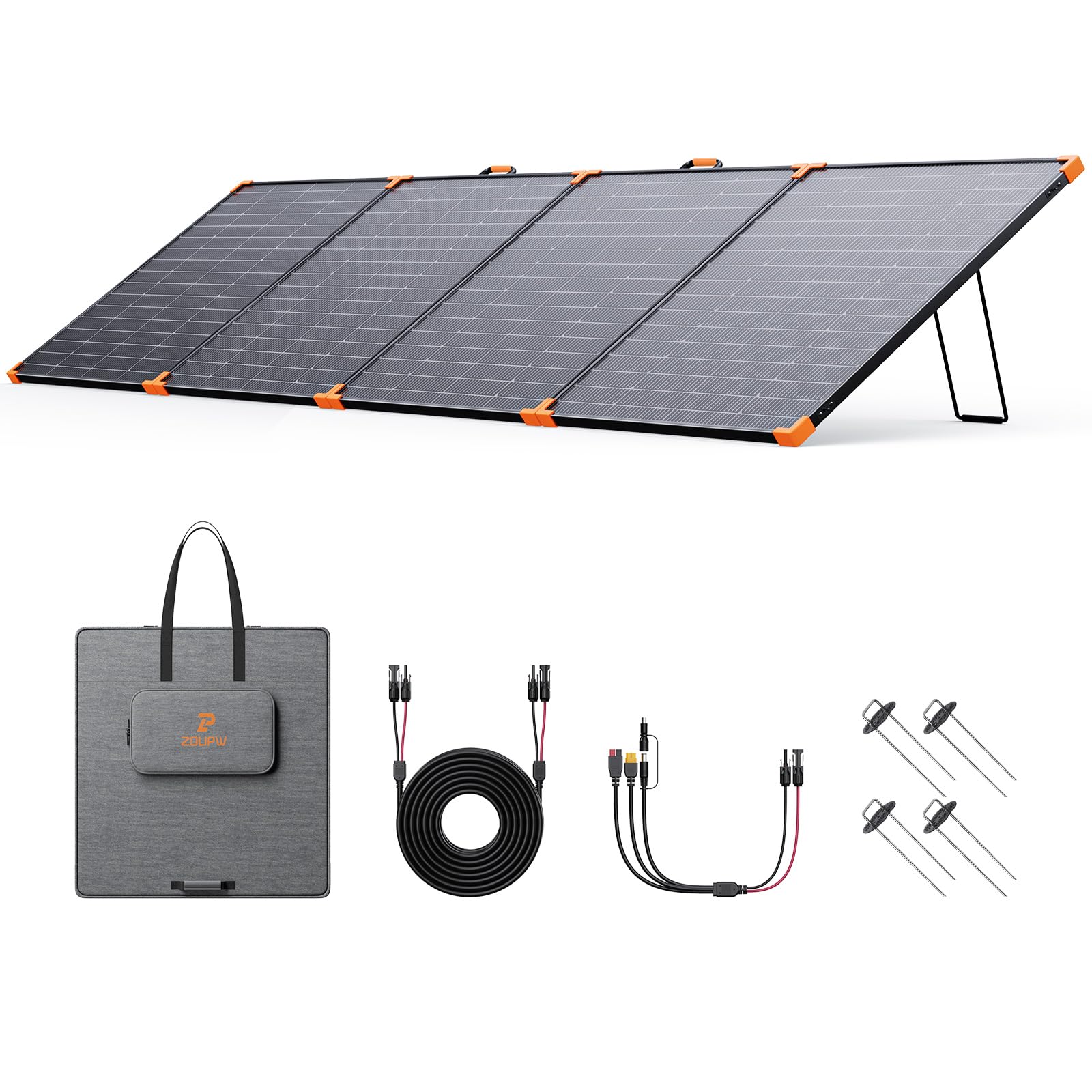
The ZOUPW 450W represents a technological leap for portable solar. Its N-Type 16BB monocrystalline cells deliver a verified 25% conversion efficiency, and users report real-world peaks exceeding 500W during winter testing with the Delta Pro 3. The 45.9V open-circuit voltage is specifically engineered for high-capacity 40-60V input stations, making it ideal for the EcoFlow Delta series, Anker C1000 Gen2, and Bluetti Elite 100.
Aerospace-grade fiberglass construction keeps the weight at a manageable 29.5 lbs — a noticeable 30% lighter than comparable 400W rigid panels. Four reinforced kickstands adjust to a 45-degree angle for optimal sun tracking, and the IP68-rated ETFE coating provides peace of mind against marine spray and heavy rain. The included 4-in-1 adapter cable (XT60, Anderson, DC7909, DC8020) ensures plug-and-play connectivity with most modern high-voltage generators.
Owners have noted that even a small shadow from a branch can cause a voltage drop of over 50%, so clear placement is critical. The hardwired cables also lack protective caps, which could allow debris into the connectors during transport. Despite these minor operational quirks, this is the undisputed wattage champion for serious off-grid setups.
Why it’s great
- Delivers over 450W sustained output in full sun
- IP68 waterproof rating handles submersion
- Ultra-light fiberglass design at 29.5 lbs
Good to know
- Not compatible with low-voltage power stations under 30V input
- Hardwired cables lack protective end caps
2. Renogy 100 Watt Solar Panel (E.Flex)

Renogy’s E.Flex 100W sets a benchmark for portability at just 7.28 lbs. The innovative N-Type 16BB cell tech pushes conversion efficiency to 25%, outperforming standard portable panels that top out at 22.5%. Its magnetic closure and quad-fold design pack it down to a slim 22.99 x 22.54 x 1.57 inches — small enough to slide into a backpack alongside camping gear.
The three-angle adjustable kickstands (40/50/60 degrees) allow precise angling toward the sun, while the “small ear” design and ground studs provide stability in gusty conditions. The built-in USB-C port delivers 45W PD output, capable of directly charging a laptop, alongside two USB-A ports (18W and 15W) for simultaneous device charging. MC4 output allows straightforward connection to power stations or 12V battery systems.
In real-world use, the panel typically outputs between 80-87W rather than the full 100W rating, which is standard for portable units that lack active cooling. The short 3-foot MC4 cable requires an extension for convenient placement. Owners who run two units in series report effective voltage boosting to avoid clipping on MPPT controllers. It is IP65-rated, offering splash resistance, but the USB ports are not fully waterproof.
Why it’s great
- Class-leading 7.28 lbs weight at 100W
- 25% N-Type cell efficiency
- 45W USB-C PD for direct laptop charging
Good to know
- Real-world output typically peaks around 87W
- DC cable is only 3 feet long
3. SOLUPUP 200 Watt Portable Solar Panel
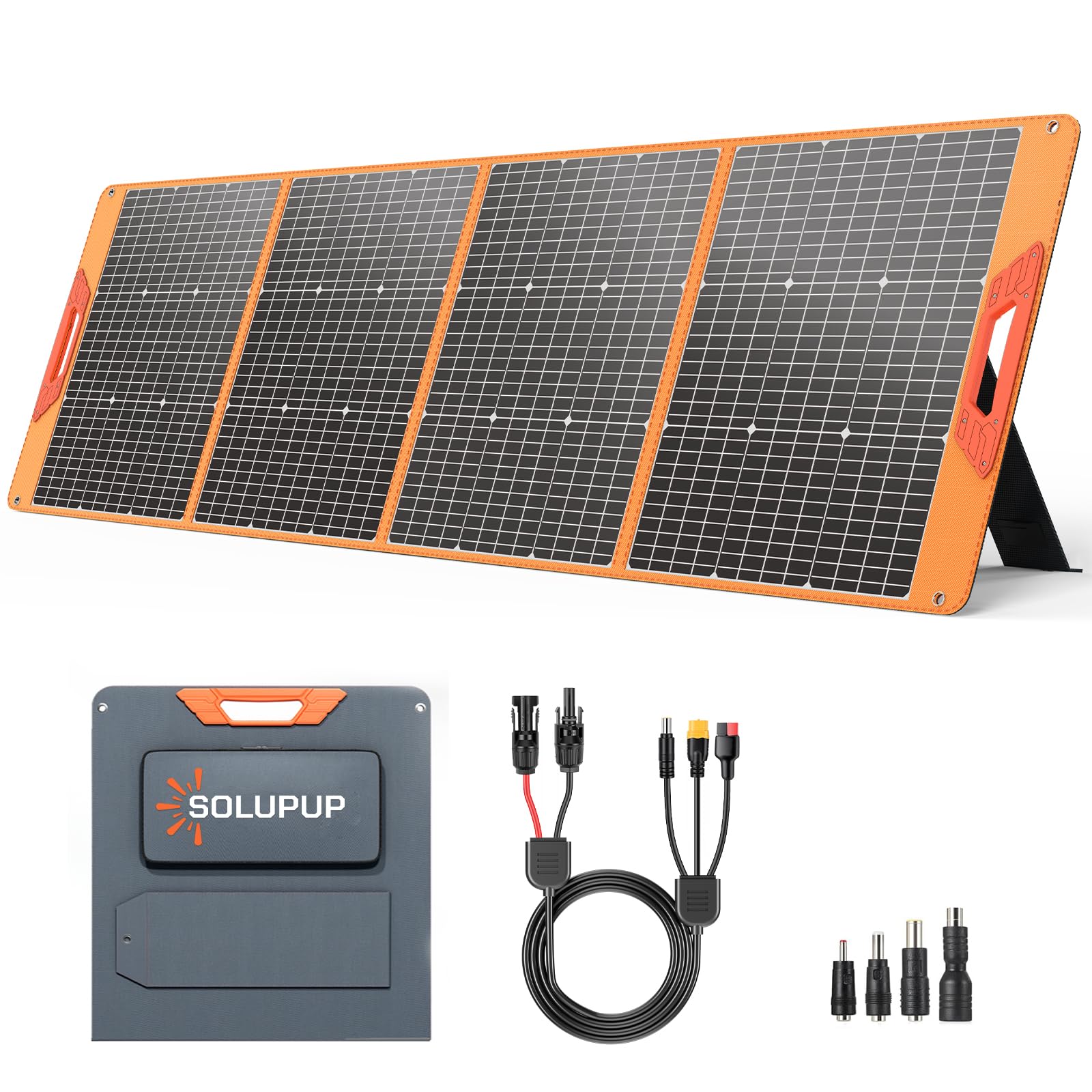
The SOLUPUP 200W distinguishes itself with a dedicated power box that includes an SAE port alongside two USB-C and two USB-A fast-charging ports. This makes it one of the select few 200W portable solar chargers that can efficiently power a smartphone, tablet, laptop, and a 12V appliance simultaneously without requiring a separate power station. With 24% monocrystalline efficiency, it consistently produces between 180W and 192W in direct sunlight according to user reports.
Folded dimensions of 24.4 x 20.8 x 1.9 inches and a magnetic handle make transport straightforward. The IP66-rated ETFE surface stands up to heavy downpours and dusty trails, while four adjustable kickstands and hanging holes offer flexible deployment on the ground or against a vehicle. The kit includes MC4 to DC5521, Anderson, and XT60 adapters for broad power station compatibility.
The power box outputs a 18V SAE line, which means owners feeding a 12V LiFePO4 battery directly will need an external MPPT charge controller. Some users have noted that while the kickstands are functional, the panel can feel floppy during initial setup. It is best suited for users who want to charge multiple devices directly from the panel without relying solely on a battery generator.
Why it’s great
- Five direct charging ports (2x USB-C, 2x USB-A, 1x SAE)
- Consistent 180-192W output in sun
- IP66 waterproof rating
Good to know
- Requires external MPPT controller for 12V battery charging
- Kickstands can feel floppy during initial setup
4. HQST 200W Ultra-Light Portable Solar Panel
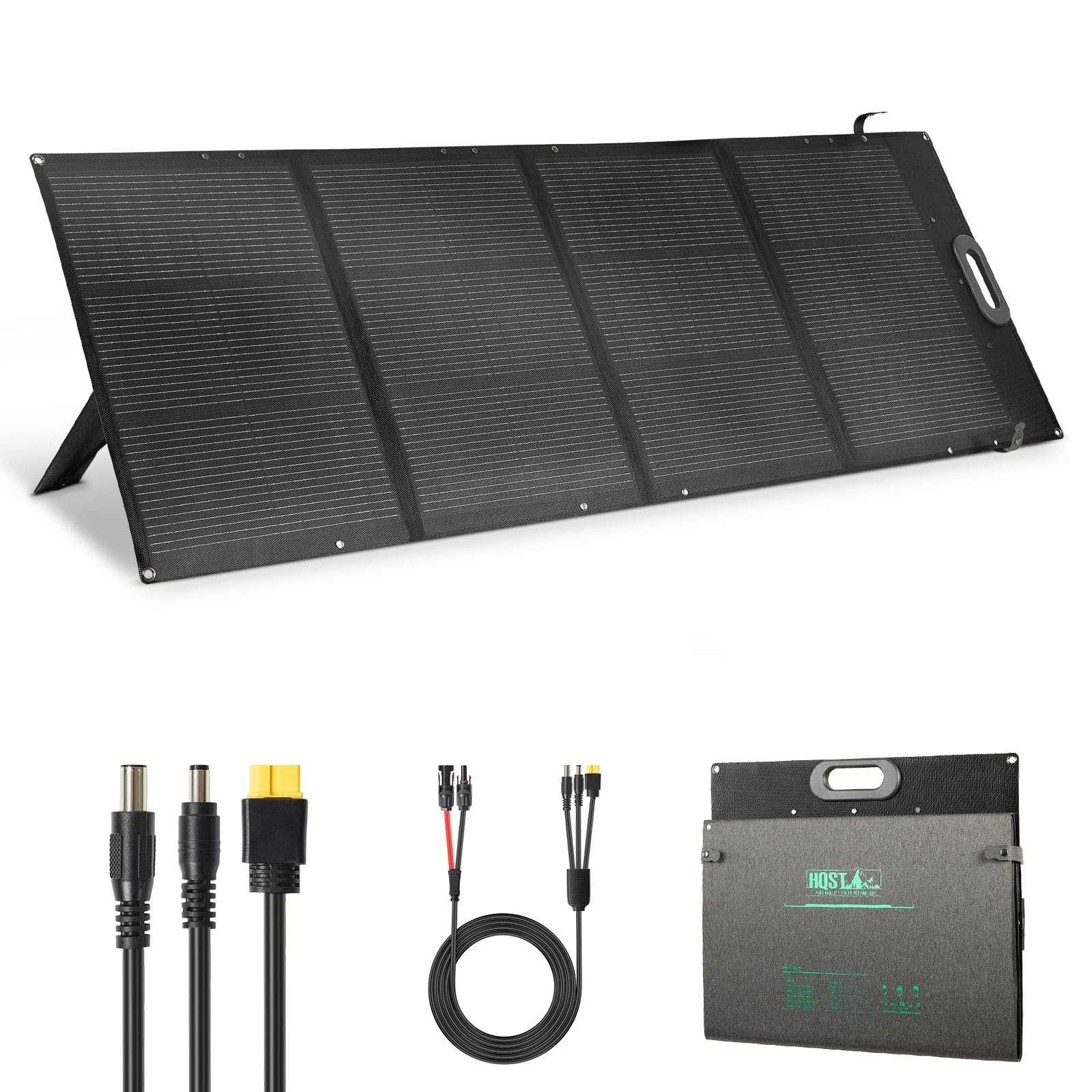
The HQST 200W is engineered for users who need the highest wattage in the smallest possible folded package. Weighing just 11 lbs and folding down to a mere 1.97 inches thick, it is up to 37% lighter and thinner than typical 200W competitors. The 16BB N-Type cells provide a 25% efficiency rating, ensuring strong performance even in overcast coastal conditions.
Two adjustable kickstands (40-60 degrees) provide stable operation on uneven terrain, and the rigid folding design prevents the floppiness common in soft-panel alternatives. The IP67 fully laminated construction eliminates stitched seams, a common failure point where water ingress occurs on lower-tier panels. The included 4.9-foot 3-in-1 adapter cable (XT60, DC7909, DC5521) offers broad compatibility with Jackery, EcoFlow, Bluetti, and Anker power stations.
The panel has been observed producing up to 180W in parallel configuration even after years of use, though some shipping damage reports indicate packaging could be improved. The Voc of approximately 21V is safe for nearly all standard portable power stations, making it a worry-free upgrade for campers seeking more capacity without compromising trunk space.
Why it’s great
- Exceptionally thin 1.97-inch folded profile
- 11 lbs weight for a 200W unit
- Seamless IP67 waterproof construction
Good to know
- Some units arrive with cosmetic shipping damage
- No USB ports for direct device charging
5. GRECELL 200W Portable Solar Panel
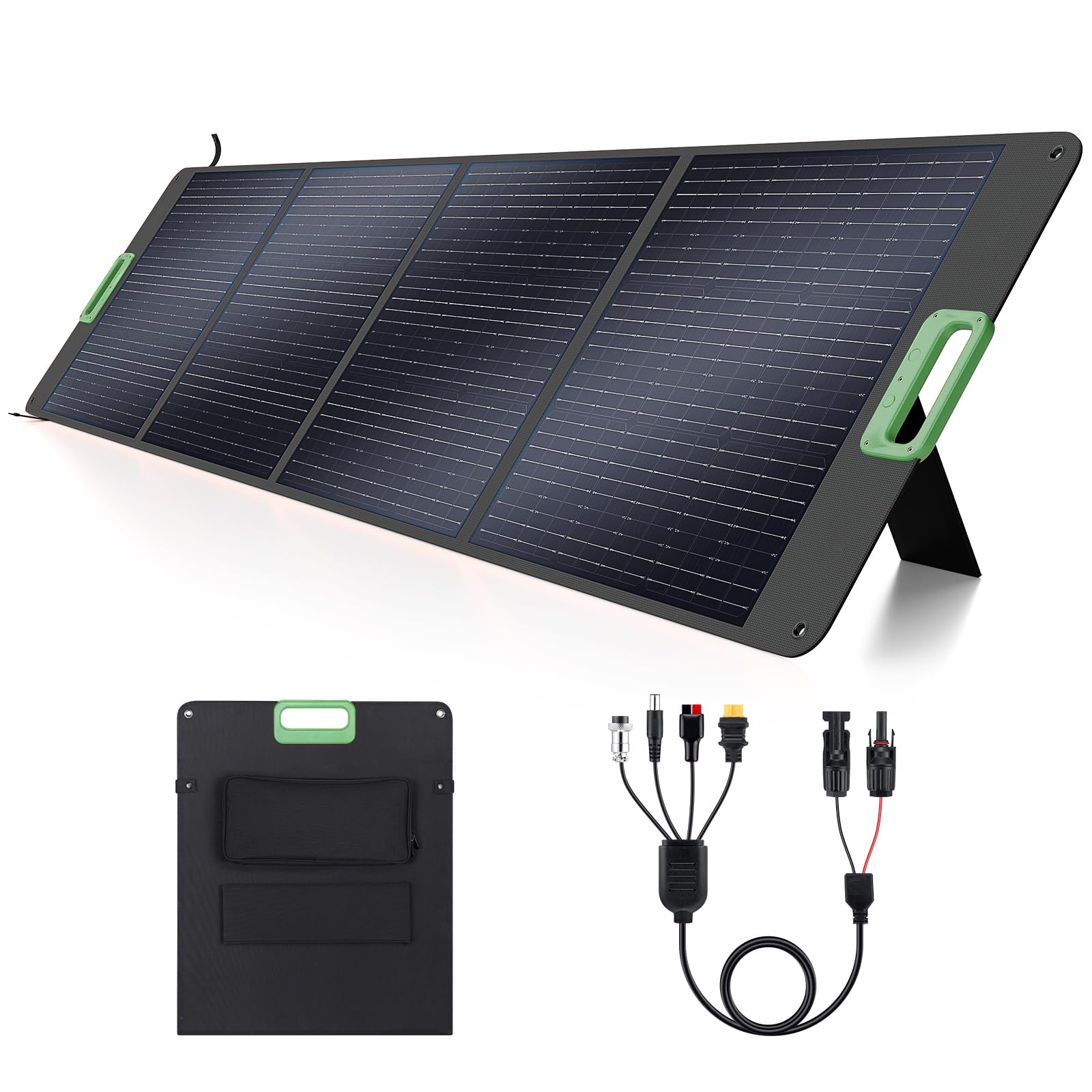
The GRECELL 200W integrates a smart MPPT controller directly into the panel, claiming a 20% faster charging boost compared to standard PWM units. The 23.5% efficient monocrystalline cells with 6-layer ETFE lamination and 97% light transmittance ensure maximum energy harvest in less-than-ideal light. This is a genuine advantage for vanlifers who often park in partial shade.
The 30-second setup relies on four adjustable kickstands and four reinforced corner grommets for flexible mounting on RVs or tent structures. The build quality is bolstered by an IP65-rated 840D Oxford cloth backing that withstands splashes, dust, and scratches. The MC-4 to 4-in-1 cable kit (XT60, Anderson, DC7909, Aviation) ensures compatibility with 95% of power stations, including Jackery and EcoFlow brands.
User reports suggest the 200W unit averages around 140W of real-world output in optimal conditions, which is reasonable for a budget-friendly foldable panel. The unit is relatively bulky when folded at 1.4 inches thick. It works best for topping up small to mid-sized power stations (500Wh-1000Wh) rather than trying to fully recharge a large 2kWh unit in a single day.
Why it’s great
- Integrated MPPT controller for faster charging
- Durable 840D Oxford cloth and ETFE coating
- Broad MC-4 to 4-in-1 cable compatibility
Good to know
- Real-world output averages around 140W
- Folded size is bulky at 1.4 inches thick
6. EBL 200W Portable Solar Panel
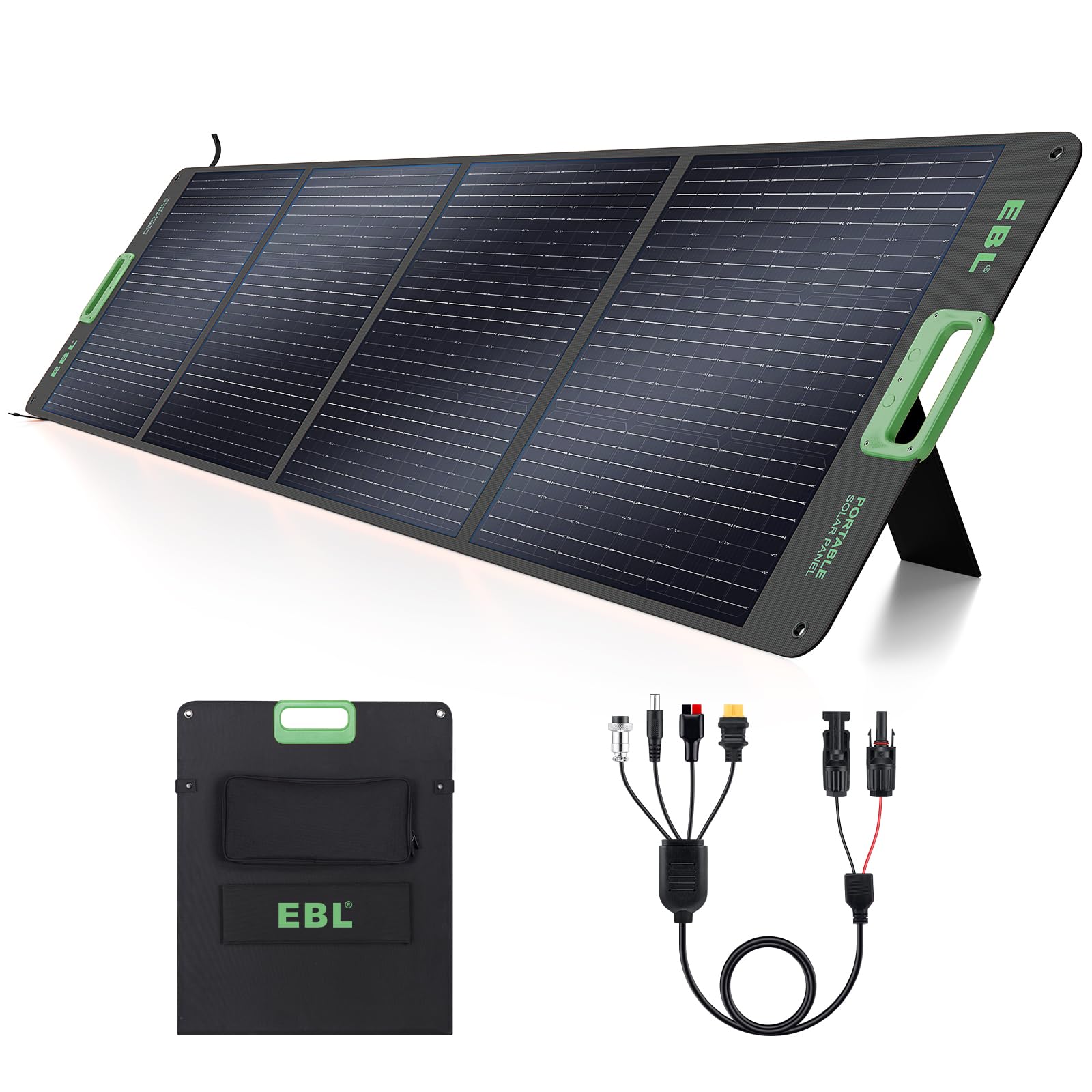
The EBL 200W is a straightforward, no-nonsense solar blanket that delivers reliable power without premium frills. Its 23.5% monocrystalline cells, protected by upgraded PET lamination and an 840D Oxford cloth outer, provide a rugged solution for RV and camping use. The folding briefcase design (25.31 x 20.87 x 2.17 inches when folded) includes a convenient carry handle for transport.
The system includes an MC-4 to 4-in-1 charge cable featuring XT60, Anderson, DC7909, and Aviation connectors, ensuring wide compatibility with Grecell, Bluetti, Anker, and EcoFlow generators. In real-world testing, it averages around 131-145W of output — enough to charge a 448Wh battery from 7% to 100% in roughly three hours. Users have noted it can hit peaks near 191W with optimal sun angle.
One notable limitation is that the unit is not fully waterproof; the PET lamination handles splashes but prolonged heavy rain can cause issues. The included 6-foot cable is shorter than ideal for flexible placement. Despite these minor drawbacks, the build quality and customer service response have been praised, making it a safe choice for those seeking a budget-conscious 200W entry point.
Why it’s great
- Solid real-world average of 131-145W output
- Rugged 840D Oxford cloth exterior
- Excellent customer service experience
Good to know
- Not suitable for prolonged heavy rain exposure
- Included cable is only 6 feet long
7. ZOUPW 100W Portable Solar Panel

The ZOUPW 100W solves the most frustrating pain point of portable solar: connector incompatibility. Its unique 5-in-1 solar cable includes a dedicated DC8020 connector for newer Jackery Explorer models (1000V2 and above), alongside XT60, Anderson, DC7909, and DC5521 ends. This means no dangling adapters or frustrating returns because your power station’s port was just slightly different than expected.
Grade A+ monocrystalline cells with 23.5% efficiency and two adjustable kickstands that angle to 45 degrees deliver up to 25% more sunlight capture compared to flat laying. The ETFE coating provides IP67 waterproofing, protecting against rain and splashes. A built-in intelligent controller with one 45W USB-C PD port and two USB-A ports (including QC 3.0) allows direct charging of phones, tablets, and even some laptops without a power station in the middle.
At 9.48 lbs, it is heavier than some 100W competitors, which may be a concern for backpackers. The kickstands lack fine-adjustment capability, limiting optimal angle optimization. Overall, if you own a modern Jackery station and want one cable to rule them all, this panel is the most hassle-free option in its wattage class.
Why it’s great
- 5-in-1 cable with DC8020 for new Jackery models
- IP67 waterproof ETFE coating
- Direct USB-C 45W PD output
Good to know
- Heavier than some competitors at 9.48 lbs
- Kickstands have limited angle adjustability
8. GRECELL 100W Portable Solar Panel
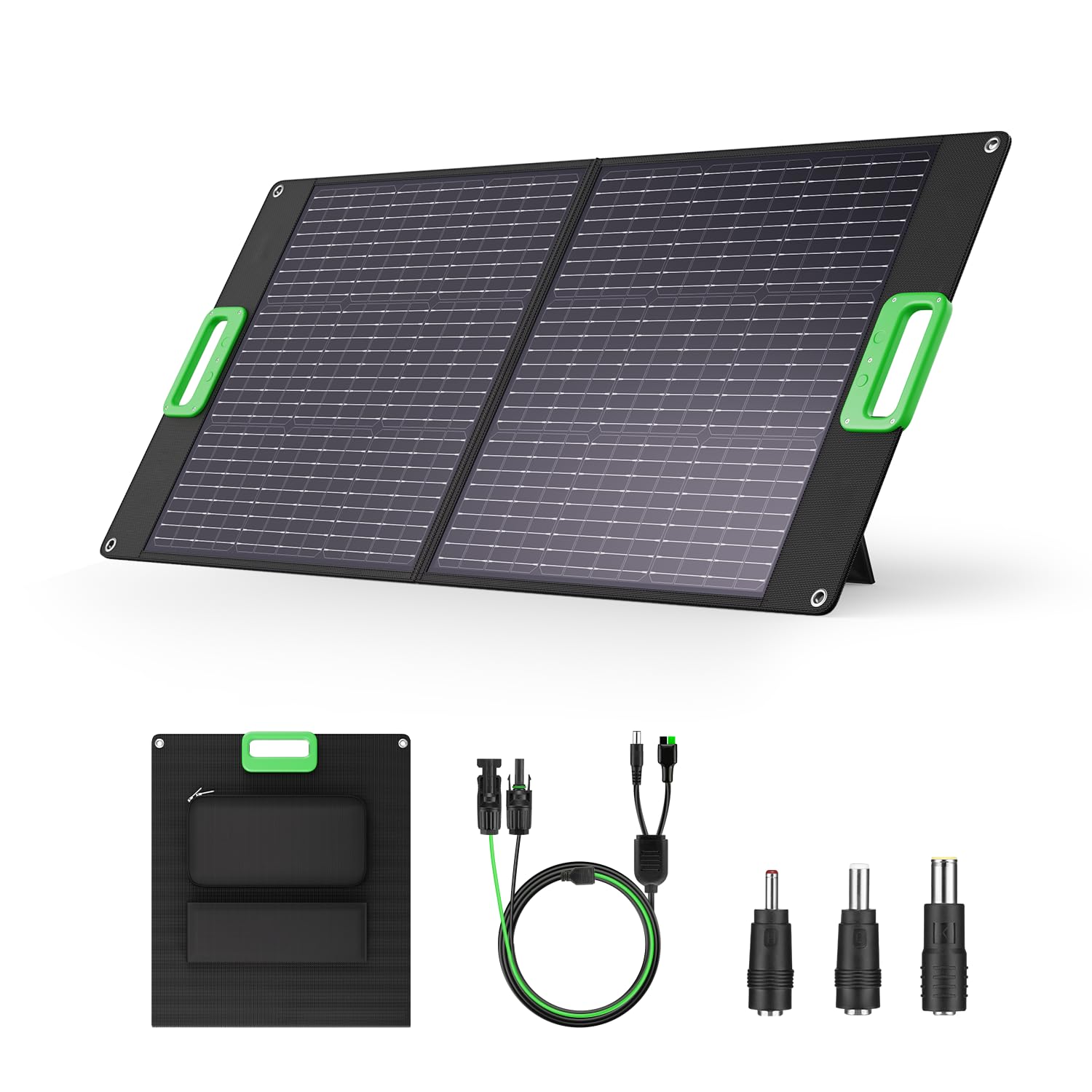
The GRECELL 100W is all about rapid deployment. Four built-in adjustable kickstands and a briefcase-style foldable design mean the panel can be operational in under 30 seconds with no tools required. The 23.5% monocrystalline cells with ETFE lamination ensure higher light transmittance and durability than PET alternatives, delivering up to 60W of charging power on a sunny morning according to user logs.
The MC4 to multi-connector cable kit includes Anderson, DC5521, 8mm, and 5.5×2.5mm adapters, guaranteeing compatibility with 95% of power stations. The panel also supports series and parallel connections, allowing users to double output to 200W by pairing two units. Four reinforced corner grommets enable mounting on tents, RV roofs, or vehicle windows for hands-free operation.
The IP65 water resistance is adequate for standard camping but not intended for prolonged heavy rain. At 6.1 lbs, it is slightly heavier than the FlexSolar but offers stronger compatibility with power station brands thanks to the MC4 connector. It is an excellent entry-level workhorse for campers who prioritize speed of setup over ultra-light weight.
Why it’s great
- Extremely fast 30-second deployment
- Supports series/parallel expansion
- MC4 connector for broad station compatibility
Good to know
- IP65 rating not suitable for heavy rain
- Slightly heavier than ultra-light competitors
9. FlexSolar 100W Portable Solar Panels Charger
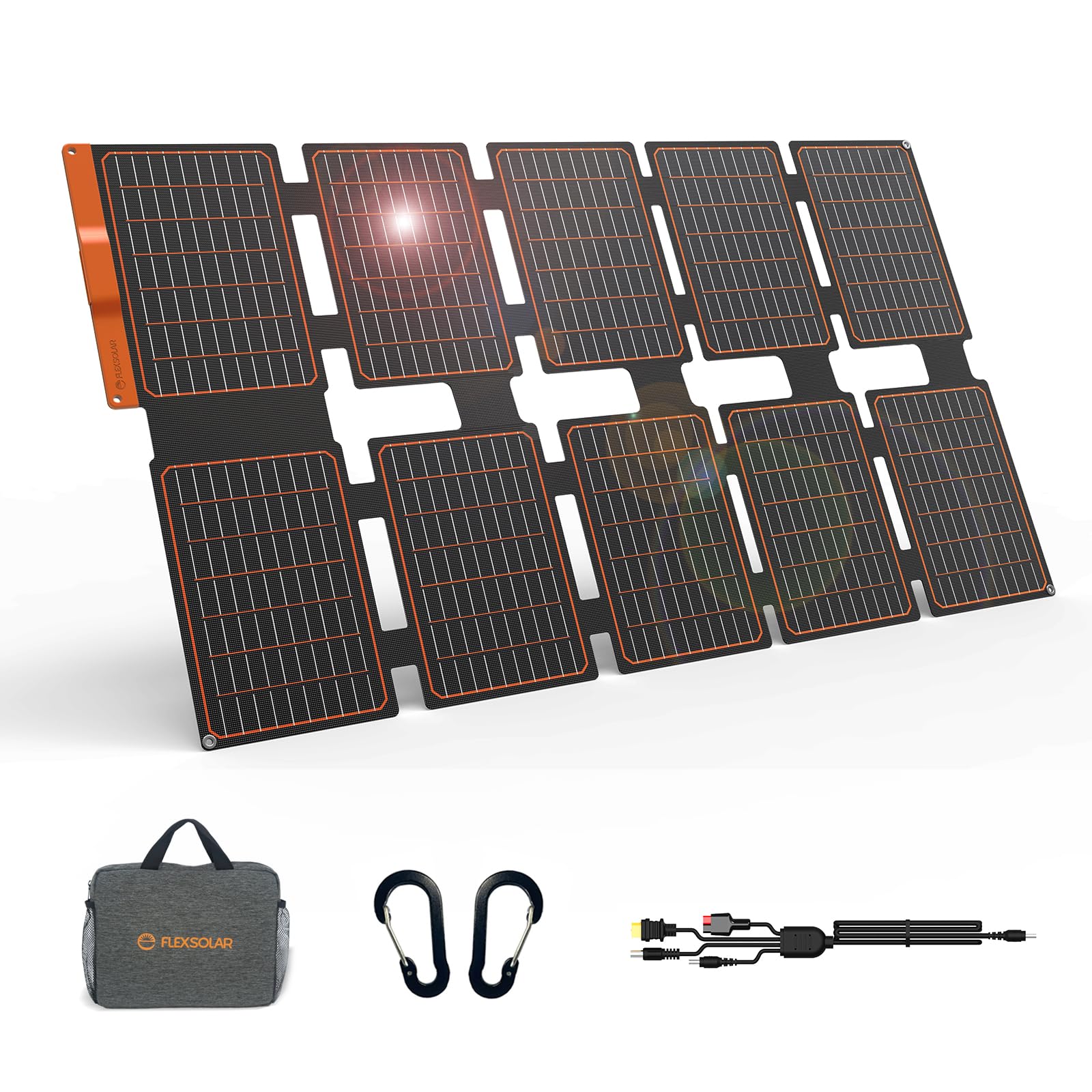
The FlexSolar 100W is the lightest panel in this review at just 4.1 lbs, making it an exceptional choice for backpackers and kayakers where every ounce matters. Its 23%+ efficient monocrystalline cells with E-Film lamination are encased in an IP67 waterproof and dustproof frame, meaning it can survive rain, splashes, and even accidental submersion without damage.
The 3-in-1 output system includes a PD3.0 45W USB-C port, an 18W QC3.0 USB-A port, and a 100W DC output. The included 4-in-1 charging cable (DC5521, DC7909, Anderson, XT60) provides universal compatibility with most power stations. Users report it can recharge a CPAP battery from 6% to 100% in 6-8 hours, showcasing its real-world usefulness for medical device users off the grid.
Some owners have noted that the USB port can be prone to corrosion if the panel is frequently exposed to rain, requiring periodic cleaning. The lightweight construction also means it can be harder to angle perfectly without some additional support. Despite these nuances, it offers the best weight-to-waterproofing ratio in the 100W category.
Why it’s great
- Ultra-light 4.1 lbs construction
- Full IP67 waterproof and dustproof rating
- 45W USB-C PD for fast direct charging
Good to know
- USB port may corrode with frequent rain exposure
- Lightweight design can be tricky to angle
FAQ
Can I leave my 4 panel solar charger out in the rain?
My power station only accepts 60W input. Will a 100W charger damage it?
Final Thoughts: The Verdict
For most users, the best 4 panel solar charger winner is the ZOUPW 450W because it delivers the highest sustained wattage per dollar with industry-leading N-Type cell efficiency. If you want a lightweight, packable 100W unit for backpacking, grab the Renogy 100W E.Flex. And for a budget-friendly waterproof option that won’t weigh down your tent, nothing beats the FlexSolar 100W.