
Shooting after sunset reveals a camera’s true character. The moment the last light fades, consumer-grade sensors and slow kit lenses produce muddy, grainy images that lack detail. Night photography demands hardware that can handle high ISO without collapsing into noise, and a lens that can gather enough photons to expose a scene properly. The wrong choice leaves you frustrated, the right one unlocks a world the human eye barely registers.
I’m Min — the co-founder and writer behind Gadgets Feed. I’ve spent hundreds of hours analyzing sensor architectures, comparing autofocus systems in low light, and cross-referencing real-world sample images to separate cameras that merely claim low-light capability from those that genuinely deliver clean files at ISO 6400 and above.
This guide breaks down the technical realities behind the best affordable camera for night photography so you can invest in real low-light performance rather than marketing hype.
How To Choose The Best Affordable Camera For Night Photography
The gap between cameras that produce usable night images and those that don’t often comes down to three interdependent specifications. Ignore the marketing fluff about scene modes and focus on these physical properties.
Sensor Size and Pixel Pitch
A full-frame sensor (35.9 x 24mm) captures roughly 2.4x more total light than an APS-C sensor at the same ISO and aperture, and about 7x more than a 1-inch sensor. Larger pixels — often found on sensors with lower megapixel counts for their size — have higher individual light-gathering capacity, which translates directly to less visible noise in dark areas. For night photography, prioritizing a larger sensor over a higher megapixel count is almost always the correct trade.
Lens Maximum Aperture
An f/1.8 lens passes roughly 2.8 stops more light than the f/4.5-5.6 kit zooms included with most entry-level cameras. That is the difference between shooting at ISO 6400 and ISO 800 for the same shutter speed, or between a sharp handheld shot at 1/30s and a blurry one at 1/8s. Budget-conscious buyers should factor the cost of a fast prime (35mm f/1.8 or 50mm f/1.8) into their total system price.
In-Body Image Stabilization (IBIS)
IBIS shifts the sensor to counteract hand shake, allowing usable handheld exposures at shutter speeds 3 to 5 stops slower than an unstabilized camera. For nighttime cityscapes or low-light environmental shots where subject movement isn’t a factor, IBIS can eliminate the need for a tripod. Cameras with 5-axis IBIS rated at 4.5 stops or higher enable 1-second handheld exposures in conditions that would normally require a tripod at ISO 3200.
Quick Comparison
On smaller screens, swipe sideways to see the full table.
| Model | Category | Best For | Key Spec | Amazon |
|---|---|---|---|---|
| Panasonic LUMIX G85 | Mid-Range Mirrorless | Stabilized handheld low-light | 5-axis IBIS rated at 4.5 stops | Amazon |
| Sony Alpha 6700 | Premium APS-C Mirrorless | AI autofocus in dim conditions | 26.0MP BSI sensor + dedicated AI processor | Amazon |
| FUJIFILM X-M5 | Premium APS-C Mirrorless | Lightweight travel with film sims | 26.1MP X-Trans 4 sensor (same as X100V) | Amazon |
| Nikon Z 6II | Premium Full-Frame Mirrorless | Full-frame low-light excellence | 24.5MP BSI full-frame sensor | Amazon |
| Sony Alpha 7 IV | Premium Full-Frame Mirrorless | Hybrid pro stills/video at night | 33MP full-frame Exmor R sensor | Amazon |
| FUJIFILM X-T30 III | Mid-Range Mirrorless | Style-driven night shooting | AI-powered subject detection AF | Amazon |
| Canon EOS Rebel T7 | Entry-Level DSLR | Budget telephoto reach at dusk | 24.1MP APS-C CMOS + DIGIC 4+ | Amazon |
| OM System Olympus E-M10 Mark IV | Mid-Range Mirrorless | Compact stabilization on a budget | 5-axis IBIS (4.5 stops) in a small body | Amazon |
| Canon EOS R100 | Entry-Level Mirrorless | Beginner-friendly RF mount system | 24.1MP APS-C sensor + Dual Pixel CMOS AF | Amazon |
| Nikon D7500 | Mid-Range DSLR | Fast-action in fading light | 51-point AF system with 15 cross-type sensors | Amazon |
| OM System Olympus TG-7 | Rugged Compact | Waterproof night macro shooting | F2.0 lens + 4 macro modes | Amazon |
In‑Depth Reviews
1. Panasonic LUMIX G85

The Panasonic G85 strikes an ideal balance between budget and low-light performance thanks to its class-leading 5-axis in-body image stabilization, which the company rates at 4.5 stops. At night, this means you can handhold a 1/5s exposure at ISO 800 and come away with a sharp image — something most unstabilized systems require a tripod to achieve. The 16-megapixel Micro Four Thirds sensor omits the optical low-pass filter to extract slightly more fine detail, and paired with the 12-60mm f/3.5-5.6 kit lens, the combination delivers acceptable low-light files when you push ISO to 3200.
The magnesium-alloy body is weather-sealed, an unusual durability trait at this tier, and the electronic viewfinder has a respectable 2360K-dot OLED panel for composing in darkness. The combination of IBIS and a tilting touchscreen makes the G85 a strong option for night street photography or tripod-free cityscape work where stopping subject motion isn’t required.
Autofocus uses a contrast-detect system with 49 points, which works reliably in moderate light but can hunt in very dark scenes. 4K video recording adds flexibility for low-light videography, and the Sony sensor captures clean enough 3840 x 2160 footage up to ISO 3200 with some chroma noise in shadows.
Why it’s great
- Best-in-class 5-axis IBIS for handheld night shooting
- Weather-sealed magnesium alloy body
- Excellent value for stabilization performance
Good to know
- Contrast-detect AF hunts in very low light
- Kit lens has f/3.5-5.6 max aperture — invest in a fast prime for true night work
2. Sony Alpha 6700

The Sony Alpha 6700 uses a 26.0MP APS-C Exmor R back-illuminated sensor combined with a dedicated AI processing chip that delivers impressive low-light autofocus reliability. In practice, the Real-time Recognition system tracks eye and face subjects in scenes as dark as approximately EV -3, which is dimmer than moonlight. The back-illuminated architecture provides better per-pixel light sensitivity than front-illuminated sensors, giving it a measurable advantage over earlier-generation APS-C bodies.
The BIONZ XR processor handles 4K/60p video with 6K oversampling for a sharper 4:2:2 10-bit output, making this a strong low-light video choice. Sony rates the in-body stabilization at 5 stops, but real-world testing shows it handles roughly 3 stops reliably for night video without a tripod. The dedicated AI processor also enables LUT input for color grading directly in-camera.
The menu system is dense — expect a learning curve to locate the noise reduction settings and custom ISO ranges. The body is compact, and the E-mount lens ecosystem offers numerous fast prime options like the Sigma 16mm f/1.4 or Sony 35mm f/1.8 that transform its night capabilities.
Why it’s great
- AI-powered AF locks onto subjects even in near-dark conditions
- Back-illuminated sensor with exceptional dynamic range at ISO 6400
- 6K oversampled 4K video with 10-bit color depth
Good to know
- Complex menu navigation requires significant setup time
- In-body stabilization is decent but not gimbal-smooth for walking video
3. FUJIFILM X-M5

The FUJIFILM X-M5 packs the same 26.1MP APS-C X-Trans 4 CMOS sensor found in the highly regarded X100V into a body that weighs just 12.5 ounces. For night photography, the X-Trans color filter array produces organic-looking files with less of the color blotching typical of Bayer sensors at high ISO — ISO 6400 images show luminance noise that resembles film grain rather than digital artifacts. The X-Processor 5 drives a hybrid autofocus system that uses both phase and contrast detection.
The kit lens is an XC 15-45mm f/3.5-5.6 OIS PZ zoom, which is a power zoom with optical stabilization. For serious night work, pairing this body with a fast prime like the FUJINON 23mm f/1.4 or the XF 35mm f/1.4 unlocks its full low-light potential. The X-M5 records 6K video internally, but 4K 60p is oversampled from 6K for cleaner detail. The 20 Film Simulations provide straight-out-of-camera JPEG options that can bypass the need for raw editing in low-light conditions.
The body has no built-in flash and the tilting screen articulates fully out rather than upward, making overhead night compositions slightly awkward. The power zoom lens extends and retracts automatically, which adds a slight delay when powering on in a dark environment.
Why it’s great
- X-Trans sensor produces film-like noise at high ISO, not harsh digital artifacts
- Ultralight body at 12.5 oz for comfortable nighttime walkaround
- 6K oversampled 4K video for clean night footage
Good to know
- Power zoom lens delays startup in dark environments
- Screen flips down, not upward — overhead night shots require more effort
4. Nikon Z 6II

The Nikon Z 6II is the most affordable full-frame mirrorless camera on this list that genuinely delivers pro-grade low-light performance. Its 24.5MP back-illuminated sensor has larger individual pixels than any APS-C option here — at 5.9 microns versus roughly 3.7 microns on a 24MP APS-C sensor — which translates to significantly less noise at ISO 12800. The Expeed 6 processor drives 273 phase-detect AF points covering 90% of the frame, and the -4.5 EV low-light AF rating means it locks focus in conditions where your eyes struggle to see.
The in-body 5-axis stabilization works with all Z-mount lenses and provides 5 stops of correction. For night photography, this enables handheld exposures of 1/4s at ISO 800 with acceptable sharpness. The body is weather-sealed, dual card slots (CFexpress Type B/XQD plus UHS-II SD) provide redundancy for important night shoots, and the Z lens lineup includes proven performers like the NIKKOR Z 35mm f/1.8 S and Z 50mm f/1.2 S.
Video capabilities are strong with 4K/60p using full pixel readout and 10-bit external recording. The variable aperture 24-240mm kit lens is not ideal for night work, but the body’s high-ISO sensor means you can still shoot ISO 6400 and get clean files. The battery is rated for 410 shots on a single charge, which is reasonable but expect to drain it faster with extended night shooting and IBIS active.
Why it’s great
- Large 5.9-micron pixels for minimal high-ISO noise
- Phase-detect AF rated to -4.5 EV for reliable night focus
- Dual card slots with 5-axis IBIS
Good to know
- AF tracking can lose subjects with erratic movement in dim conditions
- Kit lens is variable aperture — invest in f/1.8 glass for full night potential
5. Sony Alpha 7 IV

The Sony Alpha 7 IV pairs a 33MP full-frame Exmor R back-illuminated sensor with the BIONZ XR processor to deliver exceptional low-light performance without sacrificing resolution. The sensor’s pixel pitch is approximately 4.9 microns — still generous compared to high-megapixel full-frame sensors — and the back-illuminated design improves quantum efficiency, meaning more photons are captured per unit area. At ISO 12800, the A7 IV maintains usable color accuracy with fine luminance noise that cleans up well in post-processing.
The 693 phase-detect and 425 contrast-detect AF points cover 93% of the sensor area, and Real-time Eye AF for humans, animals, and birds works reliably down to about -4 EV. The 5-axis IBIS provides 5.5 stops of correction, making it possible to handhold cityscape shots at 1/2s. The S-Cinetone color profile is built into the camera, delivering cinematic color rendering in low-light video without grading time.
Video records 4K/60p with 10-bit 4:2:2 internal, with full pixel readout from a crop of the sensor. The body is weather-sealed with dual card slots (CFexpress Type A + SD UHS-II). The menu system is improved over earlier Sony bodies but still requires dedicated learning time to locate ISO-related settings. Battery life is excellent at over 2,000 shots per charge in moderate use.
Why it’s great
- 33MP full-frame sensor with BSI architecture for superior quantum efficiency
- Real-time Eye AF functions in near-dark conditions (approx. -4 EV)
- S-Cinetone color profile for instant cinematic night video
Good to know
- 4K 60p requires crop factor — reduces low-light area coverage
- Menu system is still complex despite improvements
6. FUJIFILM X-T30 III

The FUJIFILM X-T30 III is a compact APS-C mirrorless body that uses a 26.1MP X-Trans 4 CMOS sensor paired with an AI-powered subject detection autofocus system. The X-Trans color filter array produces distinctively organic noise patterns at high ISO, making ISO 6400 shots from this camera significantly more usable than equivalently-pixel-dense Bayer sensors. The Auto mode is genuinely smart enough for handing the camera to a companion to capture a night scene reliably.
The X-T30 III features 20 built-in Film Simulations, including classic presets like Acros (black-and-white with high contrast suitable for night street photography) and Classic Chrome (muted colors that handle sodium vapor street lighting well). The hybrid AF system uses both phase and contrast detection points across the sensor, though in very dark scenes (EV -2 or lower) it switches entirely to contrast detection and can hunt.
The body uses a tilting touchscreen and external exposure dials for ISO, shutter speed, and exposure compensation, which is ideal for fast manual adjustments in the dark. The compact footprint makes it easy to carry with a fast prime like the XF 23mm f/1.4 or XF 35mm f/1.4. It lacks in-body stabilization, so night shooting requires a fast lens or tripod.
Why it’s great
- X-Trans sensor produces film-like grain at high ISO, not digital chroma noise
- Dedicated analog dials for ISO and shutter speed — ideal for dark manual adjustments
- 20 Film Simulations create usable JPEGs straight out of camera at night
Good to know
- No in-body stabilization — requires fast lens or tripod for night shots
- Autofocus switches to slower contrast-detect in very dim conditions
7. Canon EOS Rebel T7
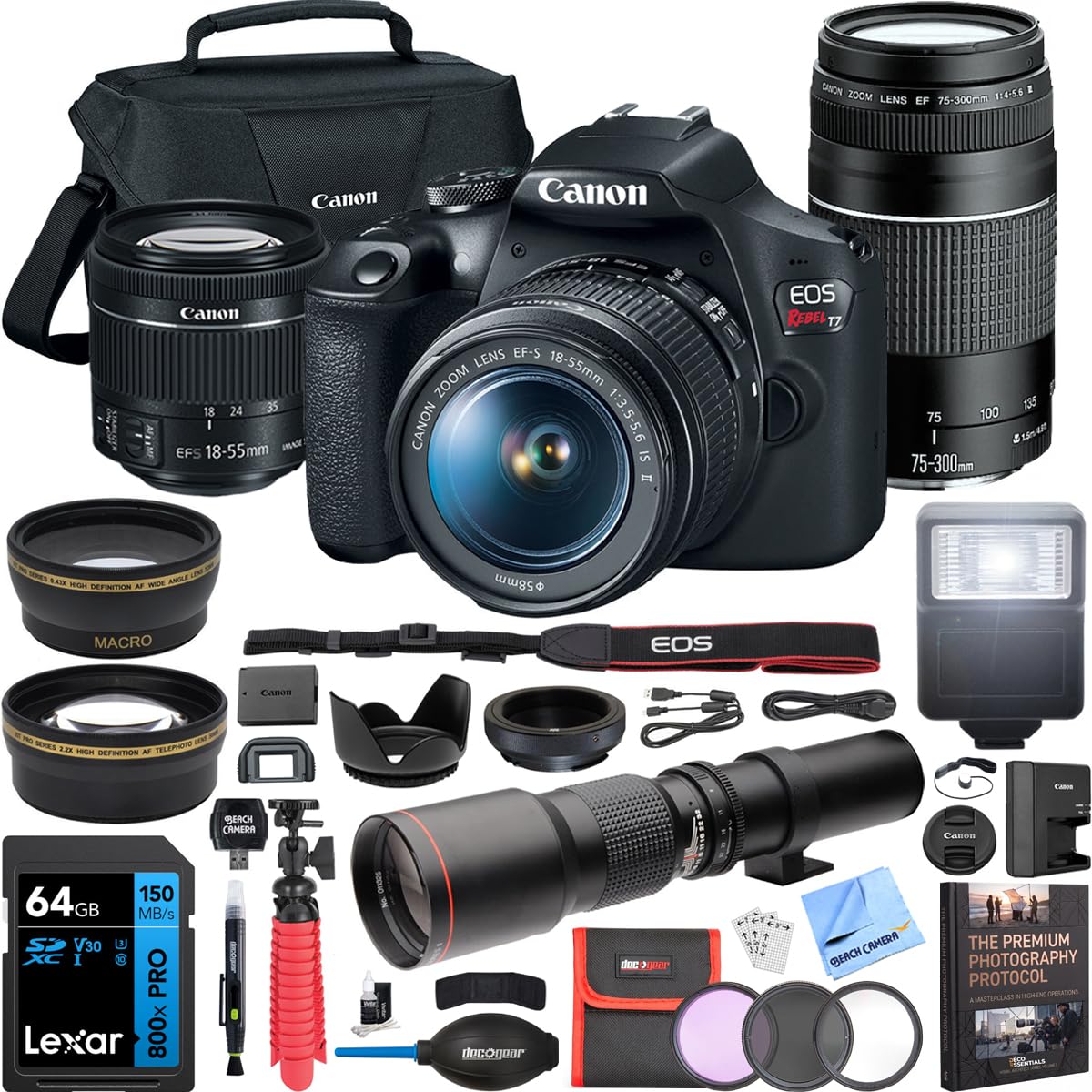
The Canon EOS Rebel T7 is an entry-level DSLR that uses a 24.1MP APS-C CMOS sensor with a DIGIC 4+ processor, which has been available for many years — the processor is the primary limitation for high-ISO noise compared to modern alternatives. At ISO 1600 the Rebel T7 is still usable with careful noise reduction in post; above ISO 3200, chroma noise becomes noticeable in shadow areas. The 9-point phase-detect AF system with AI Servo tracking is serviceable in decent light but struggles in dim conditions, often requiring AF assist beam.
The bundle includes both an EF-S 18-55mm f/3.5-5.6 IS II and an EF 75-300mm f/4-5.6 III lens, plus a 500mm preset telephoto lens. The variable aperture kit lenses are not optimized for night work — the 18-55mm at f/5.6 at the long end forces higher ISO. The bundle also includes a hot-shoe flash unit for close-range night work. The optical viewfinder has a 95% coverage field of view and a 0.8x magnification, which is dimmer than modern electronic viewfinders in low light.
The Rebel T7 includes built-in Wi-Fi and NFC for transferring night shots to a phone for quick editing. The battery life is rated at approximately 500 shots but real-world drain is faster — one reviewer reported the battery depleting after only 8 shots, suggesting the included battery may be degraded. The camera is compatible with Canon’s full EF and EF-S lens ecosystem, meaning a used 50mm f/1.8 STM can transform it into a competent night street camera.
Why it’s great
- Access to Canon’s massive EF/EF-S lens ecosystem with cheap f/1.8 primes
- Optical viewfinder with AI Servo AF for moving subjects at dusk
- Double zoom kit provides wide shooting flexibility for day and evening
Good to know
- DIGIC 4+ processor limits usable ISO to approximately 1600
- 9-point AF system is slow and hunts in very dark scenes
- Battery life reported as significantly less than rated by multiple reviewers
8. OM System Olympus E-M10 Mark IV

The OM System (formerly Olympus) E-M10 Mark IV is a Micro Four Thirds mirrorless body with a 20MP Live MOS sensor and the brand’s well-regarded 5-axis in-body image stabilization rated at 4.5 shutter speed steps. In practical night photography terms, this stabilization means you can handhold a 1-second exposure at the 14mm wide end of the kit lens and capture a sharp cityscape — something the smaller sensor’s ISO limitations would otherwise prevent. The flip-down monitor with dedicated selfie mode is useful for night-time vlogging or group shots.
The kit lens is the M.Zuiko Digital ED 14-42mm f/3.5-5.6 EZ pancake zoom, which collapses to an extremely compact size. The Micro Four Thirds sensor has a 2x crop factor, meaning the 14-42mm gives a 28-84mm equivalent field of view. The sensor’s dynamic range at base ISO is competitive, but at ISO 6400, noise is more pronounced than APS-C or full-frame options — the IBIS compensates by allowing longer shutter speeds at lower ISO. The body weighs just 15.5 ounces with the kit lens, making it one of the most portable stabilized options for night shooting.
Autofocus uses a 121-point contrast-detect system that is fast in good light but slower in very dark environments. The built-in flash provides emergency fill for low-light portraits. The camera lacks an external charger (uses USB charging) and does not use USB-C, meaning slower charging times.
Why it’s great
- 5-axis IBIS enables 1-second handheld exposures for low-light scenes
- Extremely compact and lightweight body with pancake zoom
- Flip-down selfie screen useful for night vlogging
Good to know
- Micro Four Thirds sensor has more visible noise at ISO 6400 than larger sensors
- USB charging only, no external charger, uses micro-USB not USB-C
9. Canon EOS R100

The Canon EOS R100 is the most affordable entry point into Canon’s RF mirrorless system, using a 24.1MP APS-C CMOS sensor and DIGIC 8 processor. The sensor performs respectably at ISO 1600 with moderate noise reduction, and ISO 3200 is usable for web sharing. The Dual Pixel CMOS AF system covers 143 zones with phase detection, and face/eye detection works reliably in moderate low light — the R100 can track a subject’s eye under street lighting conditions better than the contrast-detect-only systems in similarly-priced cameras.
The RF-S 18-45mm f/4.5-6.3 IS STM kit lens includes optical stabilization rated at 4 stops, which helps at the wider end but the slow f/4.5-6.3 maximum aperture forces higher ISO than ideal for night work. The lens has a versatile 18-45mm range (29-72mm full-frame equivalent) and collapses for compact storage. The camera body is Canon’s smallest and lightest in the R series at 12.3 ounces, making it easy to slip into a coat pocket for night walks.
The R100 shoots 4K video at 24 fps and Full HD at 60 fps, with 120 fps HD slow-motion capability. The 3-inch LCD has 1.04M dots but lacks touchscreen functionality, which is an odd omission for a beginner-focused camera. The electronic viewfinder is a basic 2.36M-dot OLED. The contrast-detect system used in Live View is slower than the Dual Pixel AF used through the viewfinder.
Why it’s great
- Dual Pixel CMOS AF works reliably under street lighting
- Smallest and lightest body in Canon’s R series
- Access to growing RF lens ecosystem with future upgrade path
Good to know
- Kit lens at f/4.5-6.3 is very slow for night work
- No touchscreen, limiting quick focus point adjustment
- DIGIC 8 processor produces noticeable noise above ISO 3200
10. Nikon D7500

The Nikon D7500 is a 20.9MP APS-C DSLR that uses the same 51-point phase-detect AF system with 15 cross-type sensors found on the higher-end D500. The 51-point AF array concentrates points in the center of the frame, and in low light the cross-type sensors can lock focus down to approximately -3 EV — significantly better than entry-level DSLRs. The 20.9MP sensor is a sweet spot that balances pixel density with per-pixel light capture, and the EXPEED 5 processor handles ISO 6400 with good detail retention and luminance noise rather than chroma noise.
The AF-S DX NIKKOR 18-140mm f/3.5-5.6G ED VR kit lens includes Nikon’s Vibration Reduction (VR) stabilization rated at 4 stops, extending usable handheld shooting by about 2 shutter speed steps in practice. The 8 fps continuous burst is fast for a mid-range DSLR and useful for capturing movement in fading light — think wildlife at dusk or street performers after dark. The 3.2-inch tilting 922K-dot touchscreen LCD is useful for composing from low angles in dark environments.
The D7500 records 4K Ultra HD video at 30fps with stereo sound and power aperture control during video. It has a single SD slot, unlike the dual-slot configuration on the D500. The body is weather-sealed and the optical pentaprism viewfinder has 100% frame coverage and 0.94x magnification, providing a bright composition tool in low light. The EN-EL15b battery is rated at 950 shots per charge, which is excellent for extended night field work.
Why it’s great
- 51-point AF with 15 cross-type sensors for reliable low-light focus down to -3 EV
- 20.9MP sensor optimized for per-pixel light capture and clean ISO 6400 files
- 8 fps burst captures nocturnal action without blur
Good to know
- Single SD card slot limits redundancy on important night shoots
- Kit lens is variable aperture — a f/2.8 zoom or f/1.8 prime is transformative for night work
11. OM System Olympus TG-7

The OM System Olympus TG-7 is a rugged compact camera built for extreme conditions rather than large-sensor night photography. Its 12MP back-illuminated CMOS sensor and F2.0 lens provide a low-light advantage over most other compact cameras. At night, the F2.0 lens gathers roughly 4x more light than a typical compact f/3.5 lens, and the sensor’s back-illuminated architecture helps maintain usable files at ISO 1600. For night macro photography — shooting small subjects after sunset — the TG-7’s four macro modes include microscope mode that can focus as close as 1 centimeter from the lens.
The camera is waterproof to 15 meters (50 feet), shockproof from 2.1 meters (7 feet), crushproof to 100 kgf, freezeproof to -10°C, and fog-proof. For night conditions that involve moisture or cold — shooting bioluminescence at the ocean’s edge, night hiking in rain, or star-scapes at sub-zero temperatures — the TG-7 survives conditions that destroy any other camera on this list. The 4K movie recording at 30fps and 120fps high-speed recording provide options for night-time action capture.
Five underwater modes include underwater microscope and underwater HDR, useful for night diving. The built-in flash with the F2.0 lens can illuminate close subjects more effectively than slower compacts. The 4x optical zoom (25-100mm equivalent f/2.0-4.9) provides flexibility but the small sensor means usable ISO is limited to 800-1600 for clean output. The TG-7 is not the best choice for general night photography, but if your night work involves water, cold, or impact risk, it is the only specialized option.
Why it’s great
- F2.0 lens provides meaningful low-light advantage over typical compacts
- Rugged to 15m waterproof, -10°C freezeproof, and 2.1m shockproof
- Macro microscope mode captures tiny subjects at 1cm distance in low light
Good to know
- 12MP small sensor limits usable ISO to 800-1600 for clean images
- Low-light noise is noticeable and reduces dynamic range compared to larger sensor cameras
FAQ
How many stops of IBIS do I need for handheld night photography?
Can a Micro Four Thirds camera perform well for night photography with a fast prime lens?
Does a higher megapixel count help with night photography on an affordable camera?
What is the minimum lens aperture I should look for on an affordable night photography camera?
Final Thoughts: The Verdict
For most users, the best affordable camera for night photography winner is the Panasonic LUMIX G85 because its 5-axis IBIS and weather-sealed body deliver the most versatile low-light performance at the price point. If you want full-frame sensor quality for clean ISO 12800 images, grab the Nikon Z 6II. And for rugged conditions like night diving or freezing environments, nothing beats the OM System Olympus TG-7.