
Tap water chemistry varies block by block — chlorine, lead, PFAS, and sediment are real, but they don’t show up in a taste test. A carbon water filter is the single most effective first-line defense, stripping out the compounds that make water smell like a pool or taste like a pipe. The catch? Not all carbon media are created equal, and the wrong choice leaves contaminants flowing straight into your glass.
I’m Min — the co-founder and writer behind Gadgets Feed. I’ve spent hundreds of hours dissecting filter certifications, pore sizes, and flow rates to separate products that merely claim performance from those that deliver measurable reductions across the full contaminant spectrum.
This guide breaks down the most effective best carbon water filter options available, focusing on certified third-party test results and real-world filtration speed so you can make a confident, informed decision.
How To Choose The Best Carbon Water Filter
Carbon water filters work by adsorption — contaminants stick to the porous surface of the carbon media as water passes through. But the thickness of the carbon block, the micron rating, and third-party certifications determine whether that process actually removes the specific toxins in your water supply.
Certifications Are Everything
A filter that claims to reduce lead without NSF/ANSI 53 certification is just guessing. NSF/ANSI 42 covers chlorine taste and odor, which is the bare minimum. NSF/ANSI 53 gets serious — lead, mercury, and benzene reduction. The highest bar includes NSF/ANSI 401 for emerging contaminants like pharmaceutical residues and PFOA/PFOS. Always verify the certifying body (IAPMO, WQA, or NSF International) in the product documentation.
Filter Media Type and Micron Rating
Granular activated carbon (GAC) is cheap and fast but lets finer particles slip through. Carbon block filters compress the media into a solid matrix, achieving micron ratings as low as 0.5 µm. A lower micron means tighter filtration — essential for removing cysts, microplastics, and finer sediment. The tradeoff is flow rate: a 0.5 µm block flows more slowly than a GAC cartridge, but the water is substantially cleaner.
Total Capacity and Replacement Cost
Gallon ratings range from 100 to 8,000 gallons depending on the system design. Pitcher-style filters typically last 40-100 gallons, while countertop faucet units can go six to twelve months. Factor in the annual cost of replacement filters — a cheap system with expensive, short-lived cartridges costs more over two years than a mid-range unit with a longer lifespan. Gravity systems often offer the best cost-per-gallon ratio.
Quick Comparison
On smaller screens, swipe sideways to see the full table.
| Model | Category | Best For | Key Spec | Amazon |
|---|---|---|---|---|
| Waterdrop ED01W | Electric Pitcher | Instant electric dispensing | 0.5 µm carbon block | Amazon |
| Waterdrop ED02B | Electric Pitcher | Compact fridge-friendly design | 200-gallon filter lifespan | Amazon |
| APEX EXPRT MR-2050 | Faucet Countertop | Dual carbon + mineral pH boost | 0.9 GPM flow rate | Amazon |
| OEMIRY Countertop | Faucet Countertop | Ultra-high 8,000 gallon capacity | 1.6 GPM flow rate | Amazon |
| ZeroWater 32-Cup | Dispenser | Zero TDS measurement | 5-stage ion exchange | Amazon |
| Waterdrop PF01A-P | Pitcher Replacement | NSF 53 certified 3-pack value | 100-gallon lifespan per filter | Amazon |
| Purewell 2.25G | Gravity Countertop | No-electricity bulk filtration | 0.01 µm UF membrane | Amazon |
In‑Depth Reviews
1. Waterdrop ED01W Electric Water Filter Pitcher
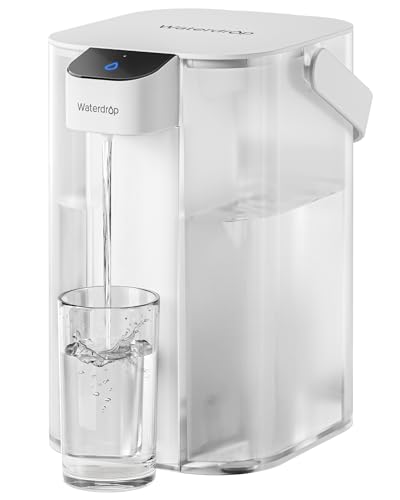
The Waterdrop ED01W brings an electric pump and a 0.5 µm premium carbon block together in a 15-cup countertop pitcher. It delivers filtered water in one second via one-touch dispensing — no tilting, no waiting. The carbon block is ten times more efficient than standard granular media, targeting lead, chlorine, microplastics, and benzene while retaining beneficial minerals.
NSF/ANSI 42, 53, 401, and 372 certifications cover chlorine, lead, mercury, PFOA/PFOS, and over 45 total contaminants. The filter lasts 200 gallons or roughly three months. A built-in rechargeable battery holds charge for up to 30 days in standby, and the unit charges via USB-C. Indicator lights show remaining filter life and battery status, removing the guesswork from replacement timing.
Users consistently report excellent taste improvement and reliable customer service — one reviewer noted the pump failed after two years and the company sent a free replacement overnight. The unit does not lower TDS, so if you want demineralized water, choose the TDS reduction model instead.
Why it’s great
- One-second electric dispensing eliminates waiting
- 0.5 µm carbon block captures microplastics and cysts
- NSF 53 & 401 certified for lead and emerging contaminants
- 30-day rechargeable battery with USB-C charging
Good to know
- Does not reduce TDS — minerals remain in water
- Fill only to the max line to avoid leaks
- Electric pump audible during dispensing
2. Waterdrop ED02B Compact Electric Water Filter Pitcher

The ED02B shares the same electric one-key dispensing DNA as its larger sibling but in a slimmer 10.6-inch-wide footprint designed to fit refrigerator door shelves. It holds 14 cups and filters at up to 0.21 gallons per minute — water is available in about one second with no heavy lifting required. The compact body works equally well on countertops, in RVs, or at campsites.
IAPMO certification to NSF/ANSI 42, 53, 401, and 372 covers chlorine, lead, mercury, benzene, bisphenol A, and PFOA/PFOS. The filter lasts 200 gallons or three months. The built-in battery delivers up to 30 days per charge, and a drainage hole at the bottom protects the electronics if water accidentally spills into the feeder area.
Reviewers love the fridge-friendly fit and long battery duration — one user reports the charge holds for weeks. A few note the dispenser motor is audible, with a beep that some find tolerable and others place on a mat to dampen. Measure your fridge door shelf depth before ordering, as the unit requires clearance for the handle.
Why it’s great
- Fits refrigerator door shelves with proper clearance
- Electric dispensing with one-touch operation
- NSF 42, 53, 401 & 372 certified for broad contaminant reduction
- No tilting required — ideal for all ages and mobility levels
Good to know
- Motor noise is noticeable during dispensing
- Double-check your fridge shelf depth before purchase
- Does not reduce TDS
3. APEX EXPRT MR-2050 Dual Countertop Water Filter
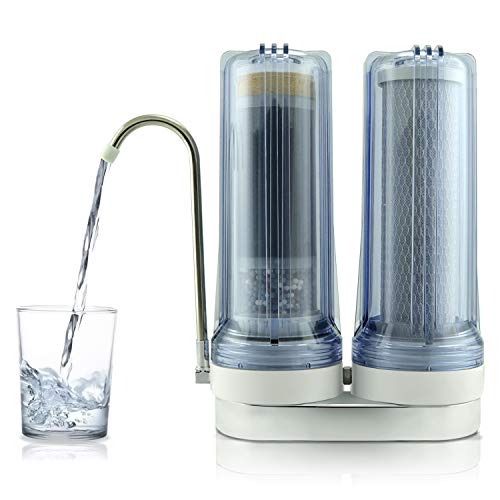
The APEX EXPRT MR-2050 combines a coconut-shell carbon cartridge with a KDF-55 media cartridge for dual-stage filtration on your kitchen faucet. KDF-55 uses a copper-zinc redox process to reduce chlorine, chloramine, and heavy metals including lead, iron, and mercury, while the carbon stage adsorbs pesticides and hydrogen sulfide. The system adds calcium, magnesium, and potassium back in, raising the water’s pH into the alkaline range.
Installation requires no drilling — a diverter valve screws onto standard 55/64-inch faucet threads, and the included adapter kit covers most non-standard connections. Flow rate reaches 0.9 gallons per minute, filling a 116-ounce jug in about 25 seconds. Each filter set lasts 4-6 months or up to 750 gallons, depending on feed water quality.
Customer reviews highlight easy setup and excellent taste — one user notes mineral water flavor takes two days to adjust to but is preferred over bottled alkaline water. The diverter valve knob between the faucet and filter line is fragile; if it breaks, the entire valve assembly requires replacement. This system works with municipal water only, not well water.
Why it’s great
- KDF-55 with coconut carbon for comprehensive contaminant reduction
- Adds alkalizing minerals for pH-boosted water
- Tool-free screw-on installation with multiple adapters included
- Replacement filters last 4-6 months at low per-gallon cost
Good to know
- Not compatible with well water — municipal only
- Diverter valve connection is somewhat fragile
- Does not lower TDS or PPM readings
4. OEMIRY Countertop Water Filter

The OEMIRY countertop system claims an industry-leading 8,000-gallon filter lifespan — that is twelve months of continuous use for a typical household. Its multi-stage alkaline filtration targets 99% of chlorine, heavy metals, and bad odors while retaining beneficial minerals like potassium, calcium, and magnesium. Flow rate hits 1.6 gallons per minute, delivering an 8-ounce cup in roughly two to three seconds.
The ABS housing is compact at 5.5 by 5.5 by 12.4 inches, sitting on the counter without occupying much space. A diverter valve connects to standard faucets (not pull-type, handheld, spray, or sensor faucets). Installation takes about one minute with the included wrench, six adapters, and Teflon tape. Operating pressure range is 15 to 100 psi, and temperature range is 41 to 100°F.
Users on catchment and well water systems report significant improvement in taste and sediment removal — one reviewer in Hawaii uses it as a secondary filter for rainwater. The system does not reduce TDS, so if you need demineralized water, this is not the right tool. A few users mention the water stop takes a moment to fully halt, leading to occasional drips after use.
Why it’s great
- 8,000-gallon filter lifespan — replace only once per year
- 1.6 GPM flow rate fills glasses in seconds
- Alkaline filtration retains essential minerals
- Zero wastewater and no electricity required
Good to know
- Does not reduce TDS — minerals remain in the water
- Not compatible with pull-out, spray, or sensor faucets
- Drip after shut-off can occur without a drip tray
5. ZeroWater 32-Cup 5-Stage Water Filter Dispenser

ZeroWater takes a different approach from standard carbon filters — its five-stage system uses ion exchange technology to reduce total dissolved solids to 0 ppm. The included instant-read TDS meter lets you verify water purity at any time, and the manufacturer instructs filter changes when the reading hits 006 ppm. IAPMO certification covers PFOA/PFOS, lead, chromium, and mercury reduction.
The 32-cup dispenser holds 7.5 liters and uses a sliding hatch for refilling — no lifting the top tank, which many users find more convenient than gravity pitchers. Each filter lasts approximately 40-80 gallons depending on your source water TDS level. Hard water above 300 ppm will burn through filters faster; users in Arizona with 500 ppm tap water report filters lasting just three weeks.
Taste reviews are consistently glowing — one user describes the water as “ultra-pure, almost sweet.” The tradeoff is speed: the dense filter media slows filtration significantly compared to standard carbon pitchers. Annual filter cost is a serious consideration, running from to over depending on filter life and local TDS levels. The mineral-free water may taste flat to some, but mineral drops solve that.
Why it’s great
- Built-in TDS meter for instant purity verification
- Reduces total dissolved solids to 0 ppm
- IAPMO certified for PFOA/PFOS, lead, chromium, and mercury
- Large 32-cup capacity reduces refill frequency
Good to know
- Filter lifespan shortens dramatically with hard water
- Annual replacement costs can exceed in high-TDS areas
- Filtration is significantly slower than standard carbon pitchers
- Removes all minerals — water may taste flat without mineral addition
6. Waterdrop PF01A-P Upgrade NSF Certified Replacement Filters

The Waterdrop PF01A-P replacement filters use advanced activated carbon fiber (ACF) technology sourced from Japan, offering higher adsorption capacity than conventional granular carbon. Each of the three filters in this pack is NSF/ANSI 42, 53, and 372 certified for reducing chlorine, taste and odor, lead, mercury, cadmium, copper, and PFOA/PFOS. The 100-gallon rated lifespan per filter provides up to 300 total gallons in the three-pack.
These filters are designed specifically for Waterdrop pitchers and dispensers — they ensure tight seals without leakage, though the manufacturer advises caution with non-Waterdrop brands. The five-stage filtration process runs through fine carbon fiber media that captures contaminants at higher efficiency than standard carbon blocks in this price class.
Users with the Waterdrop glass pitcher report these filters produce water that tastes “like fresh spring water” and outperform Brita and ZeroWater in terms of filtration balance. A few users note that flow rate depends on water pressure, but general consensus is that the speed is normal for a carbon filter. The three-pack offers strong value for anyone already in the Waterdrop ecosystem or switching from a less effective pitcher.
Why it’s great
- Japanese ACF technology delivers high adsorption capacity
- NSF 53 certified for lead and PFOA/PFOS reduction
- Three-pack covers 300 total gallons
- Secure fit with no leakage in Waterdrop pitchers
Good to know
- Compatible with Waterdrop pitchers only — not universal
- No TDS reduction — retains beneficial minerals
- Flow rate varies with local water pressure
7. Purewell 2.25G Gravity Water Filter System

The Purewell 2.25G gravity system uses a three-stage filtration stack with a 0.01 µm hollow fiber UF membrane — that is 20 times tighter than the 0.2 µm pores common in competing systems. The black carbon filter combines activated carbon block, silver ion membrane, and the UF membrane to reduce chlorine, sediment, rust, organic matter, and heavy metals. Despite the microscopic pore size, the system maintains a 4-gallon-per-hour flow rate.
Operating on pure gravity — no electricity, no plumbing, no pumps — the stainless steel upper chamber holds unfiltered tap water, and the lower chamber collects clean water via a spigot. A transparent water level window lets you see exactly how much water remains without opening the lid. Each of the two included filters serves up to 3,000 gallons, and the manufacturer recommends replacement every six months. Total system capacity reaches 6,000 gallons before any filter change is needed.
Users report that chlorine smell and taste disappear completely within the first week of use. The stainless steel housing has held up without leaks or corrosion after six months. A few owners note that the filter displacement in the lower chamber reduces the usable capacity below the rated 2.25 gallons. The system works well for both drinking water and plant watering, and the gravity operation makes it ideal for emergency preparedness and off-grid living.
Why it’s great
- 0.01 µm UF membrane catches 99.99% of microscopic particles
- No electricity required — works off-grid
- Transparent water level window for easy monitoring
- 6,000 total gallons from the included filter pair
Good to know
- Does not lower TDS — minerals remain in filtered water
- Filter elements reduce usable capacity below the tank rating
- One-week break-in period before water flavor stabilizes
FAQ
How often should I replace a carbon water filter?
Does a carbon water filter remove fluoride?
Final Thoughts: The Verdict
For most users, the best carbon water filter winner is the Waterdrop ED01W because it combines a tight 0.5 µm carbon block with electric instant dispensing and broad NSF certifications in a single countertop unit. If you want the absolute longest filter lifespan and off-grid capability, grab the Purewell 2.25G gravity system. And for zero-TDS water with verifiable purity readings, nothing beats the ZeroWater 32-Cup dispenser.