
Your van is a mobile home, but without a proper cooling system, it can become a metal oven in summer and a damp freezer in winter. Standard RV air conditioners are designed for massive rigs with endless shoreline power, leaving van dwellers with a frustrating choice: roast silently or succumb to a noisy, power-hungry unit that drains your battery bank by lunchtime. The problem is worse than simple discomfort—excessive heat ruins food, degrades electronics, and makes quality sleep impossible in a compact space.
I’m Min — the co-founder and writer behind Gadgets Feed. I’ve spent hundreds of hours dissecting the technical specifications of low-voltage rooftop units, under-dash kits, and portable heat pumps to find which systems actually deliver on their BTU claims without crippling a camper van’s electrical system.
This guide cuts through the noise to identify the single best solution for mobile cooling and heating, helping you confidently choose a 12v ac for van that matches your build, your battery bank, and your tolerance for installation labor.
How To Choose The Best 12V AC For Van
Van air conditioning is a different animal from residential or standard RV cooling. The finite battery bank, the limited roof space, and the need for silent operation while sleeping all demand careful trade-offs. Instead of buying a generic unit and hoping it works, focus on four specific decision points that separate a livable van from a hot, noisy box.
Rooftop vs. Under-Dash vs. Portable
Rooftop units are the most popular option because they keep the floor plan clear and vent through an existing 14″ x 14″ fan opening. They do require roughly 6–10 inches of roof clearance for the external shroud, so low-profile models are mandatory for stealth vans. Under-dash split systems mount the compressor outside the chassis and the evaporator inside, preserving roof space for solar panels but requiring fabrication skills for a clean install. Portable units like the Cybertake S2 Pro sit on the floor and duct through a window or roof vent—they are the easiest to install but use interior space and tend to be less powerful for full-size vans.
BTU Rating vs. Insulation Reality
A 10,000 BTU unit sounds powerful, but in a poorly insulated van with large windows, that same unit will run continuously and drain your battery in hours. For a standard Ford Transit or Sprinter with moderate insulation and a 200Ah LiFePO4 battery, a 10,000 BTU inverter compressor unit is the sweet spot—it cycles down to roughly 300–400W in eco mode, giving you 6–8 hours of runtime. A 15,000 BTU unit is overkill for a short-wheelbase van and will waste energy on frequent cycling. Always size the unit to the air volume of your specific build, not just the square footage of the floor.
Battery Compatibility and Amperage Draw
Your electrical system is the bottleneck. A 12V AC unit that draws 50A in turbo mode will consume 600Wh per hour; a 100Ah lithium battery can theoretically run it for about 2 hours before hitting the low-voltage cutoff. Most van dwellers target a 300–600Ah house battery bank, which comfortably supports a 12V inverter AC running in eco mode (20–30A) through the night. Units that also accept 24V or 48V input, like the Outequip models, give you flexibility to run a higher-voltage battery bank and reduce current drop over longer wire runs.
Noise Level and Sleep Mode
A droning compressor at 65 dB destroys the quiet of a campsite. The best van AC units advertise sleep mode noise levels around 40–45 dB, which is quieter than a typical window fan. Look for units that use a brushless DC motor and an inverter scroll compressor—they ramp up and down smoothly instead of slamming on and off. Real-world noise also depends on how the unit is mounted. Direct-bolting a rooftop AC to a thin van roof transfers vibration into the interior; a rubber gasket and vibration-dampening mounts make a measurable difference in perceived noise.
Quick Comparison
On smaller screens, swipe sideways to see the full table.
| Model | Category | Best For | Key Spec | Amazon |
|---|---|---|---|---|
| Treeligo 11000 BTU | Rooftop | All-around off-grid cooling | 11000 BTU, 45 dB, Inverter | Amazon |
| Aspligo 10000 BTU | Under-Dash | Custom split-system builds | 10000 BTU, 20CC Scroll Compressor | Amazon |
| VEVOR 13500 BTU | Rooftop | Large campers / high heat | 13500 BTU, 65 dB, Non-Ducted | Amazon |
| Cybertake S2 Pro | Portable | Simple setup, tent or small van | 5100 BTU, 40 dB, 3-Way Power | Amazon |
| TURBRO S15 | Rooftop | Smart control and app users | 15000 BTU, 52 dB, WiFi / Remote | Amazon |
| Ivation 6500 BTU | Window Sill | No-roof-modification cooling | 6500 BTU, Saddle Mount, Quiet | Amazon |
| Outequip 10000 BTU | Rooftop | Long off-grid runtime | 10000 BTU, 54 dB, 8-10 hr battery | Amazon |
| Gidrox 10000 BTU | Rooftop | Winter-ready heat pump | 10000 BTU, 40 dB, PTC Heater | Amazon |
| Countrymod 10000 BTU | Rooftop | Mid-range off-grid efficiency | 10000 BTU, 45-55 dB, Inverter | Amazon |
| Outequip 10000 BTU w/Heat | Rooftop | Light heat with AC efficiency | 10000 BTU, 43 lbs, 6″ Profile | Amazon |
| RecPro 15K | Rooftop | Large fifth wheel / ducted vans | 15000 BTU, 55 dB, Heat Pump | Amazon |
In‑Depth Reviews
1. Treeligo 11000 BTU 12V DC Rooftop RV Air Conditioner
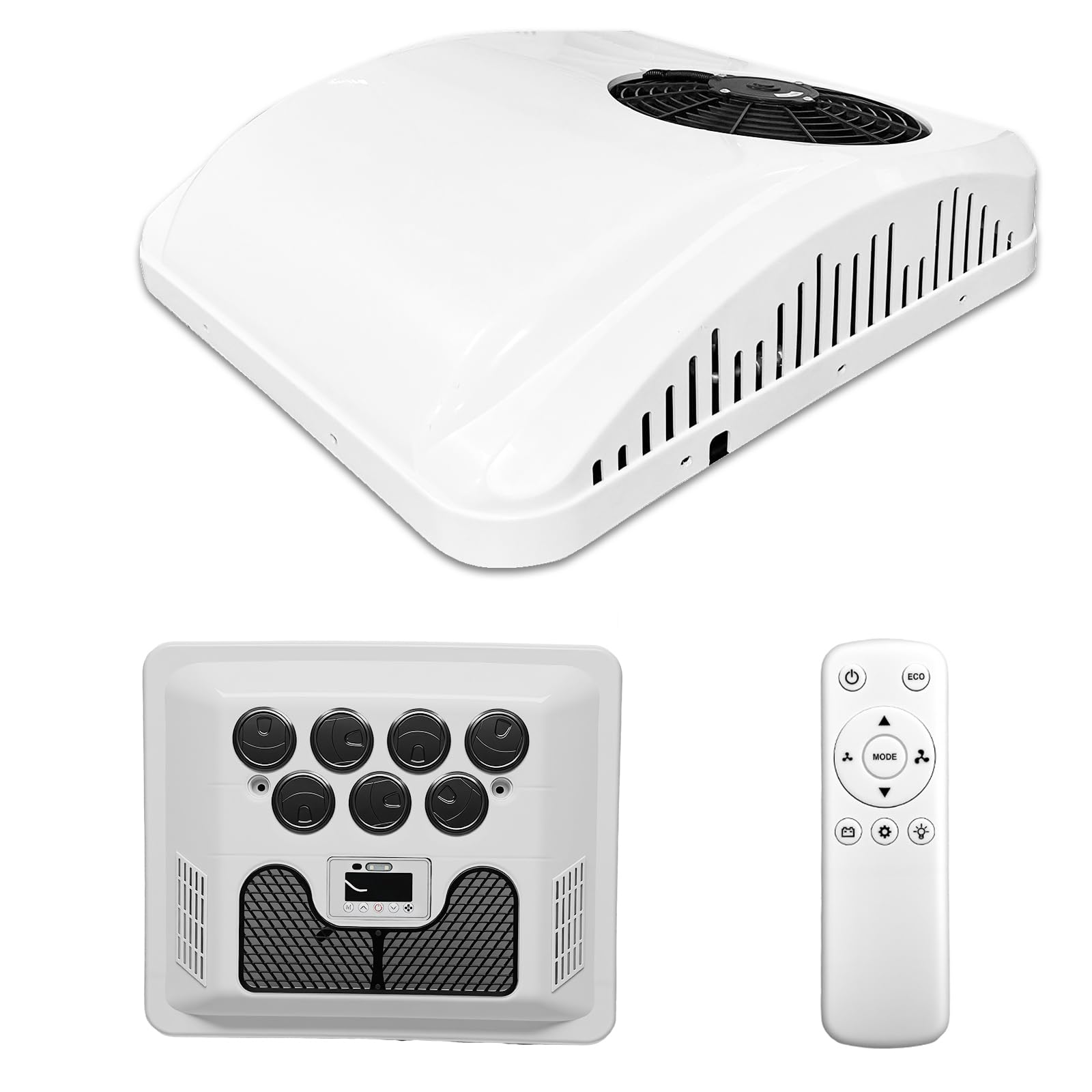
The Treeligo delivers a rare combination of high BTU output and genuine 12V battery operation with an inverter scroll compressor that varies power from 330W to 1000W. At 11000 BTU, it battles a full-size van in 100°F weather without needing a generator, and users report it cools a 5th wheel bedroom rapidly when paired with 300W of solar and a 300Ah battery bank. The system includes a heater mode for chilly desert nights, making it a true four-season solution rather than a single-use cooling gadget.
Noise stays under 45 dB thanks to frequency conversion technology and low-noise internal insulation, which is quiet enough for undisturbed sleep in a compact space. The unit is FCC and UL certified, adding peace of mind that the electronics won’t interfere with the van’s radio or navigation system. Installation requires a minimum roof opening of 12.6″ x 10.24″, which fits many existing fan cutouts but does not match the standard 14″ x 14″ vent pattern—measure twice before cutting.
A few owners report temperature code errors (2P, 3P, 4P) when trying to adjust setpoint from the control panel, and the customer support response has been inconsistent, with some users receiving quick email help and others hitting a loop of automated replies. For the DIY van builder who can troubleshoot a control board or upgrade to 4-gauge cable from the stock 6-gauge, this unit offers impressive cold output and real energy savings over traditional 120V rooftop monsters.
Why it’s great
- Variable inverter compressor sips power in eco mode (330W)
- Dual cooling and heating for year-round van comfort
- Compact roof footprint fits non-standard vent openings
Good to know
- Control panel interface can be buggy (code errors)
- Customer support responsiveness is hit-or-miss
- 6-gauge wiring may be undersized for long cable runs
2. Aspligo 10000 BTU Under Dash AC Kit

The Aspligo kit is a complete split-system under-dash solution designed for the builder who prefers to keep the roof clear for solar panels. The 20CC electric scroll compressor sits outside the chassis, and the evaporator unit (15.89″ x 13.58″ x 6.12″) mounts under a seat or a cabinet, blowing cold air directly into the living space. At 10000 BTU, it’s suitable for a medium van or truck sleeper, and the rated power draw of 550–600W means it pulls roughly 45–50A from a 12V battery, which is manageable for a 200–300Ah bank if used sparingly during the day.
The integrated receiver-dryer and condenser fan design reduces the number of potential refrigerant leak points compared to pieced-together systems. Installation requires mechanical experience—mounting the compressor securely, running refrigerant hoses, and pulling a vacuum before charging with R134A. Experienced DIYers report the kit as straightforward, and the company’s customer service responds within 24 hours with troubleshooting help. The unit draws 40-60A depending on the fan speed and thermal load, and the low voltage protection prevents the compressor from draining the house battery past a safe cutoff point.
Quality control is a concern: a few buyers received units with broken components or units that simply would not cool, and the return process through the seller has been frustrating for some international customers. This unit is not for anyone who wants plug-and-play simplicity. It’s for the van builder who already has a lithium battery bank, a BMS, and is comfortable charging refrigerant. For that audience, the Aspligo offers a clean way to add AC without sacrificing a square inch of valuable roof real estate.
Why it’s great
- Keeps roof free for solar panels and storage
- Integrated components minimize leak points
- Low voltage protection safeguards battery health
Good to know
- Installation requires AC refrigerant knowledge
- Inconsistent quality and return support
- Compressor and condenser need secure under-vehicle mounting
3. VEVOR RV Air Conditioner, 13500 BTU
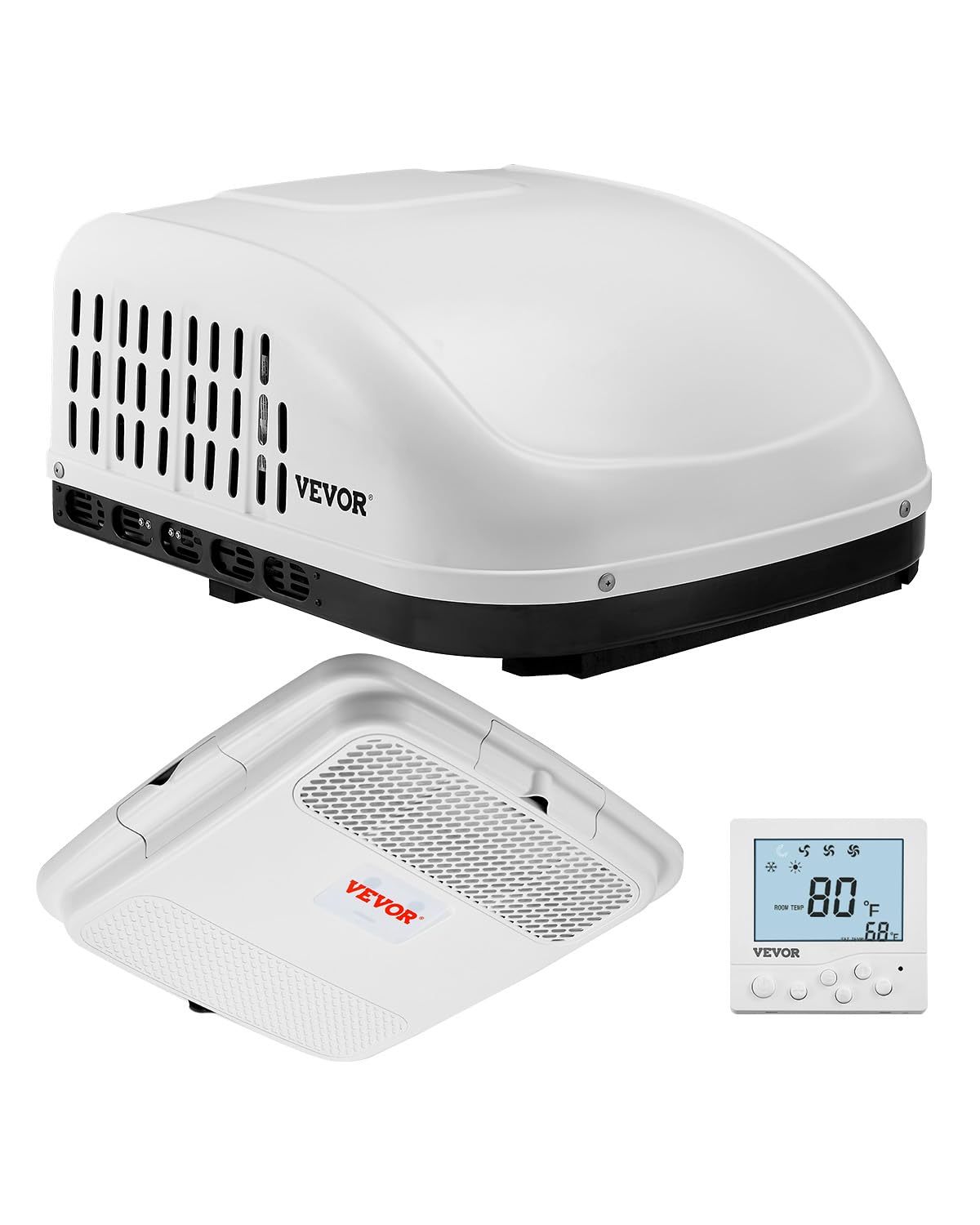
The VEVOR is a heavy-hitter designed for larger camper vans and trailers that need serious cooling capacity. With a 13,500 BTU compressor and R32 refrigerant, it can bring a space of up to 107.6 square feet down to a comfortable temperature in about ten minutes. The unit fits the standard 14.25″ x 14.25″ roof opening, which is the industry norm for most RV vent openings, making it a drop-in candidate for many conversion vans that already have a MaxxAir fan cutout. The non-ducted design simplifies installation and reduces air loss through short ducts, directing all the cold air straight down into the living area.
The control panel offers Auto, Cooling, and 3-Speed Fan modes, and the Auto mode switches between cooling and fan-only based on the ambient temperature. The built-in timer allows you to set the unit to turn off after a set number of hours, which is useful for overnight use when you want the cabin cool as you fall asleep but don’t need the compressor running all night. Some users note that the control panel defaults to Celsius, but a long press on the TIMER button switches it to Fahrenheit—a detail missing from the printed manual.
The 65 dB noise level is noticeably louder than the 40–45 dB inverter-based units, and this a major drawback for van sleepers who are sensitive to humming compressors. Furthermore, at 13,500 BTU on a non-inverter compressor, this unit draws substantial current—likely over 100A at startup—so it really demands shoreline power or a large generator rather than a modest lithium battery bank. It is a solid option for a weekend camper that stays at RV parks with hookups, but not for true off-grid boondockers.
Why it’s great
- High 13,500 BTU capacity rapidly cools large spaces
- Fits standard 14.25″ x 14.25″ roof opening
- Durable EPP exterior resists cracking in outdoor conditions
Good to know
- 65 dB noise is loud for overnight sleeping
- Non-inverter compressor has high startup current draw
- Some units fail after seasonal storage with no support
4. Cybertake S2 Pro Portable Camping Air Conditioner
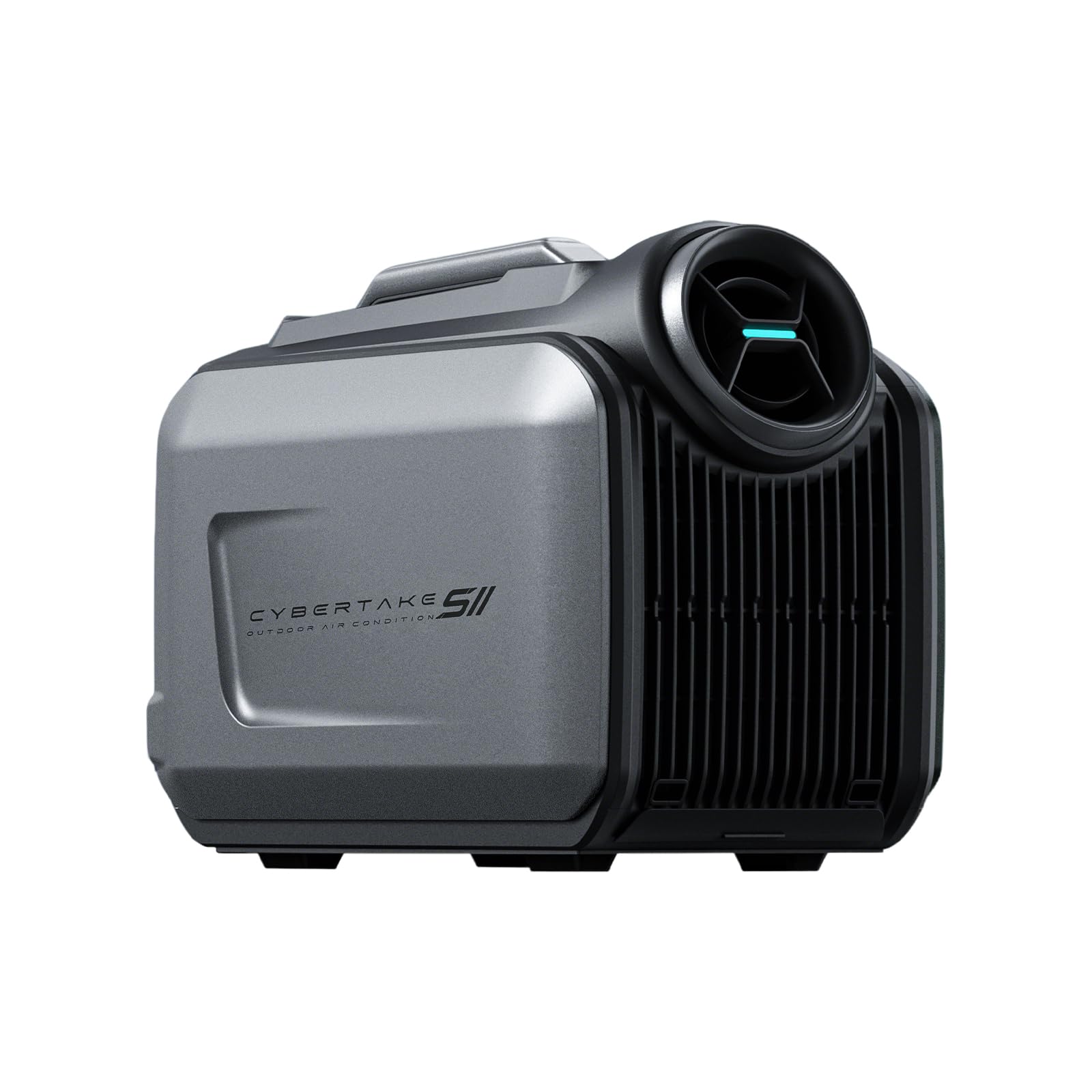
The Cybertake S2 Pro redefines portable AC for van life with a clever 3-way power system: it runs on standard 100-240V wall outlets, 12V/24V vehicle systems, and even 48V DC from a portable power station. This flexibility means you can use it as a standalone cooling unit in a tent on a weekend trip, then deploy it inside a van during a cross-country road trip without any permanent modifications. At 5100 BTU of cooling and 6100 BTU of heating, it’s best suited for small spaces—a short-wheelbase van or a rooftop tent—or as a supplementary zone cooler for a larger rig.
The unit is remarkably efficient in Eco+ mode, consuming roughly 1kWh over 8 hours, which translates to about 125W average draw. This is a fraction of the power a 10,000 BTU rooftop unit consumes, and it means you can run it all night from a 200Ah LiFePO4 battery without breaking a sweat. The IPX4 water-resistant shell and dual-duct setup mean you can place it on the floor, run the exhaust hose out a window, and have cold air circulating in under 30 seconds. Noise is claimed at 40 dB, and user reports confirm it is genuinely quiet—fine for a light sleeper in a tent or a van.
The primary caveat for van use: the product description mentions 12V/24V vehicle power, but the included plug is a standard AC wall plug. To power it directly from a 12V van system without an inverter, you need to buy a separate DC boost converter cable that the company sells optionally. This hidden cost can be a surprise for the budget-focused buyer. Additionally, at 5100 BTU, this unit is insufficient as the sole cooling source for a large, uninsulated van in direct sun—it is a comfort enhancer, not a replacement for a proper rooftop unit.
Why it’s great
- Extremely low power consumption (125W in Eco+ mode)
- Multi-voltage input (12V, 24V, 48V, AC) for total flexibility
- Quiet 40 dB operation and IPX4 weather resistance
Good to know
- 12V DC cable is optional, not included
- 5100 BTU is too low for large, hot vans
- Uses interior floor space and requires exhaust hose routing
5. TURBRO RV Air Conditioner, 15,000 BTU

The TURBRO S15 is a premium rooftop unit that stands out for its smart home integration and luxury touches. The 15,000 BTU cooling capacity is paired with a 9.6 EER rating, meaning it delivers high output without wasting power. The ceiling assembly includes an atmosphere lamp with white, blue, or yellow lighting, a subtle aesthetic upgrade over the standard white plastic grille. The unit can be controlled via a physical remote or a smartphone app, which allows you to turn on the AC remotely and set automation scenes—turn the AC on automatically when the inside temp hits 85°F, for example.
Noise is rated down to 52 dB, which is about the volume of a normal conversation, and the sleep mode further reduces fan noise for nighttime. The unit fits the standard 14.25″ x 14.25″ roof opening and is compatible with RVs, campers, and food trucks. TURBRO recommends pairing this unit with a soft starter if powering from a small generator like the Honda 2200W, because the startup surge of a 15,000 BTU compressor can trip the generator’s breaker. The sleek white shell and recessed side handles make it easy to carry and position on the roof.
The Achilles’ heel appears to be shipping and long-term reliability. Several buyers report units arriving with cracked plastic shells, and in one case, the replacement unit was a different (louder) model that failed after three weeks, leaving the owner with no AC in Florida summer heat. The WiFi setup process has confused some users, and the display is described as very bright with no dimming option, which can be annoying in a van at night. For the price, the TURBRO is the most feature-rich option, but only if you get a unit that arrives undamaged and holds up over time.
Why it’s great
- Smartphone app with remote start and automation scenes
- 15,000 BTU cooling plus 1,500W electric heating
- Mood lighting adds a premium interior feel
Good to know
- Inconsistent quality control; some units arrive damaged
- Very bright display with no dimming option
- Requires a soft starter for small generator use
6. Ivation 6,500 BTU Camper Air Conditioner

The Ivation is the best solution for the van dweller who wants air conditioning without cutting a hole in the roof or losing valuable window real estate. The saddle design places the compressor on the outside of the window sill while the main unit sits inside, preserving natural light and the ability to open the window fully. With 6,500 BTU cooling power, it’s adequate for a mid-size van or as a secondary unit in a larger rig—several users have successfully installed it over a front passenger window in a motorhome and reported it kept the space comfortable.
The split construction naturally decouples the noisy compressor from the interior, and the unit includes shockproof rubber dampers that reduce vibration transfer, resulting in genuinely quiet operation. The digital display allows temperature control between 60°F and 86°F, and the unit also functions as a fan and dehumidifier, which is beneficial for combating humidity in a small camper. Installation is tool-light—the kit includes brackets and hardware that clamp onto the window sill—and can be done in minutes without modifying the vehicle.
Drainage is a chronic issue: if the unit is not perfectly level, the interior section can leak water, and the included drain hose does not attach securely. Some early reviews also noted missing hardware pieces like screws and gaskets, which suggests inconsistent packing. For someone who is willing to adjust the angle with a shim and buy a better hose clamp, the Ivation is an elegant hack to bring window AC cooling to a van without permanent changes—perfect for renters or people who use their van as a daily driver and don’t want a roof pod.
Why it’s great
- No roof or wall modifications needed for installation
- Compressor stays outside for quieter interior
- Functions as AC, fan, and dehumidifier
Good to know
- Prone to interior water leaks if not perfectly level
- Hardware quality and packing are inconsistent
- 6,500 BTU is light for large, uninsulated vans
7. Outequip 10000 BTU 12V Rooftop AC (No Heater)
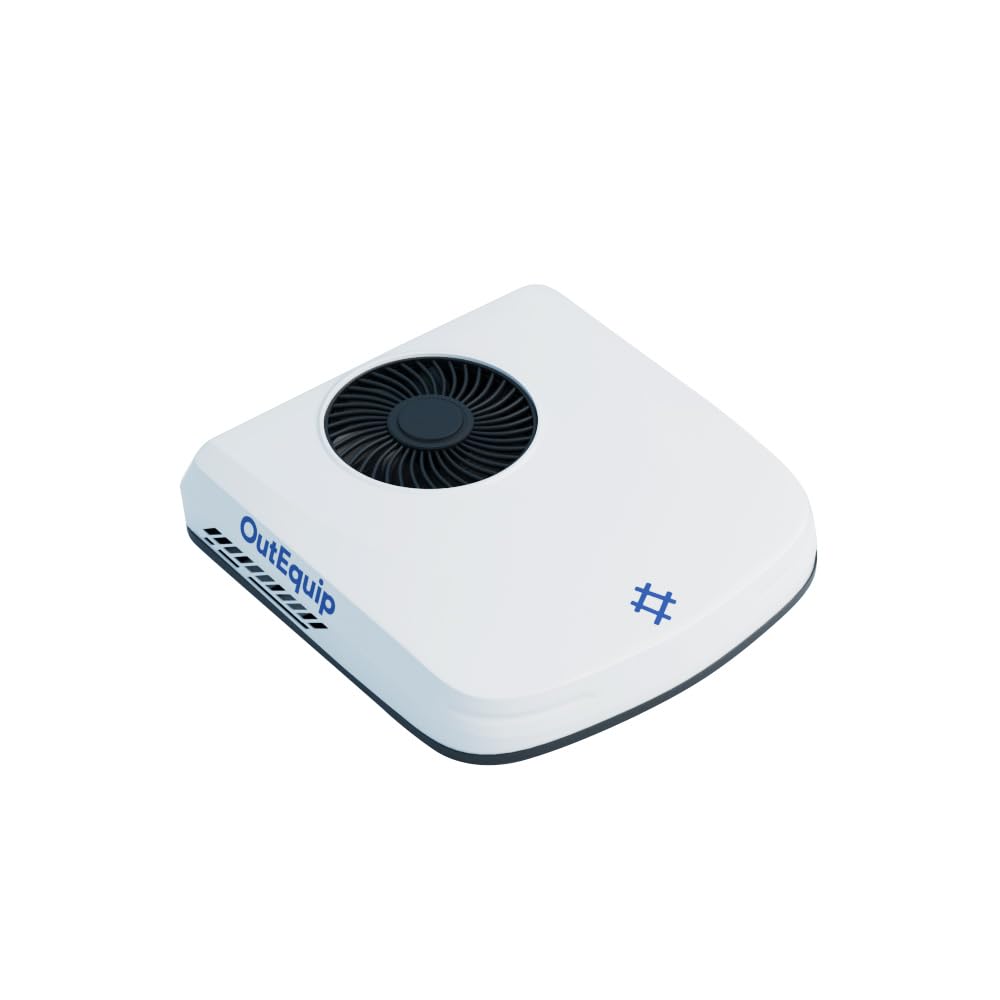
The Outequip 10,000 BTU rooftop unit is purpose-built for the serious off-grid van lifer who wants genuine 12V battery-powered cooling without the weight penalty of traditional RV units. At just 45 lbs, it is roughly half the weight of a standard Coleman or Dometic rooftop unit, which makes solo installation on a van roof feasible without a lift. The inverter-driven compressor draws around 50A in turbo mode and drops to about 20A in eco mode, giving a 480Ah battery bank roughly 8 hours of continuous cooling—enough for a full night’s sleep in a parking lot or forest.
The brushed DC copper motors and spring-supported mounts keep vibration to a minimum, and the unit measures 54 dB in normal operation, which is quiet enough for conversation. The multi-mode operation (ECO, Sleep, Turbo) lets you fine-tune the trade-off between noise and cooling speed. The UV-stabilized ABS housing and zinc-coated condenser are built to withstand highway debris and sun exposure, and the EPDM foam gasket provides a tight seal against the roof surface to prevent water ingress during rain.
Installation instructions are sparse, especially regarding the proper torque for mounting bolts. Over-tightening can crack the plastic pan, and the 8mm threaded rods included with the kit are too short for vans with thicker roofs (over 3 inches). Also, the unit only covers the 14″ x 14″ standard vent opening—if your van has a smaller roof fan, you will need to enlarge the cutout. For the van builder who reads the manual closely and buys longer all-thread rods ahead of time, the Outequip delivers class-leading efficiency and weight savings for a 12V system.
Why it’s great
- Very light weight (45 lbs) for easy solo roof install
- Draws only 20A in ECO mode for all-night battery runtime
- Durable UV-stabilized ABS and zinc-coated condenser
Good to know
- Included mounting bolts may be too short for thick roofs
- Installation instructions lack torque specs
- Only fits 14×14″ vent opening—may need roof modification
8. Gidrox 10000 BTU 12V DC RV Air Conditioner with Heater
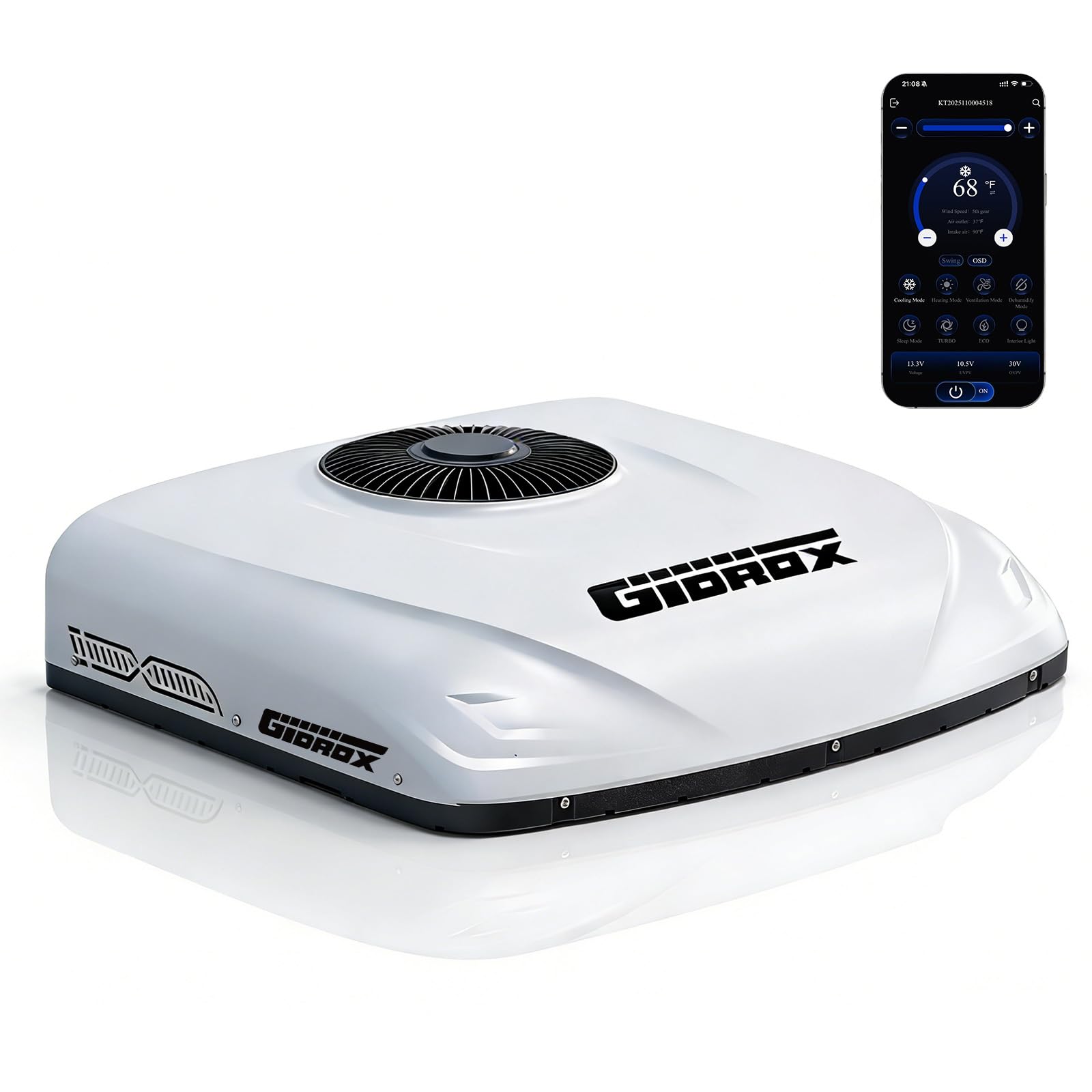
The Gidrox unit is engineered for van dwellers who deal with cold mornings as much as hot afternoons, thanks to its PTC ceramic heater that blows warm air within seconds of activation. The 12V inverter compressor runs directly off the house battery bank without an inverter, and the manufacturer claims an average nighttime power consumption of only 350W in 30°C ambient conditions—that’s about 29A, which a 400Ah lithium bank can comfortably support all night. The three operating modes (Turbo, ECO, Sleep) let you blast the space to temp quickly, then coast on low power.
The noise level is a standout feature: 40 dB in Sleep mode is genuinely library-quiet, making it one of the best options for light-sleeping van owners. The control options are equally flexible: you can use the physical buttons on the unit, the included IR remote, or a Bluetooth smartphone app that lets you monitor temperature, set timers, and switch between °C and °F without leaving your bed. The total unit weight is about 54 lbs, which is manageable for a two-person roof install.
The primary limitation is the overall build configuration: this is a split-type rooftop system (the compressor is in the roof shroud, the evaporator is in the ceiling panel), not a true all-in-one. The included 8mm threaded rods are generally adequate for standard RV roofs, but some users with thicker camper roofs (over 4 inches) had to source longer bolts and build a custom plenum to bridge the gap. The infrared remote also has a finicky line-of-sight sensor—point it at the correct angle or use the app instead.
Why it’s great
- PTC ceramic heater provides instant warm air in cold weather
- Ultra-quiet 40 dB sleep mode for undisturbed rest
- Bluetooth app control for remote temperature management
Good to know
- Thick roofs (4″+ ) may require custom longer bolts and plenum
- Infrared remote has a narrow line-of-sight reception angle
- Split design means two components to mount in the ceiling
9. Countrymod 10000 BTU 12V DC RV Air Conditioner
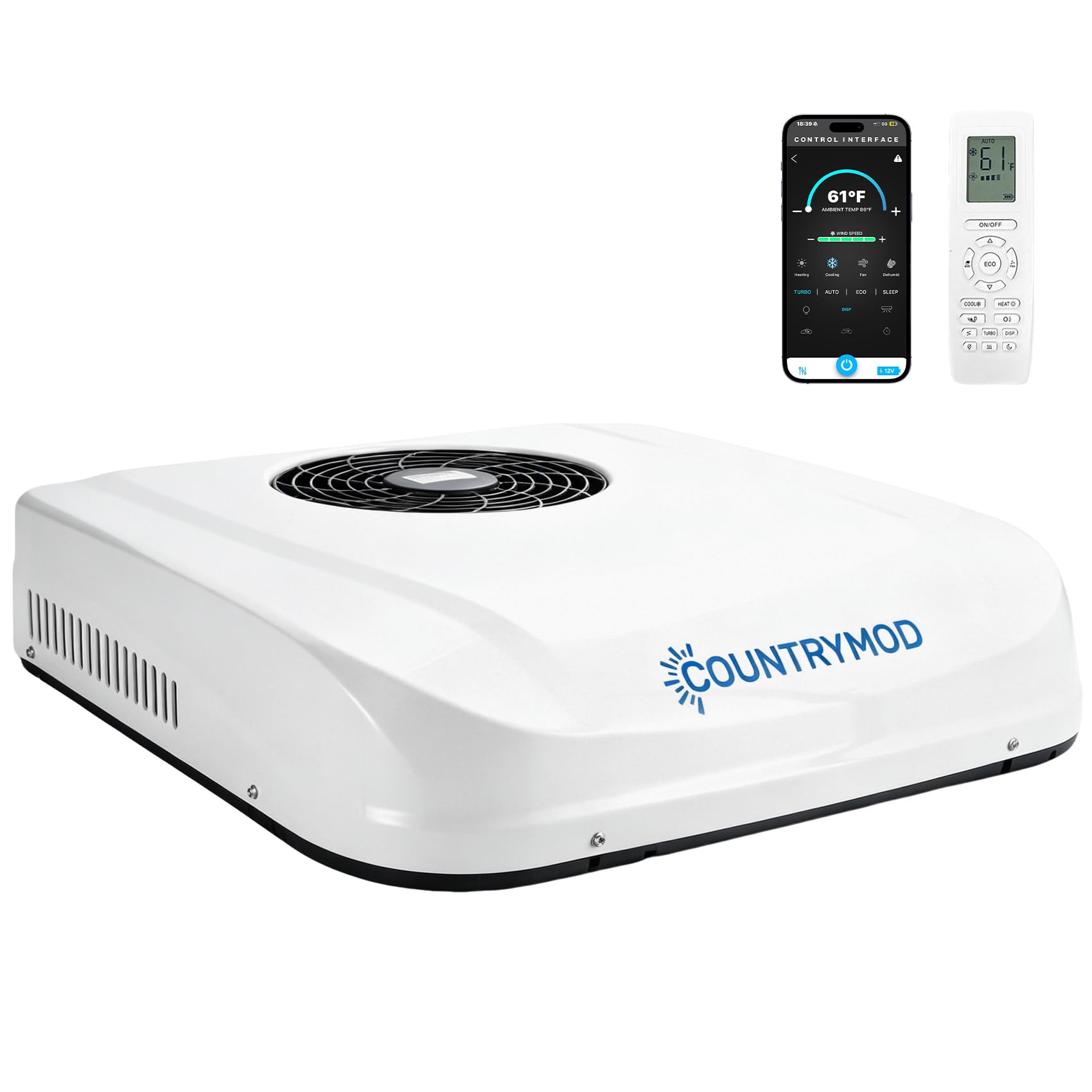
The Countrymod offers a compelling value proposition for the builder who wants an inverter-driven 12V rooftop unit without paying a premium for brand names. The horizontal compressor design reduces vibration and lowers the center of gravity compared to typical vertical compressors, which means less roof flex and potentially longer lifespan for the vehicle roof structure. At 0.3 kWh per hour average consumption, it’s about five times more efficient than a standard 1.5 kWh/hr rooftop unit, allowing a 480Ah battery to deliver about 19 hours of runtime before hitting 50% depth of discharge.
The noise range of 45–55 dB is competitive, with sleep mode at the lower end of that spectrum. The unit is also remarkably lightweight and compact, fitting a standard 14″ x 14″ vent opening. It is a ductless design, so installation involves mounting the shroud, connecting the 12V wiring, and sealing the roof—no ductwork modifications needed. The remote and touch control panel allow you to set temperature, fan speed, and mode without climbing onto the roof to reach a physical knob.
Installation is generally straightforward, but a few owners noted that the metric all-thread rods were too short for their thicker van roofs. The instructions are underwhelming and the corner bracket on some units broke at low torque (4.5 lb-ft), requiring a delicate touch. Despite these hiccups, the overwhelming majority of users praise the unit for its silent operation, efficient power use, and excellent customer support (Tony Allen from Countrymod is mentioned by name for solving a compressor cycling issue). For a budget-friendly yet efficient 12V AC, the Countrymod is a solid bet.
Why it’s great
- Very efficient 0.3 kWh/hr consumption for long battery life
- Horizontal compressor reduces vibration and roof stress
- Lightweight and compact for easy solo installation
Good to know
- Metric all-thread rods may be too short for thick roofs
- Corner brackets can break at low torque specs
- Instructions are minimal and could be clearer
10. Outequip 10000 BTU 12V Rooftop AC with Heater
The heated version of the Outequip rooftop unit mirrors the excellent off-grid efficiency of its cooling-only sibling but adds a 4,500 BTU PTC heater for chilly mornings. The standout physical attribute is the 6-inch low-profile roof shroud, which is about 2–3 inches shorter than traditional RV AC units. This makes a massive difference for stealth van builds—the unit is far less visible from ground level and reduces wind drag on the highway. At just 43 lbs, it is arguably the lightest full-featured 12V unit on the market, and the inverter technology draws as little as 300–350W in idle or eco mode.
The PTC heater is not a replacement for a proper diesel heater in freezing conditions, but it takes the edge off a 50°F morning or prevents fog buildup on windows. The unit accepts both 12V and 24V input, which is a huge advantage for builders running larger 24V battery banks—current drop over long cable runs is halved compared to 12V. Customer support from Outequip has received exceptional feedback, with one user reporting that the company swapped a 12V unit for a 24V unit after installation at no extra cost.
The main gripe from multiple installers is the difficulty of removing the lid screws during installation; the screws feel permanently bonded, and stripping them is common. The connectors are also reported to be fragile, with some breaking under normal handling. Once installed, however, the unit performs reliably in both cooling and heating modes. For the minimalist van builder who prioritizes a low roof profile and light weight above all else, the Outequip with heater is hard to beat.
Why it’s great
- Extremely low 6″ profile for stealth and aerodynamics
- Only 43 lbs total weight for easy mounting
- Dual-voltage (12V/24V) compatibility for building flexibility
Good to know
- Lid screws are very tight and prone to stripping
- Connectors are fragile and can break during install
- PTC heater is for “chill off” only, not sub-freezing temps
11. RecPro RV Air Conditioner 15K Ducted / Non-Ducted
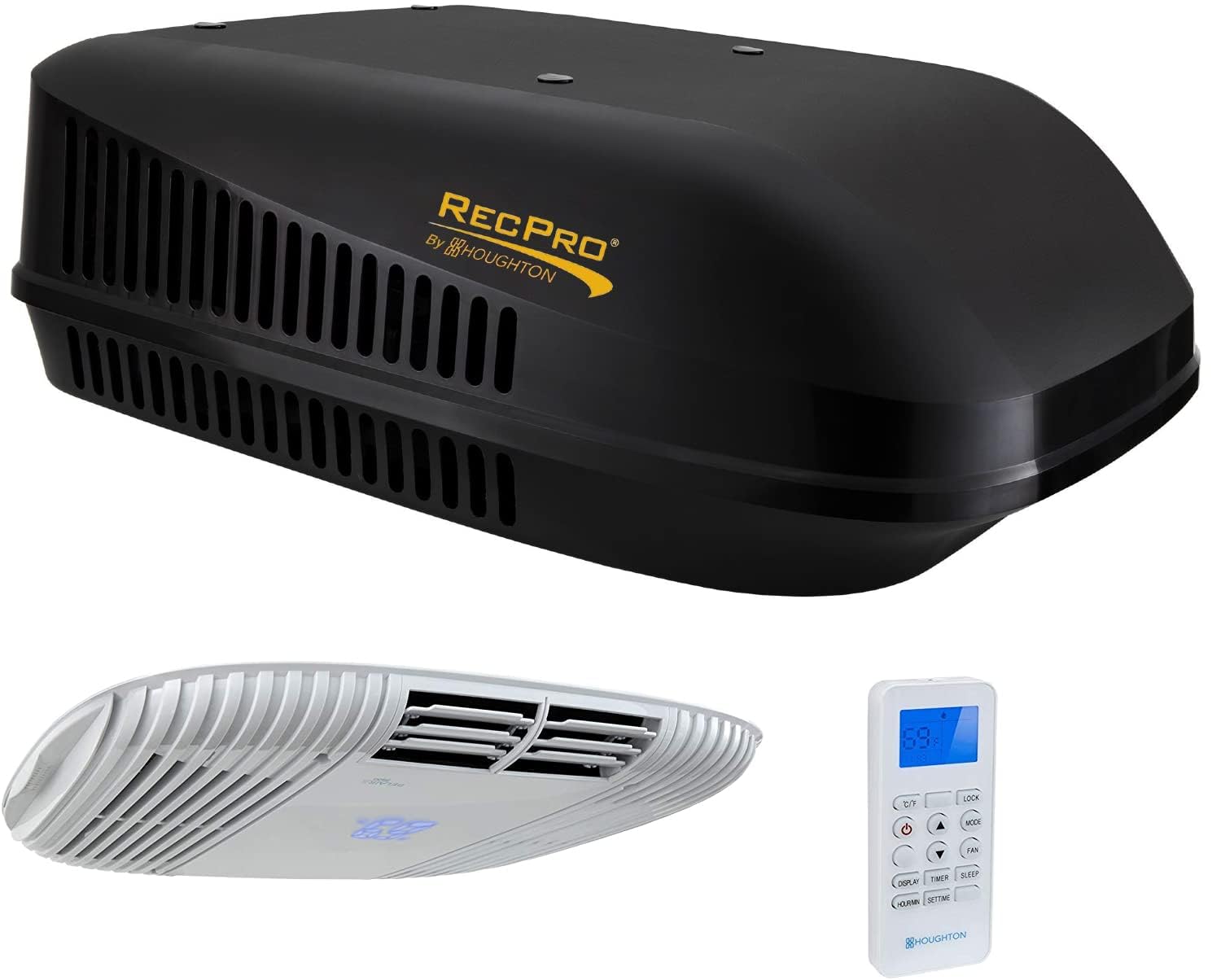
The RecPro 15K is the most versatile premium option on this list because it works with both ducted and non-ducted air distribution systems. This is critical for larger Class B+ vans or fifth wheels that already have ceiling ductwork for even airflow distribution across multiple rooms. The 15,000 BTU cooling capacity is paired with a built-in heat pump, providing genuine four-season comfort that goes beyond what a strip heater can achieve. The unit is built around a scroll compressor with a low amp draw design, making it compatible with solar and generator setups that have limited surge capacity.
The noise level is rated at 55.4 dB, which is slightly louder than the best inverter units but still quieter than older Dometic and Coleman models. The included multi-function remote and LED touchscreen allow full control of cooling, fan, dehumidify, sleep, and timer modes without needing a separate thermostat. The physical build quality is praised as superior to common OEM units, with better pipe layout that prevents chafing from vibration. The aerodynamic black or white shell reduces drag and UV degradation.
The main trade-off: this is a 120V AC unit, not a true 12V DC system. It requires a 120V power source (shore power, generator, or a large pure sine wave inverter). It is not designed for direct 12V battery operation, which limits its off-grid potential without a significant inverter and battery bank. For van dwellers who spend a lot of time at RV parks or have a massive electrical system, the RecPro offers unmatched flexibility in duct configuration and build quality. For pure boondockers, the 12V units above are a better fit.
Why it’s great
- Ducted and non-ducted compatible for complex van layouts
- Scroll compressor with low surge draw for generator use
- Heat pump provides warmth without a separate heater
Good to know
- Runs on 120V AC, not direct 12V DC battery power
- Requires a large inverter and battery bank for off-grid
- Plastic shell can develop cosmetic cracks in shipping
FAQ
Can I run a 12V AC directly from my van’s starter battery?
Do 12V rooftop AC units work with standard MaxxAir fan openings?
How many solar panels do I need to support a 12V AC in a van?
What gauge wire should I use for a 12V rooftop AC installation?
Final Thoughts: The Verdict
For most van builders, the 12v ac for van winner is the Treeligo 11000 BTU because its inverter compressor and heating functionality deliver genuine year-round comfort with a power draw that a 300Ah LiFePO4 bank can handle overnight. If you need a true split system to keep the roof clear, grab the Aspligo 10000 BTU Under Dash Kit. And for weight-obsessed stealth van builders who demand the lowest possible roof profile, nothing beats the Outequip 10000 BTU with Heater at just 43 lbs and a 6-inch shroud.