
A belt sander for knife sharpening is the fastest route to a razor edge, but only if the motor speed doesn’t overheat the steel and ruin the heat treatment. Unlike hand stones or pull-through sharpeners, a dedicated belt sander removes material aggressively, making quick work of dull blades, chips, and damaged edges—but the wrong belt speed turns a chef’s knife into scrap metal.
I’m Min — the co-founder and writer behind Gadgets Feed. I’ve spent hundreds of hours analyzing belt sander motor curves, platen materials, belt tracking mechanisms, and angle guide tolerances to find the models that deliver consistent results without compromising blade integrity.
Whether you are a professional knife maker, a home cook with a drawer full of dull blades, or a weekend warrior restoring vintage tools, this guide breaks down every critical spec so you can confidently choose the best belt sander knife sharpener for your workshop.
How To Choose The Best Belt Sander Knife Sharpener
The difference between a belt sander that delivers a hair-popping edge and one that destroys steel comes down to three things: motor speed control, belt selection, and the quality of the angle guide. Most beginners assume any belt sander works for knives, but that assumption ruins more blades than any other mistake.
Low Speed vs. High Speed Motors
Standard woodworking belt sanders spin at 3000–3600 RPM, which generates enough friction heat to soften the tempered edge of a knife within seconds. A dedicated knife sharpening belt sander should run at 1790 RPM or lower, or feature full variable speed control down to that range. Low-speed motors allow you to grind slowly without burning the steel, and they give you finer control over edge geometry.
Belt Size and Grit Progression
The 1×30 inch belt format is the industry standard for knife sharpening because it offers a narrow enough contact area for precise edge work while providing sufficient surface speed for efficient material removal. You need a sander that supports belts from coarse 60–80 grit for reshaping damaged edges through to 400+ grit and a leather strop for a mirror finish. Quick belt change mechanisms are essential here—you don’t want to spend five minutes swapping belts when switching grits.
Angle Guide and Platen Support
A solid, adjustable angle guide that locks between 10° and 45° is the difference between consistent bevels and wavy edges. The platen—the metal plate behind the belt—must be flat, rigid, and ideally made of steel or ceramic-coated aluminum. A flexible platen allows the belt to round over the edge, while a hard platen maintains a precise flat bevel. Look for a hardened steel platen that won’t wear grooves over hundreds of sharpenings.
Quick Comparison
On smaller screens, swipe sideways to see the full table.
| Model | Category | Best For | Key Spec | Amazon |
|---|---|---|---|---|
| Bucktool BS130 | Low-Speed Dedicated | Knife making & sharpening | 1790 RPM, 2.3A induction motor | Amazon |
| Goldsand GD-SDJ-8 | Variable-Speed Professional | Professional sharpening & metalwork | 550W motor, VFD, 5500 RPM max | Amazon |
| KFMK BD1600VS | Variable-Speed Combo | Versatile knife & wood sanding | 3/4 HP, 2000–3400 RPM disc | Amazon |
| Work Sharp MK2 | Compact Guided System | Entry-level kitchen & pocket knives | Two-speed motor, edge guide, 3yr warranty | Amazon |
| Wusthof Easy Edge | Push-Through Guided | Wusthof kitchen knife maintenance | 3-stage, one-touch pre-programmed | Amazon |
| Bucktool MM493C | Multi-Purpose Bench Sander | General wood & metal sanding | 1/3HP, 3590 RPM, 1×30 belt + 5″ disc | Amazon |
In‑Depth Reviews
1. Bucktool 2.3A Belt Sander, 1×30 Inch Low-Speed (BS130)
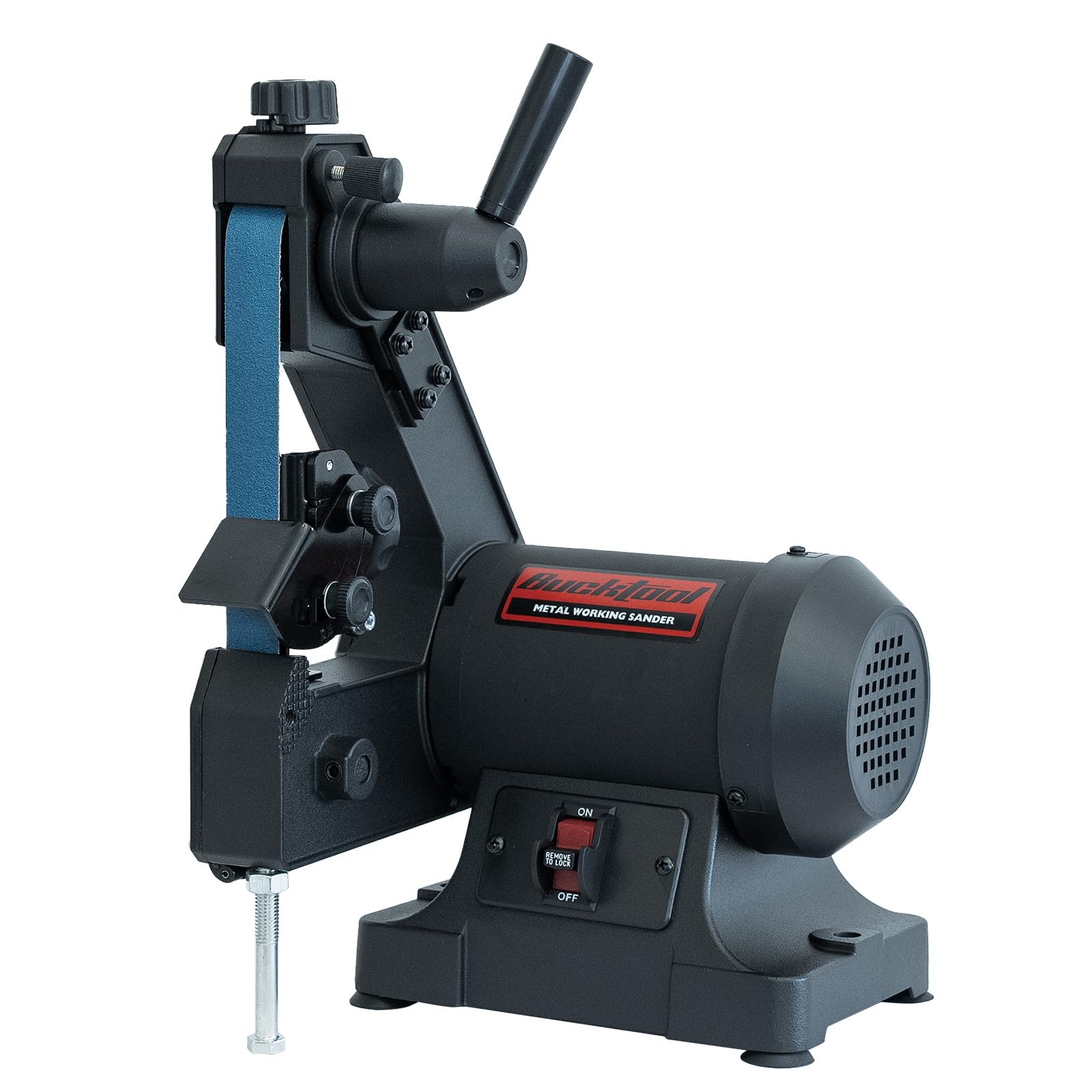
The Bucktool BS130 is the closest thing to a purpose-built knife sharpening belt sander at a mid-range price point. Its 1790 RPM induction motor runs at roughly half the speed of a standard woodworking belt sander, which means you can grind edge bevels without the steel ever turning blue from heat buildup. The 2.3A motor delivers consistent torque through the cut, and the one-button belt cover release paired with the quick-release belt tension system lets you swap between 80 grit and 400 grit belts in under 10 seconds.
The precision knife sharpening angle guide adjusts from 10° to 45° and locks solidly with a thumbscrew, making bevel consistency repeatable even for users who are new to belt sharpening. The removable safety key switch prevents accidental startups, which matters when you’re leaning into the belt with a freshly-ground edge. Reviewers consistently note that the belt only moves downward into the leading edge, which takes a moment to adjust to but provides excellent control once you’re used to it.
The vacuum port actually works effectively, keeping the fine metal dust from accumulating in the motor housing. The included 80 grit belt is coarse enough for reshaping damaged tips, and the machine runs cool enough that you can sharpen an entire set of kitchen knives without needing a cool-down break. For the combination of dedicated low-speed design, included angle guide, and solid build, this is the best option for anyone serious about knife sharpening.
Why it’s great
- True low-speed motor prevents blade overheating during extended grinding sessions
- Adjustable angle guide with locking mechanism enables repeatable bevel angles for consistent edges
- Quick-release belt system with tension relief handle allows sub-10-second grit changes
Good to know
- Belt only moves in downward direction, which requires learning a new hand position for some users
- Angle guide can be modified for larger bevels but out-of-box range is limited to 45° max
2. Goldsand Belt Sander Professional (GD-SDJ-8)
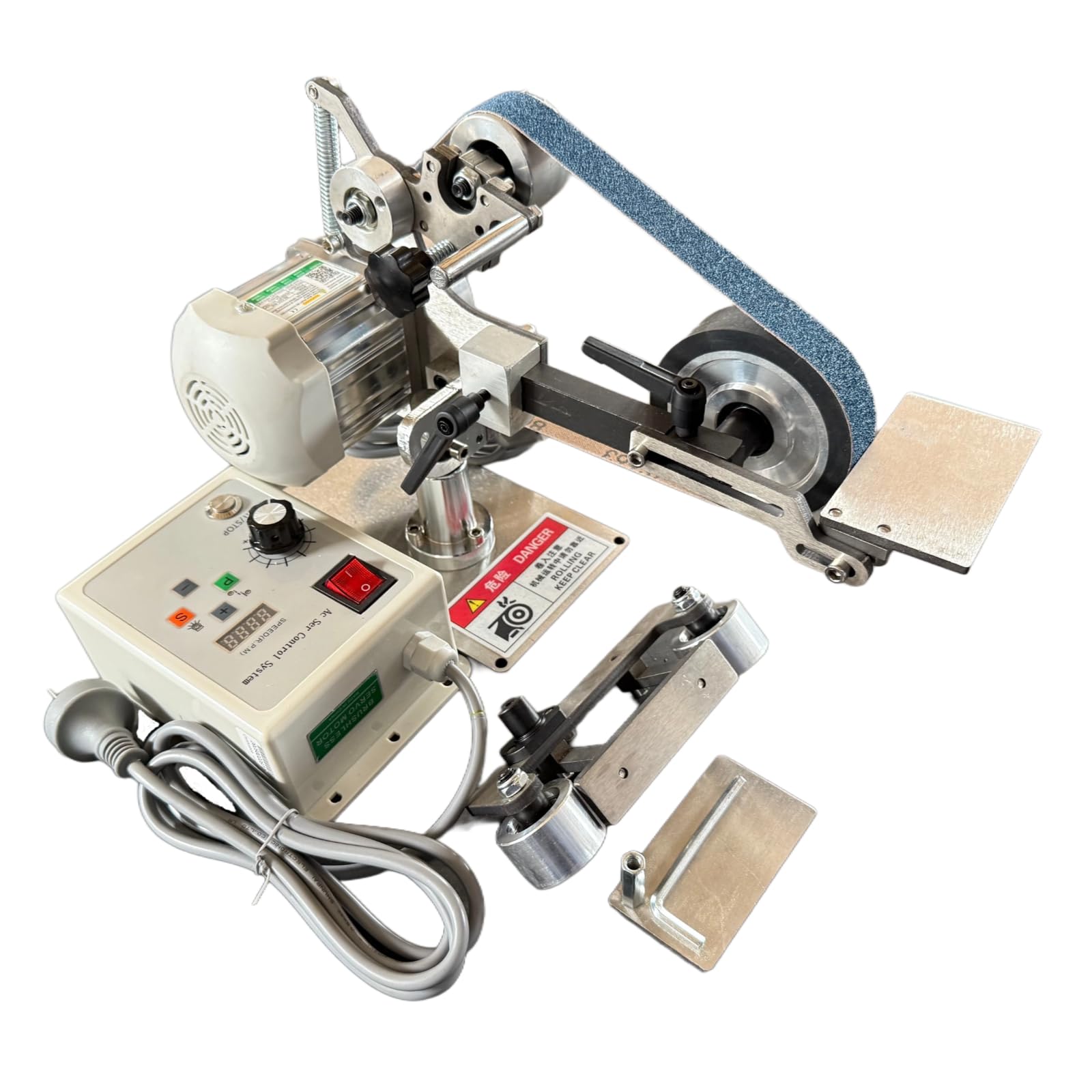
The Goldsand GD-SDJ-8 brings variable frequency drive (VFD) technology to the 1×30 belt sander format, giving you true stepless speed control from a crawl up to 5500 RPM. This is the only model in this lineup with a reverse function button, allowing you to switch belt direction instantly for grinding on both edges of the knife without flipping the blade. The 550W pure copper motor runs quieter than standard brushed motors and the VFD protects the motor from overheating during low-speed operation.
The sander includes three zirconia corundum belts at 100, 180, and 240 grit, covering the range from coarse profiling to medium finishing. The detachable workbench mounts at any angle, and when used with the flat rest, it creates perfect bevels with no guesswork—you set the angle and slide the blade against the belt. The vertical and horizontal support modes let you switch between freehand grinding and jig-guided work without any tools.
Professional sharpeners in customer reviews report using this machine in their knife sharpening businesses. The belt tracking is adjustable via a linkage system, though some users note that tracking in reverse mode is less stable and requires readjustment. The 17.42-pound steel frame provides excellent rigidity with minimal vibration, and the included control system unit allows fine-tuning of speed without any hidden menus. For the combination of VFD control, reverse function, and pro-grade build, this offers exceptional value for the price.
Why it’s great
- VFD stepless speed control lets you dial in exact RPM for heat-sensitive blade steels
- Push-button reverse function enables dual-edge grinding without repositioning the blade
- Includes 3 grit belts (100/180/240) and detachable workbench with multi-angle positioning
Good to know
- Belt tracking requires readjustment when switching between forward and reverse directions
- Assembly instructions are limited; studying the product photos is necessary for proper setup
3. KFMK Variable Speed 1″ x 30″ Belt & 6″ Disc Sander Combo (BD1600VS)
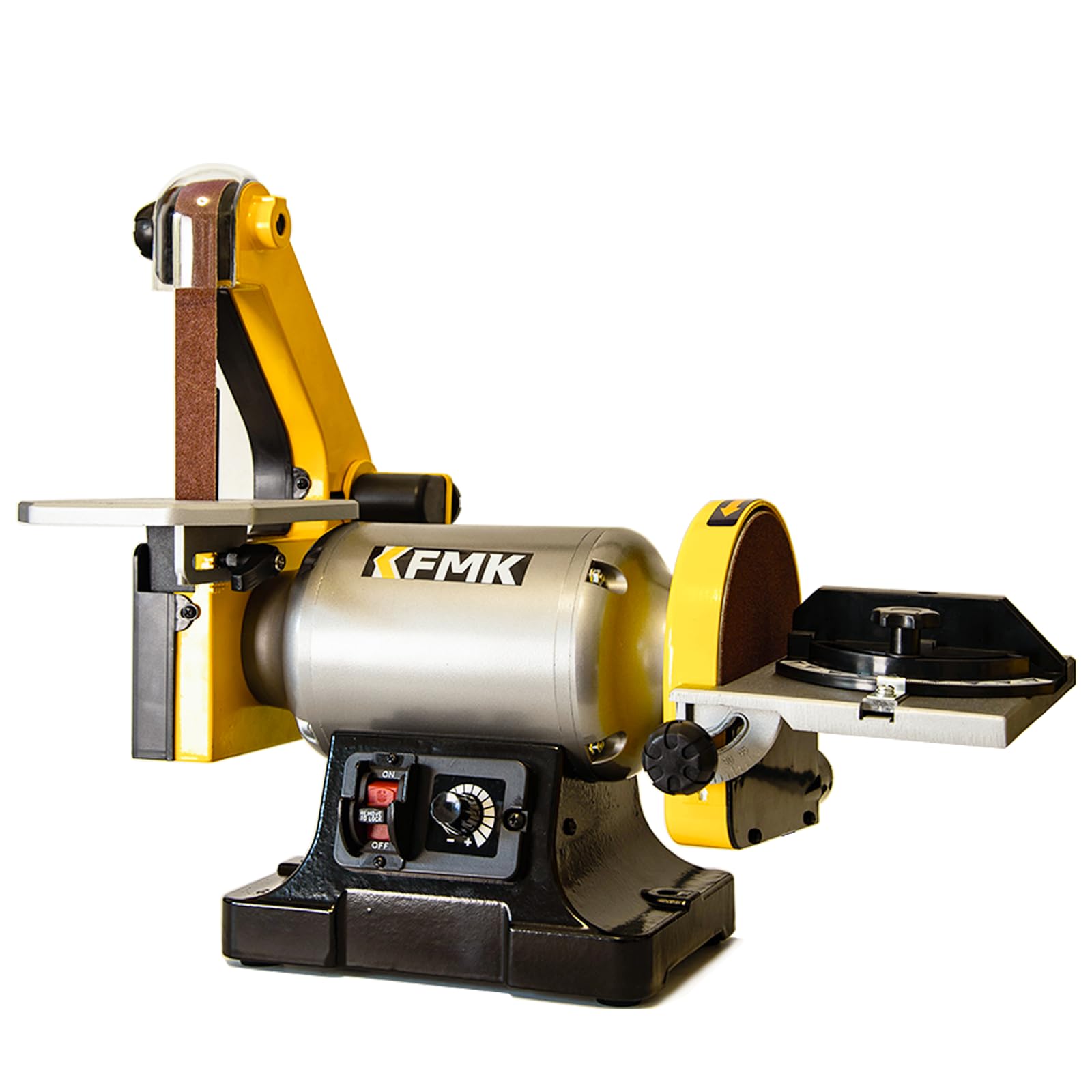
The KFMK BD1600VS combines a 1×30 belt sander with a 6-inch disc sander in a single benchtop unit, making it the most versatile option for users who need both knife sharpening capability and general woodworking sanding. The variable speed control adjusts the disc from 2000–3400 RPM and the belt from 1909–3248 SFPM, giving you the flexibility to slow down for delicate knife edge work or speed up for aggressive stock removal on wood handles.
The 3/4 HP direct-drive motor delivers consistent torque without the maintenance headaches of belt-driven systems. Both the belt and disc sides include solid aluminum work tables, and the disc table features a precise miter gauge for accurate angle sanding. The removable belt cover allows round-corner sanding when you need to contour knife handles, then snaps back on for straight-line sharpening work.
This is a solid choice for knife makers who also need a general-purpose sander for handle shaping and finishing. The disc side provides a stable flat surface for squaring blade tangs and beveling scales. Customer feedback highlights the quiet, smooth operation and the heavy build that stays planted on the bench. Note that the belt side rest table has uneven groove machining on some units, and the platen coating may wear faster than hardened steel alternatives. For users who want one machine that does both knife sharpening and wood sanding, this is the best compromise.
Why it’s great
- Variable speed belt and disc covers both heat-sensitive blade sharpening and aggressive wood removal
- 3/4 HP direct-drive motor provides consistent torque with less maintenance than belt-driven designs
- Dual sanding functions with removable belt cover enable knife handle contouring and edge work on one machine
Good to know
- Some units have uneven grooves on the belt side work table, requiring aftermarket replacement
- Platen coating wears through relatively quickly under frequent knife sharpening use
4. Work Sharp MK2 Electric Knife Sharpener & Replacement Belts
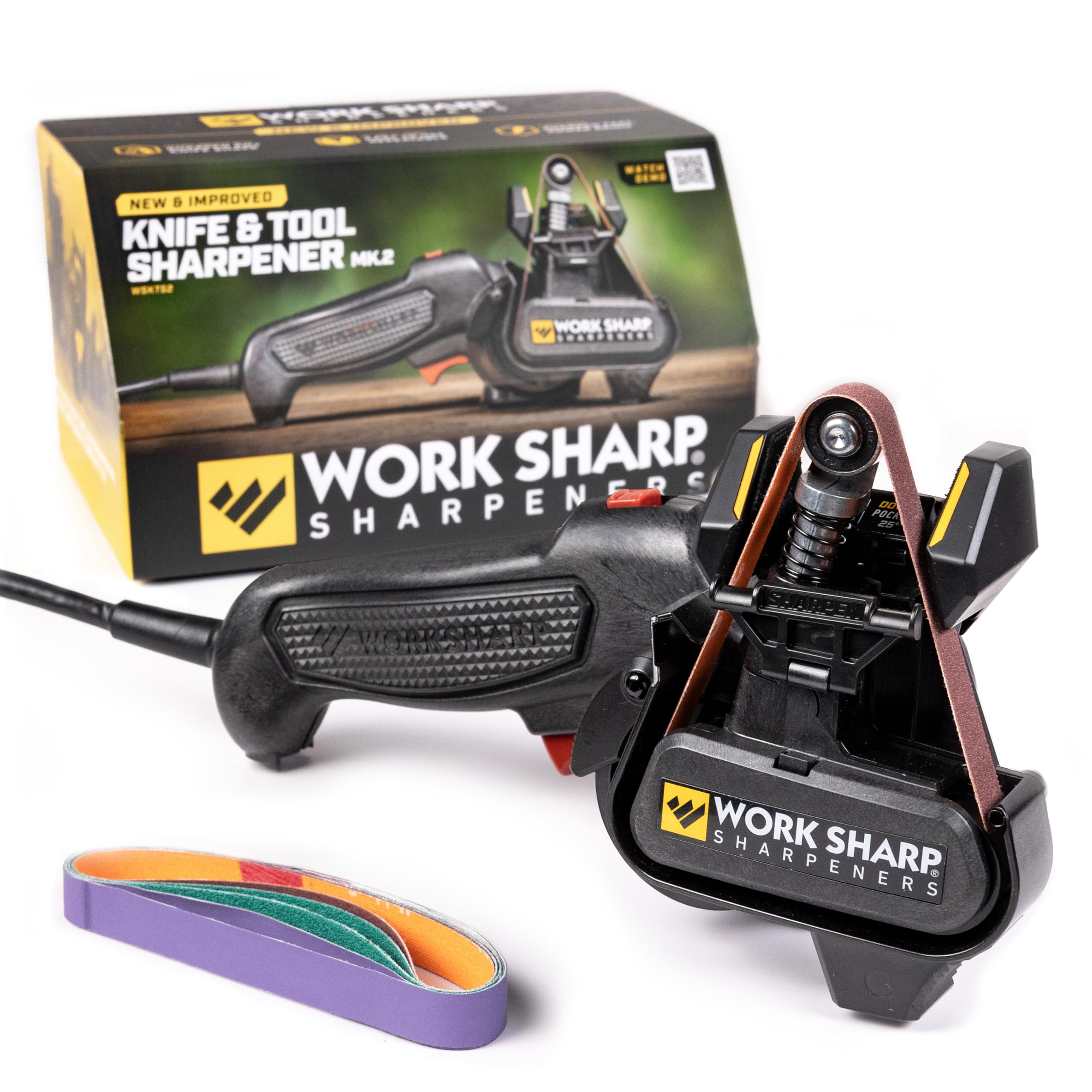
The Work Sharp MK2 is a compact guided belt sharpening system that delivers the ease of a pull-through sharpener with the edge quality of a belt sander. Unlike bench-mounted belt sanders, the MK2 sits on your countertop and uses interchangeable abrasive belts that conform to the edge geometry of any blade. The two-speed motor gives you a lower speed for fine sharpening and a higher speed for aggressive grinding on tools like axes and lawnmower blades.
The edge guide supports the knife all the way to the tip, making it nearly impossible to mess up the angle. First-time users report sharpening 10 knives in under 30 minutes with results comparable to professional service. The MK2 handles kitchen knives, serrated blades, pocket knives, scissors, shears, and even swords and machetes. It ships with extra belts and carries a comprehensive 3-year warranty from Work Sharp’s Oregon facility.
This is the ideal choice for home cooks and hobbyists who want the speed of belt sharpening without the learning curve of a bench-mounted sander. It won’t do everything a 1×30 bench sander can do—you can’t grind complex blade bevels or shape handles—but for maintaining sharp edges on your daily-use knives, it’s faster and more consistent than any stone system. The compact footprint means it lives on your countertop rather than in the garage.
Why it’s great
- Guided edge support system ensures consistent angles even for first-time belt sharpener users
- Two-speed motor handles everything from delicate kitchen knife edges to heavy tool grinding
- Compact countertop design takes up minimal space and requires no bench mounting
Good to know
- Belts wear faster than bench-mounted sanders due to the smaller belt surface area
- Not suitable for creating custom bevels or profiling blade shapes—fixed guide limits geometry
5. Wusthof Electric Knife Sharpener – Easy Edge

The Wusthof Easy Edge is a dedicated belt-based guided sharpener designed specifically for Wusthof knives, though it works with any standard European-style blade. The pre-programmed three-stage system walks you through shape, sharpen, and refine cycles with one-touch controls—there is no guesswork about angle selection or grit progression. The Shape button reprofiled damaged edges, the Sharpen button exposes a fresh cutting edge for monthly maintenance, and the Refine button polishes the edge for weekly touch-ups.
Made in the USA with a 3-year warranty, this sharpener uses the same belt technology as the Work Sharp but fully automates the process. The rubber o-ring guides that drive the belts are known to wear over time, but replacement 2-packs are available directly from Work Sharp (Darex LLC) for a reasonable cost. Asian-style knives with different edge angles require separate dedicated guides, which is a notable limitation.
This is the best option for owners of premium German kitchen knives who want a foolproof, repeatable sharpening process that doesn’t require practice or skill. One reviewer who owns thousand-dollar honing wheels still reaches for this as their daily driver. It’s limited to kitchen knife maintenance and won’t help with pocket knives, axes, or outdoor tools, but within its narrow lane, it delivers perfect edges every time.
Why it’s great
- Pre-programmed three-stage system eliminates all guesswork from the sharpening process
- One-touch controls with shape, sharpen, and refine cycles cover full edge restoration to daily maintenance
- Compact countertop footprint designed specifically for standard European kitchen knife angles
Good to know
- Rubber o-ring belt guides wear over time and require periodic replacement
- Does not support Asian-style knife edge angles without purchasing additional separate guides
6. Bucktool MM493C 1×30 Inch Bench Belt Sander with 5 Inch Disc

The Bucktool MM493C is a conventional 1×30 bench belt and disc sander running at 3590 RPM, making it a general-purpose tool for woodworking and light metalwork rather than a dedicated knife sharpener. The 1/3HP direct-drive motor delivers 25% more sanding efficiency than belt-driven alternatives at this price point, and the one-button belt cover removal combined with wrench storage makes it convenient for users who switch between sanding tasks frequently.
The 5-inch disc sander with an adjustable 0–45° work table provides stable flat sanding for squaring handles or beveling wood scales. The quick-release belt system simplifies belt changes, and the compact benchtop design fits small workshops. At 3590 RPM, this sander runs hot for knife sharpening—you would need to use very light pressure and a water drip or frequent dipping to avoid overheating the steel. Experienced users can manage it with coarse belts and careful technique, but beginners risk ruining blade temper.
This is the most budget-friendly option for users who need a belt sander primarily for wood and metalworking with occasional light knife sharpening. The sturdy metal enclosure, quiet operation, and easy belt tracking adjustment make it a solid value for the workshop. Stick to 80–120 grit belts for aggressive shaping and keep a cup of water nearby for cooling dips. It won’t match a low-speed dedicated sharpener for edge quality, but it gets the job done for basic maintenance.
Why it’s great
- Durable metal enclosure with quiet operation and stable belt tracking for workshop use
- One-button belt cover and integrated wrench storage improve workflow efficiency during task switching
- Includes both 1×30 belt and 5-inch disc sander for versatile wood and metal sanding
Good to know
- High 3590 RPM speed generates significant heat, requiring careful technique to avoid blade damage
- No included angle guide for knife sharpening—users must freehand or purchase a separate jig
FAQ
Can I use a regular woodworking belt sander for knife sharpening?
What belt grit progression should I use for sharpening kitchen knives?
How do I prevent the belt from wandering off the platen during sharpening?
Final Thoughts: The Verdict
For most users, the best belt sander knife sharpener winner is the Bucktool BS130 because its true low-speed 1790 RPM motor eliminates the risk of burning your blades while the included angle guide makes repeatable bevels easy for any skill level. If you want VFD variable speed control with reverse function for professional-level sharpening, grab the Goldsand GD-SDJ-8. And for countertop convenience with guided precision that fits kitchen use, nothing beats the Work Sharp MK2.