
That split-second when a warbler flits into the open, backlit by morning sun, is over before your phone camera can even lock focus. Birders know the crushing feeling of reviewing a blurry, grainy image that fails to capture the defining field marks that separate a Blackburnian from a Bay-breasted. A dedicated superzoom bridge camera solves this by delivering an optical reach that puts feather detail within arm’s length, even when the bird is perched a hundred yards away.
I’m Min — the co-founder and writer behind Gadgets Feed. I have spent more hours than I care to count elbow-deep in spec sheets, AF system architectures, and sensor comparisons for this very narrow category, cross-referencing real-world user results to separate marketing claims from genuine optical performance. This guide distills that research into a single clear verdict.
So whether you are a backyard enthusiast or a dedicated lister, the right choice here comes down to zoom range, autofocus speed, and stabilization — and this analysis of the best birding bridge camera will help you make that choice with confidence.
How To Choose The Best Birding Bridge Camera
Every birder wants that magazine-cover shot of a painted bunting in sharp detail. The bridge camera market delivers this through three critical pillars: raw optical reach, autofocus intelligence, and stabilization confidence. Get these right, and you will consistently bring home identifiable, frame-worthy images.
Optical Zoom Range: The Core Metric
Digital zoom is useless for serious birding — optical zoom is the only spec that counts. A 60x to 65x zoom (roughly 24-1560mm equivalent) is the entry point for reasonable warbler shots. Jump to 83x (24-2000mm) on the Nikon P950, and you gain the ability to fill the frame with a songbird at 50 meters. The Nikon P1000’s 125x (24-3000mm) is unmatched, but it demands a tripod or rock-steady technique at the long end.
Autofocus and Bird Detection Technology
A bird moving through dense branches requires fast, intelligent autofocus. Contrast-detection AF struggles in low contrast scenarios like a bird against a washed-out sky. Hybrid or phase-detect AF systems lock onto feather edges more reliably. Bird detection modes that prioritize avian subjects over background foliage reduce missed shots significantly, especially in the Panasonic Lumix FZ series models.
Image Stabilization for Handheld Shooting
At 2000mm equivalent, any hand tremor is magnified into a camera-wrecking blur. Dual stabilization (lens-shift plus digital) is essential. The Nikon P950 and P1000 use lens-shift VR that allows surprisingly sharp half-second exposures at full zoom. For walk-and-shoot birding along a trail, this feature alone determines whether your day yields keepers or deletes.
Quick Comparison
On smaller screens, swipe sideways to see the full table.
| Model | Category | Best For | Key Spec | Amazon |
|---|---|---|---|---|
| Nikon COOLPIX P1000 | Super-Telephoto | Extreme distance & moon shots | 125x / 24-3000mm optical zoom | Amazon |
| Nikon COOLPIX P950 | Long-Reach Pro | Dedicated birding with versatility | 83x / 24-2000mm optical zoom | Amazon |
| Canon Powershot SX70 HS | Mid-Range Performer | Balanced reach and portability | 65x / 21-1365mm optical zoom | Amazon |
| Panasonic Lumix FZ82D | High-Aperture Bridge | Low-light bare-branch perching birds | F2.8-5.9 / 20-1200mm lens | Amazon |
| Leica V-LUX 3 | Premium Compact | Optical purity at 600mm reach | 24x / 25-600mm Leica lens | Amazon |
| Panasonic LUMIX ZS99 (Black) | Compact Travel Zoom | Pocketable birding for travel | 30x / 24-720mm Leica lens | Amazon |
| Panasonic LUMIX ZS99 (Silver) | Compact Travel Zoom | Stylish pocket companion for birding | 30x / 24-720mm Leica lens | Amazon |
| Panasonic LUMIX ZS99 (Black Model) | Compact Travel Zoom | General wildlife & concerts | 30x / 24-720mm Leica lens | Amazon |
| Kodak PIXPRO AZ653 | Value Superzoom | Budget entry with decent reach | 65x / 24-1560mm optical zoom | Amazon |
| Minolta Pro Shot 20MP | Budget Stretch Zoom | First-time birder on a budget | 67x / 20-67x optical zoom | Amazon |
| Panasonic LUMIX TZ/ZS99 (White) | Compact Travel Zoom | Discreet birding in bright light | 30x / 24-720mm Leica lens | Amazon |
In‑Depth Reviews
1. Nikon COOLPIX P950

The Nikon P950 is the goldilocks superzoom for birders who need serious reach without the bulk of the P1000. Its 83x optical zoom (24-2000mm equivalent) pulls in warblers at 50 meters with enough resolution to distinguish subtle wing bars. The dedicated Bird Mode optimizes contrast and color for avian subjects, while the Dual Detect Optical Vibration Reduction delivers sharp handheld frames at half-press speeds where lesser cameras would blur.
Autofocus performance is the P950’s strongest differentiator versus its predecessor. The 399-point contrast-detection system acquires focus faster on small birds against busy foliage, and the manual focus ring (activated via a side switch) gives you precise override when the camera hunts for a heron in deep shadow. The 16MP sensor is modest by modern megapixel standards, but the combination of RAW output and Nikon’s EXPEED processing yields files that hold up well to cropping — a critical workflow for birders.
What seals the deal for serious birders is the rotating 3.2-inch LCD combined with the 2.36M-dot OLED electronic viewfinder. Shooting at low angles to catch a waterbird at pond level becomes effortless, and the EVF’s high refresh rate eliminates lag during burst sequences. The battery life is adequate for a full day’s outing, and the built-in Wi-Fi makes sharing a life-list shot to eBird seamless. For the birder who demands 2000mm of genuine optical reach without stepping into DSLR territory, this is the reference standard.
Why it’s great
- 83x optical zoom captures feather detail at extreme distances without heavy cropping
- Dual Detect image stabilization allows confident handheld shooting at 2000mm
- Bird Mode and RAW output provide field-ready flexibility
Good to know
- Autofocus can hunt on small birds against low-contrast sky backgrounds
- Small 1/2.3-inch sensor limits low-light performance compared to Micro Four Thirds
2. Nikon COOLPIX P1000
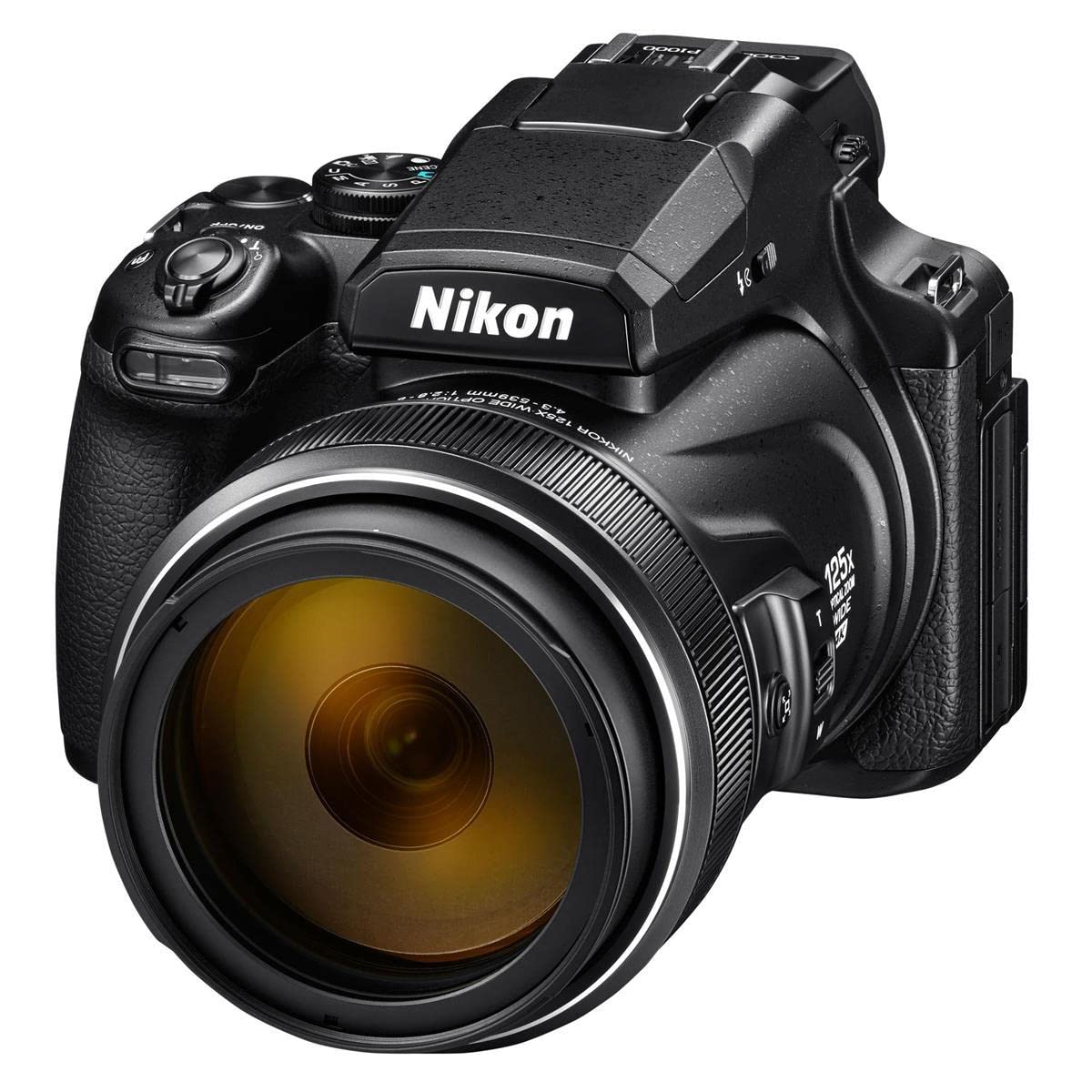
No other bridge camera on the market — birding or otherwise — offers 3000mm of genuine optical zoom. The Nikon P1000 is the undisputed king of extreme telephoto, capable of resolving individual feathers on a perched eagle at a quarter mile. Its 125x optical zoom (24-3000mm equivalent) is a purpose-built tool for the birder who needs identification shots of distant raptors or shorebirds that would otherwise require a thousand-dollar spotting scope.
The trade-off for this reach is physical size and weight — the P1000 is easily the largest and heaviest camera in this roundup. The Dual Detect Optical Vibration Reduction is effective, but beyond 1500mm, any hand movement is magnified, and a tripod becomes almost mandatory for critical sharpness. The autofocus system uses contrast detection across 100 points, and while it works well in good light, it struggles with birds in flight (BIF) — the acquisition speed simply is not fast enough for erratic swallows or fast-diving kingfishers.
Where the P1000 excels is stationary birds and the sheer thrill of the zoom. The rotating LCD, hot shoe for an external flash or microphone, and full manual controls (including bulb and time modes) appeal to birders who also dabble in astrophotography (the moon setting is a crowd-pleaser). For the dedicated lister who wants the absolute longest reach in a single-lens solution, the P1000 has no rival — but be prepared for the bulk and plan your support system accordingly.
Why it’s great
- Unmatched 3000mm optical zoom captures birds at distances no other bridge camera can reach
- Excellent moon and astrophotography modes for creative versatility
- Dual VR produces usable handheld results at mid-zoom ranges
Good to know
- Heavy and large construction discourages casual carry on long trails
- Contrast-detection AF lacks the speed for reliable birds-in-flight capture
3. Panasonic Lumix FZ82D

The Panasonic Lumix FZ82D takes a different approach from the Nikon long-reach strategy. Instead of chasing extreme zoom, it pairs a 60x optical zoom (20-1200mm equivalent) with a fast F2.8-F5.9 aperture that captures more light at the wide and mid-telephoto ranges. This makes it a compelling choice for birders who work in dim forest understories or during the low golden hours when many birds are most active.
The lens range covers the most practical birding distances — warblers in mid-canopy, herons at wetland edges — without the weight penalty of a 125x zoom. Panasonic’s 5-Axis Hybrid O.I.S.+ stabilization is among the best in class, allowing sharp images at 1/30th second at the telephoto end. The camera also includes a 4K Photo mode that extracts 8MP stills from 30fps bursts, useful for catching a bird in a dynamic pose rather than relying on a single shutter press.
One notable omission for modern users is the lack of built-in Wi-Fi. Transferring images requires removing the SD card and connecting to a computer, which adds friction to the workflow for eBird uploading. The camera body is compact for a bridge — lighter than the P950 or P1000 — but still provides a comfortable handgrip. For the budget-conscious birder who prioritizes low-light performance over raw zoom distance, the FZ82D punches well above its weight.
Why it’s great
- F2.8 wide aperture significantly improves low-light performance at shorter focal lengths
- 4K Photo mode captures rapid action sequences for dynamic bird poses
- Excellent 5-Axis stabilization reduces blur at slow shutter speeds
Good to know
- No built-in Wi-Fi — requires card reader or computer cable for image transfer
- Maximum 1200mm reach is less than Nikon competitors for extreme-distance subjects
4. Canon Powershot SX70 HS (Renewed)

The Canon Powershot SX70 HS pairs a 65x optical zoom (21-1365mm equivalent) with a 20.3MP CMOS sensor and the DIGIC 8 image processor, creating a balanced package for birders who want solid reach and fast processing. The 0.39-inch 2.36M-dot OLED electronic viewfinder is bright and responsive, making composition at full zoom much easier than relying on the rear LCD in bright sunlight.
Autofocus operates through a 99-point contrast-detection system that is reliable for stationary birds but can lose lock on fast-moving subjects. The camera does not include bird-specific subject detection, so tracking a finch through dense branches requires some practice. The optical image stabilization is effective at reducing shake at the telephoto end, and 4K video recording at 30fps with 4K time-lapse adds creative options for documenting bird behavior.
The SX70 HS is a renewed product, which means it often comes at a significant discount compared to new stock. Build quality feels solid, and the textured grip provides secure handling. For the birder who prefers Canon’s menu interface and color science, and who is comfortable with a renewed camera, the SX70 HS offers a compelling mid-range entry point for the best birding bridge camera conversation.
Why it’s great
- 65x optical zoom provides ample reach for most birding scenarios
- Bright OLED EVF aids composition in sunny field conditions
- 4K video and time-lapse modes add creative flexibility
Good to know
- Autofocus struggles to track birds in flight or fast-moving subjects
- Renewed units may show cosmetic wear or have inconsistent battery performance
5. Leica V-LUX 3

The Leica V-LUX 3 brings Leica’s legendary optical heritage to the bridge camera category with a 24x super telephoto zoom (25-600mm equivalent). While the 600mm reach is shorter than the superzooms above, the image quality from the Leica DC Vario-Elmarit lens is exceptional — edge-to-edge sharpness, minimal chromatic aberration, and color rendering that captures the subtle iridescence of a hummingbird’s gorget.
The 12.1MP sensor is dated by modern pixel-count standards, but the combination of a high-quality Leica lens and 12-bit RAW processing produces files that print beautifully at modest sizes. Autofocus uses contrast detection with 23 points, which is adequate for perched birds but not designed for action. The camera supports full-HD 1080p video and includes a built-in flash and hot shoe for external lighting.
Build quality feels lighter than expected — some users note the plastic construction lacks the heft of a premium DSLR, but this also translates to easy portability on long hikes. The V-LUX 3 is a niche choice for the purist who values Leica’s color science and lens quality above raw zoom distance. It is best suited for the birder who wants a compact, optically superb camera for close-to-mid-range field observations.
Why it’s great
- Leica optics deliver exceptional sharpness, color accuracy, and micro-contrast
- Compact and lightweight design for easy trail carry
- Versatile 25-600mm zoom covers most practical birding distances
Good to know
- 12.1MP resolution limits cropping potential compared to 20MP competitors
- 600mm maximum reach is insufficient for small birds at significant distance
6. Panasonic LUMIX ZS99 (Black)

The Panasonic LUMIX ZS99 (also known as the TZ99 outside the US) redefines what a birding bridge camera can be by fitting a 30x optical zoom (24-720mm equivalent) Leica lens into a genuinely pocket-size body. For the birder who refuses to compromise on pocketability, this camera slips into a jacket pocket or a small hip bag, making it the ultimate grab-and-go companion for impromptu birding walks.
Despite its small stature, the ZS99 delivers 4K video at 30fps and 4K Photo burst capture at 30fps, which extracts usable 8MP stills from moving subjects. The 20.3MP 1/2.3-inch sensor produces sharp images in good light, and the 5-Axis Hybrid O.I.S.+ stabilization works effectively given the camera’s compact design. The 1,840k-dot tiltable touchscreen allows low-angle compositions, though the lack of a built-in electronic viewfinder can make bright-sun framing a challenge.
The ZS99 is best suited for the birder who prioritizes portability and convenience above all else. The 720mm reach is enough for many backyard and park birding scenarios, and the Bluetooth 5.0 connectivity with a dedicated Send Image button makes sharing to eBird nearly effortless. It is not a substitute for a dedicated long-reach bridge like the P950, but for travel birding where every ounce matters, it is an outstanding compromise.
Why it’s great
- Pocketable design fits in a jacket — ideal for travel birding
- Leica 24-720mm zoom provides good reach in a tiny package
- 4K Photo burst mode captures action sequences effectively
Good to know
- No built-in EVF — rear LCD can wash out in bright sunlight
- 720mm maximum reach is limited compared to long-reach bridge cameras
7. Panasonic LUMIX ZS99 (Silver)

Identical in performance to its black counterpart, the Panasonic LUMIX ZS99 in silver adds a classic aesthetic appeal that stands out in a sea of black cameras. The 30x Leica DC Vario-Elmar zoom delivers the same 24-720mm equivalent reach, 4K video capture, and 5-Axis Hybrid O.I.S.+ stabilization that make the ZS99 platform so compelling for travel birding.
The tiltable touchscreen is responsive and bright enough for most conditions, though direct sunlight can still be problematic. USB-C charging is a welcome modern addition — the camera charges directly from a power bank, eliminating the need for a proprietary charger on multi-day birding trips. The dedicated Send Image button paired with Bluetooth 5.0 makes wireless transfer to a smartphone effortless for quick field notes.
For the birder who values aesthetics as much as functionality, the silver ZS99 offers a distinctive look that does not scream “photographer.” The pocketable form factor means it is always with you, ready to capture that unexpected lifer. It is functionally identical to the black version, so the choice comes down purely to personal preference — and for some, that silver body is worth the premium.
Why it’s great
- Classic silver finish stands out in a category dominated by black cameras
- USB-C charging simplifies power management during travel
- Compact enough for everyday carry without a dedicated camera bag
Good to know
- Same 720mm reach limitation as other compact travel zooms
- No viewfinder means composing in bright light requires careful screen angling
8. Panasonic LUMIX TZ/ZS99 (Black)

The Panasonic LUMIX TZ/ZS99 (black) is the same pocketable powerhouse as its ZS99 siblings but often comes at a slightly different price point depending on the seller. It shares the identical Leica 24-720mm equivalent zoom, 20.3MP sensor, 4K video capabilities, and USB-C charging that make this platform a travel birding essential.
One standout feature on this specific listing is the inclusion of Hybrid autofocus with 19 autofocus points, which provides slightly faster acquisition than the contrast-detection-only ZS99 variants. While still not as fast as a phase-detect DSLR system, the hybrid AF reduces hunting when focusing on birds against busy backgrounds. The tiltable 1,840k-dot touchscreen remains excellent for composing low-angle shots of waterfowl.
This version is particularly well-suited for the birder who wants the ZS99 platform at the best possible price. The camera accepts standard SD cards, and the Bluetooth 5.0 connectivity with the Panasonic Image App makes transferring images to a phone straightforward. It is the most practical pocket-zoom choice for birders who want a secondary camera that always fits in a pocket.
Why it’s great
- Hybrid autofocus system improves focus speed over contrast-only models
- Compact form factor fits effortlessly into most pockets and small bags
- Excellent Bluetooth image transfer workflow for quick eBird uploads
Good to know
- 30x zoom reach is still limited for small birds at long distances
- Low-light performance degrades at the telephoto end without a tripod
9. Kodak PIXPRO AZ653
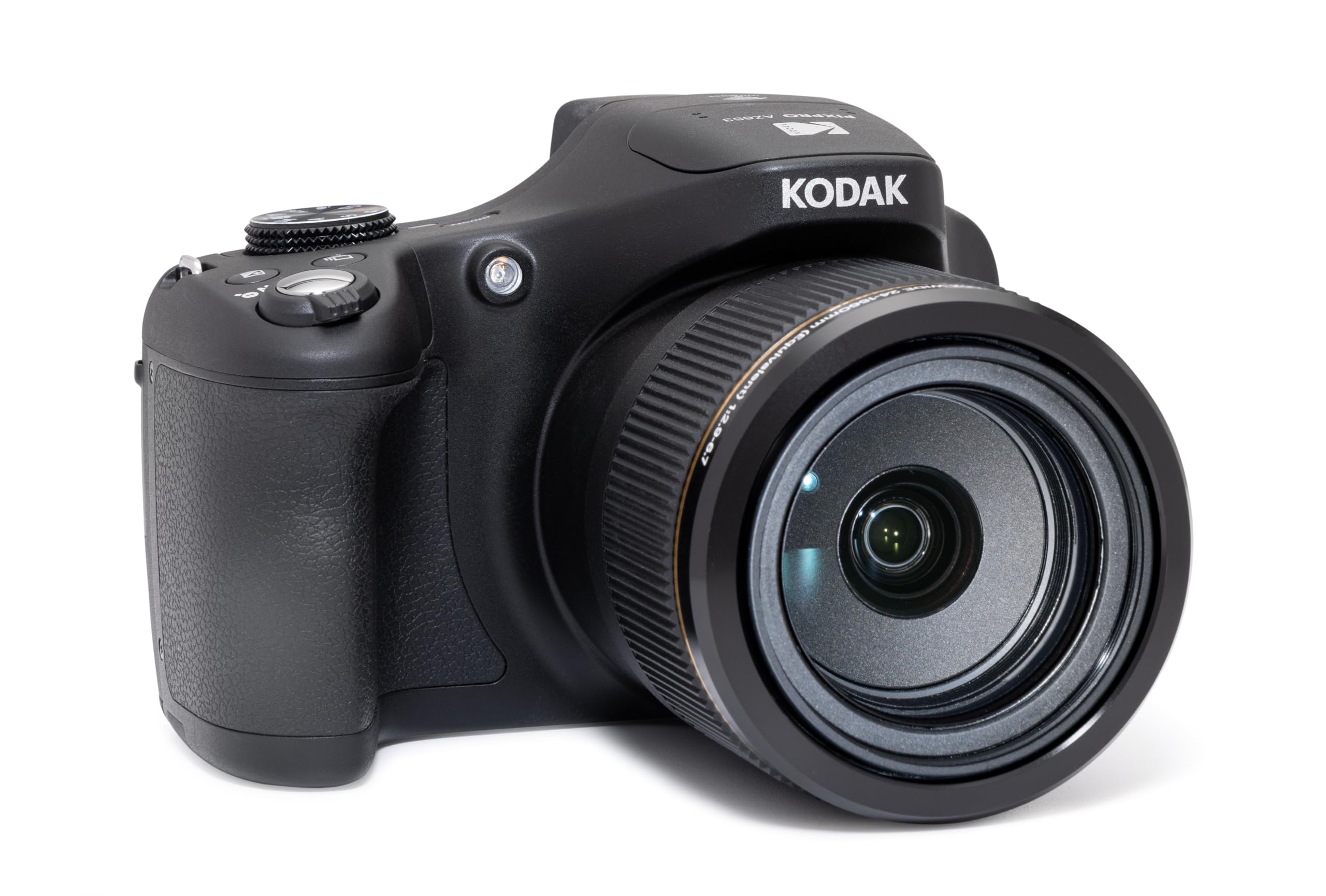
The Kodak PIXPRO AZ653 enters the birding bridge camera market with a strong value proposition: a 65x optical zoom (24-1560mm equivalent) paired with a 20MP BSI CMOS sensor at a price that undercuts most competitors. For the beginner birder who wants substantial zoom reach without a substantial investment, the AZ653 delivers an impressive focal length range that covers everything from wide landscapes to distant treetop perches.
The camera includes a 3-inch LCD and a diopter-adjustable electronic viewfinder, providing two framing options for different lighting conditions. Built-in optical image stabilization helps reduce shake at the telephoto end, though users report that a tripod becomes beneficial beyond 1000mm. The PIXPRO Remote Viewer app enables wireless sharing to a smartphone — a welcome feature at this price point that some pricier competitors lack.
Image quality is respectable for the price: the BSI CMOS sensor captures detailed images in good light, and the raw file support provides post-processing latitude. The autofocus uses contrast detection and is acceptable for stationary birds but will struggle with fast-moving subjects. For the backyard birder or someone teaching a child about bird identification, the AZ653 provides a low-friction entry into superzoom photography.
Why it’s great
- 65x optical zoom at a budget-friendly price point is unmatched value
- Wireless sharing app simplifies transferring images to a smartphone
- Electronic viewfinder and rear LCD offer dual composition options
Good to know
- Autofocus speed is inadequate for birds in flight or fast action
- Image stabilization is less effective than competitors at extreme zoom
10. Minolta Pro Shot 20MP

The Minolta Pro Shot 20MP camera offers a 67x optical zoom with a modest price tag that makes it accessible to the absolute beginner. It includes a 16GB SD card in the box — a thoughtful addition for someone buying their first superzoom. The articulating 3-inch 920K LCD screen provides useful flexibility for composing shots at awkward angles, such as pointing the lens up into a tree canopy.
Autofocus is a hybrid system with 493 points — a surprisingly high count for this price tier — and the optical image stabilization helps mitigate hand shake at the telephoto end. The camera records 1080p Full HD video at 30fps and includes 27 scene modes including fireworks, night portrait, and landscape. The Wi-Fi connectivity and companion app allow remote camera control, which can be useful for setup shots near a bird feeder.
Build quality and reliability have drawn mixed reports — some users report units with defects, so purchasing from a reputable seller with a good return policy is advised. Image quality is acceptable for web sharing and small prints, but the 20MP sensor’s performance in low light is mediocre. For the entry-level birder who wants to explore whether bridge camera photography suits them without a significant investment, the Minolta is a viable starting point.
Why it’s great
- 67x optical zoom provides substantial reach at an entry-level price
- Articulating LCD enables creative low-angle bird compositions
- Includes SD card, battery, and accessories for immediate out-of-box use
Good to know
- Quality control concerns reported — inspect unit on arrival
- Low-light performance and autofocus reliability lag behind premium options
11. Panasonic LUMIX TZ/ZS99 (White)

The white Panasonic LUMIX TZ/ZS99 offers the same compact Leica 30x zoom (24-720mm equivalent) and 4K video capabilities as its black siblings but in a bright white finish that is highly visible and less likely to heat up in direct sunlight. For the birder who spends long hours in the field under a hot sun, the white body reflects solar radiation better than dark finishes, keeping the camera slightly cooler during extended outdoor sessions.
All the core features are identical: the 20.3MP sensor, 5-Axis Hybrid O.I.S.+ stabilization, tiltable 1,840k-dot touchscreen, USB-C charging, and Bluetooth 5.0 connectivity. The 4K Photo mode captures 30fps bursts from which 8MP stills can be extracted — useful for documenting a bird’s distinctive flight pattern or behavior sequence. The compact size means it disappears into a jacket pocket or small hip pouch.
Autofocus performance is the same contrast-detection system used across the ZS99 line — adequate for perched and slow-moving birds but not designed for high-speed action. The lack of an EVF is the primary ergonomic compromise. For the birder who wants a pocketable travel camera in a bright, heat-reflective finish, the white TZ/ZS99 is a distinctive and practical choice.
Why it’s great
- White finish reflects heat and stays cooler during long field sessions
- Pocketable size makes it the most portable birding camera option
- 4K Photo burst mode captures action sequences for behavioral documentation
Good to know
- 720mm reach is insufficient for distant treetop birds or shorebirds
- No EVF and contrast-detection AF limit use in bright light and for action
FAQ
How much optical zoom do I really need for bird photography?
Can I use a bridge camera for birds in flight photography?
Is 16MP enough for bird photography when I need to crop heavily?
How important is image stabilization for birding bridge cameras?
Final Thoughts: The Verdict
For most users, the best birding bridge camera winner is the Nikon COOLPIX P950 because it offers the best balance of extreme 83x optical zoom, effective dual stabilization, dedicated Bird Mode, and a size that remains manageable for field use. If you want the absolute maximum reach for distant raptors and shorebirds, grab the Nikon COOLPIX P1000. And for the birder who values pocketability and travel convenience above all else, nothing beats the Panasonic LUMIX ZS99.