
A factory RV showerhead dribbles out a weak stream, the leveling jacks struggle on uneven gravel, and that first fill-up from a campground spigot tastes faintly of rust—these are the small frustrations that turn a getaway into a chore. The right accessories solve all three before you even leave the driveway.
I’m Min — the co-founder and writer behind Gadgets Feed. I’ve spent countless hours cross-referencing flow rates, material densities, and filtration certifications to find the gear that actually changes how an RV handles on the road and at the campsite.
This guide narrows hundreds of possible purchases down to seven proven upgrades so you can stop guessing and start rolling. Read on for the definitive breakdown of the best accessories for rv owners who want real results without overthinking.
How To Choose The Best Accessories For RV Living
An RV is a house that moves and a machine that breaks down—every accessory you buy should solve one of those two realities. The best picks tighten the home feel during camping and prevent mechanical nightmares on the highway. Ignore the fluffy marketing and focus on three areas: onboard comfort, external setup, and electrical protection.
Prioritize Comfort Upgrades First: Water & Temperature
The single biggest quality-of-life improvement comes from replacing the stock shower head. Look for a unit with a max flow rate around 1.8 GPM at 45 PSI—it saves tank water while delivering pressure strong enough to rinse thick hair. A pause button on the handle lets you soap up without losing the temperature setting. After water, address cabin temperature: a reflective windshield sunshade rated for large RV cutouts (102 x 51 inches or larger) will keep the dashboard cool and reduce the strain on your air conditioner during midday sun.
Stability & Safety on Uneven Ground
Leveling blocks and wheel chocks form a non-negotiable safety pair. For leveling, pick blocks made of polypropylene with UV stabilizers—the cheap recycled plastics crack under a heavy trailer’s tongue jack. Twelve blocks give you enough height variability for most campsite slopes. For wheel chocks, rubber blocks weighing roughly 1.35 pounds each with reflective strips offer the grip to hold a loaded travel trailer stationary, even on a sloped driveway or a gravel lot.
Don’t Skip the Electrical & Water Filtration Layers
A surge protector is cheap insurance for a repair that can run into the thousands. Look for a minimum 10,000-joule rating and a built-in circuit analyzer that checks for open ground or reverse polarity before you plug in. For drinking water, an inline filter with NSF 42 certification (kinetic degradation fluxion plus granular activated carbon) removes the chlorine taste and sediments that come from spigots in older parks. Two filter packs usually cover an entire camping season.
Quick Comparison
On smaller screens, swipe sideways to see the full table.
| Model | Category | Best For | Key Spec | Amazon |
|---|---|---|---|---|
| Awelife RV Shower Head | Shower System | Water pressure & conservation | 1.8 GPM @ 45 PSI | Amazon |
| Bringpure 2-Pack Water Filters | Water Filtration | Clean drinking water | NSF 42 certified | Amazon |
| OULEME 12-Pack Leveling Blocks | Leveling | Stable setup on uneven ground | 1.5-inch height per block | Amazon |
| WECARLLE 4-Pack Wheel Chocks | Safety Gear | Holding the rig in place | 1.35 lbs per chock | Amazon |
| Sudaya 8-Pack Collapsible Containers | Kitchen Storage | Space-saving food prep | 40.6 oz largest bin | Amazon |
| EPLCSE 30 Amp Surge Protector | Electrical | Power line safety | 10,000 Joules rating | Amazon |
| EcoNour RV Windshield Sunshade | Cabin Comfort | Heat and UV blocking | 102 x 51 inches | Amazon |
In‑Depth Reviews
1. Awelife RV Shower Head with Hose

The Awelife shower head delivers the highest pressure-to-flow ratio we tested among RV-specific units. At 1.8 GPM it uses 28% less water than the standard 2.5 GPM OEM shower head, yet the five spray modes produce a stream strong enough to feel like a home shower. The real trick is the water pause button on the handle—push it to stop flow mid-shampoo and the temperature stays locked, so you never blast yourself with cold water when you toggle back on.
Installation genuinely takes five minutes. The kit includes a hand-tighten connector, Teflon tape, and an adhesive-backed bracket for no-drill mounting on fiberglass walls. The 60-inch PVC hose is kink-free and threaded with brass fittings that won’t snap under repeated camper vibration. Multiple buyer reports confirm the bracket’s adhesive holds firmly even after months of travel on bumpy roads.
For anyone whose RV habit involves rinsing long hair or a tall partner, this head solves the two biggest annoyances: low pressure and short hot-water windows. The matte black finish hides water spots better than chrome, and the included hose guide ring stops the line from sloshing against the wall. For the price, nothing else in this category matches its output.
Why it’s great
- True high-pressure spray at a tank-saving 1.8 GPM flow rate
- Handle pause button holds temperature when you soap up
- No-drill adhesive bracket holds firmly on RV walls
Good to know
- Body is ABS plastic, not all-metal
- Adhesive bracket may require cleaning the wall surface first
2. Bringpure 2-Pack RV Inline Water Filters

Municipal campground spigots often carry residual chlorine, sediment, and trace heavy metals that give fresh fill-ups a chemical taste. The Bringpure filter uses a two-stage media bed—Kinetic Degradation Fluxion (KDF) for heavy metals and Granular Activated Carbon (GAC) for chlorine and odor—to turn any hose connection into potable water. The NSF 42 certification confirms it actually reduces the contaminants it claims to target.
Each filter cartridge handles roughly 20,000 gallons, so the two-pack in this set covers an entire camping season without replacements. Installation is twist-on: the included hose protector (a braided sleeve) fits between the spigot and the filter housing, then your drinking hose screws into the outlet. No tools, no Teflon tape, no permanent plumbing changes. The transparent housing also lets you see when the media starts clouding, which is a reliable indicator it’s nearing capacity.
Owners report that water from questionable spigots tastes noticeably cleaner, and the filter removes enough sediment to prevent the RV’s built-in water pump screen from clogging. The only caution is to support the filter housing with a strap or bungee—the plastic threads on the inlet can crack if the heavy filter hangs unsupported at an angle.
Why it’s great
- NSF 42 certified for chlorine, lead, and odor reduction
- Twist-on installation requires zero tools
- Two-pack covers a full season of camping trips
Good to know
- Inlet threads are plastic, not brass—support the housing to prevent cracking
- Not designed for freezing temperatures
3. OULEME 12-Pack RV Leveling Blocks
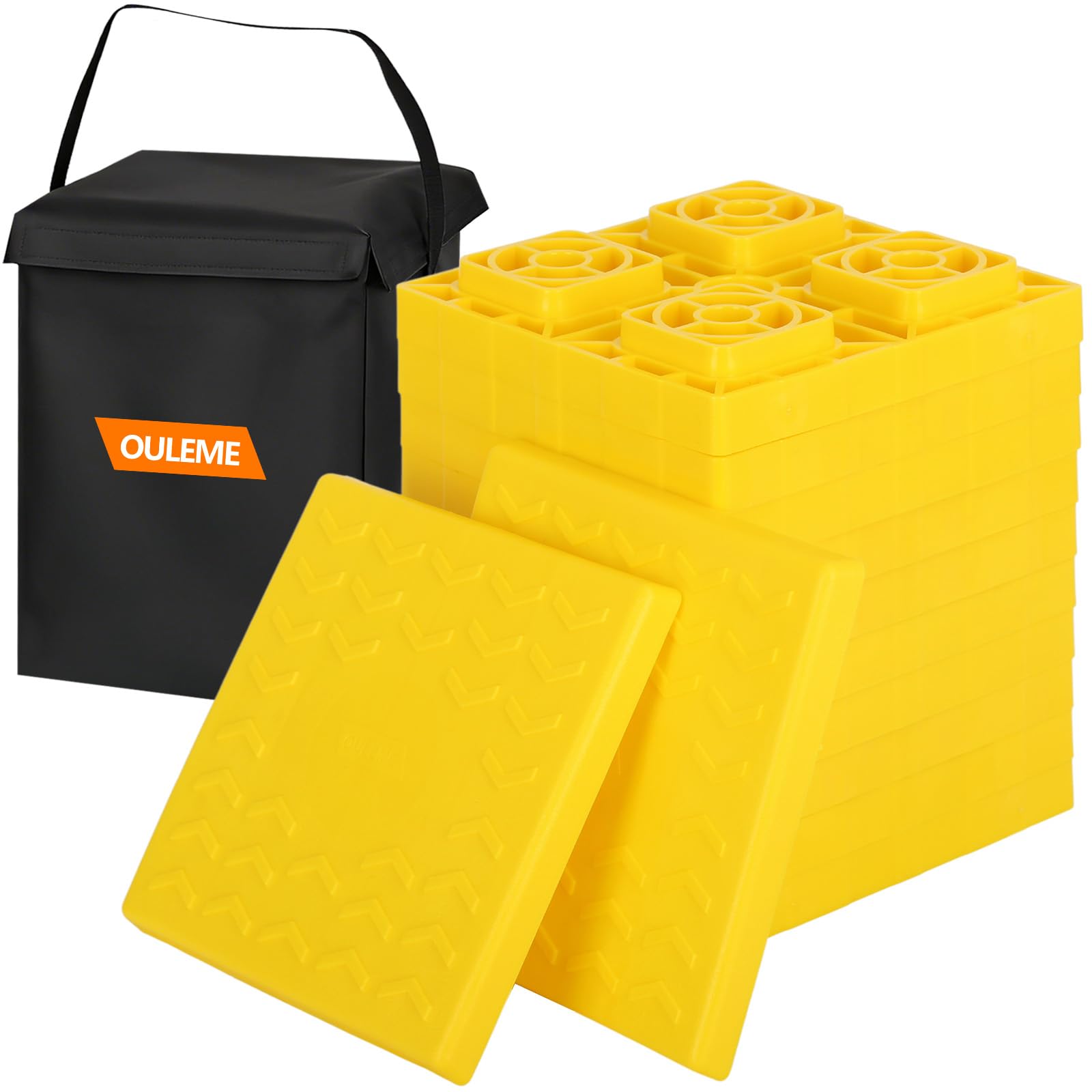
The OULEME set contains ten interlocking blocks and two top blocks, each measuring 8.5 inches square and 1.5 inches thick. The material is polypropylene with anti-UV aging additives—a meaningful upgrade over the recycled plastic that turns brittle after two seasons in direct sun. Users stacking six blocks under a stabilizer jack report zero cracking, even with a heavy travel trailer settled on top.
Each block interlocks via molded tab-and-slot edges, so the stack stays aligned as you drive the tongue jack up. The textured top surface provides enough grip that the jack foot won’t slide sideways on a sloped campsite. When you pack up, the entire twelve-block stack slides into the included carrying bag, which zips closed and fits neatly into a storage bay. Owners praise the convenience of having exactly the right number of blocks to level a single-axle trailer without digging for extra cribbing.
A small fraction of users noted the blocks can shift slightly if the stack height exceeds eight inches on soft ground. Placing a wide base plate under the stack or driving a single screw into the ground beside the bottom block solves this. For the majority of pavement and gravel lots, these blocks hold the rig solid with no creep.
Why it’s great
- Interlocking design prevents stack slippage during leveling
- UV-stabilized polypropylene won’t crack from sun exposure
- Twelve blocks provide custom heights for most camper slopes
Good to know
- Can slip slightly on very soft ground above 8-inch stacks
- Top blocks have a different thickness (0.7″) than the main blocks (1.5″)
4. WECARLLE 4-Pack Wheel Chocks

Each chock in this four-pack measures 6.5 x 5 x 5 inches and weighs roughly 1.35 pounds—heavy enough to bite into asphalt or gravel without being a pain to carry. The rubber compound provides a high coefficient of friction that holds a 30-foot travel trailer steady even on moderate slopes. Three yellow reflective strips wrap around each chock, making them visible from a distance when you’re backing into a dark campsite or a dimly lit storage lot.
Every chock comes with a pre-attached rope tether, so you can link front and rear chocks together or loop them around a tire’s sidewall to keep the set from wandering off during setup. Buyers report that the rubber stays pliable in cold weather and doesn’t harden into a skid slab the way cheaper PVC chocks do. The rope tethers also double as a pull handle to yank the chock out from under the tire when it’s time to leave.
The only trade-off is that the rubber material leaves subtle black marks on concrete after extended parking, though most campground surfaces are gravel or dirt where this doesn’t matter. For the price of a two-axle protection set (four chocks), these offer more grip and visibility than any one-piece plastic chock we’ve tested.
Why it’s great
- Rubber grip holds trailers steady on sloped asphalt and gravel
- Reflective strips provide high visibility in low-light conditions
- Rope tethers keep chocks paired and easy to remove
Good to know
- Rubber can leave marks on clean concrete surfaces
- Heaviest in the class at 5.4 lbs for the 4-pack
5. Sudaya 8-Pack Collapsible Food Storage Containers

An RV galley has precious few cubic inches of cabinet space, and rigid plastic containers waste most of it. The Sudaya eight-pack solves this with food-grade silicone bodies that collapse to a fraction of their expanded height when empty. Four sizes span 12, 17, 27, and 40.6 ounces—enough range to hold a lunch’s worth of berries or a full night’s leftovers from dinner.
The silicone is rated from -4°F to 428°F, so the bases survive freezer storage and microwave reheating (lids are not microwave-safe—they must be removed before heating). Each lid snaps down with a four-point seal that keeps liquids from leaking during transit on bumpy roads. After six months of use, buyers report the stain-resistant surface doesn’t hold tomato sauce or turmeric color the way cheaper silicones do. Stacking them flat after collapsing reclaims around 60% of the cabinet volume they would otherwise occupy.
Because weight matters in an RV, the entire set weighs a fraction of what glass or thick Tritan containers would. The lids require firm pressure to seal completely, and some users find they pop open if the container is overfilled and laid on its side, but for dry ingredients and leftovers stored upright, the seal holds reliably.
Why it’s great
- Collapses to save 60% cabinet space when not in use
- Heat-safe silicone base works in microwave and freezer
- Four-point lid seal prevents leaks during road travel
Good to know
- Lids cannot be microwaved
- Lids can pop off if container is laid sideways when overfilled
6. EPLCSE RV Surge Protector 30 Amp
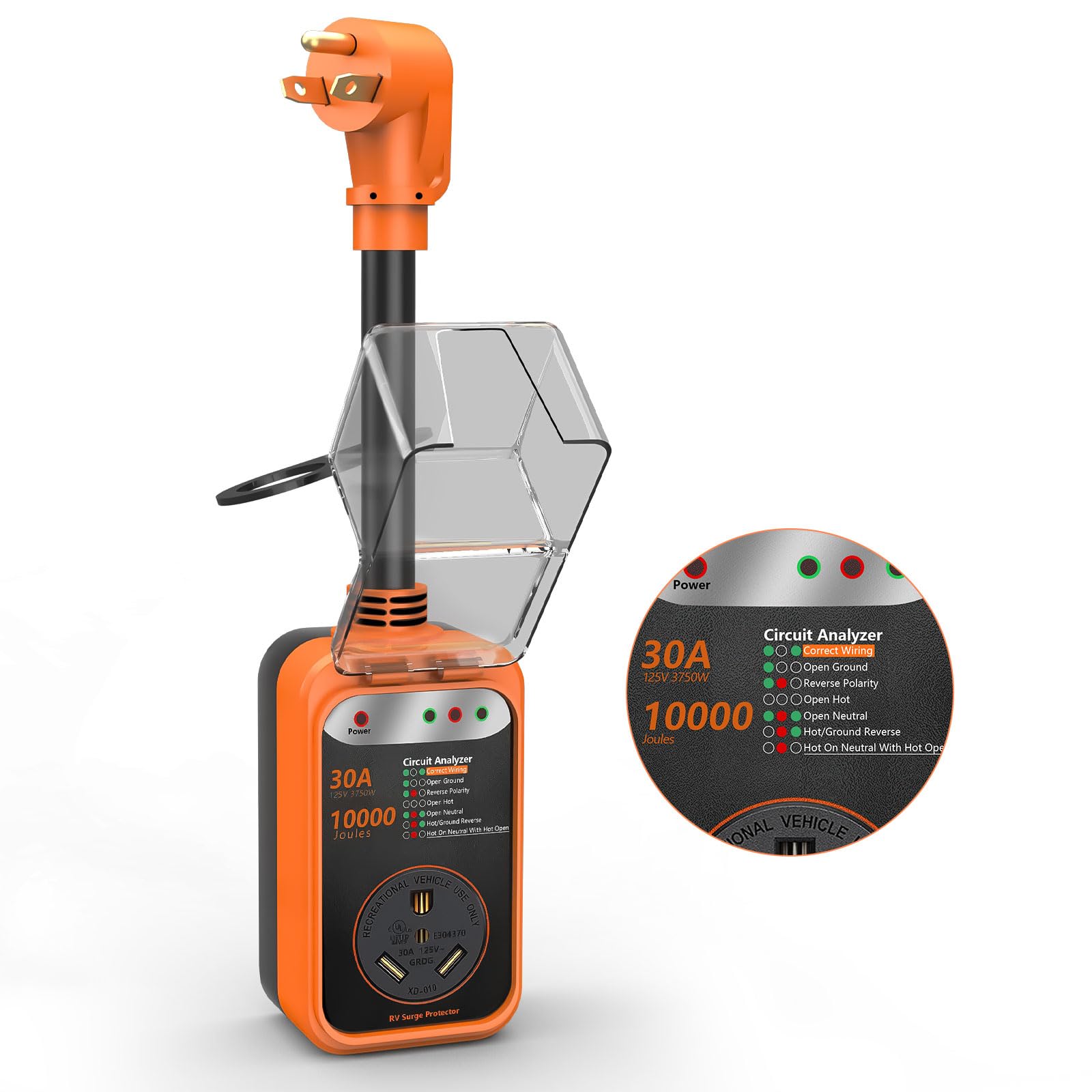
A single voltage spike from a campground pedestal can fry the converter, the inverter, and every appliance on the 12-volt side—and that repair bill will exceed the cost of this protector many times over. The EPLCSE unit handles up to 10,000 joules of surge energy and includes a built-in circuit analyzer that illuminates a color-coded LED matrix to show wiring faults: open ground, reverse polarity, open neutral, and correct wiring. If the pedestal power is bad, you see it before the RV’s breaker box ever closes.
The housing is made from V-1 flame-retardant material, and a hinged waterproof cover keeps the connector dry during rain. An ergonomic handle makes it easy to grip with cold or wet hands when plugging into shore power. FCC certification and RoHS compliance back the electrical safety claims. Owners report the LEDs are bright enough to read in direct sunlight, and the whole assembly weighs just under two pounds—light enough to store in a glove compartment but heavy enough to feel substantial.
There’s no remote monitoring or smartphone app—this is a plug-and-forget device. The simplicity is actually a strength: you plug it in, look at the lights, and you’re confident the power is clean. For anyone towing a travel trailer with a 30-amp service, this is the minimum insurance you should buy before the first camping trip of the season.
Why it’s great
- 10,000-joule surge protection guards converter and appliances
- Built-in circuit analyzer detects five common wiring faults
- Waterproof cover and V-1 flame-retardant housing
Good to know
- No remote monitoring or Bluetooth functionality
- Only compatible with 30-amp shore power connections
7. EcoNour RV Windshield Sunshade

An RV cockpit can easily climb 30°F above the outside temperature in direct sun, making the driving position miserable and forcing the AC to run harder than it should. The EcoNour sunshade covers the full windshield of a Class A motorhome, large bus, or truck-based RV with a 102 x 51-inch reflective panel made from 240T polyester. The material blocks the majority of UV rays and reflects radiant heat before it can soak into the dashboard and steering wheel.
Installation takes seconds: unfold the shade, hold it up to the windshield, and snap the integrated visor hooks over the sun visors. When you park, the shade stays in place even without flipping the visors down, because the memory coil in the fabric edge holds tension against the glass. Folding it back into the included storage pouch is straightforward once you learn the pattern printed on the inside. Owners report the interior temperature drops enough that the AC catches up within minutes rather than fighting the sun all day.
The shade is designed for specific vehicle fitments—EcoNour offers seven size variants ranging from 69 x 35 inches up to 102 x 51 inches, so measure your windshield before buying. The large sizes won’t cover the side windows, so some heat still enters through the door glass, but for the primary windshield opening, this shade is the most effective passive heat management tool we’ve tested.
Why it’s great
- Reflective 240T polyester cuts interior heat significantly
- Visor hooks hold the shade in place without falling
- Foldable design packs into a compact storage pouch
Good to know
- Does not cover driver and passenger side windows
- Seven sizes available—measure windshield length and width before ordering
FAQ
Can I use a regular home shower head in my RV?
How many leveling blocks do I need for a 30-foot travel trailer?
Will a 30-amp surge protector work with a 50-amp RV plug?
How often should I replace an RV inline water filter?
Final Thoughts: The Verdict
For most users, the best accessories for rv winner is the Awelife RV Shower Head because it directly solves the number one comfort complaint—low water pressure—without draining your fresh-water tank. If you want clean drinking water from any spigot, grab the Bringpure 2-Pack Inline Water Filters. And for electrical peace of mind, nothing beats the EPLCSE 30-Amp Surge Protector.