
Capturing crisp 4K video is half the battle—getting that feed reliably to your streaming destination without a massive hardware budget is where the real challenge begins. For live production teams, houses of worship, and event streamers, the demand for H.265 (HEVC) encoding paired with the resilient SRT protocol has never been higher, yet the market is flooded with complicated, costly broadcast gear. Finding the right balance of video quality, protocol support, and user-friendly operation at a reasonable cost requires knowing exactly which specs matter most.
I’m Min — the co-founder and writer behind Gadgets Feed. I’ve spent countless hours dissecting technical data sheets, cross-referencing customer benchmarks, and analyzing the build quality and firmware evolution of the latest generation of network video encoders to bring you a clear, actionable guide.
After careful analysis of market options, this guide cuts through the noise to pinpoint the absolute best budget 4k hevc encoder with srt for your specific live production and streaming workflow.
How To Choose The Best Budget 4K HEVC Encoder With SRT
The term “budget” in the broadcast encoder space doesn’t mean cheap—it means delivering professional-grade features like HEVC compression and SRT protocol support without the five-figure price tag of rackmount broadcast gear. Your selection hinges on three distinct pillars: video processing power, network protocol flexibility, and the hardware’s long-term support ecosystem.
Video Encoding & Resolution Handling
Not all 4K encoders are created equal. Some top out at 30 frames per second at 4K, while others handle 60fps for silky-smooth live sports or fast-moving presentations. The encoding chipset—typically an Ambarella or HiSilicon variant—dictates how efficiently the unit manages H.265 bitrates. A good budget encoder will maintain visual fidelity at lower bitrates, saving you bandwidth costs without sacrificing the 4K detail your audience expects.
SRT Protocol Depth & Reliability
SRT (Secure Reliable Transport) is the backbone of reliable long-distance streaming. It handles packet loss and jitter that would otherwise cripple a standard RTMP stream. Look for units that support SRT caller and listener modes, as well as the ability to set latency and ARQ parameters. Some encoders market SRT support but only offer basic pass-through—the best units natively generate the SRT stream with full error correction.
Multi-Stream Output & Ease of Use
Can the encoder push 4K HEVC over SRT to a primary CDN while simultaneously broadcasting a lower-resolution H.264 stream to social media? This dual-stream capability separates value-oriented production tools from single-purpose black boxes. The user interface also matters—web-based configuration panels are far more manageable than serial terminal access, especially for teams without dedicated IT support.
Quick Comparison
On smaller screens, swipe sideways to see the full table.
| Model | Category | Best For | Key Spec | Amazon |
|---|---|---|---|---|
| URayCoder UHE265-4-4K | Standalone Encoder | Single-channel pro-grade | 4K H.265/HEVC at 30fps, dual encode | Amazon |
| URayCoder UHE265-8 | Multi-Input Encoder | Multi-camera production | 8x HDMI, dual stream per channel | Amazon |
| Blackmagic UltraStudio 4K Mini | Capture & Playback | Post-production capture | Thunderbolt 3, 12G-SDI & HDMI 2.0 | Amazon |
| FoMaKo K820 | PTZ Camera | Combined camera & encoder | 4K60, NDI HX3, SRT, built-in FreeD | Amazon |
| YoloLiv YoloBox Ultra | All-in-One Studio | Mobile multi-platform live streaming | Snapdragon 865, NDI, cellular bonding | Amazon |
| Blackmagic HyperDeck Studio 4K Pro | Recorder / Player | SSD-based 4K recording | ProRes/H.265, 2x SSD slots, 12G-SDI | Amazon |
| YoloLiv YoloBox Extreme | Multi-Input Switcher | Large-scale multi-cam events | 8x HDMI, 6 NDI inputs, 2.5K OLED | Amazon |
In‑Depth Reviews
1. URayCoder UHE265-4-4K
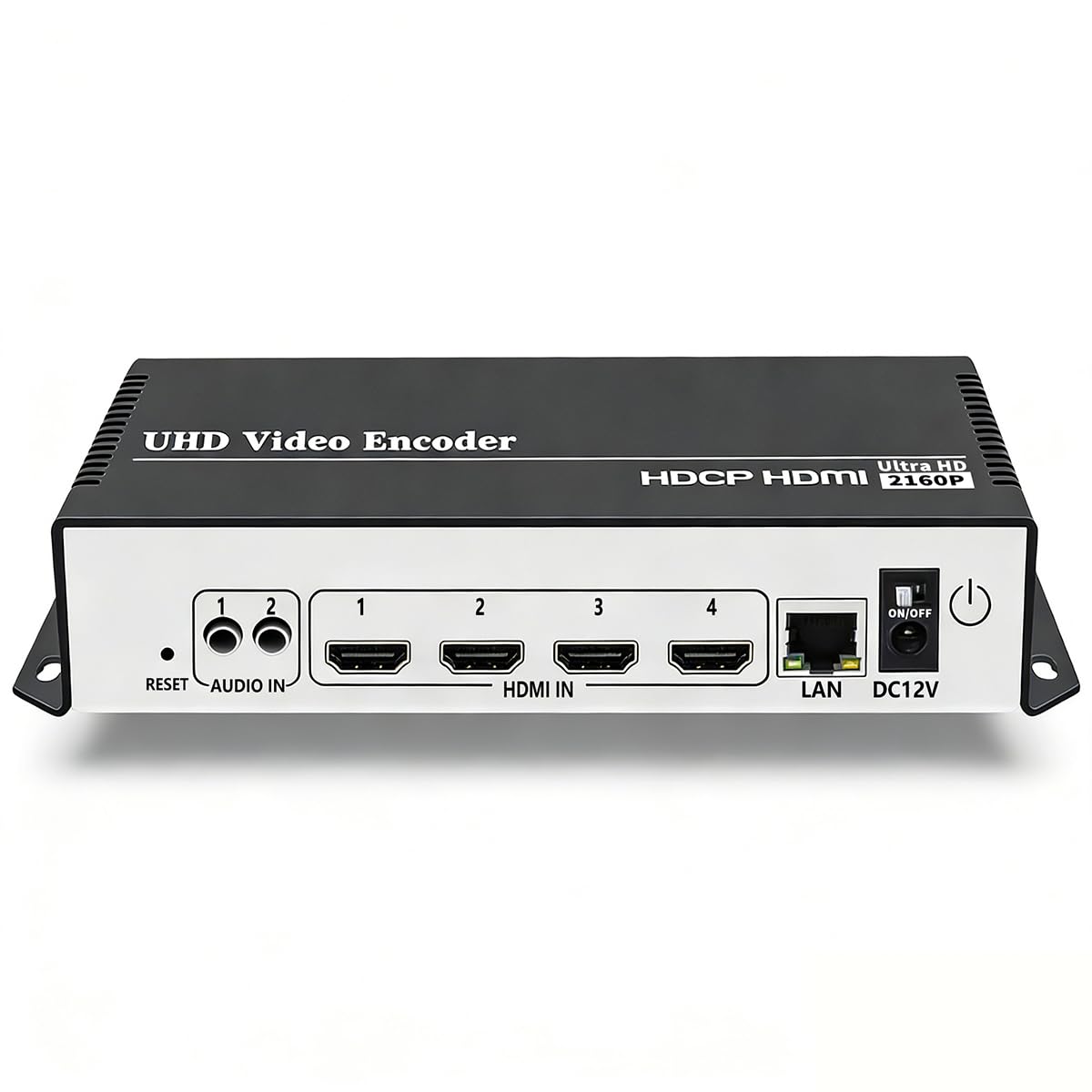
The URayCoder UHE265-4-4K is the goldilocks encoder for teams that need genuine 4K H.265 encoding with SRT without jumping into the four-figure range. It houses a dual H.265/H.264 encoding chip that handles 4K UHD at 30fps, and cranks up to 120fps at lower resolutions for sports or slow-motion feeds. Simultaneous output of four independent video streams, each using its own protocol (RTMP, RTSP, SRT, HLS), means you can push to YouTube, Facebook, and your private CDN all at once from a single box.
Setup requires a moderate level of networking knowledge—the DHCP is off by default, which tripped up several early buyers. However, once configured through the web UI, the encoder is rock solid for 24/7 streaming. The metal enclosure (4.72 x 3.94 inches) dissipates heat efficiently, and the unit draws low power compared to fan-cooled rack encoders. It also includes HDCP 1.4 decryption, allowing you to stream from Blu-ray players or cable boxes legally.
Where this unit truly shines is the customer backing. URayCoder includes lifetime technical support that multiple reviewers specifically praised, with engineers like Linda providing firmware fixes within 24 hours. For a budget-focused encoder, that level of service transforms the purchase from a gamble into a reliable investment.
Why it’s great
- Native 4K H.265 encoding with simultaneous multi-protocol output
- Lifetime firmware updates and responsive tech support
- Small footprint with durable aluminum chassis
Good to know
- DHCP off by default requiring manual network setup
- Limited to 30fps at 4K resolution
2. URayCoder UHE265-8

For productions managing multiple camera feeds, the URayCoder UHE265-8 eliminates the need for a separate encoder per camera by cramming eight HDMI inputs into a single compact chassis. Each input can generate two simultaneous video streams using different protocols—so camera 1 can go out as SRT to your main server while simultaneously pushing an RTMP stream to a backup. This is the efficiency engine for multi-camera houses of worship, esports venues, and conference centers.
The unit weighs just over 1.4 pounds and measures 7 x 5 x 1.5 inches, making it surprisingly portable for an 8-input device. It supports all the core protocols: SRT, RTMP, RTSP, HLS, and UDP multicast. One configuration detail that matters is the note from experienced buyers—there are two different chipset versions in circulation. The newer chipset (firmware 1.63CU3-L55M-U) handles 720x480i input correctly, while the older chipset requires enabling a “field to frame” option for interlaced sources.
Picture quality remains excellent even at lower bitrates, as verified by users deploying these for custom ffmpeg/gstreamer pipelines and corporate RTMP distribution. The dual-stream output per HDMI channel means you can deliver a high-bitrate 4K SRT feed to the production truck and a compressed 1080p stream to social platforms simultaneously without additional gear.
Why it’s great
- Eight HDMI inputs with independent dual-stream encoding per channel
- Compact, lightweight design for multi-camera rack or field use
- Strong support for SRT, RTMP, RTSP, and HLS protocols
Good to know
- Two hardware revisions in circulation with different interlaced handling
- Setup requires understanding of IP networking and encoder configuration
3. Blackmagic Design UltraStudio 4K Mini

The Blackmagic UltraStudio 4K Mini approaches the encoding challenge from a different angle—it’s a Thunderbolt 3 capture and playback device rather than a standalone IP encoder. If your workflow involves capturing uncompressed 4K DCI footage directly into DaVinci Resolve, Adobe Premiere, or Final Cut Pro on a Mac or PC, this is the pipeline solution. It accepts both 12G-SDI and HDMI 2.0 inputs, allowing you to ingest high-quality video from any professional camera or deck.
The unit outputs 40Gb/s over Thunderbolt 3, meaning zero compression artifacts in your captured footage. This is critical for post-production workflows where every pixel matters. However, this is not a standalone streaming encoder—you cannot simply plug it into a network and have it push SRT streams. It requires a host computer running compatible NLE software. One known issue is that some units require a certified Thunderbolt cable (not a standard USB-C cable) for detection, which has led to “dead on arrival” confusion.
Audio handling is another consideration: the line-level audio input is weak and the monitoring delay can be problematic without external audio gear. For teams whose primary need is pristine 4K capture for editing rather than live IP streaming, the UltraStudio Mini delivers broadcast-standard quality. For pure SRT encoding, you would pair it with software like vMix running on the host machine.
Why it’s great
- Uncompressed 4K DCI capture over Thunderbolt 3 at 40Gb/s
- Accepts 12G-SDI and HDMI 2.0 simultaneously
- Seamless integration with professional NLE workflows
Good to know
- Requires a host computer—not a standalone streaming encoder
- Audio input is weak; external audio interface recommended
4. FoMaKo 4K 60fps 12G-SDI PTZ Camera

The FoMaKo K820 series flips the script by building the encoder directly into a broadcast-grade PTZ camera. It delivers 4K 60fps video through a 1/1.8-inch Ambarella-powered CMOS sensor and supports native NDI 6, NDI HX3, SRT, and FreeD protocols. This means you get a single ethernet cable carrying video, PTZ control, and power over PoE+ while simultaneously outputting SRT streams for remote production—no separate encoder box required.
The 20x optical zoom with 16x digital zoom and 0.5 Lux low-light sensitivity makes it viable for auditoriums and dimly lit stages. The AI auto-tracking with Presenter and Zone modes frees operators from manual control, though some users note that the auto-tracking leaves excessive headroom that cannot currently be adjusted without disabling zoom. The camera outputs simultaneously over HDMI 2.0 (4K60), 12G-SDI (4K60), USB 3.0 (4K30), and LAN (4K30), giving you redundant paths.
Compatibility with Blackmagic ATEM switchers via NDI works well, but some users reported HDMI handshake issues with certain Blackmagic hardware. Support is responsive, providing firmware updates via email. For teams building a multi-camera IP-based studio, the K820 eliminates a significant amount of rack gear by integrating the camera, encoder, and PTZ server into one unit.
Why it’s great
- Built-in NDI HX3, SRT, and FreeD in a single PTZ camera
- 4K60 with Ambarella chipset and 20x optical zoom
- AI auto-tracking and 12G-SDI output for broadcast workflows
Good to know
- HDMI compatibility issues reported with some Blackmagic switchers
- Auto-tracking headroom adjustment not available in current firmware
5. YoloLiv YoloBox Ultra

The YoloLiv YoloBox Ultra defies simple categorization—it is an encoder, a video switcher, a monitor, a recorder, and a cellular bonding gateway all baked into a portable tablet form factor. Powered by a Snapdragon 865 processor, it accepts up to four HDMI inputs plus USB-C and USB-A sources, then encodes in 4K H.264/H.265 and streams to up to three horizontal platforms and two vertical platforms simultaneously. The 8-inch 650-nit touchscreen provides the operator interface, eliminating the need for an external laptop.
Where the YoloBox Ultra excels is its network resilience. It combines up to five network connections—Ethernet, Wi-Fi, 4G LTE internal modem, and two USB modems—into a single bonded stream via the YoloCast service. This makes it the premier choice for outdoor events, sports tournaments, and mobile productions where reliable internet is not guaranteed. The battery life stretches to roughly 9 hours with moderate use, and it supports NDI HX3 and SRT for remote production scenarios.
The built-in ISO recording captures each input separately, giving editors full multi-camera timelines for post-production. Features like instant replay, scoreboard overlays, and PiP switching make it a complete live production studio in a bag. The main trade-off is the premium price compared to a standalone encoder, justified by the sheer breadth of functionality it consolidates.
Why it’s great
- All-in-one design: encoder, switcher, monitor, recorder, and cellular bonder
- Bonds up to five network connections for reliable remote streaming
- 4K encoding with NDI HX3 and SRT protocol support
Good to know
- Audio input quality is functional but not broadcast reference level
- Vehicle for full live production, not a simple single-stream encoder
6. Blackmagic Design HyperDeck Studio 4K Pro

While the HyperDeck Studio 4K Pro is primarily a recorder, it earns its place in this guide as a secondary output option that complements SRT-based encoding workflows. It captures 4K video from 12G-SDI or HDMI 2.0 sources directly to SSDs in ProRes, DNxHD, or H.264/H.265 formats. The front panel includes two SSD slots and two SD card slots, giving you up to four recording media options for redundancy or hot-swapping during extended events.
The unit records compressed 10-bit 4:2:2 H.265, which maintains high visual quality while managing file sizes. It also includes RS-422 control for integration with broadcast automation systems. The main limitation for our use case is that the HyperDeck is a recorder, not a network encoder—it does not natively push SRT streams. However, the files it produces can be fed into any encoding software or hardware for later distribution.
Setup is genuinely plug-and-play: connect SDI or HDMI in, insert an SSD, and press record. Some users found that uncompressed 4K60 fills a 64GB card in about 30 minutes, so investing in 512GB SSDs is recommended for multi-hour events. For teams that need reliable local backup of their 4K feed before encoding for SRT distribution, this is an ideal companion.
Why it’s great
- Records compressed H.265 and ProRes directly to affordable SSDs
- 12G-SDI and HDMI 2.0 inputs with redundant media slots
- Broadcast-standard RS-422 control for automation
Good to know
- Recorder only—requires external encoder or software for SRT streaming
- Large storage needed for extended 4K60 sessions
7. YoloLiv YoloBox Extreme

The YoloLiv YoloBox Extreme is the flagship model for teams that need massive I/O flexibility without the complexity of a broadcast truck. It features eight HDMI inputs with built-in 4K60 scaling, plus support for up to six NDI inputs (two NDI FX or six NDI HX) over the network. The 11.2-inch OLED touchscreen runs at 2.5K resolution with 120Hz refresh and 1,000 nits brightness, providing a clear view even under direct sunlight.
Encoding is handled internally, outputting 4K streams via SRT, RTMP, or RTMPS to up to five platforms simultaneously. The integrated ISO recording captures up to five inputs at 4K30 or six inputs at 1080p60, giving post-production teams all the angles. The cellular bonding capability, inherited from the YoloBox family, bundles ethernet, Wi-Fi, 4G LTE, and external USB modems into a single reliable data pipe—crucial for outdoor events.
The unit includes instant replay across six cameras at 1080p60, chroma key compositing, scoreboard overlays, and StreamDeck support through the latest firmware update. Audio management has a minor quirk: if the microphone input level is too hot, the system may automatically level the audio and drop camera feeds as a protective measure. For serious multi-camera productions, the YoloBox Extreme consolidates what would otherwise require a rack full of gear.
Why it’s great
- Eight HDMI plus six NDI inputs in a portable form factor
- OLED touchscreen at 2.5K with 120Hz for crisp monitoring
- Full live production suite: SRT encoding, ISO recording, cellular bonding
Good to know
- High input sensitivity can cause automatic audio leveling that drops feeds
- Significant investment for a single-stream encoding need
FAQ
Can I stream 4K HEVC directly to YouTube using SRT?
What is the difference between SRT and RTMP for live encoding?
Does a budget encoder support both H.264 and H.265 simultaneously?
Final Thoughts: The Verdict
For most users, the best budget 4k hevc encoder with srt winner is the URayCoder UHE265-4-4K because it delivers genuine 4K HEVC encoding with full SRT protocol support, simultaneous multi-stream output, and lifetime technical support at a mid-range price that doesn’t break production budgets. If you need multi-camera encoding in a single chassis, grab the URayCoder UHE265-8. And for all-in-one mobile live production combining encoding, switching, and cellular bonding, nothing beats the YoloLiv YoloBox Ultra.