
Your podcast’s audio quality defines whether a listener stays or clicks away within the first ten seconds. A dedicated audio mixer separates you from the host with the hollow, distant sound — it hands you control over gain, EQ, compression, and live mixing so every voice lands clean and present. Without the right interface, you fight background hum, inconsistent levels, and muddy recordings that no amount of post-production polish can fully fix.
I’m Min — the co-founder and writer behind Gadgets Feed. This guide comes from weeks of cross-referencing technical datasheets, analyzing preamp gain figures, channel counts, connectivity options, and real-world noise floor measurements to identify which mixers actually solve the pain points podcasters face every day.
Whether you manage a solo show or juggle four co-hosts, the right audio mixer for podcasting eliminates echo, handles phantom power for professional microphones, and gives you the fader control you need for a broadcast-ready mix.
How To Choose The Best Audio Mixer For Podcasting
A mixer is the central nervous system of your podcast rig. You don’t just plug in a mic — you route audio, manage headphone mixes, trigger sound effects, and send a finished signal to your computer or recorder. The right choice depends on understanding a few core specs that directly affect your final sound quality.
Preamp Quality and Gain Range
The preamp boosts your microphone’s weak electrical signal to a usable line level. For dynamic microphones like the Shure SM7B or Rode PodMic, which output a naturally quiet signal, you need at least 60 dB of gain to avoid cranking the volume and introducing hiss. A lower noise floor, measured in dBu, indicates cleaner amplification. Preamps from brands like Focusrite, Mackie, and Rode are known for their quiet, high-headroom performance.
Channel Count and Connectivity
Count your inputs before you count your dollars. A solo host needs just one XLR input. A host with one co-host needs two. If you plan to invite guests or record in-studio bands, look for mixers with four to eight XLR combo jacks. Also check for Bluetooth audio input, which lets you bring in remote guests or backing tracks wirelessly, and USB-C connectivity for low-latency recording to your computer.
Mix-Minus and Headphone Outputs
Mix-Minus prevents echo when you have a remote caller on the line — it sends the caller’s audio to your broadcast feed but stops their own voice from looping back to them. This feature is essential for interview-style podcasts. The number of independent headphone outputs matters too: each host and guest needs their own mix to hear themselves and the conversation without latency.
Quick Comparison
On smaller screens, swipe sideways to see the full table.
| Model | Category | Best For | Key Spec | Amazon |
|---|---|---|---|---|
| Zoom PodTrak P8 | Premium Recorder | Multi-host remote recording | 6 XLR, 13-track record | Amazon |
| RØDE RØDECaster Duo | Premium All-in-One | Pro APHEX processing | 76dB gain, 4 faders | Amazon |
| Zoom LiveTrak L-8 | Premium Recorder | Portable multi-track recording | 8 inputs, SD record | Amazon |
| Mackie ProFX10v3+ | Premium Analog | Live events and home studios | 10-ch, 192kHz USB-C | Amazon |
| Behringer FLOW 8 | Mid-Range Digital | App-controlled mixing | 8 channels, Bluetooth | Amazon |
| Mackie Mix12FX | Mid-Range Analog | Small PA and band practice | 12-ch, onboard FX | Amazon |
| Focusrite Vocaster Two | Mid-Range Interface | Easy two-host setup | 70dB gain, Auto Gain | Amazon |
| MAONO MaonoCaster AME2 | Budget All-in-One | Sound pads and reverb | 10-ch, 11 sound pads | Amazon |
| FIFINE AmpliGame KS5W | Budget Bundle | Gaming and beginner podcasting | Dynamic mic, slider fader | Amazon |
In-Depth Reviews
1. Zoom PodTrak P8
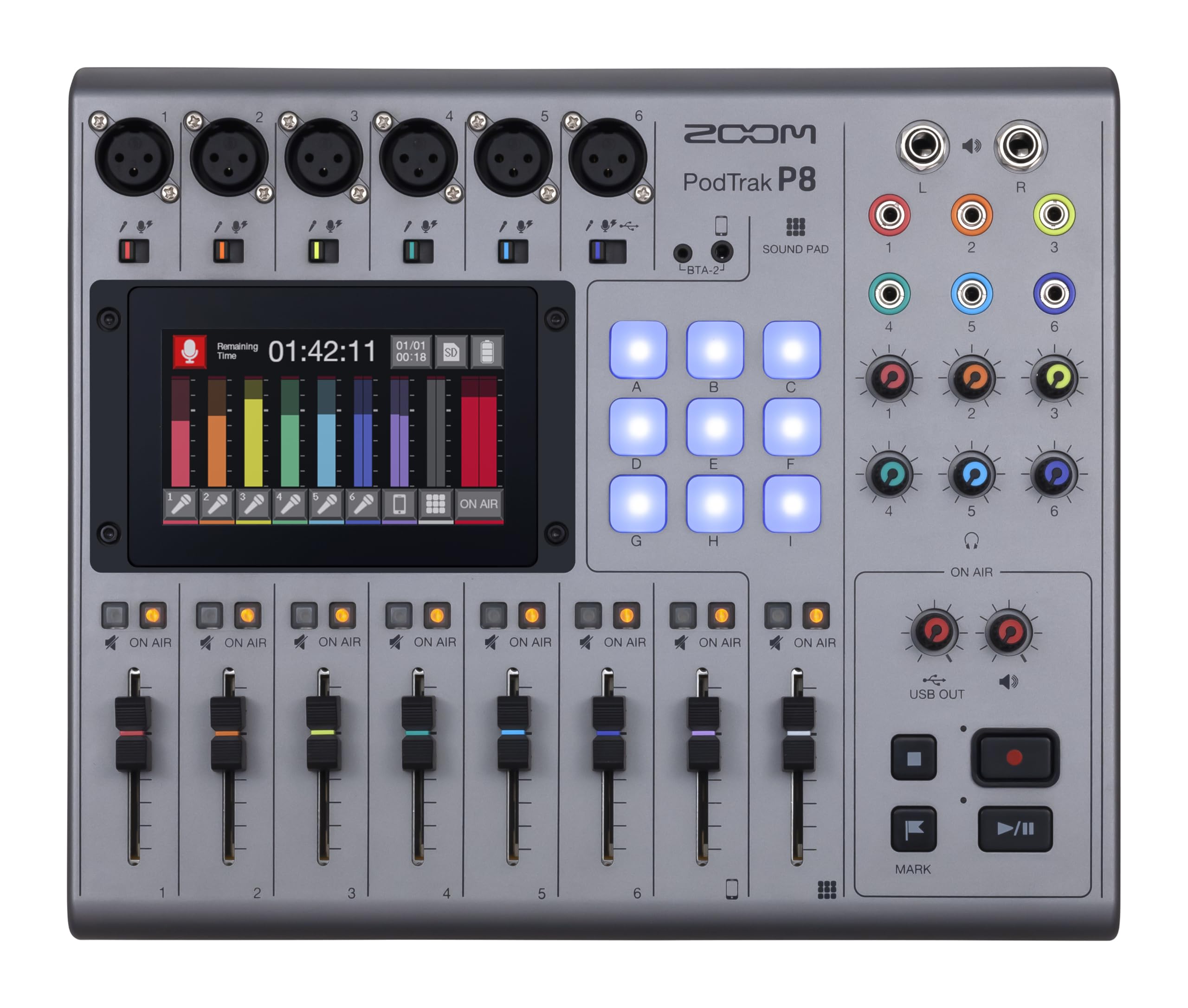
The Zoom PodTrak P8 is a complete podcast production studio in a single chassis. Six XLR inputs with clean preamps and individual gain control allow you to host up to six in-person guests without daisy-chaining additional gear. The 4.3-inch color touchscreen puts EQ, compression, de-essing, and noise reduction sliders right on the display, making on-the-fly adjustments fast and intuitive.
What sets the P8 apart for interview-heavy shows is the built-in Mix-Minus for phone calls and remote guests. The dedicated phone input with echo cancellation ensures professional-sounding interviews. The nine multi-colored sound pads across four banks give you instant access to 36 sound clips for intros, jingles, or pre-recorded segments, and battery power via four AA cells keeps you recording when AC power isn’t available.
For podcasters who need standalone operation, the P8 records directly to an SD card at up to 24-bit/96kHz resolution. It also functions as a 13-in/2-out USB audio interface for live streaming. The six independent headphone outputs with individual mixes mean every host and guest hears exactly what they need, which is rare at this level.
Why it’s great
- Six XLR inputs with individual headphone mixes eliminate the need for external splitters.
- Onboard editing tools and touchscreen reduce reliance on a computer during recording.
Good to know
- Battery life is capped at two hours on four AA batteries, so an external power bank is recommended for long sessions.
- The learning curve for the touchscreen interface is steeper than a purely analog mixer.
2. RØDE RØDECaster Duo
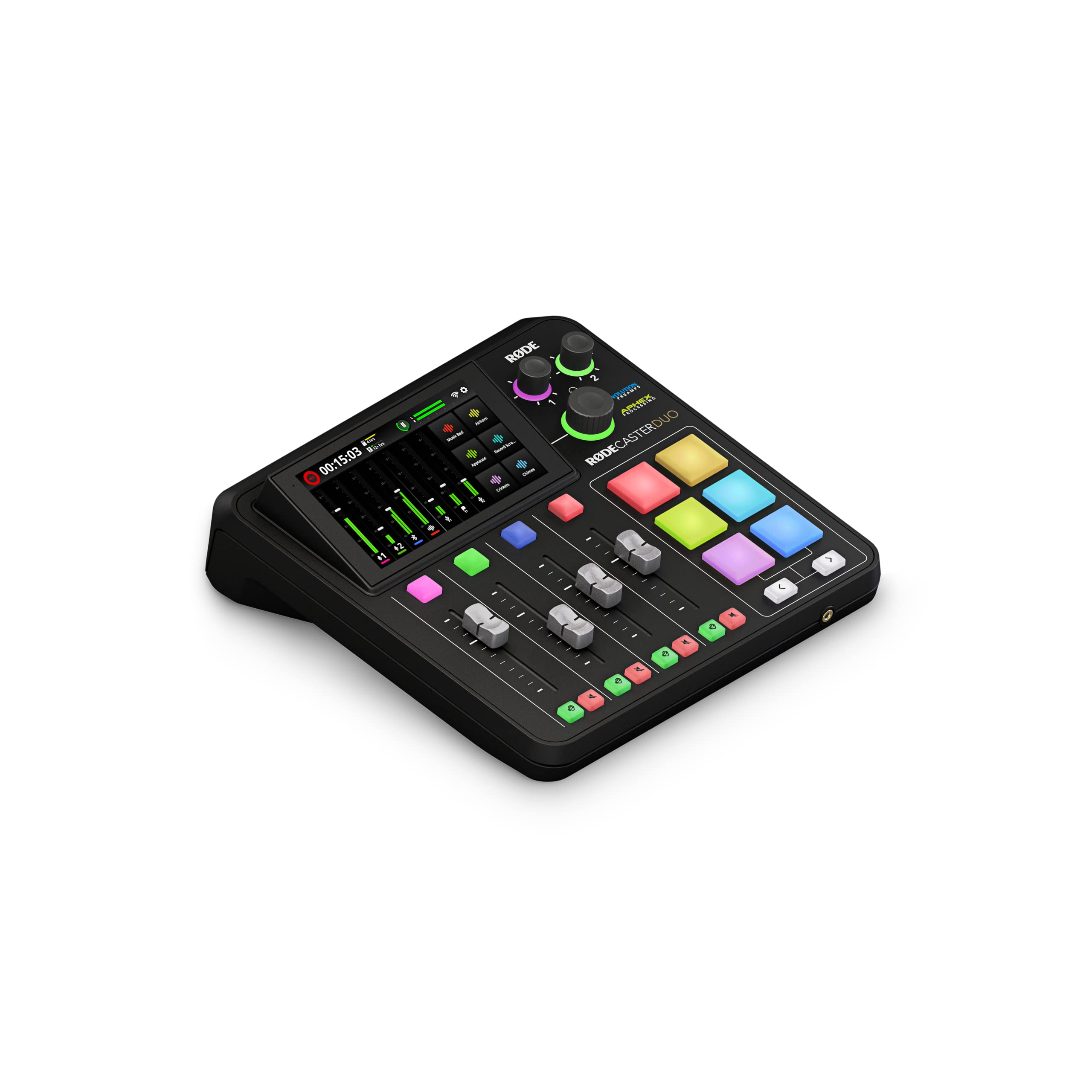
The RØDE RØDECaster Duo delivers broadcast-quality preamps with a -131.5dBV EIN noise floor and 76 dB of gain, meaning even quiet dynamic mics like the Shure SM7B come through without an external booster. The two Neutrik combo jacks handle both XLR microphones and instrument inputs, giving musicians and podcasters a unified input solution. The four physical broadcast faders provide tactile control over up to four audio sources.
RØDE integrated the legendary APHEX processing suite into the Duo, which includes the Aural Exciter and Big Bottom effects. These are not gimmicks — the Aural Exciter adds presence and clarity to voices, while Big Bottom tightens low-end frequencies. The six SMART pads with bank switching let you trigger sound effects, jingles, or even MIDI commands, all programmable via the touchscreen interface with haptic feedback.
The Duo functions as a compact audio interface via USB-C, recording up to 14 channels simultaneously. Bluetooth connectivity allows remote guests to join via smartphone, and the dedicated headphone output with independent mix ensures zero-latency monitoring. The build quality is dense and professional — it sits on a desk like a piece of studio furniture, not a plastic toy.
Why it’s great
- Revolution Preamps deliver 76 dB of clean gain, eliminating the need for a Cloudlifter with most dynamic mics.
- APHEX processing — specifically the Aural Exciter — adds professional polish without external plugins.
Good to know
- Some users report occasional software freezes that require a full power cycle to resolve.
- The setup process for iOS integration can be finicky, requiring extra adapters for certain workflows.
3. Focusrite Vocaster Two

Focusrite engineered the Vocaster Two specifically for podcasters, not musicians. The headline feature is Auto Gain — press the button, speak at your natural volume for a few seconds, and the interface automatically sets your input level for optimal headroom. This removes the guesswork that trips up beginners who don’t know to aim for peaks around -6dB in their recording software.
The Vocaster Two provides over 70 dB of gain across its two mic preamps, which is enough to drive a Rode PodMic or Shure SM58 without external boosters. The Enhance feature offers four presets — Clean, Warm, Bright, and Radio — that apply EQ and compression tailored to different voice types. Connectivity covers both Bluetooth for wireless phone calls and a TRRS input for wired phone integration. The dedicated camera output lets you send studio-quality audio directly to a DSLR or mirrorless camera for video-first creators.
Two headphone outputs with independent monitor mixes mean both host and guest can hear themselves clearly without latency. The hardware mute button on the front panel is tactile and satisfying for cutting coughs or off-mic chatter. The plastic chassis feels rugged enough for regular transport between home and office.
Why it’s great
- Auto Gain sets levels perfectly in seconds, ideal for podcasters who want to skip the technical setup.
- Enhance presets apply professional EQ and compression without needing to understand the underlying parameters.
Good to know
- The included USB-C cable is short — you may need to purchase a longer one for desk setups.
- The rubber mute button can feel like a potential wear point with heavy daily use.
4. Zoom LiveTrak L-8

The Zoom LiveTrak L-8 bridges the gap between a portable field recorder and a full mixer. Six combo XLR/TRS inputs with Zoom’s -121dBu noise floor preamps deliver clean gain up to +54dB, paired with a 3-band EQ and onboard effects on every channel. The L-8 records directly to an SD card at 24-bit/96kHz, which means you can capture a full podcast session without ever turning on a computer.
For podcasters who juggle multiple guests, the four headphone outputs with three independent monitor mixes are a standout feature. Each participant can craft their own mix of the main bus, their own mic, and effects. The phone input with Mix-Minus ensures remote callers sound natural without echo. Nine sound pads across customizable banks let you trigger intros, transitions, or laugh tracks on the fly during live recordings.
The L-8 also works as a USB audio interface, allowing simultaneous recording to both SD card and computer. The internal battery operation via four AA batteries adds true portability for recording in different locations — a feature most competing mixers lack. The compact form factor fits easily into a backpack alongside a laptop and microphones.
Why it’s great
- Dual recording to SD card and computer provides a safety backup during critical sessions.
- Battery power and compact size make it genuinely portable for location recording.
Good to know
- Phantom power is ganged for all six XLR channels — you cannot switch it on or off per channel.
- The micro USB port for computer connection is dated; USB-C would be welcome in a future revision.
5. Mackie ProFX10v3+

The Mackie ProFX10v3+ blends the tactile feel of an analog mixer with modern digital connectivity. Ten channels — four mic/line inputs with Onyx preamps, two stereo line channels, and a dedicated Bluetooth channel — give you flexibility for podcasting, live streaming, and small live events. The Onyx preamps are respected for their clarity and low noise, with 60 dB of gain suitable for dynamic microphones.
The built-in GigFX+ effects engine offers 24 editable presets viewable on the color LCD screen. You can adjust reverb, delay, chorus, and more without external processors. The 2×4 USB-C interface records at 24-bit/192kHz and offers three routing modes: Standard for the full mix with effects, Loopback to include computer audio for streaming, and Interface mode to capture raw channel 1-2 signals without processing. One-knob compression on the mic channels simplifies dynamic control for podcasters who don’t want to dial in multiple parameters.
Bluetooth bidirectional connectivity with Mix-Minus is a welcome addition — you can bring in phone callers wirelessly and feed clean audio to speakers or headphones. The Hi-Z switches on channels 1-2 accommodate direct guitar or bass input for musicians recording demos or live sessions alongside podcast content.
Why it’s great
- USB-C interface with three recording modes adapts to podcasting, streaming, and raw recording workflows.
- Onyx preamps deliver clean, low-noise amplification suitable for entry-level and intermediate dynamic mics.
Good to know
- Some units have arrived with signs of prior handling — inspect the packaging and knobs on arrival.
- The internal effects library, while versatile, lacks the depth of dedicated processors like APHEX.
6. Behringer FLOW 8

The Behringer FLOW 8 is a compact digital mixer that can be controlled wirelessly via the FLOW Control app on iOS and Android. This gives you the ability to adjust levels from across the room or while sitting in front of your microphone — a convenience analog mixers can’t match. The eight-channel design includes two Midas-designed microphone preamps with programmable gain and 48V phantom power, delivering the same preamp quality found in Behringer’s higher-end touring consoles.
The 60mm channel faders provide smooth, precise control, and the EZ-Gain function automatically sets optimal gain levels to prevent clipping before you even touch a slider. Six additional line inputs handle backing tracks, keyboard outputs, and other line-level sources. Built-in Bluetooth lets you stream music or backing tracks from a smartphone, making it easy to incorporate theme music or ad breaks into a live podcast. The onboard effects include reverb, delay, and chorus with dedicated FX send and return busses.
The FLOW 8 works as a USB audio interface, sending the main mix or individual channels to recording software. Physical mute buttons and a master rotary encoder with an LED collar give you tactile control even when the app isn’t open. For mobile DJs and small-venue podcasters, the ability to save and recall complete mixer scenes via the app eliminates setup time between shows.
Why it’s great
- FLOW Control app provides full remote mixing from a phone or tablet — ideal for adjusting levels while on mic.
- Midas preamps deliver professional-grade clarity and headroom at a mid-range price point.
Good to know
- The headphone amplifier is relatively weak, which may struggle with high-impedance studio headphones.
- The micro USB port for computer connection is fragile — a right-angle adapter is recommended to reduce strain.
7. Mackie Mix12FX

The Mackie Mix12FX is an analog workhorse built on the brand’s decades of live-sound engineering. Twelve channels give you four mic/line inputs with high-headroom, low-noise preamps, four stereo line inputs, and dedicated RCA inputs and outputs for playback and recording. The 3-band EQ per channel with a 75Hz low-cut filter gives you precise tone shaping to cut room rumble and plosives at the source.
The onboard effects processor offers twelve different algorithms, including reverbs, choruses, and delays. These are not deep editable presets, but the quality is respectable for live applications. The built-in 48V phantom power accommodates condenser microphones, and the preamps deliver enough clean gain for most dynamic mics without additional boosters. The Mix12FX is always on when power is connected, which some users appreciate for immediate turn-and-go operation.
For podcasters who also do small live events, band rehearsals, or PA duties, the Mix12FX is more versatile than a dedicated podcast interface. The compact footprint — 11.7 inches wide and 2.1 inches tall — fits into a laptop bag for transport. The lack of USB audio interface means you’ll need an external audio capture device to record to a computer, but for analog purists, the simplicity of a pure mixer is the appeal.
Why it’s great
- Noiseless pots and 48V phantom power on mic channels provide clean signal handling at a low noise floor.
- Twelve channels offer headroom for expanding from a simple podcast setup to a small live PA system.
Good to know
- No built-in USB audio interface — recording requires a separate capture device or audio interface.
- The plastic chassis feels less durable than Mackie’s older all-metal designs, though the internal components are still solid.
8. MAONO MaonoCaster AME2

The MAONO MaonoCaster AME2 packs an impressive feature set into an entry-level price point. Ten channels of routing with a built-in preamp capable of 60 dB of gain and 48V phantom power let you use both dynamic and condenser XLR microphones. The 32-bit chipset and dedicated DENOISE function help clean up background noise, which makes a real difference in untreated rooms where budget podcasters often start.
The eleven customizable sound pads are a highlight for creators who want to add production value to their shows. Three pads record up to 60 seconds of audio with one-key looping, while eight pads hold 20-second clips. You can load sound effects, intro music, or pre-recorded segments via smartphone, PC, microphone, or Bluetooth. The six reverb modes, 12-step auto-tune, and three-band EQ with bass, mid, and treble control give you creative options that rival more expensive mixers.
Connectivity covers USB-C for computer recording, dedicated LIVE-OUTPUT for smartphone streaming, AUX-IN for external music sources, and a 6.35mm instrument input for guitar or bass. The plug-and-play compatibility with PC, Mac, and mobile devices makes it easy to integrate into an existing setup. The lightweight 0.95 kg build means it travels well for remote recordings or live streams.
Why it’s great
- Eleven sound pads with loop and one-key playback add production value without extra hardware.
- 60 dB preamp gain with 48V phantom power supports both dynamic and condenser microphones at this price point.
Good to know
- Multiple user reports indicate USB-C port failure after roughly one year of use — the long-term reliability is inconsistent.
- Headphone monitoring may produce a slight reverb that isn’t present in the actual recording, which can be distracting during live sessions.
9. FIFINE AmpliGame KS5W

The FIFINE AmpliGame KS5W bundles a dynamic XLR/USB microphone with a dedicated audio mixer, creating an all-in-one starting point for gamers and beginner podcasters. The microphone delivers clear vocal capture with a gain knob to adjust sensitivity, and the mute button provides instant silence. The mixer features a slider fader for intuitive volume control and function buttons for voice-changing effects and RGB lighting.
The voice changer adds fun effects — elder, baby, robot, and girl modes — which are more gimmick than professional tool, but they add entertainment value for live streaming. The five RGB color modes allow visual customization of the mixer. The kit is simple enough that you can be recording a podcast within minutes of unboxing, with no driver installation required for basic functionality.
USB-C connectivity ensures modern compatibility, and the included XLR cable gives you the option to use the microphone with a different audio interface if you upgrade later. The cardioid dynamic microphone pattern rejects background noise better than standard USB condenser mics, which is crucial for podcasters recording in untreated rooms. The white color scheme looks clean on desks with light-toned gear.
Why it’s great
- Complete kit includes both a quality dynamic microphone and a dedicated mixer, removing guesswork for first-time buyers.
- Dynamic mic pattern naturally rejects room noise, delivering cleaner audio than condenser mics in untreated spaces.
Good to know
- Some units experience sporadic shutdowns and reboots of the mixer during use — reliability appears inconsistent.
- The plastic build of the mixer feels light and may not withstand heavy daily use over multiple years.
FAQ
Do I need 48V phantom power for my podcast microphone?
How many XLR inputs do I actually need for a two-host podcast?
What is the difference between an audio interface and an audio mixer for podcasting?
Why does my mixer need independent headphone outputs?
Can I use a Behringer FLOW 8 without the mobile app?
Final Thoughts: The Verdict
For most users, the audio mixer for podcasting winner is the Zoom PodTrak P8 because it combines six XLR inputs, independent headphone mixes for every host, onboard editing, and standalone SD card recording in a single portable unit that grows with your show. If you want broadcast-grade preamp quality and APHEX processing in a compact desktop format, grab the RØDE RØDECaster Duo. And for effortless setup with Auto Gain and Enhance presets that deliver professional sound without a steep learning curve, nothing beats the Focusrite Vocaster Two.