
Every boat owner knows the grind: haul-out, pressure wash, scrape barnacles, sand, mask, paint, splash, repeat. The single variable that determines whether that cycle is annual or biennial is the anti-fouling paint you choose. Get it right, and your hull stays clean, your fuel economy stays high, and your weekends stay free for cruising instead of scraping.
I’m Min — the co-founder and writer behind Gadgets Feed. I’ve spent hundreds of hours analyzing marine paint formulations, biocide technologies, coverage rates, and real-world user reports across saltwater, freshwater, and brackish conditions to build this guide.
Whether you’re protecting a center console, a sailboat fin keel, or an outboard motor, this guide will steer you to the best anti-fouling paint for your specific hull material and boating environment. best anti-fouling paint
How To Choose The Best Anti-Fouling Paint
Selecting marine bottom paint requires balancing three variables: your hull material, your typical water type, and how long you leave the boat moored. A hard racing paint won’t work on a trailered aluminum boat, and a soft ablative paint will wear off too fast on a high-speed powerboat. Here’s how to match the chemistry to your specific use case.
Copper vs. Copper-Free Biocides
Copper has been the standard antifouling biocide for decades, and it works exceptionally well on fiberglass, wood, and steel hulls. However, copper causes galvanic corrosion when applied directly to aluminum hulls, outdrives, and trim tabs. If your boat has unpainted aluminum below the waterline, a copper-free formula using zinc or organic biocides is non-negotiable. TotalBoat Krypton and Pettit Hydrocoat Eco are two reliable copper-free options.
Ablative vs. Hard Paint
Ablative (self-polishing) paints wear away slowly as the boat moves through water, constantly exposing fresh biocide. They are ideal for displacement hulls and sailboats that spend extended periods moored. Hard paints create a durable, non-polishing barrier that resists abrasion, making them better for trailered boats, high-speed powerboats, and aluminum hulls that grind against sand or mud. Fasco Epoxies Super Slick 2000 represents the toughest end of the hard coating spectrum, while TotalBoat JD Select is a premium ablative formula.
Coverage Rate and Total Project Cost
The coverage rate listed on the can — typically 400 to 700 square feet per gallon — assumes a single coat on a smooth, properly prepared surface. Most boats require 2 to 3 coats for adequate protection. If the label says 500 sq ft/gal, a 27-foot sailboat with a 250 sq ft bottom will use roughly 1.5 gallons total. Buying a gallon-sized container almost always offers better value per square foot than quarts, especially if you plan to recoat every season.
Quick Comparison
On smaller screens, swipe sideways to see the full table.
| Model | Category | Best For | Key Spec | Amazon |
|---|---|---|---|---|
| Interlux Bottomkote NT | Hard Paint | Freshwater sail & power | 500 sq ft/gal coverage | Amazon |
| TotalBoat JD Select | Ablative | Multi-season saltwater | 500 sq ft/gal, low-VOC | Amazon |
| TotalBoat Krypton | Copper-Free | Aluminum hulls & outdrives | Copper-free, 500 sq ft/gal | Amazon |
| Fasco Epoxies Super Slick 2000 | Epoxy Coating | Airboats & jet skis | 2-part epoxy, PTFE additive | Amazon |
| Pettit Hydrocoat | Ablative | Long-term mooring | 700-1200 sq ft/gal | Amazon |
| Interlux Trilux 33 | Copper-Free | Outboard motors & drives | Biolux slime-block tech | Amazon |
| Rust-Oleum Marine Flat | Hard Paint | Trailered boats | Copper release, 100 sq ft/qt | Amazon |
In‑Depth Reviews
1. Interlux Fiberglass Bottomkote NT

Interlux Bottomkote NT delivers a hard, glossy finish that stands up to repeated pressure washing without flaking or peeling. With a rated coverage of 500 square feet per gallon, this paint stretches further than most competitors. One gallon covers two full coats on a 27-foot Bayliner with material left over for a third coat, according to verified buyers. The low viscosity means it flows out evenly with a 3/8-inch nap roller, leaving a slightly textured surface that minimizes drag.
Real-world performance in freshwater is exceptional — one user reported only 5% algae and quagga mussel growth after three full seasons of immersion. The copper-based biocide formula is optimized for fiberglass and wood hulls, though it should not be applied directly to bare aluminum without an appropriate epoxy barrier coat. The strong solvent smell requires a cartridge respirator rather than a simple dust mask, as multiple reviewers emphasize.
Packaging is a strong point: the gallon can arrives with four plastic clips securing the lid, plus the entire lid is taped shut to prevent leakage during shipping. This attention to packaging detail matters immensely for a liquid product that can ruin a car trunk or garage floor if the can arrives dented. For boat owners leaving their hull in freshwater for months at a time, Bottomkote NT offers the best balance of durability, coverage, and long-term protection.
Why it’s great
- Exceptional 500 sq ft/gal coverage reduces total coats needed
- Hard finish withstands aggressive power washing without damage
- Three-season performance reported in freshwater with minimal growth
Good to know
- Not recommended for bare aluminum without a barrier coat
- Strong solvent odor requires a respirator, not a dust mask
- Requires thorough mixing with a drill attachment to suspend pigment
2. TotalBoat JD Select Ablative
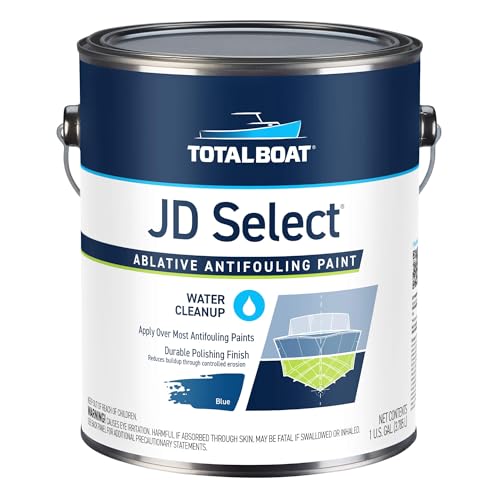
TotalBoat JD Select uses a water-based, low-VOC formula that qualifies for use in environmentally restricted marinas and boatyards. The ablative action means the coating self-polishes as the boat moves, gradually wearing away and exposing fresh biocide. This minimizes bottom paint buildup year after year — less sanding required between seasons. The hybrid paint film is designed specifically for fiberglass, wood, and steel hulls in both salt and fresh water.
Application is straightforward with a 3/16-inch nap roller or natural bristle brush. Users report that one gallon applies smoothly to a 41-foot boat at roughly two to three gallons total, with minimal settling and excellent streak-free coverage. The paint dries to a flat finish in about an hour at 52°F, and cleanup requires only soap and water — no hazardous solvents needed. Multiple reviewers note the absence of toxic fumes, making it tolerable for DIY application in enclosed spaces.
Shipping damage is the most common complaint, with cans arriving dented but without leaks thanks to the manufacturer’s sealing. For powerboats and sailboats that stay in saltwater for a full season, JD Select provides reliable antifouling performance verified by third-party sailing magazine tests. The low-VOC chemistry and easy cleanup make this the most user-friendly premium option for DIY boat owners.
Why it’s great
- Low-VOC water-based formula with soap-and-water cleanup
- Ablative self-polishing reduces yearly sanding work
- Low odor makes indoor or confined-space application practical
Good to know
- Not suitable for bare aluminum without a primer
- Shipping packaging lacks sufficient protection against dents
- Requires 2-3 coats for full season protection on larger hulls
3. TotalBoat Krypton Copper Free
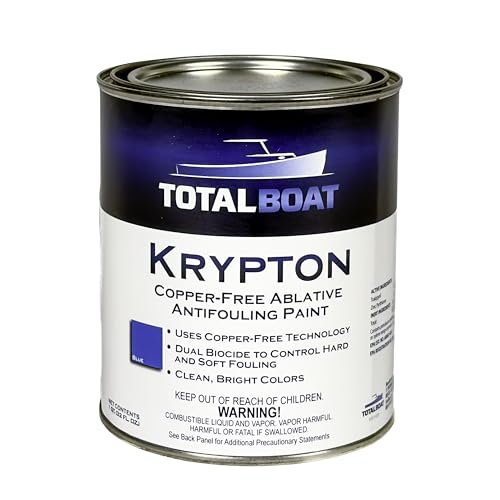
For aluminum boat owners, copper-free antifouling paint is a mandatory safety requirement, and TotalBoat Krypton delivers single-season protection without risking galvanic corrosion. The formula uses non-copper biocides that won’t cause electrolysis when applied directly onto aluminum hulls, outdrives, and trim tabs. An additional benefit: the color palette is far brighter than copper-based paints, which are inherently dulled by the copper content. Krypton is available in blue, black, white, green, and red.
Application requires a natural bristle brush or a 3/16-inch nap roller, and the paint can be thinned with TotalBoat Special Brushing Thinner 100 for spraying. Users report excellent adhesion over zinc chromate primer on Volvo Penta DP-S drives, drying to a durable eggshell finish. Coverage is rated at 500 square feet per gallon, and there is no maximum dry time before launch — allowing you to apply coats days apart if needed.
Real-world testing by a sailing magazine ranked Krypton as having the least marine growth among a group of ablative paints after two years of immersion. The only drawback is the can’s tendency to arrive dented from shipping, though the manufacturer seals the containers well enough to prevent leakage. For any boater with aluminum components below the waterline, Krypton is the most affordable copper-free option with proven performance.
Why it’s great
- Copper-free formula prevents galvanic corrosion on aluminum
- Bright color options not available in copper-based paints
- No maximum dry time before launch simplifies multi-coat schedule
Good to know
- Single-season performance may not suit permanent moorings
- Shipping damage is a recurring issue with dented cans
- Requires thinning for spray application with HVLP equipment
4. Fasco Epoxies Super Slick 2000

Fasco Epoxies Super Slick 2000 is not a traditional antifouling paint — it is a two-part epoxy coating infused with PTFE (Teflon) that creates an armor-like, friction-free surface. This is the right choice for airboats, jet skis, jon boats, and any hull that regularly grinds against sand, mud, or grass. The cured epoxy forms a hard plastic shell that resists abrasion far better than any conventional ablative or hard paint.
Application follows a 1:1 mix ratio that must be used within 15 to 20 minutes of mixing. One quart covers a jet ski bottom with four thin coats, and the gallon kit covers roughly 120 square feet at two coats. Users consistently describe the cured surface as “slicker than snot” — drastically reducing drag on airboat hulls and allowing jet skis to glide noticeably better. The coating also acts as a protective layer against rocks and submerged debris.
Surface preparation is the single most critical factor: the existing coating must be completely ground down to bare aluminum or fiberglass, and the substrate must be etched for proper adhesion. If moisture gets behind the epoxy film, it will peel off in sheets. This coating does not contain biocides, so it does not prevent marine growth on its own. However, the slick surface makes it much harder for barnacles to gain a foothold, and any growth that does attach is easier to pressure wash off.
Why it’s great
- PTFE additive creates an ultra-slick, low-friction surface
- Epoxy hardness protects against abrasion from sand and mud
- Dramatically reduces drag on planing hulls and jet skis
Good to know
- Not a standalone antifouling paint — lacks biocides for growth prevention
- Requires complete stripping and etching for proper adhesion
- Short 15-20 minute pot life after mixing can lead to waste
5. Pettit Hydrocoat, Black, Gallon

Pettit Hydrocoat is the highest-coverage paint in this guide, with a rated range of 700 to 1,200 square feet per gallon depending on application thickness. This water-based ablative formula is designed for boaters who leave their hull in the water for extended periods and want maximum value per gallon. It checks the major boxes: water-based cleanup, multi-season capability, and effective growth prevention in both salt and brackish water.
Long-term users on Long Island Sound report consistent performance over many seasons, though some note that the copper-containing formula has been superseded by Pettit’s own Hydrocoat Eco (copper-free version). The paint dries to a gloss finish and fully cures in roughly six hours at moderate temperatures. The 19-pound gallon container is heavy but delivers enough material to cover a large sailboat or cruiser with material to spare.
There are scattered reports of rapid wear along the waterline, with one buyer seeing complete paint loss after just five months. This suggests that surface preparation and the number of coats applied significantly influence real-world durability. For boaters who are willing to invest in thorough prep and multiple coats, Hydrocoat offers the best coverage per dollar of any premium option. The soap-and-water cleanup adds convenience for DIY applications in areas with strict solvent disposal regulations.
Why it’s great
- Industry-leading 700-1200 sq ft/gal coverage reduces total cost
- Water-based formula with simple soap-and-water cleanup
- Ablative action minimizes yearly buildup for multi-season use
Good to know
- Waterline wear can be rapid if applied too thinly
- Copper content may not suit aluminum hulls without barrier coat
- Heavy 19-pound gallon requires sturdy shelving during storage
6. Interlux YBA063/PT Trilux 33

Interlux Trilux 33 uses Biolux technology — a copper-free biocide system specifically developed to block slime and soft growth on outboard motors, sterndrives, and trim tabs. This pint-sized container is perfect for touch-ups or for coating smaller metal components that are prone to fouling but don’t warrant a full gallon purchase. The paint is suitable for fiberglass, wood, steel, and primed aluminum surfaces, making it a versatile addition to any boater’s maintenance kit.
Buyers report excellent results on outboard motor mounts in seawater, noting that the non-copper formula does not cause galvanic corrosion on aluminum lower units. The matte finish applies evenly when stirred thoroughly, and a single pint is enough to coat the submerged portion of a standard outboard with two thin coats. The 400 sq ft per gallon coverage rate scales down proportionally for the pint size, meaning you get roughly 50 sq ft of coverage from this container.
The primary drawback is packaging: the can ships in a thin plastic bag with no additional padding, and multiple users report bent rims and leaking paint upon arrival. Amazon’s return policy typically covers damaged items, but the hassle of dealing with a leaking can of paint is frustrating. For the specific use case of protecting outboard motors and sterndrives from slime and soft fouling without risking corrosion, Trilux 33 remains the most targeted option on the market.
Why it’s great
- Copper-free Biolux technology prevents slime on aluminum drives
- Pint size is perfect for small components and touch-up work
- Compatible with fiberglass, wood, steel, and primed aluminum
Good to know
- Fragile packaging frequently results in damaged, leaking cans
- Small pint size limits application to outboards and small areas
- Not intended for full hull coverage on boats over 20 feet
7. Rust-Oleum 396967 Marine Flat Boat Bottom
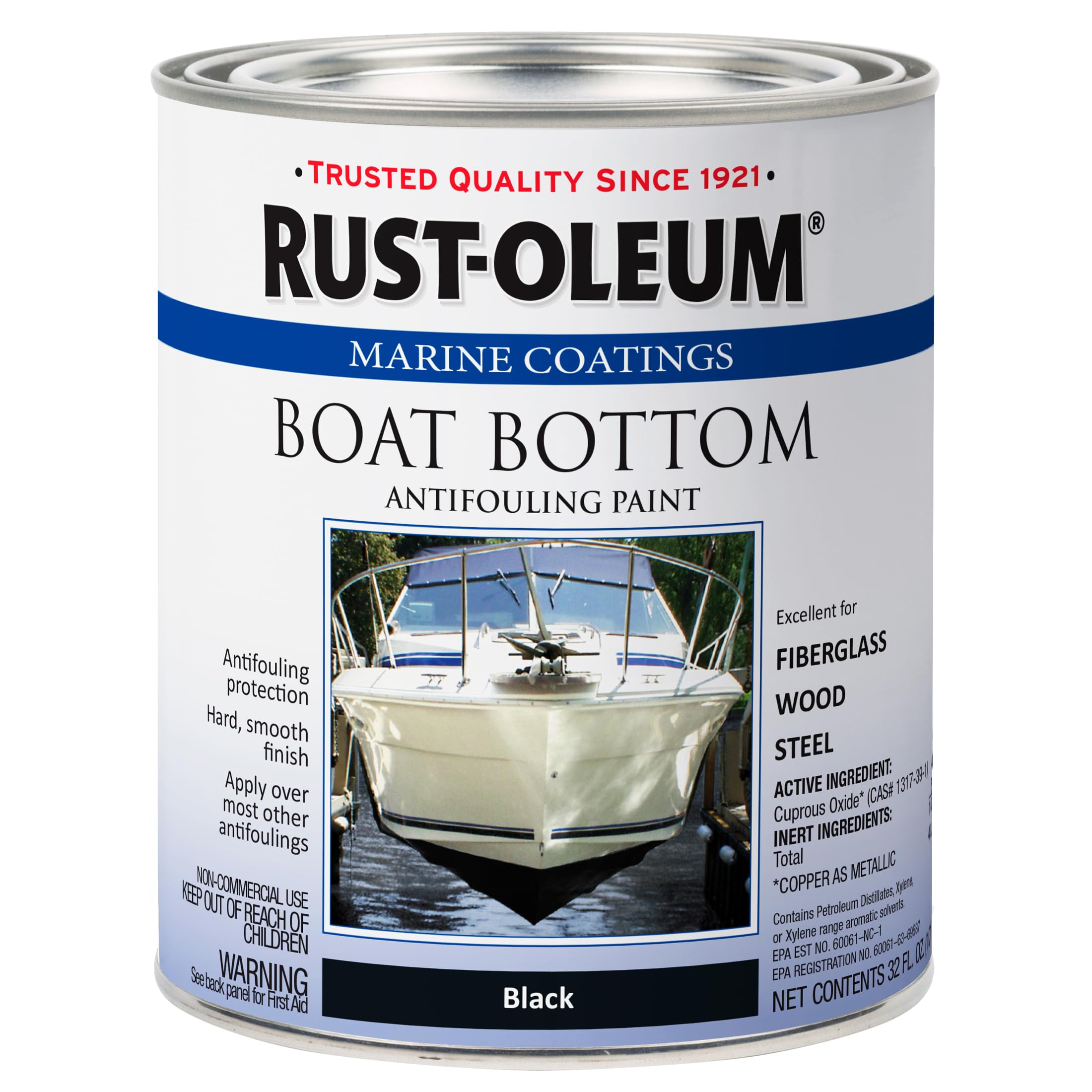
Rust-Oleum’s Marine Flat Boat Bottom Antifouling Paint is the entry-level option that delivers solid performance at a fraction of the cost of premium brands. The hard, copper-release coating resists barnacles, algae, and slime on fiberglass, wood, and steel hulls. It is specifically formulated for trailered boats that spend days at a time in the water rather than permanent moorings — the hard finish holds up well to repeated haul-outs and pressure washing.
One quart covers roughly 110 square feet, which translates to two coats on a 13-foot boat. Users on Lake Michigan report two seasons of reliable protection with blue paint, and a 22-foot center console in hot South Florida required just two quarts for a single coat — with monthly diver cleaning keeping growth minimal. The paint is thick and requires thorough mixing with a stir stick or drill attachment before application. Recoat time is 4 hours, and the boat can be launched after 16 hours of dry time.
Packaging is a significant concern: multiple reviewers report that cans arrive leaking due to inadequate protection during transit. The product itself performs well when the can arrives undamaged, but the shipping experience is inconsistent. For budget-conscious boaters with small trailered boats who want a hard, durable coating that can survive multiple launch-and-retrieve cycles, Rust-Oleum offers the best value proposition in this guide — provided you’re prepared for potential shipping issues.
Why it’s great
- Most budget-friendly option for small trailered boats
- Hard finish stands up to repeated pressure washing
- Fast 4-hour recoat and 16-hour launch time
Good to know
- Frequent shipping damage with leaking cans reported
- Quart size only covers small boats under 15 feet adequately
- Copper content limits use on aluminum surfaces
FAQ
Can I apply copper-based antifouling paint directly to an aluminum hull?
How many coats of bottom paint do I need for a full season of protection?
What happens if I apply anti-fouling paint over old, incompatible bottom paint?
Final Thoughts: The Verdict
For most users, the best anti-fouling paint winner is the Interlux Fiberglass Bottomkote NT because it combines high coverage, a durable hard finish, and proven multi-season performance in freshwater — all at a reasonable per-gallon cost. If you need a copper-free formula for an aluminum hull or outdrive, grab the TotalBoat Krypton. And for airboats or jet skis that grind through shallow water and mud, nothing beats the Fasco Epoxies Super Slick 2000.