
The jump from smartphone photography to a real DSLR is one of the biggest upgrades to image quality, creative control, and sheer satisfaction that any budget-conscious shooter can make. But with so many entry-level models packed into the same price corridor, it is brutally easy to waste money on a camera that feels outdated before the lens cap is off. The right budget DSLR must deliver a large APS-C sensor, reliable autofocus, decent burst speed, and a clear upgrade path for future lenses — all without forcing you into the premium tier.
I’m Min — the co-founder and writer behind Gadgets Feed. I have spent hundreds of hours cross-referencing APS-C sensor sizes, autofocus point counts, ISO ranges, processor generations, and lens ecosystem depth to separate the genuine bargains from the marketing-heavy duds in the entry-level DSLR market.
After weeks of analysis on sensor specs, lens compatibility, build quality, and real-world shutter counts, I am ready to break down the choices that matter. This guide is your complete resource for selecting the absolute best budget dslr camera that fits your specific skill level and shooting goals.
How To Choose The Best Budget DSLR Camera
A proper entry-level DSLR hits a sweet spot: a large APS-C sensor, a mechanical optical viewfinder, interchangeable lenses, and enough manual controls to learn the craft. Before you click “buy,” lock in the specs that actually affect your everyday photos.
Sensor Megapixels and Processor Generation
An 18MP sensor from a previous generation (like the Canon EOS Rebel T100) can still produce good prints, but it shows its age in low-light noise and dynamic range compared to a 24.1MP sensor paired with a newer DIGIC 4+ or DIGIC 8 processor. The processor determines how fast the camera clears the buffer, how high you can push the ISO before grain becomes offensive, and whether you get 3 fps or 6.5 fps for action shots.
Autofocus System and Point Density
A 9-point phase-detect system with a single cross-type point works fine for stationary subjects in good light, but it punishes you when kids, pets, or sports enter the frame. For reliable tracking, aim for at least 11 autofocus points with more cross-type sensors. The Nikon D3500’s 11-point system and the Canon Rebel T7’s 9-point system are the entry-level standard — any less than that, and you will fight the focus more than you compose the shot.
Lens Ecosystem and Bundle Contents
Canon and Nikon both offer massive used-lens markets, but Canon’s EF/EF-S mount has more third-party options at the budget end. Pay close attention to what comes in the bundle. A kit with two lenses (18-55mm and 75-300mm) adds genuine versatility, but cheap accessories like a flimsy tripod or generic filter kit should not sway your decision. The camera body and the kit lens quality matter far more than the number of box fillers.
Quick Comparison
On smaller screens, swipe sideways to see the full table.
| Model | Category | Best For | Key Spec | Amazon |
|---|---|---|---|---|
| Nikon D3500 | Mid-Range | Sharp entry-level versatility | 24.2MP / 5 fps / 11 AF points | Amazon |
| Canon EOS R100 (Mirrorless) | Premium | Modern AF in compact body | 24.1MP / 6.5 fps / 143 AF zones | Amazon |
| Canon EOS R100 Kit | Premium | Complete mirrorless starter kit | 24.1MP / 6.5 fps / Dual Pixel AF | Amazon |
| Canon Rebel T7 (Bundle) | Premium | Double-lens versatility | 24.1MP / 3 fps / 9 AF points | Amazon |
| Nikon D7500 | Premium | Enthusiast speed and control | 20.9MP / 8 fps / 51 AF points | Amazon |
| Nikon D850 | Premium | Professional full-frame power | 45.7MP / 7 fps / 153 AF points | Amazon |
| Canon EOS 2000D Bundle | Mid-Range | Full kit for beginners | 24.1MP / 3 fps / 9 AF points | Amazon |
| Canon Rebel T7 (Renewed) | Mid-Range | Affordable entry with Wi-Fi | 24.1MP / 3 fps / 9 AF points | Amazon |
| Canon EOS 2000D (28pc) | Mid-Range | Maximum accessories included | 24.1MP / 3 fps / 9 AF points | Amazon |
| Canon Rebel T100 (Renewed) | Budget | Lowest cost DSLR body | 18MP / 3 fps / 40 AF points | Amazon |
| Canon EOS Rebel T100 New | Budget | Simple single-lens learning | 18MP / 3 fps / 40 AF points | Amazon |
In‑Depth Reviews
1. Nikon D3500 Bundle

The Nikon D3500 is the gold standard for budget-friendly DSLRs because it pairs a 24.2MP DX-format CMOS sensor with no optical low-pass filter, delivering noticeably sharper fine detail than older 18MP sensors. Nikon’s Guide Mode is genuinely useful for beginners, walking you through aperture, shutter speed, and ISO adjustments without the guesswork. The 11-point autofocus system, while not the densest on paper, locks onto subjects reliably, and the 5 fps burst rate handles casual action shots comfortably.
The lens ecosystem here is a major long-term advantage. The AF-P DX NIKKOR 18-55mm f/3.5-5.6G VR kit lens includes Vibration Reduction, which helps steady handheld shots in dimmer lighting without needing to push the ISO to extreme values. The camera body is compact enough for daily carry, and the battery life is exceptional — Nikon rates it at roughly 1,550 shots per charge, dramatically better than most entry-level mirrorless cameras.
The refurbished listing on Amazon includes all original accessories and a 90-day warranty, which mitigates most risk of a lemon. Just be aware that the Snapbridge app has a reputation for unreliable connectivity, and there is no built-in Wi-Fi for direct file transfer. If you can live with pulling the SD card to transfer photos, this camera remains an unbeatable value for the image quality it produces.
Why it’s great
- 24.2MP sensor with no low-pass filter gives cutting sharpness
- Guide Mode genuinely teaches exposure basics
- Battery life is class-leading at ~1,550 shots
Good to know
- Snapbridge app connectivity is unreliable
- No in-camera Wi-Fi; must transfer from SD card
- 11-point autofocus feels constrained for fast action
2. Canon EOS R100 (Mirrorless)

Although technically a mirrorless camera, the Canon EOS R100 is often cross-shopped with budget DSLRs because of its entry-level price point, APS-C sensor, and lack of a mechanical viewfinder hump. The 24.1MP CMOS sensor paired with the DIGIC 8 image processor resolves crisp detail, and Dual Pixel CMOS AF with 143 AF zones is a generational leap ahead of 9-point or 11-point DSLR phase-detect systems for tracking moving faces and animals.
The compact RF mount body is the lightest in the EOS R series at roughly 356 grams body-only, which makes it far easier to carry on long walks compared to a traditional DSLR like the T7. The 6.5 fps burst speed with One-Shot AF gives you a real advantage for capturing kids or pets mid-jump. The RF-S 18-45mm f/4.5-6.3 IS STM kit lens includes image stabilization, though the f/6.3 maximum aperture at the telephoto end limits low-light performance compared to a typical f/3.5-5.6 DSLR kit lens.
Be aware that the R100 records 4K video with a crop factor, which narrows your field of view significantly, and there is no in-body image stabilization. The lack of a built-in flash is also a departure from most budget DSLRs. If you prioritize modern autofocus and a smaller carry size over optical viewfinder tradition, the R100 is a compelling choice that will grow with you further into the RF lens system.
Why it’s great
- 143-zone Dual Pixel AF is incredibly accurate for eye/face tracking
- Lightest body in the EOS R series enhances portability
- DIGIC 8 processor enables 6.5 fps continuous shooting
Good to know
- 4K video has a significant crop factor
- No built-in flash and no in-body stabilization
- Kit lens f/6.3 on tele end struggles in low light
3. Canon EOS R100 Kit (with Bag & 64GB Card)

This bundle takes the same Canon EOS R100 mirrorless body and adds a shoulder bag, 64GB SD card, and the LC-E17 charger — crucial because the R100 does not ship with a charger in its base package. The core camera delivers the same 24.1MP APS-C CMOS sensor with DIGIC 8 processing and Dual Pixel CMOS AF covering 143 zones, giving you high-confidence autofocus for portraits, family candids, and even vehicle tracking.
The RF-S 18-45mm f/4.5-6.3 IS STM kit lens in this bundle is optically identical to the standalone version, featuring a 4-stop image stabilization system that keeps handheld shots crisp at slower shutter speeds. The 2.36-million-dot OLED electronic viewfinder offers a brighter, more information-rich framing experience than the optical viewfinders on budget DSLRs. For beginners migrating from smartphone photography, the WYSIWYG preview through the EVF is much more intuitive.
Just as with the standalone R100, you get the 4K crop, no internal flash, and no IBIS. The included bag is functional but not padded enough for heavy protection, so consider it a storage pouch rather than a travel case. If you want a turnkey mirrorless setup that requires no additional purchases to start shooting, this kit skips the guesswork and gets you into the Canon RF ecosystem immediately.
Why it’s great
- Includes charger, bag, and 64GB card for immediate use
- 2.36M-dot OLED EVF is superior to entry-level DSLR OVFs
- Canon’s Dual Pixel AF with eye detection is fast and accurate
Good to know
- 4K video is cropped; no flash or IBIS
- Included bag offers minimal padding
- Only one battery included; spare recommended
4. Canon T7 Rebel Bundle (with 75-300mm Lens)
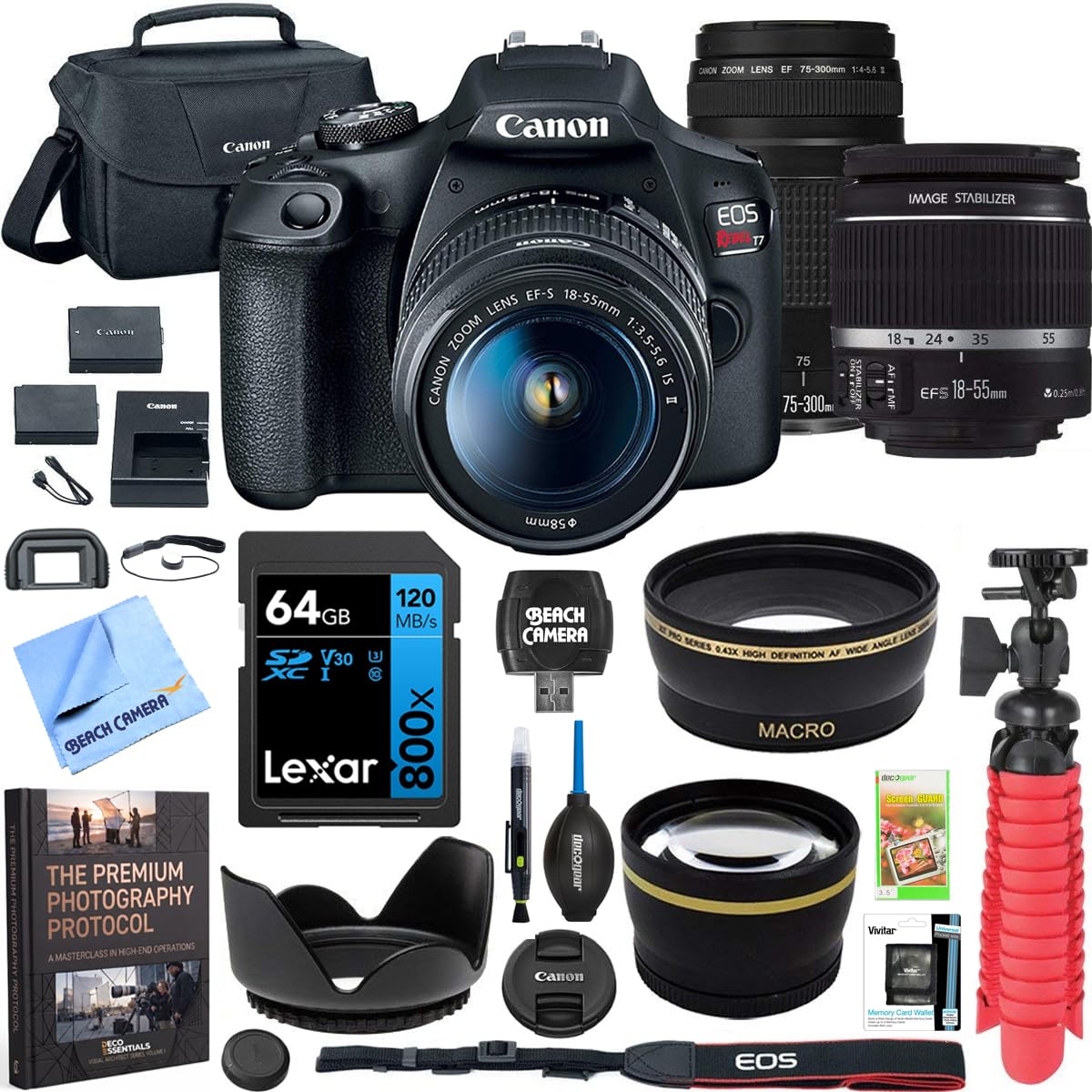
This Canon T7 bundle is the classic entry-level DSLR package: a 24.1MP APS-C CMOS sensor, DIGIC 4+ processor, Full HD 1080p video at 30 fps, and the unmistakable long-lens look that smartphone users crave. The kit includes both the EF-S 18-55mm f/3.5-5.6 IS II lens for general shooting and the EF 75-300mm f/4-5.6 III telephoto lens for sports, wildlife, and compressed-background portraits — giving you two focal ranges from day one.
The 9-point autofocus system with a single cross-type center point is basic by today’s standards, but it works reliably in good light. The optical viewfinder offers 95% coverage, so you get a very close approximation of your final frame. Built-in Wi-Fi and NFC allow you to transfer images to your phone via the Canon Camera Connect app, though the transfer speed is slow for batches of full-resolution JPEGs. The included accessories — a tripod, filter kit, extra battery, and 64GB SD card — provide real utility for a beginner who owns nothing else.
The main downsides are the 3 fps burst rate and the battery life, which several reviewers report drains quickly — some experienced a full-to-dead drop after only 8 shots, suggesting the included LP-E10 battery may be weak or counterfeit in some bundles. The camera body is also larger and heavier than the Nikon D3500 or the Canon R100. If you want the convenience of a dual-lens kit and are comfortable swapping batteries often, this bundle delivers impressive versatility for the money.
Why it’s great
- Includes both 18-55mm and 75-300mm lenses for versatile reach
- 24.1MP sensor produces high-quality prints and crops
- Built-in Wi-Fi and NFC for easy smartphone sharing
Good to know
- Battery life reported as inconsistent; some units drain extremely fast
- 3 fps burst speed limits action photography
- Camera body is heavier than newer mirrorless alternatives
5. Nikon D7500

The Nikon D7500 is an upper-mid-range DSLR that often slips under the radar of budget buyers, but its price-to-performance ratio is exceptional if you can stretch your budget. The 20.9MP DX-format CMOS sensor is derived from the pro-level D500, and it produces clean, detailed images up to ISO 6400 with remarkably low noise. The 51-point autofocus system with 15 cross-type sensors and group-area AF gives you professional-grade subject tracking for sports, wildlife, and fast-moving children — a massive upgrade from entry-level 11-point or 9-point systems.
The continuous shooting speed of 8 fps with full autofocus tracking is genuinely competitive with mirrorless cameras in a higher price bracket. The 3.2-inch 922K-dot tilting touchscreen LCD is bright and responsive, and the touch functionality makes menu navigation and focus-point selection faster than any button-only DSLR. The 18-140mm f/3.5-5.6G ED VR lens included in the kit is a high-quality all-in-one zoom that covers wide-angle to mid-telephoto without forcing you to swap lenses.
The trade-offs are weight and age — at roughly 720 grams body-only, the D7500 is noticeably heavier than modern mirrorless options, and the body design dates from 2017. There is no in-body image stabilization. But the weather-sealed build, deep buffer for RAW bursts, and 4K UHD video at 30 fps with power aperture control make it a genuine tool for semi-professional use. If you can handle the weight, this is the most capable DSLR on this list for a budget-conscious enthusiast.
Why it’s great
- 51-point AF with 15 cross-type sensors rivals professional bodies
- 8 fps burst is excellent for action photography
- 18-140mm VR lens is a versatile all-in-one zoom
Good to know
- Heavier build (720g body) is fatiguing on long shoots
- 2017 model lacks newer features like USB-C or IBIS
- Single SD card slot limits backup options
6. Nikon D850
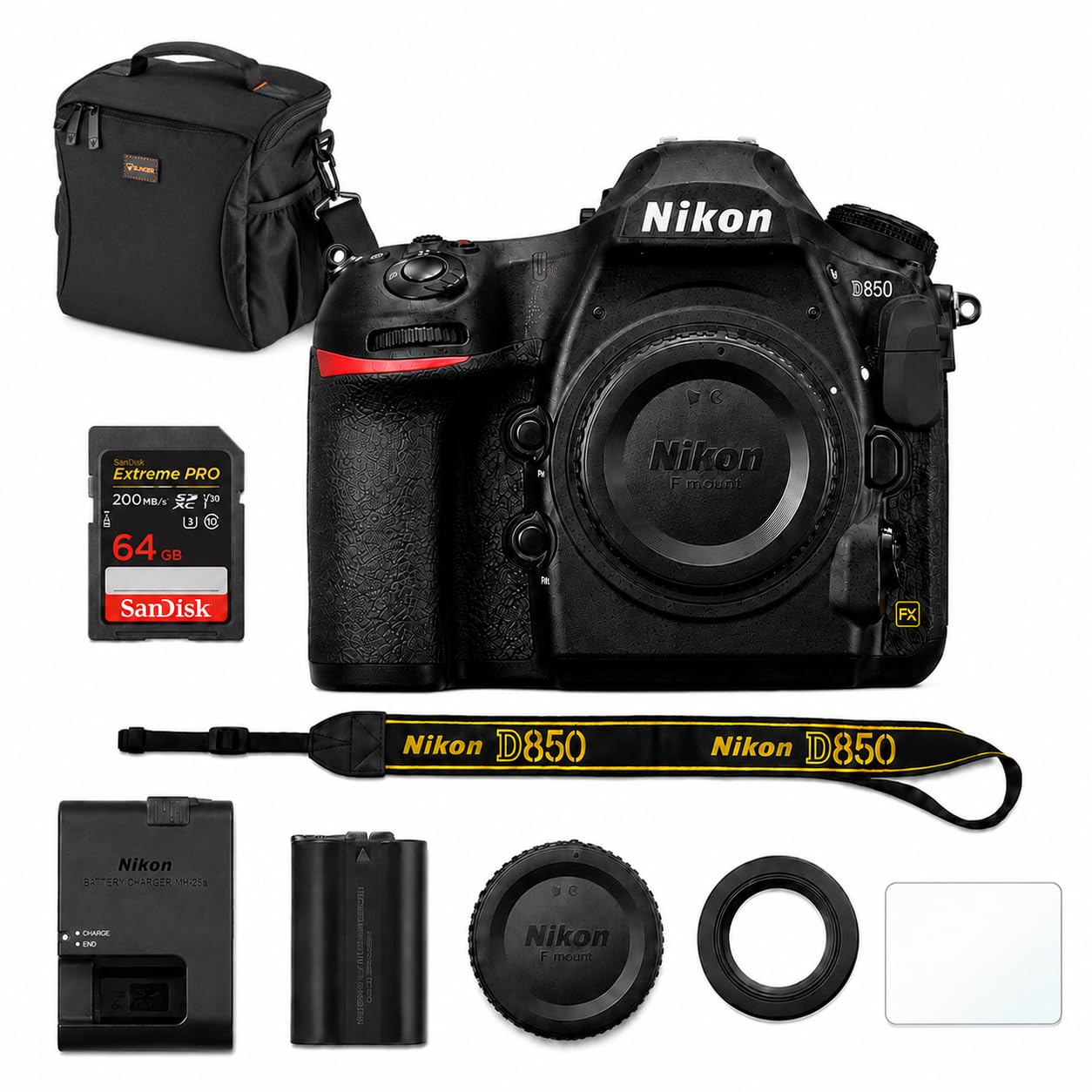
The Nikon D850 sits at the absolute top of the DSLR pyramid, and its price reflects that. But for a budget-minded photographer willing to buy used or refurbished, the D850 offers 45.7 megapixels of full-frame resolution, a 153-point autofocus system with 99 cross-type sensors, and a native ISO range down to 64 for exceptional dynamic range. Shooting at 7 fps with full autofocus and up to 9 fps with the optional battery grip, it is a studio and landscape legend that also performs well for wildlife and events.
The EXPEED 5 image processor handles the massive data load from the 45.7MP BSI CMOS sensor, giving you 14-bit RAW files with 15 stops of dynamic range — enough to lift shadows by several stops without introducing objectionable noise. The 3.2-inch 2.36-million-dot tilting touchscreen LCD, SnapBridge Bluetooth/Wi-Fi connectivity, and 4K UHD video at 30 fps round out the feature set. This bundle adds a 64GB SanDisk Extreme PRO SD card, a multi-device shoulder bag, and a screen protector.
The main reason to buy a D850 in 2024 is still image quality. No budget mirrorless camera under the premium tier can match its resolution and dynamic range. The downsides are the sheer weight (approximately 1,005 grams body-only), the absence of in-body image stabilization, and the fact that the body is DSLR-sized, meaning lenses are also large and heavy. If your budget allows for this leap and you prioritize ultimate image quality for print or commercial work, the D850 is the most capable DSLR ever made.
Why it’s great
- 45.7MP full-frame sensor offers unmatched resolution for landscapes and commercial work
- 153-point AF system with 99 cross-type sensors is professional-grade
- ISO 64 native base provides exceptional dynamic range and low noise
Good to know
- Body alone weighs over 1kg; very heavy for travel
- No in-body image stabilization
- Included SD card is slow for burst writing; recommend upgrading
7. Canon EOS 2000D Bundle (Renewed)

The Canon EOS 2000D, also known as the Rebel T7, is the most widely available entry-level DSLR on the planet, and this renewed bundle includes the 18-55mm f/3.5-5.6 lens plus a wide-angle adapter, a telephoto adapter, a flash, a 128GB memory card, a case, and a tripod. The 24.1MP APS-C CMOS sensor and DIGIC 4+ processor deliver solid image quality that outclasses any smartphone, with a depth of field control and low-light capability that phone cameras cannot replicate.
The 9-point autofocus system is basic, but the AI Servo AF mechanism helps track moving subjects more effectively than simple contrast detection. Built-in Wi-Fi and NFC allow wireless image transfer to a smartphone for quick social media posting. The on-board Feature Guide explains each setting, making this a genuine learning tool for beginners who do not want to read a dense manual.
The renewed (refurbished) nature of this bundle means the camera may show minor cosmetic wear, but most reviewers report units that look and function like new. The kit’s telephoto and wide-angle adapters are screw-on attachments, not true lenses, so image quality at the extreme ends of their range is soft. The included tripod is flimsy. For the price, however, this bundle gives you everything you need to start shooting immediately, and many users report the accessories alone offset the camera cost.
Why it’s great
- Massive accessory bundle includes lenses, flash, tripod, and 128GB card
- 24.1MP sensor with DIGIC 4+ processor produces excellent starter images
- Built-in Wi-Fi and NFC for easy image sharing
Good to know
- Wide-angle and telephoto adapters degrade image quality
- Included tripod is unstable and likely to break quickly
- Renewed unit may show light cosmetic wear
8. Canon EOS Rebel T7 (New)
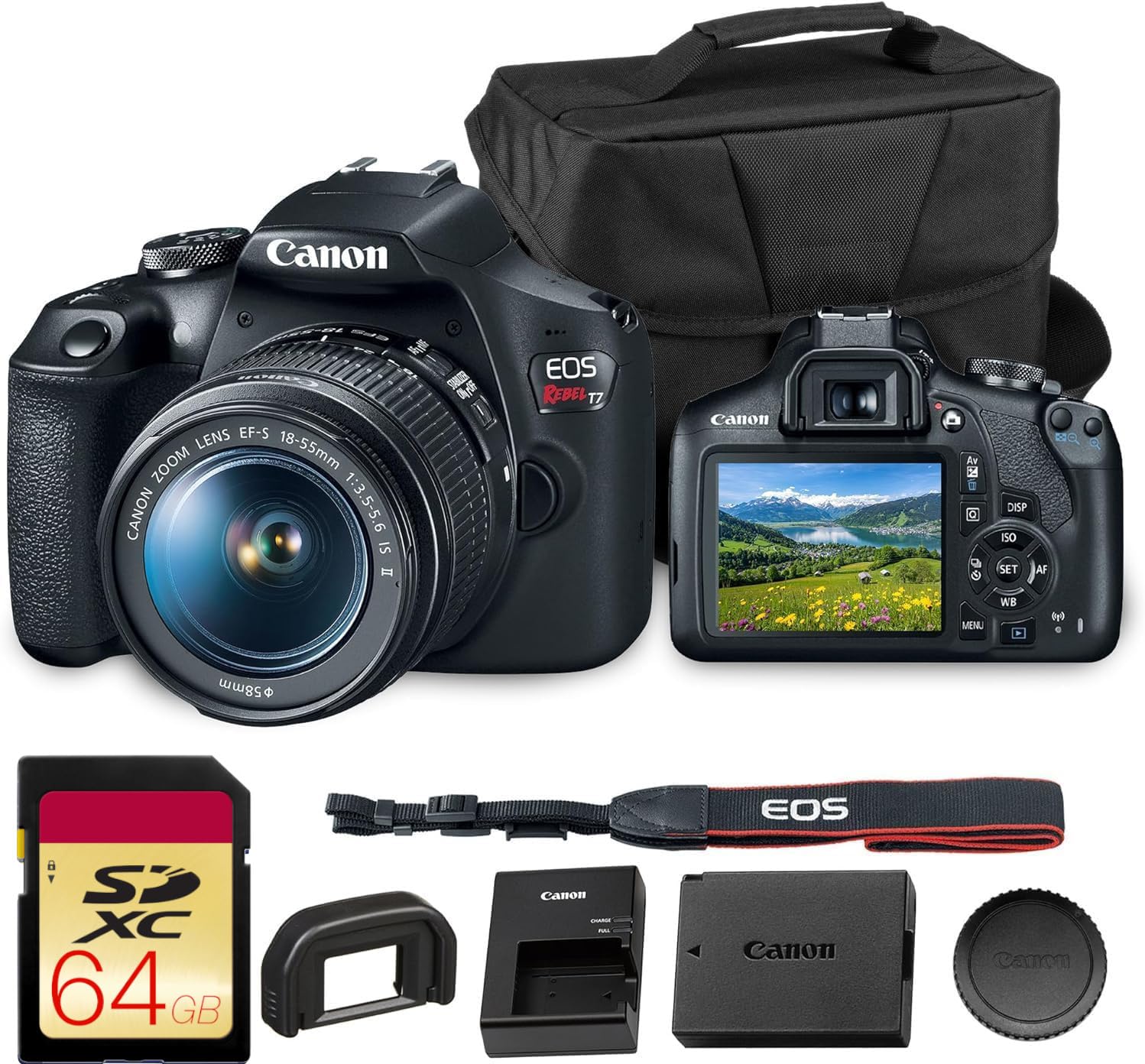
This new-in-box Canon Rebel T7 kit comes with the 18-55mm f/3.5-5.6 IS II lens, a shoulder bag, and a 64GB SD card, making it a clean, warranty-backed alternative to renewed or bundle-heavy listings. The 24.1MP APS-C CMOS sensor and DIGIC 4+ image processor are identical to the one found in the 2000D, and they deliver the same quality, but the Rebel T7 tends to have slightly more polished autofocus tuning and a more robust build finish.
The 9-point autofocus system with a central cross-type point works quietly and efficiently for portraits, still life, and everyday snapshots. The built-in Wi-Fi and NFC pair with the Canon Camera Connect app for wireless remote shooting and image transfer. The 3.0-inch 920K-dot LCD screen is bright enough for outdoor use, and the optical viewfinder offers a crisp, immediate view with no lag. Video recording at 1080p 30 fps is smooth enough for casual clips, and the lens’s image stabilization visibly reduces handheld shake.
The main limitation is the 3 fps burst speed, which frustrates when trying to capture a child’s expression or a pet’s playful moment. If you want a brand-new camera with a full manufacturer warranty, no cosmetic risk, and a straightforward bag-and-card bundle, the new Rebel T7 is the safe, predictable choice for a first-time DSLR buyer.
Why it’s great
- Brand new with full manufacturer warranty for peace of mind
- 24.1MP sensor produces sharp, color-accurate images
- Wireless connectivity via Wi-Fi and NFC for easy sharing
Good to know
- 3 fps burst rate is too slow for action photography
- Average battery life (~500 shots) requires spare batteries for long days
- 9-point autofocus feels dated compared to mirrorless alternatives
9. Canon EOS 2000D 28pc Bundle (Renewed)

This 28-piece kit is the most accessory-rich bundle on the list, including the Canon EOS 2000D (Rebel T7) body, the EF-S 18-55mm f/3.5-5.6 DC III lens, two 64GB SD cards, a 58mm filter kit, a 58mm macro kit, a 0.43x wide-angle adapter, a 2.2x telephoto adapter, a tulip hood, a full-size tripod, a wired remote shutter, an extra battery, a slave flash, and a camera bag. The camera itself is the same 24.1MP APS-C unit with 9-point phase-detect AF, DIGIC 4+ processing, and built-in Wi-Fi.
The shear volume of accessories is overwhelming in the best way for an absolute beginner. The macro adapter lets you take genuine close-up shots of flowers or coins, and the wide-angle adapter opens up landscape compositions without needing an expensive second lens. The wired remote shutter is useful for long exposures on the tripod, though the Rebel T7 lacks a bulb mode, limiting its astrophotography utility to 30-second exposures maximum.
The trade-off is that many of these accessories are budget-grade—the tripod is described as flimsy, the filter kit is basic glass, and the slave flash lacks any TTL metering. The bundle also includes a slug of smaller items (cleaning cloth, lens caps, body caps) that build the 28pc count but add minimal value. If you want the most accessories possible for the lowest entry price and are willing to replace the cheap tripod later, this bundle is the most complete starting point on the list.
Why it’s great
- 28-piece bundle includes nearly every accessory a beginner needs
- Includes macro and wide-angle adapters for creative shots
- Extra battery and wired remote add real value for long shoots
Good to know
- Included tripod is flimsy and prone to tipping
- Lens adapters reduce image quality at their extremes
- No bulb mode limits long-exposure and astrophotography
10. Canon EOS Rebel T100 (Renewed)

The Canon EOS Rebel T100 (also called the 4000D) is the absolute cheapest way to get a dedicated APS-C DSLR sensor into your hands. At 18 megapixels, the CMOS sensor offers exactly the same pixel count as the original Canon Digital Rebel from 2003, but the DIGIC 4+ processor helps control noise and speeds up operation. The 40 autofocus points listed in the specs are contrast-detect points for live-view mode, not phase-detect points for the viewfinder — a distinction that matters when tracking moving subjects.
The Scene Intelligent Auto mode genuinely works well for beginners: point, compose, and shoot, and the camera picks reasonable exposure settings. The optical viewfinder is small but functional, and the 2.7-inch LCD screen at 230K dots is noticeably lower resolution and smaller than the 3-inch 920K-dot screens on the T7 and D3500. The included EF-S 18-55mm f/3.5-5.6 III lens is the most basic kit lens Canon makes, with no image stabilization, so you will need steady hands or a tripod in low light.
The major limitation is the 30-second maximum shutter speed with no bulb mode, which makes the T100 effectively useless for astrophotography — a common beginner desire. The Wi-Fi is unreliable, and the build quality feels more plastic and hollow than the Rebel T7. Reviewers note that smartphones often outperform this camera for night shots and long exposures. If your budget absolutely cannot stretch to a 24MP model and you only shoot in good daylight, the T100 works. For anything else, spend a bit more.
Why it’s great
- Lowest entry price for a DSLR body with interchangeable lenses
- Scene Intelligent Auto makes it simple for absolute beginners
- 18MP sensor is adequate for web sharing and small prints
Good to know
- No bulb mode; 30-second max shutter prevents astrophotography
- Kit lens lacks image stabilization, limiting low-light handheld use
- 2.7-inch 230K-dot screen is small and low-resolution
11. Canon EOS Rebel T100 (New with Card)

This new-in-box Canon EOS Rebel T100 adds a 32GB SD card to the base kit, giving you the same 18MP APS-C sensor, DIGIC 4+ processor, and 3 fps burst speed as the renewed version but with the confidence of a brand-new unit and full warranty. The camera includes Scene Intelligent Auto, Creative Auto modes, and Creative Filters that let beginners add toy camera, fisheye, and miniature effects in-camera — a playful touch that younger photographers enjoy.
The optical viewfinder is dimmer and smaller than the T7 or D3500, but it still provides that authentic DSLR shooting experience. The Canon Camera Connect app works with the built-in Wi-Fi to transfer 2MP versions of your images to a smartphone for quick sharing, but the app is slow and the connection can drop. The 18MP sensor is the same one used in much older Canon DSLRs, so images look good at 8×10 prints but show more noise in shadow areas than newer 24MP designs.
The biggest practical problem remains the lack of bulb mode. If you ever want to shoot a starry sky or a light trail, this camera will stop you at 30 seconds. The kit lens lacks image stabilization, the build is all plastic, and the 3 fps burst is anemic. For a total beginner on the tightest possible budget who only shoots in daytime and wants to learn on a real DSLR, the new T100 with a warranty is the safest bet in this price basement. Just manage your expectations about night photography and autofocus speed.
Why it’s great
- New-in-box with full manufacturer warranty and included SD card
- Creative Filters add fun effects for beginners without a computer
- Lowest price point for a brand new DSLR on the market
Good to know
- No bulb mode; max 30-second shutter — unsuitable for night or astro
- 18MP sensor shows more noise at high ISO than 24MP competitors
- Build is largely plastic with a hollow feel
FAQ
Can I use an EF-S lens on a Canon Rebel T7?
Which budget DSLR has the best autofocus for sports?
Is a 24.1MP DSLR noticeably better than an 18MP model?
Can I use my budget DSLR for astrophotography?
Should I buy a renewed or new budget DSLR?
Final Thoughts: The Verdict
For most users, the best budget dslr camera winner is the Nikon D3500 Bundle because its 24.2MP sensor with no low-pass filter, beginner-friendly Guide Mode, and exceptional battery life deliver the highest image quality per dollar spent. If you want modern autofocus with eye detection and a lighter carry, grab the Canon EOS R100. And for entry-level versatility with dual lenses included, nothing beats the Canon T7 Rebel Bundle.