
The stereo receiver you grew up with is dead. A new generation of compact, Class D amplifiers has cut the cord, ditching the heavy transformer and limited input banks for Bluetooth streaming and high-efficiency power stages that drive demanding passive speakers with startling authority. Choosing the right amp with Bluetooth today means weighing more than just wattage — it means deciding how much control you want over your sound signature, how many speakers you need to drive, and whether you prefer a minimalist puck or a traditional full-width chassis.
I’m Min — the co-founder and writer behind Gadgets Feed. I’ve spent countless hours analyzing the power ratings, DAC chipsets, Bluetooth codecs, and real-world thermal performance of these Class AB and Class D amplifiers to separate the noisy compromises from the genuinely musical performers.
The best amp with bluetooth delivers high-current output, low distortion, and reliable wireless pairing without forcing you to buy a bulky AV receiver you will never use.
How To Choose The Best Amp With Bluetooth
Bluetooth integration has transformed stereo amplifiers into wireless hubs, but the wide price range — from compact mini amps to full-width integrated receivers — can make the selection process confusing. Focus on the amplifier’s native power output into your speaker’s impedance, the quality of its Bluetooth codec, and the versatility of its input and output options to match your specific setup.
Match Power to Your Speakers
An amplifier’s rated wattage matters only when paired with your speaker’s sensitivity and impedance. A 60W-per-channel amp can drive 89dB-sensitive bookshelf speakers to satisfying room-filling levels, but the same amp may struggle with 84dB floor-standing towers. Look for continuous RMS power ratings at 4 ohms and 8 ohms, not peak or maximum figures. The Yamaha R-S202BL delivers 100W into 8 ohms (typical for a traditional receiver), while the Fosi Audio BL20A delivers 100W into 2 ohms per channel in a much smaller Class D package.
Bluetooth Version and Codec Support
Bluetooth 5.0 provides up to 4x the range of version 4.1 and supports higher data throughput, which translates to fewer dropouts. The Denon PMA-600NE and Yamaha R-S202BL still use older Bluetooth implementations (4.1/2.1 + EDR), while the WiiM Amp Ultra steps up to Bluetooth 5.3 with LE Audio for lower latency. For critical listening, Wi-Fi streaming — available only on the WiiM models — offers lossless 24-bit/192kHz playback that Bluetooth cannot match.
Connectivity and System Expansion
A subwoofer output lets you add a powered sub without splitting the speaker-level signal, which is essential for a 2.1-channel system. HDMI ARC simplifies TV integration — only the WiiM Amp and WiiM Amp Ultra offer this over a single cable. If you own a turntable, a built-in phono preamp saves you a separate box; the Denon PMA-600NE and Cambridge Audio AXR100 include one. The number of analog inputs, optical/coaxial digital inputs, and headphone outputs should match the sources you plan to connect.
Quick Comparison
On smaller screens, swipe sideways to see the full table.
| Model | Category | Best For | Key Spec | Amazon |
|---|---|---|---|---|
| WiiM Amp Ultra | Streaming Amp | Multi-room hi-res streaming | 100W/ch, ESS ES9039Q2M DAC | Amazon |
| WiiM Amp | Streaming Amp | Compact all-in-one system | 60W/ch, HDMI ARC | Amazon |
| Denon PMA-600NE | Integrated Amp | Analog purist with sub out | 70W/ch, Phono input, DAC | Amazon |
| Cambridge Audio AXR100 | Stereo Receiver | Full-width traditional system | 100W/ch, AM/FM tuner | Amazon |
| Yamaha R-S202BL | Stereo Receiver | Budget two-zone setup | 100W/ch, Dual speaker selector | Amazon |
| AIYIMA A07 MAX | Power Amp | High-power mono bridging | 300W/ch @ 4 ohm, TPA3255 | Amazon |
| Fosi Audio BL20A | Mini Amp | Ultra-compact starter system | 200W peak, TPA3116 chip | Amazon |
In‑Depth Reviews
1. WiiM Amp Ultra with Voice Remote 2
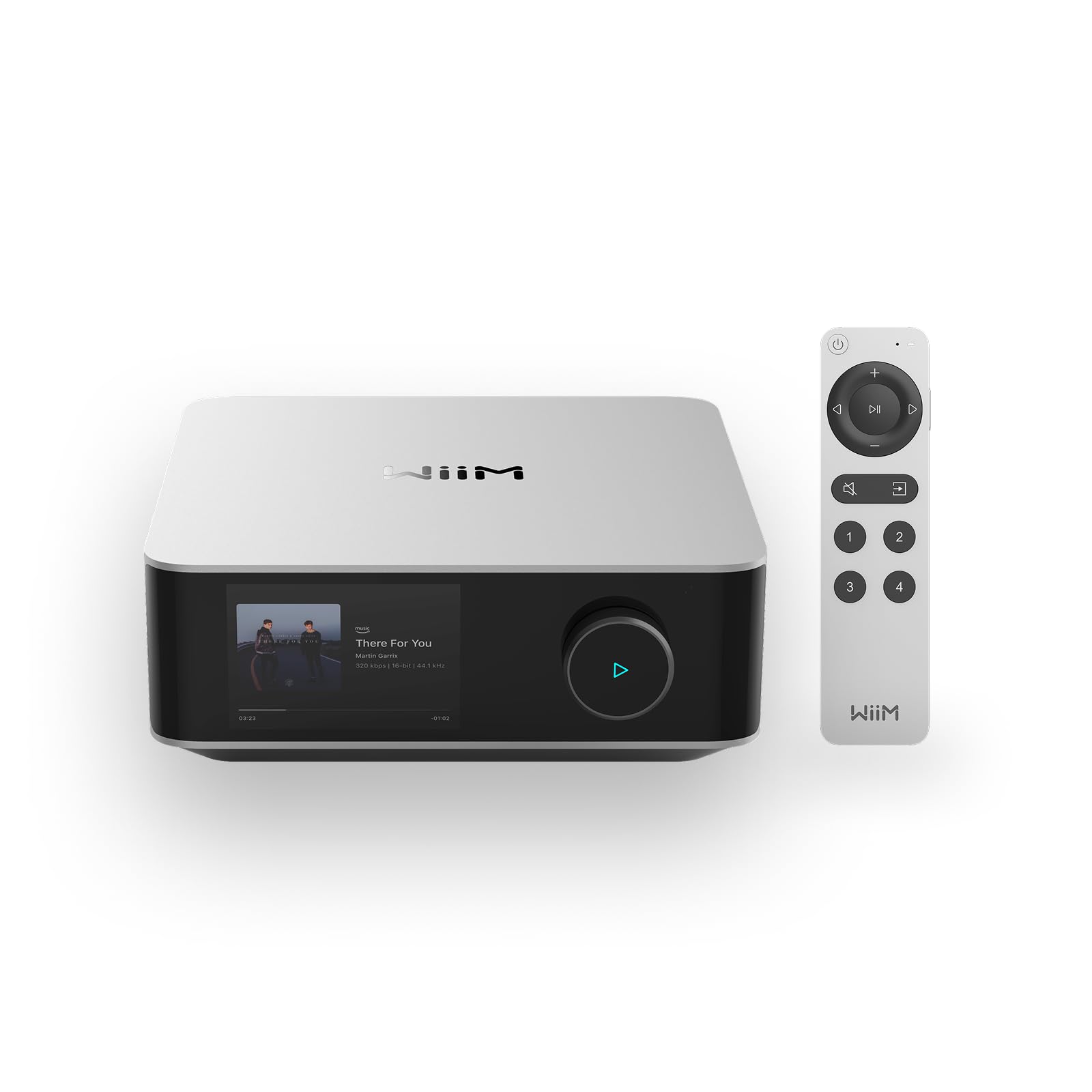
WiiM leaps ahead of its own standard Amp with the Ultra, packing 100W per channel into a sleek unibody aluminum chassis and a 3.5-inch glass-covered touchscreen that displays album art and system settings. At its heart sits an ESS ES9039Q2M Sabre DAC paired with dual TI TPA3255 Class D amps, delivering a measured -106 dB THD+N that rivals separates costing twice as much. The built-in RoomFit room correction auto-calibrates the sound to your space, and the combination of Wi-Fi 6 and Bluetooth 5.3 with LE Audio ensures the fastest, most stable wireless streaming currently available in this form factor.
Connectivity is generous: HDMI ARC, optical, RCA, and a subwoofer output let you integrate a turntable, TV, or powered sub without adapters. The included voice remote and full WiiM Home app give you granular control over parametric EQ per source, alarms, volume limits, and multi-room grouping with other WiiM devices or Alexa/Google speakers. Listeners upgrading from a basic receiver will immediately notice the cleaner soundstage and extended frequency response — the Ultra breathes life into budget Polk towers and high-end Klipsch references alike.
The only catch is the lack of AirPlay receiver support, which limits iPhone users who rely solely on Apple’s protocol for multi-room sync. Additionally, the Bluetooth source introduces a slight delay that some users find noticeable when watching video, though the auto-input switching and dedicated TV HDMI ARC connection mitigate this for most setups. For the price, the Ultra delivers studio-perfect clarity, flexible room correction, and a feature set that genuinely replaces a stack of separates.
Why it’s great
- ESS Sabre DAC with dual TPA3255 amps for ultra-low distortion and high current.
- Built-in RoomFit EQ auto-calibrates sound to your listening environment.
- Wi-Fi 6 and Bluetooth 5.3 ensure lag-free, high-bandwidth streaming.
Good to know
- No AirPlay receiver support — iPhone multi-room requires an alternative.
- Bluetooth source introduces latency unsuitable for video without workarounds.
- Coaxial input is absent; optical and HDMI ARC are the digital options.
2. WiiM Amp

The original WiiM Amp upends the budget streaming amplifier segment by packing 60W per channel into a compact chassis that fits in the palm of your hand, yet drives floor-standing and architectural passive speakers with authority. Its HDMI ARC port is a standout feature at this price point — plug your TV in, and the amp auto-powers on and off with the TV, consolidating remote control and turning a basic stereo setup into a smart home theater center. The WiiM Home app integrates Spotify, TIDAL, Amazon Music, Qobuz, and local library streaming with gapless playback up to 24-bit/192kHz, plus full multi-room grouping with other WiiM products.
Voice control via Alexa, Google Assistant, or Siri, plus the included physical voice remote, makes the Amp genuinely family-friendly. The built-in room correction (basic parametric EQ) and adjustable subwoofer crossover allow you to dial in a 2.1-channel system without an external processor. Pair it with high-sensitivity bookshelf speakers like Polk Atrium 6s, and the sound is detailed, dynamic, and surprisingly spacious given the size — jazz and classical fans will appreciate the clarity, while rock listeners get enough punch for mid-size rooms.
There are trade-offs. There is no headphone jack, so late-night listening requires a USB dongle. The dedicated subwoofer output does not auto-power the subwoofer, leaving you to manage that separately. A few units also exhibit HDMI ARC handshake issues that lose sound on a power cycle, though a restart usually resolves it. Despite these quirks, the WiiM Amp delivers an unbeatable blend of smart features and sound quality for its class.
Why it’s great
- HDMI ARC simplifies TV integration with auto power/source switching.
- Full multi-room streaming via Wi-Fi with 24-bit/192kHz hi-res support.
- Voice remote and app-based parametric EQ for precise tuning.
Good to know
- No headphone jack — must use a USB-C dongle for private listening.
- Subwoofer output does not trigger auto-power on the sub.
- Some users report HDMI ARC sound-drop issues requiring a reboot.
3. Denon PMA-600NE

The Denon PMA-600NE represents a return to analog-focused design in the Bluetooth era. Its most distinctive feature is the Analog Mode switch that completely disengages the digital circuitry — including the Bluetooth receiver — for a pure signal path that yields a warm, tube-like sound reminiscent of 1970s solid-state receivers. The Advanced High Current (AHC) push-pull circuit delivers 70W per channel into 4 ohms with a massive 185W power consumption rating, indicating a serious power supply that outperforms many higher-rated receivers in dynamic headroom and current delivery.
The built-in DAC accepts two optical and one coaxial input, while the integrated phono stage handles moving-magnet turntables cleanly. Listeners report that the PMA-600NE drives Elac and Q Acoustics bookshelf speakers with spacious warmth, airier treble, and a deeper soundstage than similarly priced vintage alternatives. The subwoofer output with adjustable crossover (tight bass, well-integrated) and tone controls (bass, treble, balance) give you flexibility without entering the digital realm. The headphone output is surprisingly capable, driving 300-ohm Sennheisers to comfortable volume at the 9 o’clock position.
The trade-off comes in connectivity. Bluetooth is version 2.1 + EDR, which is dated and may limit range and codec support. The remote control has a noticeable volume lag that makes fine adjustments frustrating, and the dim LED indicators and loud relay switching have a distinctly old-school feel. If wireless streaming is your primary source, the older Bluetooth implementation is a real drawback. But for vinyl enthusiasts or anyone who values analog purity over app-based control, the PMA-600NE delivers a gorgeously musical experience.
Why it’s great
- Analog Mode disables all digital circuits for uncompromised signal purity.
- Massive power supply delivers excellent current and dynamic headroom.
- Phono input and subwoofer out with adjustable crossover built in.
Good to know
- Bluetooth version 2.1 + EDR is outdated and range-limited.
- Remote control has coarse volume steps and noticeable lag.
- Lacks a Loudness button and USB input.
4. Cambridge Audio AXR100

The Cambridge Audio AXR100 is a traditional full-width stereo receiver that combines 100 watts per channel of Class AB power with modern Bluetooth connectivity and a dedicated phono stage. Its build quality is excellent — a brushed aluminum fascia, heavy chassis, and high-quality binding posts that accept banana plugs easily. The amplifier section delivers a balanced, slightly warm sound that users describe as “accurate with a touch of musicality,” making it suitable for long listening sessions across genres. The built-in DAC handles optical and coaxial inputs, and the A/B speaker switching allows two separate zones for whole-home distribution.
FM and AM tuning is surprisingly strong, with high signal-to-noise ratio reception that pulls in distant stations clearly. The subwoofer pre-out gives you 2.1-channel expansion, though the crossover is fixed and not adjustable from the front panel. Users report that pairing the AXR100 with Klipsch RF7 floor-standers produces superb clarity at all volumes, with no fan noise — a common issue in some traditional receivers. The phono stage is clean and loud enough to handle moving-magnet cartridges without an external preamp, making vinyl integration seamless.
Bluetooth performance is the weakest link here. Several users report short range (a few feet before dropouts) and poor phone volume synchronization, which feels unacceptable at this price point. The remote control is nearly impossible to read in a dark room and has mushy buttons with limited IR range. There is no adjustable crossover or USB input, which may frustrate users who want precise subwoofer integration or direct digital playback from a flash drive. If you value robust power and classic design above flawless Bluetooth, the AXR100 is a stellar performer, but its wireless implementation lags behind modern competitors.
Why it’s great
- 100W Class AB power with a balanced, musical sound signature.
- Excellent AM/FM tuner with high signal-to-noise ratio.
- Built-in phono stage handles vinyl without external preamp.
Good to know
- Bluetooth range is limited to a few feet with frequent dropouts.
- Remote control is dimly backlit and has poor IR range.
- No adjustable subwoofer crossover; no USB input.
5. Yamaha R-S202BL

Yamaha’s R-S202BL is a no-frills stereo receiver that focuses on delivering clean 100W-per-channel power at an aggressive price point. Its brushed aluminum front panel and minimalist layout give it a classic aesthetic that fits into any shelf. The receiver includes a speaker selector for two separate A/B systems — perfect for running a main listening room plus a patio or bedroom set of speakers from the same source. Bluetooth 4.1 with EDR provides reliable pairing for music streaming from smartphones and tablets, with enough range for a typical living room.
The R-S202BL’s strongest suit is its FM/AM tuner, which users consistently report as having exceptional sensitivity — it pulls in distant stations with crystal clarity where other receivers fail. The 40-station preset memory is generous for radio enthusiasts. Sound quality is clean and neutral, with no audible distortion even at high volume levels. Users have successfully driven vintage Large Advents and other power-hungry speakers without strain. The headphone jack and auto-standby function add convenience for late-night sessions and energy savings.
Where the R-S202BL shows its age is in connectivity. There is no onboard DAC, no subwoofer pre-out, and no digital inputs whatsoever — it is purely analog (RCA and tape monitor loops). The Bluetooth implementation is functional but lacks aptX or LDAC support. Volume only becomes audible past 45/99 on the dial, limiting fine control at low listening levels. If your needs are simple — a radio, a CD player, a turntable (with external preamp), and occasional Bluetooth streaming — this receiver offers unbeatable power-per-dollar. It will not serve a modern streaming-focused setup well.
Why it’s great
- 100W of clean power drives most bookshelf/floor-standing speakers easily.
- Speaker selector for two separate A/B zones from one unit.
- Exceptional FM/AM tuner performance with 40 presets.
Good to know
- No subwoofer pre-out, no digital inputs, no built-in DAC.
- Volume knob has limited control below 45/99 on the dial.
- Bluetooth is basic v4.1 without aptX or AAC codecs.
6. AIYIMA A07 MAX

The AIYIMA A07 MAX is a Class D power amplifier that prioritizes raw power output over integrated streaming features, making it the right choice for users who already own a separate preamp, DAC, or streamer. It delivers 300W per channel in stereo mode (4 ohms) using dual TI TPA3255 chips paired with NE5532 op-amps, and an innovative bridge switch converts it to a 600W mono amplifier for driving a single demanding speaker or subwoofer. The included DC 36V 6A power supply is adequate for most setups, but upgrading to a 48V 10A unit unleashes even more headroom — measured at 315W x1 in mono mode at 4 ohms.
The build quality is an improvement over earlier AIYIMA models, with upgraded Nichicon 63V capacitors, German WIMA film caps, and a massive heatsink that keeps the case temperature around 100°F regardless of volume. The binding posts are staggered but accept banana plugs, and the 3.5mm line output allows chaining a second A07 MAX for a true dual-mono configuration. Sound quality is described as clean and musical with punchy bass in stereo mode, and refined with better separation in mono mode — a noticeable step up in refinement from the cheaper Fosi ZA3.
The A07 MAX has no Bluetooth receiver, no DAC, no tone controls, and no remote control — it is a straight power amplifier. The volume knob also serves as the power switch, and its low-level control is poor: sound becomes audible around 9 o’clock, with a smooth range until 1-2 o’clock, then a dramatic jump past that. Some users note crosstalk in mono mode at very high volumes. For system builders who want to pair a WiiM Mini or external DAC with a high-power Class D stage, the A07 MAX delivers exceptional value, but it requires a willingness to build a component system.
Why it’s great
- Switchable stereo (300W/ch) and mono (600W) modes for flexible setups.
- Upgraded Nichicon/WIMA capacitors and massive heatsink for thermal stability.
- Aux output allows chaining a second unit for dual-mono systems.
Good to know
- No built-in Bluetooth, DAC, tone controls, or remote control.
- Volume knob has poor low-level control with a steep jump past 2 o’clock.
- Runs warm (~100°F) at idle and exhibits crosstalk in mono mode at loud volumes.
7. Fosi Audio BL20A

The Fosi Audio BL20A is a pocket-sized Class D amplifier that punches well above its footprint, delivering a peak 200W output via dual Texas Instruments TPA3116 chips. Its aluminum alloy chassis measures just 5.2 x 3.54 x 1.42 inches, making it easy to hide behind a bookshelf or place on a desktop without dominating the space. Bluetooth 5.0 provides a stable 50-foot connection range that outperforms many larger receivers, and the 24V 4.5A power adapter included in the box delivers full power for driving most home passive speakers — users report excellent results driving vintage Bose 501s and Polk in-wall speakers with clean stereo separation.
Input versatility is strong for such a small unit: you get Bluetooth, RCA, 3.5mm AUX, and U-Disk (USB flash drive) playback. The front-panel bass and treble controls are responsive and effective, allowing quick tonal adjustments without an app. A standout feature at this price point is the 3.5mm pre-out, which lets you connect external powered speakers or a subwoofer, or daisy-chain to a more powerful amplifier. The included remote control handles volume, input selection, and basic transport, making the BL20A a surprisingly complete starter system in a box.
There are limitations. The speaker terminals are spring clips rather than binding posts, meaning banana plugs will not work — you must strip bare speaker wire or use pin connectors. The USB flash drive playback is finicky; it reads MP3 files without issue but fails to recognize larger WAV files unless they are re-encoded to a smaller format. Some users report slight graininess at maximum volume, particularly with bass-heavy content. For a budget-friendly, tiny amplifier that serves as a capable entry point into hi-fi, the BL20A is wonderfully effective — it simply will not satisfy users who need high-current binding posts or flawless high-resolution USB playback.
Why it’s great
- Ultra-compact aluminum chassis fits any desktop or shelf.
- Bluetooth 5.0 provides stable 50-foot range.
- 3.5mm pre-out enables external subwoofer or powered speaker integration.
Good to know
- Spring-clip terminals do not accept banana plugs — bare wire only.
- USB playback struggles with large WAV files; MP3 works reliably.
- Audible graininess at maximum volume with bass-heavy content.
FAQ
Can I connect a turntable to an amp with Bluetooth?
Does Bluetooth version matter for sound quality?
Can I use an amp with Bluetooth for outdoor speakers?
How do I connect a TV to an amp with Bluetooth?
What speaker impedance should I match with my amplifier?
Final Thoughts: The Verdict
For most users, the best amp with bluetooth winner is the WiiM Amp Ultra because it combines a top-tier ESS DAC, dual TPA3255 amps, Wi-Fi 6 streaming, and built-in room correction in a touchscreen-equipped chassis that fits any modern system. If you want HDMI ARC and multi-room streaming, grab the WiiM Amp. And for vinyl enthusiasts who prioritize analog sound quality over streaming features, nothing beats the Denon PMA-600NE.