
The difference between a decent close-up and a stunning macro photograph comes down to one thing: edge-to-edge sharpness at 1:1 magnification. A 100mm macro lens delivers the ideal working distance for insects, jewelry, and product shots, letting you fill the frame with detail while keeping a comfortable gap between you and the subject. The right lens will render tiny hairs on a bee’s leg or the sparkle on a diamond ring with zero chromatic aberration.
I’m Min — the co-founder and writer behind Gadgets Feed. I’ve spent hundreds of hours analyzing optical bench tests, MTF charts, and real-world sample galleries to separate lenses that merely claim macro capability from those that deliver true 1:1 or even 2:1 magnification without sacrificing contrast or resolution.
The best 100mm macro lens balances magnification ratio, aperture sharpness, autofocus speed, and build quality to match your camera system and shooting style.
How To Choose The Best 100mm Macro Lens
Not every 100mm, f/2.8 lens is created equal at close focus. The real test happens when you rack the focus ring to its minimum distance and inspect the corners at 100% zoom. Optical design optimized for infinity often shows softening or color fringing at macro distances, so the glass formula and coating quality separate the serious contenders from the also-rans.
Magnification Ratio — 1:1 vs 2:1
Standard macro lenses reproduce the subject at life-size (1:1) on the sensor. Lenses offering 2:1 (twice life-size) push into extreme close-up territory, where small insects fill more of the frame without cropping. The trade-off is a narrower depth of field that demands precise focusing technique and often a tripod. For most jewelry, coin, and flower work, 1:1 is plenty. For serious entomology, 2:1 unlocks detail you simply cannot get with a standard macro lens.
Autofocus Speed and Accuracy
Linear motors (VXD, XD Linear, USM) provide quiet and fast focusing, critical for handheld macro work where the subject moves or the photographer breathes. Older screw-drive or gear-driven AF systems may hunt at close distances, especially in low light. For product or studio macro with a stationary subject on a tripod, manual focus with a long-throw ring offers greater precision than the fastest autofocus system.
Optical Stabilization and Build Quality
Handheld macro photography at 1:1 demands either a very fast shutter speed or optical stabilization. Lenses with built-in VR or Hybrid IS allow hand-held shooting at 1/15th of a second, while unstabilized lenses require flash or a tripod. Weather sealing is a real advantage for outdoor macro work with dew-covered leaves or dusty trails — rubber gaskets at the mount and internal seals keep fine particles out of the focus mechanism.
Quick Comparison
On smaller screens, swipe sideways to see the full table.
| Model | Category | Best For | Key Spec | Amazon |
|---|---|---|---|---|
| Nikon NIKKOR Z MC 105mm f/2.8 VR S | High-End | Z system macro and portrait | 4.5-stop VR + IBIS | Amazon |
| Canon RF100mm F2.8 L Macro is USM | High-End | 1.4x magnification + SA control | 1.4x max. magnification | Amazon |
| Sony FE 100mm F2.8 GM OSS | High-End | Sony E with 1.4x + teleconverter | 4 XD Linear AF motors | Amazon |
| Canon EF 100mm f/2.8L is USM | Premium | DSLR macro with Hybrid IS | Hybrid Image Stabilization | Amazon |
| Panasonic S 100mm F2.8 Macro | Compact High-End | Ultra-light L-mount macro | 298g weight | Amazon |
| Sigma 105mm F2.8 DG DN Macro Art | Mid-Range | Sony E with de-clicked aperture | Hypersonic Motor AF | Amazon |
| Tamron 90mm F/2.8 Di III VXD | Mid-Range | Fast VXD AF for Sony | VXD linear motor | Amazon |
| TOKINA ATX-i 100mm F2.8 | Mid-Range | Nikon F with extending barrel | 525g lightweight | Amazon |
| Laowa 100mm f/2.8 2X Ultra Macro APO (Canon EF) | Value | 2:1 manual macro at budget price | 2X magnification | Amazon |
| Laowa 100mm f/2.8 2X Ultra Macro APO (Nikon Z) | Value | Nikon Z with 2:1 manual | APO chromatic correction | Amazon |
| TTArtisan 100mm F2.8 Macro 2X | Budget | Entry-level 2x manual macro | 0.75kg all-metal build | Amazon |
In‑Depth Reviews
1. Nikon NIKKOR Z MC 105mm f/2.8 VR S
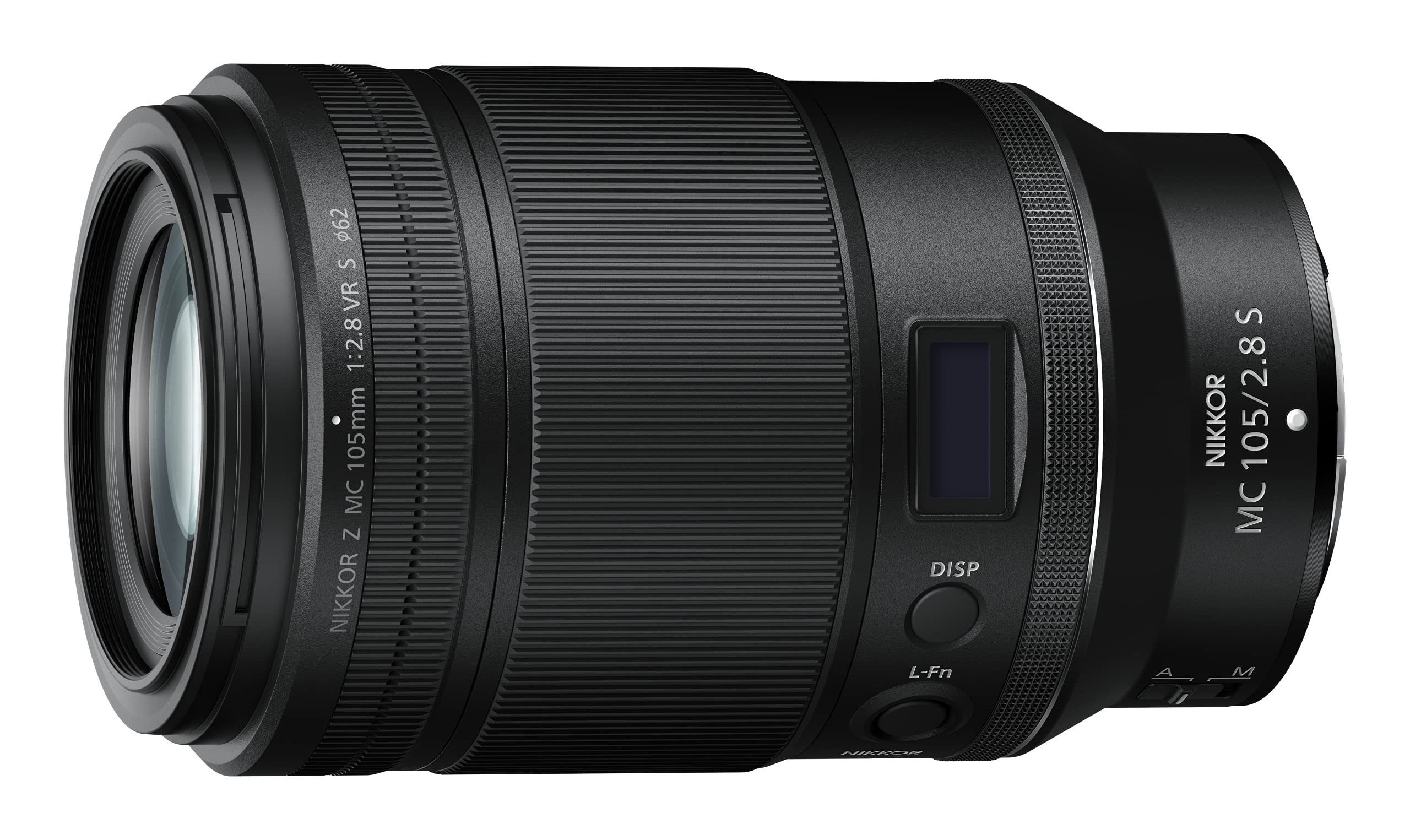
The NIKKOR Z MC 105mm f/2.8 VR S uses Nikon’s S-Line optical formula with extra-low dispersion elements and Nano Crystal Coat to suppress flare and chromatic aberration even at minimum focus distance. The 4.5-stop Vibration Reduction works in tandem with in-body stabilization on Z cameras, making handheld 1:1 shots at 1/15 second reliable for product and flower work.
The multi-focus stepping motor drives AF quietly and quickly, and the focus limiter switch lets you restrict the range to macro distances (0.29m–0.5m) to reduce hunting. The S-Line weather sealing includes rubber gaskets at every joint, which gives confidence when shooting dew-covered subjects outdoors.
At 630g, it balances well on full-frame Z bodies like the Z6 II and Z8. The barrel has a programmable control ring for aperture or exposure compensation, and the minimum focus distance of 0.29m delivers 1:1 with a comfortable 10cm working distance from the front element.
Why it’s great
- Exceptional sharpness wide open at f/2.8, with peak resolution at f/5.6
- VR + IBIS combo allows reliable handheld macro shots without flash
- Full weather sealing for outdoor insect and nature photography
Good to know
- Noticeable focus breathing at close distances may affect video composition
- Plastic lens hood feels less premium than the metal barrel
2. Canon RF100mm F2.8 L Macro is USM

Canon’s RF100mm f/2.8 L IS USM is the first medium-telephoto macro lens to achieve 1.4x maximum magnification, which means you get 40% more subject detail on the sensor compared to standard 1:1 lenses. The Spherical Aberration (SA) Control ring lets you dial in smoother or harsher bokeh character, which portrait shooters can use to soften backgrounds without resorting to software.
The optical Image Stabilizer delivers 5 stops of shake correction, and when paired with the R5 or R6 IBIS, the effective stabilization climbs to 8 stops — enough to shoot 1:1 handheld in dim indoor light. The Nano USM motor provides fast, near-silent autofocus that tracks small moving subjects like crawling insects.
Build quality matches the L-series standard with fluorite and UD lens elements, weather sealing, and a fluorine coating on the front element to repel water and dust. The minimum focus distance is 0.26m, giving a practical working gap of about 8cm from the filter thread — tight but workable for controlled macro setups.
Why it’s great
- 1.4x magnification exceeds standard macro capability out of the box
- IS + IBIS synergy delivers best-in-class handheld macro stability
- SA control ring gives creative bokeh adjustment in-camera
Good to know
- SA ring is largely a gimmick — most users leave it at neutral
- Heavy and large at 730g and 148mm length
3. Sony FE 100mm F2.8 GM OSS

The Sony FE 100mm F2.8 GM OSS joins the G Master lineup with four XD Linear AF motors that deliver exceptionally fast and silent focusing — a crucial advantage when tracking a moving insect or shooting a video macro sequence. The optical formula includes one XA (extreme aspherical) element and three ED glass elements to kill color fringing and maintain corner-to-corner sharpness from f/2.8 through f/16.
Optical SteadyShot (OSS) provides up to 4 stops of stabilization, and the lens supports a 1.4x teleconverter (SEL14TC) that pushes magnification to 1.4x while retaining full AF functionality. The Nano AR Coating II suppresses ghosting and flare when shooting into backlit subjects like translucent flower petals.
Minimum focus distance is 0.28m at 1:1, and the 67mm filter thread allows standard polarizers and close-up diopters to be attached. The barrel features a focus-hold button, a focus range limiter (full/macro/portrait), and an aperture ring with a de-click switch for video work.
Why it’s great
- Four XD Linear motors provide the fastest AF among 100mm macro lenses
- Teleconverter compatibility expands magnification to 1.4x with AF
- XA and ED elements deliver near-zero chromatic aberration
Good to know
- Premium price places it above most competitors
- Minimum focus distance of 0.28m is not the shortest in class
4. Canon EF 100mm f/2.8L is USM

Its Hybrid Image Stabilizer compensates for both angular and shift-type camera shake, which is critical at 1:1 where standard IS becomes less effective due to the parallax effect at close distances.
The Ring-type USM motor delivers fast, near-silent autofocus, and the full-time manual focus override allows fine adjustments without switching out of AF mode. The optical construction includes a fluorite element and UD glass to minimize lateral chromatic aberration, yielding edge-to-edge sharpness that rivals modern mirrorless macro lenses.
At 625g and 124mm long, it feels balanced on EF-mount DSLRs like the 5D Mark IV and 6D II. The minimum focus distance is 0.3m, and the 67mm filter thread is consistent with many L-series primes. The weather-sealed barrel with a fluorine-coated front element protects against dust and moisture during outdoor macro shoots.
Why it’s great
- Hybrid IS is uniquely effective for close-distance macro shake
- Ring-type USM motor provides fast, quiet, and reliable AF
- Robust L-series build and proven durability over many years
Good to know
- Requires an adapter for mirrorless RF-mount bodies
- Minimum focus distance of 0.3m is longer than newer designs
5. Panasonic S 100mm F2.8 Macro

The Panasonic S 100mm F2.8 Macro defies the category trend with a shockingly compact 298g design — less than half the weight of most 100mm macro lenses. The Dual Phase Linear Motor keeps the lens length unchanged during focusing, eliminating focus breathing for stable video macro sequences, and operates silently to avoid picking up mechanical noise on internal microphones.
Optically, it delivers high resolution from center to edge, with nano surface coating to suppress ghosting. The 1:1 magnification requires a minimum focus distance of 0.204m, which is one of the shortest in this roundup. The all-metal barrel includes a focus clutch mechanism for instant switching between AF and manual focus.
For L-mount shooters (Panasonic S5 II, S1, Leica SL2, Sigma fp), this lens is a no-brainer if portability is a priority. It pairs particularly well with the S5 II X for run-and-gun macro videography where a gimbal would struggle under a heavier lens. The 67mm filter thread accepts standard close-up filters and polarizers.
Why it’s great
- Ultra-light 298g design is unmatched in the 100mm macro class
- Focus breathing suppression makes it ideal for video macro work
- Metal barrel with focus clutch for precision manual override
Good to know
- Shortest minimum focus distance leaves only 5cm working room
- Not weather-sealed against heavy rain or dust
6. Sigma 105mm F2.8 DG DN Macro Art

The Sigma 105mm F2.8 DG DN Macro Art brings the brand’s benchmark optical standards to the macro world. The lens uses an SLD (Special Low Dispersion) glass element and a high-refractive-index element to deliver contrast and resolution that Sigma rates as the best in its class for corner-to-corner sharpness at f/2.8. The Hypersonic Motor (HSM) is optimized for smooth and accurate AF, though it is audibly louder than linear motor designs.
A unique feature is the de-clicked aperture ring with a lock switch, allowing stepless iris control for video capture. The focus limiter switch offers macro (0.295m–0.5m), portrait (0.5m–∞), and full range positions, reducing AF search time during macro shooting. The all-metal barrel includes a weather-sealed mount and fluorine coating on the front element.
At 715g, it leans toward the heavier side for the category, but the weight contributes to a solid feel on Sony E-mount bodies like the A7 IV and A7R V. Minimum focus distance is 0.295m, achieving true 1:1 magnification with a practical working distance of about 10cm. The 62mm filter thread is smaller than the 67mm standard, requiring a step-up ring for common filters.
Why it’s great
- Class-leading optical resolution, especially at center frame
- De-clicked aperture ring with lock for smooth video iris control
- Weather-sealed mount and fluorine coating protect against elements
Good to know
- Hypersonic Motor AF is noticeably louder than linear-motor alternatives
- 62mm filter thread breaks from the 67mm standard, limiting filter compatibility
7. Tamron 90mm F/2.8 Di III VXD
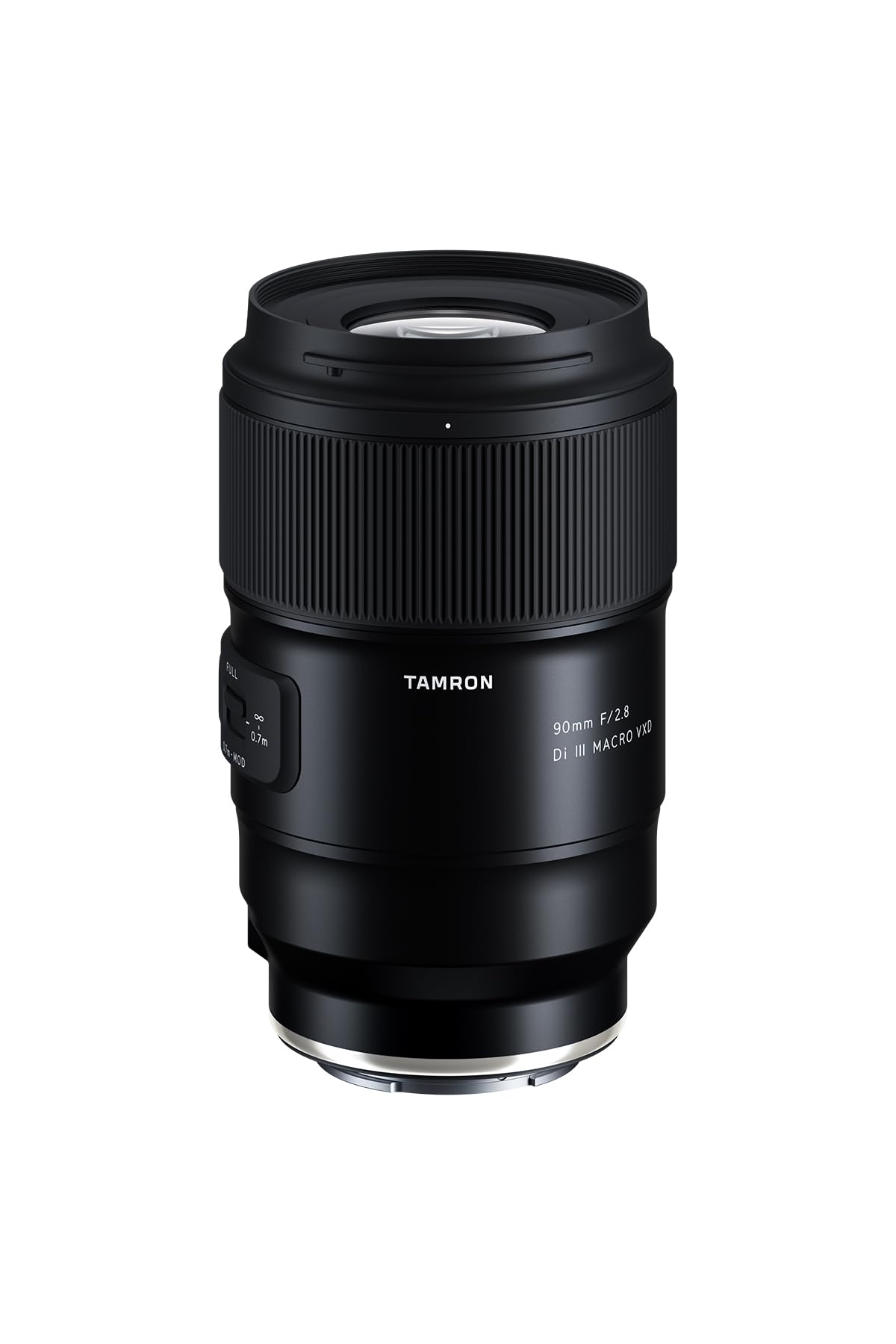
The Tamron 90mm F/2.8 Di III VXD offers a 90mm focal length that sits between classic macro and short telephoto, making it equally adept for food and product photography as it is for portraits. The Voice-coil eXtreme Drive (VXD) linear motor delivers fast, precise, and near-silent autofocus that competes directly with Sony’s own G Master lenses in tracking speed.
The optical design includes BBAR-G2 (Broad-Band Anti-Reflection Generation 2) coating to minimize flare and ghosting, plus a fluorine coating on the front element to repel moisture and fingerprints. The flat-field performance is exceptionally strong, keeping edges sharp when photographing a flat subject like a printed circuit board or a stamp collection.
At 630g, it is well-balanced on full-frame Sony bodies. The minimum focus distance of 0.23m achieves a true 1:1 magnification ratio. Moisture-resistant construction and the included lens hood add to its outdoor readiness. This lens does not include optical image stabilization, relying instead on Sony’s in-body SteadyShot on compatible bodies.
Why it’s great
- VXD linear motor provides fast, quiet autofocus competitive with OEM lenses
- Outstanding flat-field correction for reproduction and product work
- Fluorine coating simplifies cleaning in field conditions
Good to know
- No optical image stabilization — relies on camera IBIS alone
- 90mm focal length is slightly wider than the 100mm standard
8. TOKINA ATX-i 100mm Macro F2.8 for Nikon F

The TOKINA ATX-i 100mm Macro F2.8 revives the classic extending barrel focusing system, which physically extends the lens length as you focus closer. This mechanical design provides extremely smooth manual focus with a long rotation arc for precise adjustments at 1:1. The 9-blade rounded aperture produces circular background highlights that are especially pleasing in portrait and flower shots.
Optically, the lens delivers near-zero distortion and high corner-to-corner resolving performance, according to Tokina’s MTF charts. The minimum focus distance of 0.3m achieves life-size 1:1 reproduction, and the lens is compatible with both Nikon FX (full-frame) and DX (APS-C) bodies via the F mount. At 525g, it is among the lighter 100mm macro options available.
One limitation: screw-drive autofocus means the lens will not autofocus on entry-level Nikon bodies like the D3500 or D5600 that lack an internal motor. On bodies with an AF motor (D7500, D500, D850), the AF is functional but noticeably slower than modern ring-type motors. For dedicated macro work on a tripod, the manual focus experience is the real draw here.
Why it’s great
- Classic extending barrel provides smooth, precise manual focus feel
- 9-blade aperture yields excellent circular bokeh highlights
- Lightweight 525g design with near-zero distortion
Good to know
- Screw-drive AF does not work on entry-level Nikon DSLRs
- No autofocus function when adapted to mirrorless Z bodies
9. Laowa 100mm f/2.8 2X Ultra Macro APO (Canon EF)

The Laowa 100mm f/2.8 2X Ultra Macro APO delivers true 2:1 magnification — double life-size — which lets you photograph a honeybee’s compound eye or a snowflake crystal with far greater detail than any 1:1 lens. The APO (Apochromatic) optical design uses multi-refractive glass elements to eliminate longitudinal and lateral chromatic aberration, producing images free of green and purple fringing at any aperture.
This is a fully manual lens with no electronic contacts on the Canon EF version. Aperture is set via an engraved ring on the barrel, and focus is controlled through a smooth dampened ring with a long travel arc for precise adjustments. The minimum focus distance is 0.25m at 2:1, and the 67mm filter thread accepts standard accessories.
Weighing 638g, the lens feels dense and solid, with an all-metal barrel that inspires confidence in the field. The Canon EF version has been used successfully on Sony bodies via a manual adapter, though the updated chip revision fixes aperture control and EXIF data issues reported on earlier units. It is an excellent choice for photographers who prioritize maximum magnification over autofocus convenience.
Why it’s great
- 2X magnification captures twice the detail of standard macro lenses
- APO correction eliminates all chromatic aberration at all focus distances
- All-metal manual construction with smooth, damped focus ring
Good to know
- No autofocus or electronic communication with the camera body
- Early units had aperture control issues on Sony — verify chip revision
10. Laowa 100mm f/2.8 2X Ultra Macro APO (Nikon Z)

The Nikon Z version of the Laowa 100mm f/2.8 2X Ultra Macro APO is optically identical to the Canon EF model but built with a native Nikon Z mount, meaning no adapter is needed. It retains the full 2:1 magnification ratio and the APO design that effectively eliminates lateral chromatic aberration, making it one of the sharpest macro lenses available for the Z mount at any price.
The fully manual focus operation is well-suited to macro work where precise control matters more than speed. The focus ring has a long throw — approximately 180 degrees — allowing fine adjustments that a fly-by-wire focus-by-wire system cannot match. The metal barrel includes an engraved depth-of-field scale for zone focusing at higher apertures.
At 1.8 pounds (about 815g), the Nikon Z version is heavier than its EF sibling due to the larger Z-mount flange design, but it remains manageable on a Z6 II or Z8 with a good tripod collar. A common observation is that the lens is very sharp at f/11 to f/22, but the narrow depth of field at 2:1 requires careful focus stacking for flat subjects. Some users have reported internal dust on delivery, so inspecting the glass immediately upon arrival is advisable.
Why it’s great
- Native Z-mount, no adapter required for Nikon mirrorless cameras
- 2X APO macro delivers zero color fringing at maximum magnification
- Long-throw manual focus ring enables precise micro-adjustments
Good to know
- Heavier than the EF version at 815g
- Quality control issues with internal dust reported on some units
11. TTArtisan 100mm F2.8 Macro 2X Manual Focus

The TTArtisan 100mm F2.8 Macro 2X is a budget-friendly full-frame manual macro lens for Sony E-mount that offers an impressive 2:1 magnification ratio for under budget-tier prices. Its optical structure uses 14 elements in 10 groups, including 6 high-index glass elements, which effectively control spherical aberration and improve sharpness for a lens in its price class.
The all-metal barrel with engraved markings gives it a classic, durable feel. The f/2.8 maximum aperture provides bright manual focusing on Sony bodies with focus peaking enabled, and the 0.25m minimum focus distance achieves the 2X magnification without extension tubes. The included metal lens hood and front and rear caps add to the value proposition.
The manual focus ring is smooth with reasonable damping, though the throw is shorter than the Laowa’s, which can make precise focusing at 2X a bit challenging. Autofocus is not available on this lens, so it is best suited for tripod-based macro shooting or photographers comfortable with focus peaking and magnification. Given the low entry cost, the optical performance is surprisingly capable for intricate subject detail.
Why it’s great
- 2X magnification at a budget-friendly price point is unmatched value
- All-metal construction with high-index glass elements
- Bright f/2.8 aperture aids manual focusing with focus peaking
Good to know
- Short manual focus throw makes precise 2X focusing difficult
- No electronic contacts — no EXIF data or aperture control from the body
FAQ
What is the difference between 1:1 and 2:1 magnification in a 100mm macro lens?
Can I use a 100mm macro lens for portraiture?
Do I need image stabilization for a 100mm macro lens?
Final Thoughts: The Verdict
For most users, the best 100mm macro lens winner is the Nikon NIKKOR Z MC 105mm f/2.8 VR S because it combines S-Line optical sharpness, 4.5-stop VR stabilization, and robust weather sealing in a versatile package that handles both macro and portrait work exceptionally well. If you want 1.4x magnification with creative bokeh control, grab the Canon RF100mm F2.8 L Macro is USM. And for budget-conscious photographers who prioritize 2:1 magnification over autofocus, nothing beats the Laowa 100mm f/2.8 2X Ultra Macro APO.