
Whether you’re patterning a big buck three weeks before opening day or tracking a hot bedding area from a half-mile away, the camera you strap to that tree or carry in your pack determines every decision you make from that moment forward. Blurry stills, false triggers from swaying grass, and dead batteries on the third morning are not inconveniences—they’re blown opportunities that cost you the season.
I’m Min — the co-founder and writer behind Gadgets Feed. I’ve spent countless hours cross-referencing sensor resolutions, trigger speeds, cellular plan pricing, low-light IR throw distances, and battery endurance figures from real-world field tests to build a guide that separates actual hunting gear from overpriced marketing fluff.
The quiet after dawn is when you need absolute confidence in your gear. This guide breaks down the top contenders for the best camera for filming hunts, covering everything from cellular trail cams that ping your phone in real time to thermal monoculars that turn total darkness into a tactical advantage.
How To Choose The Best Camera For Filming Hunts
A camera that works for a backyard bird feeder will fail miserably on a November deer hunt. You need a device built for long-range detection, extreme weather reliability, and minimal disturbance to wildlife. The three factors that matter most are trigger responsiveness, the type of IR illumination, and whether you need real-time cellular transmission to your phone.
Cellular vs. Non-Cellular vs. Thermal: Which Hunting Strategy Fits You?
Cellular trail cameras send photos straight to your phone via LTE, letting you monitor a property from miles away without walking in and spreading human scent. Non-cellular cams require manual SD card retrieval but have zero monthly costs and often run longer on a set of batteries. Thermal monoculars are handheld tools for real-time spotting in darkness or thick brush—they don’t record time-lapse activity but give you live intel on animal movement right now. Pick cellular for remote scouting, non-cellular for high-volume close-in setups, and thermal for after-dark stalk management.
IR Flash: Red Glow vs. Low Glow vs. No Glow
A red-glow IR flash casts a visible red light that spooks mature deer and nocturnal hogs. Low-glow IR is dimmer—visible if an animal looks directly at the camera—but offers excellent night image clarity. No-glow (940nm) IR is completely invisible to both human and animal eyes, making it the only safe choice for pressure-sensitive game. The tradeoff is that no-glow IR has shorter effective range, usually topping out around 60 to 80 feet, while low-glow can push past 100 feet.
Trigger Speed and Recovery Time
A slow trigger speed (1.0 second or worse) means you’ll crop photos of a deer’s back hip instead of its rack. Look for 0.5 second or faster for trail cameras. Recovery time—how quickly the camera resets to take the next shot—matters for high-traffic areas like mineral licks or pinch points. A camera with 1-second recovery can miss multiple animals walking single file. Sub-1-second recovery is ideal for herd monitoring.
Quick Comparison
On smaller screens, swipe sideways to see the full table.
| Model | Category | Best For | Key Spec | Amazon |
|---|---|---|---|---|
| TOPDON TS004 | Thermal Monocular | Night detection up to 410m | 5000mAh battery (11 hours) | Amazon |
| GOYOJO G215 | Thermal Monocular | Budget thermal spotters | 256×192 @ 50Hz sensor | Amazon |
| Tactacam Reveal Pro 3.0 | Cellular Trail Cam | Multi-network cellular | Built-in GPS & 2″ LCD | Amazon |
| Tactacam Reveal X 3.0 | Cellular Trail Cam | Best battery life | Low-glow IR flash | Amazon |
| TACTACAM 2 Pack X Gen 2.0 | Cellular Trail Cam | Entry-level cellular scouting | 120° field of view | Amazon |
| GoPro HERO13 Black | Action Camera | POV hunt filming | 5.3K60 with HyperSmooth 6.0 | Amazon |
| Canon RF100-400mm Lens | Telephoto Lens | Long-range wildlife detail | 5.5-stop IS, 400mm reach | Amazon |
| Canon VIXIA HF G70 | Camcorder | All-day hunt recording | Dual SD slots, time stamp | Amazon |
| Sony FDR-AX43 | Camcorder | Built-in gimbal shooting | 20x optical zoom, 4K | Amazon |
In‑Depth Reviews
1. TOPDON TS004 Thermal Imaging Monocular
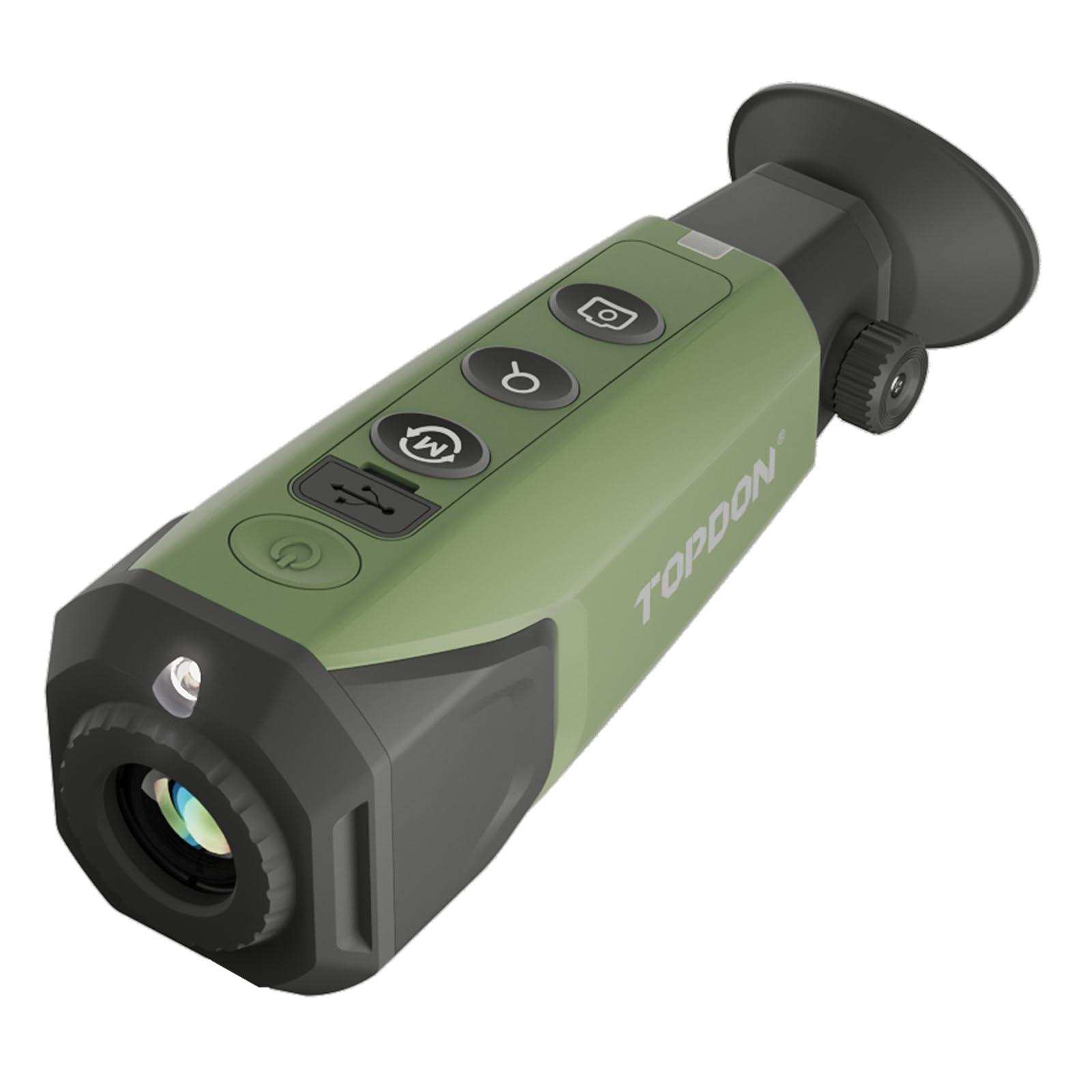
The TOPDON TS004 sits at the top because it combines a sharp 256×192 IR sensor with a 50Hz refresh rate—smooth enough to track a running coyote without motion blur. Its 13mm lens provides a detection range of 410 meters, which means you can scan a powerline cut or field edge from a stand and identify heat signatures that would be invisible to any trail cam or standard glass. The 5000mAh battery delivers a genuine 11 hours of continuous use, covering a full evening sit plus a dawn scouting sweep on a single charge.
This unit packs an IP67 waterproof rating, meaning it survives submersion in up to one meter of water for 30 minutes. In practical hunting terms, you can use it in a heavy downpour or drop it in a creek crossing without panic. The silicone overmold absorbs impacts, and the manual focus ring lets you fine-tune target ID at varying distances. Wireless connectivity via the TopInfrared App enables live streaming to a phone, useful for sharing the view with a hunting partner without handing over the monocular.
A minor design oversight: the bright green power light can give away your position in total darkness, and there is no built-in neck strap or padded case included. Users report the digital zoom gets grainy past 2x, so rely on the optical path clarity at native magnification. For hunters who need one device that does passive thermal spotting and live confirmation, the TS004 is the most well-rounded tool on this list.
Why it’s great
- 11-hour runtime from a single charge covers full-day excursions
- 50Hz refresh rate delivers smooth, blur-free tracking of moving targets
- IP67 rating handles rain, dust, and accidental submersion
Good to know
- Bright green power LED is visible in low-light conditions
- Does not ship with a neck strap or protective carry case
- Digital zoom introduces noticeable grain beyond 2x magnification
2. Tactacam Reveal Pro 3.0 Cellular Trail Camera (2-Pack)
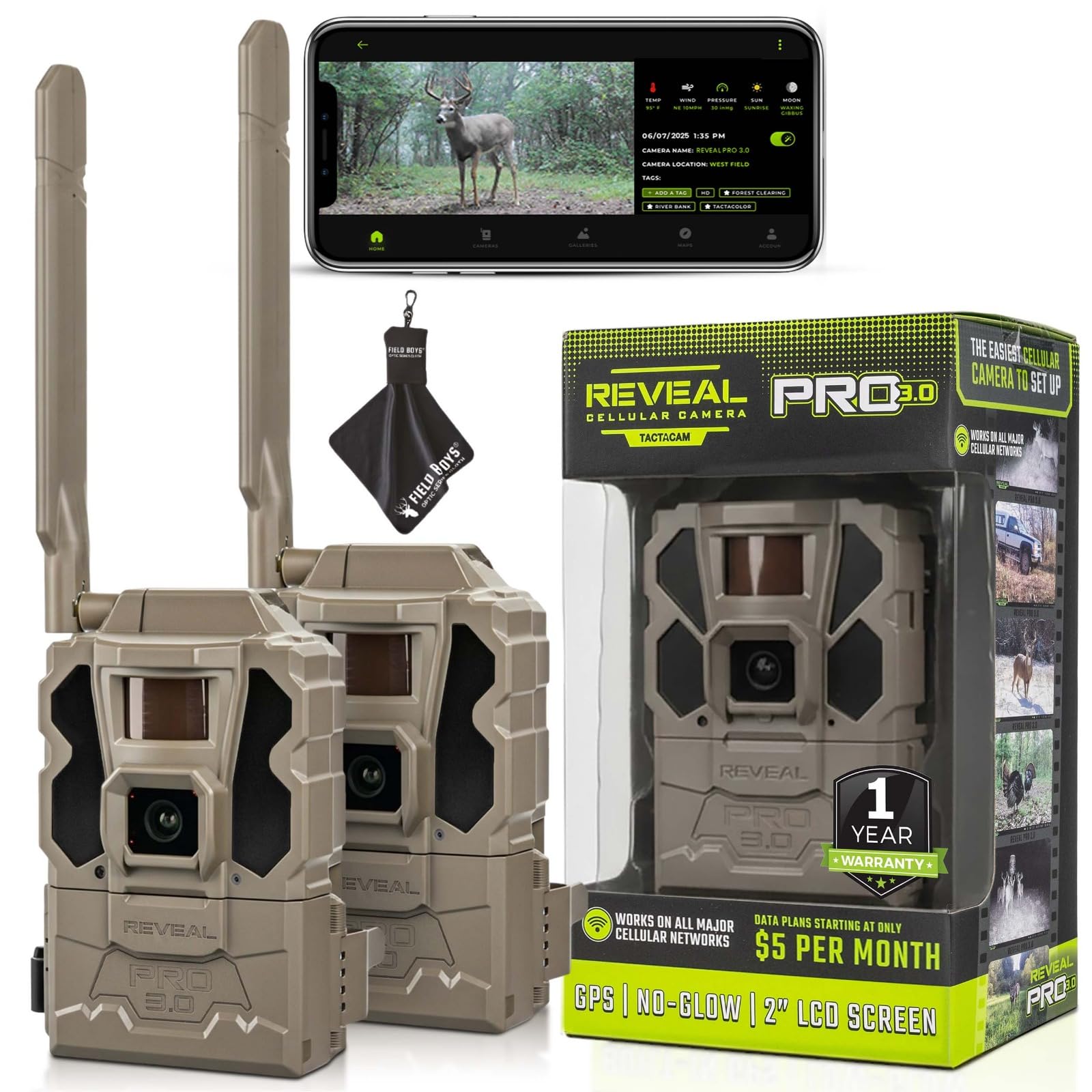
The Reveal Pro 3.0 is the most versatile cellular trail camera in Tactacam’s lineup because it works across multiple carrier networks—switching between AT&T and Verizon depending on signal strength at your camera location. This flexibility matters when you are bouncing between creek bottoms that favor Verizon and ridges that lock onto AT&T. The 2-inch LCD screen on the camera body lets you review images on-site without pulling the SD card, saving time and reducing scent intrusion during check visits.
Image quality holds up well at night thanks to the no-glow IR technology; animals never see the flash, which keeps mature bucks from patterning your cell cam. The built-in GPS tags every image with location metadata, so the REVEAL app shows exactly which camera took the photo and where it was placed—critical when managing a dozen units across public land. The one-year warranty and responsive customer support give confidence for a rugged outdoor tool that lives in the elements year-round.
Running costs add up: the cheapest plan starts around for 250 photos, but unlimited photo plans push closer to per camera per month. Over a six-month scouting season on ten cameras, that represents a serious recurring expense. The IP54 waterproof rating is adequate for rain but not dust or submersion—mount it under a tree canopy rather than in an open field subject to driving sideways rain.
Why it’s great
- Multi-network modem chooses the strongest available carrier
- No-glow IR flash is invisible to game at night
- Built-in GPS and 2-inch LCD simplify camera management and on-site review
Good to know
- Monthly cellular plans are a recurring cost that increases with camera count
- IP54 rating is water-resistant but not waterproof
- Alkaline batteries drain faster in cold weather; LiPo packs are recommended
3. Tactacam Reveal X 3.0 Cellular Trail Camera (2-Pack)
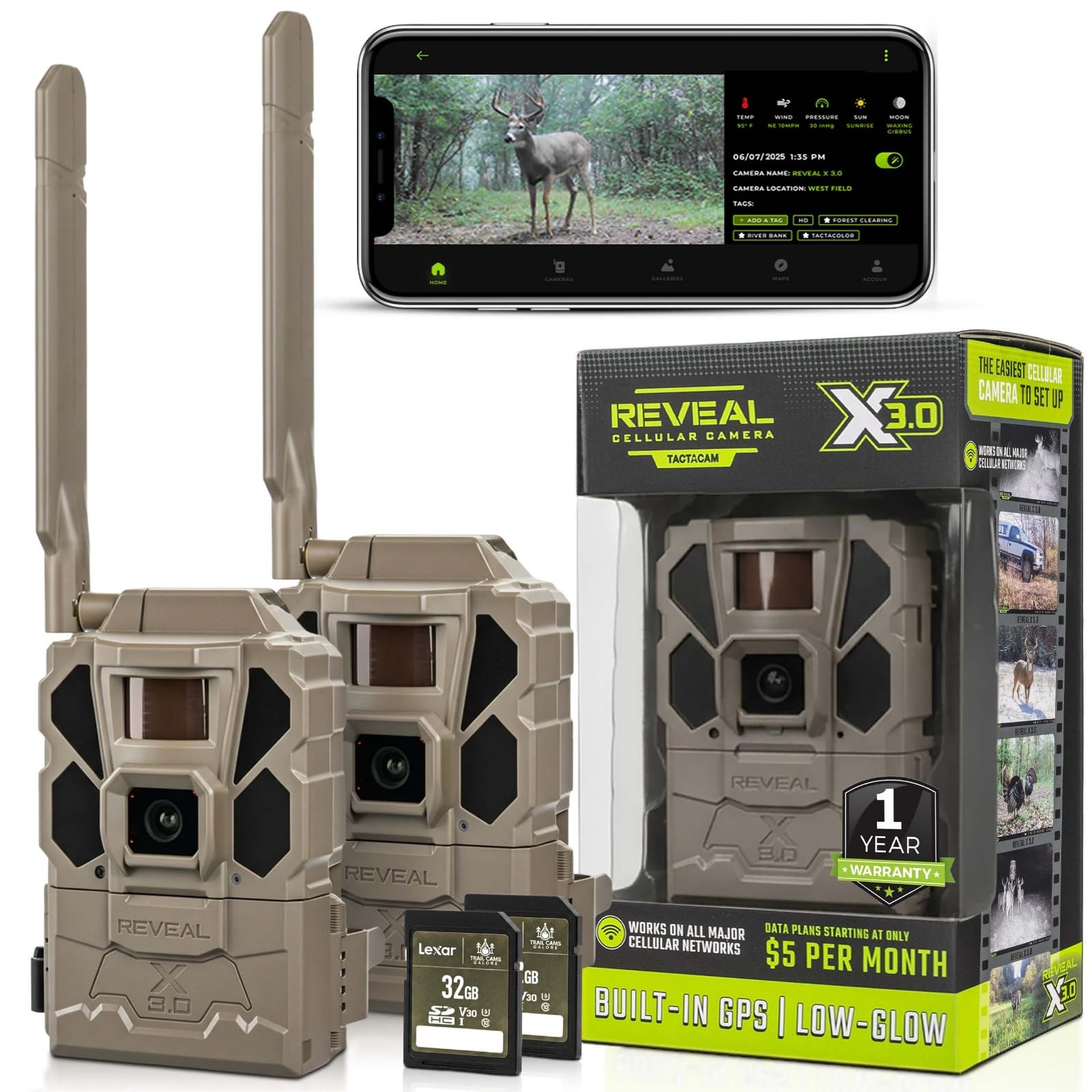
The Reveal X 3.0 is optimized for battery efficiency above all else, making it the right choice for deep-woods setups where changing batteries means a two-mile hike. On 12 AA lithium cells with moderate daytime activity (50-100 images per day), users report four to six months of runtime before replacement is needed. The camera ships with 32GB SD cards included, so you start scouting the day the package arrives without a separate trip to the electronics store.
The low-glow IR flash provides better nighttime illumination range than no-glow alternatives, pushing usable identification out to roughly 100 feet. Images are crisp enough to read ear tags or distinguish between a 130-inch and a 150-inch buck at that distance. The pre-installed antenna is more durable than previous generation screw-on designs, reducing a common failure point when branches smack the camera during wind. The 3-shot burst mode captures a sequence of frames that helps confirm whether a target was moving straight through or feeding in the plot.
The same subscription pricing structure applies: expect to per month depending on photo volume. The low-glow IR is faintly visible if an animal looks directly at the camera lens; ultra-spooky bucks in high-pressure public land may still notice it. Battery life drops sharply in sub-zero conditions if you use standard alkaline cells instead of lithium or rechargeable LiPo packs with a solar panel.
Why it’s great
- Exceptional battery life stretches four to six months on lithium cells
- Low-glow IR provides superior night illumination range over no-glow cameras
- 3-shot burst mode captures motion sequences for better target evaluation
Good to know
- Low-glow flash can be faintly visible to wary game
- Monthly subscription required for cellular image transmission
- Alkaline batteries perform poorly in freezing temperatures
4. GOYOJO G215 Thermal Imaging Monocular

The GOYOJO G215 delivers a 256×192 thermal sensor at a price point that undercuts most comparable units by a wide margin, making it the entry-level gateway into thermal hunting for shooters who have never looked through a digital heat viewer. The 50Hz refresh rate keeps the image fluid—you won’t see the choppy stutter that cheaper 9Hz units produce when panning across a field. It fits in a jacket pocket at under 6 inches long, which means it stays in the pack instead of sitting on the truck seat at home.
The removable 18650 battery is a standout feature for field sustainability: you can carry three spares in a small pouch and never worry about running out of power on a multi-day hunt. Focus is manual via a knurled ring that operates smoothly even with gloved hands. The six color palettes (white-hot, black-hot, rainbow, iron-red, red-hot, glimmer) let you switch modes depending on background vegetation and target contrast. On a clear night, users can detect a deer-sized heat signature at roughly 500 yards and positively identify it at 250 yards.
The internal 16GB storage is non-expandable, so you are limited to roughly 4 hours of video before you must offload files via USB-C. The companion WiFi app is functional but crashes occasionally, and connecting can be cumbersome in the field. The IP65 rating handles rain and dust but not submersion, so keep it out of creeks. For beginners who want to test whether thermal fits their hunting style without spending over the threshold for a premium unit, the G215 is the logical starting point.
Why it’s great
- Pocket-friendly form factor with a removable 18650 battery for unlimited runtime
- 50Hz refresh rate eliminates panning stutter common in budget thermal units
- Detection range of 500+ yards is impressive for a sub- device
Good to know
- 16GB internal storage cannot be expanded with an SD card
- WiFi app connection is glitchy and slower than dedicated display use
- IP65 is weather-resistant but not submersible
5. TACTACAM 2 Pack Reveal X Gen 2.0 Cellular Trail Camera

The two-pack TACTACAM Reveal X Gen 2.0 is the most cost-effective way to start building a cellular scouting network. Each camera comes with a pre-activated SIM card and a 30-day free trial of the REVEAL app service, giving you a month to decide whether cellular monitoring fits your workflow before committing to a subscription. The 120-degree field of view covers a wider swath of trail or food plot edge than the narrower 60-80 degree lenses found on some competing cameras, reducing the number of units you need to cover a given area.
Picture quality is good enough to determine antler score and distinguish individual animals, though the non-HD preview images in the app appear compressed. Full HD files are available for download if you subscribe to the premium plan. Batteries last roughly six months on Duracell alkalines with moderate activity, though lithium cells extend that significantly in cold weather. The low-glow IR flash does emit a faint red glow that some hunters report spooking pressured deer, but in most settings it is acceptable.
Setup is straightforward: mount the camera, insert batteries, and pair via the REVEAL app. Some users find the interface slightly clunky compared to newer models, and the Gen 2.0 lacks the built-in storage and multi-network switching of the Gen 3.0 series. The plastic housing feels less rugged than the Pro line, so mount it in relatively protected locations rather than exposed field edges where falling branches could crack the shell.
Why it’s great
- Two cameras in one package for immediate multi-location setup
- 120-degree wide field of view reduces blind spots compared to standard trail cams
- 30-day free trial lets you test cellular monitoring without upfront subscription commitment
Good to know
- App and hardware interface feel less intuitive than newer generation models
- Low-glow IR flash is faintly visible to wildlife
- Plastic housing is less durable than the Pro series for high-impact areas
6. GoPro HERO13 Black (Bundle)

The GoPro HERO13 Black is not a trail camera or a thermal spotter—it is the GoPro for POV footage of the actual hunt, from the approach stalk through the shot. Its 5.3K60 HDR video with HyperSmooth 6.0 stabilization eliminates the shaky, unwatchable footage that cheaper action cams produce when you are walking. The 1/1.9-inch sensor and GP-Log color profile give you latitude to grade footage in post, recovering shadow detail from pre-dawn woods and preventing blown-out highlights on snowy fields.
The 1900mAh Enduro battery records up to 1.5 hours of 5.3K video, enough to capture a full morning sit or a spot-and-stalk sequence without swapping cells. Bluetooth audio support means you can pair a wireless lavalier mic to capture natural sound without wind interference. The bundle includes a 64GB microSD card and a 50-piece accessory kit (chest mount, head strap, tripod, etc.) that saves you from buying POV filming gear separately.
A single usability issue: the HERO13 runs hot in warm climates. Some users report thermal shutdown after 20 minutes of continuous 5.3K recording in Florida summer heat. Switching to 4K120 or 2.7K240 in extreme temperatures mitigates the issue. The camera is waterproof to 33 feet without a housing, but fogging can occur when moving from a cold truck to a humid hunting blind. If your primary goal is first-person hunt documentation, this is the benchmark.
Why it’s great
- HyperSmooth 6.0 delivers gimbal-like stabilization for stalk and walk footage
- GP-Log and HDR provide professional-grade grading latitude for variable lighting
- Bundle includes full POV mounting accessories and a 64GB card out of the box
Good to know
- Overheating can occur during extended 5.3K recording in high ambient temperatures
- Lens fogging can happen when transitioning between temperature extremes
- Not a replacement for trail cameras or thermal spotters—strictly POV filming
7. Canon RF100-400mm F5.6-8 IS USM Telephoto Lens

The Canon RF100-400mm is not a stand-alone camera—it is the glass you put on an EOS R-series mirrorless body to capture wildlife from the distances hunting requires. At 400mm on a full-frame body, you can fill the frame with a standing buck at 50 yards or identify individual tines at 150 yards. The 5.5-stop optical image stabilization means you can shoot handheld at 1/60th of a second at 400mm and still get sharp, printable images—critical when you cannot deploy a tripod without spooking game.
The Nano USM autofocus is fast enough to track a deer breaking from a thicket, and it operates silently—no whirring motor that alerts animals. The lens weighs only 1.4 pounds, making it feasible to carry on a chest pack for a full-day spot-and-stalk. Minimum focus distance of 2.89 feet at 200mm gives you surprise macro capability for blood trail documentation or gear photos at camp. At 400mm, the 0.41x maximum magnification renders feather detail on a turkey at 30 yards.
The variable aperture (f5.6-8) is the limiting factor: in dense timber during the last 15 minutes of legal shooting light, you will struggle to maintain shutter speeds above 1/125th even with the stabilizer. There is no weather sealing, so a rain cover is mandatory for wet hunts. The zoom ring rotates in the opposite direction from some third-party lenses, which takes a few outings to commit to muscle memory.
Why it’s great
- 5.5-stop image stabilization enables sharp handheld shots at 400mm
- Nano USM autofocus is fast, accurate, and silent for game tracking
- Lightweight build (1.4 lbs) is packable for all-day hikes
Good to know
- f5.6-8 aperture struggles in low light during dawn and dusk
- No weather sealing—requires a rain cover in wet conditions
- Zoom ring rotation direction is opposite to some competing lenses
8. Canon VIXIA HF G70 Camcorder

The VIXIA HF G70 is a dedicated camcorder built for one job: recording long-form 4K UHD video without the overheating or battery anxiety that plagues hybrid mirrorless cameras. The 20x optical zoom gives you genuine reach from a ridge to a feeding meadow without the resolution loss of digital zoom, and the 8-blade aperture creates natural, cinema-style bokeh in the background. The Hybrid AF system with face detection keeps a walking deer in sharp focus even as it passes behind brush.
The on-screen display (OSD) time stamp recording is a niche but essential feature for hunt documentation—it burns date, time, and timecode directly into the video file, providing indisputable evidence for harvest logs, land management reports, or legal records. Dual SD card slots give you hot-swap capability: record to card A while card B is ready, so you never miss footage during a 20-minute encounter. UVC livestreaming via USB allows real-time sharing of the hunt to a smartphone or laptop without extra capture cards.
Low-light performance is the major caveat: once the sun dips below the treeline, gain ramps up past 4dB and image quality turns soft. The 1/2.3-inch sensor is simply smaller than what APS-C or full-frame cameras offer. Dynamic stabilization works well for walking shots but introduces an occasional background jitter when panning. For daylight-to-dusk filming of hunts in open terrain, this camcorder is a purpose-built workhorse.
Why it’s great
- 20x optical zoom provides genuine long-range reach without digital degradation
- Time stamp OSD recording creates verifiable hunt documentation
- Dual SD card slots enable uninterrupted recording during extended action sequences
Good to know
- Low-light performance softens noticeably after dusk
- 1/2.3-inch sensor is smaller than hybrid camera sensors
- Background jitter can appear during 4K autofocus while panning
9. Sony FDR-AX43 UHD 4K Handycam Camcorder

The Sony FDR-AX43 incorporates Balanced Optical SteadyShot image stabilization—essentially a built-in gimbal mechanism inside the camcorder body—that cancels out the long-lens shake that makes handheld hunting footage unwatchable. At 20x optical zoom, you can punch in on a buck working a scrape line 80 yards away and keep the frame steady without a tripod. The 1/2.5-inch Exmor R CMOS sensor is optimized for low-light video, producing usable color footage until the last sliver of legal light disappears.
The 26.8mm wide-angle ZEISS Vario-Sonnar T lens means you can film your setup from inside the blind or capture landscape establishing shots without backing up into the brush. Clear Image Zoom extends effective reach to 30x in 4K and 40x in HD, though this is a digital assist—not true optical extension—so expect some softening at maximum zoom. Fast Intelligent AF locks onto moving subjects quickly, and the BIONZ X processor handles motion without the pulsing focus characteristic of older camcorders.
The battery protrudes from the back, making the camera awkward to mount on a selfie stick or small tripod. There is no internal memory: you must supply a UHS-I U3 SD card before first use. Some reviewers note that the FDR-AX53 predecessor offers identical core features at the same price point, so check availability before committing. For hunters who prioritize stabilized long-zoom video over low-light stills, the AX43 delivers that stability natively.
Why it’s great
- Balanced Optical SteadyShot eliminates tripod need for smooth 20x zoom footage
- Exmor R sensor and BIONZ X processor deliver excellent low-light video color
- ZEISS wide-angle lens captures spacious establishing shots from tight stands
Good to know
- Battery protrudes awkwardly, making small tripod mounting difficult
- No internal memory—requires a fast SD card before first use
- Date and time reset after battery removal, which is frustrating for time-stamp hunters
FAQ
Can I use a standard trail camera for filming hunts, or do I need a camcorder?
How many cellular trail cameras do I need to monitor a 100-acre property?
Why does my thermal monocular show a black screen when pointing at a cold object?
What does “50Hz refresh rate” mean for a thermal monocular during a hunt?
Can I use a telephoto lens on any camera to film distant game?
Final Thoughts: The Verdict
For most users, the best camera for filming hunts winner is the TOPDON TS004 because its 320×240 thermal sensor, 50Hz refresh rate, and 11-hour battery life give you real-time detection capability in total darkness without the subscription costs of cellular trail cameras. If you want remote scouting intel delivered to your phone, grab the Tactacam Reveal Pro 3.0 with its multi-network cellular modem and built-in GPS. And for POV hunt documentation that turns a stalk into cinematic footage, nothing beats the GoPro HERO13 Black with HyperSmooth stabilization and 5.3K resolution.