
Bending 1/2-inch conduit by hand is the fastest way to destroy a clean run of EMT or soft copper if you’re using the wrong tool. A poor bender kinks the pipe wall, crushes the inner diameter, and leaves you with a scrap pile instead of a professional-looking 90-degree turn. The right bender applies leverage evenly, maintains the tube’s roundness, and reproduces accurate angles bend after bend without guesswork.
I’m Min — the co-founder and writer behind Gadgets Feed. I’ve spent countless hours analyzing tube bender specs, reading real customer feedback on wall thickness compatibility, handle leverage ratios, and bending radius consistency to help you pick the right tool for your next electrical or HVAC project.
This buying guide breaks down the top-rated manual benders for EMT, rigid conduit, and soft tubing so you can confidently choose the best 1/2 inch conduit bender for your skill level and budget.
How To Choose The Best 1/2 Inch Conduit Bender
Choosing a bender for 1/2-inch pipe means matching the tool to the material and wall thickness you work with most. A tubing bender designed for thin-wall copper will crush schedule 40 rigid steel, and an EMT bender won’t grip soft refrigeration tubing. Start with material compatibility, then prioritize handle leverage and angle marking clarity.
Understanding Material Compatibility
Tubing benders use a form-and-follower design that wraps around the pipe OD — they work on copper, aluminum, and thin-wall stainless with wall thicknesses between 0.6 mm and 2 mm. EMT conduit benders use a shoe-and-pedal system that bends steel conduit without crushing the internal diameter. Mixing them up either strips the pipe or fails to produce a clean bend. Check the manufacturer’s stated OD range — many multi-size benders list exact diameters like 12.7 mm (1/2 inch) for tubing and 16 mm (0.706 inch) for EMT.
Leverage and Handle Length
Longer handles multiply your input force. A 15-inch handle works fine on soft copper, but bending 1/2-inch rigid steel or thick-wall EMT requires at least a 36-inch handle to generate enough mechanical advantage without straining your arms. Look for handles with rubberized grips and a wide foot pedal on EMT benders — these reduce fatigue during multi-bend runs and give you stability while applying downward force.
Quick Comparison
On smaller screens, swipe sideways to see the full table.
| Model | Category | Best For | Key Spec | Amazon |
|---|---|---|---|---|
| Klein Tools 51606 | EMT Bender | Accurate repeated bends | Angle Setter technology | Amazon |
| TEMCo Dual Shoe | Dual Bender | 1/2 and 3/4 EMT versatility | Two shoes in one tool | Amazon |
| IDEAL 74-026 | Rigid/EMT | Heavy-duty steel conduit | Ductile iron head | Amazon |
| WISSCOOL 1/2 | Tubing Bender | Multi-material tubing | Double-roller system | Amazon |
| Super Stars 3-in-1 | Tubing Bender | Budget 3-size flexibility | Quick-action trigger | Amazon |
| Bonvoisin 2-in-1 | Tubing Bender | 3/8 and 1/2 tubing | Carbon steel construction | Amazon |
| VEVOR 3-in-1 | Tubing Bender | DIY light metal bending | Aluminum alloy frame | Amazon |
In‑Depth Reviews
1. Klein Tools 51606 Aluminum Conduit Bender

Klein’s 51606 is the gold standard for a reason. The full assembly comes with their patent-pending Angle Setter — a removable hard stop that locks in 10-, 22.5-, 30-, and 45-degree bends automatically, compensating for conduit spring-back. The wide foot pedal gives excellent stability during 90-degree bends, and the interior hook surface keeps the conduit from rolling or twisting under load.
The aluminum head is lightweight at 4.4 pounds, but the handle delivers enough leverage for smooth 1/2-inch EMT bends without excessive effort. Bold cast markings on both sides show star, arrow, degree scale, and rim notch — you don’t need to flip the bender to read your angle mid-bend. Users consistently report that the removable orange angle finder produces identical results every time, as long as you remember to remove it after each bend.
This bender is strictly for 1/2-inch EMT conduit. It won’t handle rigid steel or copper tubing, but for electrical work it is the most repeatable, most comfortable bender in its class. The clamping surface also holds the conduit steady for hacksaw cutting, eliminating the need for a separate vise.
Why it’s great
- Angle Setter ensures repeatable bends without manual protractor checks
- Wide foot pedal provides stable, comfortable downward force
- Cast markings on both sides improve visibility in tight spaces
Good to know
- EMT only — not compatible with rigid pipe or tubing
- Angle Setter must be removed after each bend to avoid interference
- Premium price, but built to last for professionals
2. TEMCo 2 in 1 Dual Shoe Conduit Bender

The TEMCo TH1909 packs two benders into one head: it bends 1/2-inch EMT and 3/4-inch EMT, plus 1/2-inch Rigid and IMC conduit. The dual-shoe design uses the same bend radius as a standard single-size bender, so your offsets and saddles stay accurate. At 7 pounds, the head is noticeably heavier than a single-size bender, but the added weight is a fair trade for swapping tools mid-run.
The handle is a two-piece metal assembly that unscrews for storage — useful for keeping the tool compact in a truck box. Users report that the threads need pipe compound or Teflon tape to prevent loosening during heavy bends. The handle itself is thick-gauge steel, sturdier than many aluminum handles in this price range, and the offset multiplier chart printed on the handle saves time on common angle calculations.
If you run 1/2-inch and 3/4-inch conduit on the same job, this bender eliminates the need to carry two separate tools. It includes a 5-year limited warranty and a 1-year no-questions-asked return policy, which is rare at this price point.
Why it’s great
- Bends both 1/2 and 3/4 EMT plus rigid in a single tool
- Metal handle is thicker and stronger than plastic alternatives
- 5-year warranty backs the construction
Good to know
- Heavier head design — noticeable difference vs single-size benders
- Handle threads benefit from added sealant
- Learning curve to switch between shoe sizes smoothly
3. IDEAL Electrical 74-026 Ductile Iron Bender

The IDEAL 74-026 uses ductile iron — not cast iron — which means the head resists cracking and chipping under repeated heavy loads. The grooved internal hook surface prevents the pipe from slipping when you apply extra force, and the heat-treated stress points keep the bending shoe aligned even after hundreds of bends. The baked-on blue enamel handle resists corrosion from job-site moisture and abrasion.
This bender follows the industry-standard Benfield bending system, so the star, arrow, degree scale, and rim notch markings are exactly where experienced electricians expect them. Cast markings on both sides improve visibility when working in dimly lit crawl spaces or basements. At 6 pounds, the iron head is heavier than aluminum competitors, but that weight gives the tool stability when bending rigid 1/2-inch EMT without the bender lifting off the floor.
Users note that the factory adjustment may need a small amount of extra tightening before the first heavy use — after that, it performs like a commercial-grade tool. The included handle is long enough to generate the leverage required for steel conduit, and the head attaches securely without wobble.
Why it’s great
- Ductile iron head outlasts aluminum and cast iron alternatives
- Benfield bending system markings match standard electrician practice
- Grooved hook surface prevents pipe slippage during high-force bends
Good to know
- Heavier than aluminum benders — less portable for ladder work
- May require minor adjustment out of the box
- Premium price for professional-grade build
4. WISSCOOL 1/2” Tube Bender with Double Roller

The WISSCOOL bender is built for multi-material tubing — copper, aluminum, iron, and stainless steel — with an outer diameter of 12.7 mm (1/2 inch). Its key differentiator is the double-roller system, which reduces friction and prevents scratching on the pipe surface during the bend. The steel frame is treated with baking varnish to resist rust, and the handles are wrapped in non-slip rubber and plastic for comfort during extended use.
The bending radius is 37 mm (1.43 inches), and the tool handles wall thicknesses from 0.6 mm to 2.0 mm. Users report clean, round bends on hard copper Type L (which has a 5/8-inch OD despite being called 1/2-inch ID) and on 0.049-inch wall stainless steel tubing. The compact weight — 2.44 pounds — makes it easy to pack into a service tool kit for HVAC and refrigeration calls.
It is important to note this is a tubing bender, not an EMT conduit bender. The form-and-follower design wraps around the pipe OD, so it works best on soft and medium-wall tubing. For thin-wall materials below 0.6 mm, deformation is possible.
Why it’s great
- Double-roller design minimizes friction and surface damage
- Works on copper, aluminum, iron, and stainless steel tubing
- Lightweight at 2.44 pounds — easy to carry on service calls
Good to know
- Not designed for EMT or rigid conduit
- Only works with 1/2-inch (12.7 mm) OD tubing
- Requires slow, even pressure for best results on hard copper
5. Super Stars 3-in-1 Tubing Bender
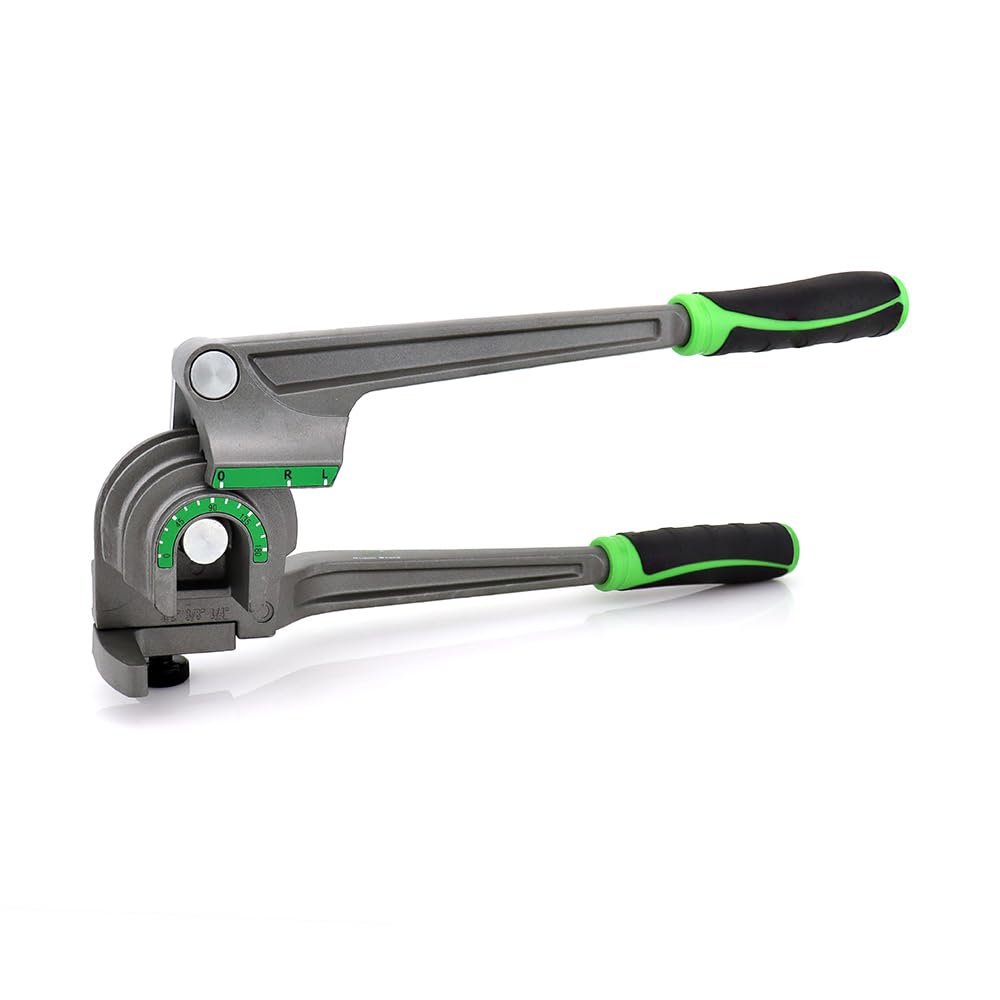
Super Stars’ 3-in-1 bender handles 1/4-inch, 3/8-inch, and 1/2-inch OD soft copper and aluminum tubing with a patented quick-action trigger that lets you reposition the two-stage handle mid-bend for better leverage. The 12-inch handles are shorter than some competitors, but the built-in vise clamp allows you to anchor the tool in a bench vise for extra stability on harder materials.
The aluminum alloy frame keeps weight at 2.79 pounds, and the trigger mechanism is genuinely useful for bending near walls or in tight cabinets where you can’t swing a long handle. Users note that it works well on 5/16-inch brake line tubing and on soft copper for HVAC compressor installations. The 180-degree bend capability covers most residential and light commercial needs.
The learning curve is mild — a couple of practice bends on scrap tubing will teach you where to align the tangency mark. For the price, this is one of the most versatile multi-size tubing benders available.
Why it’s great
- Quick-action trigger enables mid-bend handle repositioning
- Three groove sizes cover 1/4 to 1/2 inch OD tubing
- Vise clamp allows bench-mounting for extra stability
Good to know
- 12-inch handles limit leverage on thick-wall materials
- Aluminum frame may wear faster under heavy daily use
- Not designed for rigid steel or EMT conduit
6. Bonvoisin 3/8 & 1/2 OD Tubing Bender

The Bonvoisin bender focuses on two common HVAC sizes — 3/8-inch and 1/2-inch OD — with a carbon steel frame that feels solid in the hand. The bending radius for the 1/2-inch groove is 35.8 mm, producing clean 180-degree bends on copper and aluminum tubing with wall thicknesses between 0.6 mm and 2 mm. The upper handle includes a round hole for measuring tube size, a small but handy detail during installation work.
At 2.75 pounds, it is light enough to carry in a tool bag, and the carbon steel material resists bending under high force better than aluminum. Users who bent 1/2-inch 0.035-inch wall aluminum tubing reported excellent repeatability with no preheat needed — just a thin oil film on the follower arm. The tool is specifically for copper and aluminum tubes; attempting to bend steel conduit will damage the groove.
The “L” and “R” markings on the follower align with your length mark depending on whether you measure from the left or right side of the bend — a good feature for first-time users who haven’t memorized tangency points.
Why it’s great
- Carbon steel construction provides rigidity under load
- Separate L and R markings simplify left/right bend measurements
- Lightweight and compact for service tool kits
Good to know
- Only two sizes — no 1/4-inch groove included
- Not suitable for steel pipe or EMT conduit
- Some users report difficulty with thicker-wall tubing in tight positions
7. VEVOR 3-in-1 Manual Pipe Tube Bender

The VEVOR 3-in-1 bender covers 1/4-inch, 3/8-inch, and 1/2-inch OD tubing with a 40 cm (15.7-inch) aluminum alloy handle and a flexible rubber grip. The form-and-follower design applies force evenly to prevent pipe flattening or compression, and the bend angle range covers 0 to 180 degrees. The tool weighs 2.42 pounds, making it one of the lightest multi-size benders on this list.
VEVOR specifies compatibility with copper, aluminum, thin iron, and thin stainless steel tubes with a wall thickness of 0.5 to 1.2 mm. A critical note: this bender uses the pipe’s outer diameter (OD), not inner diameter. If you are working with 1/2-inch ID copper tubing (which has a 15.9 mm OD), the 12.7 mm groove will not fit. Users who matched their tubing to the OD spec reported excellent results on steel tube and aluminum, though the instructions are needlessly complicated — the actual procedure is simply aligning the tangency mark.
For the price, this is a solid entry-level tool for DIY metal projects and light HVAC work. The main trade-off is handle length — shorter handles require more arm strength, especially on 1/2-inch steel tube.
Why it’s great
- Three groove sizes in one lightweight tool under 2.5 pounds
- Aluminum alloy frame resists corrosion and stays portable
- 0-180 degree range covers most residential bend needs
Good to know
- Works only with OD measurements — not ID tubing
- Short handle reduces leverage on harder materials
- Instructions are poorly written; practice on scrap first
FAQ
Can I use a 1/2 inch tubing bender on EMT conduit?
What wall thickness can a 1/2 inch bender handle?
How do I prevent kinking when bending soft copper tubing?
What is the Benfield bending system?
Final Thoughts: The Verdict
For most users, the best 1/2 inch conduit bender winner is the Klein Tools 51606 because it combines the Angle Setter for foolproof repeatable bends with a lightweight aluminum frame and rock-solid stability from the wide foot pedal. If you need a single tool for both 1/2-inch and 3/4-inch EMT, grab the TEMCo Dual Shoe. And for heavy-duty steel conduit work that demands maximum durability, nothing beats the IDEAL 74-026 ductile iron bender.