
An oscilloscope is the single most revealing tool in electronics diagnostics, yet budget models often hide frustrating compromises — poor sampling rates that miss glitches, single-channel limits that force guesswork, and battery life measured in minutes, not hours. The right budget oscilloscope should capture the waveforms you actually need without emptying your wallet or burying you in unusable menus.
I’m Min — the co-founder and writer behind Gadgets Feed. I’ve combed through dozens of spec sheets and thousands of real-user accounts on sub- oscilloscopes to separate the genuinely practical from the overhyped toys.
Finding a reliable budget oscilloscope means knowing which specs actually matter at this price tier — bandwidth limits, sampling rates, channel count, and whether the multimeter and signal generator features are usable or just marketing checkboxes.
How To Choose The Best Budget Oscilloscope
Buying a budget oscilloscope forces trade-offs that don’t exist on pro gear. You need to decide which compromises hurt least for the circuits you actually troubleshoot — automotive sensor waveforms, audio amplifier clipping, Arduino logic signals, or home appliance power rails. The three specs below define where your dollars go furthest.
Bandwidth vs. Sampling Rate — The Real Bottleneck
Bandwidth (in MHz) tells you the maximum sine-wave frequency the scope can measure without significant attenuation. A 50MHz scope handles most audio, control, and slow-digital work. Sampling rate (in MSa/s) determines how many data points per second the scope grabs. A 200MSa/s sampling rate on a 50MHz scope is fine; 50MSa/s on a 12MHz scope means you’ll see the general shape but miss fast transients. For a budget oscilloscope, target at least 50MSa/s for general repair and 200MSa/s if you touch any digital or automotive pulse-width modulation signals.
Channel Count — Single vs. Dual
A single-channel scope is cheaper and simpler, but you cannot compare the input and output waveforms of a circuit at the same time. Dual-channel lets you measure input-to-output delay, see which channel triggers first, or watch a control signal against its response. For automotive diagnostics (crank sensor vs. cam sensor) or audio work (preamp in vs. out), dual-channel is nearly mandatory. Most budget oscilloscopes in the – range now offer dual-channel, and skipping it saves very little money while cutting your diagnostic ability in half.
Integrated Multimeter & Signal Generator — Useful or Distracting?
Many budget handheld oscilloscopes bundle a digital multimeter and a basic signal generator. The multimeter is almost always worth having — 6000-count or higher resolution, auto-ranging, capacitance and diode tests. The signal generator varies wildly: some output only a fixed sine wave at a few kHz, while others let you set frequency, amplitude, and waveform shape. If you repair audio gear or need to inject a test tone into a circuit, a generator with adjustable frequency (at least 50kHz) and multiple waveform types (sine, square, triangle) is a real asset. If you only measure existing signals, the generator can be ignored.
Quick Comparison
On smaller screens, swipe sideways to see the full table.
| Model | Category | Best For | Key Spec | Amazon |
|---|---|---|---|---|
| FNIRSI 2C53T | Premium | Lab-quality portable diagnostics | 50MHz, 250MSa/s, dual channel | Amazon |
| IMARS HO-3S | Premium | High-voltage automotive diagnostics | 70MHz, 200MSa/s, dual channel | Amazon |
| HANMATEK HO52 | Mid-Range | Isolated-ground floating measurements | 50MHz, 250MSa/s, dual channel | Amazon |
| ZOYI ZT-703S | Mid-Range | Teaching and student electronics | 50MHz, 280MSa/s, dual channel | Amazon |
| ZOYI ZT-703 | Mid-Range | Automotive sensor and actuator testing | 50MHz, 280MSa/s, dual channel | Amazon |
| GOCHIFIX 3-in-1 | Budget | Basic on-site continuity and waveform checks | 12MHz, 50MSa/s, single channel | Amazon |
| YEAPOOK YP101A | Budget | Entry-level DIY and guitar amp biasing | 12MHz, 50MSa/s, single channel | Amazon |
In‑Depth Reviews
1. FNIRSI 2C53T Upgraded Handheld Oscilloscope
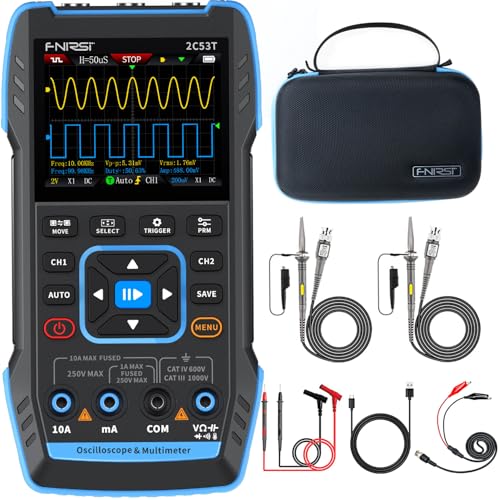
The FNIRSI 2C53T is the most complete all-in-one package at the top end of the budget tier. Its 50MHz bandwidth with a 250MSa/s sampling rate is sufficient for most embedded, audio, and automotive diagnostics, and the FPGA+MCU+ADC architecture keeps waveform rendering crisp and stable. The 19999-count multimeter handles voltage up to 999.9V DC and capacitance up to 99.99mF, and the integrated DDS signal generator outputs 13 waveform types up to 50kHz — genuinely useful for injecting test tones into amplifier stages or sensor circuits. Dual-channel scope mode includes XY mode, persistence mode, and cursor measurements, which you normally have to pay double to get.
The 2.8-inch LCD display is bright enough for indoor bench work, and the 3000mAh battery delivers around six hours of real-world mixed use. Type-C charging at 5V/1A is adequate, though the charge cycle runs long if you drain the battery completely. The included probe set (10X probe, crocodile clip, multimeter leads) covers almost every immediate need, and the storage case keeps everything organized. The only notable friction is the UI language defaulting to Chinese — you must navigate into system settings to switch to English, which takes about a minute after unboxing.
Where the 2C53T truly separates itself from cheaper entries is the combination of dual-channel, a usable signal generator, and a real multimeter that does not feel tacked on. Users report the meter accuracy holds within 0.2% on DC voltage, rivaling basic Fluke units. The scope function works reliably up to at least 30MHz before noticeable roll-off, and at 40MHz it still captures usable waveforms for non-critical work. If you want one tool for the bench and the field and you are willing to spend a bit more to avoid the compromises of the entry-level options, this is the choice.
Why it’s great
- Best bandwidth-to-sampling-rate ratio in the budget class (50MHz / 250MSa/s).
- Dual-channel scope with XY mode and persistence — rare at this price.
- Built-in DDS signal generator with 13 waveforms up to 50kHz.
Good to know
- UI defaults to Chinese; English requires a settings change on first boot.
- Multimeter auto-ranging mode is slower than dedicated handheld meters.
- Battery charge time is relatively long at 5V/1A input.
2. IMARS 3-in-1 Dual Channel Handheld Oscilloscope HO-3S
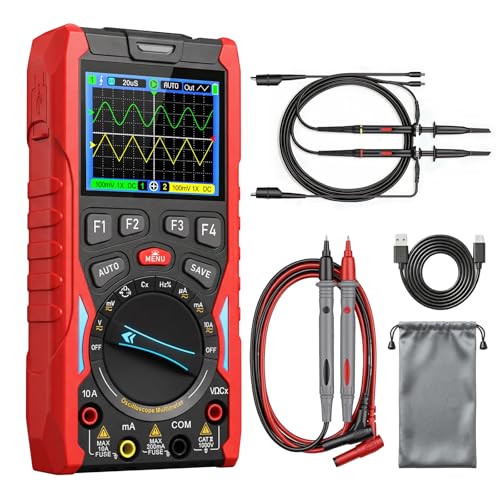
The IMARS HO-3S pushes the bandwidth ceiling in the budget category to 70MHz, which is unusual for any sub- oscilloscope. The 200MSa/s sampling rate pairs well with that bandwidth for signals up to roughly 20MHz before the Nyquist limit starts to smooth edges, but for automotive sensor waveforms (crank position, camshaft, wheel speed sensors) that sit well under 10MHz, this scope captures crisp, trigger-stable traces. The 20000-count True RMS multimeter is fully independent and supports voltage up to 1000V DC with CAT II safety rating, making it one of the few budget scopes you can safely use on mains-powered circuits.
The storage capacity is unusually generous: 1000 sets of multimeter data and 200 oscilloscope waveform records, all recallable via one-touch save. The 2.4-inch color TFT display offers eight levels of adjustable backlight, and the integrated one-key flashlight is a thoughtful addition for dark crawl spaces or under-dash automotive work. The unit runs on a replaceable 18650 lithium cell that gives about four hours of continuous use, and Type-C fast charging replenishes it reasonably quickly. The auto sleep timer is user-adjustable from five to sixty minutes or can be disabled entirely.
The HO-3S is not faultless. The interface requires some familiarization — there is no dedicated vertical position knob, and navigating the menu system for advanced trigger settings takes practice. A printed cheat card is included, but it is small. The included probes are serviceable but not premium, and the overall weight (7.8 oz) is light enough to feel slightly insubstantial, though the anti-drop housing reassures. For users who need 70MHz bandwidth for automotive or industrial diagnostics and want a scope rated for CAT II 1000V safety, this is the best option in the budget space.
Why it’s great
- Highest bandwidth in the budget bracket at 70MHz.
- CAT II 1000V safety rating for mains-level measurements.
- Replaceable 18650 battery and large waveform storage capacity.
Good to know
- Menu navigation is less intuitive than competitors with rotary knobs.
- Battery life is shorter (roughly 4 hours) than larger-capacity models.
- No hard carrying case included — only a soft pouch.
3. HANMATEK Handheld Digital Oscilloscope HO52

The HANMATEK HO52 stands apart because it provides isolated-ground inputs for both the oscilloscope and the multimeter channels. Isolation means you can probe across different reference points in a circuit without creating ground loops or shorting out your measurement — critical when working on switch-mode power supplies, motor drives, or any mains-referenced equipment. The scope side delivers 50MHz bandwidth with a 250MSa/s real-time sampling rate and a 8k-point record length, and the 3.5-inch TFT display is the largest in this roundup, making waveform details easier to read at a glance.
The multimeter mode offers 4.5-digit resolution (roughly 20000 counts) with true RMS AC measurements, auto-ranging, and separate physical inputs from the scope BNCs — you can keep probes connected to both functions simultaneously. The unit saves up to four groups of settings, four reference waveforms, four images, and four CSV waveform files, and you can export data via the Type-C port for PC analysis. The auto-calibration function maintains accuracy without manual adjustment, and the one-key autoset reliably scales waveforms down to about 18-20mV amplitude on the scope side.
The big trade-off is the control scheme. The HO52 uses push-button digital navigation rather than dedicated analog knobs for vertical scaling and timebase, which slows down rapid adjustments compared to a benchtop scope. Users accustomed to full-size scopes will find the learning curve frustrating initially. The multimeter’s capacitance measurement reads in millifarads by default, so a 470µF capacitor shows as 0.4893 mF — mathematically correct but confusing if you are not expecting it. For floating, isolated measurements on mains-derived circuits, though, the HO52 is the safest and most capable tool in this price bracket.
Why it’s great
- Fully isolated inputs for safe floating measurements on powered circuits.
- 3.5-inch display is the largest among these budget oscilloscopes.
- Separate scope and multimeter inputs allow simultaneous probing.
Good to know
- Digital button controls are slower than analog knob-based interfaces.
- Capacitance display uses mF instead of µF, causing confusion.
- Limited to basic trigger modes; no advanced math or FFT.
4. ZOYI ZT-703S 3-in-1 Digital Multimeter Oscilloscope
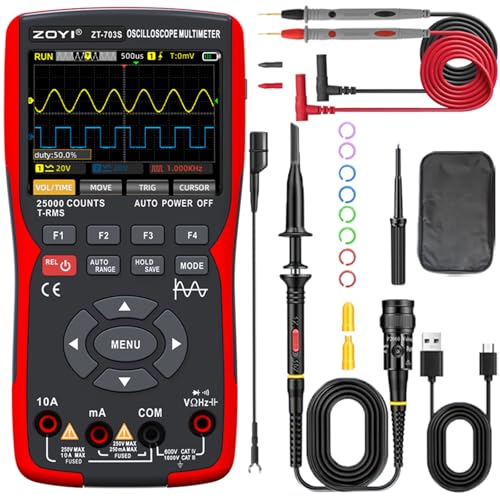
The ZOYI ZT-703S offers the highest sampling rate in its price tier at 280MSa/s in high-speed mode, paired with a 50MHz dual-channel oscilloscope. That sampling headroom means you see waveform details — rising edges, ringing, and glitches — that 50MSa/s units simply miss. The multimeter resolution is 19999 counts, and real-world testing shows DC voltage accuracy within 0.2% of a calibrated reference, which is genuinely impressive for a sub- tool. The built-in signal generator covers sine, square, and triangle waves, but the output is limited to roughly 5kHz in basic mode and a fixed 2.5Vpp amplitude — fine for audio injection but inadequate for higher-frequency stimulus.
Battery life is the strongest in the test group thanks to the 3400mAh cell. Expect six to seven hours of mixed scope and meter use, and the Type-C charging is standard and convenient. The display is bright and readable under indoor lighting, and the user interface, while menu-heavy, becomes navigable after an hour of use. The USB-C port also supports data transfer, so you can export saved waveforms to a PC for documentation — a feature often missing in cheaper handhelds.
The main weaknesses are the signal generator’s limited frequency range and a steep learning curve driven by multi-page menus. The FFT visualization lacks frequency-axis labeling, which reduces its diagnostic value. The included cloth bag is minimal, and the probe quality is average. Still, if your priority is dual-channel scope performance with the highest sampling rate in the budget sector and long battery life for all-day field work, the ZT-703S delivers the best raw measurement capability for the money.
Why it’s great
- Highest sampling rate at 280MSa/s in high-speed mode — catches fast edges.
- Large 3400mAh battery delivers 6-7 hours of real-world runtime.
- Multimeter accuracy within 0.2% of reference-grade meters.
Good to know
- Signal generator limited to ~5kHz and fixed 2.5Vpp output.
- Deep menu structure requires time to learn for full feature access.
- FFT display lacks frequency-axis labeling.
5. ZOYI ZT-703 3-in-1 Handheld Oscilloscope Automotive Dual Channel

The ZOYI ZT-703 shares its core platform with the ZT-703S but arrives in a slightly earlier revision with the same 50MHz bandwidth and 280MSa/s high-speed mode. The dual-channel oscilloscope handles pulse waves, sine waves, and noise waveforms, and the AUTO recognition function identifies unknown waveforms automatically — though the recognition time varies with signal complexity. The multimeter side offers 25000 counts, which is higher resolution than the 703S, and supports capacitance, resistance, continuity, diode, and current measurements up to 10A. The replaceable lithium-ion battery is a meaningful advantage for users who want to carry a spare for all-day fieldwork.
The display is slightly smaller than the 703S but still clear, and the physical button layout is identical. The signal generator mode stores waveform images and outputs sine, square, and triangle waves with synchronous display in the demonstration window, which is useful for education and basic stimulus work. Automotive users report excellent results with low-amp probes for fuel pumps, injectors, and ignition signals, and the scope reliably triggers on sensor waveforms that often confuse cheaper single-channel units. The fast startup time — roughly two seconds from power-on to waveform display — is a practical advantage when you are moving between test points.
The ZT-703 is not quite as polished as the 703S. The documentation is sparse, and figuring out the dual operating modes (normal vs. high-speed) requires reading the manual carefully. The storage depth is 128K points, which is adequate but not outstanding. Some users report the rotary encoder feels slightly loose. For the same price as the 703S, the ZT-703 trades a slightly larger multimeter count for a smaller battery and older firmware — if you find the 703S in stock, choose that; if only the 703 is available, it still outperforms most competitors at the price point.
Why it’s great
- 25000-count multimeter resolution exceeds most budget competitors.
- Replaceable battery allows hot-swapping for extended fieldwork.
- Two-second startup and AUTO waveform recognition speed up diagnostics.
Good to know
- Smaller battery capacity than the newer ZT-703S variant.
- Documentation is sparse and hard to follow for beginners.
- Rotary encoder has a slightly loose feel reported by some users.
6. GOCHIFIX Handheld Oscilloscope Multimeter 3-in-1

The GOCHIFIX 3-in-1 is the entry-level choice that still feels like a proper tool rather than a toy. Its 12MHz bandwidth and 50MSa/s sampling rate are enough for audio circuits, basic power supply ripple checks, and low-speed digital signals like I2C and UART. The 6000-count auto-ranging multimeter measures voltage, current, resistance, capacitance, continuity, and diode drop, and the one-key switching between modes is genuinely fast — press and hold the AUTO button for two seconds to cycle between scope, meter, and generator. The built-in signal generator outputs sine, triangle, and square waves, which is adequate for injecting a test tone into an audio amplifier or sensor circuit.
Battery life is rated at over eight hours from the 1500mAh lithium cell, and Type-C charging keeps the unit topped up without needing a dedicated charger. The 0.44-pound weight and compact dimensions (6.3 x 3.3 x 1.3 inches) make it easy to slip into a laptop bag or tool pouch. The screen is readable indoors and in moderate daylight, though direct sun washes it out. Users particularly praise the GOCHIFIX for biasing guitar amps and repairing home appliances, where the combination of a scope, multimeter, and signal generator in one hand-sized package reduces bench clutter.
The limitations are clear at this price. Single-channel operation means you cannot compare two signals simultaneously. The 12MHz bandwidth rolls off signals above roughly 8MHz on the 1x probe, and even the 10x probe struggles past 50MHz — not that the sampling rate supports it anyway. The COM port on the multimeter side has been reported as slightly tight, causing banana plugs to stick. There is no data export or PC connectivity. For pure entry-level diagnostics and learning, though, the GOCHIFIX delivers a fully functional 3-in-1 experience at the lowest working price point.
Why it’s great
- Full 3-in-1 functionality at the lowest entry price in the roundup.
- Over eight hours of real-world battery life from a 1500mAh cell.
- Compact and lightweight at 0.44 pounds for on-the-go diagnostics.
Good to know
- Single-channel only — no dual-signal comparison.
- 12MHz bandwidth limits usefulness for faster digital circuits.
- COM port on multimeter side can be overly tight for some banana plugs.
7. YEAPOOK 3-in-1 Handheld Digital Oscilloscope Multimeter YP101A

The YEAPOOK YP101A is the most affordable fully functional 3-in-1 oscilloscope multimeter signal generator on the market, and it earns its place by not cutting corners on the basics. The 12MHz bandwidth and 50MSa/s sampling rate match the GOCHIFIX, but the multimeter resolution here is 6000 counts with true RMS support. The signal generator mode outputs sine, triangle, and square waves, and the one-key save function stores up to 100 multimeter data sets and 10 waveform captures — more than enough for hobby-level documentation. The 1500mAh battery consistently delivers over eight hours of operation, and the Type-C charging port means you can recharge from any phone charger or laptop.
Build quality is decent for the price point. The unit measures 180 x 83 x 32mm and weighs 250 grams, fitting comfortably in one hand. The color display is clear, and the one-key mode switching is responsive. Users have successfully used the YP101A for biasing guitar amplifiers, testing alternator output waveforms, diagnosing inverter noise, and general home appliance repair. The auto-off function (15 minutes of inactivity) is programmable and can be disabled in the menu if you need continuous monitoring. The included velvet storage bag is basic but functional, and the test leads are standard quality.
The YP101A shares the same fundamental limitation as every sub- scope: single-channel input. You cannot simultaneously view input and output signals. The documentation is genuinely unhelpful — several users reported being unable to figure out how to display a simple sine wave without external guidance. The supplied carrying case is too tight to comfortably store the unit with probes attached. For the absolute lowest cost of entry into the world of oscilloscopes, especially for guitar amp biasing and audio repair where a signal generator is actually helpful, the YEAPOOK YP101A is the cheapest working option that does not feel like a scam.
Why it’s great
- Lowest-priced genuinely working 3-in-1 oscilloscope multimeter generator.
- Over eight hours of battery life from a compact 1500mAh cell.
- One-key save stores 100 measurement sets for later analysis.
Good to know
- Single-channel only — cannot compare two waveforms simultaneously.
- Poor documentation makes basic operation confusing for new users.
- Velvet storage bag is too tight for convenient probe storage.
FAQ
What is the minimum bandwidth I need for a budget oscilloscope?
Is dual-channel worth the extra cost on a budget oscilloscope?
Can a budget oscilloscope replace a benchtop scope for professional work?
Final Thoughts: The Verdict
For most users, the budget oscilloscope winner is the FNIRSI 2C53T because it combines a genuine 50MHz dual-channel scope, a full-function 19999-count multimeter, and a 50kHz signal generator in a package that actually performs to spec, all at the top end of the budget range. If you need 70MHz bandwidth for automotive diagnostics and CAT II 1000V safety, grab the IMARS HO-3S. And for the absolute lowest entry cost that still delivers a real 3-in-1 experience for guitar amp biasing and basic appliance repair, nothing beats the YEAPOOK YP101A.