
The problem with most tap water isn’t just taste—it’s the invisible cocktail of dissolved solids, chlorine byproducts, and microplastics that standard pitchers leave behind. An altitude water machine tackles this by either stripping water down to near-zero parts per million through reverse osmosis or by pulling moisture straight from the air, giving you a supply independent of municipal pipes entirely.
I’m Min — the co-founder and writer behind Gadgets Feed. I’ve spent hundreds of hours cross-referencing NSF certification data, TDS reduction percentages, and real-world production rates to find which machines actually deliver on their purification claims without driving you nuts with maintenance.
This guide breaks down everything from GPD flow rates to filter replacement intervals so you can confidently pick the right altitude water machine for your home or off-grid setup.
How To Choose The Best Altitude Water Machine
Narrowing down the right machine means matching the purification method to your setup—countertop RO units need a power outlet and a refillable tank, while atmospheric generators need decent humidity and no plumbing at all. Here are the three pillars to focus on.
Purification Stages vs. Real Contaminant Removal
More stages don’t automatically mean safer water. Look for actual NSF 58 or NSF 53 certification that confirms the membrane reduces lead, PFAS, and VOCs to safe levels. A 7-stage system with a UV lamp is better than a 4-stage unit without one, but only if each stage serves a purpose—sediment, carbon block, RO membrane, and post-carbon are the core four.
Pure-to-Drain Ratio and Filter Longevity
Traditional RO systems waste 3-4 gallons for every gallon they make. Modern countertop units now achieve 3:1 or even 5:1 pure-to-drain ratios, which directly affects how often you empty the wastewater tank. Filter lifespan matters too: a unit that needs new filters every six months at 50 bucks is cheaper per year than one that requires quarterly swaps at 40 bucks.
Atmospheric vs. Tap-Based: Which Source Fits Your Life
If you have decent tap water pressure and want maximum contaminant rejection, a countertop RO machine is the practical choice. If you live off-grid, in an RV, or in an area with sketchy municipal water, an atmospheric water generator that pulls water from humidity frees you from any pipe dependence—but it requires at least 50% relative humidity and uses more power per gallon.
Quick Comparison
On smaller screens, swipe sideways to see the full table.
| Model | Category | Best For | Key Spec | Amazon |
|---|---|---|---|---|
| SimPure Y9A | Countertop RO | Fast, mineral-enhanced water | 300 GPD flow rate | Amazon |
| Aigerri TJYJ001 | Countertop RO | Eco-conscious with UV | 5:1 pure-to-drain ratio | Amazon |
| DREO WF511 | Countertop RO | Two-pitcher convenience | 1,050-gallon filter life | Amazon |
| VonWater CT910 | Countertop RO | Entry-level certified RO | NSF 58 certified | Amazon |
| H2o Labs 100SS | Countertop Distiller | VOC-free distilled purity | 304 stainless steel chamber | Amazon |
| Avalon A52 | Freestanding Bottle Filler | High-traffic bottle filling | WiFi enabled counter | Amazon |
| Avalon A51 | Wall Mounted Fountain | Cold water + bottle station | Compressor cooling | Amazon |
| LifeWell S20 | Atmospheric Generator | No tap water needed | 10L/day from air | Amazon |
| Pure AirWater A10 | Atmospheric Generator | Off-grid / RV primary source | 2.64-gal daily max output | Amazon |
In‑Depth Reviews
1. SimPure Y9A UV Countertop Reverse Osmosis

The SimPure Y9A blasts through the competition with a 300 GPD flow rate that fills an 8-ounce glass in about 18 seconds—roughly four times faster than typical 75 GPD countertop units. Its 6-stage filtration includes a UV lamp and a remineralization cartridge that adds calcium, magnesium, and potassium back into the water, raising TDS from single digits to a crisp 50-80 ppm for a balanced mouthfeel.
The side-mounted water tank is a practical touch: you refill without pulling the whole unit away from the wall, and the transparent tank lets you see water level at a glance. Owners report TDS drops from 180 ppm down to single digits before remineralization, and the compact footprint (16 x 9.3 x 14.3 inches) fits under standard kitchen cabinets with 18 inches of vertical clearance.
Filter replacements run every six months for the PPC and ALK stages and every nine months for the RO membrane, with indicator lights tracking each filter’s remaining life. The only consistent feedback is that the dispenser spout sits a bit low for tall bottles, and the system requires flushing about 10 times initially to clear glycerin from new filters.
Why it’s great
- Fastest GPD in this roundup at 300 gallons per day
- Remineralization gives water flavor that flat RO lacks
- Side-tank design is genuinely convenient for daily refilling
Good to know
- Dispenser height too low for containers over 8 inches tall
- Needs multiple flushes to eliminate initial glycerin taste
- Wastewater collects in rear tank that must be emptied manually
2. Aigerri TJYJ001 Countertop RO

The Aigerri TJYJ001 stands out for its industry-leading 5:1 pure-to-wastewater ratio, meaning it wastes only one gallon for every five gallons of clean water produced—an efficiency leap over the 3:1 units that dominate this price tier. Its 5-liter raw tank feeds a separate 2-liter purified reservoir, and the built-in UV lamp provides an extra microbial kill step after the 5-stage RO process.
Setup is genuinely plug-and-play: fill the tank, plug into any standard outlet, and the unit auto-starts production. Customers consistently note that the water tastes noticeably cleaner than tap, with some specifically comparing it favorably against the more expensive Sans brand. The compact dimensions (7.4 x 16.2 x 16.4 inches) mean it occupies minimal counter space despite the dual-tank layout.
Total filter capacity reaches 529 gallons per filter set, and the pre-installed PPC and RO cartridges are easy to swap when the indicator light flashes. The main drawbacks are the sparse user manual and the relatively slow water flow during dispensing, though neither is a dealbreaker given the 5:1 efficiency savings.
Why it’s great
- Best pure-to-drain ratio on this list at 5:1
- UV light adds bacterial protection post-RO
- Favorable comparison to pricier Sans alternative
Good to know
- User manual lacks detail for first-time RO owners
- Dispensing flow is slower than premium units
- Only one purified tank means careful rationing
3. DREO WF511 7-Stage RO
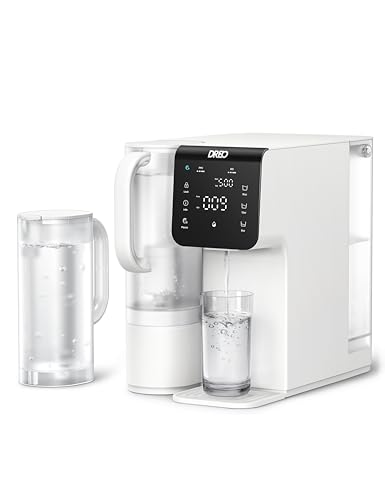
DREO’s WF511 takes a different approach by including two BPA-free pure-water pitchers—one that stays docked for immediate dispensing and a second that auto-refills for fridge storage or on-the-go use. The 7-layer filtration, anchored by a 0.0001-micron RO membrane, removes 99.99% of over 1,000 contaminants as verified by SGS testing, with owners seeing TDS readings drop to 001-003 ppm.
The real-time TDS display on the front panel updates constantly, and the filter-life indicator takes the guesswork out of replacement timing. With a 3:1 pure-to-drain ratio, the system wastes less than traditional under-sink units, and the included 1 RO filter plus 2 PPC filters push total capacity to 1,050 gallons—enough to replace roughly 8,000 plastic bottles.
Feedback from three-month owners confirms the unit stays quiet during operation and the water tastes excellent even with high-nitrate well sources. The main complaints center on the raw water tank needing daily refills for families and the removable pitchers occasionally spilling if you don’t mind the lid alignment when full.
Why it’s great
- Includes two pitchers for simultaneous dispensing and fridge storage
- Massive 1,050-gallon total filter capacity
- Verified 99.99% contaminant reduction by SGS
Good to know
- Raw tank may need daily refills for larger households
- Pitcher lids can drip if not seated properly when full
- No dedicated power button—unit runs continuously
4. VonWater CT910 7-Stage RO
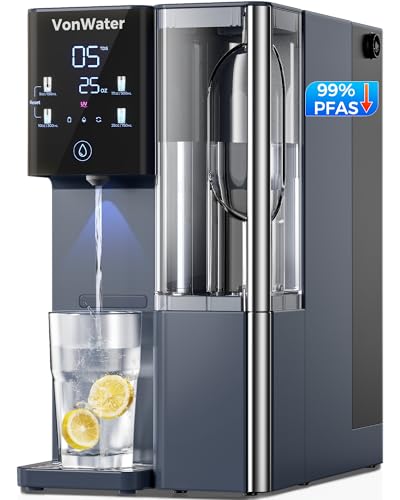
The VonWater CT910 is the most affordable entry into certified reverse osmosis, carrying NSF 372, 53, 42, and 58 certifications that cover lead reduction, TDS reduction, and material safety. Its 7-stage filtration with a 0.0001-micron RO membrane targets 99.99% of contaminants including PFAS, fluoride, and chromium, and the 3:1 pure-to-drain ratio is respectable for this price point.
The smart TDS display on the LED touch panel updates in real time, and the five volume settings (4, 8, 12, 17 ounces, or unlimited) let you dial in exact pours without overfilling. The detachable 1.2-liter pitcher works well for single-person households or small offices, and the twist-and-lock filter design makes replacements a three-second job.
Customers in Florida and other hard-water areas report the unit removes chlorine smell and mineral taste completely, leaving water that tastes bottled. The only real friction is that the feed tank must be lifted to reset the auto-production sensor, and some users wish the included pitcher were larger for fewer refills.
Why it’s great
- Full NSF certification suite at the lowest entry price
- Five precise volume settings for portion control
- Filter replacement takes only three seconds
Good to know
- 1.2-liter pitcher requires frequent refills for families
- Lift-to-reset mechanism for tank is slightly awkward
- Flow rate is slower at 0.07 GPM than premium models
5. H2o Labs 100SS Stainless Steel Distiller
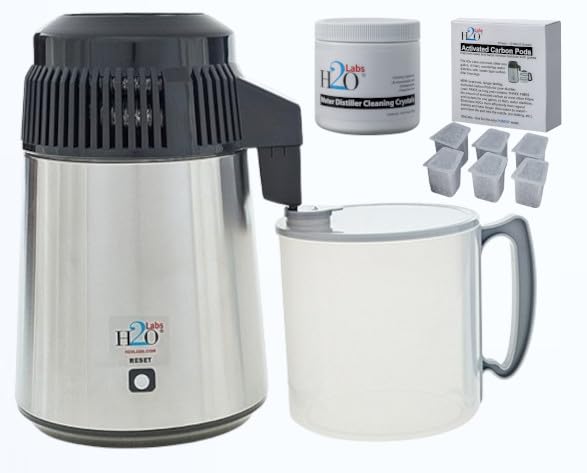
The H2o Labs 100SS uses distillation rather than RO, boiling water into steam and condensing it back into liquid to leave behind VOCs, heavy metals, and dissolved solids. The entire steam chamber—bottom, sides, dome, and condensing coil—is built from 304 stainless steel, and the company’s exclusive activated carbon pods contain three times the filtering media of standard pods for superior VOC removal.
This machine produces one gallon per 5-hour cycle using a 565-watt heating element that the manufacturer argues is the optimal power level: too large an element boils water too aggressively, allowing VOCs to pass through with the steam. The single-button operation automatically shuts off when the batch finishes, and the included cleaning crystals handle hard-water scale buildup without harsh chemicals.
Long-term owners report the unit surviving thousands of gallons with only routine descaling, though the fan is noticeably audible during operation—most users run it overnight or in a utility room. The main trade-off is speed: at roughly 5 hours per gallon, it’s much slower than a countertop RO unit, but the resulting water is about as pure as it gets outside a lab.
Why it’s great
- Full 304 stainless steel distillation chamber
- Carbon pods with triple filtering media for VOC removal
- Proven track record of thousands of gallons from owners
Good to know
- Five-hour cycle per gallon is slow for heavy usage
- Audible fan noise may require nighttime or distant placement
- One-gallon carafe is heavy for some users when full
6. Avalon A52 Freestanding Bottle Filler
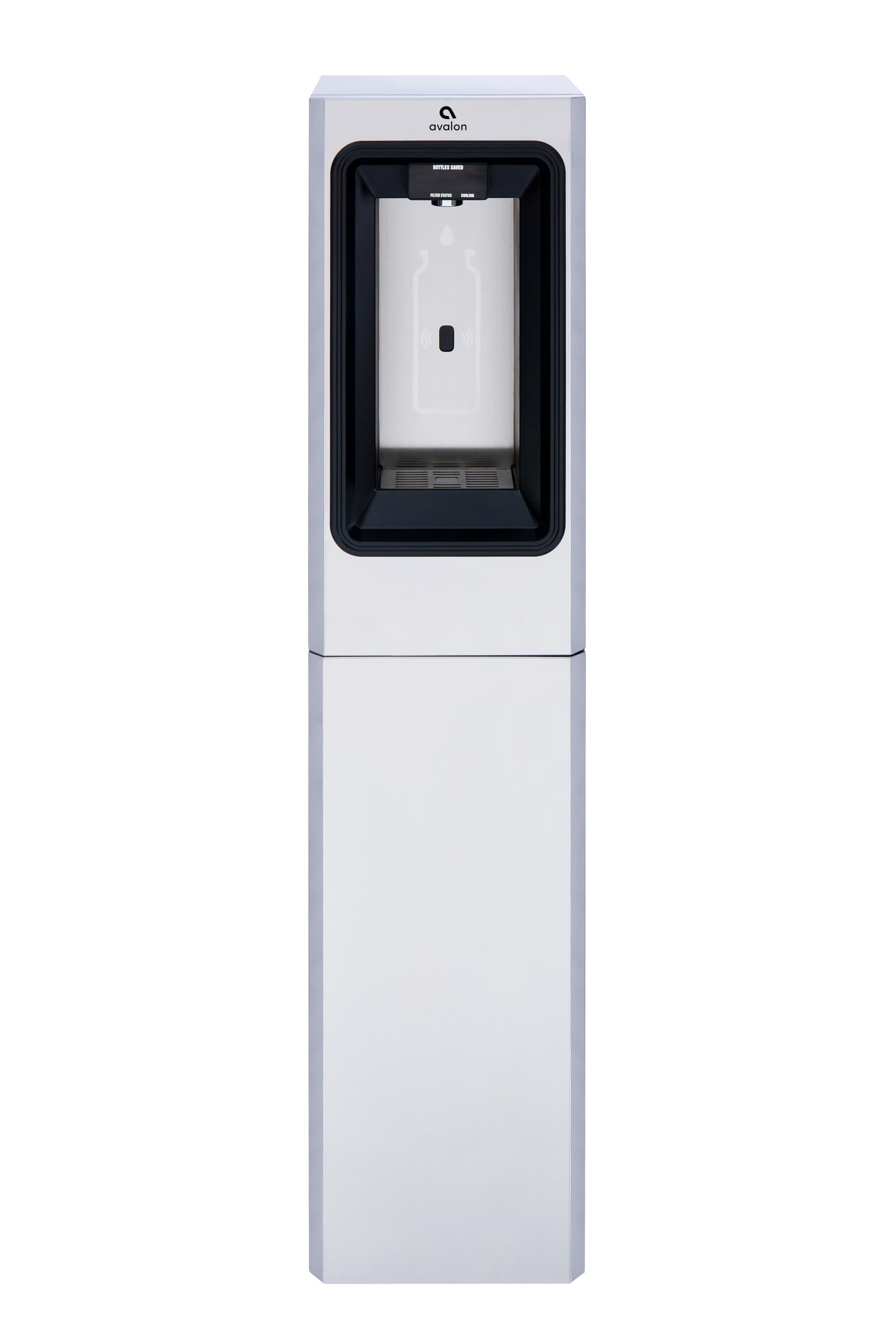
The Avalon A52 is a freestanding bottle-filling station that requires a dedicated water line and drain, making it a permanent fixture rather than a portable countertop unit. It uses dual filtration—a sediment filter and a carbon block filter rated for 1,500 gallons or six months—and features an infrared touchless sensor that dispenses water when you place a bottle in the fill zone.
The digital display tracks bottles saved from the landfill and shows a filter replacement indicator, and the included WiFi module connects to the Avalon app so you can monitor usage and filter life remotely. The dispense area accommodates bottles up to 12 inches tall with 11.5 inches of headroom below the spout, and the UV self-cleaning cycle sanitizes the internal path periodically.
Owners in home gyms and basements appreciate eliminating bottled water lugging, and the unit’s sleek stainless finish fits modern interiors. The downside is that it delivers room-temperature water unless you buy the cooling add-on, and the sensor occasionally overfills bottles if you don’t remove them quickly enough after the auto-stop engages.
Why it’s great
- WiFi-connected usage tracking and filter monitoring
- Touchless infrared sensor is hygienic for high-traffic use
- 1500-gallon filter life reduces replacement frequency
Good to know
- Requires plumbing and drain line installation
- Only room-temperature water without optional cooler
- Sensor can overfill if bottle isn’t removed promptly
7. Avalon A51 Wall Mounted Water Fountain

The Avalon A51 is a wall-mounted water fountain with a high-capacity compressor that delivers genuinely cold water via a hermetically sealed compressor and copper-tube winding cooling tank. It combines the same touchless infrared sensor and dual-filtration system (sediment plus carbon block, 1,500-gallon capacity) found in the freestanding A52, but adds a traditional drinking fountain spout alongside the bottle-filling station.
The digital bottle counter and filter-change indicator are identical to the A52, and the unit is ADA compliant for wheelchair accessibility. The stainless steel construction and 39-inch height make it a natural fit for office break rooms, school hallways, or gyms where both bottle filling and fountain drinking are needed.
Professional installers rate the build quality highly, though the installation instructions could be more detailed regarding drain connections—the unit requires a standard P-trap drain. Owners report that the compressor cooling is a major upgrade over thermoelectric units, keeping water genuinely cold even in warm environments, but note that the unit is heavy at 72 pounds and requires solid wall mounting.
Why it’s great
- Genuine compressor cooling for cold water on demand
- Dual functionality: bottle filler and drinking fountain
- ADA compliant for accessible installations
Good to know
- Heavy 72-pound unit requires secure wall mounting
- Installation instructions lack detail for drain connection
- Customer support response can be slow post-purchase
8. LifeWell S20 Atmospheric Water Generator
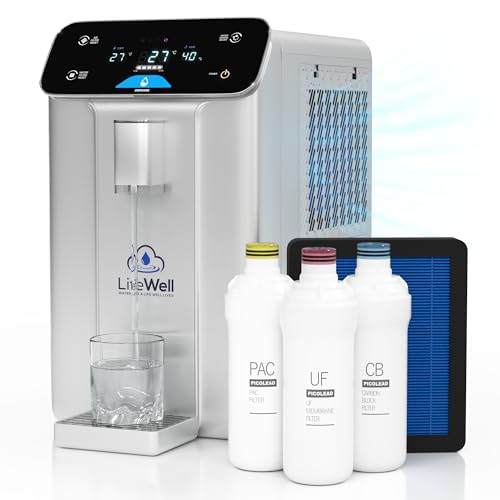
The LifeWell S20 is a countertop atmospheric water generator that pulls moisture from the air and runs it through 4-stage filtration, including a UV sterilization step, to produce up to 10 liters (2.64 gallons) per day under optimal conditions of 80% humidity and 86°F. It’s completely independent of any water line or tap, making it viable for off-grid cabins, RVs, or emergency preparedness kits.
The automatic operation is straightforward: fill nothing, just plug into a standard outlet, and the unit handles the condensation and filtration cycle on its own. Integrated alarms alert you to faults like full tank or system errors, and the stainless steel housing gives it a more premium feel than the plastic-dominated AWG options.
The biggest practical concerns are noise—the compressor and fan produce a constant hum that some owners find disruptive—and the 220V power requirement that has caught some buyers off guard. Replacement filter availability has also been flagged as inconsistent, which is a critical issue for a machine that cannot function without its filtration cartridge.
Why it’s great
- Produces water from air with no tap water connection needed
- 4-stage filtration including UV for microbial safety
- Stainless steel build feels durable for countertop placement
Good to know
- Some units require 220V power, not standard US 110V
- Replacement filter availability has been inconsistent
- Compressor noise is noticeable during operation
9. Pure AirWater A10 Atmospheric Generator
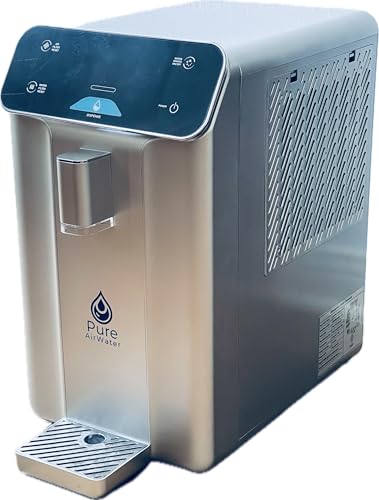
The Pure AirWater A10 is a desktop atmospheric generator that uses PAC treatment, ultrafiltration, a carbon block filter, and UVC-LED sterilization to turn humid air into drinking water. Its maximum output matches the LifeWell at 2.64 gallons per day, but it’s designed to work best at 50% relative humidity and above, with a minimum operating temperature of 59°F.
A standout feature is solar panel compatibility, making the A10 a genuine off-grid companion for RVs, boats, or emergency scenarios where grid power is unreliable. Owners report the water tastes noticeably clean and soft, and the machine automatically stops producing when the internal tank is full, preventing overflow.
Real-world output varies significantly with climate—users in drier winter conditions report roughly 8 half-liter bottles per day versus the max 20 under ideal summer humidity. The machine is quieter than the LifeWell but still produces the compressor hum typical of AWGs. A small number of units have arrived non-functional, and customer service response times vary, so warranty support is worth confirming before purchase.
Why it’s great
- Solar panel compatible for true off-grid independence
- Produces noticeably clean, soft water from ambient air
- Auto-shutoff prevents tank overflow during operation
Good to know
- Output drops significantly below 50% humidity
- Some units have arrived DOA with inconsistent support
- Compressor noise is present though quieter than competitors
FAQ
What TDS reading should my altitude water machine produce?
How often do I need to replace the filters on a countertop RO unit?
Can an atmospheric water generator work in dry climates?
Do I need to descale a countertop RO machine?
What is the difference between a water distiller and a reverse osmosis machine?
Final Thoughts: The Verdict
For most users, the altitude water machine winner is the SimPure Y9A because it combines the fastest 300 GPD flow rate with a remineralization stage that raises TDS to a pleasant 50-80 ppm, all in a compact side-tank design. If you want maximum water efficiency with a 5:1 pure-to-drain ratio, grab the Aigerri TJYJ001. And for off-grid independence from any tap water line, nothing beats the Pure AirWater A10 with its solar-compatible atmospheric generation.