
The promise of a real surround sound system—bullets whizzing past your ear, a helicopter thrumming overhead, the deep thump of an explosion in your chest—has traditionally come with a four-figure price tag. The market is flooded with soundbars that fake it, virtual processing that tries to trick your ears, and budget kits that rattle apart after a few months. Cutting through the noise to find an affordable system that delivers genuine channel separation, clean dialogue, and a subwoofer that doesn’t distort is the real challenge. This guide identifies the setups that actually honor the surround sound promise without emptying your wallet.
I’m Min — the co-founder and writer behind Gadgets Feed. I’ve spent hundreds of hours researching and comparing affordable home theater audio, analyzing board-level specs, decoding real customer longevity data, and separating the marketing fluff from the measurable performance that matters for a multi-channel setup under the premium ceiling.
Whether you are upgrading from tinny TV speakers or replacing an aging receiver-based system, these picks represent the strongest value in immersive audio. This guide breaks down the very best options for an affordable surround sound system across every key consideration: channel count, subwoofer quality, real-world durability, and ease of setup.
How To Choose The Best Affordable Surround Sound System
Building an affordable home theater requires a sharp focus on a few non-negotiable pillars. The cheapest system with the highest wattage number is often a trap. You should prioritize actual channel configuration, subwoofer size and type, the quality of the DAC and amplification stage, and how well the system handles dialogue clarity. Read real owner feedback for longevity clues — crackling, popping, or early failure of the main unit are red flags that no spec sheet will show you.
Channel Configuration: 5.1 vs 5.1.2 vs 7.1
The first number is the satellite/surround channels, the second is the subwoofer, and the third (if present) is the height or up-firing channels. A standard 5.1 system provides a center channel for dialogue, front left/right, and two rear speakers. This is the baseline for true surround. A 5.1.2 setup adds two up-firing drivers for overhead effects (Dolby Atmos). A 7.1 system adds two side surround speakers. For affordable systems, the 5.1 or 5.1.2 configuration offers the best balance of immersion and setup simplicity — more channels require more physical speaker placement and amp power, which strains the budget.
Subwoofer Reality: Size, Type and Bass Quality
Wattage ratings on subwoofers are notoriously inflated. The real differentiators are driver size (typically 6.5 to 8 inches for affordable models), cabinet volume, and whether it is wired or wireless. A wired subwoofer generally offers tighter, more controlled bass with zero latency or interference. Wireless subs offer placement flexibility but can sometimes introduce a slight delay or dropouts. Look for a subwoofer that reaches down to at least 40Hz for meaningful rumble — and read reviews about distortion at higher volumes.
Connectivity and Control: eARC, Bluetooth and App Support
HDMI eARC is the gold standard for passing lossless multi-channel audio (like Dolby TrueHD) from your TV to the sound system. It also allows your TV remote to control the bar’s volume — a massive convenience. Optical (TOSLINK) is a backup that supports compressed 5.1 (Dolby Digital/DTS) but cannot handle lossless or object-based Atmos. Bluetooth 5.3 or 5.4 is important for wireless music streaming. A dedicated app with a graphic equalizer adds significant value, allowing you to tailor the sound to your specific room and taste.
Dialogue Clarity and Center Channel Performance
This is the single most common complaint about soundbars: mumbling dialogue that forces constant volume adjustments. Any surround system worth buying must have a dedicated center channel speaker. The physical driver and crossover in that channel are what anchor voices to the screen. Some systems include dedicated Voice Boost or Clear Voice modes — test them in reviews to see if they actually improve clarity without introducing an unnatural tinny quality.
Quick Comparison
On smaller screens, swipe sideways to see the full table.
| Model | Category | Best For | Key Spec | Amazon |
|---|---|---|---|---|
| Hisense AX5140Q | 5.1.4 Soundbar | Full Atmos immersion | 5.1.4ch with up-firing drivers | Amazon |
| Hiwill-Audio M514 | 5.1.4 Hi-Fi System | Real speaker separation | True 5.1.4 with wood cabinets | Amazon |
| Amazon Fire TV Soundbar Plus | 5.1 Soundbar System | Dialogue clarity & Fire TV sync | 5-level dialog boost, Dolby Atmos | Amazon |
| ULTIMEA Skywave F40 | 5.1.2 Soundbar | Atmos height effects on budget | Up-firing neodymium drivers | Amazon |
| ULTIMEA Aura A60 | 7.1ch Soundbar | Maximum channel count | 7.1ch with 4 surround speakers | Amazon |
| Sony HT-S40R | 5.1 Soundbar System | Brand reliability & bass | 600W peak, real rear speakers | Amazon |
| Samsung HW-B550F | 2.1ch Soundbar | Dialogue & bass upgrade | Adaptive Sound, Bass Boost | Amazon |
| LG S40TR | 4.1ch Soundbar | Wireless rear simplicity | Wireless sub & rears, WOW Orchestra | Amazon |
| Rockville HTS56 | 5.1ch System | Max volume on a shoestring | 1000W peak, 8″ subwoofer | Amazon |
In‑Depth Reviews
1. Hisense AX5140Q 5.1.4ch Soundbar
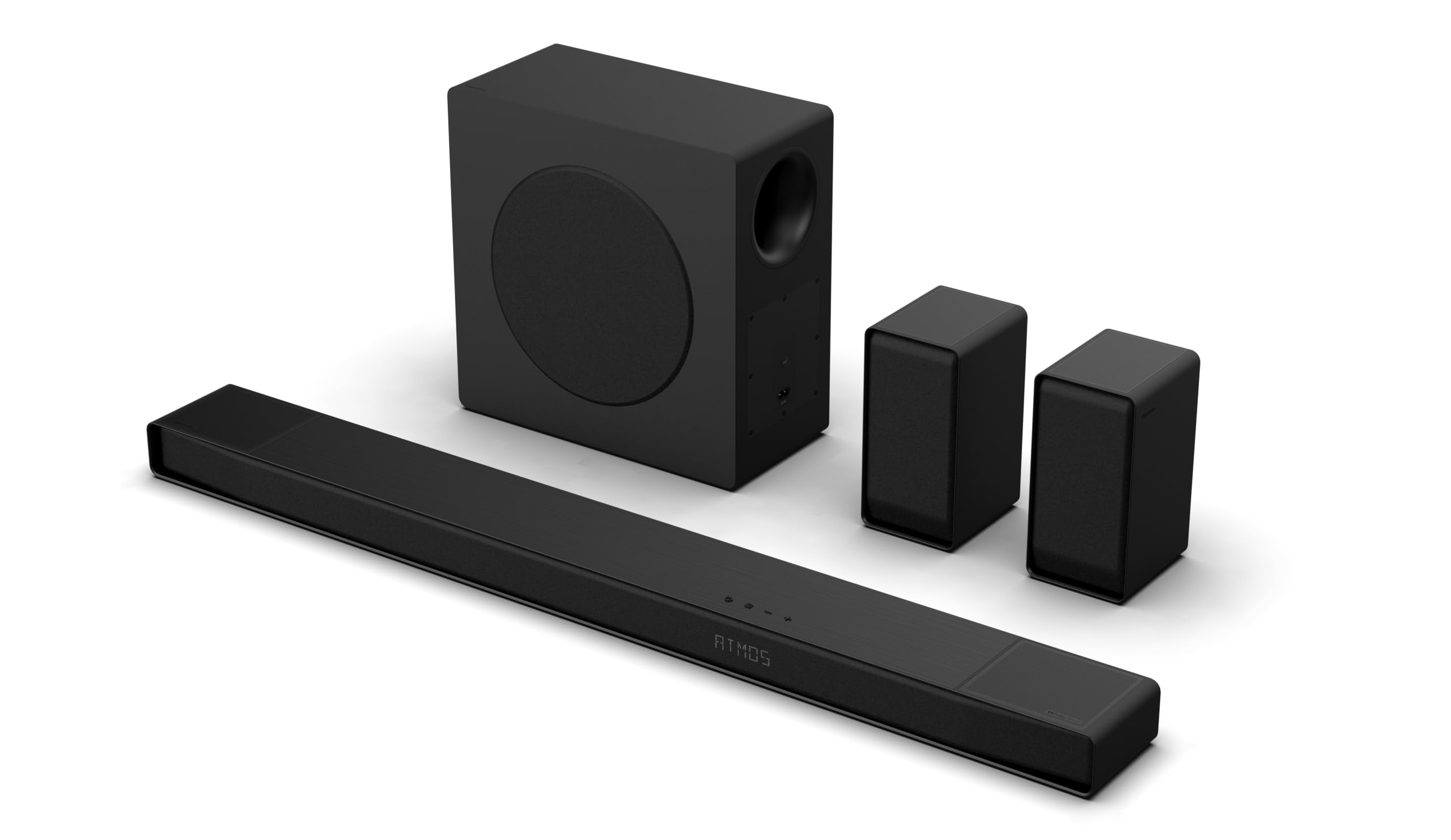
The Hisense AX5140Q is the most complete affordable soundbar system available, delivering a full 5.1.4 channel configuration — six front-firing, two up-firing drivers, and four surround speakers — paired with a 6.5-inch wireless subwoofer. This is the configuration you want for Dolby Atmos and DTS:X, as the dedicated up-firing speakers create genuine overhead effects that virtual processing cannot simulate. The 4K HDR pass-through via HDMI eARC ensures no video quality loss when connecting sources directly through the bar.
Owners consistently praise the deep, punchy bass from the wireless subwoofer and the immersive surround field created by the rear speakers. The system includes seven EQ modes (Movie, Music, News, etc.) and room calibration, which optimizes the sound profile for your specific space. Dialogue clarity is significantly better than TV speakers, and the wireless subwoofer can be placed discreetly out of sight. The build quality is solid for the price point, with a clean minimalist design.
The rear speakers are slightly less powerful in larger rooms, and while the Bluetooth 5.3 connection is stable, true surround requires an HDMI eARC connection. A minor quirk involves occasional audio garbling over Bluetooth with iPhones. The system pairs seamlessly with Hisense TVs but works equally well with any brand. For pure channel-count-per-dollar, the AX5140Q is the most compelling value in this guide.
Why it’s great
- True 5.1.4 with dedicated up-firing Atmos drivers
- Wireless 6.5″ subwoofer delivers deep, non-distorting bass
- Room calibration and 7 EQ modes tailor sound to your space
Good to know
- Rear speakers feel underpowered in very large rooms
- Occasional Bluetooth garbling reported with iPhone
2. Hiwill-Audio M514 True 5.1.4 System
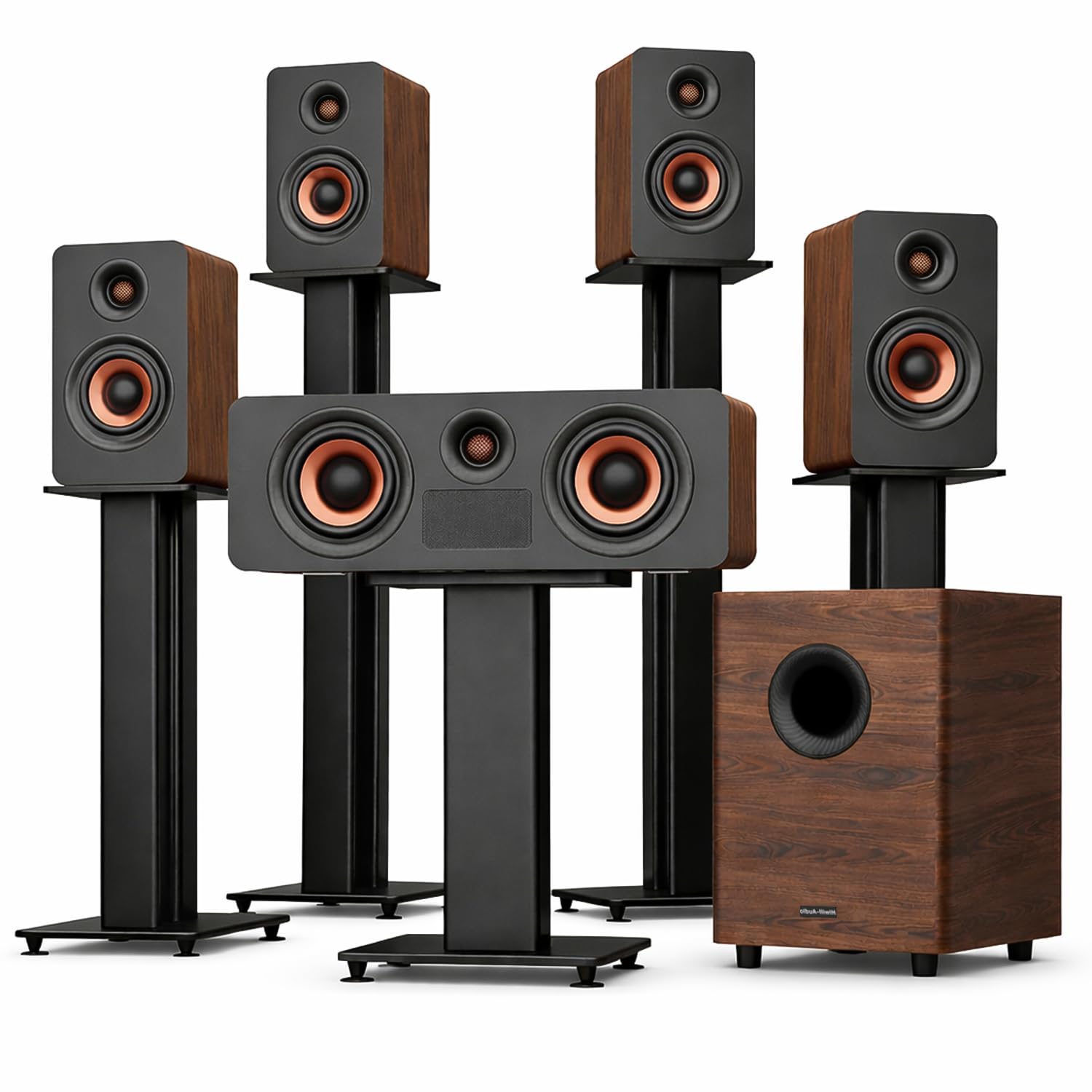
The Hiwill-Audio M514 is a radical departure from the soundbar format — it is a genuine 5.1.4 Hi-Fi home theater system with an independent center channel, four discrete surround speakers, and a dedicated 25Hz subwoofer housed in handcrafted wooden cabinets. The 900W peak power claim is best understood as 450W RMS, but the crucial detail is the use of 16 rose-gold aluminum-magnesium alloy drivers with independent crossovers, delivering clean channel separation that no single-bar soundbar can match.
Reviews highlight the immersive, room-filling sound and the deep, controlled bass from the 13.5L subwoofer. Dialogue is locked to the center channel, preventing the common issue of voices getting lost in busy action scenes. The system supports Dolby Atmos with four dedicated up-firing height channels for genuine overhead effects. Setup involves more cables than a soundbar, but the color-coded wiring and included 6m rear speaker cable make it straightforward. The wooden cabinets enhance acoustic warmth and reduce cabinet resonance.
A small number of units have reported occasional popping sounds from the rear speakers, often resolved by a firmware update from the manufacturer. The system requires a 90-degree HDMI adapter for wall mounting. The M514 is heavier and takes up more physical space than a soundbar. For anyone who prioritizes genuine speaker separation and Hi-Fi soundstage over the sleek aesthetics of a soundbar, this system delivers performance that rivals setups costing considerably more.
Why it’s great
- True discrete 5.1.4 with independent center and height channels
- Wooden cabinets with aluminum-magnesium alloy drivers
- Subwoofer reaches 25Hz for deep, clean bass
Good to know
- Some units reported rear speaker popping (firmware fixable)
- Requires more space and cable management than a soundbar
3. Amazon Fire TV Soundbar Plus 5.1

The Amazon Fire TV Soundbar Plus system takes a different approach, arriving as a complete 5.1-channel package with a soundbar, wireless subwoofer, and two wireless rear surround speakers. The standout feature is a dedicated center dialogue channel with a 5-level dialog boost, which is among the most effective in this price range for making voices crystal clear without adding harshness. It supports both Dolby Atmos and DTS:X for multi-dimensional audio.
Setup is near-instant — the subwoofer and surround speakers arrive pre-paired and simply need power. The system is designed for deep integration with Fire TV, allowing one remote to control everything. Owners note significant improvement in voice clarity over older systems like the Vizio SB3651, and the bass is deep without being boomy. The subwoofer placement is critical: it needs to be at least 12 inches from a wall for optimal performance. The system lacks up-firing speakers, so Atmos height effects are virtualization-based rather than driver-driven.
Some users report initial HDMI handshake issues with certain TVs, which typically resolve after a simple reset. The build quality is decent but not premium. The Bluetooth streaming works well for music. At its price point, this system offers the best out-of-box dialogue clarity and the simplest setup, especially for existing Fire TV users. It is the top choice for anyone for whom “I can’t hear what they’re saying” is the primary complaint about their current TV audio.
Why it’s great
- Excellent 5-level dialogue boost center channel
- Easiest setup: pre-paired wireless sub and rears
- Supports Dolby Atmos and DTS:X
Good to know
- No up-firing drivers; Atmos is virtualized
- Occasional HDMI handshake issues on first install
4. ULTIMEA Skywave F40 5.1.2ch
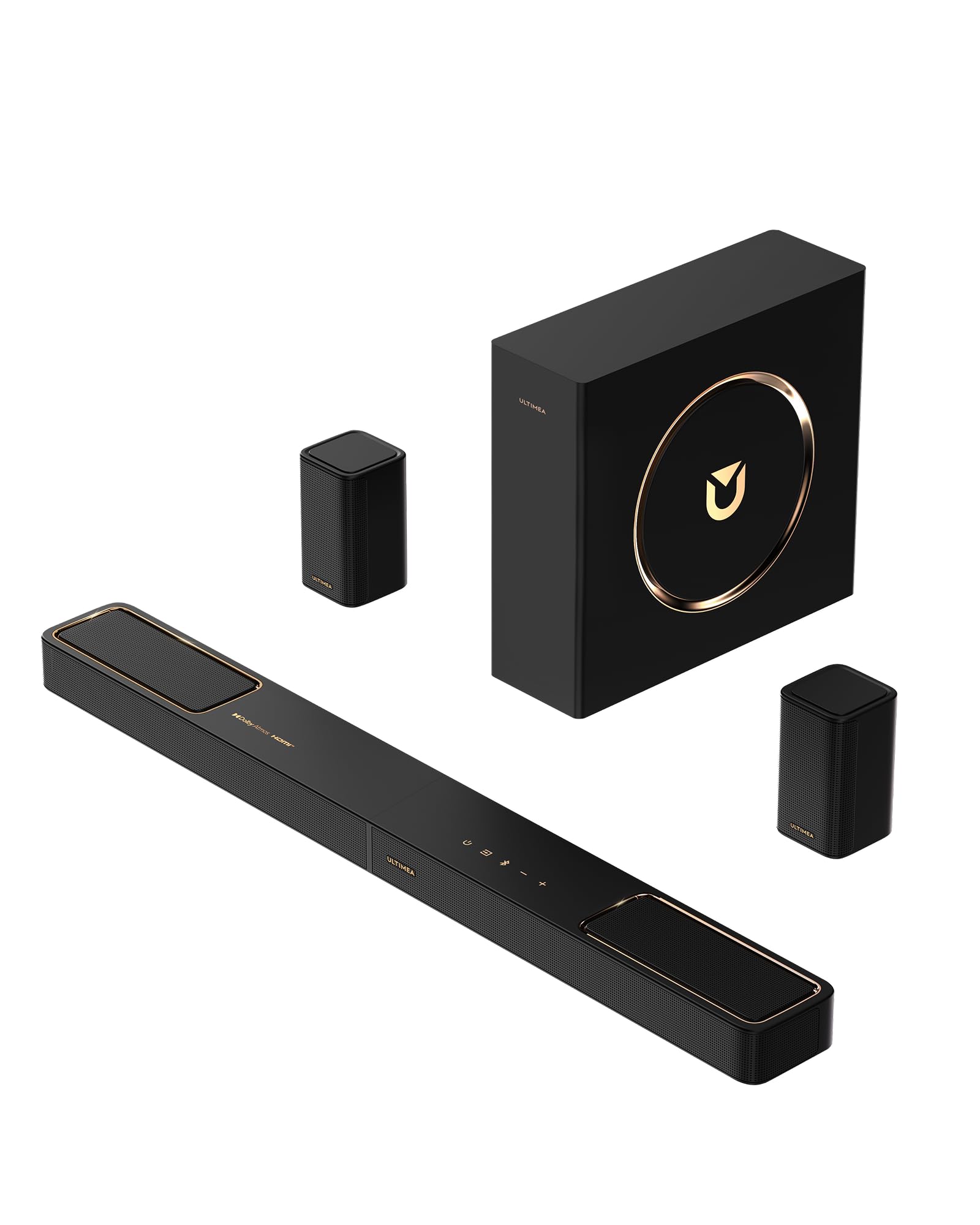
The ULTIMEA Skywave F40 is a 5.1.2-channel soundbar system that brings Dolby Atmos height effects to the affordable segment through genuine up-firing drivers, not virtual processing. The key differentiator is the use of neodymium internal magnets and 18-core voice coils in the up-firing channels, which deliver a cleaner high-frequency throw for overhead sounds like rain or helicopter flyovers. The system includes a 5.25-inch wired subwoofer and two wireless rear surround speakers connected by a cable between them.
Users describe the sound as loud and clear, with noticeable bass presence that works well for small to medium rooms. The 360-degree SurroundX technology effectively positions audio around the listener. The Ultimea App offers deep control: 121 preset EQ matrices, a 10-band graphic equalizer, and 13-step level adjustment for each surround channel. The HDMI eARC connection supports lossless audio transmission up to 37Mbps. Setup is straightforward, with the rear speakers requiring only a power outlet.
The bass is described as “solid but not room-shaking,” which is a fair characterization of the 5.25-inch subwoofer. The system is not compatible with DTS. Some users note that the rear speakers are small and benefit from being placed on stands. The app does not include a speaker test function. For the price, the Skywave F40 offers the most faithful Dolby Atmos height reproduction in a compact soundbar form factor, making it ideal for gamers and movie fans in medium-sized rooms.
Why it’s great
- Real up-firing drivers with neodymium cores for Atmos height
- Deep app control with 121 EQ presets and 10-band EQ
- Lossless eARC transmission up to 37Mbps
Good to know
- Subwoofer bass is good but not room-shaking
- Not compatible with DTS audio formats
5. ULTIMEA Aura A60 7.1ch

The ULTIMEA Aura A60 offers the highest channel count in this guide: a legitimate 7.1-channel configuration with four physical surround speakers (two front, two rear) plus a 4-inch wired subwoofer. This system uses a main soundbar with three channels for clear dialogue, but what sets it apart is the inclusion of four discrete surround speakers that create a genuinely wide and enveloping sound field. The rear speakers connect wirelessly to the soundbar, while the front surrounds are wired.
Dolby Atmos support creates a convincing 3D soundscape, and the BassMX technology on the 4-inch subwoofer delivers resonant low frequencies that outperform expectations for its size. The Ultimea App provides 121 expert EQ presets across genres, a 10-band equalizer, and six tailored sound modes (Movie, Music, Voice, Sport, Game, Night). Users praise the powerful subwoofer and clear, loud audio. The system is compact enough for small spaces but is recommended for rooms between 108 and 270 square feet.
The 4-inch subwoofer cannot match the deeper low-end extension of a larger 8-inch or 6.5-inch driver. Some users note that the sound quality does not match older premium soundbars despite extensive EQ adjustment. The included 6-meter rear surround cable is generous for placement. The Aura A60 is the best choice for buyers who want the widest channel count and most immersive sound field from a soundbar form factor, especially in rooms where rear speaker placement is straightforward.
Why it’s great
- Genuine 7.1ch configuration with four surround speakers
- BassMX subwoofer outperforms expectations for a 4-inch driver
- Excellent app control with 121 EQ presets
Good to know
- 4-inch subwoofer lacks deeper sub-40Hz extension
- Sound quality may not match older premium soundbars
6. Sony HT-S40R 5.1ch System

The Sony HT-S40R is a 5.1-channel soundbar system that uses a 600W peak power figure and a genuinely simple setup process — the rear speakers connect to the subwoofer via color-coded cables, and the subwoofer connects wirelessly to the soundbar. This wired rear configuration avoids potential wireless interference issues, making it a reliable choice. The system includes a separate subwoofer, soundbar, and two rear speakers, plus dialogue enhancement for nighttime viewing.
Owners report that the system delivers excellent surround sound quality for the price, with clear dialogue and immersive movie-watching experiences. The bass is impressive for a soundbar system. The system connects via HDMI, Optical, or Analog, providing flexibility for older TVs. Sony’s brand reliability is a factor for many buyers. The sound is described as far exceeding expectations for the size and wattage, making it a great option for bedrooms or smaller living rooms.
However, reliability issues have been reported. A significant number of reviews describe a random loud cracking or popping noise from the rear speakers that occurs multiple times per week. Some units also fail to detect the TV input monthly. The subwoofer is not fully wireless — it uses a proprietary cable to connect to the rear speakers. Sony’s repair process has frustrated some owners, with multiple components requiring sequential service. The HT-S40R sounds excellent when it works, but the reliability reports make it a calculated risk.
Why it’s great
- Excellent audio clarity and immersion for the price
- Simple color-coded, wired rear speaker connection avoids wireless issues
- Strong Sony brand and dialogue enhancement features
Good to know
- Frequent reports of random crackling/popping from rear speakers
- Subwoofer is not fully wireless — uses proprietary cable
- Some owners report reliability issues requiring multiple repairs
7. Samsung HW-B550F 2.1ch Soundbar

The Samsung HW-B550F is a 2.1-channel soundbar with a wireless subwoofer, making it the most affordable entry point into improved TV audio in this guide. It uses DTS Virtual:X to simulate surround sound from a 2.1 configuration — meaning it lacks physical rear speakers. The value proposition is in the Adaptive Sound feature, which analyzes content in real-time and optimizes the audio profile, and the Voice Enhance Mode, which amplifies dialogue automatically.
Owners consistently describe this as a “movie theater experience” in terms of the upgrade from built-in TV speakers. The bass from the wireless subwoofer is described as deep and not overwhelming. Setup is simple, with easy connection to Samsung TVs via HDMI-ARC or optical. The ability to add optional Samsung rear speakers later is a key benefit for buyers who want to expand to a true 5.1 system over time. Reviews note huge improvements for music and movies.
This is a 2.1 system, not true surround sound — the Virtual:X processing is effective but cannot replace physical speakers behind you. Some users report that the subwoofer may not work out of the box, requiring a replacement. The system is best for those on a tight budget who want a dramatic improvement over TV speakers and the option to upgrade later. For pure dialogue clarity and bass boost in a living room, this is the safest, most reliable entry-level choice in the guide.
Why it’s great
- Adaptive Sound and Voice Enhance for automatic optimization
- Option to add real rear speakers later for true 5.1
- Massive audio upgrade from built-in TV speakers
Good to know
- 2.1 channel system with virtual, not physical, surround
- Some units shipped with defective subwoofers
8. LG S40TR 4.1ch Soundbar

The LG S40TR is a 4.1-channel soundbar system — a soundbar with a wireless subwoofer and two wireless rear surround speakers, but no dedicated center channel. This is an Amazon-exclusive model designed for simplicity: the wireless subwoofer and wireless rear speakers connect to the soundbar without a receiver, making setup as easy as plugging each component into a power outlet. The WOW Orchestra feature enables the soundbar and compatible LG TVs to use all their speakers simultaneously.
Users are extremely positive about the value, describing the S40TR as “the best for the money” that transforms small den and bedroom audio. The wireless implementation is reliable, with no connection issues reported. The subwoofer provides deep, immersive bass that is neighbor-friendly. The system includes Clear Voice Plus for dialogue visibility, and the Smart Up-Mixer converts stereo content into a multi-channel experience. The Crest Design with a metal grill helps protect against dust. The remote allows individual volume control for the rear speakers.
Optimal placement requires the seating position to be between the rear speakers for proper surround imaging. The rear speakers need a wire connecting them to each other, and then connect wirelessly to the bar. The subwoofer needs a power outlet. Users report that the rear speakers may arrive silent until enabled through the LG Soundbar App. The 4.1 configuration means there is no discrete center channel, so dialogue clarity relies on Clear Voice Plus processing rather than a dedicated driver. The LG S40TR is the best choice for those who prioritize the easiest possible wireless setup for a real 4.1 surround experience.
Why it’s great
- Truly simple wireless setup for subwoofer and rear speakers
- WOW Orchestra for combined TV + soundbar audio
- Clear Voice Plus and Smart Up-Mixer enhance dialogue and immersion
Good to know
- 4.1 configuration lacks a discrete center channel
- Optimal sound requires careful rear speaker placement
- Rear speakers need initial activation via LG app
9. Rockville HTS56 1000W 5.1 System

The Rockville HTS56 is a traditional 5.1-channel home theater system with an 8-inch subwoofer and five satellite speakers, delivering 1000W of peak power. This is a receiver-less system where the amplifier is built into the subwoofer cabinet. It includes Bluetooth, USB, SD card, RCA, and optical inputs, plus two microphone inputs with echo control for karaoke. The LED light effects on the subwoofer and satellites blink to the beat or display a spectrum analyzer — a feature unique at this price.
Long-term owners (some with two years of use) report that the system is incredibly loud and offers impressive clarity and bass for the price. The remote allows individual speaker volume adjustment, and the 5-band EQ provides some sound customization. The system outputs true 5.1 surround from PCM 2.1 sources, but crucially, it cannot decode a native 5.1 Dolby Digital signal over optical — it will only accept stereo PCM. This is the single most important technical limitation to understand. Users who want true 5.1 from streaming devices need an external DAC.
Setup is time-consuming due to the many wires (each satellite speaker must be wired to the subwoofer). Some reviewers report the unit failing after 15 minutes, producing a burning smell. The LED lights are not dimmable, which may be distracting in a dark theater room. The system is best suited for a garage, man-cave, or office where raw volume and flashy aesthetics matter more than audiophile fidelity. It is the definition of “you get what you pay for” — a loud, fun system with clear technical limitations.
Why it’s great
- Extremely loud with a large 8-inch subwoofer for powerful bass
- Unique LED light effects and karaoke microphone inputs
- Incredible price for a 5.1 speaker set with Bluetooth
Good to know
- Only accepts stereo PCM over optical, not true 5.1 Dolby Digital — requires external DAC
- Reports of units failing early (burning smell)
- Very time-consuming setup with many wires; LED lights not dimmable
FAQ
What is the minimum channel count I need for real surround sound?
Can I get Dolby Atmos effects without speakers in the ceiling?
Why does my cheap 5.1 system only play sound from two speakers?
Can I use any subwoofer with my soundbar system?
How important is HDMI eARC for an affordable surround sound system?
Final Thoughts: The Verdict
For most users, the affordable surround sound system winner is the Hisense AX5140Q because it offers the most complete feature set — true 5.1.4 channels with dedicated up-firing Atmos drivers, a wireless subwoofer, and room calibration — at a price that undercuts competitors. If you want the purest speaker separation and Hi-Fi quality, grab the Hiwill-Audio M514. And for the absolute best dialogue clarity with the simplest setup, nothing beats the Amazon Fire TV Soundbar Plus.