
Choosing the wrong solar charge controller for your 12V system is a fast track to a dead battery bank and wasted solar panels. The core difference between PWM and MPPT technology determines how much of your panel’s power actually reaches your battery, and that decision is the single biggest variable in off-grid performance, whether you’re outfitting an RV, a cabin, a boat, or a van.
I’m Min — the co-founder and writer behind Gadgets Feed. I’ve spent countless hours poring through technical datasheets, comparing conversion efficiency curves, and analyzing hundreds of real-world user reports to find the controllers that actually deliver their rated amps without excessive self-consumption or early failure.
This guide cuts through the jargon to help you find the right 12v solar charge controller for your specific battery type and panel setup, focusing on build quality, charging algorithms, and long-term reliability.
How To Choose The Best 12V Solar Charge Controller
Selecting the right controller starts with matching its technology and input ratings to your solar panels and battery bank. Ignoring the voltage ceiling or current capacity will either kill your controller or leave serious wattage on the table.
PWM vs. MPPT: The Core Decision
Pulse Width Modulation (PWM) controllers are simpler and cheaper, but they force your solar panel to operate at the battery voltage. This means you lose the extra voltage potential if your panel’s nominal voltage is higher than the battery (e.g., most 12V panels have a Vmp around 18V). Maximum Power Point Tracking (MPPT) controllers convert that extra voltage into additional charging current, typically delivering 20-30% more power, especially in cold weather or low light. If your panels are a standard 12V type (36-cell), a PWM unit can work fine. If you are using higher voltage panels (like 60-cell residential panels), an MPPT is mandatory.
Battery Chemistry Compatibility
Modern controllers offer dedicated charging profiles for different batteries. A Lithium Iron Phosphate (LiFePO4) battery requires a specific absorption voltage (typically around 14.4V to 14.6V) and a bulk-absorption-float profile that differs significantly from lead-acid. Using the wrong profile can prevent a full charge or trigger over-voltage protection. A mid-range or premium controller will have a clear menu setting for LiFePO4, AGM, Gel, and Flooded batteries, and ideally a user-defined mode for custom parameters.
Current Rating and System Voltage
The controller’s amperage rating (e.g., 10A, 30A, 40A) is the maximum current it can handle from the solar panels to the battery. You must calculate your total solar wattage divided by your battery voltage to find your system’s peak current, then choose a controller rated for at least that amount. For 12V systems, this is roughly watts/12 = amps. A 30A controller can handle about 360-400W of solar. Also check the Maximum PV Input Voltage (Voc) – this is the highest voltage your controller can accept. Never connect a panel string whose total Voc exceeds this rating, or you risk instant destruction.
Quick Comparison
On smaller screens, swipe sideways to see the full table.
| Model | Category | Best For | Key Spec | Amazon |
|---|---|---|---|---|
| Renogy Rover 40A | MPPT | Premium Full-Feature System | 99% MPPT Efficiency, Built-in BT | Amazon |
| LiTime 30A MPPT | MPPT | Bluetooth Monitoring | Die-Cast Aluminum, 30A | Amazon |
| POWLAND 60A MPPT | MPPT | Large Capacity Solar Arrays | 60A Charge, 150V Max Input | Amazon |
| LNEX 20A PWM | PWM | Outdoor/Weatherproof Build | IP65 Waterproof, 0.87″ Thin | Amazon |
| Renogy Adventurer 30A | PWM | Reliable Flush-Mount Install | 4-Stage Charging, Temp. Comp. | Amazon |
| Bateria Power MPPT 10A | MPPT | Small Systems & Mobility | SAE Connector, 3.7″ Wide | Amazon |
| BougeRV Li 30A | PWM | Budget-Friendly Lithium Support | 30A, Backlit Display | Amazon |
In‑Depth Reviews
1. Renogy Rover 40A MPPT

The Renogy Rover 40A is the benchmark for mid-to-large 12V setups, offering a robust MPPT algorithm that users report yields up to a 25% increase in daily harvest versus PWM. Its ability to auto-detect 12V or 24V systems and accept a PV input up to 100V allows you to wire panels in series for higher voltage and lower line loss. The included Bluetooth module enables real-time monitoring via the DC Home app, letting you configure custom lithium battery parameters down to 0.1V increments.
The controller’s heat sink design operates silently with no fan noise, and its UL certification adds a layer of safety assurance for permanent installations. Users consistently praise the app’s clarity for tracking daily production and battery state of charge, though the manual remains cryptic on advanced settings. The unit can jump-start a dead lithium battery at 0V, a critical feature for deeply discharged battery banks.
While the terminal clamps accept up to 6 AWG wire securely, a few users note the supplied Bluetooth module has a range of around 40 feet, which is fine for most RVs but not for a house. The load output with its 5 selectable modes (e.g., Dusk-to-Dawn, Manual) is a valuable bonus for controlling DC lights directly. For a high-reliability, fully-featured system, this is the front-runner.
Why it’s great
- Industry-leading 99% MPPT tracking efficiency significantly boosts charge yield in cloudy conditions
- Built-in Bluetooth module (BT-2) for comprehensive remote monitoring and parameter adjustment
- Fully customizable lithium charging profile with 0V battery activation capability
Good to know
- Bluetooth app interface can have minor connectivity quirks that require re-pairing
- Included manual is spartan and often requires external YouTube tutorials for full setup
2. LiTime 30A MPPT
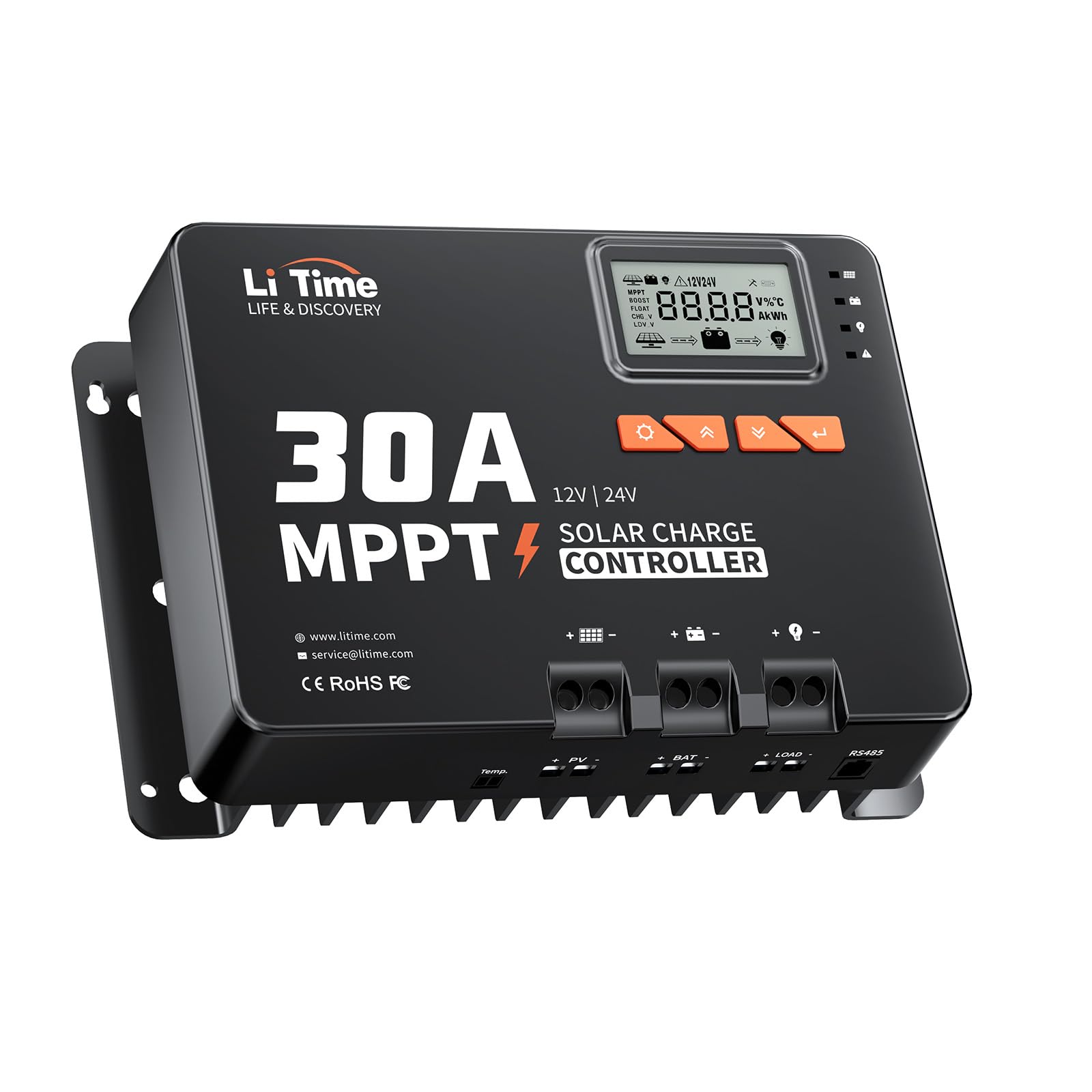
The LiTime 30A MPPT stands out for its heavy-duty die-cast aluminum enclosure, which acts as a formidable heat sink. This design allows it to sustain its full 30A charge current at higher ambient temperatures without derating, a common failure point for plastic-housed controllers. It includes a built-in Bluetooth module for app-based monitoring, eliminating the need for a separate accessory.
Its LCD screen displays voltage, current, and battery percentage with large, easy-to-read digits. The controller supports 12V and 24V systems automatically and is compatible with LiFePO4, Sealed, Gel, and Flooded batteries. Users highlight the install process as straightforward, with included copper wire connectors that improve contact area. The Bluetooth app, while functional, has some interface quirks with dark gray text on black backgrounds and an occasional pairing loss after shutdown.
One unique advantage is the load terminal that can be toggled on/off via the app or the physical button, perfect for controlling a ventilation fan or small pump. The unit is larger than a typical 30A controller, requiring more mounting space. For a system where long-term thermal performance and integrated smart monitoring are top priorities, this aluminum-bodied controller offers excellent value.
Why it’s great
- Rugged die-cast aluminum body provides superior heat dissipation for sustained high-current output
- Integrated Bluetooth for real-time data monitoring without needing a separate purchase
- Sturdy copper wire terminals improve current transfer and reduce connection resistance
Good to know
- Bluetooth app pairing can be reset after a power cycle, requiring manual reconnection
- Physical dimensions are larger than many 30A competitors, requiring ample mounting space
3. POWLAND 60A MPPT

The POWLAND 60A MPPT is built for large solar arrays, handling up to 150V DC input (Voc) and a hefty 60A charge current, making it suitable for systems well over 700W on a 12V bank. Auto-detection of 12V, 24V, 36V, and 48V systems gives it incredible flexibility for future expansion. The unit uses a four-level charging algorithm (Bulk, Boost, Float, Equalization) to maximize lead-acid battery health.
The LCD screen and four-button menu system provide detailed system data, including PV voltage, battery voltage, charging current, and accumulated Amp-hours. Users running large off-grid setups appreciate its ability to handle multiple high-voltage panels. The aluminum heat sink is essential for a 60A current, and the unit is relatively heavy at 3.8 pounds. Some users report success running the controller at its limit for extended periods.
The main caveat is a small but non-trivial number of reports of the unit failing within the first year, suggesting some quality control variance. However, the majority of users praise its performance and value for the money, especially when compared to brands charging two to three times as much. For power-hungry setups demanding high amperage, this controller packs serious capacity.
Why it’s great
- High 60A charge current and 150V PV input support very large solar arrays and series wiring
- Auto-sensing 12V/24V/36V/48V battery voltage for maximum system configuration flexibility
- Provides detailed LCD data including accumulated Amp-hours for tracking daily solar harvest
Good to know
- Some units have been reported to fail within a year of operation, indicating potential reliability issues
- Lacks built-in Bluetooth; separate communication module not included in the standard package
4. LNEX 20A PWM

The LNEX 20A PWM controller breaks the mold with an IP65 waterproof rating and an extremely thin profile at just 0.87 inches thick. This fully potted (epoxy-sealed) unit is designed to be mounted in exposed outdoor locations like sheds, open trailers, or marine compartments. Its 5-stage PWM charging algorithm (Soft Start, Bulk, Absorption, Float, Equalization) is ideal for maintaining AGM, Gel, Flooded, and LiFePO4 batteries.
The backlit LCD display cycles through battery voltage and solar current, and users note it’s accurate when compared to a separate battery monitor. The screw terminals are full-size, allowing for secure connections with 10 AWG or smaller wire, a clear upgrade over budget units with tiny ports. The auto-memory function saves your last selected battery type and settings. A 28-day auto-equalization cycle is especially good for calcium or EFB batteries used in start-stop vehicles.
The only feedback is that it lacks a dedicated display for total wattage, and its optional temperature sensor is not included. Additionally, its maximum PV input voltage is limited to 50V, meaning you cannot wire high-voltage panels in series. For a dedicated weatherproof solution on a small to medium-sized system where water ingress is a genuine risk, this is a standout choice.
Why it’s great
- Fully potted IP65 design makes it immune to water spray, rain, and condensation exposure
- Ultra-slim 0.87-inch profile is ideal for tight mounting spaces where depth is limited
- Full-size screw terminals accept thicker wire for a more secure and lower-resistance connection
Good to know
- No LCD wattage display; screen only shows voltage and current cycling every few seconds
- Optional battery temperature sensor must be purchased separately if needed
5. Renogy Adventurer 30A PWM

The Renogy Adventurer 30A is a trusted PWM workhorse from one of the most established brands in the solar space. Its standout feature is the flush-mount design, which allows the controller to be embedded into a wall or cabinet for a clean, permanent installation. It automatically detects 12V or 24V systems and features a 4-stage smart charging algorithm (Bulk, Boost, Float, Equalization) that extends battery life.
It is compatible with Lithium, AGM, Gel, and Flooded batteries, and includes a lithium reactivation function for deeply discharged cells. The backlit LCD provides clear status info, and the unit is rated to operate in extreme temperatures from -4°F to 140°F, thanks to its built-in temperature compensation sensor. It is easily one of the most trusted units for RVs, with users frequently using it to replace failed OEM controllers from brands like GoPower.
One minor design quirk is that the manual states a specific positive/negative wiring order; getting it wrong triggers an error code that users have to troubleshoot via the manual. Additionally, no mounting template is included for the flush-mount cutout. As a straightforward, highly reliable PWM controller for a standard 12V system, the Adventurer is a near-flawless choice.
Why it’s great
- Flush-mount design allows for a clean, integrated look in RV walls or boat panels
- Reliable 4-stage charging with automatic temperature compensation for extreme climates
- Trusted brand with strong user support and a 2-year warranty; millions of units deployed
Good to know
- No flush-mount cutout template included, requiring careful manual measurement for installation
- Battery type setting menu is not immediately intuitive for first-time users
6. Bateria Power MPPT 10A

The Bateria Power SunRock 10 is an exceptionally compact MPPT controller designed specifically for 12V batteries with a PV input limit of 30 Voc. Its pre-installed SAE connector makes it plug-and-play for small panels used with motorcycles, boat trickle charges, and portable ham radio setups. The MPPT technology is a major upgrade over cheap PWM tenders, claiming 20% faster charging.
Despite its tiny size (3.7 x 2.4 inches), it includes a clear LCD and LED indicator lights to show battery status. It supports AGM, Gel, Flooded, and LiFePO4 batteries. Users have successfully used it to maintain high-compression motorcycle batteries for months with just a 35W panel. The package includes two SAE extension cables for easy DIY installation or panel relocation.
One concern is that it generates measurable RF noise, which can interfere with sensitive radio receivers (AM/FM, Ham). A simple solution is wrapping the power cord on a ferrite toroid. Also, it’s only 10A, so it is strictly for small charging tasks, not large battery banks. For a tiny, efficient, and portable MPPT solution that won’t break the bank, this is a very niche but highly effective tool.
Why it’s great
- Ultra-compact size and SAE connector make it ideal for motorcycles, boats, and portable systems
- True MPPT technology boosts charging efficiency compared to standard battery tenders
- Includes two SAE extension cables for flexible installation in tight spaces
Good to know
- Can produce RF interference that may require ferrite core chokes for radio-sensitive users
- Limited to 10A and 30Voc input, making it unsuitable for larger or higher-voltage solar panels
7. BougeRV Li 30A PWM
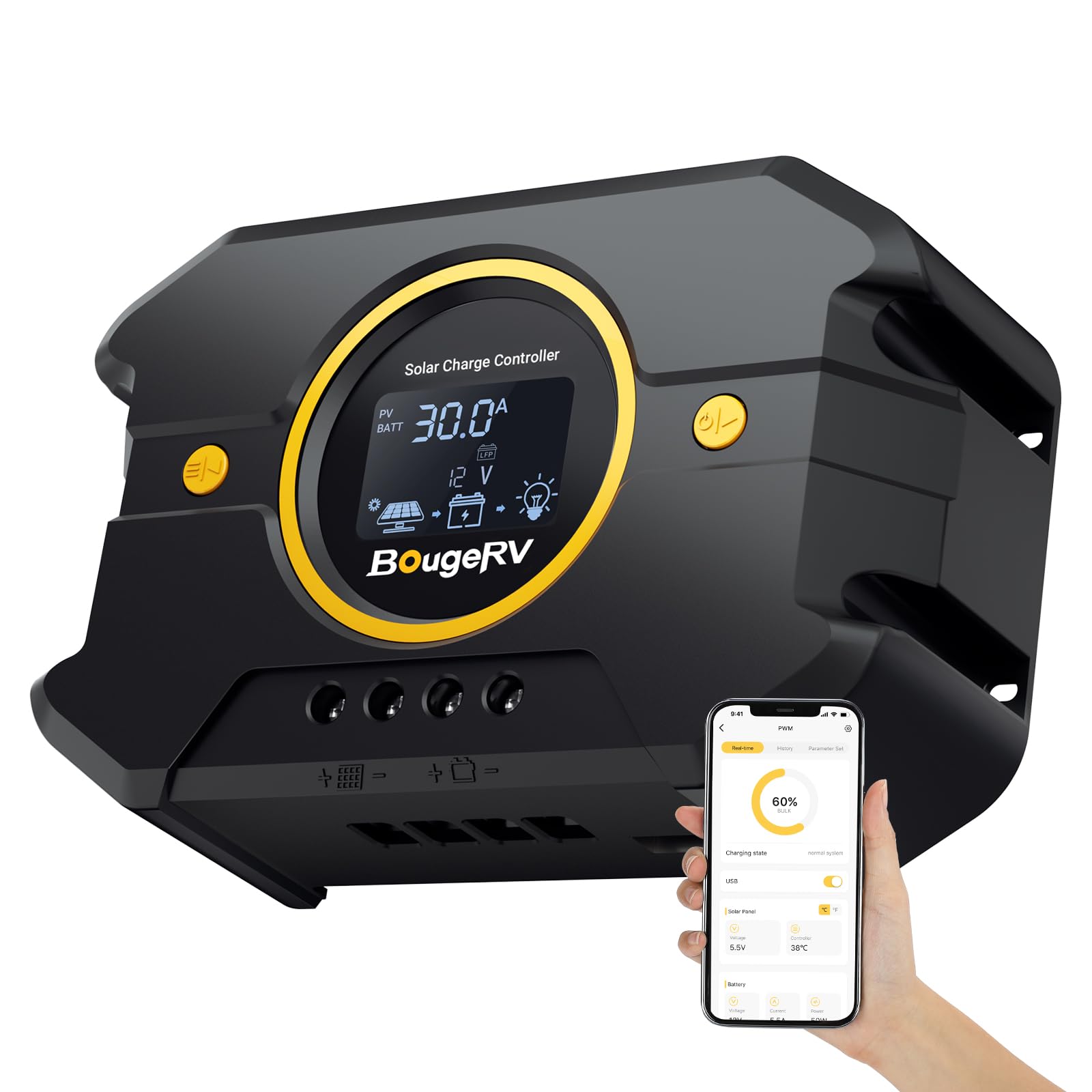
The BougeRV Li 30A PWM controller is one of the most affordable ways to add robust LiFePO4 support to a 12V system. Its key differentiator is dedicated LCD icons for Lithium battery types (LFP for LiFePO4, Li for Ternary, LTO for Lithium-Titanium-Oxide), and a jump-start function to revive a depleted lithium cell. It can handle up to 55V PV input and supports both 12V and 24V battery banks.
The backlit display cycles through PV input current and battery voltage, making it easy to read in dim light. A wide compatibility with SLD, FLD, GEL, AGM, and multiple Lithium chemistries means it can match almost any battery type. Users consistently report it as a fantastic value for the money, especially when compared to far more expensive PWM units from bigger brands.
The main drawback is the physical build: the wire holes are small and struggle with 10 AWG wire, and the included plastic spade connectors can be bulky. A few users report melted wires at the connection points if the terminal screws aren’t tightened perfectly. The build quality is acceptable for the price, but it lacks the terminal heft of the Renogy Adventurer. For a very tight budget, it is a capable and versatile entry-level controller.
Why it’s great
- Excellent support for multiple lithium battery chemistries with dedicated LCD icons and jump-start
- Very affordable price point for a 30A controller with a large backlit display
- Accepts up to 55V PV input, offering more flexibility than many budget PWM units
Good to know
- Small wire terminals make it difficult to secure 10 AWG or thicker solar panel wire safely
- Reported cases of terminal overheating and melting if connections are not extremely tight
FAQ
Can I use an MPPT controller with a small 12V panel?
What happens if my solar panel voltage is too high for the controller?
How do I reset my solar charge controller for LiFePO4 settings?
Final Thoughts: The Verdict
For most users, the 12v solar charge controller winner is the Renogy Rover 40A MPPT because its combination of high MPPT efficiency, built-in Bluetooth, and customizable lithium profiles offers a complete package for any serious off-grid setup. If you want a robust Bluetooth controller with superior thermal performance, grab the LiTime 30A MPPT. And for a weatherproof outdoor install, nothing beats the LNEX 20A PWM.