
A bandsaw that drifts mid-cut, burns the work piece, or produces uneven kerfs isn’t malfunctioning — it’s almost always suffering from incorrect blade tension. The single most overlooked adjustment on any bandsaw is the tension applied to the blade, yet most woodworkers rely on a plastic knob with ambiguous markings or a weak spring that drifts with temperature. A dedicated gauge removes that guesswork and lets you measure actual tension in real time, transforming a frustrating tool into a precision cutting machine.
I’m Min — the co-founder and writer behind Gadgets Feed. Over many hours spent analyzing workshop alignment tools, I’ve studied the machining tolerances, indicator resolution specs, and miter-slot compatibility data that separate a genuinely useful gauge from a frustrating one.
This buying guide cuts through the marketing to deliver the straight facts on the best bandsaw blade tension gauge for your workshop, whether you’re calibrating a portable job-site saw or a stationary cabinet model.
How To Choose The Best Bandsaw Blade Tension Gauge
Choosing a bandsaw blade tension gauge requires understanding the specific measurement you’re taking. You’re not just buying a dial indicator — you’re buying a system that fits your saw’s miter slot, offers a clear reading at 0.01 mm or 0.0005 inch resolution, and stays stable as you slide it along the table. A gauge that wobbles in the slot or loses zero mid-measurement is worse than no gauge at all.
Dial Indicator Resolution and Type
The most critical spec on a tension gauge is the resolution of its dial indicator. A digital indicator with 0.01 mm (0.0005 inch) resolution is the practical standard for woodworking; anything coarser can’t detect subtle fence or blade misalignment that causes burning and drift. Digital models offer instant readout switching between metric and imperial, while analog dials provide a smooth, battery-free movement that some purists prefer for detecting minute directional changes. Both work — just ensure the resolution hits at least 0.01 mm.
Miter-Slot Fit and Bar Design
Your gauge’s guide bar must fit snugly in your saw’s miter slot without slop. Most standard slots measure 3/8 inch deep by 3/4 inch wide, but variations exist. Look for bars with adjustable expansion screws or spring-loaded plungers that take up slack across the slot’s length. A bar machined from anodized aluminum with multiple chute partitions offers better rigidity than a single-slot design, and a straight-through chute lets you slide the indicator past obstacles without removing and reattaching it.
Versatility Beyond Blade Tension
The best gauges double as alignment tools for your table saw, router table, jointer, and planer. A gauge that checks blade-to-miter-slot parallelism, fence squareness, and arbor runout delivers more value than a single-purpose tool. Extended measuring rods of 18 cm or longer let you reach into awkward spaces on larger machinery, while a compact form factor stores easily in a protective case. Weighing portability against reach is a personal call, but a gauge that serves multiple machines earns its place in any shop.
Quick Comparison
On smaller screens, swipe sideways to see the full table.
| Model | Category | Best For | Key Spec | Amazon |
|---|---|---|---|---|
| Rockler Table Saw Alignment Gauge | Premium | Precision calibration | Analog Dial Indicator | Amazon |
| GOINGMAKE Dial Indicator Gauge | Premium | Versatile multi-machine use | 0.01mm Accuracy | Amazon |
| ALLmeter Digital Table Saw Gauge | Mid-Range | Digital precision for table saws | 0.01mm Resolution | Amazon |
| ALLmeter Alignment Tool (B0F1S959YQ) | Mid-Range | Fast straight-through setup | 0.0005″ Precision | Amazon |
| Neoteck Digital Dial Indicator Gauge | Mid-Range | Complete workshop alignment | 0.0005″ Resolution | Amazon |
| TOOLCOOL Table Saw Alignment Gauge | Budget | 2-in-1 gauge and thin rip jig | 0.01mm Ultra-High Precision | Amazon |
| iGaging Band Saw Gauge Companion | Budget | Quick blade-to-table alignment | 12″ Laser-Etched Scale | Amazon |
In‑Depth Reviews
1. Rockler Table Saw Alignment Gauge
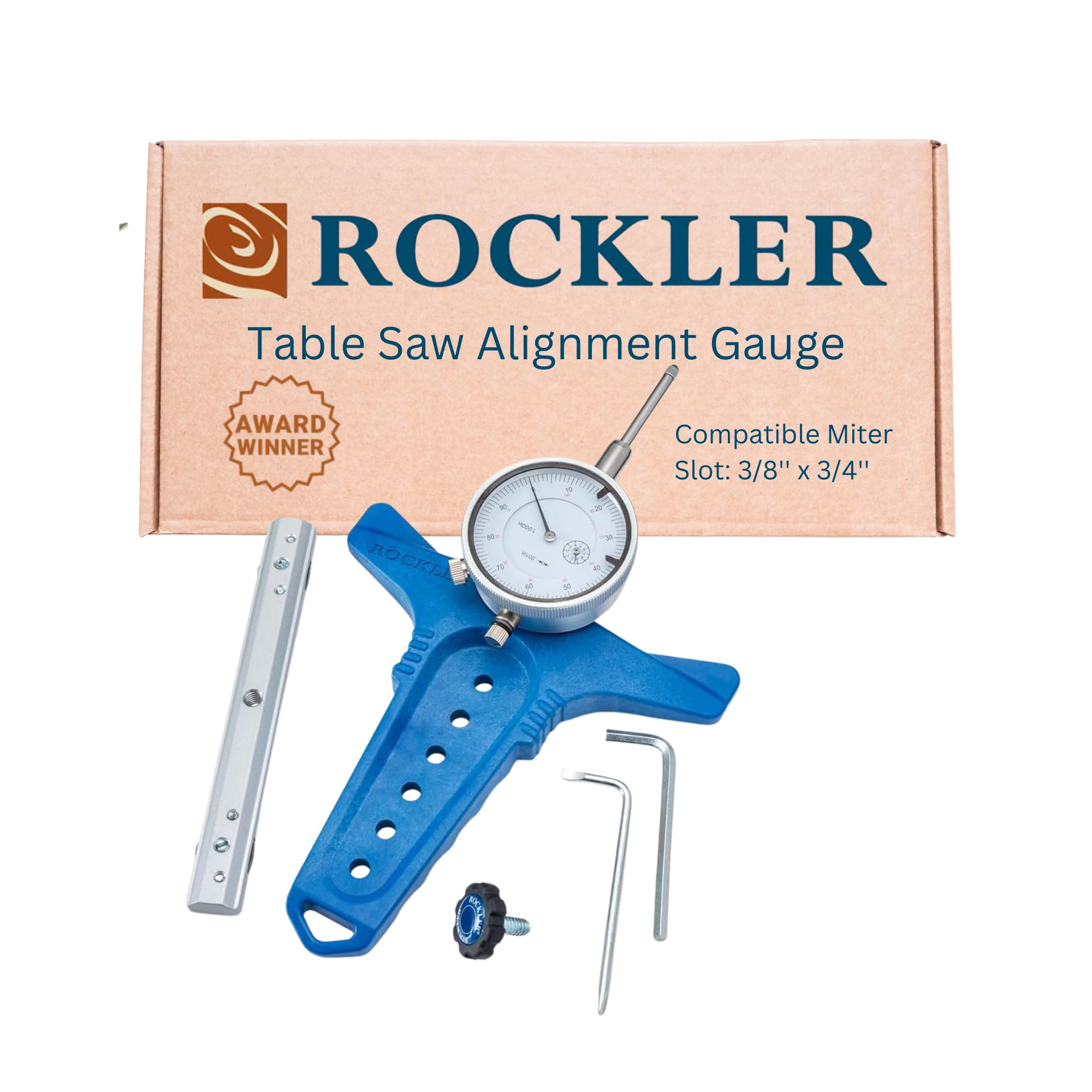
The Rockler gauge combines a precision analog dial indicator with an expandable aluminum miter bar that fits saws with standard 3/8-inch by 3/4-inch slots. The expandable glide blocks take up any slack in the miter slot, eliminating side-to-side play that ruins repeatability. Users report dialing in Dewalt and Delta contractor saws to perfect parallelism in under ten minutes, with the analog movement proving especially sensitive to the slightest directional change — a real advantage when hunting for blade runout.
The kit includes an aluminum miter bar with a locking knob, a hex key, and a tension adjustment screwdriver, so you’re ready to calibrate out of the box. Reviewers consistently note that the plastic body on the indicator housing feels durable and won’t mar the cast-iron table surface. The molded finger grips and hang holes on the bar keep storage tidy, and the wide-set base provides excellent stability during sliding measurements.
Where the Rockler truly shines is reliability. The dial maintains zero through repeated passes, and the expandable blocks compensate for miter slots that aren’t perfectly uniform along their length. Whether you’re a beginner fighting blade drift or a pro chasing sub‑0.001 inch tolerances, this gauge delivers consistent, repeatable results that justify its place in any serious shop.
Why it’s great
- Expandable aluminum bar eliminates slot slop completely
- Analog dial offers smooth, battery-free movement with instant response
- Works on table saw, bandsaw, router table, and jointer
Good to know
- Indicator housing is plastic, not aluminum
- Not suitable for saws with non-standard miter slots over 7-3/4 inches from blade
2. GOINGMAKE Table Saw Gauge Dial Indicator
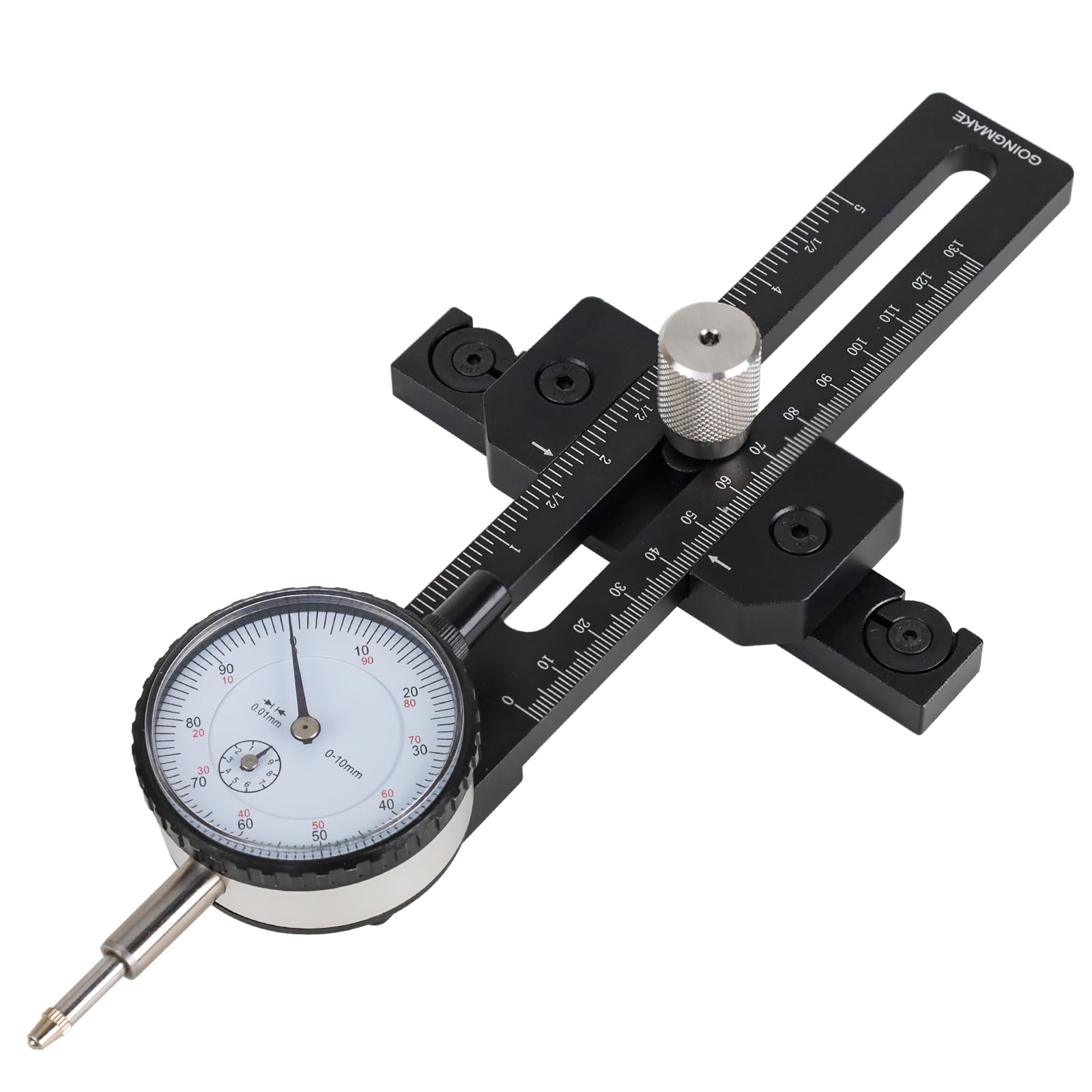
The GOINGMAKE gauge delivers professional-level 0.01 mm accuracy at a price point that undercuts many competitors by a wide margin. Its adjustable miter bar features two locking rings that you tighten to create a zero-slop fit inside the miter slot, and the extra support base keeps the assembly stable during sliding measurements. The dial indicator itself is machined from metal and aluminum alloy, giving it a solid feel that contradicts its budget-friendly cost.
Versatility is the GOINGMAKE’s strong suit — the gauge spans an adjustable range from 4 inches to 8.85 inches, making it compatible with table saws, band saws, and router tables of varying sizes. Customers praise how quickly it resolved chronic fence misalignment that a simple square couldn’t detect. One reviewer called it “amazing quality” with well-machined parts, though a few noted the dial indicator feels slightly less robust than premium analog units — an expected trade-off at this tier.
This gauge is ideal for the woodworker who needs precision across multiple machines without buying separate tools. The 0.01 mm resolution is fine enough to catch blade wobble and fence misalignment, and the simple spring-loaded bar design means you can swap from saw to saw in seconds. For the price, the GOINGMAKE outperforms its weight class by a meaningful margin.
Why it’s great
- Adjustable range fits table saws, band saws, and router tables
- Zero-slop miter bar with locking rings for repeatable readings
- Excellent value for 0.01mm accuracy
Good to know
- Dial indicator feels lighter than premium analog models
- Not ideal for heavy daily professional use
3. ALLmeter Digital Table Saw Gauge (B0D4YWQ9MF)

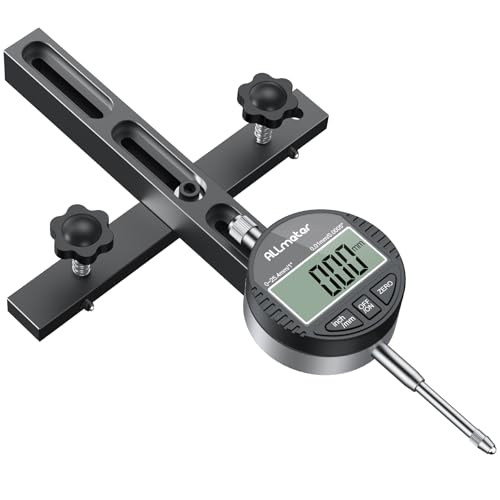
ALLmeter’s digital gauge brings modern readout convenience to the workshop with a 0.01 mm (0.0005 inch) resolution digital indicator that switches between millimeters and inches at the press of a button. The CNC-machined aluminum bar measures 3.2 inches long and features three chute partitions for increased rigidity, while the 18 cm extended rod provides excellent reach for measuring arbor runout and out-feed table alignment. Users report consistent readings to 0.001 inches after initial setup, with no sticking or zero drift issues that plague cheaper digital units.
The straight-through chute design is a standout feature — it lets you slide the indicator past the blade without removing and repositioning it, speeding up calibration significantly. The included LR44 battery is pre-installed, and the zero-setting function makes quick resets trivial. Reviewers particularly like that this gauge outperforms dial indicator models costing three times as much, calling it “surprisingly precise” and noting improved cut quality and reduced saw noise after calibration.
Where the ALLmeter truly excels is ease of use. The digital display locks cleanly, updates in real time, and eliminates the parallax errors that analog dials can introduce. If digital readout speed and clarity are priorities in your workflow, this gauge offers the best digital experience in its class.
Why it’s great
- Straight-through chute speeds blade-to-slot measurement
- Digital display with instant mm/inch switching
- Outperforms dial indicators costing three times as much
Good to know
- Minimal printed instructions — expect a learning curve
- Requires LR44 battery (included, but must be replaced)
4. ALLmeter Table Saw Alignment Tool (B0F1S959YQ)
This second ALLmeter entry shares the same digital indicator and anodized aluminum bar DNA as its sibling, but arrives with a refined straight-through chute design and adjustable expansion screws for a tighter fit in wider miter slots. The 7-inch (18 cm) measuring rod provides enough reach for deep alignments on planers and jointers, and the included protective storage case keeps everything organized. The digital indicator delivers 0.0005 inch precision with a smooth zero-set button, and users consistently hit 0.001 inch alignment on their table saws after a few minutes of adjustment.
Customer feedback highlights the tool’s ability to reduce “saw marks” on wood by making the fence flush with the blade in both positions, and one reviewer noted an immediate improvement in cut quietness after calibration. The spring-loaded mechanism holds the bar firmly in the T-slot using horizontal force, enabling a snap-in setup that feels quick and intuitive. The L-shaped mounting bracket provides a stable platform for the indicator, though a couple of users wished the instructions offered more detail.
This gauge is best suited for woodworkers who value speed of setup and need a tool that works across multiple machines. The CNC-machined bar maintains a wobble-free fit, and the digital readout’s consistency eliminates the need to interpolate between analog markings. For rapid, repeatable calibrations, this ALLmeter model is a strong contender.
Why it’s great
- Adjustable expansion screws fit standard and wider miter slots
- Snap-in spring-loaded bar for fast setup
- Durable CNC-machined aluminum with protective storage case
Good to know
- Instruction manual is sparse
- Digital indicator requires occasional battery replacement
5. Neoteck Digital Dial Indicator Table Saw Gauge

Neoteck’s offering stands out because it includes two CNC-machined anodized aluminum bars instead of one, plus a full complement of hardware — spring plungers, hex socket nuts, wrenches, and a hard storage case — making it a complete alignment system right out of the package. The digital indicator reads from 0 to 1 inch (0 to 25.4 mm) with 0.0005 inch resolution and switches between metric and imperial units. The self-adjusting “Smart Bar” uses spring plungers that you set once, after which the bar stays tight in the miter slot regardless of slot variations along its length.
Users consistently report that the Neoteck gauge enabled them to adjust their saw table to within 0.001 inch. The anodized aluminum bars resist corrosion and wear, and the straight-through chute design allows the indicator to slide past obstacles without disassembly. The included storage case is sturdy enough for transport, and the kit comes with two LR44 batteries (one installed, one spare) so you’re never caught without power.
The dual-bar system is what pushes the Neoteck into premium territory. Having a second bar means you can set up one for your table saw and leave the other dedicated to your bandsaw or router table, saving setup time between machines. For woodworkers who calibrate multiple tools regularly, this kit’s completeness and build quality justify the investment.
Why it’s great
- Two CNC-machined aluminum bars for multi-machine setup
- Self-adjusting Smart Bar with spring plungers for zero slop
- Sturdy storage case with spare battery included
Good to know
- Digital display may dim in bright workshop light
- Three short chute slots limit continuous adjustment range
6. TOOLCOOL Table Saw Alignment Gauge Calibrator
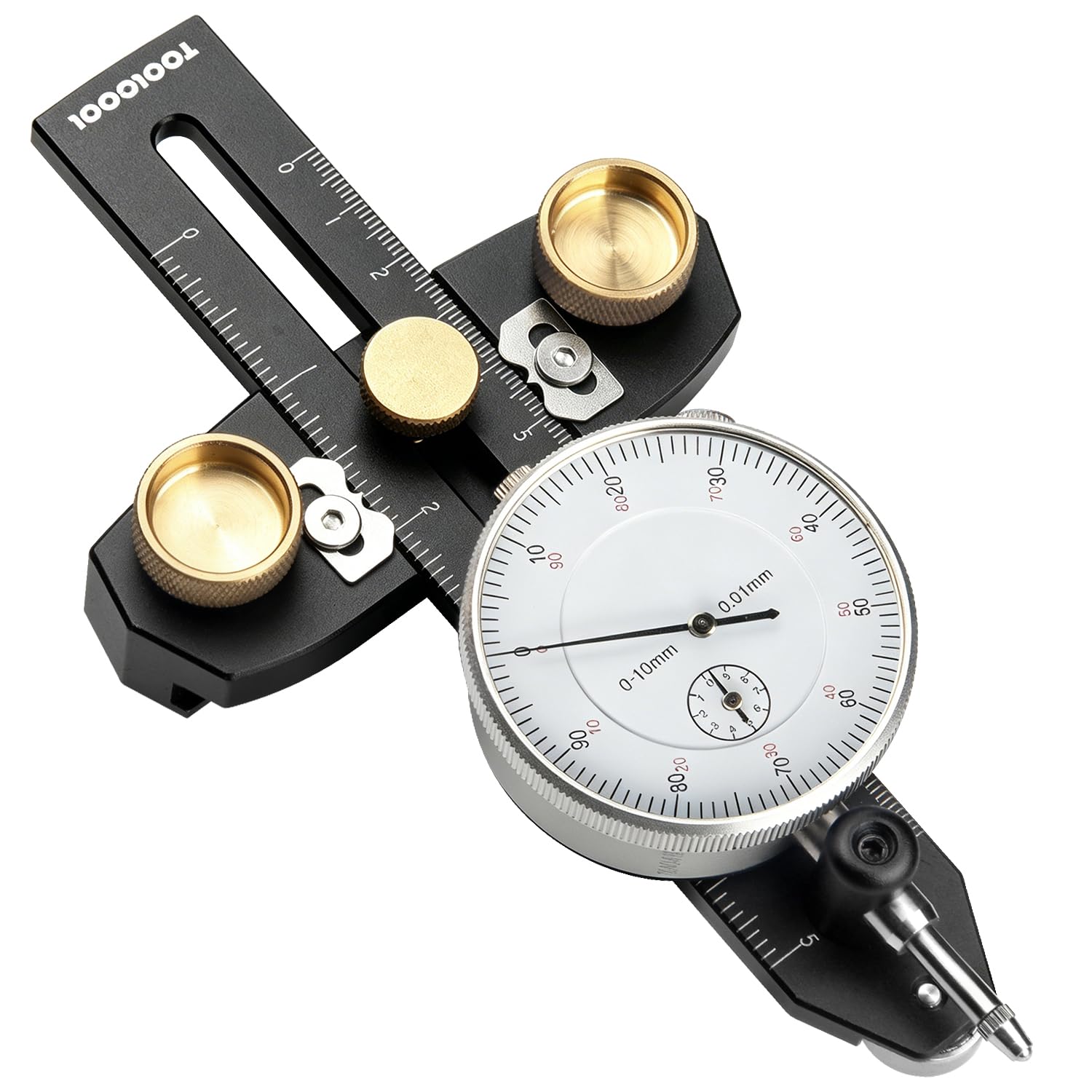
The TOOLCOOL calibration tool offers an unusual dual purpose: it functions as both a 0.01 mm resolution dial indicator gauge and a thin rip jig for safe, repeatable cutting of narrow strips. The indicator measures from 0 to 10 mm with 0.01 mm resolution, and when you remove it, the remaining assembly transforms into a thin rip jig that works with 3/8-inch by 3/4-inch U-slot tracks. The extension range spans 1.5 to 6.4 inches, accommodating a variety of thin-rip cutting tasks.
The body is constructed from CNC-machined aluminum alloy and brass, with an anodized finish that resists corrosion. Two-way bearing supports keep the jig stable when switching between saw tables or flipping the gauge to the opposite side. Reviewers with Dewalt 10-inch saws found the T-slot version fitted perfectly and enabled calibration of three different fence positions in one session. The Allen wrench included in the package handles all adjustments, though the lack of any paperwork means you’ll need to figure out indicator attachment and zeroing on your own.
Where the TOOLCOOL stands apart is its efficient 2-in-1 design. For shops with limited drawer space, a single tool that calibrates the blade and then switches to a thin rip jig saves both bench space and budget. Build quality is solid, and the 0.01 mm resolution is adequate for general woodworking calibration. Just confirm your saw’s miter groove dimensions before ordering.
Why it’s great
- Dial indicator and thin rip jig in one tool
- CNC-machined aluminum and brass construction
- Two-way bearing supports for stable multi-table use
Good to know
- No printed instructions — zero documentation in box
- May not fit non-standard miter slot dimensions
7. iGaging Band Saw Gauge Bandsaw Companion

The iGaging Bandsaw Companion takes a different approach from the dial-indicator-based gauges above: instead of measuring with a needle or digital readout, it uses four strong rare-earth magnets to attach a laser-etched 12-inch ruler directly to the blade. The ruler is marked in 16th and 32nd increments and allows you to align the blade to the table and check parallelism by sight. The tool also functions as a marking hook ruler and a compass, adding versatility beyond alignment tasks.
Customers who struggle with blade drift report that the magnets hold the gauge firmly to the blade, letting them see exactly where the blade sits relative to the table surface. The anodized aluminum body resists rust and stays rigid during use. Some users, however, find the concept fussier than traditional setup blocks and dial indicators, noting that setup adds complexity without necessarily improving accuracy over a simpler square-and-feeler-gauge approach.
The iGaging Companion is best suited for budget-conscious woodworkers who want a quick visual check rather than a precise numerical measurement. The magnets make attachment and removal effortless, and the 3-in-1 functionality adds utility for marking and layout work. If your goal is to eliminate major blade drift on a bandsaw without investing in a full dial-indicator system, this is the most affordable way to get there. Just don’t expect the sub‑0.001 inch precision that a digital indicator provides.
Why it’s great
- Strong magnets attach directly to blade for visual alignment
- Triple-purpose tool: alignment ruler, marking hook, compass
- Laser-etched 16th and 32nd markings are easy to read
Good to know
- No numerical readout — requires visual interpretation
- Setup can feel fussy compared to traditional gauge blocks
FAQ
Can I use a table saw alignment gauge on a bandsaw?
What does 0.01 mm resolution actually mean for cut quality?
Are analog dial indicators better than digital for blade tension?
How often should I recalibrate my bandsaw blade tension?
Final Thoughts: The Verdict
For most users, the best bandsaw blade tension gauge winner is the Rockler Table Saw Alignment Gauge because its expandable aluminum bar eliminates miter-slot slop and the analog dial provides reliable, battery-free repeatability across multiple machines. If you want a digital readout with faster setup, grab the ALLmeter Digital Table Saw Gauge. And for woodworkers on a budget who need a quick visual check, nothing beats the iGaging Band Saw Gauge Companion for its magnetic simplicity and triple-function design.