
A whistle that fails when wet, cold, or dropped isn’t a safety tool—it’s a liability. The difference between a successful rescue and a missed signal often comes down to a device small enough to fit in your pocket: a properly engineered all-weather whistle that works when you need it most, whether you’re submerged, in a downpour, or buried under gear.
I’m Min — the co-founder and writer behind Gadgets Feed. After analyzing the decibel ratings, material composition, and real-world performance data across dozens of emergency whistles, I’ve separated the gear that genuinely penetrates wind, water, and distance from the novelties that belong in a toy box.
This guide cuts through the marketing noise to help you identify a reliable signal device that functions in any environment, delivering a piercing blast that can be heard from over half a mile away. These are the best all-weather whistles for outdoor safety, emergency preparedness, and professional use.
How To Choose The Best All-Weather Whistle
Not every loud whistle is an all-weather whistle. The defining feature is its ability to produce a clear, penetrating sound regardless of moisture, freezing temperatures, or submersion. A pea whistle, for instance, becomes useless when the pea freezes or gets clogged with debris. Look for designs that have no moving internal parts and rely solely on air chambers to generate sound pressure.
Decibel Output vs. Perceived Loudness
Manufacturers often quote decibel ratings, but the human ear perceives higher frequencies as louder at the same dB level. A whistle rated at 120 dB with a high-pitched tone (around 3–4 kHz) will cut through ambient noise more effectively than a lower-frequency 120 dB sound. For rescue scenarios, you want a whistle that produces sound in the 105–120 dB range, ideally with harmonic overtones that travel further. The Storm Safety Whistle, for example, has been measured at 105 dB at 2 meters, which translates to roughly 10 times the sound pressure of standard whistle designs.
Material Integrity in Extreme Conditions
The housing must resist corrosion, temperature extremes, and impact. Stainless steel is excellent for durability and water resistance but can become very cold in winter. High-impact ABS thermoplastics, like those used in the Storm series, offer excellent all-weather performance: they don’t corrode, they’re lightweight, and they withstand freezing without becoming brittle. Avoid painted metals or thin plastics that can crack under pressure or temperature swings. The construction should feel solid and have no seams that could leak air, which would reduce volume.
Quick Comparison
On smaller screens, swipe sideways to see the full table.
| Model | Category | Best For | Key Spec | Amazon |
|---|---|---|---|---|
| Storm Safety Whistle | Pealess | Marine & Remote Rescue | 105 dB at 2m | Amazon |
| Wind Storm Safety Whistle | Pealess | Hiking & Trail Safety | 18g Weight | Amazon |
| Kwik Tek Whistle | Pealess | Paddling & Boating | Floating Design | Amazon |
| UNIWA Electronic Whistle | Electronic | Coaching & Crowd Noise | 120 dB Volume | Amazon |
| binboll Three-Tube Whistle | Metal Pea | EDC & Personal Safety | 150 dB Claimed | Amazon |
| Emergency Zone 5-in-1 Whistle | Multi-tool | Quick-Access Survival Kit | Waterproof Container | Amazon |
| Paracord Bracelet Whistle | Wearable | Scout & Light Hiking | Integrated Bracelet | Amazon |
In‑Depth Reviews
1. Storm Safety Whistle

The Storm Safety Whistle is the benchmark for all-weather performance, proven in military, coast guard, and diving operations. Its patented dual-chamber pealess design produces a measured 105 dB at 2 meters, which independent testing confirms is significantly louder than standard whistle designs—roughly an order of magnitude higher in sound pressure. The sound is a piercing, penetrating tone that carries over half a mile on land and remains audible underwater at depths up to 50 feet. This isn’t a claim; it’s a spec validated by real-world use in rescue scenarios.
The non-corroding thermoplastic housing is oversized for easy gloved handling, and the whistle functions whether held right-side up or upside down. There are no internal moving parts, no peas to freeze or jam, and the design purges moisture automatically after submersion. This means it works in snow, rain, or direct immersion without losing volume. The housing is unsinkable and impact-resistant, making it ideal for attaching to life jackets, packs, or emergency kits where reliability is non-negotiable.
Users consistently report that this whistle is immediately recognized as louder than anything else in their group. The trade-off is its size: it is bulkier than a compact referee whistle, which some hikers find inconvenient for lightweight packing. However, for any situation where being heard is a matter of safety, this bulk is a worthy price for the acoustic advantage. It is the clear choice for boaters, divers, backcountry hunters, and anyone who needs a guaranteed signal device.
Why it’s great
- Measured 105 dB at 2m—louder than competitors by a wide margin
- Proven by US military, Coast Guard, and emergency divers
- Functions underwater up to 50 ft and automatically clears moisture
- No moving parts: zero risk of freezing or jamming
Good to know
- Larger than standard whistles; not for minimalist keychain carry
- Grip texture is smooth plastic, not rubberized for wet hands
2. Wind Storm Safety Whistle

The Wind Storm Safety Whistle takes the acoustic technology of the full-size Storm and shrinks it into a pack-friendly form that weighs just 18 grams with the keychain ring attached. This is the same pealess dual-chamber construction that delivers the piercing, high-frequency blast the Storm series is known for, but in a profile that slips easily into a pocket or hangs discreetly from a zipper pull. For hikers and trail runners who obsess over every gram, this is a significant advantage.
Users report that this whistle is loud enough to be heard over engine noise on a racetrack and is effective for waking a deaf dog—indicating its sound pressure and frequency penetrate deep into the hearing range. The bright yellow dayglo color makes it easy to spot if dropped on the forest floor. Like its larger sibling, the Wind Storm has no moving parts and will not fail when wet or frozen. It uses the same moisture-clearing mechanism, ensuring it delivers full volume even after submersion in a stream or unexpected downpour.
This is an acceptable trade-off for the weight savings, especially for day hikers who carry a whistle as a backup to a personal locator beacon. For ultralight backpackers, scout leaders, and anyone who wants the Storm’s reliability without the bulk, the Wind Storm is the perfect compromise. It also comes on a keychain ring, making it ready to attach immediately.
Why it’s great
- Same proven pealess tech as the full-size Storm at 18 grams
- Loud enough for race corner work and emergency signaling
- No moving parts: ideal for wet, icy, or muddy conditions
- Bright dayglo color for easy visibility
Good to know
- Slightly lower volume than the full-size Storm version
- Color may vary by order (some receive black instead of yellow)
3. Kwik Tek Whistle with Lanyard

The Kwik Tek Whistle is purpose-built for the marine environment, featuring a high-pitch pealess design on a floating lanyard that makes it nearly impossible to lose overboard. This whistle meets the audible signal device requirement for boats and personal watercraft in most states, and its compact size clips easily onto a life jacket, PFD, or safety lanyard. The floating lanyard doubles as a keychain float, adding utility beyond emergency signaling.
The whistle itself produces a piercing, high-pitched tone that users describe as loud enough to deter pickpockets or signal distress downriver. The pealess construction means no internal components to corrode or seize in saltwater environments. The included lanyard has a clip that hooks securely inside a PFD pocket for quick access while paddling. For kayakers and canoeists who need a whistle they can grab instantly if capsized, this design is particularly smart—it stays accessible and visible even in rough water.
Some users note that the whistle requires a fairly strong lung effort to produce its full volume, and the clip on the lanyard may not withstand heavy-duty repeated use. It is not the loudest whistle on this list, but for its intended use—boating and paddling safety—it hits the perfect balance of buoyancy, accessibility, and sound output. It is a reliable, low-cost addition to any water sports kit, and its replaceable nature means you’re never out much if it gets lost.
Why it’s great
- Floating lanyard prevents loss in water
- Pealess design resists saltwater corrosion
- Compact and clips easily to PFD or life jacket
- Meets boating safety device requirements
Good to know
- Requires strong lung effort for full volume
- Clip may wear out over time; not heavy-duty
4. UNIWA Electronic Whistle

The UNIWA Electronic Whistle takes a fundamentally different approach: instead of relying on lung power, it uses a piezoelectric driver and four CR2032 batteries to produce a consistent 120 dB output at the press of a button. This makes it ideal for situations where the user may be out of breath, injured, or unable to generate the air pressure needed for a traditional whistle. It offers three distinct tone options, allowing the user to personalize the sound for different environments.
The ABS plastic housing is crack-resistant and compact at 5.4 inches, coming with a drawstring pouch and a 46-inch lanyard for neck or wrist carry. The electronic design eliminates the hygiene concerns of sharing a traditional whistle, making it popular among coaches, referees, and teachers who need a loud, reliable signal without mouth contact. The unit count of 2 provides a backup or allows sharing between officials. It is significantly louder than the average pea whistle, and the tone is consistent regardless of the user’s lung capacity.
The trade-off is battery dependency. The CR2032 cells are included, but in extreme cold, battery performance can drop, reducing volume. Unlike a pure mechanical whistle, this device cannot function without power. For indoor use, gymnasiums, and organized sports, this is rarely an issue. For backcountry emergencies where the whistle may sit unused for years, the batteries could be depleted when needed. It is best treated as a specialized tool for high-use, high-hygiene environments rather than a primary emergency whistle for remote expeditions.
Why it’s great
- Consistent 120 dB output requires zero lung effort
- Three tone options for different environments
- Hygienic—no mouth contact needed for sharing
- Comes with carrying case, lanyard, and backup unit
Good to know
- Battery-dependent; performance drops in extreme cold
- CR2032 cells may deplete in storage over years
5. binboll Three-Tube Whistle

The binboll Three-Tube Whistle uses a multiple-chamber design to produce sound that users describe as resembling a train whistle—a distinctive, chime-like tone that cuts through ambient noise. Made from food-grade stainless steel, it is extremely durable, corrosion-resistant, and easy to sanitize. The manufacturer claims a 150 dB output, though independent measurements are not available; user reports consistently confirm it is “very loud,” with some noting hearing damage after close-range testing.
The steel construction gives this whistle a premium heft and feel. It comes in a 2-pack, making it easy to stash one in a car, pack, or keychain. The three-tube design is an evolution of the classic pea whistle, but without an internal pea, it avoids the freezing and clogging issues that plague traditional metal whistles. It is also naturally waterproof—submersion will not affect performance since there is no pea to swell or warp. This makes it a genuine all-weather option, despite its traditional appearance.
Several users mention that the included chain is insecure and the whistle can detach if snagged on objects during movement. The stainless steel surface can also become very cold to the touch in winter conditions. While it is incredibly loud, the tone is somewhat unique and may not be immediately recognized as a distress signal compared to the standard high-pitched trill of a pealess rescue whistle. It stands out as an excellent EDC and personal safety whistle, but the chain issue demands an upgrade to a more secure lanyard setup.
Why it’s great
- Distinctive three-tone sound carries well outdoors
- Durable stainless steel resists corrosion and impact
- No internal pea: works when wet, cold, or frozen
- 2-pack for easy multi-location storage
Good to know
- Included chain is weak; whistle detaches easily when snagged
- Steel body becomes very cold in winter conditions
6. Emergency Zone 5-in-1 Survival Whistle
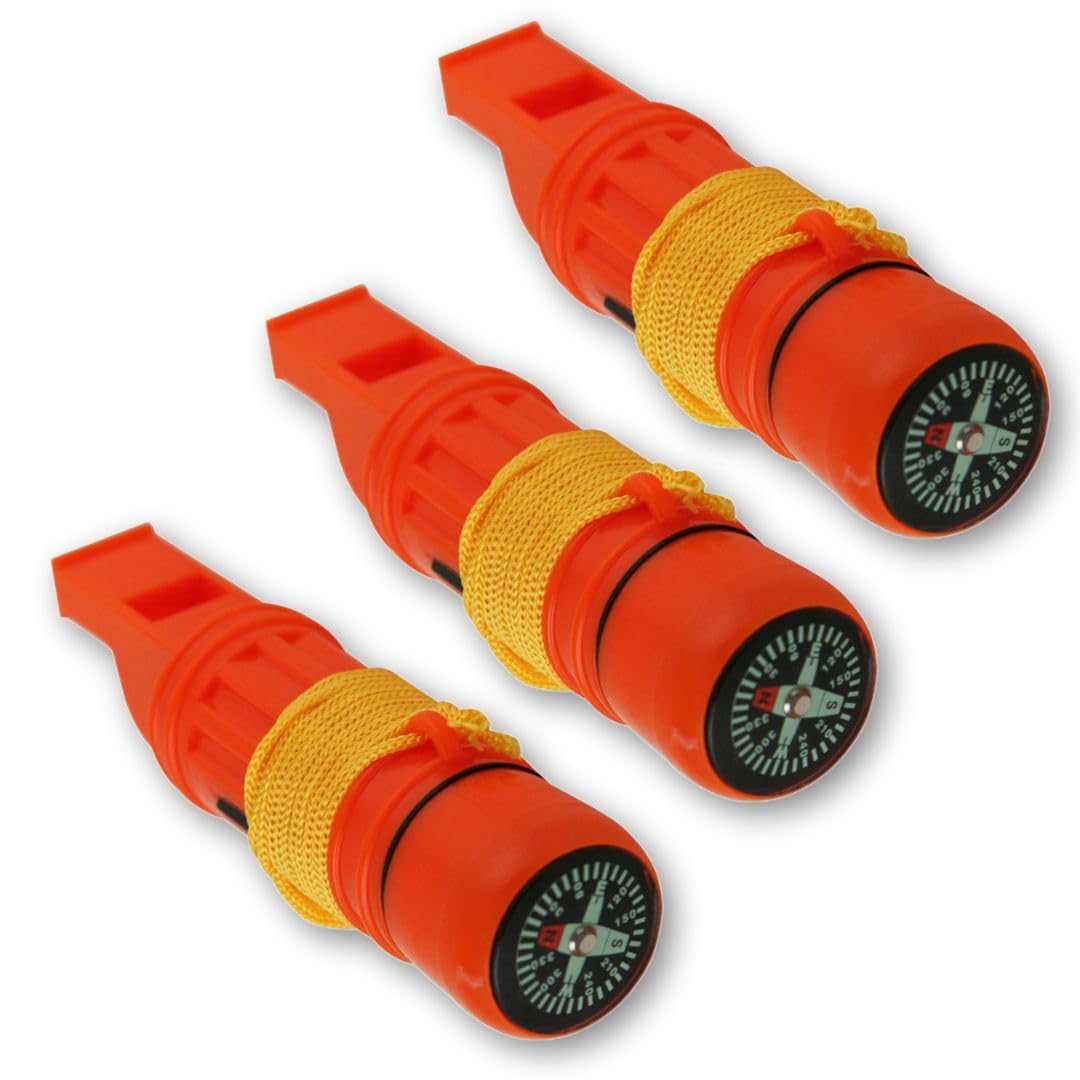
The Emergency Zone 5-in-1 Survival Whistle packages a shrill whistle, a waterproof container, a compass, a signal mirror, and a ferro rod into a single compact device. For budget-conscious preppers and scout groups, this multi-tool approach is appealing—one item covers several basic survival functions. The whistle itself is a plastic pealess design that delivers a loud, attention-grabbing tone. The waterproof compartment is large enough to hold matches, a mini lighter, or small pills, protected from moisture by a threaded cap.
The integrated compass uses a liquid-filled capsule and is reasonably accurate when held level. The signal mirror is a small reflective surface, and the ferro rod is a tiny cylindrical piece meant for emergency spark creation. Users report that the whistle is genuinely loud and effective, the compartment stays dry in rain and shallow submersion, and the value for the price is excellent when bought in multi-packs. It is a solid option for teaching kids about survival gear or as a backup that stays inside a car glove box.
The compromises are clear: the compass is not trustworthy for precise navigation, the signal mirror detaches easily, and the ferro rod is more of a novelty than a reliable fire-starting tool. The plastic cap can cross-thread if overtightened, potentially breaking the gasket seal. This is not a piece of gear for serious backcountry survival—rather, it is an all-in-one training tool and starter kit item. For its intended role as a low-cost, packable emergency whistle with bonus features, it outperforms expectations.
Why it’s great
- Integrated waterproof container works well for matches
- Loud, shrill whistle tone effective for emergency signaling
- Excellent value for multi-packs (3, 30, or 300)
- Lightweight and easy to attach to a pack
Good to know
- Compass is not precise enough for navigation
- Ferro rod and signal mirror are low-quality novelties
- Cap cross-threads easily; overtightening breaks the seal
7. Paracord Bracelet Compass & Whistle
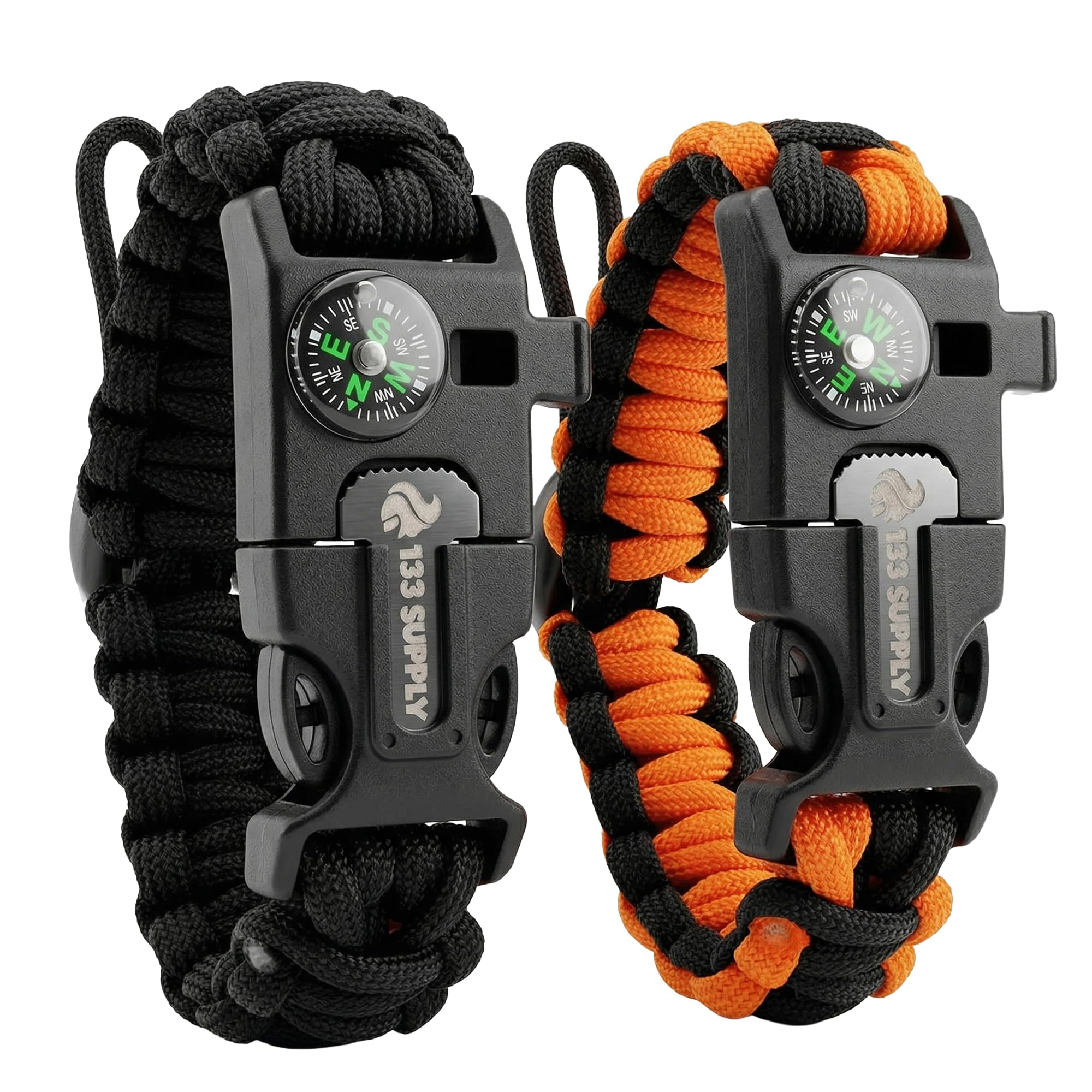
The Paracord Bracelet Compass Hiking Survival Kit takes the “always carry” philosophy to heart by weaving an emergency whistle and compass directly into a wearable paracord bracelet. The whistle itself is a compact, pealess plastic unit integrated into the bracelet clasp, ensuring it is always on your person without needing to remember a separate device. The included compass is embedded in the bracelet’s side and provides basic directional awareness for trail navigation. The paracord can be unbraided in a survival situation for cordage.
User feedback highlights the durability of the clasp and the overall construction, with scouts and hikers reporting that the bracelet holds up well to regular outdoor use. The compass is simple but functional for its purpose—enough to keep you on a recognizable trail, not for serious off-trail navigation. The whistle produces a clear, audible tone that carries in outdoor environments. For parents equipping their children for camping trips or scout outings, this is an ideal solution: the gear is worn, not packed, so it won’t get left behind.
There are clear limitations. The whistle’s volume is lower than dedicated rescue whistles, and the compass lacks the precision for emergency navigation. The bracelet itself is not adjustable beyond its woven length, so fit may vary. The paracord is standard 550 cord, useful but not specialized. This is a convenience-oriented product, not a high-performance signaling device. For its target audience—casual hikers, scout groups, and anyone wanting a no-thought solution to carrying emergency basics—it is a clever, well-executed design that encourages everyday carry.
Why it’s great
- Wearable design ensures you always have a whistle and compass
- Durable paracord and clasp hold up to outdoor use
- Excellent for kids and scouts—no separate gear to remember
- Paracord provides emergency cordage if needed
Good to know
- Whistle volume is lower than dedicated rescue models
- Compass is basic and not suitable for serious navigation
- Bracelet size is fixed; may not fit all wrists comfortably
FAQ
Can a plastic whistle work as well as a metal one in freezing conditions?
What is the effective range of a typical 105 dB rescue whistle?
Are electronic whistles more reliable than mechanical ones for emergency use?
Final Thoughts: The Verdict
For most users, the best all-weather whistle is the Storm Safety Whistle because its measured 105 dB output at 2 meters and pealess dual-chamber design set the standard for reliability in any environment—wet, dry, hot, or frozen. If you want a lightweight whistle for hiking and trail running, grab the Wind Storm Safety Whistle, which packs the same proven technology at just 18 grams. And for marine and paddling safety, nothing beats the Kwik Tek Whistle with its floating lanyard and corrosion-resistant pealess design.